seamus dubhghaill

Promoting Irish Culture and History from Little Rock, Arkansas, USA


Leave a comment

First Assassination by “The Squad”

On July 30, 1919, the first assassination authorised by Michael Collins is carried out by The Squad, also known as the Twelve Apostles, when Detective Sergeant “the Dog” Smith is shot near Drumcondra, Dublin.

The Squad is an Irish Republican Army (IRA) unit founded by Collins to counter British intelligence efforts during the Irish War of Independence, mainly by means of assassination.

On April 10, 1919, the First Dáil announces a policy of ostracism of Royal Irish Constabulary (RIC) men. At the time Sinn Féin official policy is against acts of violence. Boycotting, persuasion and mild intimidation succeed against many officers. However, others escalate their activities against republicans and in March 1920 Collins asks Dick McKee to select a small group to form an assassination unit.

When The Squad is formed, it comes directly under the control of the Director of Intelligence or his deputy and under no other authority. The Squad is commanded by Mick McDonnell.

The original “Twelve Apostles” are Mick McDonnell, Tom Keogh, Jimmy Slattery, Paddy Daly, Joe Leonard, Ben Barrett, Vincent Byrne, Sean Doyle, Paddy Griffin, Eddie Byrne, Mick Reilly and Jimmy Conroy. After some time, The Squad is strengthened with members Ben Byrne, Frank Bolster, Mick Keogh, Mick Kennedy, Bill Stapleton and Sam Robinson. Owen Cullen, a member of 2nd Battalion, is driver for a short time, and Paddy Kelly of County Clare for a short time. They are employed full-time and received a weekly wage.

Sometimes, as occasion demands, The Squad is strengthened by members of the IRA Intelligence Staff, the Active Service Unit, munition workers and members of the Dublin Brigade, Tipperary Flying Column men, Dan Breen, Séumas Robinson, Seán Treacy and Seán Hogan, and also Mick Brennan and Michael Prendergast of County Clare. The IRA Intelligence Staff consists of the Director of Intelligence Michael Collins, the Deputy Director of Intelligence Liam Tobin, the Second Deputy Director of Intelligence Tom Cullen, the Third Director of Intelligence Frank Thornton, and members Joe Dolan, Frank Saurin, Ned Kelleher, Joe Guilfoyle, Paddy Caldwell, Paddy Kennedy, Charlie Dalton, Dan McDonnell and Charlie Byrne. The munitions workers include Mat Furlong, Sean Sullivan, Gay McGrath, Martin O’ Kelly, Tom Younge and Chris Reilly.

Other members include Mick Love, Gearoid O’Sullivan, Patrick Caldwell, Charlie Dalton, Mick O’Reilly, Sean Healy, James Ronan, Paddy Lawson, John Dunne, Johnny Wilson and James Heery. Seán Lemass and Stephen Behan, the father of Irish writers Brendan and Dominic Behan, have also been listed as members of the Apostles. There is no hard evidence to support the inclusion of many of the names, but those who subsequently serve in the Irish Army have their active service recorded in their service records held in the Military Archives Department in Cathal Brugha Barracks, Rathmines. Andrew Cooney is also reported to have been associated with The Squad. Stephen Behan’s involvement is first made public in 1962, when the BBC broadcasts an episode of This Is Your Life dedicated to Behan. During the broadcast, remaining members of the squad joined Behan on the set of the show.

Following “The Dog” Smith’s assassination, The Squad continues to target plainclothes police, members of the G Division of the Dublin Metropolitan Police, and, occasionally, problematic civil servants. Organisationally it operates as a subsection of Collins’ Intelligence Headquarters. Two of the executions by The Squad are the killing on January 21, 1920, of RIC Inspector William Redmond of the DMP “G” Division and on March 2, 1920, a British double agent John Charles Byrnes.

One of the Apostles’ particular targets is the Cairo Gang, a deep-cover British intelligence group, so called since it has either been largely assembled from intelligence officers serving in Cairo or from the Dublin restaurant called The Cairo, which the gang frequents. Sir Henry Wilson brings in the Cairo Gang in the middle of 1920, explicitly to deal with Michael Collins and his organization. Given carte blanche in its operations by Wilson, the Cairo Gang adopts the strategy of assassinating members of Sinn Féin unconnected with the military struggle, assuming that this will cause the IRA to respond and bring its leaders into the open.

The most well-known operation executed by the Apostles occurs on what becomes known as Bloody Sunday, November 21, 1920, when British MI5 officers, linked to the Cairo Gang and significantly involved in spying, are shot at various locations in Dublin with fourteen killed and six wounded. In addition to the The Squad, a larger number of IRA personnel are involved in this operation. The only IRA man captured during the operation is Frank Teeling. In response to the killings, the Black and Tans retaliate by shooting up a Gaelic football match between Dublin and Tipperary at Croke Park, the proceeds from which are for the Irish Republican Prisoners Fund. Fourteen civilians are killed including one of the players, Michael Hogan, and 68 are wounded. The Hogan stand at Croke Park is named after Hogan.

The elimination of the Cairo Gang is seen in Dublin as an intelligence victory, but British Prime Minister David Lloyd George comments dismissively that his men “… got what they deserved, beaten by counterjumpers…”. Winston Churchill adds that they were “.. careless fellows … who ought to have taken precautions.”

Some members of The Squad are hanged in 1921 for the killings on Bloody Sunday, including Thomas Whelan and Patrick Moran. Moran had killed a vet, Patrick MacCormack, who seems to have been an innocent victim.

In May 1921, after the IRA’s Dublin Brigade takes heavy casualties during the burning of the Custom House, The Squad and the Brigade’s Active Service Unit are amalgamated into the Dublin Guard, under Paddy Daly. Under the influence of Daly and Michael Collins, most of the Guard take the Free State side and join the National Army in the Irish Civil War of 1922–23. During this conflict some of them are attached to the Criminal Investigation Department and are accused of multiple assassinations of Anti-Treaty fighters. They are also involved in several atrocities against Republican prisoners, particularly after the death of Collins, due to many of them having personal ties with him.

Bill Stapleton goes on to become a director in Bord na Móna, Charles Dalton and Frank Saurin become directors in the Irish Sweepstakes. In October 1923, Commandant James Conroy is implicated in the murder of two Jewish men, Bernard Goldberg and Emmanuel ‘Ernest’ Kahn. He avoids arrest by fleeing to Mexico, returning later to join the Blueshirts. A later application for an army pension is rejected. The killings are the subject of a 2010 investigative documentary by RTÉ, CSÍ: Murder in Little Jerusalem.


Leave a comment

Birth of George Campbell, Artist & Writer

George Campbell, Irish artist and writer, is born on July 29, 1917, in Arklow, County Wicklow. Although he grows up in Belfast, Northern Ireland, he spends much of his adult life living and painting in Spain and Dublin.

Campbell is the son of Matthew Arthur Campbell (1866-1925), caterer, and Gretta Campbell (née Bowen) (1880-1981). He attends boarding school at Masonic Orphan Boys’ School at Clonskeagh, Dublin, before moving to Belfast to live with his widowed mother and family.

Campbell is working in an aircraft factory at the time of the Belfast Blitz, and begins to paint, taking the bomb-damage as his subject. He is one of the founders of the Irish Exhibition of Living Art in 1943. In the same year, along with his brother Arthur (1909-94), he publishes a sixteen page book entitled Ulster in Black and White, that includes drawings from the two brothers and their close contemporaries Maurice Wilks and Patricia Webb. Owing to the success of the original publication, the brothers then publish Now in Ulster (1944), an anthology of short stories, essays and poetry by young Belfast writers.

Campbell holds a joint exhibition at the William Mol Gallery, Belfast, with his brother Arthur in 1944. In the same year he also shows with Gerard Dillon at the Portadown gallery of John Lamb. In 1946 he shows with the Victor Waddington Gallery in Dublin, where he is to return on a number of occasions. The Council for the Encouragement of Art and Music hosts a solo exhibition in 1949 where he is to show twice more, in 1952 and 1960. He wins £500 at the first Council for the Encouragement of Music and the Arts (CEMA) Open Painting Competition at the Ulster Museum in 1962. Campbell also shows in one-man exhibitions with the Arts Council of Northern Ireland in 1966 and 1972.

After the war Campbell becomes increasingly interested in Spain. In 1946 he comes to know Spaniards who had settled in Dublin, and when in London paints visiting Spanish dancers in their traditional costume. He first visits Spain in 1951, encouraged by his friendship with Gerard Dillon and “an interest in bohemian characters.” He lives there for six months almost every year throughout much of the following twenty-five years.

Campbell makes stained glass windows for the Cathedral of Our Lady Assumed into Heaven and St Nicholas in Galway. He also plays flamenco guitar. A member of the Royal Hibernian Academy, he wins the Douglas Hyde Gold Medal in 1966 and the Oireachtas Prize for Landscape in 1969. The Spanish government makes him a Knight Commander of Spain in 1978.

Campbell dies in Dublin on May 18, 1979, and is buried at St. Kevin’s Cemetery in Glendalough, County Wicklow. He is survived by his wife Margaret, his mother, and two brothers, Arthur and Stanley. After his death the Arts Council of Northern Ireland and An Chomhairle Ealáion join with the Instituto Cervantes to initiate the George Campbell Memorial Travel Award. In May 2017, Arklow Municipal District Council unveils two plaques at St. Patrick’s Terrace, Arklow, marking Campbell’s birthplace and the centennial of his birth.

Campbell’s work forms part of many private and public art collections, including Queen’s University Belfast, Ulster Museum, Irish Museum of Modern Art, Hugh Lane Gallery, The National Self-Portrait Collection of Ireland, and Municipal Museum of Antequera, Málaga.

(Pictured: “Three Nuns” by George Campbell)


Leave a comment

Éamon de Valera Visits Butte, Montana During His American Tour

President Éamon de Valera visits Butte, Montana, on July 25, 1919, during his American Tour of 1919-20. Montana Lieutenant Governor W. W. McDowell meets his train and rides with de Valera through the streets to where de Valera then addresses over 10,000 people who have come out to hear him. The next day, de Valera addresses a joint session of the Montana State Legislature.

De Valera’s eventful 1919 begins in Lincoln Jail and ends in New York City’s Waldorf Astoria, the largest and most luxurious hotel in the world. Smuggled aboard the SS Lapland in Liverpool in June, he sails for the United States during the closing stages of the Paris Peace Conference. As London’s Sunday Express complains in August 1919, “there is more Irish blood in America than in Ireland,” making the United States the obvious destination for a sustained propaganda and fundraising mission.

After his highly-publicised American debut at New York’s Waldorf Astoria, the self-styled “President of the Irish Republic” embarks on the first leg of what is to be an eighteen-month tour of the United States. The purpose of his mission is twofold: to gain formal recognition of the Irish Republic and to raise funds via a bond issue to support the independence movement and the newly established Dáil Éireann.

Between July and August 1919, de Valera and his entourage travel over 6,000 miles from New York to San Francisco, addressing enormous crowds at dozens of venues. He fills Madison Square Garden to capacity and receives a thirty-minute standing ovation from 25,000 people in Chicago’s Wrigley Field. Twice as many people fill Boston’s Fenway Park on June 29, cheering the arrival of the “Irish Lincoln.” The Sinn Féin envoys also visit less obvious Irish communities of the period, such as Scranton, Savannah, New Orleans and Kansas City. For de Valera’s personal secretary, Seán Nunan, the public meeting in Butte, Montana is like “an election meeting at home – there were so many first-generation Irishmen working on the mines – mainly from around Allihies in West Cork.” In San Francisco de Valera dedicates a statue of Robert Emmet by Irish-born sculptor Jerome Connor in Golden Gate Park, a replica of which stands sentinel in St. Stephen’s Green in Dublin. This is one of many symbolic gestures linking the American and Irish struggles for independence played out before the flashing bulbs of the ubiquitous press photographers. On August 15, The Cork Examiner notes that the enthusiastic American exchanges “indicate that few public missionaries from other lands – possibly only Mr. Parnell – have ever had such receptions as were accorded to the Sinn Féin leader.”

De Valera’s team deserves credit for the incredible logistical triumph that is the U.S. tour. As chief organiser, Liam Mellows travels ahead to each city, ensuring a suitable reception is prepared and a venue secured for a mass meeting. Seán Nunan is de Valera’s fastidious personal secretary and Harry Boland, Sinn Féin TD for South Roscommon and Irish Republican Brotherhood (IRB) envoy, is at his side troubleshooting, speechmaking and shaking hands. As the tour progresses, de Valera’s supporting cast expands to include Kerry-born Kathleen O’Connell who becomes de Valera’s full-time personal secretary from 1919.

The next stage of de Valera’s American odyssey begins on October 1, 1919, in Philadelphia, a city with a rich Irish heritage and rife with symbolism of America’s struggle for independence. Over the next three weeks, de Valera and his team travel from the Atlantic to the Pacific seaboard and back again, delivering seventeen major public speeches and a host of smaller ones to aggregate crowds of over half a million.

The pace is relentless as the Irish team makes its way through middle America. De Valera is received as a visiting dignitary at multiple state legislatures and presented with honorary degrees from six American universities. In line with his secondary objective to foster the interest of “wealthy men of the race in the industrial development of Ireland,” he addresses the Chambers of Commerce in a number of cities and arranges a personal meeting with Henry Ford, the son of an Irish emigrant, during his visit to Detroit in October. In the same month in Wisconsin, he is made a Chief of the Chippewa Nation, an honour he later says meant more to him than all the freedoms of all the cites he was ever given. It is not surprising that by the time they reach Denver on October 30, The Irish World reports that “the President looked tired.” Still, he musters the energy to make high profile visits to Portland, Los Angeles and San Diego before beginning the return journey to New York at the end of November.

After a short break for Christmas, the Irish team prepares for the launch of the Bond Certificate Drive. A week-long frenzy of publicity kicks off on January 17 at New York City Hall where Mayor John F. Hylan presents de Valera with the Freedom of the City. During the spring of 1920, de Valera addresses the Maryland General Assembly at Annapolis before making the swing through the southern states of America.

It is not all plain sailing for the Sinn Féin representatives in America. The tour of the west coast in late 1919 sees increasing tensions with American patriotic bodies who are critical of de Valera’s perceived pro-German stance during World War I. He is heckled during a speech in Seattle and a tricolour is ripped from his car in Portland by members of the American Legion. The trip through the southern states in the spring of 1920 coincides with rising American anti-immigration and anti-Catholic nativism. A small number of counter demonstrations are organised by right-wing Americans. Most notably, members of the Ku Klux Klan make unwelcome appearances at several rallies in the American south, making clear their opposition to de Valera’s presence.

The Irish envoys also contend with antagonism from the leaders of Friends of Irish Freedom (FOIF), the broad-based popular front of Clan na Gael headed by veteran Fenian John Devoy and Judge Daniel Cohalan. The FOIF uses its significant resources to finance de Valera’s tour and facilitate the Bond Certificate Drive, but behind the scenes there are significant personality clashes and tensions over tactics.

The increasingly public dispute comes to a head in a row over strategies at the Republican National Convention in Chicago in June 1920. Drawing on his influential political contacts, Cohalan persuades the Republican Party to include Irish self-determination in their election platform. However, much to Cohalan’s fury, de Valera leads a separate delegation to the Convention and insists on a resolution calling for recognition of the Irish Republic. The result is that two resolutions are submitted to the Platform Committee, which indicates dissension in the Irish ranks and gives the Committee the excuse to include neither in the final platform. After de Valera also fails to secure the endorsement of the Democratic convention in San Francisco in June, it is clear that the Irish question will not be a significant factor in the ensuing presidential election. Relations between the FOIF and de Valera reach a new low. In November 1920, de Valera makes the final break with the FOIF and sets up a new organisation, the American Association for the Recognition of the Irish Republic.

De Valera is in Washington, D.C. on October 25 when Terence MacSwiney dies after 74 days on hunger strike. Six days later, at the last great meeting of the American tour, 40,000 people fill New York’s Polo Grounds to commemorate MacSwiney’s death. By late November, de Valera knows that it is time to return to Ireland. Smuggled aboard SS Celtic in New York harbour on December 10, he prepares for the nine-day journey home. He had failed to obtain the recognition of the United States Government for the Republic, but his cross-continental tour and associated press coverage raised international awareness and over $5 million for the Irish cause.

(From: An article by Helene O’Keeffe that was first published in the Irish Examiner on March 24, 2020 | Photo: Eamon de Valera, center, president of the Provisional Government of the Irish Republic, in Butte, Montana, in 1919 to encourage support for Ireland’s fight for independence. Courtesy of Butte-Silver Bow Public Archives)


Leave a comment

Birth of Máire MacSwiney Brugha, Activist & Author

Máire MacSwiney Brugha, Irish activist who is the daughter of Terence MacSwiney and niece of Mary MacSwiney, is born in Cork, County Cork, on June 23, 1918. In addition to being an activist she is also an author and is now regarded as a person of historical importance.

MacSwiney Brugha is the daughter of the former Lord Mayor of Cork Terence MacSwiney and his wife Muriel Frances Murphy. Her father dies on hunger strike when she is two years old. Her father is in jail when she is born and does not see her until she is brought to see him when she is three months old. Her family’s republican and political activities leave a strong mark on her life.

Following the death of her father, her mother moves to Dublin. MacSwiney Brugha goes to live with Madame O’Rahilly, widow of The O’Rahilly, and sees her mother intermittently. Although as a child her parents decide she would speak the Irish language, her father’s death and her mother’s health results in her move to Germany in 1923 and there she is moved around a lot. She learns German and speaks no English and little or no Irish. In 1930 she is moved to Grainau in Bavaria, where she attends school. Her aunt, Mary MacSwiney, a legal guardian of hers, eventually comes to collect her and takes her back to Ireland. This causes a court case when it is claimed her aunt had kidnapped her. As a result of the court case her aunt is given custody, and she and her mother became estranged.

MacSwiney Brugha attends Scoil Íte and then St. Louis Secondary School in Monaghan where, in 1936, she completes her Leaving Certificate and gets a scholarship to University College Cork to study arts. In 1937 she plays the lead role in a play, The Revolutionist, published in 1914 and written by her father and produced by her aunt. She returns to Germany in 1938 to keep up her German and graduates with a first-class honours degree. She goes on to get her higher diploma and becomes a teacher. She spends some time teaching in Scoil Íte and then goes to Dublin in 1942 to get a master’s degree. She meets Ruairí Brugha while in Dublin. His father, Cathal Brugha, was killed in the Irish Civil War in 1922. They marry on July 10, 1945. The marriage produces four children: Deirdre, Cathal, Traolach and Ruairí.

MacSwiney Brugha’s husband has a strong political career with her support. He is a senator, a TD, and a member of the European Parliament. She leads her Fianna Fáil cumann and volunteers with the aid agency Gorta. With her husband as Official Opposition Spokesman on Northern Ireland from 1975 to 1977, the couple are very much involved in creating the policy of developing conciliation rather than aimed more at ending partition which they previously have been focused on.

At the age of 85 and after her sight has failed MacSwiney Brugha dictates her story to her daughter-in-law, Catherine Brugha. History’s Daughter: A Memoir from the Only Child of Terence MacSwiney is launched in 2005. Her own story is recorded in Irish Life and Lore. Her story is also the subject of a radio production. She dies unexpectedly at her home in Clonskeagh, County Dublin, at the age of 93 on May 20, 2012. She is buried in Glasnevin Cemetery.

Fianna Fáil leader Micheál Martin describes her as having made a “strong and valued” contribution to the development of Fianna Fáil while Gerry Adams says she “made her mark” on Irish history.

(Pictured: Máire MacSwiney Brugha on her wedding day, July 10, 1945)


2 Comments

Murder of Vincent Patrick Fovargue

Vincent Patrick Fovargue, a company officer in the Dublin brigade of the Irish Republican Army (IRA) during the Irish War of Independence, is shot dead at a golf course near London, England by the IRA on April 2, 1921. The IRA accuses him of being a British spy.

Fovargue is born on August 22, 1900, at 2 Rutland Place, Clontarf, Dublin, to Robert Fovargue, an engineer/fitter, and Elizabeth (Lillie) Larkin.

An intelligence officer with the 4th Battalion of the Dublin Brigade of the IRA in the Ranelagh area, he is captured by the British Army in Dublin. Under interrogation, he allegedly leaks information that results in the arrest of the other members of his unit a few days later. In return for this information, the Intelligence Corps allegedly allow him to escape during a staged ambush in Dublin’s South Circular Road.

This attempted ruse however does not go unnoticed by Michael Collins‘ informants in the Crown’s security forces. On the night of the escape, Detective Constable David Neligan of the Dublin Metropolitan Police‘s “G” Division is on duty in Dublin Castle when he is passed a telephone message on a police form. The message, issued by the British Military Headquarters, states that a “Sinn Féin” suspect named Fovargue had escaped from three Intelligence Corps officers in a car while en route to prison. It gives a description of his appearance and asks that the British Army be notified in the event of his recapture by the Dublin Metropolitan Police.

Joe Kinsella is the I/O of the 4th Battalion. He is temporarily transferred to take care of munitions under Seán Russell for a few weeks and Fovargue is put in his place. In Kinsella’s statement to the BMH, he writes:

“From the outset I personally did not place a lot of trust in him, because on the morning that he took over from me he appeared to me, to be too inquisitive about the movements of Michael Collins and the GHQ staff generally. He wanted to know where they could be located at any time. He said that he had big things in view, and that it would be to the advantage of the movement generally if he was in a position to get in touch with the principal men with the least possible delay. From his attitude I there and then formed the opinion, rightly or wrongly, that he was inclined to overstep his position. I did not feel too happy about him and I discussed him with Sean Dowling. It transpired that my impressions of this man were correct. I told him of two meeting places of Intelligence staff, one of Company Intelligence held at Rathmines Road and one of Brigade Intelligence held at Saville Place. A short time after giving him this information both these places were raided…I was now confirmed in my suspicions that Fovargue was giving away information. He was later shot in England by the IRA.”

Neligan is not fooled by this either, as he explains:

“Now if they had said that this man (who was completely unknown to both of us) had escaped from one I.O. it might have sounded reasonable enough. But to tell us that an unarmed man had escaped out of a motor-car in the presence of three presumably armed men was imposing a strain on our credulity. Both of us thought this story too good to be true.”

The two men retype the message and pass it to Collins the following day. Meanwhile, Fovargue has been sent to England where he adopts the alias of Richard Staunton. Fovargue has in fact been sent to England by Intelligence Corps Colonel Ormonde Winter to infiltrate the IRA in Britain.

Sean Kavanagh, a Kilkenny IRA man, claims that Fovargue is put in a cell with him in Kilmainham in 1921 in order to try to extract information from him.

On April 2, 1921, a boy walking on the golf links of the Ashford Manor Golf Club in Ashford, Middlesex discovers the body of Fovargue, who had been shot through the chest. Discovered near the corpse is a small piece of paper on which had been scribbled in blue pencil the words “Let spies and traitors beware – IRA.”

In the Neil Jordan film Michael Collins, Fovargue’s assassination is depicted onscreen. Fovargue is tracked down while working out at the golf course, allowed to say the Act of Contrition, and then fatally shot by Liam Tobin (Brendan Gleeson).


Leave a comment

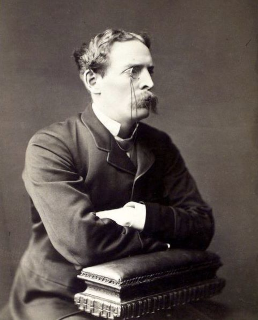
The Death of Stopford Brooke, Chaplain & Writer

Stopford Augustus Brooke, churchman, royal chaplain and writer, dies in Ewhurst, Surrey, England, on March 18, 1916.

Brooke is born in the rectory of Glendoen, near Letterkenny, County Donegal on November 14, 1832, the eldest son of the Rev. Richard Sinclair Brooke, later incumbent of the Mariners’ Church, Kingstown (now Dún Laoghaire). His maternal grandfather, Joseph Stopford, is then rector of the parish. He is educated at Trinity College, Dublin. He is ordained in the Church of England in 1857 and holds various charges in London. From 1863 to 1865 he is chaplain to Victoria, Princess Royal in Berlin. In 1869, with his brother Edward, he makes long tours of Counties Donegal and Sligo, and spends much time at Kells, County Meath studying Irish antiquities. Between 1866 and 1875 he is the minister at St. James’s Chapel, a proprietary chapel. After it closes, he takes services at Bedford Chapel, Bloomsbury where he continues to attract large congregations. In 1875, he becomes chaplain in ordinary to Queen Victoria. But in 1880 he secedes from the Church, being no longer able to accept its leading dogmas, and officiates as an independent preacher for some years at Bedford Chapel, Bloomsbury.

Bedford Chapel is pulled down about 1894, and from that time Brooke has no church of his own, but his eloquence and powerful religious personality continues to make themselves felt among a wide circle. A man of independent means, he is always keenly interested in literature and art, and a fine critic of both. The two-volume Life and Letters of Stopford Brooke, written by his son-in-law L. P. Jacks and published in 1917, contains many details of different facets of his life.

In 1890-1891 Brooke takes the lead in raising the funds to purchase Dove Cottage, William Wordsworth’s home in Grasmere from 1800 to 1808, and establishing it “for the eternal possession of those who love English poetry all over the world.” Dove Cottage is now administered by the Wordsworth Trust.

Brooke publishes in 1865 his Life and Letters of FW Robertson (of Brighton), and in 1876 writes an admirable primer of English Literature, followed in 1892 by The History of Early English Literature down to the accession of Alfred the Great, and English Literature from the Beginnings to the Norman Conquest (1898).

Brooke gives the inaugural lecture to the Irish Literary Society, London, on “The Need and Use of Getting Irish Literature into the English Tongue” at Bloomsbury House, March 11, 1893. He delivers a sermon on “The Kingdom of God Within” to the International Council of Unitarian and Other Liberal Religious Thinkers and Workers, meeting in London in May 1901. He continues preaching at Bedford Chapel and to unitarian congregations throughout Britain until forced to retire because of ill-health in 1895.

Brooke lives in London until 1914 and then retires to Ewhurst, Surrey, where he dies on March 18, 1916. His published letters record that his work brought him into touch with most of his famous contemporaries – including Alfred, Lord Tennyson, Philip Burne-Jones, William Morris, James Bryce, 1st Viscount Bryce, James Martineau and Matthew Arnold.


Leave a comment

Execution of Bernard Ryan, One of “The Forgotten Ten”

Bernard Ryan is one of six men hanged in Mountjoy Prison, Dublin on March 14, 1921. He is a member of the Irish Republican Army (IRA) and part of the Dublin Brigade’s Active Service Unit (ASU). He is one of the Forgotten Ten.

Ryan is born in Dublin c. 1901, the son of Joseph Ryan and Anne Ryan, née Plummer. Affectionately known as Bertie, he is recorded with his widowed mother and his two sisters, Katie and Sarah, in Quarry Lane, Glasnevin, Dublin in the 1911 Census of Ireland. He also has a foster brother, Paddy. He attends St. Gabriel’s National School in Cowper Street. By trade he is an apprentice tailor and is only 20 years old when he wis hanged.

Ryan, together with Patrick Doyle, Thomas Bryan, and Frank Flood, are tried by court-martial on February 24, 1921, and convicted of high treason and ‘levying war against the King,’ following an attempted ambush at Drumcondra, Dublin on January 21, 1921. The four of them, along with Thomas Whelan and Patrick Moran, are hanged at Mountjoy Prison by executioner John Ellis on March 14, 1921, while a crowd of over 20,000 people protest outside. They are hanged in pairs with Whelan and Moran hanged at 6:00 a.m., Doyle and Ryan at 7:00 a.m., and Bryan and Flood at 8:00 a.m.

Ryan is one of a group of men hanged in Mountjoy Prison in the period 1920-1921 commonly referred to as the Forgotten Ten. In 2001 he and the other nine, including Kevin Barry, are exhumed from their graves in the prison and given a full State Funeral. He is now buried in Glasnevin Cemetery, Dublin.


Leave a comment

Birth of Anne Butler Yeats, Painter and Costume and Stage Designer

Anne Butler Yeats, Irish painter, costume and stage designer, is born in Dublin on February 26, 1919.

Yeats is the daughter of the poet William Butler Yeats and Georgie Hyde-Lees, a niece of the painter Jack B. Yeats, and of Lily Yeats and of Elizabeth Corbet Yeats. Her birth is commemorated by her father with the poem A Prayer for My Daughter. Her aunts are associated with the arts and crafts movement in Ireland and are associated with the Dun Emer Press, Cuala Press, and Dun Emer industries. Her brother Michael Yeats is a politician. She is known as “feathers” by her family.

Yeats spends her first three years between Ballylee, County Galway, and Oxford before her family moves to 82 Merrion Square, Dublin in 1922. She is very sick as a child and spends three years in two different hospitals, St. Margaret’s Hall, 50 Mespil Road, and Nightingale Hall, Morehampton Road, Dublin. She then goes to the Pension Henriette, a boarding school in Villars-sur-Bex, Switzerland from 1928–30. In 1923 her Aunt Elizabeth “Lolly” gives her brush drawing lessons which aid her in winning first prize in the Royal Dublin Society (RDS) National Art competition for children under eight years old in 1925 and 1926.

Yeats trains in the Royal Hibernian Academy school from 1933 to 1936 and works as a stage designer with the Abbey Theatre in Dublin. In 1936, at the age of 16, she is hired by the Abbey Theatre as assistant to Tanya Moiseiwitsch. She studies for four months at the School of Theatrical Design in Paris with Paul Colin in 1937. At 18, she begins her costume career on sets with Ria Mooney‘s company. At the Abbey, she designs the sets and costumes for revivals of W.B. Yeats’ plays The Resurrection and On Baile’s Strand (1938).

In 1938 Yeats designs the first production of W.B. Yeats’ play Purgatory. The designs for Purgatory are her most successful achievement. Purgatory is the last play that W.B Yeats sees on stage, and when it is performed it is a full house. When working on Purgatory, Hugh Hunt wants to have a moon on the back cloth of the production, but she refuses. “If she does not win, she is going to say that she doesn’t wish to have her name on the programme as a designer of the setting.” This could be the main reason why her name is not on many productions that she worked on. She also designs the first play of her uncle Jack Yeats to receive professional production, Harlequin’s Positions.

In 1939 Yeats is promoted to head of design at the Abbey until her departure in May 1941. In 1939 it is commented that her designs are “getting arty” and not in keeping with style of the Abbey. One of her last designs is her father’s last play, The Death of Cuchulain, for the Lyric Theatre on the Abbey stage in 1949. She designs and stage-manages for the Peacock Theatre, the Cork Opera House, the Olympia Theatre, the Gaiety Theatre, the Lyric Theatre, the Abbey Theatre and the Players Theatre.

Among the work Yeats is credited with in the Abbey Theatre, she also works on five productions in the Peacock Theatre with the Theatre Company: Alarm Among the Clerks (1937), The Phoenix (1937), Harlequin’s Positions (1939), The Wild Cat (1940), and Cavaliero (The Life of a Hawk) (1948).

Yeats chooses to move towards painting full-time beginning a brief study at the Dublin Metropolitan School of Art in 1941. She experiments with watercolour and wax. She has a touching naive expressionist style and is interested in representing domestic humanity. She designs many of the covers for the books of Irish language publisher Sáirséal agus Dill over a twenty-year period from 1958. She does illustrations for books by Denis Devlin, Thomas Kinsella and Louis MacNeice, and works with many young designers, such as Louis le Brocquy.

Yeats participates in group exhibitions in the United States, Canada, Germany, the Netherlands, Monaco, and Scotland, along with the Irish Exhibition of Living Art and Taispeántas an Oireachtas.

Yeats dies at the age of 82 on July 4, 2001, and is buried in Shanganagh Cemetery, south Dublin.

The Royal Hibernian Academy holds a retrospective of her work in 1995, as does the National Gallery of Ireland in 2002. She donates her collection of Jack B. Yeats’ sketch books to the National Gallery of Ireland, leading to the creation of the Yeats Museum within the Gallery. Her brother, Michael, in turn, donates her sketchbooks to the Museum.

(Pictured: “Coole Park,” oil on board by Anne Butler Yeats, Duke Street Gallery, Dublin)


Leave a comment

The Soloheadbeg Ambush

The Soloheadbeg ambush takes place on January 21, 1919, when members of the Irish Volunteers, which becomes the Irish Republican Army (IRA) later that year, ambush Royal Irish Constabulary (RIC) officers who are escorting a consignment of gelignite explosives at Soloheadbeg, County Tipperary. Two RIC officers are killed, and their weapons and the explosives are seized. As it happens on the same day that the revolutionary Irish parliament first meets and declares Ireland’s independence, it is often seen as the first engagement of the Irish War of Independence.

In April 1916, during World War I, Irish republicans launch an uprising against British rule in Ireland, called the Easter Rising. They proclaim an Irish Republic. After a week of heavy fighting, mostly in Dublin, the rising is put down by British forces. About 3,500 people are taken prisoner by the British, many of whom had played no part in the Rising. Most of the Rising’s leaders are executed. The rising, the British response, and the British attempt to introduce conscription in Ireland, leads to an even greater public support for Irish republicanism.

In the 1918 Irish general election, the Irish republican party Sinn Féin wins a landslide victory in Ireland, gaining 73 out of 105 seats in the British Parliament. However, in its election manifesto, the party has vowed to set up a separate government in Ireland rather than sit in the British Parliament. At a meeting in Dublin on January 21, 1919, Sinn Féin establishes an independent parliament called Dáil Éireann and declares independence from the United Kingdom.

That same day, an ambush is carried out by Irish Volunteers from the 3rd Tipperary Brigade. It involves Seán Treacy, Dan Breen, Seán Hogan, Séumas Robinson, Tadhg Crowe, Patrick McCormack, Patrick O’Dwyer and Michael Ryan. Robinson is the commander of the group that carries out the attack and Treacy coordinates the planning of the attack. The unit involved acts on its own initiative as had they had to wait for a response, even if it is affirmative, it might come too late.

In December 1918, they receive information that there are plans to move a consignment of gelignite from Tipperary British Army barracks to the Soloheadbeg quarry. They begin plans to intercept the consignment and Dan Breen’s brother Lars, who works at the quarry, receives information that the consignment is to be moved around January 16, 1919. They anticipate that there would be between two and six armed escorts, and they discuss different plans. If the escort is small, they believe they can overpower the RIC officers without firing a shot. Gags and ropes are hidden in the quarry, so that should officers surrender they can be bound and gagged. The planning for the ambush takes place in the ‘Tin Hut,’ a deserted semi-derelict house at Greenane.

Each day from January 16 to 21, the men chosen for the ambush take up their positions from early in the morning to late afternoon and then spend the night at the deserted house. Seven of the Volunteers are armed with revolvers while Treacy is armed with a small automatic rifle. On a rainy January 21, around noon, Patrick O’Dwyer sees the transport leaving the barracks. The consignment of 160 lbs. of gelignite is on a horse-drawn cart, led by two council men and guarded by two RIC officers armed with carbine rifles. O’Dwyer cycles quickly to where the ambush party is waiting and informs them. Robinson and O’Dwyer hide about 20 yards in front of the main ambush party of six, in case they rush through the main ambush position.

When the transport reaches the position where the main ambush party is hiding, masked Volunteers step out in front of them with their guns drawn and call on the RIC to surrender. The officers can see at least three of the ambushers. One officer gets down behind the cart and the other apparently fumbles with his rifle. According to the Volunteers, the officers raise their rifles to fire at them, but the rifles do not fire. The Volunteers immediately fire at the officers, and it is believed that Treacy fires the first shot. Both officers, James McDonnell and Patrick O’Connell, native Roman Catholics, are killed. MacDonnell (50) of Belmullet, County Mayo, is a widower with five children. O’Connell is unmarried and a native of Coachford, County Cork.

As planned, Hogan, Breen and Treacy take the horse and cart with the explosives and speed off. Tadhg Crowe and Patrick O’Dwyer take the guns and ammunition from the dead officers, while Robinson, McCormack and Ryan guard the two council workers, Ned Godfrey and Patrick Flynn, before releasing them once the gelignite is far enough away. Initially the explosives are hidden in a field in Greenane. They are moved several times and are later divided up between the battalions of the brigade.

The ambush is later seen as the beginning of the Irish War of Independence. The British government declares South Tipperary a Special Military Area under the Defence of the Realm Act two days later. There is strong condemnation from the Catholic Church in Ireland. The parish priest of Tipperary calls the dead officers “martyrs to duty.”

A meeting of the Executive of the Irish Volunteers takes place shortly thereafter. On January 31, An t-Óglach, the official publication of the Irish Volunteers, states that the formation of Dáil Éireann “justifies Irish Volunteers in treating the armed forces of the enemy – whether soldiers or policemen – exactly as a National Army would treat the members of an invading army.”

In February 1919 at a Brigade meeting in Nodstown, Tipperary, Brigade officers draft a proclamation, signed by Séumas Robinson as OC, ordering all British military and police forces out of South Tipperary and, should they stay, they will be held to have “forfeited their lives.” GHQ refuses to sanction the proclamation and demands it not be publicly displayed. Despite this it is still posted in several places in Tipperary.

In order to avoid capture, Breen, Treacy, Hogan and the other participants are forced to stay on the move for the following months, often hiding in the barns and attics of sympathisers.

A monument (pictured) has been erected at the site of the ambush, and each year a ceremony of remembrance is held there.


Leave a comment

O’Connell Bridge Civilian Shootings

On January 13, 1921, British troops manning a checkpoint at O’Connell Bridge, Dublin, during the Irish War of Independence, open fire on a crowd of civilians, killing two and seriously wounding five.

Martha Nowlan, a cashier in a local restaurant, and James Brennan, a 10-year-old boy of Mary Street, are killed and five others are wounded when soldiers open fire on O’Connell Bridge, where they have been mounting checks for motor vehicle permits and licences. An English journalist who observes the incident says he saw a soldier on a lorry put his rifle to his shoulder and fire. Nowlan, 22, from Phibsborough, is shot through the left lung and is pronounced dead on arrival at Jervis Street Hospital. Brennan is shot through the centre of the forehead with the bullet coming through the top of his skull.

The incident follows an attack on a lorry carrying six Auxiliary cadets the day before on nearby Bachelor’s Walk. According to an official account, four bombs and a number of revolver shots were directed at the lorry, which was heading in the direction of the Phoenix Park. None of the cadets were killed and only one suffered minor injuries. Onlookers view the police officers’ escape as something of a miracle as the attack extended over a distance of 100 yards and involved two separate groups.

Women and men are seen throwing themselves on the path to avoid the bullets and splinters. A tram conductor named J. Doyle is also slightly wounded in the incident.