seamus dubhghaill

Promoting Irish Culture and History from Little Rock, Arkansas, USA


Leave a comment

Opening of Assembly’s College, Belfast

assemblys-college-belfast

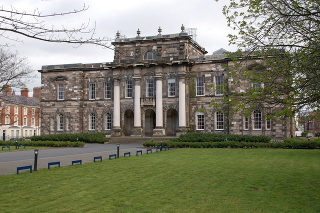
Assembly’s College, Belfast, opens for the training of Presbyterian clergy on December 5, 1853.

The Renaissance Revival style building with its grand Doric porch and Baroque attic is designed by Sir Charles Lanyon, the architect of the main building at Queen’s University Belfast and built with Scrabo stone at a cost of £5,000. Jean-Henri Merle d’Aubigné of Geneva participates in the opening ceremony alongside Henry Cooke, President of the Faculty. The five other professors in the new college are John Edgar, Robert Wilson, William Dool Killen, James G. Murphy and William Gibson.

There is a large influx of students in the wake of the 1859 Ulster revival and the south wing with its dining hall and student accommodations is added in 1869. Princeton Theological Seminary has an important influence in the shaping of the ethos of the College during this period as the Reverend Roberts Watts, who is appointed Professor of Systematic Theology in 1866, hopes to make “Belfast another Princeton.” The north wing with its wood-panelled chapel is designed by John Lanyon, son of original architect, and completed in 1881. The first degrees under the Royal Charter are conferred in 1883. However, the death of Watts in 1895 marks the beginning of the end of the Princetonian influence. A partial union takes place between the faculties in Belfast and Magee in 1922.

The newly formed Parliament of Northern Ireland meets in Assembly’s College from 1921 until 1932 while Stormont is being built with the House of Commons meeting in the Gamble Library and the Senate in the College chapel. During this period the College conducts classes in a house and provides library resources in a house on University Square. In 1926 the College becomes a Recognised College of Queen’s University. During this period the College comes under criticism for its embrace of theological liberalism. This culminates in a charge of heresy being brought against Professor James Ernest Davey in 1926-27. The College officially reopens in October 1932 and the inaugural lecture is delivered by the Scottish Historian Robert Rait.

Between 1941 and 1948 the Royal Ulster Constabulary, the city police, use the College as its own headquarters are bombed in the Belfast Blitz. In 1953, to mark the College’s centenary year, Prof. Davey is elected Moderator of the General Assembly.

In 1976 theological teaching at Magee College in Derry, County Londonderry, ceases and the two colleges amalgamate in 1978. The new college, constituted by an Act of Parliament, is named Union Theological College.

Today Union Theological College offers a full range of courses in Theology. The professors at the College constitute the Presbyterian Theological Faculty Ireland (PTFI) which was granted a Royal Charter in 1881 to confer academic degrees. The PTFI still awards degrees, diplomas and certificates. The majority of students are enrolled for degrees and diplomas, undergraduate and postgraduate, through the Institute of Theology of the Queen’s University of Belfast, in particular the BTh, BD, MTh and PhD.

Leave a comment

Death of Michael Cusack, Founder of the GAA

michael-cusack

Michael Cusack, teacher and founder of the Gaelic Athletic Association, dies in Dublin on November 25, 1906.

Cusack is born on the eastern fringe of the Burren to Irish speaking parents in Carran, County Clare on September 20, 1847, during the Great Famine. He becomes a national school teacher and in 1874, after teaching in various parts of Ireland, becomes a professor at Blackrock College, then known as the French College. In 1877, he establishes his own civil service academy, Cusack’s Academy, in Dublin which proves successful in preparing pupils for the civil service examinations.

A romantic nationalist, Cusack is also reputed to have been associated with the Fenian movement. He is active in the Gaelic revival, initially as a member of the Society for the Preservation of the Irish Language which is founded in 1876, and later the Gaelic League who in 1879 breaks away from the Society. Also in 1879, he meets Pat Nally, who is a member of the Irish Republican Brotherhood and a leading nationalist and athlete. He finds that he and Nally agree on the influence of British landlordism on Irish athletics.

He would recall how both Nally and himself, While walking through Phoenix Park in Dublin and seeing only a handful of people playing sports in the park so depresses Cusack and Nally that they agree it is time to “make an effort to preserve the physical strength of [their] race.” Nally organises a National Athletics Sports meeting in County Mayo in September 1879 which is a success, with Cusack organising a similar event which is open to artisans in Dublin the following April.

On November 1, 1884, Cusack together with Maurice Davin, of Carrick-on-Suir, County Tipperary, calls a meeting in Hayes’ Commercial Hotel, Thurles, County Tipperary, and founds the Gaelic Athletic Association (GAA). Davin is elected president and Cusack becomes its first secretary. Later, Archbishop Thomas William Croke, Archbishop of Cashel & Emly, Michael Davitt and Charles Stewart Parnell become patrons. Cusack also becomes involved in the Irish language movement, founding The Celtic Times, a weekly newspaper which focuses on “native games” and Irish culture.

Michael Cusack dies in Dublin on November 27, 1906, at the age of 59. He is buried in Dublin’s Glasnevin Cemetery.


Leave a comment

Birth of Charlotte Grace O’Brien

charlotte-grace-obrien

Charlotte Grace O’Brien, author, philanthropist, plant collector, and activist in nationalist causes and the protection of female emigrants, is born on November 23, 1845, at Cahirmoyle, County Limerick.

O’Brien is the younger daughter in a family of five sons and two daughters of William Smith O’Brien, Irish nationalist, and his wife Lucy Caroline, eldest daughter of Joseph Gabbett, of High Park, County Limerick. Upon her father’s return in 1854 from the penal colony in Tasmania, she rejoins him in Brussels and stays there until his removal to Cahirmoyle in 1856. Upon her mother’s death in 1861 she moves with her father to Killiney, near Dublin, and is his constant companion until his death at Bangor, Gwynedd in 1864.

From 1864 O’Brien lives at Cahirmoyle with her brother Edward, tending his motherless children, until his remarriage in 1880. She then goes to live at Foynes on the River Shannon and there devotes herself to literary pursuits. She has already published in 1878 her first novel, Light and Shade, a tale of the Fenian rising of 1867, the material for which had been gathered from Fenian leaders. A Tale of Venice, a drama, and Lyrics appear in 1880.

By 1881 her interests and pen are absorbed in Irish political affairs, in which she shares her father’s opinions. She contributes articles to the Nineteenth Century on The Irish Poor Man (December 1880) and Eighty Years (March 1881). In the spring of 1881, the attitude of the liberal government towards Ireland leads her to address many fiery letters to The Pall Mall Gazette, then edited by John Morley.

Another interest, however, soon absorbs O’Brien’s activities. The disastrous harvest in Ireland in 1879, combined with Irish political turmoil, leads to much emigration to the United States. At Queenstown, the port of embarkation, female emigrants suffer much from overcrowded lodgings and robbery. She not only induces the board of trade to exercise greater vigilance but also founds in 1881 a large boarding-house at Queenstown for the reception and protection of girls on the point of emigrating.

In order to improve the steamship accommodations for female emigrants, and to study their prospects in America, O’Brien makes several steerage passages to America. She also establishes in New York a similar institution to that in Queenstown for the protection of girls. Many experiences during this period find expression in her Lyrics (Dublin, 1886), a small volume of poems, which gives simple pictures of the emigrants and contains some stirring nationalist ballads.

On her retirement from active public work in 1886, O’Brien returns to Ardanoir, Foynes, on the bank of the Shannon, devoting her leisure to writing and to study of plant life. She contributes much on the flora of the Shannon district to the Irish Naturalist and joins the Roman communion in 1887.

Charlotte Grace O’Brien dies on June 3, 1909, at Foynes, and is buried at Knockpatrick. Selections from her Writings and Correspondence is published at Dublin in 1909. Her verses have dignity and grace, her polemical essays are vigorous and direct, and her essays on nature charm by their simple style.


Leave a comment

Death of Poet William Allingham

william-allingham

William Allingham, Irish poet, diarist and editor, dies in Hampstead, London, England on November 18, 1889. He writes several volumes of lyric verse, and his poem “The Faeries” is much anthologised. However, he is better known for his posthumously published Diary, in which he records his lively encounters with Alfred Tennyson, Thomas Carlyle and other writers and artists. His wife, Helen Allingham, is a well-known watercolourist and illustrator.

Allingham is born on March 19, 1824, in the small town of Ballyshannon, County Donegal, and is the son of the manager of a local bank who is of English descent. During his childhood his parents move twice within the town, where he enjoys the country sights and gardens, learns to paint and listens to his mother’s piano playing. When he is nine, his mother dies.

Allingham obtains a post in the custom house of his native town and holds several similar posts in Ireland and England until 1870. During this period, he publishes Poems (1850), which includes his well-known poem “The Fairies,” and Day and Night Songs (1855). Laurence Bloomfield in Ireland, his most ambitious, though not his most successful work, a narrative poem illustrative of Irish social questions, appears in 1864. He also edits The Ballad Book for the Golden Treasury series in 1864, and Fifty Modern Poems in 1865.

In April 1870 Allingham retires from the customs service, moves to London and becomes sub-editor of Fraser’s Magazine, eventually becoming editor in succession to James Anthony Froude in June 1874, a post he holds until 1879. On August 22, 1874, he marries the illustrator, Helen Paterson, who is twenty-four years younger than he. His wife gives up her work as an illustrator and becomes well known under her married name as a water-colour painter. At first the couple lives in London, at 12 Trafalgar Square, Chelsea, near Allingham’s friend, Thomas Carlyle, and it is there that they have their first two children – Gerald Carlyle (b. 1875 November) and Eva Margaret (b. 1877 February).

Allingham’s Songs, Poems and Ballads appears in 1877. In 1881, after the death of Carlyle, the Allinghams move to Sandhills near Witley in Surrey, where their third child, Henry William, is born in 1882. At this period Allingham publishes Evil May Day (1883), Blackberries (1884) and Irish Songs and Poems (1887).

In 1888, due to Allingham’s declining health, they move back to the capital, to the heights of Hampstead village. However, on November 18, 1889, he dies at Hampstead. According to his wishes he is cremated. His ashes are interred at St. Anne’s church in his native Ballyshannon.

Posthumously Allingham’s Varieties in Prose is published in 1893. William Allingham A Diary, edited by Mrs. Helen Allingham and D. Radford, is published in 1907. It contains Allingham’s reminiscences of Tennyson, Carlyle and other writers and artists.


Leave a comment

Birth of Sophie Mary Peirce-Evans, Irish Aviator

lady-heath

Sophie Mary Peirce-Evans, Lady Heath, Irish aviator, is born on November 10, 1896, in Knockaderry, County Limerick, near the town of Newcastle West. She is one of the best-known women in the world for a five-year period from the mid-1920s.

When Peirce-Evans is one year old, her father, John Peirce-Evans, bludgeons her mother, Kate Theresa Dooling, to death with a heavy stick. He is found guilty of murder and declared insane. She is taken to the home of her grandfather in Newcastle West where she is brought up by two maiden aunts, who discourage her passion for sports.

After schooldays in Rochelle School in Cork, Princess Garden Belfast and St. Margaret’s Hall on Mespil Road in Dublin, where she plays hockey and tennis, Peirce-Evans enrolls in the Royal College of Science for Ireland. The college is designed to produce the educated farmers which the country then needs. One of the few women in the college, she duly takes a top-class degree in science, specialising in agriculture. She also plays with the college hockey team and contributes to a student magazine, copies of which are held in the National Library of Ireland.

Before becoming a pilot, Peirce-Evans has already made her mark. She spends two years as a dispatch rider during World War I, based in England and later France. By that time, she has married the first of her three husbands, Major William Elliot Lynn, and, as Sophie Mary Eliott-Lynn, is one of the founders of the Women’s Amateur Athletic Association after her move to London in 1922. She is Britain’s first women’s javelin champion and sets a disputed world record for the high jump. Alleging cruelty, her marriage to Elliot Lynn ends in divorce.

In 1925, Elliot-Lynn takes her first flying lessons and two years later becomes the first woman to hold a commercial flying licence in Britain. Along the way, she set records for altitude in a small plane and later a Shorts seaplane and is the first woman to parachute from an aeroplane.

In an era when the world has gone aviation-mad due to the exploits of Charles Lindbergh and Amelia Earhart, Elliot-Lynn is more than able to hold her own. “Britain’s Lady Lindy,” as she is known in the United States, makes front-page news as the first pilot, male or female, to fly a small open-cockpit aircraft from Cape Town to London. A scale model of the plane is on display at The Little Museum of Dublin. She writes about the experience later in the book Woman and Flying, which she co-authors with Stella Wolfe Murray. After her great flight from the Cape, she takes a mechanic’s qualification in the United States, the first woman to do so.

On October 11, 1927, Peirce-Evans marries Sir James Heath at Christ Church in Mayfair, London, and assumes the title Lady Heath. In July 1928, she spends a few weeks volunteering as a co-pilot with a civil airline, KLM. She is hoping to be appointed to the newly created Batavia route, which would make her the first female pilot with a commercial airline. The world is not ready for female pilots and her hope is not fulfilled.

In 1929, just when her fame is at its height, with her life a constant whirl of lectures, races and long-distance flights, Lady Heath is badly injured in a crash just before the National Air Races in Cleveland, Ohio. Before the accident Lady Heath applies for American citizenship, intending to remain in the United States where she has made a good living on the lecture circuit and as an agent for Cirrus engines. She is never the same after her accident.

Lady Heath divorces Sir James Heath in Reno, Nevada in January 1930. On 12 November 12, 1931, in Lexington, Kentucky, she marries G.A.R Williams, a horseman and pilot of Caribbean origin. They return to Ireland, and she becomes involved in private aviation, briefly running her own company at Kildonan, near Dublin in the mid-1930s, and helping produce the generation of pilots that would help establish the national airline Aer Lingus.

Lady Heath dies in St Leonard’s Hospital, Shoreditch, London on May 9, 1939, following a fall inside a double-decker tram. Although alcoholism had been a problem in previous years, a pathologist finds no evidence of alcohol but detailed evidence of an old blood clot which might have caused the fall. On May 15, 1939, according to newspaper reports, her ashes are scattered over Surrey from an aircraft flown by her estranged husband although legend has it that her ashes are returned to Ireland where they are scattered over her native Newcastle West.


Leave a comment

Birth of Sir Arnold Bax, Composer, Poet & Author

arnold-bax

Sir Arnold Edward Trevor Bax, English composer, poet, and author, is born to a prosperous family in the London suburb of Streatham on November 8, 1883. His prolific output includes songs, choral music, chamber pieces, and solo piano works, but he is best known for his orchestral music. In addition to a series of symphonic poems he writes seven symphonies and is for a time widely regarded as the leading British symphonist.

Bax is encouraged by his parents to pursue a career in music, and his private income enables him to follow his own path as a composer without regard for fashion or orthodoxy. Consequently, he comes to be regarded in musical circles as an important but isolated figure.

After a preparatory school in Balham, Bax attends the Hampstead Conservatoire during the 1890s. In 1900 he moves on to the Royal Academy of Music, where he remains until 1905, studying composition with Frederick Corder and piano with Tobias Matthay.

While still a student at the Royal Academy of Music, Bax becomes fascinated with Ireland and Celtic culture, which become a strong influence on his early development. In the years before World War I he lives in Ireland and becomes a member of Dublin literary circles, writing fiction and verse under the pseudonym Dermot O’Byrne. Later, he develops an affinity with Nordic culture, which for a time supersedes his Celtic influences in the years after World War I.

Between 1910 and 1920 Bax writes a large amount of music, including the symphonic poem Tintagel, his best-known work. During this period he forms a lifelong association with the pianist Harriet Cohen – at first an affair, then a friendship, and always a close professional relationship. In the 1920s he begins the series of seven symphonies which form the heart of his orchestral output.

In 1942 Bax is appointed Master of the King’s Music, but composes little in that capacity. In his last years he maintains a contented retirement for much of the time but finds his music regarded as old-fashioned, and after his death it is generally neglected.

Celebrations are planned by the Hallé Orchestra and others to celebrate Bax’s seventieth birthday in November 1953. However, the celebrations become memorials as while visiting Cork in October 1953 he dies suddenly of heart failure. He is interred in St. Finbarr’s Cemetery, Cork.

From the 1960s onwards, mainly through a growing number of commercial recordings, his music is gradually rediscovered, although little of it is heard with any frequency in the concert hall. In more recent years, his music has been rediscovered enthusiastically by a new generation via online distribution services such as YouTube.

(Picture credit to Alan Patient of http://www.plaquesoflondon.co.uk)


Leave a comment

Birth of Actress Sara Ellen Allgood

sara-allgood

Sara Ellen Allgood, Irish American actress,is born to a Catholic mother and Protestant father in Dublin on October 31, 1879.

Allgood joins Inghinidhe na hÉireann (“Daughters of Ireland”), where she first begins to study drama under the direction of Maud Gonne and William Fay. She begins her acting career at the Abbey Theatre and is in the opening of the Irish National Theatre Society. Her first big role is in December 1904 at the opening of Lady Gregory‘s Spreading the News. By 1905 she is a full-time actress, touring England and North America.

In 1915 Allgood is cast as the lead in Peg o’ My Heart which tours Australia and New Zealand in 1916. She marries her leading man, Gerald Henson, in September 1916 in Melbourne, however, her happiness is short lived. She gives birth to a daughter named Mary in January 1918, who dies just a day later. Her husband dies of influenza during an outbreak in November 1918. After her return to Ireland, she continues to perform at the Abbey Theatre. Her most memorable performance is in Seán O’Casey‘s Juno and the Paycock in 1923. She wins acclaim in London when she plays Bessie Burgess in O’Casey’s The Plough and the Stars in 1926.

Allgood is frequently featured in early Alfred Hitchcock films, such as Blackmail (1929), Juno and the Paycock (1930), and Sabotage (1936). She also has a significant role in Storm in a Teacup (1937).

After many successful theatre tours in the United States, she settles in Hollywood in 1940 to pursue an acting career. She is nominated for the Academy Award for Best Supporting Actress for her role as Beth Morgan in the 1941 film How Green Was My Valley. She also has memorable roles in the 1941 retelling of Dr. Jekyll and Mr. Hyde, It Happened in Flatbush (1942), Jane Eyre (1943), The Lodger (1944), The Keys of the Kingdom (1944), The Spiral Staircase (1946), The Fabulous Dorseys (1947), and the original Cheaper by the Dozen (1950).

Allgood becomes a United States citizen in 1945 and dies of a heart attack on September 13, 1950, in Woodland Hills, California.

(Note: Many accounts give October 31, 1879, as her date of birth. Her headstone also gives 1879 as her year of birth. However, her sister Margaret is born on August 1, 1879, meaning she could not have been born in that year. Sara Allgood may have been born on October 31, 1880, but her parents may have been late registering her.)


Leave a comment

Birth of Rose Maud Young, Writer & Scholar

rose-maud-young

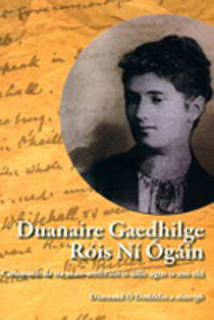
Rose Maud Young (Irish: Róis Ní Ógáin), writer, scholar and collector of Irish songs, is born in Galgorm Castle, Ballymena, County Antrim, in what is now Northern Ireland, on October 30, 1866. She is best known for her work to preserve the Irish language. Her books make lyrics from the Gaelic tradition accessible to the general public and are used in the Irish classroom for several decades.

Young is the daughter and seventh of twelve children born to Grace Charlotte Savage and John Young, who is a prosperous unionist and high sheriff. Despite his position he is a believer in tenant rights. Her younger sister is the writer Ella Young and her brother Willie Young is secretary of the Ulster Unionist League.

Young is educated by governesses until 1884 before completing training as a teacher through the University of Cambridge. She also attends Gaelic League classes in 1903 in London while visiting her sister who is living in the city at the time. After visiting the Bodleian Library she becomes committed to the study of the Irish language.

In the early 1900s Young returns to Ireland and continues her study of the Irish language in Belfast at Seán Ó Catháin‘s Irish College and in Donegal at Coláiste Uladh in Gort an Choirce. She also stays in Dublin and becomes friends with members of the Gaelic League and meets Margaret Dobbs. She works with Dobbs on the Feis na nGleann (The Glens Festival), a gathering dedicated to the Irish language.

Young is not involved in nationalism though she is strongly supportive of creating and maintaining a sense of “Irishness” through language and culture. She is also a friend and patron of Roger Casement. She also works with Ellen O’Brien and contributes to O’Brien’s book, The Gaelic Church. She keeps meticulous diaries and becomes interested in Rathlin Island and the Gaelic spoken there.

Rose Young dies on May 28, 1947 in Cushendun, County Antrim, where she resides with Dobbs. She is buried in the Presbyterian churchyard at Ahoghill, County Antrim.


Leave a comment

Birth of Poet John Harold Hewitt

john-harold-hewitt

Poet John Harold Hewitt is born in Belfast on October 28, 1907. He is the most significant Belfast poet to emerge prior to the 1960s generation of Northern Irish poets that includes Seamus Heaney, Derek Mahon and Michael Longley.

After attending Agnes Street National School, Hewitt attends the Royal Belfast Academical Institution from 1919 to 1920 before moving to Methodist College Belfast, where he is a keen cricketer. In 1924, he starts an English degree at Queen’s University Belfast, obtaining a BA in 1930, which he follows by obtaining a teaching qualification from Stranmillis College, Belfast.

From November 1930 to 1957, Hewitt holds positions in the Belfast Museum & Art Gallery. His radical socialist ideals prove unacceptable to the Belfast Unionist establishment and he is passed over for promotion in 1953. Instead in 1957 he moves to Coventry, a city still rebuilding following its devastation during World War II. He is appointed Director of the Herbert Art Gallery & Museum where he works until retirement in 1972.

Hewitt is appointed the first writer-in-residence at Queen’s University Belfast in 1976. His collections includes The Day of the Corncrake (1969) and Out of My Time: Poems 1969 to 1974 (1974). He is also made a Freeman of the City of Belfast in 1983, and is awarded honorary doctorates at the University of Ulster and Queen’s University Belfast.

Hewitt has an active political life, describing himself as “a man of the left,” and is involved in the British Labour Party, the Fabian Society and the Belfast Peace League. He is attracted to the Ulster dissenting tradition and is drawn to a concept of regional identity within the island of Ireland, describing his identity as Ulster, Irish, British and European. He officially opens the Belfast Unemployed Resource Centre (BURC) Offices on May Day 1985.

John Hewitt dies in Belfast on June 22, 1987. His life and work are celebrated in two prominent ways – the annual John Hewitt International Summer School and, less conventionally, the John Hewitt Bar and Restaurant, a Belfast pub is named after him. The bar is named after him as he officially opens the Belfast Unemployed Resource Centre, which owns the establishment. It is a popular meeting place for local writers, musicians, journalists, students and artists. Both the Belfast Festival at Queen’s and the Belfast Film Festival use the venue to stage events.


Leave a comment

Execution of Thomas Russell, United Irishmen Co-founder

thomas-russell

Thomas Paliser Russell, co-founder and leader of the Society of United Irishmen, is executed for his part in Robert Emmet‘s rebellion on October 21, 1803.

Born in Dromahane, County Cork to an Anglican family, Russell joins the British army in 1783 and serves in India. He returns to Ireland in 1786 and commences studies in science, philosophy and politics. In July 1790 he meets Theobald Wolfe Tone in the visitors’ gallery in the Irish House of Commons and they become firm friends.

In 1790 Russell resumes his military career as a junior officer in the 64th Regiment of Foot and is posted to Belfast. The French Revolution in 1789 is warmly greeted in Belfast as are its ideals of liberty, equality, and fraternity. With his keen mind and radical ideas, Russell soon becomes a confidante of Henry Joy McCracken, James Hope, Samuel Neilson and others who are to play a prominent role in the United Irish movement. With them he develops ideas of parliamentary reform, to include the bulk of the people, and Catholic emancipation.

Russell leaves the army in July 1791 and attends a convention of the Whig Club in Belfast to mark Bastille Day. The convention is addressed by William Drennan, who proposes a brotherhood promoting separation from England and co-operation with the increasingly radical Cisalpine Club in the pursuit of political and social reforms. However, Russell notes the lack of trust between Dissenters and Catholics which is due to fears that Catholic radicalism can be bought off by religious concessions. Informing Wolfe Tone of his observations, within weeks leads to Wolfe Tone’s publication of Argument on Behalf of the Catholics of Ireland to address these suspicions. The pamphlet is extremely well received and provides the impetus for the founding of the Society of United Irishmen in Belfast on October 18, 1791.

Pressure from Dublin Castle later forces the United Irish movement to become a clandestine organisation as the would-be revolutionaries seek to continue their slow progress towards challenging the occupying British.

In 1795 Russell, Andrew Henderson, Henry Joy McCracken and Samuel Neilson lead a band of United Irishmen to the top of Cavehill overlooking the town of Belfast where they swear an oath “never to desist in our effort until we have subverted the authority of England over our country and asserted her independence” prior to Wolfe Tone’s exile to the United States. The event is noted in Dublin Castle although there is no immediate move to disband or arrest the members of the United Irishmen.

In 1796, Russell publishes an ambitious and far-sighted document, Letter to the People of Ireland, which lays out his vision of social and economic reform for the Irish nation. In addition to his stance on religious freedom, he makes clear his anti-slavery views in the Northern Star on March 17, 1792.

Russell takes an active part in organising the Society of United Irishmen becoming the United Irish commander in County Down. However, the outbreak of the French Revolution in 1793 leads to an ongoing campaign against the United Irishmen and in 1796 he is arrested and imprisoned as a “state prisoner” in Dublin. In March 1799 he and the other state prisoners are transferred to Fort George in Scotland, an extensive fortress some miles north of Inverness built in the wake of the failed Jacobite rebellion of 1745-46. He is released on condition of exile to Hamburg in June 1802 following a brief cessation in the war with France.

Not content to sit things out in Hamburg, Russell soon makes his way to Paris where he meets Robert Emmet who is planning another insurrection pending the French renewal of the war against England. He agrees to return to Ireland in March 1803 to organise the North in conjunction with James Hope. However, he meets with little success as much of the north is subdued following the suppression of the Irish Rebellion of 1798 and displays little appetite for a renewed outbreak. Finally, finding some support in the vicinity of Loughinisland, he prepares to take to the field on July 23, 1803, the date set by Emmett.

However, the plan is badly thought out and quickly collapses, forcing Russell to flee to Dublin before a shot is fired in anger. He manages to hide for a number of weeks, but Dublin is a hard place in which to hide in the days following the failure of Emmett’s rebellion as the shocked authorities have launched a massive campaign of raids and arrests in an effort to finally eradicate the United Irishmen.

Thomas Russell is promptly arrested and sent to Downpatrick Gaol where he is executed by hanging then beheaded on October 21, 1803.