seamus dubhghaill

Promoting Irish Culture and History from Little Rock, Arkansas, USA


2 Comments

Birth of Robert Nugent, Civil War and Indian Wars Officer

robert-nugent

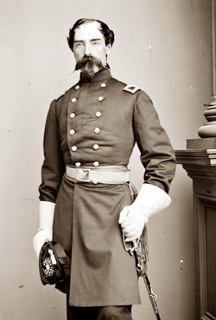
Brigadier General Robert Nugent, Irish-born American United States Army officer during the American Civil War and the American Indian Wars, is born on June 27, 1824, in Kilkeel, County Down, in what is now Northern Ireland.

Nugent serves with the Irish Brigade‘s 69th Infantry Regiment, from its days as a National Guard unit and into its incorporation into the Union Army at the start of the war. He is one of its senior officers at the First Battle of Bull Run.

When the unit is originally mustered out of service, the 90-day enlistment terms having expired, Nugent accepts a commission as a captain in the regular army. He is immediately assigned to the 13th Infantry Regiment whose commanding officer, Colonel William Tecumseh Sherman, personally requests. Taking a leave of absence to return to New York, he assists Thomas Francis Meagher in organizing the Irish Brigade. The newly reformed 69th Infantry Regiment is the first unit assigned to the Irish Brigade and, with Nugent as its colonel, he leads the “Fighting 69th” at the Battles of Fair Oaks, Gaines’ Mill, Savage’s Station, White Oak Swamp, Glendale and Malvern Hill.

Nugent is shot in the stomach at the Battle of Fredericksburg and is eventually forced to resign his command. He is appointed acting assistant provost marshal for the southern district of New York, which includes New York City and Long Island, by the United States War Department. An Irishman and Democrat, his appointment is thought to assure the Irish American population that conscription efforts would be carried out fairly. The Irish American, a popular Irish language newspaper, writes that the selection is a “wise and deservedly popular one.” He encounters resistance from city officials wanting to remain uninvolved, however by mid-June reports to his superior officer and provost marshal general Colonel James Barnet Fry that conscription efforts are “nearing completion without serious incident.”

Understanding the seriousness of the situation, Nugent attempts to keep the draft selections quiet and in isolated parts of the city. In Manhattan however, lotteries are placed in the heart of Irish tenement and shanty neighborhoods where the draft is most opposed.

In the ensuing New York City draft riots, Nugent takes command of troops and attempts to defend the city against the rioters. Despite issuing the cancellation of the draft, the riots continue for almost a week. His home on West 86th Street is looted and burned by the rioters during that time, his wife and children barely escaping from their home. Upon breaking into his house, furniture is destroyed, and paintings of Nugent and Meagher are slashed, although a painting of Brigadier General Michael Corcoran is reportedly left untouched.

On October 28, Nugent is relieved of his post and succeeded by General William Hays. Returning to active duty, he assumes command of the Irish Brigade in November 1864, shortly after the death of Corcoran. He is present at the battle of Battle of Spotsylvania Court House, the Siege of Petersburg and the Appomattox Campaign. As its last commanding officer, he and the Irish Brigade also march in the victory parade held in Washington, D.C. following Robert E. Lee‘s surrender at Appomattox Court House.

Nugent is brevetted Brigadier General for distinguished leadership of the 69th Regiment on March 13, 1865. The veterans of the Irish Brigade are honorably discharged and mustered out three months later. Nugent remains in the regular U.S. Army for the next twenty years, a formidable “Indian fighter” during the American Indian Wars with the 13th and 24th Infantry Regiments. In 1879, he retires at the rank of major and resides in New York where he is involved in the Grand Army of the Republic, the War Veterans’ Association of the 7th Regiment and an honorary member of The Old Guard.

Nugent becomes ill in his old age, complications arising from his wounds suffered at Fredericksburg, and remains bedridden for two months before his death at his McDonough Street home in Brooklyn on June 20, 1901. In accordance with his last wishes, he is buried at Cypress Hills National Cemetery.


Leave a comment

Birth of Audie Murphy, Decorated Soldier & Actor

audie-leon-murphy

Audie Leon Murphy, one of the most decorated American combat soldiers of World War II, is born to sharecropping parents of Irish descent in Kingston, Texas on June 20, 1925.

As a child, Murphy is a loner with mood swings and an explosive temper. He grows up in Texas, around Farmersville, Greenville, and Celeste, where he attends elementary school. His father drifts in and out of the family’s life and eventually deserts them. He drops out of school in fifth grade and gets a job picking cotton for a dollar a day to help support his family. After his mother dies of endocarditis and pneumonia in 1941, he works at a radio repair shop and at a combination general store, garage and gas station in Greenville.

After the attack on Pearl Harbor, Murphy’s older sister helps him to falsify documentation about his birthdate in order to meet the minimum-age requirement for enlisting in the military. Turned down by the Navy and the Marine Corps, he enlists in the Army. He first sees action in the 1943 Allied invasion of Sicily. Then, in 1944, he participates in the Battle of Anzio, the liberation of Rome, and Operation Dragoon, the invasion of Southern France. He fights at Montélimar and leads his men on a successful assault at the L’Omet quarry near Cleurie in northeastern France in October.

Murphy receives every military combat award for valor available from the U.S. Army, as well as French and Belgian awards for heroism. He receives the Medal of Honor for valor that he demonstrates at the age of 19 for single-handedly holding off an entire company of German soldiers for an hour at the Colmar Pocket in France in January 1945, then leading a successful counterattack while wounded and out of ammunition.

After the war, Murphy embarks on a 21-year acting career. He plays himself in the 1955 autobiographical film To Hell and Back, based on his 1949 memoirs of the same name, but most of his roles are in westerns. He makes guest appearances on celebrity television shows and stars in the series Whispering Smith. He is a fairly accomplished songwriter. He breeds American Quarter Horses in California and Arizona and becomes a regular participant in horse racing.

Suffering from what would today be described as posttraumatic stress disorder (PTSD), Murphy sleeps with a loaded handgun under his pillow. He looks for solace in addictive sleeping pills. In his last few years, he is plagued by money problems but refuses offers to appear in alcohol and cigarette commercials because he does not want to set a bad example.

Audie Murphy is killed on May 28, 1971 when the private plane in which he is a passenger crashes into Brush Mountain, near Catawba, Virginia, twenty miles west of Roanoke in conditions of rain, clouds, fog and zero visibility. The pilot and four other passengers are also killed. On June 7, 1971, he is buried with full military honors at Arlington National Cemetery. In attendance are United States Ambassador to the United Nations George H.W. Bush, Chief of Staff of the United States Army William Westmoreland, and many of the 3rd Infantry Division. His gravesite is the cemetery’s second most-visited gravesite, after that of President John F. Kennedy.

(Pictured: Audie Murphy as Tom Smith in the television series Whispering Smith, 1961)


Leave a comment

Birth of Januarius MacGahan, Journalist & Correspondent

januarius-macgahan

Januarius Aloysius MacGahan, American journalist and war correspondent for the New York Herald and The Daily News, is born near New Lexington, Ohio on June 12, 1844. His articles describing the massacre of Bulgarian civilians by Turkish soldiers and irregular volunteers in 1876 creates public outrage in Europe and are a major factor in preventing Britain from supporting Turkey in the Russo–Turkish War of 1877–78, which leads to Bulgaria gaining independence from the Ottoman Empire.

MacGahan’s father is an immigrant from Ireland who had served on the Northumberland, the ship which took Napoleon into exile on Saint Helena. He moves to St. Louis, where he briefly works as a teacher and as a journalist. There he meets his cousin, General Philip Sheridan, an American Civil War hero also of Irish parentage, who convinces him to study law in Europe. He sails to Brussels in December 1868.

MacGahan does not get a law degree, but he discovers that he has a gift for languages, learning French and German. He runs short of money and is about to return to America in 1870 when the Franco-Prussian War breaks out. Sheridan happens to be an observer with the German Army, and he uses his influence to persuade the European editor of the New York Herald to hire MacGahan as a war correspondent with the French Army.

MacGahan’s vivid articles from the front lines describing the stunning defeat of the French Army win him a large following, and many of his dispatches to the Herald are reprinted by European newspapers. When the war ends, he interviews French leader Léon Gambetta and Victor Hugo and, in March 1871, he hurries to Paris and is one of the first foreign correspondents to report on the uprising of the Paris Commune. He is arrested by the French military and nearly executed and is only rescued through the intervention of the U.S. Minister to France Elihu B. Washburne.

In 1871 MacGahan is assigned as the Herald‘s correspondent to Saint Petersburg. He learns Russian, mingles with the Russian military and nobility, covers the Russian tour of General William Tecumseh Sherman and meets his future wife, Varvara Elagina, whom he marries in 1873. In 1874 he spends ten months in Spain, covering the Third Carlist War.

In 1876 MacGahan quarrels with James Gordon Bennett Jr., the publisher of the New York Herald, and leaves the newspaper. He is invited by his friend, Eugene Schuyler, the American Consul-General in Constantinople, to investigate reports of large-scale atrocities committed by the Turkish Army following the failure of an attempted uprising by Bulgarian nationalists in April 1876. He obtains a commission from The Daily News, then the leading liberal newspaper in England, and leaves for Bulgaria on July 23, 1876.

MacGahan reports that the Turkish soldiers have forced some of the villagers into the church, then the church is burned, and survivors tortured to learn where they have hidden their treasures. He says that of a population of seven thousand, only two thousand survive. According to his account, fifty-eight villages in Bulgaria are destroyed, five monasteries demolished, and fifteen thousand people in all massacred. These reports, published first in The Daily News, and then in other papers, cause widespread popular outrage against Turkey in Britain. The government of British Prime Minister Benjamin Disraeli, a supporter of Turkey, tries to minimize the massacres and says that the Bulgarians are equally to blame, but his arguments are refuted by the newspaper accounts of MacGahan.

In the wake of the massacres and atrocities committed by the Ottoman forces during the suppression of the April Uprising, as well as centuries-long conflicts between Russia and Turkey in Crimea, the Russian Government, stirred by anti-Turkish and Pan-Slavism sentiment, prepare to invade the Ottoman Empire, and declare war on it on April 24, 1877. The Turkish Government of Sultan Abdul Hamid II appeals for help to Britain, its traditional ally against Russia, but the British government responds that it cannot intervene “because of the state of public feeling.”

MacGahan is assigned as a war correspondent for The Daily News and, thanks to his friendship with General Skobelev, the Russian commander, rides with the first units of the Russian Army as it crosses the Danube into Bulgaria. He covers all the major battles of the Russo–Turkish War, including the Siege of Plevna and the Battle of Shipka Pass. He reports on the final defeat of the Turkish armies and is present at the signing of the Treaty of San Stefano, which ends the war.

MacGahan is in Constantinople, preparing to travel to Berlin for the conference that determines the final borders of Bulgaria, when he catches typhoid fever. He dies on June 9, 1878, and is buried in the Greek cemetery, in the presence of diplomats, war correspondents, and General Skobelev. Five years later his body is returned to the United States and reburied in New Lexington and a statue is erected in his honor by a society of Bulgarian Americans.


Leave a comment

Birth of Mary Lavin, Short Story Writer & Novelist

mary-josephine-lavin

Mary Josephine Lavin, noted Irish short story writer and novelist, is born in Walpole, Massachusetts on June 10, 1912. She is regarded as a pioneering female author in the traditionally male-dominated world of Irish letters. Her subject matter often deals explicitly with feminist issues and concerns as well as a deep Catholic faith.

Lavin is the only child born to Tom and Nora Lavin, an immigrant Irish couple. She attends primary school in East Walpole until the age of ten, when her mother decides to go back to Ireland. Initially, Mary and Nora live with Nora’s family in Athenry, County Galway. Afterwards, they purchase a house in Dublin, and Mary’s father comes back from the United States to join them.

Lavin attends Loreto College, a convent school in Dublin, before going on to study English and French at University College Dublin (UCD). She teaches French at Loreto College for a while. As a postgraduate student, she publishes her first short story, “Miss Holland,” which appears in the The Dublin Magazine in 1938. Tom Lavin then approaches Edward Plunkett, 18th Baron of Dunsany, the well-known Irish writer, on behalf of his daughter and asks him to read some of Mary’s unpublished work. Suitably impressed, Lord Dunsany becomes her literary mentor.

In 1943, Lavin publishes her first book, Tales from Bective Bridge, a volume of ten short stories about life in rural Ireland. It is a critical success and goes on to win the James Tait Black Memorial Prize for fiction. That same year, she marries William Walsh, a Dublin lawyer. Over the next decade, the couple has three daughters and moves to “abbey farm” which they purchase in County Meath and includes the land around Bective Abbey. Her literary career flourishes. She publishes several novels and collections of short stories during this period. Her first novel, The House in Clewe Street, is serialised in The Atlantic Monthly before its publication in book form in 1945.

In 1954, William Walsh dies. Lavin, her reputation as a major writer already well-established, is left to confront her responsibilities alone. She raises her three daughters and keeps the family farm going at the same time. She also manages to keep her literary career on track, continuing to publish short stories and winning several awards for her work, including the Katherine Mansfield Prize in 1961, Guggenheim Fellowships in 1959 and 1961, and an honorary doctorate from UCD in 1968. Some of her stories written during this period, dealing with the topic of widowhood, are acknowledged to be among her finest.

Lavin remarries in 1969. Michael Scott is an old friend from her student days in University College. He has been a Jesuit priest in Australia but has obtained release from his vows from Rome and returned to Ireland. The two remain together until Scott’s death in 1991.

In 1992, Lavin, by now retired, is elected Saoi by the members of Aosdána for achieving “singular and sustained distinction” in literature. Aosdána is an affiliation of creative artists in Ireland, and the title of Saoi one of the highest honours in Irish culture.

Mary Lavin dies at the age of 83 on March 25, 1996.


Leave a comment

Death of Victor Herbert, Composer, Cellist and Conductor

victor-herbert

Victor August Herbert, an Irish-born, German-raised American composer, cellist and conductor, dies suddenly of a heart attack on May 26, 1924, shortly after his final show, The Dream Girl, begins its pre-Broadway run in New Haven, Connecticut.

Herbert is born in Dublin on February 1, 1859, to Protestants Edward Herbert and Fanny Herbert (née Lover). At age three and a half, shortly after the death of his father, he and his mother move to live with his maternal grandparents in London, England, where he received encouragement in his creative endeavours. His grandfather is the Irish novelist, playwright, poet and composer Samuel Lover. The Lovers welcome a steady flow of musicians, writers and artists into their home. He joins his mother in Stuttgart, Germany in 1867, a year after she marries a German physician, Carl Schmidt of Langenargen. In Stuttgart he receives a strong liberal education at the Eberhard-Ludwigs-Gymnasium, which includes musical training.

Herbert initially plans to pursue a career as a medical doctor. Although his stepfather is related by blood to the German royal family, his financial situation is not good by the time Herbert is a teenager. Medical education in Germany is expensive, and so he focuses instead on music. He initially studies the piano, flute and piccolo but ultimately settles on the cello, beginning studies on that instrument with Bernhard Cossmann from age 15 to age 18. He then attends the Stuttgart Conservatory. After studying cello, music theory and composition under Max Seifritz, he graduates with a diploma in 1879.

Although Herbert enjoys important careers as a cello soloist and conductor, he is best known for composing many successful operettas that premiere on Broadway from the 1890s to World War I. He is also prominent among the Tin Pan Alley composers and is later a founder of the American Society of Composers, Authors, and Publishers (ASCAP). A prolific composer, Herbert produces two operas, a cantata, 43 operettas, incidental music to 10 plays, 31 compositions for orchestra, nine band compositions, nine cello compositions, five violin compositions with piano or orchestra, 22 piano compositions and numerous songs, choral compositions and orchestrations of works by other composers, among other music.

In the early 1880s, Herbert begins a career as a cellist in Vienna, Austria, and Stuttgart, Germany, during which he begins to compose orchestral music. Herbert and his opera singer wife, Therese Förster, move to the United States in 1886 when both are engaged by the Metropolitan Opera. He continues his performing career, while also teaching at the National Conservatory of Music of America, conducting and composing. His most notable instrumental compositions are his Cello Concerto No. 2 in E minor, Op. 30 (1894), which enters the standard repertoire, and his Auditorium Festival March (1901). He leads the Pittsburgh Symphony Orchestra from 1898 to 1904 and then founds the Victor Herbert Orchestra, which he conducts throughout the rest of his life.

Herbert begins to compose operettas in 1894, producing several successes, including The Serenade (1897) and The Fortune Teller (1898). Some of the operettas that he writes after the turn of the 20th century are even more successful: Babes in Toyland (1903), Mlle. Modiste (1905), The Red Mill (1906), Naughty Marietta (1910), Sweethearts (1913) and Eileen (1917). After World War I, with the change of popular musical tastes, he begins to compose musicals and contributes music to other composers’ shows. While some of these are well-received, he never again achieves the level of success that he enjoyed with his most popular operettas.

A healthy man throughout his life, Herbert dies suddenly of a heart attack at the age of 65 on May 26, 1924, shortly after his final show, The Dream Girl, began its pre-Broadway run in New Haven. He is survived by his wife and two children, Ella Victoria Herbert Bartlett and Clifford Victor Herbert. He is entombed in Woodlawn Cemetery in The Bronx, New York City.

Herbert and his music are celebrated in the 1939 film The Great Victor Herbert, where he is portrayed by Walter Connolly, and which also features Mary Martin. He is also portrayed by Paul Maxey in the 1946 film Till the Clouds Roll By. Many of Herbert’s own works are made into films, and his music has been used in numerous films and television shows. A Chicago elementary school is named for him. During World War II the Liberty ship SS Victor Herbert is built in Panama City, Florida, and named in his honor.


Leave a comment

Birth of Dennis Day, Radio, TV & Film Personality

dennis-day

Dennis Day, American singer, radio, television and film personality and comedian of Irish descent, is born Owen Patrick Eugene McNulty on May 21, 1916 in The Bronx borough of New York City.

Day is the second of five children born to Irish immigrants Patrick McNulty and Mary (née Grady) McNulty. He graduates from Cathedral Preparatory School and Seminary in New York City, and attends Manhattan College in the Bronx, where he sings in the glee club.

Mary Livingstone, wife of comedian Jack Benny, brings Day to Benny’s attention after hearing him on the radio during a visit to New York. She takes a recording of Day’s singing to Benny, who then goes to New York to audition Day. The audition results in Day’s role on the Benny program.

Day appears for the first time on Benny’s radio show on October 8, 1939, taking the place of another famed tenor, Kenny Baker. He remains associated with Benny’s radio and television programs until Benny’s death in 1974. He is introduced as a young, naive boy singer, a character he keeps through his whole career.

Besides singing, Day is an impressionist. On the Benny program, he performs impressions of various noted celebrities of the era, including Ronald Colman, Jimmy Durante and James Stewart.

From 1944 through 1946 Day serves in the United States Navy as a Lieutenant. While in service he is temporarily replaced on the Benny radio program by fellow tenor Larry Stevens. On his return to civilian life, he continues to work with Benny while also starring on his own NBC show, A Day in the Life of Dennis Day (1946–1951). His last radio series is a comedy/variety show that airs on NBC’s Sunday afternoon schedule during the 1954–55 season.

An attempt is made to adapt A Day in the Life Of Dennis Day as an NBC filmed series, produced by Jerry Fairbanks for Dennis’ sponsor, Colgate-Palmolive, featuring the original radio cast, but gets no farther than an unaired 1949 pilot episode. Eventually, his own TV series, The Dennis Day Show, is first telecast on NBC on February 8, 1952, and then in the 1953–1954 season. Between 1952 and 1978, he makes numerous TV appearances as a singer, actor and voice for animation, such as the Walt Disney feature Johnny Appleseed, handling multiple characters. His last televised work with Benny is in 1970, when they both appear in a public service announcement together to promote savings and loans.

Although his career is mainly radio and TV-based, Day also appears in a few films. These include Buck Benny Rides Again (1940) opposite Jack Benny, Sleepy Lagoon (1943), Music in Manhattan (1944), I’ll Get By (1950), Golden Girl (1951), The Girl Next Door (1953), and Won Ton Ton, the Dog Who Saved Hollywood (1976) as a singing telegraph man. For the soundtrack of My Wild Irish Rose (1947), a biopic about Chauncey Olcott, Day provides the singing voice to the acting of Dennis Morgan.

Dennis Day dies on June 22, 1988, of amyotrophic lateral sclerosis (ALS), more commonly known as Lou Gehrig’s disease, in Los Angeles, California. His star on the Hollywood Walk of Fame is at 6646 Hollywood Boulevard. He is interred in Holy Cross Cemetery in Culver City.


Leave a comment

Birth of John Brougham, Actor & Dramatist

john-brougham

John Brougham, Irish American actor and dramatist, is born in Dublin on May 9, 1814.

Brougham’s father is an amateur painter and dies young. His mother is the daughter of a Huguenot, whom political adversity has forced into exile. He is the eldest of three children. Both of his siblings die in youth, and the father being dead, and the widowed mother left penniless, he is reared in the family and home of an uncle.

Brougham is prepared for college at an academy at Trim, County Meath, twenty miles from Dublin, and subsequently is sent to the University of Dublin. There he acquires classical learning and forms interesting and useful associations and acquaintances. He also becomes interested in private theatricals. He falls in with a crowd that puts on their own shows, cast by drawing parts out of a hat. Though he most always trades off larger roles so he can pay attention to his studies, he takes quite an interest in acting. He is a frequent attendant, moreover, at the Theatre Royal in Hawkins Street.

Brougham is educated with the intention of his becoming a surgeon and walks the Peth Street Hospital for eight months. However, misfortune comes upon his uncle, so he is obliged to provide for himself. Before leaving the university he, by chance, becomes acquainted with the actress Lucia Elizabeth Vestris.

Brougham goes to London in 1830 and, after a brief experience of poverty, suddenly determines to become an actor. He is destitute of everything except fine apparel, and he has actually taken the extreme step of offering himself as a cadet in the service of the East India Company. But, being dissuaded by the enrolling officer, who lends him a guinea and advises him to seek other employment, and happening to meet with a festive acquaintance, he seeks recreation at the Tottenham Theatre where Madame Vestris is acting.

Brougham’s acquaintance with Madame Vestris leads to him being engaged at the theatre, and he thus makes his first appearance on the London stage in July in Tom and Jerry, in which he plays six characters. In 1831 he is a member of Madame Vestris’s company and writes his first play, a burlesque. He remains with Madame Vestris as long as she and Charles Mathews retain Covent Garden Theatre, and he collaborates with Dion Boucicault in writing London Assurance, the role of Dazzle being one of those with which he becomes associated. His success at small or “low” comic roles such as Dazzle earn him the nickname “Little Johnny Brougham,” a moniker which he embraces, and which boosts his popularity with working-class audiences.

In 1840 Brougham manages the Lyceum Theatre, for which he writes several light burlesques, but in 1842 he moves to the United States, where he becomes a member of William Evans Burton‘s company, for which he writes several comedies, including Met-a-mora; or, the Last of the Pollywogs, a parody of John A. Stone and Edwin Forrest’s Metamora; or The Last of the Wamponoags, and Irish Yankee; or, The Birthday of Freedom.

Later Brougham is the manager of Niblo’s Garden, and in 1850 opens Brougham’s Lyceum, which, like his next speculation, the lease of the Bowery Theatre, is not a financial success, despite the popularity of such works as Po-ca-hon-tas; or, The Gentle Savage. He is later connected with James William Wallack‘s and Augustin Daly‘s theatres and writes plays for both.

In 1860 Brougham returns to London, where he adapts or writes several plays, including The Duke’s Motto for Charles Fechter. In November 1864 he appears at the Theatre Royal in his native Dublin in the first performance of Dion Boucicault’s Arrah-na-Pogue with Boucicault, Samuel Johnson and Samuel Anderson Emery in the cast.

After the American Civil War Brougham returns to New York City. Brougham’s Theatre is opened in 1869 with his comedies Better Late than Never and Much Ado About a Merchant of Venice, but this managerial experience is also a failure due to disagreements with his business partner, James Fisk. He then takes to playing the stock market. His last appearance onstage is in 1879 as “O’Reilly, the detective” in Boucicault’s Rescued.

John Brougham dies in Manhattan on June 7, 1880.


Leave a comment

Birth of Bing Crosby

bing-crosby

Harry Lillis “Bing” Crosby Jr., American singer and actor and descendant of Irish immigrants, is born on May 3, 1903, in Tacoma, Washington. His trademark warm bass-baritone voice makes him one of the best-selling recording artists of all time, selling over one billion analog records and tapes, as well as digital compact discs and downloads around the world.

Crosby’s parents are Harry Lillis Crosby Sr. (1870–1950), a bookkeeper of English descent, and Catherine Helen “Kate” (née Harrigan; 1873–1964), a second-generation Irish American. An ancestor, Simon Crosby, emigrates to America in the 17th century, and one of his descendants marries a descendant of Mayflower passenger William Brewster.

The first multimedia star, from 1931 to 1954 Crosby is a leader in record sales, radio ratings, and motion picture grosses. His early career coincides with technical recording innovations such as the microphone. This allows him to develop a laid-back, intimate singing style that influences many of the popular male singers who follow him, including Perry Como, Frank Sinatra, Dick Haymes, and Dean Martin. Yank, the Army Weekly magazine says that he is the person who has done the most for American soldiers’ morale during World War II.

The biggest hit song of Crosby’s career is his recording of Irving Berlin‘s “White Christmas,” which he introduces on a Christmas Day radio broadcast in 1941. The song then appears in his 1942 movie Holiday Inn. His record hits the charts on October 3, 1942, and rises to No. 1 on October 31, where it stays for eleven weeks.

In 1948, American polls declare him the “most admired man alive,” ahead of Jackie Robinson and Pope Pius XII. Also in 1948, Music Digest estimates that his recordings fill more than half of the 80,000 weekly hours allocated to recorded radio music.

Crosby wins an Academy Award for Best Actor for his role as Father Chuck O’Malley in the 1944 motion picture Going My Way and is nominated for his reprise of the role in The Bells of St. Mary’s opposite Ingrid Bergman the next year, becoming the first of six actors to be nominated twice for playing the same character. In 1963, he receives the first Grammy Global Achievement Award. He is one of 33 people to have three stars on the Hollywood Walk of Fame, in the categories of motion pictures, radio, and audio recording.

Crosby influences the development of the postwar recording industry. After seeing a demonstration of an early Ampex reel-to-reel tape recorder he places a large order for their equipment and convinces ABC to allow him to tape his shows. He becomes the first performer to pre-record his radio shows and master his commercial recordings onto magnetic tape. Through the medium of recording, he constructs his radio programs with the same directorial tools and craftsmanship (editing, retaking, rehearsal, time shifting) used in motion picture production, a practice that becomes an industry standard. In addition to his work with early audio tape recording, he helps to finance the development of videotape, purchases television stations, breeds racehorses, and co-owns the Pittsburgh Pirates baseball team.

On October 13, 1977, Crosby flies alone to Spain to play golf and hunt partridge. The following day, at the La Moraleja Golf Course near Madrid, he plays 18 holes of golf. As Crosby and his party head back to the clubhouse, Crosby says, “That was a great game of golf, fellas.” At about 6:30 PM, he collapses about 20 yards from the clubhouse entrance and dies instantly from a massive heart attack. At Reina Victoria Hospital he is administered the last rites of the Catholic Church and is pronounced dead. On October 18, following a private funeral Mass at St. Paul’s Catholic Church in Westwood, he is buried at Holy Cross Cemetery in Culver City, California. A plaque is placed at the golf course in his memory.


2 Comments

Birth of Actor Spencer Tracy

spencer-tracy

Spencer Bonaventure Tracy, American actor noted for his natural style and versatility, is born in Milwaukee, Wisconsin on April 5, 1900. One of the major stars of Hollywood’s Golden Age, Tracy wins two Academy Awards for Best Actor, from nine nominations, sharing the record for nominations in that category with Laurence Olivier.

Tracy is the second son of Caroline and John Edward Tracy, a truck salesman. His mother is a Presbyterian from a wealthy Midwestern family and his father is of Irish Catholic background.

Tracy first discovers his talent for acting while attending Ripon College, and he later receives a scholarship for the American Academy of Dramatic Arts. He spends seven years in the theatre, working in a succession of repertory theatres and intermittently on Broadway. His breakthrough comes in 1930, when his lead performance in The Last Mile catches the attention of Hollywood. After a successful film debut in Up the River, he is signed to a contract with Fox Film Corporation. His five years with Fox are unremarkable and he remains largely unknown to audiences after 25 films, most of them starring Tracy as the leading man. None of them are hits although The Power and the Glory (1933) features one of his most acclaimed performances.

In 1935, Tracy joins Metro-Goldwyn-Mayer, at the time Hollywood’s most prestigious studio. His career flourishes with a series of hit films, and in 1937 and 1938 he wins consecutive Oscars for Captains Courageous and Boys Town. By the 1940s, Tracy is one of the studio’s top stars. In 1942, he appears with Katharine Hepburn in Woman of the Year, beginning a popular partnership that produces nine movies over 25 years.

Tracy leaves MGM in 1955 and continues to work regularly as a freelance star, despite an increasing weariness as he ages. His personal life is troubled, with a lifelong struggle against alcoholism and guilt over his son’s deafness. He becomes estranged from his wife in the 1930s but never divorces, conducting a long-term relationship with Katharine Hepburn in private. Towards the end of his life, he works almost exclusively for director Stanley Kramer. It is for Kramer that he makes his last film, Guess Who’s Coming to Dinner in 1967, completed just 17 days before his death.

On June 10, 1967, Tracy awakens at 3:00 AM to make himself a cup of tea in his apartment in Beverly Hills, California that he shares with Hepburn. She hears a loud thump and finds Tracy lying dead on the kitchen floor from a heart attack.

A Requiem Mass is held for Tracy on June 12, 1967, at the Immaculate Heart of Mary Catholic Church in East Hollywood. Pallbearers included George Cukor, Stanley Kramer, Frank Sinatra, James Stewart, and John Ford. Out of consideration for Tracy’s family, Hepburn does not attend the funeral. Tracy is interred at Glendale‘s Forest Lawn Memorial Park, near his wife, Louise, and son John.

During his career, Tracy appears in 75 films and develops a reputation among his peers as one of the screen’s greatest actors. In 1999 the American Film Institute ranks Tracy as the 9th greatest male star of Classical Hollywood Cinema.


Leave a comment

Death of Olympic Gold Medalist Martin John Sheridan

martin-john-sheridan

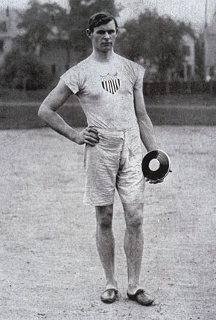
Martin John Sheridan, “one of the greatest athletes the United States has ever known” according to his obituary in The New York Times, dies in St. Vincent’s Hospital in Manhattan, New York City on March 27, 1918, the day before his 37th birthday.

Sheridan is born in Bohola, County Mayo on March 28, 1881. At 6’3″ and 194 lbs., Sheridan is the best all-around athlete of the Irish American Athletic Club, and like many of his teammates, serves with the New York City Police Department from 1906 until his death. He is so well respected in the NYPD, that he serves as the Governor’s personal bodyguard when the governor is in New York City.

A five-time Olympic gold medalist, with a total of nine Olympic medals, Sheridan is called “one of the greatest figures that ever represented this country in international sport, as well as being one of the most popular who ever attained the championship honor.” He wins the discus throw event at the 1904, 1906, and 1908 Summer Olympic Games as well as the shot put at the 1906 Olympics and the Greek discus in 1908. At the 1906 Intercalated Games in Athens, Greece he also wins silver medals in the standing high jump, standing long jump and the stone throw.

In 1907, Sheridan wins the National Amateur Athletic Union discus championship and the Canadian championship, and in 1908 he wins the Metropolitan, National and Canadian championships as well as two gold medals in the discus throw and bronze in the standing long jump at the 1908 Olympic Games.

Two of Sheridan’s gold medals from the 1904 Summer Olympic Games in St. Louis, Missouri, and one of his medals from the 1906 Intercalated Games in Athens, Greece, are currently located in the USA Track & Field‘s Hall of Fame History Gallery, in Washington Heights, Manhattan.

There are claims that Sheridan fuels a controversy in London in 1908, when flagbearer Ralph Rose refuses to dip the flag to King Edward VII. Sheridan supports Rose by explaining “This flag dips to no earthly king,” and it is claimed that his statement exemplifies both Irish and American defiance of the British monarchy. However, careful research has shown that this is first reported in 1952. Sheridan himself makes no mention of it in his published reports on the Games and neither does his obituary.

Martin Sheridan dies in Manhattan, New York City on March 27, 1918, a very early casualty of the 1918 flu pandemic. He is buried in Calvary Cemetery, Queens, New York. The inscription on the granite Celtic Cross monument marking his grave says in part: “Devoted to the Institutions of his Country, and the Ideals and Aspirations of his Race. Athlete. Patriot.” He is part of a group of Irish American athletes known as the “Irish Whales.”