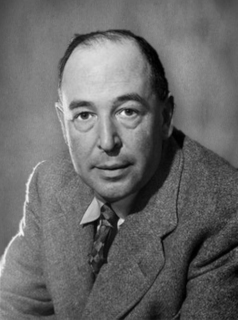
Lewis is schooled by private tutors until age nine when his mother dies in 1908 from cancer. His father then sends him to live and study at Wynyard School in Watford, Hertfordshire. After the school is closed soon afterward, he attends Campbell College in the east of Belfast about a mile from his home, but leaves after a few months due to respiratory problems. He is then sent to the health-resort town of Malvern, Worcestershire, where he attends the preparatory school Cherbourg House. It is during this time that he abandons his childhood Christian faith and becomes an atheist. In September 1913, he enrolls at Malvern College. After leaving Malvern, he studies privately with William T. Kirkpatrick, his father’s old tutor and former headmaster of Lurgan College.
Lewis and fellow novelist J. R. R. Tolkien are close friends. They both serve on the English faculty at Oxford University and are active in the informal Oxford literary group known as the Inklings. He returns to Anglicanism at the age of 32, owing to the influence of Tolkien and other friends, and he becomes an “ordinary layman of the Church of England.” His faith profoundly affects his work, and his wartime radio broadcasts on the subject of Christianity bring him wide acclaim.
Lewis writes more than 30 books which have been translated into more than 30 languages and have sold millions of copies. The books that make up The Chronicles of Narnia have sold the most and have been popularised on stage, television, radio and cinema. His philosophical writings are widely cited by Christian apologists from many denominations.
In early June 1961, Lewis begins suffering from nephritis, which results in blood poisoning. He recovers but on July 15 of that year he falls ill and is admitted to the hospital where he suffers a heart attack the following day, lapses into a coma and awakens the next day. After he is discharged from the hospital his condition continues to decline. He is diagnosed with end-stage renal failure in mid-November. He collapses and dies in his bedroom on November 22. He is buried in the churchyard of Holy Trinity Church, Headington, Oxford.
Media coverage of Lewis’s death is almost completely overshadowed by news of the assassination of United States PresidentJohn F. Kennedy, which takes place approximately 55 minutes after Lewis’s collapse.
Trench is educated at Haileybury and Keble College, Oxford, and is elected a fellow of All Souls College, Oxford. In 1891, after some years spent in traveling, he is appointed an examiner in the Board of Education. He gives up this appointment in 1908 in order to devote himself to literary work.
From his school days Trench has been a writer of verse, and his first volume of poems, Deirdre Wed and other Poems, appears in 1901. It is followed by further poems, notably Apollo and the Seaman, included in New Poems (1907), and Lyrics and Narrative Poems (1911). Among his later publications are an Ode from Italy in time of War (1915), Poems with Fables in Prose (1917) and a poetic play Napoleon (1919), which is produced in London by the Stage Society in 1919. Some of his poems are set to music by Arnold Bax.
Butler is the son of Richard and Ellen Butler. The great famine of 1847 and scenes of suffering and eviction are amongst his earliest recollections. He is educated chiefly by the Jesuits at Tullabeg College.
On June 11, 1877, Butler marries Elizabeth Thompson, an accomplished painter of battle scenes, notably The Roll Call (1874), Quatre Bras (1875), Rorke’s Drift (1881), The Camel Corps (1891), and The Dawn of Waterloo (1895). They have six children. His daughter, Elizabeth Butler, marries Lt.-Col. Randolph Albert Fitzhardinge Kingscote (1867-1940) on July 24, 1903.
In 1898 Butler succeeds General William Howley Goodenough as commander-in-chief in South Africa, with the local rank of lieutenant general. For a short period (December 1898 – February 1899), during the absence of Sir Alfred Milner in England, he acts as high commissioner, and as such, and subsequently in his military capacity, he expresses views on the subject of the probabilities of war which are not approved by the home government. He is consequently ordered home to command the Western District and holds this post until 1905. He also holds the Aldershot Command for a brief period from 1900 to 1901. He is promoted to lieutenant general in 1900 and continues to serve, finally leaving the King‘s service in 1905.
In October 1905, having reached the age limit of sixty-seven, Butler is placed on the retired list. The few years of life which remain to him he spends at Bansha Castle in Ireland, devoted chiefly to the cause of education. He is a frequent lecturer both in Dublin and the provinces on historical, social, and economic questions. He is known as a Home Ruler and an admirer of Charles Stewart Parnell. He is a member of the Senate of the National University of Ireland, and a commissioner of the Board of National Education. In June 1906, he is appointed Knight of the Grand Cross of the Order of the Bath, and in 1909 he is made a member of the Privy Council of Ireland.
William Butler dies at Bansha Castle in Bansha, County Tipperary, on June 10, 1910, and is buried at the cemetery of Killaldriffe, a few miles distant and not far from his ancestral home.
Butler had long been known as a descriptive writer, since his publication of The Great Lone Land (1872) and other works and he was the biographer (1899) of Sir George Pomeroy Colley. He had started work on his autobiography a few years before his death but died before it was completed. His youngest daughter, Eileen, Viscountess Gormanston, completes the work and has it published in 1911.
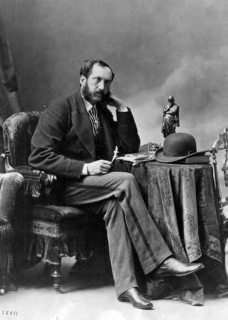
(Pictured: William Francis Butler, Source: Archives of Manitoba, Personalities – Butler, W. F. 1, N10492)
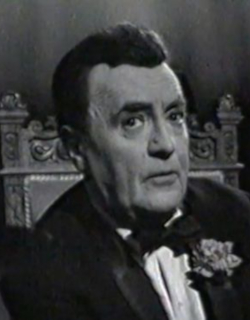
As Alfred Willmore, he is one of the leading child actors on the English stage, in the company of Noël Coward. He appears for several seasons in Peter Pan. He studies painting at London’s Slade School of Fine Art, continuing to paint throughout his lifetime. In the 1920s he travels all over Europe. He is captivated by Irish culture and learns the Irish language which he speaks and writes fluently. He changes his name to an Irish version, presenting himself in Ireland as a descendant of Irish Catholics from Cork. Later in his life, he writes three autobiographies in Irish and translates them into English.
While acting in Ireland with the touring company of his brother-in-law Anew MacMaster, Mac Liammóir meets the man who becomes his partner and lover, Hilton Edwards. Their first meeting takes place in the Athenaeum, Enniscorthy, County Wexford. Deciding to remain in Dublin, where they live at Harcourt Terrace, the pair assists with the inaugural production of Galway‘s Irish language theatre, An Taibhdhearc. The play is Mac Liammóir’s version of the mythical story Diarmuid agus Gráinne, in which Mac Liammóir plays the lead role as Diarmuid.
Mac Liammóir and Edwards then throw themselves into their own venture, co-founding the Gate Theatre in Dublin in 1928. The Gate becomes a showcase for modern plays and design. Mac Liammóir’s set and costume designs are key elements of the Gate’s success. His many notable acting roles include Robert Emmet/The Speaker in Denis Johnston‘s The Old Lady Says “No!” and the title role in Hamlet.
In 1948, Mac Liammóir appears in the NBC television production of Great Catherine with Gertrude Lawrence. In 1951, during a break in the making of Othello, he produces Orson Welles‘s ghost-story Return to Glennascaul which is directed by Hilton Edwards. He plays Iago in Welles’s film version of Othello (1951). The following year, he goes on to play ‘Poor Tom’ in another Welles project, the TV film of King Lear (1953) for CBS.
Mac Liammóir claims when talking to Irish playwright Mary Manning, to have had a homosexual relationship with General Eoin O’Duffy, former Garda Síochána Commissioner and head of the paramilitary Blueshirts in Ireland, during the 1930s. The claim is revealed publicly by RTÉ in a documentary, The Odd Couple, broadcast in 1999. However, Mac Liammóir’s claims have not been substantiated.
Mac Liammóir’s life and artistic development are the subject of a major study by Tom Madden, The Making of an Artist. Edwards and Mac Liammóir are the subject of a biography, titled The Boys by Christopher Fitz-Simon.
Micheál Mac Liammóir dies at the age of 78 on March 6, 1978. Edwards and Mac Liammóir are buried alongside each other at St. Fintan’s Cemetery, Sutton, Dublin.
Patrick Kavanagh, Irish poet and novelist whose best-known works include the novel Tarry Flynn, and the poems “On Raglan Road” and “The Great Hunger,” is born in rural Inniskeen, County Monaghan, on October 21, 1904. He is known for his accounts of Irish life through reference to the everyday and commonplace.
Kavanagh is the fourth of ten children of James Kavanagh, a cobbler and farmer, and Bridget Quinn. He is a pupil at Kednaminsha National School from 1909 to 1916, leaving in the sixth year at the age of 13. He becomes apprenticed to his father as a shoemaker and works on his farm. He is also goalkeeper for the Inniskeen Gaelic football team.
Kavanagh’s first collection, Ploughman and Other Poems, is published in 1936. It is notable for its realistic portrayal of Irish country life, free of the romantic sentiment often seen at the time in rural poems, a trait he abhors. Two years after his first collection is published, he has yet to make a significant impression. The Times Literary Supplement describes him as “a young Irish poet of promise rather than of achievement.”
In 1938 Kavanagh goes to London and remains there for about five months. The Green Fool, a loosely autobiographical novel, is published in 1938 and Kavanagh is accused of libel by Oliver St. John Gogarty who sues Kavanagh for his description of mistaking Gogarty’s “white-robed maid for his wife or his mistress.” Gogarty is awarded £100 in damages. The book, which recounts Kavanagh’s rural childhood and his attempts to become a writer, receives international recognition and good reviews.
Patrick Kavanagh dies on November 30, 1967, from an attack of bronchitis, bringing to a close the life of one of Ireland’s most controversial and colorful literary figures. Kavanagh’s reputation as a poet is based on the lyrical quality of his work, his mastery of language and form and his ability to transform the ordinary into something of significance.
In 1939, Fallon leaves Dublin to serve as a Customs official in County Wexford, living in Prospect House, near Wexford with his wife, Dorothea (née Maher) and his six sons. During this time, he becomes a close friend of the painter Tony O’Malley.
Fallon’s early poetry, short stories and literary criticism are published in The Dublin Magazine and The Bell. He is a regular contributor to Raidió Éireann in the 1940s and 1950s, serving variously as a journalist, scriptwriter and literary critic. A number of his short stories and early dramatic pieces are broadcast by the station during the 1940s. The first of his verse plays for radio, Diarmuid and Gráinne, is broadcast by Raidió Éireann in November 1950. This is followed by The Vision of Mac Conglinne (1953), Two Men with a Face (1953), The Poplar (1953), Steeple Jerkin (1954), The Wooing of Étain (1954), A Man in the Window (1955), Outpost (1955), Deirdre’s King (1956), The Five Stations (1957), The Hags of Clough (1957), The Third Bachelor (1958), At the Bridge Inn (1960) and Lighting up Time (1961).
Three plays adapted from Irish mythology, Diarmuid and Gráinne, The Vision of Mac Conglinne and Deirdre’s King, receive particular contemporary critical acclaim. The landscape, mythology and history of Ireland, interwoven with classical themes and religious symbolism, are frequent themes in his poetry and dramatic works. A number of Fallon’s radio plays are later broadcast on BBC Third Programme and, in translation, in Germany, the Netherlands, and Hungary. The play The Seventh Step is staged at The Globe Theatre in Dublin in 1954. A second one, Sweet Love ’till Morn, is staged at the Abbey Theatre in 1971. He also writes dramatic pieces for television such as A Sword of Steel (1966) and The Fenians (1967), the latter produced by James Plunkett. In a number of his plays and radio dramas he cooperates with contemporary composers providing incidental music, an example being The Wooing of Étain (1954) with music by Brian Boydell.
Fallon retires from the Civil Service in 1963, returning to Dublin before moving to Cornwall in 1967 to live with his son, the sculptor Conor Fallon and his daughter-in-law, the artist Nancy Wynne-Jones. He and his wife return to Ireland in 1971. He spends his last years in Kinsale. He is visiting his son Ivan Fallon in Kent at the time of his death.
While Fallon’s poetry had previously appeared in The Dublin Magazine, The Bell, The Irish Times and a number of anthologies, his first volume of collected poetry, Poems, incorporating a number of previously unpublished poems, is not produced until 1974, months before his death. Three volumes of his poetry, edited by his son, the journalist and critic Brian Fallon, are published after his death: Poems and Versions in 1983, Collected Poems in 1990, and A Look in the Mirror and Other Poems in 2003. In 2005, three of his verse plays, The Vision of Mac Conglinne, The Poplar, and The Hags of Clough, are published in a single volume. A selection of his prose writings and criticism edited by Brian Fallon, A Poet’s Journal, is published in the same year.
Mac Fhionnlaoich is the son of Micheal McGinley and Susan Toner. He attends school locally until he is seventeen. He then attends Blackrock College in Dublin for two years. Upon leaving school he enters into the British Civil Service becoming an Inland Revenue Officer. In 1895 he marries Elizabeth Woods (Irish: Sibhéal Ní Uadhaigh) and they have twelve children. He speaks Irish from an early age and keeps an interest in the language throughout his life, first publishing an Irish language short story and poem in The Donegal Christmas Annual 1883. It is not until 1895 while living in Belfast that he becomes involved in the Gaelic Movement.
It is in Mac Fhionnlaoich’s Belfast home that the first meeting of the Ulster branch of the Conradh na Gaeilge takes place in 1895. From this point on he becomes very involved in Conradh na Gaeilge becoming the organisations president on several occasions.
Louis MacNeice, British poet and playwright, is born in Belfast on September 12, 1907. He is a member, along with Wystan Hugh Auden, Cecil Day-Lewis, and Stephen Spender, of a group whose low-keyed, unpoetic, socially committed, and topical verse is the “new poetry” of the 1930s. His body of work is widely appreciated by the public during his lifetime, due in part to his relaxed but socially and emotionally aware style.
MacNeice’s first book of poetry, Blind Fireworks, appears in 1929, followed by more than a dozen other volumes, such as Poems (1935), Autumn Journal (1939), Collected Poems, 1925–1948 (1949), and, posthumously, The Burning Perch (1963). An intellectual honesty, Celtic exuberance, and sardonic humour characterize his poetry, which combines a charming natural lyricism with the mundane patterns of colloquial speech. His most characteristic mood is that of the slightly detached, wryly observant, ironic and witty commentator. Among MacNeice’s prose works are Letters from Iceland (with W.H. Auden, 1937) and The Poetry of W.B. Yeats (1941). He is also a skilled translator, particularly of Horace and Aeschylus (The Agamemnon of Aeschylus, 1936).
By the early 1960s, MacNeice is “living on alcohol,” and eating very little, but still writing. In August 1963 he goes caving in Yorkshire to gather sound effects for his final radio play, Persons from Porlock. Caught in a storm on the moors, he does not change out of his wet clothes until he is home in Hertfordshire. Bronchitis evolves into viral pneumonia and he is admitted to hospital in London on August, 27. He dies there on September 3, 1963 at the age of 55. He is buried in Carrowdore churchyard in County Down, alongside his mother.
MacNeice’s final book of poems, The Burning Perch, is published a few days after his funeral. His life-long friend from Oxford, W.H. Auden, who gives a reading at MacNeice’s memorial service, describes the poems of his last two years as “among his very best.”
Christy Brown, Irish writer and painter who has cerebral palsy and is able to write or type only with the toes of one foot, dies on September 7, 1981, in Parbrook, Somerset, England. His most recognized work is his autobiography, My Left Foot (1954).
Brown is born into a working-class Irish family at the Rotunda Hospital in Dublin on June 5, 1932. He is one of 22 siblings of parents Bridget Fagan and Patrick Brown. After his birth, doctors discover that he has severe cerebral palsy, a neurological disorder which leaves him almost entirely spastic in his limbs. Though urged to commit him to a hospital, his parents are unswayed and subsequently determined to raise him at home with their other children. During his adolescence, social worker Katriona Delahunt becomes aware of his story and begins to visit the Brown family regularly. She brings him books and painting materials as, over the years, he has shown a keen interest in the arts and literature. He has also demonstrated extremely impressive physical dexterity since, soon after discovering several household books, he had learned to both write and draw himself with his left leg, the only limb over which he has unequivocal control.
Brown quickly matures into a serious artist. Although he famously receives almost no formal schooling during his youth, he does attend St. Brendan’s School-Clinic in Sandymount intermittently. At St. Brendan’s he comes in contact with Dr. Robert Collis, a noted author. Collis discovers that Brown is also a natural novelist and, later, helps use his own connections to publish My Left Foot, by then a long-gestating autobiographical account of Brown’s struggle with everyday life amidst the vibrant culture of Dublin.
When My Left Foot becomes a literary sensation, one of the many people who write letters to Brown is married American woman Beth Moore. Brown and Moore become regular correspondents and, in 1960, he holidays in North America and stays with Moore at her home in Connecticut. When they meet again in 1965, they began an affair. Brown journeys to Connecticut once more to finish his magnum opus, which he had been developing for years. He finally does so in 1967 with help from Moore, who introduces and administers a strict working regimen, mostly by denying him alcohol until a day’s work is completed. The book, Down All the Days, is published in 1970. It is an ambitious project drawn largely from a playful expansion of My Left Foot. It becomes an international best-seller, translated into fourteen languages. The Irish Times reviewer Bernard Share claims the work is “the most important Irish novel since Ulysses.”
Down All the Days is followed by a series of other novels, including A Shadow on Summer (1972), Wild Grow the Lilies (1976) and A Promising Career (published posthumously in 1982). He also publishes three poetry collections: Come Softly to My Wake, Background Music and Of Snails and Skylarks. All the poems are included in The Collected Poems of Christy Brown.
Brown’s fame continues to spread internationally, and he becomes a prominent celebrity. Upon his return to Ireland, he is able to use proceeds from the sales of his books to design and move into a specially constructed home outside Dublin with his sister’s family. Though he and Beth had planned to marry and live together at the new home, and though Moore had informed her husband of these plans, it is around this time that he begins an affair with Englishwoman Mary Carr, whom he meets at a party in London. He then terminates his affair with Moore and marries Carr at the Registry Office, Dublin, in 1972. They move to Stoney Lane, Rathcoole, County Dublin, to Ballyheigue, County Kerry and then to Somerset. He continues to paint, write novels, poetry and plays. His 1974 novel, A Shadow on Summer, is based on his relationship with Moore, whom he still considers a friend.
Brown’s health deteriorates after marrying Carr. He becomes mainly a recluse in his last years, which is thought to be a direct result of Carr’s influence and perhaps abusive nature. He dies at the age of 49 on September 7, 1981, after choking during a lamb chop dinner. His body is found to have significant bruising, which leads many to believe that Carr had physically abused him. Further suspicions arise after Georgina Hambleton’s biography, The Life That Inspired My Left Foot, reveals a supposedly more accurate and unhealthier version of their relationship. The book portrays Carr as an abusive alcoholic and habitually unfaithful. He is buried in the Glasnevin Cemetery in Dublin.
The Anglo-Irish rock band The Pogues pay tribute to Christy Brown with a song titled “Down All the Days.” It is the seventh track on their 1989 recording Peace and Love. Similarly, U2 releases a song titled “Down All the Days” with the 20th anniversary edition of Achtung Baby. The Men They Couldn’t Hang also writes a song “Down All the Days” which appears on their Silver Town album also released in 1989.
Steele is born in Dublin on March 12, 1672, to Richard Steele, an attorney, and Elinor Symes (née Sheyles). He is largely raised by his uncle and aunt, Henry Gascoigne and Lady Katherine Mildmay. A member of the Protestant gentry, he is educated at Charterhouse School, where he first meets Addison. After starting at Christ Church, Oxford, he goes on to Merton College, Oxford, then joins the Life Guards of the Household Cavalry in order to support King William‘s wars against France. He is commissioned in 1697 and rises to the rank of captain within two years. He leaves the army in 1705, perhaps due to the death of the 34th Foot’s commanding officer, Robert Lucas, 3rd Baron Lucas, which limits his opportunities of promotion.
Steele is a member of the Kit-Kat Club. Both Steele and Addison become closely associated with Child’s Coffee-house in St. Paul’s Churchyard.
Steele’s first published work, The Christian Hero (1701), attempts to point out the differences between perceived and actual masculinity. Written while he is serving in the army, it expresses his idea of a pamphlet of moral instruction.
Steele writes a comedy that same year titled The Funeral. This play meets with wide success and is performed at Theatre Royal, Drury Lane, bringing him to the attention of the King and the Whig party. Next, he writes The Lying Lover, one of the first sentimental comedies, but a failure on stage. In 1705, he writes The Tender Husband with contributions from Addison, and later that year writes the prologue to The Mistake, by John Vanbrugh, also an important member of the Whig Kit-Kat Club with Addison and Steele.
The Tatler, Steele’s first journal, first appears on April 12, 1709, and appears three times a week. He writes this periodical under the pseudonym Isaac Bickerstaff and gives Bickerstaff an entire, fully developed personality. The Tatler is closed down to avoid the complications of running a Whig publication that had come under Tory attack.
While at Drury Lane, Steele writes and directs the sentimental comedyThe Conscious Lovers, which is an immediate hit. However, he falls out with Addison and with the administration over the Peerage Bill (1719), and in 1724 he retires to his second wife’s homeland of Wales. He remains in Carmarthen after his wife’s death, dying there on September 1, 1729. He is buried there at St. Peter’s Church. During restoration of the church in 2000, his skull is discovered in a lead casket, having previously been accidentally disinterred during the 1870s.
(Pictured: Portrait of Sir Richard Steele by Jonathan Richardson)