seamus dubhghaill

Promoting Irish Culture and History from Little Rock, Arkansas, USA


Leave a comment

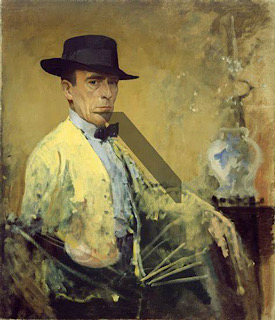
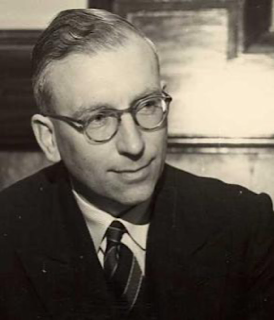
Death of Leo Whelan, Portrait & Genre Painter

(Michael) Leo Whelan, portrait and genre painter, dies from leukemia on November 6, 1956, at the Mater private nursing home in Dublin.

Whelan is born on January 17, 1892, at 20 St. George’s Villas, Fairview, Dublin, one of two sons and three daughters of Maurice Whelan, a draper, of County Kerry ancestry, and Mary Whelan (née Cruise), from County Roscommon. The family subsequently moves to 65 Eccles Street, where his parents operated a small hotel. Educated at Belvedere College, Dublin, he then attends the Dublin Metropolitan School of Art (DMSA) (1908–14), where he is a student of William Orpen, who has a huge influence on his artistic style. His fellow students at the school include Patrick Tuohy and Séan Keating.

Whelan is awarded many prizes in the Royal Dublin Society (RDS) Taylor art competitions, including one in 1912 for a portrait of his sister Lena, entitled On the Moors, rendered in a strongly academic technique. In 1916, he wins the Taylor scholarship for the Royal Hibernian Academy (RHA) schools for his finest early work, The Doctor’s Visit, an adroitly executed composition of contrasting shadows and light. Typical of many of his genre interiors, the painting depicts a room in the family home, with relatives as models: Whelan’s mother sits by the bed watching over his ill cousin, while his sister, dressed in a Mater hospital nurse’s uniform, is in the background opening the door for the doctor. The subtly evoked atmosphere of restrained emotion foreshadowed a hallmark of his mature style.

Whelan exhibits annually at the RHA for forty-five years (1911–56), averaging six works per year. He is elected an RHA associate in 1920, becoming a full member in 1924. He participates in the Exposition d’art irlandais at the Galerie Barbazanges in Paris in 1922. A visiting teacher at the RHA schools in 1924, he also teaches in the DMSA for a time. He has studios at 64 Dawson Street (1914–27) and 7 Lower Baggot Street (1931–56). Beginning in the 1910s, he receives regular commissions for portraits, constituting his primary source of income. Having become the family’s main breadwinner following his parents’ deaths in the 1920s, he concentrates most of his production on this lucrative activity, portraying numerous leading figures in the spheres of politics, academia, religion, society, medicine, and law.

Coming from a family of militant nationalist sympathies, in 1922 he begins a large group portrait, GHQ Staff of the Pre-Treaty IRA, including Michael CollinsRichard MulcahyRory O’ConnorLiam Mellows and nine others, composed from individual studies of the men rendered during clandestine sittings in his home and studio. The painting, which he leaves unfinished, is in McKee Barracks, Dublin. He receives special praise for his portraits of John Henry Bernard, Provost of Trinity College Dublin (TCD) and of Louis Claude Purser, TCD vice-provost. The latter is awarded a medal at the 1926 Tailteann Games. He exhibits seventeen paintings at the Royal Society of Portrait Painters, London, of which he is a member, and shows two works at the Royal Academy of Arts, London. His 1929 portrait of John McCormack, one of his major patrons, is presented by the tenor’s family some fifty years later to the National Concert Hall, Dublin.

Situated securely in the academic tradition, in most of his portraits Whelan favours a sombre, restricted palette, with the sitter placed, in grave demeanour, against a monotone background with few accessories. In a 1943 interview he asserts that twentieth-century portraiture suffers from the drabness of modern costume, for which the artist must compensate by careful rendition of the subject’s hands. He tends to depart from his prevailing portrait style when painting women, whom he characteristically depicts in meticulously observed interiors, a notable example being his portrait of Society hostess Gladys Maccabe (c.1946; NGI).

Whelan’s commercial concentration on portraiture notwithstanding, he expresses his true talent in genre compositions, especially kitchen interiors, in which he emulates the technique of the Dutch painter Johannes Vermeer. Two of the most accomplished of these depict his sister Frances in the basement kitchen of the family home: The Kitchen Window (1927; Crawford Art Gallery, Cork) demonstrates a particularly skillful use of light, while Interior of a Kitchen (1935) is notable for the dexterous handling of objects of varied shapes and textures. His genre works include both urban and rural scenes, with a distinctive interest in portraying occupations and other activities. Gypsy (1923), an Orpenesque composition of a shawled woman in a west-of-Ireland landscape with a caravan in the background, receives wide contemporary critical acclaim. Jer (c.1925), depicting a man seated by the fire in a cottage interior, is reproduced in J. Crampton Walker’s Irish Art and Landscape (1927). The Fiddler (c.1932), a naturalistic, sensitively characterised study, is first shown at an Ulster Academy exhibition at Stranmillis, Belfast. A Kerry Cobbler is reproduced in Twelve Irish Artists (1940), introduced by Thomas Bodkin, as among the works denoting the development of a distinctively Irish school of painting.

In 1929, Whelan designs the first Irish Free State commemorative stamp, a portrait of Daniel O’Connell for the centenary of Catholic emancipation. Commissioned by the Thomas Haverty trust to paint an incident from the life of Saint Patrick for the 1932 Eucharistic Congress, he executes The Baptism by St. Patrick of Ethna the Fair and Fedelmia the Ruddy, Daughters of the Ard Rí Laoghaire, a work highly conservative in style. He rapidly completes an oil study of the papal legate, Lorenzo Lauri, also for the Eucharistic Congress. He is represented in the art competitions at the 1932 Summer Olympics in Los Angeles. His depiction of Saint Brigid, shown at the Academy of Christian Art exhibition (1940), becomes a familiar image owing to the wide circulation of reproductions.

Whelan’s political portraits are influential in creating a strong, assured image of the newly formed Irish state, and thus retain an historical significance. His posthumous portrait, The Late General Michael Collins, exhibited at the RHA in 1943 and now held in Leinster House, is an iconic, heroic image of the fallen leader. His portraits of Arthur Griffith and Kevin O’Higgins – commissioned posthumously, as is the Collins, by Fine Gael – also hang in Leinster House, while that of John A. Costello, exhibited at the RHA in 1949, is now held in the King’s Inns, Dublin. He paints two presidents, Douglas Hyde and Seán T. O’Kelly, both works currently in Áras an Uachtaráin. A portrait of Éamon de Valera, painted in 1955 when the sitter is Leader of the Opposition, is in Leinster House. In 1954, he designs a second commemorative stamp, picturing a reproduction of a portrait bust of John Henry Newman, to mark the centenary of the Catholic University of Ireland.

Whelan is elected an honorary academician of both the Ulster Academy of Arts (1931), and the Royal Ulster Academy (1950). He becomes a member of the United Arts Club in 1934. As a representative of the RHA, he sits on the board of governors of the National Gallery of Ireland for many years, and is on the advisory committee of the Municipal Gallery of Modern Art. Unmarried, he resides until his death at the Eccles Street address, with two sisters who continue to manage the family hotel. He dies on November 6, 1956, from leukemia at the Mater private nursing home in Dublin. He is buried in Glasnevin Cemetery.

(From: “Whelan, (Michael) Leo,” by Carmel Doyle, Dictionary of Irish Biography, http://www.dib.ie, October 2009)


Leave a comment

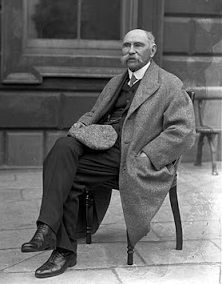
Death of Dr. Douglas Hyde, First President of Ireland

Dr. Douglas Hyde, Gaelic scholar and the first President of Ireland, dies in Dublin on July 12, 1949, at the age of 89.

Hyde is born at Longford House in Castlerea, County Roscommon, on January 17, 1860. In 1867, his father is appointed prebendary and rector of Tibohine, and the family moves to neighbouring Frenchpark, in County Roscommon. He is home schooled by his father and his aunt due to a childhood illness. While a young man, he becomes fascinated with hearing the old people in the locality speak the Irish language.

Rejecting family pressure to follow previous generations with a career in the Church, Hyde instead becomes an academic. He enters Trinity College, Dublin (TCD), where he gains a great facility for languages, learning Latin, Greek, Hebrew, French, and German, but his great passion in life is the preservation of the Irish language.

After spending a year teaching modern languages in Canada, Hyde returns to Ireland. For much of the rest of his life he writes and collects hundreds of stories, poems, and folktales in Irish, and translates others. His work in Irish helps to inspire many other literary writers, such as W. B. Yeats and Lady Gregory.

In 1892, Hyde helps establish the Gaelic Journal and in November of that year writes a manifesto called The necessity for de-anglicising the Irish nation, arguing that Ireland should follow her own traditions in language, literature, and even in dress.

In 1893, Hyde founds the Gaelic League (Conradh na Gaeilge) along with Eoin MacNeill and Fr. Eugene O’Growney and serves as its first president. Many of the new generation of Irish leaders who play a central role in the fight for Irish independence in the early twentieth century, including Patrick PearseÉamon de ValeraMichael Collins, and Ernest Blythe first become politicised and passionate about Irish independence through their involvement in the Gaelic League. Hyde does not want the Gaelic League to be a political entity, so when the surge of Irish nationalism that the Gaelic League helps to foster begins to take control of many in the League and politicize it in 1915, Hyde resigns as president.

Hyde takes no active part in the armed upheaval of the 1910s and 1920s, but does serve in Seanad Éireann, the upper house of the Irish Free State’s Oireachtas, as a Free State senator in 1925-26. He then returns to academia, as Professor of Irish at University College Dublin (UCD), where one of his students is future Attorney General and President of Ireland Cearbhall Ó Dálaigh.

In 1938, Hyde is unanimously elected to the newly created position of President of Ireland, a post he holds until 1945. Hyde is inaugurated on June 26, 1938, in the first inaugural ceremony in the nation’s history. Despite being placed in a position to shape the office of the presidency via precedent, Hyde by and large opts for a quiet, conservative interpretation of the office. In April 1940, he suffers a massive stroke and plans are made for his lying in state and state funeral, but to the surprise of everyone he survives, albeit paralysed and confined to a wheelchair. One of his last presidential acts is a visit to the German ambassador Eduard Hempel on May 3, 1945, to offer his condolences on the death of Adolf Hitler, a visit which remains a secret until 2005.

Hyde leaves office on June 25, 1945, opting not to nominate himself for a second term. He opts not return to his Roscommon home due to his ill-health, but rather moves into the former Secretary to the Lord Lieutenant’s residence in the grounds of Áras an Uachtaráin, where he lived out the remaining four years of his life.

Hyde dies in Dublin on July 12, 1949, at age 89. As a former President of Ireland he is accorded a state funeral which, as a member of the Church of Ireland, takes place in Dublin’s St. Patrick’s Cathedral. Since contemporary rules of the Roman Catholic Church in Ireland at the time prohibit Roman Catholics from attending services in non-Catholic churches, all but one member of the Catholic cabinet remain outside the cathedral grounds while Hyde’s funeral takes place. Hyde is buried in Frenchpark, County Roscommon at Portahard Church.


Leave a comment

Birth of Catherine O’Brien, Irish Stained Glass Artist

Catherine Amelia “Kitty” O’Brien, Irish stained glass artist and a member and director of An Túr Gloine, is born in Durra House, Spancill Hill, County Clare, on June 19, 1881.

O’Brien is one of five children of Pierce O’Brien, a gentleman landowner, and Sophia Angel St John O’Brien. Her first cousin is woodcarver Sophia St John Whitty. She attends the Mercy Convent in Ennis, going on to win a scholarship to the Dublin Metropolitan School of Art. While there she studies under William Orpen and Alfred E. Child who teach her the art of stained glass.

Among O’Brien’s first commissions is the St. Ita window for St. Brendan’s cathedral in Loughrea, County Galway, in 1904, which is designed by Sarah Purser. She joins An Túr Gloine in 1906, beginning her career there by designing Angel of the Annunciation window in the Enniskillen convent chapel. For a window in the Wilson private chapel at Coolcarrigan House, NaasCounty Kildare, in 1912, she incorporates Celtic design, some drawing on the Book of Durrow. In 1914, she tours the cathedrals of ParisRouen, and Chartres with Purser and Wilhelmina Geddes. She designs three windows depicting St. John, St. Flannan, and St. Munchin, for the Honan Chapel at University College Cork in 1916. Her 1923 design of the centenary memorial window in St. Andrew’s church, Lucan, represents the parable of the Good Shepherd. When in 1925 An Túr Gloine becomes a cooperative society, she becomes a shareholder along with Ethel RhindEvie Hone, and Michael Healy.

O’Brien’s 1926 lunette The Spirit of Night represents night, twilight, and dawn, and is for the private home of Keng Chee in Singapore, which is later demolished. The window of St. Catherine of Siena for the Sacred Heart convent chapel in Newton, Massachusetts dates from 1927. Her 1931 St. Patrick window, for the De La Salle school, East Coast Rd., Singapore, commissioned by architect Denis Santry, is the only extant stained-glass work by an Irish artist in that country. Much like Rhind, O’Brien also employs opus sectile, such as in her 1936 Mass in Penal Days in the Franciscan friary, AthloneCounty Westmeath. She contributes two windows, Pelican and Lamb and Host and Chalice: Wheat and Grapes, to the ten windows An Túr Gloine produces for Brophy College ChapelPhoenix, Arizona in 1937. From 1937 until 1947, she works on 22 opus sectile panels for the Protestant Church in Ennis.

Purser retires from An Túr Gloine in 1940, and O’Brien succeeds her as director, going on to purchase it and the contents in 1944. She rents a section of the premises to fellow stained-glass artist Patrick Pollen from 1954 onwards. She exhibits at the 1953 Irish Exhibition of Living Art, and the 1958 exhibition of the Arts and Crafts Society of Ireland. When the An Túr Gloine studios are damaged by fire in 1958, she rebuilds them and reopens by 1959. She is an active member of the Soroptimists and the Guild of Irish Art Workers. The last work she completes is a three-light window for the Church of St. MultoseKinsale, County Cork, in 1962. A commission for two windows for the private chapel of Áras an Uachtaráin for President Éamon de Valera is left unfinished at her death.

O’Brien dies in Dublin on July 18, 1963, and is buried in Whitechurch Parish Graveyard, County Dublin. She is commemorated in a window designed by Pollen in St. Laurence O’Toole chapel, Christ Church Cathedral, Dublin, where for forty years she made floral arrangements. Over 150 of her An Túr Gloine drawings from notebooks are now in the National Gallery of Ireland.

(Pictured: Stained glass window in the south wall of Ferns Cathedral, Ferns, County Wexford)


Leave a comment

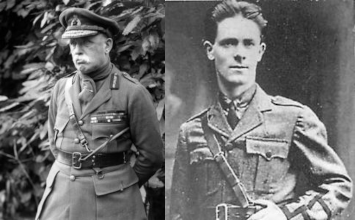
Attempted Assassination of Sir John French

The Irish Republican Army (IRA) attempts to assassinate British General John French, Lord Lieutenant of Ireland, in his car at Phoenix Park, Dublin, on December 19, 1919. French is unhurt, but one IRA Volunteer, Martin Savage, is killed. IRA volunteer Dan Breen and two Dublin Metropolitan Police (DMP) men and a driver are wounded. A Royal Irish Constabulary (RIC) sergeant is knocked unconscious.

On a cold December day in 1919, a group of young IRA volunteers wait at a public house near the Ashtown gate of Dublin’s Phoenix Park. Some are from Dublin, members of Michael Collins’ recently created assassination unit, the Squad. Others are from farther afield, like Dan Breen and Seán Treacy from County Tipperary and Martin Savage from County Sligo.

They are waiting for Sir John French, Lord Lieutenant of Ireland, the most senior British official in the land. He is returning from a visit to the west of Ireland and has alighted at Ashtown train station before returning by car to his official residence, the Viceregal Lodge, in the Phoenix Park.

The IRA men have a signaler in a tree and when French’s car approaches, they attempt to block the road with a farm cart. However, they are too late to block the Lord Lieutenant’s car which sweeps through the impromptu barricade. Shots are fired and one policeman is wounded but French himself emerges unscathed.

A second car, which the IRA believes to contain French, bears the brunt of the volunteers’ revolver fire and grenades. Though the car is badly damaged, there are no casualties.

The third car in the convoy contains French’s military escort and the soldiers inside the vehicle return fire, killing one of the attackers, Martin Savage. Some of the volunteers attempt to recover his body but the Crown forces’ fire is too heavy. Savage’s body is left on the scene as the IRA party flees on bicycles back to the city.

The Irish Times, for one, expresses outrage at the attack, “the attempted assassination of the greatest of Irishmen” which it says will “shock Ireland” and force Sinn Féin, victorious in the election of the previous year, to reflect on whether it wants to be associated with “outrage and assassination.” “There will now be many throughout the world ready to attribute the character of a murder society to the whole new Irish movement.”

But some, even British Prime Minister David Lloyd George, are surprisingly unsympathetic. “They are bad shots” is his only remark on hearing of the attack.

Many in Ireland are even less sympathetic to hear of the escape of the Lord Lieutenant. The Irish Catholic bishops issue a statement the next day condemning not the attack but British rule in Ireland, which they characterise as “rule of the sword, utterly unsuited to a civilised nation.”

The attack is, in hindsight, a turning point, moving the standoff over Irish independence toward all out guerrilla warfare, but also, in a way, symbolising the eclipse of French and of his vision for what the country should be.

Sir John French’s health declines in 1920 and though he holds the position of Lord Lieutenant until April 1921, his central role in Irish affairs is eclipsed by new Chief Secretary for Ireland Sir Hamar Greenwood. He wants to retire to his estates in Ireland in 1922 but is told it is simply too dangerous for him. During the Irish Civil War (1922-23), his country house at Drumdoe, County Roscommon, is raided by armed men who carry off much of the furniture.

French dies from cancer of the bladder at Deal Castle in Deal, Kent, England, on May 22, 1925.

(From: “Today in Irish History: 19 December 1919, The Attempted Assassination of Sir John French” by John Dorney, The Irish Story, http://www.theirishstory.com, December 18,2019 | Pictured: L to R, Sir John French and Martin Savage)


Leave a comment

Gorbachev Samples Pint of Guinness During Ireland Visit

Former Soviet leader Mikhail Gorbachev samples a pint of Guinness with Lord Mayor of Dublin Michael Mulcahy in the famous Doheny & Nesbitt pub in Baggot Street, Dublin, on Tuesday, January 8, 2002.

Gorbachev arrives in Dublin earlier in the day for a two-day visit to the Republic of Ireland. He attends a series of events in Dublin where he meets the President of Ireland, Mary McAleese, and is granted the Freedom of the City of Dublin.

Gorbachev, the man who led Russia through the most difficult days of his country’s shift to democracy, is also conferred with an honorary degree. On his arrival he goes to Trinity College Dublin to receive the honour before launching the new European Russian Trust. He later dines as a guest of the Irish Government in Dublin Castle.

On the following day, Gorbachev is accompanied by Dublin’s Lord Mayor Michael Mulcahy during a visit to see members of the city’s Russian community at the Hugh Lane Gallery. He also chats with local shop owners and residents during an informal tour of The Liberties area. After addressing the Institute of European Affairs and lunching with President McAleese at Áras an Uachtaráin, the president’s official residence and principal workplace, he is granted freedom of the Irish capital at a special ceremony.

Following his visit with President McAleese, Gorbachev jokes with Mulcahy that he fully intends to exercise his right to graze sheep in the city. Mulcahy says, “This visit will help to cement relations between us, as well as doing appropriate honour to a genuinely great man whose place in history is already secure.”

Gorbachev formally announced his resignation as Soviet President and Commander-in-Chief on December 25, 1991. The following day, the Soviet of the Republics, the upper house of the Supreme Soviet of the Soviet Union, formally voted the Soviet Union out of existence. The Soviet Union officially ceased to exist at midnight on December 31, 1991. As of that date, all Soviet institutions that had not been taken over by Russia ceased to function.

(Pictured: Mikhail Gorbachev samples a pint of Guinness watched by Dublin’s Lord Mayor Michael Mulcahy, in Doheny & Nesbitt’s pub in Merrion Row. Picture by Donal Doherty)


Leave a comment

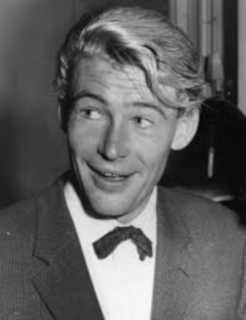
Death of Stage & Film Actor Peter Seamus O’Toole

Peter Seamus O’Toole, British stage and film actor of Irish descent, dies on December 14, 2013, at Wellington Hospital in St. John’s Wood, London, at the age of 81.

O’Toole is born on August 2, 1932, in Leeds, Yorkshire, England. Some sources give his birthplace as Connemara, County Galway. Records from the General Register Office in Leeds confirm that O’Toole is born in the north England town in 1932. He is educated at the Royal Academy of Dramatic Art in London. He is a reporter for the Yorkshire Evening Post in his teens and makes his amateur stage debut at Leeds Civic Theatre. After serving two years in the Royal Navy, he acts with the Bristol Old Vic Company from 1955 to 1958 and makes his London debut as Peter Shirley in George Bernard Shaw’s Major Barbara (1956). He appears with the Shakespeare Memorial Company at Stratford-upon-Avon, Warwickshire, England, in 1960 in highly praised performances as Shylock in The Merchant of Venice and as Petruchio in The Taming of the Shrew, and he plays the lead in Hamlet for the inaugural production of the Royal National Theatre in London in 1963. A prominent film star by this point in his career, he continues to appear on stages throughout the world to great acclaim. He is named associate director of the Old Vic in 1980.

O’Toole makes his motion picture debut in Kidnapped in 1960 and two years later becomes an international star for his portrayal of T.E. Lawrence in David Lean’s epic Lawrence of Arabia (1962). In 1964 he plays Henry II of England in Becket, and he has the title role in Lord Jim (1965). He appears as Henry II again in The Lion in Winter (1968), a film notable for the witty verbal sparring matches between O’Toole and costar Katharine Hepburn. The Ruling Class (1972), a controversial black comedy that has become a cult classic, casts O’Toole as a schizophrenic English earl with a messiah complex.

Personal problems contribute to a decline in his popularity during the 1970s, but he makes a strong comeback in the early 1980s with three well-received efforts. He portrays a duplicitous and domineering movie director in The Stunt Man (1980), and his performance as the Roman commander Lucius Flavius Silva in the acclaimed television miniseries Masada (1981) is hailed as one of the finest of his career. His most popular vehicle during this period is My Favorite Year (1982), an affectionate satire on the early days of television, in which he plays Alan Swann, a faded Errol Flynn-type swashbuckling screen star with a penchant for tippling and troublemaking.

O’Toole subsequently maintains his status with fine performances in such films as the Oscar-winning The Last Emperor (1987), the cult favourite Wings of Fame (1989), and Fairy Tale: A True Story (1997), in which he portrays Sir Arthur Conan Doyle. Notable screen roles in the 21st century included King Priam in the historical epic Troy (2004), an aging romantic in Venus (2006), the voice of a haughty food critic in the animated Ratatouille (2007), and a priest in the historical drama For Greater Glory (2012). In addition, in 2008 he portrays Pope Paul III in the TV series The Tudors.

In 1992 O’Toole publishes a lively memoir, Loitering with Intent: The Child. A second volume, Loitering with Intent: The Apprentice, appears in 1996. He is nominated for an Academy Award eight times — for Lawrence of Arabia, Becket, The Lion in Winter, Goodbye, Mr. Chips (1969), The Ruling Class, The Stunt Man, My Favorite Year, and Venus — but never wins. In 2003 he is awarded an honorary Oscar. He receives an Emmy Award for his performance as Bishop Pierre Cauchon in the television miniseries Joan of Arc (1999).

O’Toole dies on December 14, 2013, at Wellington Hospital in St. John’s Wood, London, at the age of 81. His funeral is held at Golders Green Crematorium in London on December 21, 2013, where his body is cremated in a wicker coffin. His ashes are planned to be taken to Connemara, Ireland. They are kept at the residence of the President of Ireland, Áras an Uachtaráin, by President Michael D. Higgins, an old friend of O’Toole. His family has stated their intention to fulfill his wishes and take his ashes to the west of Ireland.


Leave a comment

Taoiseach Enda Kenny Resigns Following Dáil Vote

Taoiseach Enda Kenny conveys his resignation to President Michael D. Higgins at Áras an Uachtaráin on March 10, 2016, after failing to get re-elected to the position in a Dáil vote, becoming acting Taoiseach as the Dáil adjourns until March 22. “It’s not the outcome that I personally would have liked to see but I respect the verdict of the people,” Kenny says. The vote for the former Taoiseach stands at: For 57, Against 94, Abstain 5.

Kenny, the Mayo TD, says the Cabinet will continue its work while the various parties try to form a government. A government statement issued in the evening reads, “The Taoiseach, Mr. Enda Kenny, T.D., has this evening conveyed to the President his resignation from office. In accordance with the Constitution, the Government and the Taoiseach will continue to carry on their duties until successors have been appointed.”

Kenny, Micheál Martin of Fianna Fáil, Gerry Adams of Sinn Féin and Richard Boyd Barrett of Anti-Austerity Alliance-People Before Profit (AAA-PBP) are all nominated for the position of Taoiseach but fail to secure enough votes.

Kenny cites the upcoming commemorations of the 1916 Easter Rising and his Saint Patrick’s Day visit to Washington, D.C. as two items that he will continue to take part in. In the medium term he says a government is necessary to deal with the impending Brexit referendum in the UK and issues such as climate change.

Kenny says when Fine Gael and the Labour Party entered government five years earlier “our very survival was in doubt.” He adds, “The Government had to face unprecedented sets of difficulties. Many believed the situation was hopeless. The country is in a different place now.”

The outgoing Taoiseach says he is “fully committed” to working with other parties and independents to form a new government. He adds that “a substantial number of people do not want to serve in government.” Fianna Fáil leader Micheál Martin says the situation is not unprecedented and people should put aside the notion that “speed” is an issue in forming a government. “Ireland is relatively unusual in how fast it carries out the formation of government,” he says.

A total of 50 Fine Gael TDs are re-elected to the 32nd Dáil. The five abstentions in the Enda Kenny vote are TDs Michael Harty, Noel Grealish, Denis Naughten, Michael Collins and Mattie McGrath. They say they will abstain on each vote for Taoiseach in an indication they are willing to hold further coalition talks.

The vote for the other nominees are:
Fianna Fáil leader Micheál Martin: For 43, Against 108, 5 Abstain.
Sinn Féin leader Gerry Adams: For 24, Against 116.
AAA-PBP candidate Richard Boyd Barrett: For 9, Against 111.

(From: “Enda Kenny resigns as Taoiseach after failing to get re-elected as leader” by Kevin Doyle and Niall O’Connor, http://www.independent.ie, March 10, 2016)


Leave a comment

Birth of Peter O’Toole, Stage & Film Actor

peter-o-toole

Peter Seamus O’Toole, British stage and film actor of Irish descent, is born on August 2, 1932, in Leeds, Yorkshire, England. Some sources give his birthplace as Connemara, County Galway. Records from the General Registry Office in Leeds confirm that O’Toole is born in the north England town in 1932.

O’Toole grows up in Leeds and is educated at the Royal Academy of Dramatic Art in London. He is a reporter for the Yorkshire Evening Post in his teens and makes his amateur stage debut at Leeds Civic Theatre. After serving two years in the Royal Navy, he acts with the Bristol Old Vic Company from 1955 to 1958 and makes his London debut as Peter Shirley in George Bernard Shaw’s Major Barbara (1956). He appears with the Shakespeare Memorial Company at Stratford-upon-Avon, Warwickshire, England, in 1960 in highly praised performances as Shylock in The Merchant of Venice and as Petruchio in The Taming of the Shrew, and he plays the lead in Hamlet for the inaugural production of the Royal National Theatre in London in 1963. A prominent film star by this point in his career, he continues to appear on stages throughout the world to great acclaim. He is named associate director of the Old Vic in 1980.

O’Toole makes his motion picture debut in Kidnapped in 1960 and two years later becomes an international star for his portrayal of T.E. Lawrence in David Lean’s epic Lawrence of Arabia (1962). In 1964 he plays Henry II of England in Becket, and he has the title role in Lord Jim (1965). He appears as Henry II again in The Lion in Winter (1968), a film notable for the witty verbal sparring matches between O’Toole and costar Katharine Hepburn. The Ruling Class (1972), a controversial black comedy that has become a cult classic, casts O’Toole as a schizophrenic English earl with a messiah complex.

Personal problems contribute to a decline in his popularity during the 1970s, but he makes a strong comeback in the early 1980s with three well-received efforts. He portrays a duplicitous and domineering movie director in The Stunt Man (1980), and his performance as the Roman commander Lucius Flavius Silva in the acclaimed television miniseries Masada (1981) is hailed as one of the finest of his career. His most popular vehicle during this period is My Favorite Year (1982), an affectionate satire on the early days of television, in which he plays Alan Swann, a faded Errol Flynn-type swashbuckling screen star with a penchant for tippling and troublemaking.

O’Toole subsequently maintains his status with fine performances in such films as the Oscar-winning The Last Emperor (1987), the cult favourite Wings of Fame (1989), and Fairy Tale: A True Story (1997), in which he portrays Sir Arthur Conan Doyle. Notable screen roles in the 21st century included King Priam in the historical epic Troy (2004), an aging romantic in Venus (2006), the voice of a haughty food critic in the animated Ratatouille (2007), and a priest in the historical drama For Greater Glory (2012). In addition, in 2008 he portrays Pope Paul III in the TV series The Tudors.

In 1992 O’Toole publishes a lively memoir, Loitering with Intent: The Child. A second volume, Loitering with Intent: The Apprentice, appears in 1996. He is nominated for an Academy Award eight times — for Lawrence of Arabia, Becket, The Lion in Winter, Goodbye, Mr. Chips (1969), The Ruling Class, The Stunt Man, My Favorite Year, and Venus — but never wins. In 2003 he is awarded an honorary Oscar. He receives an Emmy Award for his performance as Bishop Pierre Cauchon in the television miniseries Joan of Arc (1999).

O’Toole dies on December 14, 2013, at Wellington Hospital in St. John’s Wood, London, at the age of 81. His funeral is held at Golders Green Crematorium in London on December 21, 2013, where his body is cremated in a wicker coffin. His ashes are planned to be taken to Connemara, Ireland. They are being kept at the residence of the President of Ireland, Áras an Uachtaráin, by President Michael D. Higgins, an old friend of O’Toole. His family has stated their intention to fulfill his wishes and take his ashes to the west of Ireland.


Leave a comment

Douglas Hyde Inaugurated First President of Ireland

douglas-hyde

Dr. Douglas Hyde, Gaelic scholar from County Roscommon, is inaugurated as the first President of Ireland on June 25, 1938.

Hyde is born at Longford House in Castlerea, County Roscommon, on January 17, 1860. In 1867, his father is appointed prebendary and rector of Tibohine, and the family moves to neighbouring Frenchpark, in County Roscommon. He is home schooled by his father and his aunt due to a childhood illness. While a young man, he becomes fascinated with hearing the old people in the locality speak the Irish language.

Rejecting family pressure to follow previous generations with a career in the Church, Hyde instead becomes an academic. He enters Trinity College, Dublin, where he gains a great facility for languages, learning Latin, Greek, Hebrew, French, and German, but his great passion in life is the preservation of the Irish language.

After spending a year teaching modern languages in Canada, Hyde returns to Ireland. For much of the rest of his life he writes and collects hundreds of stories, poems, and folktales in Irish, and translates others. His work in Irish helps to inspire many other literary writers, such as W.B. Yeats and Lady Gregory.

In 1892, Hyde helps establish the Gaelic Journal and in November of that year writes a manifesto called The necessity for de-anglicising the Irish nation, arguing that Ireland should follow her own traditions in language, literature, and even in dress.

In 1893, Hyde founds the Gaelic League (Conradh na Gaeilge) along with Eoin MacNeill and Fr. Eugene O’Growney and serves as its first president. Many of the new generation of Irish leaders who play a central role in the fight for Irish independence in the early twentieth century, including Patrick Pearse, Éamon de Valera, Michael Collins, and Ernest Blythe first become politicised and passionate about Irish independence through their involvement in the Gaelic League. Hyde does not want the Gaelic League to be a political entity, so when the surge of Irish nationalism that the Gaelic League helps to foster begins to take control of many in the League and politicize it in 1915, Hyde resigns as president.

Hyde takes no active part in the armed upheaval of the 1910s and 1920s, but does serve in Seanad Éireann, the upper house of the Irish Free State‘s Oireachtas, as a Free State senator in 1925-26. He then returns to academia, as Professor of Irish at University College Dublin, where one of his students is future Attorney General and President of Ireland Cearbhall Ó Dálaigh.

In 1938, Hyde is unanimously elected to the newly created position of President of Ireland, a post he holds until 1945. He is inaugurated on June 26, 1938, in the first inaugural ceremony in the nation’s history. He sets a precedent by reciting the Presidential Declaration of Office in Irish. His recitation, in Roscommon Irish, is one of a few recordings of a dialect of which Hyde is one of the last speakers. Upon inauguration, he moves into the long vacant Viceregal Lodge in Phoenix Park, since known as Áras an Uachtaráin.

Hyde’s selection and inauguration receive worldwide media attention and is covered by newspapers in Australia, New Zealand, South Africa, Argentina, and Egypt. Adolf Hitler “orders” the Berlin newspapers “to splash” on the Irish presidential installation ceremony. However, the British government ignores the event. The Northern Ireland Finance Minister, John Miller Andrews, described Hyde’s inauguration as a “slight on the King” and “a deplorable tragedy.”

Despite being placed in a position to shape the office of the presidency via precedent, Hyde by and large opts for a quiet, conservative interpretation of the office.

In April 1940 Hyde suffers a massive stroke and plans are made for his lying-in-state and state funeral, but to the surprise of everyone he survives, albeit paralysed and confined to a wheelchair. One of Hyde’s last presidential acts is a visit to the German ambassador Eduard Hempel on May 3, 1945, to offer his condolences on the death of Adolf Hitler, a visit which remains a secret until 2005.

Hyde leaves office on June 25, 1945, opting not to nominate himself for a second term. He opts not return to his Roscommon home due to his ill-health but rather moves into the former Secretary to the Lord Lieutenant’s residence in the grounds of Áras an Uachtaráin, where he lived out the remaining four years of his life.

Hyde dies in Dublin on July 12, 1949, at age 89. As a former President of Ireland, he is accorded a state funeral which, as a member of the Church of Ireland, takes place in Dublin’s Church of Ireland St. Patrick’s Cathedral. Since contemporary rules of the Roman Catholic Church in Ireland at the time prohibit Roman Catholics from attending services in non-Catholic churches, all but one member of the Catholic cabinet remains outside the cathedral grounds while Hyde’s funeral takes place. Hyde is buried in Frenchpark, County Roscommon at Portahard Church.


Leave a comment

Resignation of Taoiseach Enda Kenny

varadkar-kenny

Enda Kenny formally resigns as Taoiseach on June 13, 2017, after six years as head of Government of Ireland. He is the longest-serving Fine Gael Taoiseach and the first in his party to serve two consecutive terms in the highest political office.

An emotional Kenny makes his final address to Dáil Éireann as Taoiseach, saying he is the first to acknowledge that he had not gotten everything right. “But I can honestly say my motivation was always what I believed was in the best interests of the Irish people,” he added. “I really do believe politics is work worth doing, a noble profession.”

Flanked by Tánaiste Frances Fitzgerald, Minister for Finance Michael Noonan, his successor Leo Varadkar, Minister for Housing Simon Coveney and Minister for Health Simon Harris, Kenny informs the Dáil that he will be going later to Áras an Uachtaráin to submit his resignation to President Michael D. Higgins. He formally submits his letter that evening.

Following his speech in the Dáil, Kenny sits down, visibly emotional, to applause from all sides of the House.

Fianna Fáil leader Micheál Martin describes Kenny as “an Irish patriot and an Irish democrat.” Throughout his time in elected office and in government he had been a proud representative of his community, political tradition and country. He adds that “the mischievous enjoyment he has taken in this has been a genuine joy to behold”.

Sinn Féin leader Gerry Adams says his party and Fine Gael do not agree on many issues but “I always found Enda to be friendly on a personal level. Probably the best leader Fine Gael ever had.” Adams adds, “Let me say I will miss you. I will miss your entertaining tales of meetings you have had and meetings you have not had and recollections of people you have met along the way, like the man with the two pints in one hand.”

Adams says there have been successes including the success of the same-sex marriage referendum. But he also says there have been abject failures, including the Taoiseach’s consistent failure to recognise the State of Palestine, the squandering of the biggest mandate in the history of the State as the Fine Gael-Labour Government reneged on election promises, the clear lack of affinity with Northern Ireland and a clear lack of consistent strategic engagement with the process of change that is under way on the island.

Kenny now becomes a party backbencher until the next general election when he is expected to retire as a Teachta Dála (TD). He is also father of the House as the longest serving TD with 42 years in the Dáil. He is first elected in 1975 in a by-election following the death of his father Henry and faces another 12 elections in his Dáil tenure.

Kenny serves three years as a cabinet minister, serving as Minister for Tourism and Trade during the 1994 to 1997 Rainbow Coalition. He also serves for a year as Minister of State for Youth Affairs from February 1986 to March 1987. He takes over from Michael Noonan as party leader in 2002 after a disastrous general election for the party and in 2007 the party’s numbers in the Dáil rise from 32 to 51 TDs. In the 2011 general election at the height of the economic recession, Fine Gael secures 76 seats, the most in the party’s history, under his leadership.

(From: “Enda Kenny steps down as Taoiseach” by Michael O’Regan and Marie O’Halloran, The Irish Times, June 13, 2017)