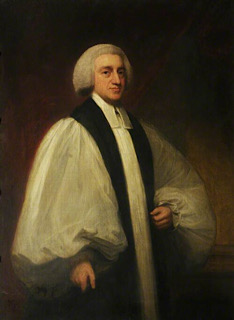
Agar is known to have held particularly marked Calvinistic positions. He serves as Dean of Kilmore from 1765 to 1768, and then as Bishop of Cloyne until 1779.
In 1794, Agar is raised to the Peerage of Ireland as Baron Somerton. In 1801, he is translated to become Archbishop of Dublin and is created Viscount Somerton. In 1806, he is further honoured when he is made Earl of Normanton. These titles are all in the Peerage of Ireland. He remains as Archbishop of Dublin until his death in 1809, and from the beginning of 1801 onward, sits in the House of Lords as one of the twenty-eight original Irish representative peer, following the Acts of Union 1800 which unites Ireland and Great Britain.
Agar dies on July 14, 1809, aged 72, and is succeeded in his secular titles by his son Welbore Ellis Agar. He is buried in the north transept of Westminster Abbey. His widow Jane, Countess of Normanton, is buried alongside him following her death in 1826. His tomb dates from 1815 and is created by John Bacon.
Butler is born c. 1467, the third son of James Butler and Sabh Kavanagh. His father is Lord Deputy of Ireland, Lord of the Manor of Advowson of Callan (1438–87). His father’s family is the Polestown cadet branch of the Butler dynasty that started with Sir Richard Butler of Polestown, second son of James Butler, 3rd Earl of Ormond. His mother, whose first name is variously given as Sabh, Sadhbh, Saiv, or Sabina, is a princess of Leinster, eldest daughter of Donal Reagh Kavanagh, MacMurrough (1396–1476), King of Leinster.
In 1485, Butler marries Lady Margaret FitzGerald, daughter of Gerald FitzGerald, 8th Earl of Kildare and Alison FitzEustace. The marriage is political, arranged with the purpose of healing the breach between the two families. In the early years of their marriage, Margaret and her husband are reduced to penury by James Dubh Butler, a nephew, heir to the earldom and agent of the absentee Thomas Butler, 7th Earl of Ormond, who resides in England. Butler retaliates by murdering James Dubh in an ambush in 1497. He is pardoned for his crime on February 22, 1498.
Butler and Margaret have three sons: James (1496–1546), also called “the Lame,” who succeeds him as the 9th Earl, Richard (1500–1571), who becomes the 1st Viscount Mountgarret, and Thomas, who is slain by Dermoid Mac Shane, MacGillaPatrick of Upper Ossory, and six daughters: Margaret, Catherine (1506–53), Joan (born 1528), married James Butler, 10th Baron Dunboyne, Ellice (1481–1530), Eleanor, married Thomas Butler, 1st Baron Cahir, and Helen, also called Ellen (1523–97), married Donough O’Brien, 2nd Earl of Thomond.
Butler also has an illegitimate son, Edmund Butler, who becomes Archbishop of Cashel and conforms to the established religion in 1539.
During the prolonged absence from Ireland of the earls, Butler’s father lays claim to the Ormond land and titles. This precipitates a crisis in the Ormond succession when the seventh earl later dies without a male heir. On March 20, 1489, King Henry VII appoints him High Sheriff of County Kilkenny. He is knighted before September 1497. The following year (1498) he seizes Kilkenny Castle and with his wife, the dynamic daughter of the Earl of Kildare, likely improve the living accommodations there. On February 28, 1498, he receives a pardon for crimes committed in Ireland, including the murder of James Ormonde, heir to the 7th Earl. He is also made Seneschal of the Liberty of Tipperary on June 21, 1505, succeeding his distant relation, James Butler, 9th Baron Dunboyne.
One of the heirs general to the Ormond inheritance is Thomas Boleyn, whose mother is Lady Margaret Butler, second daughter of the 7th Earl. Thomas Boleyn is the father of Anne, whose star is rising at the court of King Henry VIII. As the king wants the titles of Ormond and Wiltshire for Thomas Boleyn, he induces Butler and his coheirs to resign their claims on February 17, 1528. Aided by the king’s Chancellor, Cardinal Thomas Wolsey, Butler is created Earl of Ossory instead. On February 22, 1538, the earldom of Ormond is restored to him.
His birth into the politically influential Beresford family affords him a degree of opportunity, and he is made a vice-regal chaplain in 1766. Brother of George de la Poer Beresford, 1st Marquess of Waterford, he marries Elizabeth Fitzgibbon, sister of John FitzGibbon, 1st Earl of Clare, on June 16, 1763. They had three sons and five daughters. These connections, however, do not automatically result in his being promoted to bishop, despite reaching episcopal age in 1773, and he spends several years as a well-beneficed rector of Urney in the Diocese of Derry. The Beresford family complains that he has been overlooked for several episcopal vacancies in the 1770s and it is not until 1780 that he is created Doctor of Divinity and consecrated Bishop of Dromore on April 8, 1780. At Dromore he erects a handsome new episcopal residence. On May 21, 1782, he is transferred to the diocese of Ossory and, as bishop there, takes his seat in the Irish parliament and exercises influence over the ecclesiastical borough of St. Canice.
The death of Primate Richard Robinson in 1794 is the stimulus for a reorganisation within the Church of Ireland hierarchy, and Beresford is one of the candidates rumoured to succeed him. However, his familial ties disadvantage him, because the government does not want to favour one Irish “party” over another. He is instead appointed to the vacant archbishopric of Tuam on October 10, 1794. An influential and senior position within the church, it is worth £5,000 per annum, which is more than Archbishop Charles Agar receives for the archbishopric of Cashel and provides him with extensive patronage.
In the late 1790s Beresford regularly attends parliament, particularly in the crucial session of 1799 as the Acts of Union is debated and shares his brother John’s view that a union is the best means of securing the Protestant interest in Ireland.
In the years following the union Beresford gains a temporal peerage, becoming 1st Baron Decies on December 22, 1812. He is an amiable, kind and loquacious individual, and is patron to artists, including Gilbert Stuart, who produces a portrait of him as Bishop of Ossory. His long years of service within the established church also makes him very wealthy, worth £250,000 at the time of his death.
Beresford dies on September 6, 1819, at Tuam, County Galway, and is succeeded in the barony by his eldest surviving son John on September 8, 1819. His eldest son Marcus had died in 1803. His youngest daughter Louisa, widow of Thomas Hope, marries, by special license, her cousin William Carr Beresford on November 29, 1832. Through Louisa he is a grandfather of British MP and patron of the arts, Henry Thomas Hope.
(From: “Beresford, William” by Martin McElroy, Dictionary of Irish Biography, http://www.dib.ie, October 2009, revised June 2024)
Harty is born on August 11, 1867, in Knocknagurteeny, Murroe, County Limerick, the son of Francis Harty and his wife, Johana (née Ryan). He is educated locally and at the Jesuits‘ Crescent College, Limerick. In 1884, he goes to St. Patrick’s College, Thurles, and two years later proceeds to Maynooth College, where he trains for the priesthood. After ordination at Clonliffe College, Dublin, on May 20, 1894, he returns to Maynooth. The following year he is appointed to the chair of philosophy and theology there. However, he defers this for a year while he attends lectures at the Ecclesiastical university in Rome, as one of two professors who has been granted the new privilege of leave of absence on full salary to study abroad.
Back at Maynooth Harty is a prominent member of staff. In 1906, he co-founds the Irish Theological Quarterly, of which he is for many years editor, and is also editor for a time of the Irish Ecclesiastical Record. His contributions to these and other periodicals are numerous and include an essay on the “Sacredness of fetal life” for the Irish Theological Quarterly in 1906. As a founder member of the Maynooth manuscripts publication committee, which runs from 1906 to 1915, he helps oversee the publication of the edition of the Black Book of Limerick (1907) by his colleague James MacCaffrey and of some impressive student publications, including Gadaidhe Géar na Geamh-oidche (1915), a volume of tales from the Fenian cycle from manuscripts in the library. He is appointed senior professor of moral theology but ceases teaching after he is consecrated Archbishop of Cashel on January 18, 1914.
Harty is early involved with the Gaelic Athletic Association – he had been a hurler in his youth – and is a strong supporter of the Irish Parliamentary Party (IPP). In late 1915 he furnishes John Redmond with a letter of support, and a few months later is denouncing the Easter Rising and congratulating the people of Cashel for abstaining from insurrection. Later that year he is involved in a French propaganda drive to boost the war effort in Ireland. As one of the four bishop delegates to the 1917 Irish Convention, he speaks against a Methodist delegate’s call for mixed education. Criticising the Protestant educational system in Belfast, he claims the Catholic church has a right to teach its own children, and effectively closes down the discussion. By April 1918 he has moved toward tacit acceptance of Sinn Féin and is at the forefront of the anti-conscription campaign. In a speech he calls conscription unjust and hypocritical and calls for “every man with a drop of Irish blood in his veins” to sign the protest against it.
On the establishment of the Free State, Harty preaches support for Cumann na nGaedheal, but by the 1930s is closer to Éamon de Valera, and is a strong advocate of protectionism, which he feels will ensure a self-sufficient Ireland of traditional values. In 1933, he applauds the tax set on imported daily papers, as he believes English papers are corrupting the young. At the golden jubilee of the GAA the following year he makes a speech in Cashel calling for Irish industries, Irish music, and Irish dances. As president of the congress committee, he is a key organiser of the massive Eucharistic Congress of 1932. His other great concerns are the foreign missions and the promotion of Catholic literature – he is president of the Catholic Truth Society of Ireland. His practical work for his diocese includes heading a deputation to the minister for agriculture in October 1932 to press Thurles’s claims for the new sugar beet factory. It opens there in December 1934.
Although tall, athletic, and fond of open air, Harty is for many years in poor health and from about 1933 petitions the Holy See for a coadjutor-archbishop. This finally comes about in 1942 when Bishop Jeremiah Kissane of Waterford comes to Cashel as his dean and coadjutor. Four years later Harty dies at his residence in Thurles on September 11, 1946, and is buried at the Cathedral of the Assumption, Thurles. He is survived by a brother and a sister. The GAA ground in his native Murroe is named after him.
(From: “Harty, John” by Bridget Hourican, Dictionary of Irish Biography, www. dib.ie, October 2009)
Croke gains the good opinion of the Irish ecclesiastical authorities and is rewarded in 1870 by his promotion to Bishop of Auckland in New Zealand. His former professor, Paul Cullen, by then Cardinal Archbishop of Dublin, is largely responsible for filling the Australasian Catholic church with fellow Irishmen. His strong recommendations lead to Croke’s appointment. Croke arrives at Auckland on December 17, 1870, on the City of Melbourne. During his three years as bishop, he restores firm leadership to a diocese left in disarray by his predecessor, Bishop Jean Baptiste Pompallier. He devotes some of his considerable personal wealth to rebuilding diocesan finances and also takes advantage of Auckland’s economic growth following the development of the Thames goldfields to further his aims, ensuring that all surplus income from parishes at Thames and Coromandel is passed on to him, and he institutes a more rigorous system for the Sunday collection at St. Patrick’s Cathedral. He imports Irish clergy to serve the growing Catholic community, and with Patrick Moran, the first Catholic Bishop of the Diocese of Dunedin, he tries unsuccessfully to secure an Irish monopoly on future episcopal appointments in New Zealand. Croke supports separate Catholic schools and their right to state aid and voices his opposition to secular education as Auckland’s Catholic schools are threatened by the provincial council’s Education Act 1872, which helps to create a free, secular and compulsory education system. However, generally, Croke’s image is uncontroversial. On January 28, 1874, after barely three years in office, Croke departs for Europe, on what is ostensibly a 12-month holiday, and he does not return to New Zealand.
Croke becomes a member of the Irish hierarchy when he is translated to be Archbishop of Cashel, one of the four Catholic Irish archbishoprics in 1875. Archbishop Croke is a strong supporter of Irish nationalism, aligning himself with the Irish National Land League during the Land War, and with the chairman of the Irish Parliamentary Party, Charles Stewart Parnell. In an 1887 interview he explains that he had opposed the League’s “No rent manifesto” in 1881, preferring to stop payment of all taxes.
Croke also associates himself with the Temperance Movement of Fr. Theobald Mathew and Gaelic League from its foundation in 1893. Within Catholicism he is a supporter of Gallicanism, as opposed to the Ultramontanism favoured by the Archbishop of Dublin, Cardinal Cullen. His support of nationalism causes successive British governments and Lord Lieutenant of Ireland‘s governments in Dublin to be deeply suspicious of him, as are some less politically aligned Irish bishops.
Following the scandal that erupts over Parnell’s relationship with Katharine O’Shea, the separated wife of fellow MP Captain William O’Shea, Archbishop Croke withdraws from active participation in nationalist politics.
Saint Gelasius of Armagh B (AC), also known as Giolla Iosa and Gioua-Mac-Liag, dies on March 27, 1174. The son of the Irish poet Diarmaid, Saint Gelasius (meaning `servant of Jesus’) is the learned abbot of Derry for sixteen years. He is consecrated Archbishop of Armagh c. 1137, when Saint Malachy resigns and serves as Primate of Ireland until 1174.
During his long episcopacy, Gelasius has to deal with the events before and after the Norman invasion, including the alleged Donation of Ireland by Pope Adrian IV to Henry II of England, Henry’s arrival in Ireland in 1171, and Pope Alexander III’s confirmation of everything granted by Adrian IV.
Gelasius reconstructs the Cathedral of Armagh and, in 1162, consecrates Saint Laurence O’Toole as Archbishop of Dublin, although the invasion and settlement of Dublin by Norsemen means that the Christians of that see are looking more to Canterbury than Armagh. That same year, during the Synod of Clane in County Kildare, a uniform liturgy is ensured throughout Ireland by requiring that only Armagh-trained or Armagh-accredited teachers of divinity may teach in any school attached to the Irish Church.
Gelasius is an indefatigable prelate. He makes constant visitations throughout Ireland, reorganizes old monasteries, and convenes synods. He is said to be the first Irish bishop to whom the pallium is sent. Pope Eugene III’s papal legate, Cardinal Giovanni Paparoni, brings four pallia with him to the Synod of Kells in 1152 for the archbishops of Armagh, Cashel, Dublin, and Tuam. The records of this synod include the first mention of tithes in Irish annals, which Cardinal Paparoni proposes but none of the participants support. The matter of tithes and the Peter’s Pence is an important consideration in subsequent negotiations between Pope Adrian IV and Henry II of England.
Gelasius convenes another synod at Armagh in 1170 in the hope of finding some means to expel the Anglo-Normans, who had invaded the country the previous year, before they become too entrenched. In 1171, Henry II of England arrives, lavishly entertains the civic and ecclesiastic Irish leaders, and requests the convening of the Synod of Cashel, during which he presents a plan for improving the Church of Ireland. At this time there is no mention of any claim of Canterbury or the Donation. However, the eighth canon of the synod decrees that the Irish Church will celebrate the Divine Office according to the usage of the Church of England, which is still Catholic at the time.
The bishop of Armagh does not attend the Synod of Cashel. At the time he is occupied in a visitation of Connacht and Ulster in an attempt (in concert with the high king) to organize a defense of Ireland. He realizes that Henry II has duped many Irish princes by masking his true intentions.
The following year Henry II falls under interdict for his murder of Saint Thomas Becket. When news of HenryII’s penitential, bare-foot walk to the shrine of Saint Thomas and his plans for the `uplift’ of the Irish Church reaches Rome, Pope Alexander III confirms the Donation of Ireland made by Pope Adrian IV. Shortly thereafter the Church of Ireland became English, the School of Armagh is closed (c. 1188) and the last native bishop of Armagh until the Reformation dies in 1313.
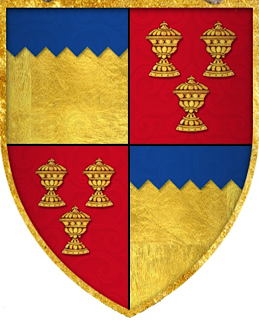
(From: “Saints of the Day – Gelasius of Armagh” by Katherine I Rabenstein, CatholicSaints.Info (www.catholicsaints.info) | Pictured: Arms of the Archbishop of Armagh, in the Church of Ireland)
The organization is set up to take over the work of the Irish National Land League after its leadership is imprisoned. They raise money for the Land League prisoners and their dependants. They encourage women to resist eviction from their cottages. If families are evicted, the Ladies’ Land League provides wooden huts to the evicted families.
The ladies find themselves with additional work late in 1881. The Land League has started its own paper, United Ireland, in August 1881, but towards the end of the year the government tries to close it down. William O’Brien, the editor, continues to smuggle out copy from Kilmainham Gaol, but it falls to the ladies to get it printed. This is done first in London and then for a while in Paris. Eventually the ladies print and circulate it themselves from an office at 32 Lower Abbey Street.
On Sunday, March 12, 1881, just more than a month after the formation of the league, a pastoral letter of Archbishop of DublinEdward McCabe is read out in all the churches of the diocese. It condemns the league in the strongest terms, deploring that “our Catholic daughters, be they matrons or virgins, are called forth, under the flimsy pretext of charity, to take their stand in the noisy street of life.” McCabe is not representative of all bishops, particularly Archbishop of CashelThomas Croke, a strong supporter of the original league. Croke publishes a letter in the Freeman’s Journal challenging the “monstrous imputations” in McCabe’s pastoral.
The dissension is revived somewhat in the summer of 1882. McCabe, now a Cardinal, and another bishop try to have a public condemnation of the Ladies’ Land League inserted into an address by the Catholic Bishops of Ireland in June. The other bishops resist on the basis that it would probably do more harm than good. They content themselves with expressing their hope that “the women of Ireland will continue to be the glory of their sex and the noble angels of stainless modesty.” When newspapers interpret this as a condemnation of the league, Croke writes again to the Freeman’s Journal to deny that this had been the intention of the bishops.
The order banning the Irish National Land League makes no direct reference to the Ladies’ Land League, but many police officers try to insist that the ban includes the women’s group. Eventually, on December 16, 1881, Inspector General Hillier of the Royal Irish Constabulary (RIC) orders the police to stop the women’s meetings. Anna Parnell defiantly issues a notice to all Ladies’ Land League branches in the country calling on them all to hold a meeting on January 1, 1882.
The prominent resident magistrate, Major Clifford Lloyd, claims that the huts built for evicted tenants are being used as posts from which the evicted tenants can intimidate anyone who attempts to take over their vacated holdings. In April 1882, he threatens that anyone attempting to erect huts will be imprisoned. That month, Anne Kirke is sent down from Dublin to Tulla, County Clare, to oversee the erection of huts for a large number of evicted tenants. Lloyd has her arrested and imprisoned for three months.
The government does not wish to be seen to use the Coercion Act to imprison women, but another stratagem is used. In December 1881 21-year-old Hannah Reynolds is imprisoned under an ancient statute from the reign of Edward III, the original purpose of which was to keep prostitutes off the streets. The statute empowers magistrates to imprison “persons not of good fame” if they do not post bail as a guarantee of their good behavior. Since Reynolds claims her behavior is good, she refuses to pay bail and spends a month in Cork gaol. In all, thirteen women serve jail sentences under this statute.
On May 3, 1882, Parnell and other leaders are released from jail after agreeing to the Kilmainham Treaty. This includes some improvement in the 1881 Land Act. He now wishes to turn his attention more to the Home Rule question. The Irish National Land League is replaced by the Irish National League. Parnell also wants to see an end to the Ladies’ Land League. There had been increased violence while he was in jail, and he sees Anna as too radical. The organization has an overdraft of £5,000 which Parnell agrees to clear from central funds only if the organization is dissolved. At a meeting of the Central Committee on August 10, 1882, the Ladies’ Land League votes to dissolve itself. Anna Parnell herself is not in attendance at that meeting having suffered a physical and mental collapse after the sudden death of her sister Fanny the previous month.
The records of the Ladies’ Land League are lost to history in 1916. Jennie Wyse Power, who had served on the Central Committee, had kept them in her house in Henry Street, Dublin. When fire spreads from Sackville Street during the 1916 Easter Rising, her house is destroyed, and the records perish in the blaze.
(Pictured: Lady Land Leaguers at work at the Dublin office)
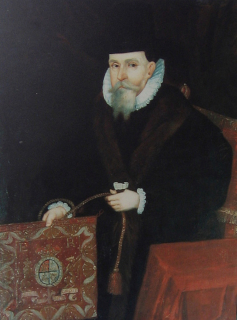
Loftus is born in 1533, the second son of a monastic bailiff, Edward Loftus, in the heart of the English Yorkshire Dales. He embraces the Protestant faith early in his development. He is an undergraduate at Trinity College, Cambridge, where he reportedly attracts the notice of the young Queen Elizabeth, as much by his physique as through the power of his intellect. Although this encounter may never have happened, Loftus certainly meets with the Queen more than once, and she becomes his patron for the rest of her reign. At Cambridge Loftus takes holy orders as a Catholic priest and is appointed rector of Outwell St. Clement in Norfolk. He comes to the attention of the Catholic Queen Mary, who names him vicar of Gedney, Lincolnshire. On Elizabeth’s accession in 1558 he declares himself Anglican.
Loftus makes the acquaintance of the Queen’s favourite Thomas Radclyffe, 3rd Earl of Sussex and serves as his chaplain in Ireland in 1560. In 1561 he becomes chaplain to Alexander Craike, Bishop of Kildare and Dean of St. Patrick’s Cathedral in Dublin. Later that year he is appointed rector of Painstown in Meath and evidently earns a reputation as a learned and discreet advisor to the English authorities in Dublin. In 1563, he is consecrated Archbishop of Armagh at the unprecedented age of 28 by Hugh Curwen, Archbishop of Dublin.
Following a clash with Shane O’Neill, the real power in Ulster during these years, he comes to Dublin in 1564. To supplement the meager income of his troubled archbishopric he is temporarily appointed to the Deanery of St. Patrick’s Cathedral by the queen in the following year. He is also appointed president of the new commission for ecclesiastical causes. This leads to a serious quarrel with the highly respected Bishop of Meath, Hugh Brady.
In 1567 Loftus, having lobbied successfully for the removal of Hugh Curwen, who becomes Bishop of Oxford, and having defeated the rival claims of the Bishop of Meath, is appointed Archbishop of Dublin, where the queen expects him to carry out reforms in the Church. On several occasions he temporarily carries out the functions of Lord Keeper of the Great Seal, and in August 1581 he is appointed Lord Chancellor of Ireland after an involved dispute with Nicholas White, Master of the Rolls in Ireland. He is constantly occupied in attempts to improve his financial position by obtaining additional preferment and is subject to repeated accusations of corruption in public office.
In 1582 Loftus acquires land and builds a castle at Rathfarnham, which he inhabits from 1585. In 1569–1570 the divisions in Irish politics take on a religious tinge with the First Desmond Rebellion in Munster and Pope Pius V‘s 1570 papal bullRegnans in Excelsis. The bull questions Elizabeth’s authority and thereafter Roman Catholics are suspected of disloyalty by the official class unless they are discreet.
Loftus takes a leading part in the execution of Dermot O’Hurley, Archbishop of Cashel. When O’Hurley refuses to give information, Francis Walsingham suggests he should be tortured. Although the Irish judges repeatedly decide that there is no case against O’Hurley, on June 19, 1584, Loftus and Sir Henry Wallop write to Walsingham “We gave warrant to the knight-marshal to do execution upon him, which accordingly was performed, and thereby the realm rid of a most pestilent member.”
Between 1584 and 1591 Loftus has a series of clashes with Sir John Perrot on the location of an Irish University. Perrot wants to use St. Patrick’s Cathedral, Dublin as the site of the new University, which Loftus seeks to preserve as the principal place of Protestant worship in Dublin, as well as a valuable source of income for himself. The archbishop wins the argument with the help of his patron, Queen Elizabeth I, and Trinity College, Dublin is founded at its current location, named after his old college at Cambridge, leaving the Cathedral unaffected. Loftus is named as its first Provost in 1593.
The issue of religious and political rivalry continues during the two Desmond Rebellions (1569–83) and the Nine Years’ War (1594–1603), both of which overlap with the Anglo-Spanish War (1585–1604), during which some rebellious Irish nobles are helped by the Papacy and by Elizabeth’s arch-enemy Philip II of Spain. Due to the unsettled state of the country Protestantism makes little progress, unlike in Celtic Scotland and Wales at that time. It comes to be associated with military conquest and is therefore hated by many. The political-religious overlap is personified by Loftus, who serves as Archbishop and as Lord Chancellor of Ireland. An unlikely alliance forms between Gaelic Irish families and the Norman “Old English“, who had been enemies for centuries but who now mostly remain Roman Catholic.
Adam Loftus dies in Dublin on April 5, 1605, and is interred in the building he had helped to preserve for future generations, while many of his portraits hang today within the walls of the University which he helped found. Having buried his wife Jane (Purdon) and two sons (of their 20 children) in the family vault at St. Patrick’s, Loftus dies at his Episcopal Palace in Kevin Street “worn out with age” and joins his family in the same vault. His zeal and efficiency are commended by James I upon the king’s accession.
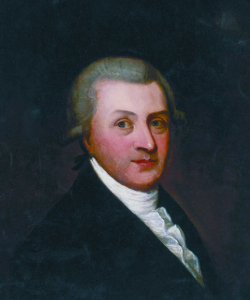
Arthur Guinness is believed to be born in Celbridge, County Kildare on September 25, 1725, into the ProtestantGuinness family, part of the Anglo-Irish aristocracy. They claim to descend from the Gaelic Magennis clan of County Down. However, recent DNA evidence suggests descent from the McCartans, another County Down clan, whose spiritual home lay in the townland of “Guiness” near Ballynahinch, County Down.
Guinness’s place and date of birth are the subject of speculation. His gravestone in Oughter Ard, County Kildare, reads that he dies on January 23, 1803, at the age of 78, and that he is born some time in 1724 or very early in 1725. This contradicts the date of September 28, 1725, chosen by the Guinness company in 1991, apparently to end speculation about his birthdate. The place of birth is perhaps his mother’s home at Read homestead at Ardclough, County Kildare.
In 2009 it is claimed that Guinness is born in nearby Celbridge where his parents live in 1725 and where his father later becomes land steward for the Archbishop of Cashel, Dr. Arthur Price. In his will, Dr. Price leaves £100 each to “his servant” Arthur and his father in 1752.
Guinness leases a brewery in Leixlip in 1755, brewing ale. Guinness also purchases a long lease of an adjacent site from George Bryan of Philadelphia in 1756 that is developed as investment property. He leaves his younger brother in charge of the Leixlip enterprise in 1759 and moves on to another at St. James’ Gate, Dublin. He signs a 9,000-year lease for the brewery, effective from December 31, 1759. The lease is presently displayed in the floor at St. James’ Gate. By 1767 he is the master of the Dublin Corporation of Brewers. His first actual sales of porter are listed on tax data from 1778. From the 1780s his second son, Arthur, works at his side and becomes the senior partner in the brewery in 1803.
Guinness’ major achievement is the expansion of his brewery in 1797–1799. Thereafter he brews only porter and employs members of the Purser family who have brewed porter in London from the 1770s. The Pursers become partners in the brewery for most of the 19th century. By the time of his death in 1803, the annual brewery output is over 20,000 barrels. Subsequently Arthur and/or his beer is nicknamed “Uncle Arthur” in Dublin. Guinness’ florid signature is still copied on every label of bottled Guinness.
From 1764, Guinness and his wife Olivia, whom he marries in 1761, live at Beaumont House, which Guinness has built on a 51-acre farm which is now a part of Beaumont Convalescent Home, behind the main part of Beaumont Hospital, between Santry and Raheny in north County Dublin. His landlord is Charles Gardiner. Beaumont, meaning beautiful hill, is named by Arthur and the later Beaumont parish copies the name. From March 1798 he lives at Mountjoy Square in Dublin, which is then in the process of being built in the style of elegant Georgian architecture. Three of his sons are also brewers, and his other descendants eventually include missionaries, politicians, and authors.
Sir Arthur Guinness dies in Mountjoy Square, Dublin, on January 23, 1803, and is buried in his mother’s family plot at Oughter Ard, County Kildare.
To further honour Arthur Guinness’s legacy, in 2009 Guinness & Co. established the Arthur Guinness Fund (AGF). An internal fund set up by the Company, its aim is to enable and empower individuals with skills and opportunities to deliver a measured benefit to their communities. Guinness has donated more than €7 million to the Fund since its inception. Arthur Guinness is also one of a handful of Irish people commemorated twice on stamps, in 1959 and 2009.
After acting as chaplain to Seth Ward, Bishop of Exeter and then Bishop of Salisbury, and Lord Chancellor Clarendon, he is elected principal of St. Alban Hall, Oxford, in 1673. In 1679 he is appointed provost of Trinity College, Dublin, where he does much to encourage the study of the Irish language. He helps to found the Dublin Philosophical Society and contributes to it a paper entitled Introductory Essay to the Doctrine of Sounds (printed in Philosophical Transactions, No. 156, Oxford, 1684).
In 1683 Marsh is consecrated Bishop of Ferns and Leighlin, but after the accession of James II he is compelled by the turbulent soldiery to flee to England in 1689, when he becomes Vicar of Gresford, Flintshire, and Canon of St. Asaph. Returning to Ireland in 1691 after the Battle of the Boyne, he is made Archbishop of Cashel, and three years later he becomes Archbishop of Dublin. About this time, he founds Marsh’s Library in Dublin, which is the oldest public library in Ireland. He becomes Archbishop of Armagh in 1703. Between 1699 and 1711 he is six times a Lord Justice of Ireland.
Narcissus Marsh dies on November 2, 1713. His funeral oration is pronounced by his successor at Dublin, Archbishop William King. A more acerbic account is provided by Jonathan Swift.
Many oriental manuscripts belonging to Narcissus Marsh are now in the Bodleian Library in Oxford.




 seamus dubhghaill