seamus dubhghaill

Promoting Irish Culture and History from Little Rock, Arkansas, USA


Leave a comment

Death of Artist Samuel McCloy

Samuel McCloy, Irish artist who trains at Belfast School of Design and later at Somerset House, dies in Balham, South London, on October 4, 1904. He exhibits widely in group shows across the British Isles and is known for his watercolours, genre paintings, still life and landscapes. He is also a commercial designer, illustrator, and an educator who is for a time Master at Waterford School of Art.

Born on March 13, 1831, in Lisburn, County Antrim, McCloy is the youngest of five children, born to Peter McCloy, a painter, and his wife Martha Phelan. He studies at the School of Design in Belfast from 1850 to 1851 while serving an apprenticeship in engraving, with J and T Smyth. He then spende a year at the Central School, Somerset House in London before being appointed Master at the Waterford School of Art around 1853, when he also becomes a visiting instructor to several other institutions. In the spring of 1865 he marries his student, the Waterford artist Ellen Lucy Harris, the fourth daughter of a banker named Richard Harris. The dismembered corpse of McCloy’s mother is recovered from the River Suir in September of the same year. She had been missing since the previous November.

Between 1873 and 1891 McCloy shows nine works at the Royal Society of British Artists. Upon his return to Belfast around 1874, he works freelance designing greetings cards for Marcus Ward & Co., and in creating damask designs for linen manufacturers. He illustrates Lucy Sale-Barker‘s Sunny Childhood, published by Routledge in 1887, and he is for a time employed by The Illustrated London News.

McCloy shows just once at the Royal Academy of Arts with a work entitled The Haunt of Meditation in 1859. He exhibits infrequently at the Royal Hibernian Academy between 1862 and 1882, where he displays sixteen works in that time. He displays eleven works in the 1876 Industrial Exhibition at Belfast’s Ulster Hall. In 1880, he shows at Rodman and Company in London where the writer in the Belfast Telegraph indicates that McCloy is becoming a popular artist and is receiving extensive patronage.

Following his relocation to London in 1881, McCloy contributes works to numerous regional exhibitions, including the spring exhibition of the Derby Sketching Club in 1883, Nottingham Castle Museum’s autumn exhibition of 1888, and at Exeter‘s Eland Art Gallery in 1892. He exhibits with the Royal Scottish Academy in 1882 and with the Royal Institute of Painters in Water Colours in 1887. He is also a member of the Belfast Art Society, an antecedent to the Royal Ulster Academy.

After a year-long illness that prevents him from working, McCloy dies in Balham, South London, on October 4, 1904. He is survived by his wife, Ellen, and nine daughters. The Lisburn Museum in his hometown offers a belated retrospective of his work in 1981 to mark the one-hundred fiftieth anniversary of his birth. The exhibition is the first known solo display of McCloy’s work and consists of 58 works. The catalogue for this show is written by Eileen Black and funded by the Arts Council of Northern Ireland.

McCloy’s work can be seen in many public collections including the Ulster Museum, the Victoria and Albert MuseumAmgueddfa Cymru – Museum Wales, the National Gallery of Ireland, and in the Irish Linen Centre and Lisburn Museum.


Leave a comment

Birth of Nannie Dryhurst, Writer, Translator, Activist & Nationalist

Nannie Florence Dryhurst, Irish writer, translator, activist and nationalist, is born Hannah Anne Robinson in Dublin on June 17, 1856.

Dryhurst is born to Alexander Robinson and Emily Egan. Her father is a dyer. She is known as Nannie to her sisters and she decides to change her name to Nannie Florence in honour of a young friend who had died. As a result she is known variously (and following her marriage) as N.F. Dryhurst, Nannie, Nora and Florence Dryhurst.

After the death of her father, Dryhurst takes a position as a governess as she speaks fluent FrenchGerman and Irish, as well as having considerable skill as an artist. She works first in Ireland and then in London. She looks after a doctor’s daughter, Nellie Tenison, and through them she meets the Dryhurst family. In 1882, she becomes engaged to British Museum official Alfred Robert Dryhurst and marries him in August 1884. Their first daughter, Norah, is born in 1885 and the second, Sylvia, in 1888.

Dryhurst soon gets involved with an anarchist group and writes regularly for the Freedom newspaper. She is friends with Charlotte Wilson and acts as editor when Wilson is away. In the early 1890s she takes over as editor completely for a period of time. She also works as a translator for Peter Kropotkin‘s works. She spends time teaching with Wilson, Agnes Henry, and Cyril Bell at the International Anarchist School set up in Fitzroy Square in London by Louise Michel. She gives active support to Spanish refugees fleeing repression and gives money to support the colony at Clousden Hill from 1895 to 1902.

Dryhurst supports a number of different countries attempting to gain independence. She becomes secretary of the Nationalities and Subject Races Committee and uses her writing in working toward Irish independence. She writes for various Irish newspapers and assists with the creation of The Irish Citizen. A friend of W. B. Yeats, she appears in his play The Land of Heart’s Desire in June 1904. She speaks Georgian, having learned it from Varlam Cherkezishvili, a close associate of Kropotkin. In 1906, she is a member of the Georgian Relief Committee and travels to the country. She speaks at an international conference at The Hague in support of Georgia. She is also a supporter of Indian independence.

It was through Dryhurst that the Gifford sisters get their connection to the Irish independence movement. She introduces Muriel Gifford to Thomas McDonagh and Grace Gifford to James Plunkett. After the executions of fifteen leaders of the Easter Rising in Dublin, she spends her time campaigning unsuccessfully for the reprieve of Roger Casement. Not all her activities are purely political. She is a neighbour of Martin Shaw and on her suggestion he founds the Purcell Operatic Society in 1899. She becomes the Society’s secretary. He rents accommodation near her and through her friends they find talented amateurs to put on their productions.

Dryhurst has a long affair with Henry Nevinson, a journalist she meets in 1892. The affair ends in 1912. She dies in 1930. Her papers are kept in the National Library of Ireland.


Leave a comment

Birth of Mildred Anne Butler, Animal & Genre Painter

Mildred Anne Butler, Irish artist who works in watercolour and oil of landscape, genre and animal subjects, is born on January 11, 1858, in Kilmurry, a Georgian house near Thomastown, County Kilkenny.

The youngest daughter of Captain Henry Butler, a grandson of the Edmund Butler, 11th Viscount Mountgarret, and Clara Butler (née Taylor) of the Newarke, Leicester, England. Her father is himself an enthusiastic painter, known for his publication South African sketches: illustrative of the wildlife of a hunter on the frontier of Cape Colony (1841). Her early artistic efforts are mainly copies of romantic subjects, but the influence of the London artist Paul Jacob Naftel, with whom she begins corresponding in the early 1880s, proves to be crucial to her artistic development. Studies with William Frank Calderon, an expert in animal painting, are also significant. She subsequently spends the summers of 1894 and 1895 in Newlyn, Cornwall, England, with the Irish artist Norman Garstin, who introduces her to contemporary French painting.

In 1885, Butler makes her first visit to the continent, traveling through France, Switzerland, and Italy. From 1905 to 1914 she travels regularly to Europe, most particularly Aix-les-Bains and Wiesbaden, during which time she produces genre views of French and German villages. After 1914 her life at the family home is interrupted only by visits to London exhibitions. She is best known for her paintings of Kilmurry and its environs, many of which display an interest in botany. Much of her work is dominated by detailed representations of animals and birds, often drawn from photographs and stuffed specimens.

Butler’s career as an exhibitor begins in 1882 with the Irish Fine Arts Society, later known as the Water Colour Society of Ireland (WCSI), with which she has a long association. She exhibits regularly with the society from 1892 onward and is a member of its committee for many years. She is also closely associated with the Dudley Museum and Art Gallery in London. Her work is first shown there in 1888, and on this evidence, she is elected to their society. The purchase by the Chantrey bequest for the Tate Gallery of The Morning Bath for £50 in 1896 is a high point in her career. The first painting by a woman to be selected by the council, its purchase is followed by almost consistently good press reviews for her work. The Athenaeum of May 5, 1897, writes: “The young lady knows how to look at her subjects with the eyes of a well-trained artist.”

Butler also comes to the attention of the American artistic press. She contributes to the portfolio of drawings given by the Society of Lady Artists to Princess May on her marriage to the Duke of York in 1893, while in 1922 her work is included in the portfolio presented to Princess Mary on her marriage. Her patrons include Queen Alexandra, and the grand duke of Hesse, who purchases two of her paintings after she is invited to exhibit in Hesse Darmstadt in 1911. In 1914 she is made a member of the Union Internationale des Beaux Arts, and in 1921 her paintings are shown in Japan. She regularly exhibits with the Belfast Ramblers, the Royal Ulster Academy, the Royal Academy of Arts (RA), the Royal Hibernian Academy (RHA), the Society of Lady Artists, and the Royal Watercolour Society, of which she is made an associate member in 1896, and a full member in 1937.

In her later years, severe rheumatism prevents Butler from painting. She has a keen interest in music. She survives all five of her siblings, and inherits Kilmurry, where she dies on October 11, 1941. She is buried at Thomastown, County Kilkenny. Her paintings are represented in the collections of the National Gallery of Ireland, Dublin City Gallery the Hugh Lane, the Ulster Museum, and the Tate, London.

(From: “Butler, Mildred Anne” by Frances Clarke, Dictionary of Irish Biography, http://www.dib.ie, October 2009)


Leave a comment

Birth of Harriet Kavanagh, Artist, Traveler & Antiquarian

Lady Harriet Kavanagh, Irish artist, traveler, and antiquarian, described as a “woman of high culture and of unusual artistic power,” is born Lady Harriet Margaret Le Poer Trench on October 13, 1799. She is believed to be the first Irish female traveler to Egypt.

Kavanagh is the second daughter of Richard Le Poer Trench and Henrietta Margaret Le Poer Trench (née Staples), with three brothers and three sisters. She marries Thomas Kavanagh of Borris House, County Carlow, on February 28, 1825, as his second wife. The couple has four children, three sons Charles, Thomas, Arthur, and one daughter, Harriet or “Hoddy.”

Kavanagh’s third son, Arthur MacMorrough Kavanagh, is born without fully formed limbs. Some attribute the disability to a peasant’s curse, while others speculate it is due to Lady Kavanagh taking laudanum during her pregnancy. She refuses to treat her son differently to his siblings, and with the help of local doctor Francis Boxwell, raises him as a normal child. During his initial education, she teaches Arthur herself, teaching him to paint and then write by holding brushes and pens in his mouth. With the help of the surgeon Sir Philip Crampton, she has a mechanical wheelchair constructed for Arthur, and also encourages him to ride horses and engage in other outdoor activities. Her husband dies after twelve years of marriage, in 1837.

In 1846, Kavanagh takes her children to learn French in Saint-Germain-en-Laye, later traveling to Rome. As an antiquarian, she also wants to visit Egypt and the Holy Land, setting off on the long journey from Marseille in October 1846. Accompanying her are her daughter, Harriet, her two sons, Thomas and Arthur, their tutor, the Rev. David Wood, and a maid, Miss Hudson. In Cairo, she hires two feluccas with Arab crews, and visits archaeological sites along the Nile, such as Thebes, Karnak, and the Nubia region. From there, she visits sites of biblical interest, including Tyre, Sidon, and Roda Island. She negotiates with Bedouin chiefs in Aqaba, hiring camels and Bedouin guides to travel to Hebron. She visits harems and a slave market and records the journey’s incidents in her diary, including her son Arthur’s accidental near drowning when he falls off their boat while fishing.

While in Cairo, Kavanagh becomes acquainted with a number of fellow Europeans, including Sir Charles Murray, Sophia Lane Poole, and Edward William Lane. Harriet Martineau travels with the party from Cairo to the Holy Land.

While visiting Jerusalem in Easter 1847, Kavanagh bears witness to a confrontation over the control of holy places between Roman and Orthodox Catholics priests. She goes on to visit Petra, the Sinai Peninsula, Beirut, Smyrna, and Constantinople. The group spends a second winter in Egypt before traveling to the Black Sea before returning to Marseilles in April 1848. Much of these journeys are conducted on horse or camel-back, with one desert crossing taking 36 days. She later comments on her travels as a woman, stating “quite enough danger to make it a very exciting business.”

In 1850 and 1852, Kavanagh travels to Corfu, returning to Borris with samples of Greek lace. She teaches a number of her tenants to copy these designs, which lead to the establishment of a local lace-making industry. She is elected to the Kilkenny Archaeological Society in 1851.

Kavanagh moves to Ballyragget Lodge, County Kilkenny, in 1860, dying there on July 14, 1885. She is buried in St. Mullin’s Abbey, Borris in County Carlow. She documented her travels in journals, with drawings and paintings of the sites she visited. These are held by the Kavanagh family, along with an oil portrait and a self-portrait. Her collection of roughly 300 Egyptian antiquities were donated to the Royal Society of Antiquaries of Ireland after her death. These collections were later moved to the National Museum of Ireland and form a core element of the Museum’s Egyptian collection. Copies of two of her watercolours, a self-portrait, and a landscape are on display in the Museum.


Leave a comment

Death of Rose Maynard Barton, Watercolour Artist

Rose Maynard Barton RWS, Anglo-Irish artist, dies on October 10, 1929, at her house at 79 Park Mansions, Knightsbridge, London. A watercolourist, she paints landscape, street scenes, gardens, child portraiture and illustrations of the townscape of Britain and Ireland.

Barton exhibits with a number of different painting societies, most notably the Water Colour Society of Ireland (WCSI), the Royal Academy of Arts (RA), the Royal Hibernian Academy (RHA), the Society of Women Artists (SWA) and the Royal Watercolour Society (RWS). She becomes a full member of the RWS in 1911.

Barton is born in Dublin on April 21, 1856. Her father is a lawyer from Rochestown, County Tipperary, and her mother’s family is from County Galway. Educated privately, she is a liberal in social affairs. Her interests include horse racing. She is cousins with sisters Eva Henrietta and Letitia Marion Hamilton. She begins exhibiting her broad-wash watercolour paintings with the Water Colour Society of Ireland (WCSI) in 1872. She and her sister Emily visit Brussels in 1875, where they receive drawing tuition in drawing and fine art painting under the French artist Henri Gervex. There, along with her close friend Mildred Anne Butler, she begins to study figure painting and figure drawing.

In 1879, Barton joins the local committee of the Irish Fine Art Society. Afterward she trains at Paul Jacob Naftel‘s art studio in London. She, like Butler, studies under Naftel. In 1882, she exhibits her painting Dead Game, at the Royal Hibernian Academy (RHA). In 1884, she exhibits at the Royal Academy of Arts (RA). Later, she shows at the Japanese Gallery, the Dudley Museum and Art Gallery and the Grosvenor Gallery in London. In 1893, she becomes an associate member of the Society of Painters in Water Colours, attaining full membership in 1911.

Barton’s watercolours and townscapes become well known in both Dublin and London. This is helped by her illustrations in books of both cities including Picturesque Dublin, Old and New by Francis Farmer and her own book Familiar London.

Barton’s paintings can be found in public collections of Irish painting in both Ireland and Britain, including the National Gallery of Ireland and Dublin City Gallery The Hugh Lane in Dublin, and the Ulster Museum in Belfast.

(Pictured: “A rest in rotten row” – 1892 watercolour by Rose Maynard Barton. The painting shows a nurse and child resting on Rotten Row, Hyde Park, London.)


Leave a comment

Birth of Artist Paul Henry

Paul Henry, Irish artist noted for depicting the Connacht province landscape in the west of Ireland in a spare Post-Impressionist style, is born at 61 University Road, Belfast, on April 11, 1876.

Henry is the third of four sons of the Rev. Robert Mitchell Henry, minister of the Reformed Presbyterian Church, and his wife Kate Ann Berry, eldest of four daughters of Thomas Berry, minister of the Baptist church, Athlone. His father becomes a Baptist in 1858 and pastor of Great Victoria Street Baptist Church, Belfast, resigning in 1875 to join the Plymouth Brethren.

Henry begins to draw in pencil and watercolours at the age of four, even before entering the kindergarten at Methodist College Belfast (MCB), in 1882 where he first begins drawing regularly. At the age of fifteen he moves to the Royal Belfast Academical Institution. He studies art at the Belfast School of Art before going to Paris in 1898 to study at the Académie Julian and at James McNeill Whistler‘s Académie Carmen.

Henry marries the painter Emily Grace Mitchell on September 17, 1903, in London at St Peter’s Anglican church, Bayswater. He returns to Ireland in 1910. From then until 1919 he lives on Achill Island, where he learns to capture the peculiar interplay of light and landscape specific to the west of Ireland. In 1919, he moves to Dublin and in 1920 he is one of the founders of the Society of Dublin Painters, originally a group of ten artists. He designs several railway posters, some of which, notably Connemara Landscape, achieves considerable sales. He separates from his wife in 1929. His second wife is the artist Mabel Young.

In the 1920s and 1930s, Henry is Ireland’s best-known artist, one who has a considerable influence on the popular image of the west of Ireland. Although he seems to cease experimenting with his technique after leaving Achill and his range is limited, he creates a large body of fine images whose familiarity is a testament to its influence.

Henry’s use of colour is affected by his red-green colour blindness. He loses his sight in 1945 and does not regain his vision before his death.

Henry dies on August 24, 1958, at his home at 1 Sidmonton Square, Bray, County Wicklow, and is buried at St. Patrick’s Church, Enniskerry, County Wicklow. He is survived by his wife, Mabel. His papers and sketchbooks are in the libraries of the National Gallery of Ireland and Trinity College Dublin.

A commemorative exhibition of Henry’s work is held at Trinity College, Dublin, in 1973 and the National Gallery of Ireland holds a major exhibition of his work in 2004.

A painting by Henry is featured on an episode of the BBC‘s Antiques Roadshow, broadcast on November 12, 2006. The painting is given a value of approximately £40,000–60,000 by the Roadshow. However, due to the buoyancy of the Irish art market at the time, it sells for €260,000 on December 5, 2006, in James Adams’ and Bonhams’ joint Important Irish Art sale.

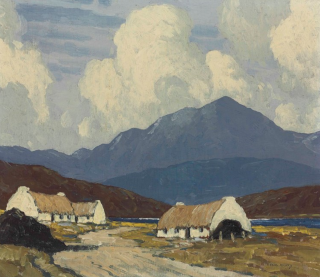
Pictured: “Roadside Cottages, below Mweelrea Mountain” by Paul Henry, RHA, oil on panel, 1940)


Leave a comment

Birth of Kathleen Cox, Artist, Sculptor & Mystic

Kathleen Cox, Irish artist, sculptor, and mystic, is born Christina Mary Kathleen Cox in Wo-Sung, China, on July 2, 1904. Cox is considered a pioneer of contemporary Irish pottery.

Cox is the eldest daughter of Dr. R. H. Cox, originally from Dundalk, County Louth, and the port health officer in Shanghai. He is also an amateur geologist and models in clay. In his retirement, he invents a periscope later used during World War I by the Royal Navy. The years living in China leave an impression on the young Cox, visually and culturally. The family returns to Ireland in 1911, first moving to Listowel, County Kerry, and later to Howth, County Dublin. She attends Alexandra College, and later the Dublin Metropolitan School of Art in 1921. While there she studies sculpture under Oliver Sheppard and is considered one of his most talented students, winning the Royal Dublin Society Taylor prize for modelling in 1925, 1926, and 1927. The money from these prizes allows Cox to travel to Paris in 1929.

Cox exhibits in 1924 at the Tailteann exhibitions, and in 1925 submits textile designs to the Arts and Crafts Society of Ireland. She establishes a pottery studio at 7 Schoolhouse Lane, Dublin, with college friend Stella Rayner in 1929. The studio has the first electric kiln in Ireland. The first exhibited piece by Cox shown by the Royal Hibernian Academy (RHA) is in 1930, with a pair of Madonna bookends, and portrait masks of the daughter of Dermod O’Brien, Brigid O’Brien, and writer Norris Davidson. Davidson is a friend and neighbour, who commissions her to design the poster for his 1929 film, Suicide. She exhibits with the RHA from 1931 to 1933, and the Tailteann 1932, while also holding exhibitions in her studio. During this period Hilda Roberts paints her portrait, Strange Spirit. Kathleen Cox in her studio. The theme of womanhood is prominent in her work, including in the sign of her studio.

In 1932, Cox begins producing a line of more commercial figurines, drawing influence from the Royal Doulton Burslem factory, where she works for a time. One such figurine is The Lavender Man (pictured), modelled on Michael Clifford, a Dublin street trader. In the mid 1930s, she develops a frustration with her work and with her lack of impact on the wider world. In attending the Chinese exhibition in London in 1935, it is confirmed to her that pottery should be practical rather than ornamental. It spurs her to destroy all her moulds and sell her kiln upon her return to Dublin.

Cox marries Alan Palmer in 1937, the couple has two daughters and relocate to England. Palmer is a conscientious objector during World War II, with the couple running a farm at Meopham, Kent, returning to London after the war.

Cox dies in early September 1972 in London. Some of her work is held in the collections of the National Museum of Ireland and with four works featured in the exhibition Not Just Pots: Contemporary Irish Ceramics of the 21st Century.

It is during the 1920s that Cox begins to question mainstream religion and becomes a vegetarian. Finding that her personal philosophy is similar to that of theosophy, she joins the movement and speaks at meetings. She is heavily influenced by the founder of the Order of the Great Companions, the Rev. William Hayes, who is living in Dublin in the 1930s. She writes and illustrates a children’s book on world religions, A story of stories, which she publishes under the pseudonym C.M. Kay in 1970.


Leave a comment

Death of Gerard Dillon, Painter and Artist

Gerard Dillon, Irish painter and artist, dies following a second stroke on June 14, 1971.

Dillon is born in Belfast in 1915 or 1916. He leaves school at the age of fourteen and for seven years works as a painter and decorator, mostly in London. From an early age he is interested in art, cinema, and theatre. About 1936 he starts out as an artist.

Dillon’s Connemara landscapes provide the viewer with context, portraits of the characters who work the land, atmosphere and idiosyncratic colour interpretations. At the age of 18, Dillon goes to London, initially working as a decorator. With the outbreak of World War II, he returns to Belfast. Over the next five years he develops as a painter in Dublin and Belfast. His works during this period are more than simple depictions of the life and people around him, they are reactions and interactions in paint.

In 1942, Dillon’s first solo exhibition is opened by his friend and fellow artist, Mainie Jellett, at The Country Shop, St. Stephen’s Green, Dublin. “Father, Forgive Them Their Sins” features depicting his concerns about the new war that had broken out. Despite a growing reputation, he has to return to London in 1944 to work on demolition gangs to restore his finances. In the late 1940s and during the 1950s, he finds himself favouring the town of Roundstone, Connemara. In 1951 he is introduced to Noreen Rice by her piano teacher. She has no formal training and she takes Dillon and George Campbell as her mentors for decades and her work is of a similar surrealistic and primitive style.

In 1958, Dillon has the double honour of representing Ireland at the Guggenheim International, and Great Britain at the Pittsburg International Exhibition. He and his sister, Mollie, have a property on Abbey Road in 1958. They let out part of the house to Arthur Armstrong and they let a flat to Noreen Rice and her brother. He and Noreen tour junk yards to find objects like leather and string that they include in their artwork.

Dillon travels widely in Europe and teaches for brief periods in the London art schools.

In 1967, Dillon suffers a stroke and spends six weeks in hospital. From this time his work changes direction. A notion of imminent death sends his work almost into another world, a realm of dreams and paintings intimating his death. In 1968 he is back in Dublin, where he helps to design sets and costumes for Seán O’Casey‘s play Juno and the Paycock. He continues to paint and also to make tapestries, sitting at his Singer sewing machine.

In 1969, Dillon pulls his artworks from the Belfast leg of the Irish Exhibition of Living Art in purported protest during the Troubles against the “arrogance of the Unionist mob.” However, he does send work to Ulster when he donates work to Sheelagh Flanagan who had organised an exhibition for the relief of victims of the Belfast riots, in October 1969. His picture is hanged alongside the donated works of T. P. Flanagan, William Scott, F. E. McWilliam, Deborah Brown and Carolyn Mulholland as well as more than twenty others. Michael Longley retorts in a further letter, “Belfast needed creativity, it needed people like Gerard Dillon.” During his last years, he is invited to be involved in a children’s art workshop in the National Gallery of Ireland.

Dillon dies of a second stroke at the age of 55 on June 14, 1971. His grave, as requested, is unmarked in Belfast’s Milltown Cemetery. Danlann Gerard Dillon/The Gerard Dillon Gallery in Cultúrlann McAdam Ó Fiaich is named in his honour.

In his biography of the artist, James White briefly touches on the artists homosexuality: “such was his religious feeling that although he was drawn to people of that type, if he once had an encounter I believe that it never occurred again.” The artist’s nephew, Martin Dillon, recalls that after his uncle’s death he found a diary entry describing a homosexual encounter with a sense of guilt, but the author Gerard Keenan insists he was “a very well-adjusted homosexual.” Reihill expands on this, pointing to a probably unrequited love for the painter Daniel O’Neill and also highlighted Dillon’s association with Basil Rákóczi and The White Stag Group‘s Kenneth Hall both strong gay connections. Pictures with both overt and covert references are known.

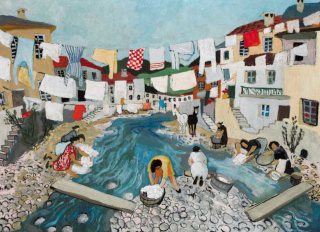
(Pictured: “Washing Day” by Gerard Dillon)


Leave a comment

Birth of Mary Ward, Astronomer, Microscopist, Author & Artist

Mary Ward (née King), Irish naturalist, astronomer, microscopist, author, and artist, is born in Ballylin near present-day Ferbane, County Offaly, on April 27, 1827. She is killed in 1869 when she falls under the wheels of an experimental steam car built by her cousins, thereby becoming the first person known to be killed by a motor vehicle.

King is the youngest child of the Reverend Henry King and his wife Harriette. She and her sisters are educated at home, as are most girls at the time. However, her education is slightly different from the norm because she is of a renowned scientific family. She is interested in nature from an early age, and by the time she is three years old she is collecting insects.

King is a keen amateur astronomer, sharing this interest with her cousin, William Parsons, 3rd Earl of Rosse, who builds the Leviathan of Parsonstown, a reflecting telescope with a six-foot mirror which remains the world’s largest until 1917. She is a frequent visitor to Birr Castle, producing sketches of each stage of the process. Along with photographs made by Parson’s wife, Mary Rosse, her sketches are used to aid in the restoration of the telescope.

King also draws insects, and the astronomer James South observes her doing so one day. She is using a magnifying glass to see the tiny details, and her drawing so impresses him that he immediately persuades her father to buy her a microscope. A compound microscope made by Andrew Ross is purchased for £48 12s 8d. This is the beginning of a lifelong passion. She begins to read everything she can find about microscopy, and teaches herself until she has an expert knowledge. She makes her own slides from slivers of ivory, as glass is difficult to obtain, and prepares her own specimens. The physicist David Brewster asks her to make his microscope specimens, and uses her drawings in many of his books and articles.

Universities and most societies do not accept women at the time, but King obtains information any way she can. She writes frequently to scientists, asking them about papers they had published. During 1848, Parsons is made president of the Royal Society, and visits to his London home allows her to meet many scientists.

King is one of only three women on the mailing list for the Royal Astronomical Society. The others are Queen Victoria and Mary Somerville, a scientist for whom Somerville College at the University of Oxford is named.

On December 6, 1854, King marries Henry Ward of Castle Ward, County Down, who in 1881 succeeds to the title of Viscount Bangor. They have three sons and five daughters, including Maxwell Ward, 6th Viscount Bangor. Her best-known descendants are her grandson, Edward Ward, the foreign correspondent and seventh viscount, and his daughter, the Doctor Who actress Lalla Ward.

When Ward writes her first book, Sketches with the microscope (privately printed in 1857), she apparently believes that no one will print it because of her gender or lack of academic credentials. She publishes 250 copies of it privately, and several hundred handbills are distributed to advertise it. The printing sells during the next few weeks, which prompts a London publisher to take the risk and contract for future publication. The book is reprinted eight times between 1858 and 1880 as A World of Wonders Revealed by the Microscope. A new full-colour facsimile edition at €20 is published in September 2019 by the Offaly Historical and Archaeological Society, with accompanying essays.

Her books are A Windfall for the Microscope (1856), A World of Wonders, Revealed by the Microscope (1857), Entomology in Sport, and Entomology in Earnest (1857, with Lady Jane Mahon), Microscope Teachings (1864), Telescope Teachings (1859). She illustrates her books and articles herself, as well as many books and papers by other scientists.

Ward is the first known automobile fatality. William Parsons’ sons had built a steam-powered car and on August 31, 1869, she and her husband are traveling in it with the Parsons boys, Richard Clere Parsons and the future steam turbine pioneer Charles Algernon Parsons, and their tutor, Richard Biggs. She is thrown from the car on a bend in the road at Parsonstown (present-day Birr, County Offaly). She falls under its wheel and dies almost instantly. A doctor who lives near the scene arrives within moments, and finds her cut, bruised, and bleeding from the ears. The fatal injury is a broken neck. It is believed that the grieving family destroys the car after the crash.

Ward’s microscope, accessories, slides and books are on display in her husband’s home, Castle Ward, County Down. William Parsons’ home at Birr Castle, County Offaly, is also open to the public.


Leave a comment

Death of Rosamond Praeger, Artist & Sculptor

Sophia Rosamond Praeger, Irish artist, sculptor, illustrator, poet and writer, dies at Rock Cottage, County Down, Northern Ireland, on April 17, 1954.

Praeger is born on April 15, 1867, in Holywood, County Down. She is the daughter of Willem Emilius Praeger, a Dutch linen merchant who had settled in Ireland in 1860, and Marie Patterson. She has five brothers of who Robert goes on to become a distinguished naturalist. Within months of her birth the family moves to Woodburn House, Croft Road, Holywood, where they have as a neighbour Rev. Charles McElester, a Non-subscribing Presbyterian minister who runs a day school in his church. She both attends this school, and later teaches there. She receives her secondary education at Sullivan Upper School, Holywood, the Belfast School of Art, and the Slade School of Fine Art, London. Before returning to Ireland to open a studio in Belfast and then in Holywood, she studies art in Paris.

Praeger writes and illustrates children’s books but achieves fame with her sculpture The Philosopher which is exhibited at the Royal Academy of Arts in London, bought by an American collector, and is now on display in the Colorado Springs Museum and Art Gallery. She mostly works in plaster, but also uses stone, marble, terracotta and bronze, and her work includes relief panels, memorial plaques and stones. She exhibits in London and Paris, at the Royal Hibernian Academy, as well as at the Irish Decorative Art Association Exhibitions. She is a member of the Guild of Irish Art Workers.

Among Praeger’s other works are The Wai, Johnny the Jig, These Little Ones, St. Brigid of Kildare and The Fairy Fountain. For the Causeway School near Bushmills, County Antrim, she carves Fionnula the Daughter of Lir in stone. She models a heraldic figure for the Northern Bank in Donegall Square West, Belfast, and bronze plaques for the front door of the Carnegie library, Falls Road, Belfast, as well as the angels on Andrews Memorial Hall in Comber, County Down, and some work in St. Anne’s Cathedral, Belfast. She illustrates three books for her brother, Robert Praeger. She is President of the Royal Ulster Academy, an honorary Fellow of the Royal Hibernian Academy, and she receives an honorary doctorate from Queen’s University, Belfast. In 1939 she is awarded the MBE.

Praeger maintains her studio in Hibernian Street, Holywood, up until 1952, at the age of 85. She dies at Rock Cottage, County Down, on April 17, 1954. She is buried in the Priory Cemetery, Holywood. Her work in included in the collections of the Ulster Museum and the National Gallery of Ireland, and some private collections around the world

(From: “Sophia Rosamond Praeger (1867 – 1954): Sculptor” by Kate Newmann and Richard Froggatt, Dictionary of Ulster Biography, http://www.newulsterbiography.co.uk)