Horan emigrates to Australia with his parents and siblings as a small child. In Melbourne, he attends Bell Street School in Fitzroy and forms a friendship with Jack Blackham. Blackham encourages in Horan a love of cricket. Horan makes his first-class debut for Victoria in the 1874-1875 season.
The first of only two players born in Ireland to play Test cricket for Australia, Horan is the leading batsman in the colony of Victoria during the pioneering years of international cricket. He plays for Australia in the game against England subsequently designated as the first Test match, before touring England with the first representative Australian team, in 1878. Four years later, he tours England for the second time and plays in the famed Ashes Test match at The Oval.
An aggressive middle-order batsman renowned for his leg side play, Horan supplements his batting by bowling medium-pace in the roundarm style common to his era and once captures six wickets in a Test match innings. During a season disrupted by financial disputes and a strike by leading players, he captains Australia in two Test matches of the 1884–85 Ashes series but loses both games. Horan’s form peaks between the ages of 26 and 29 when he scores seven of his eight first-class centuries, including a score of 124 in a Test match on his home ground at the Melbourne Cricket Ground in January 1882.
In 1879, Horan begins writing a weekly newspaper column that continues until his death 37 years later. He establishes himself as the first Australian cricket writer who has played the game at the highest level, thus paving the way for many players to enter the media. Bill O’Reilly, the noted Australian player-writer of the twentieth century, describes him as, “the cricket writer par excellence.”
Horan’s documentation of the early years of Australian cricket are the basis for many works on the subject. Gideon Haigh writes that any, “serious scholar in the field…should probably acquaint himself with Tom Horan.” An anthology of his articles is published for the first time in 1989 when he is posthumously inducted into the Sport Australia Hall of Fame for his writing. In part, his citation reads, “…it was as the first nationally known cricket writer that he made his major contribution to the game.”
Thomas Patrick Horan dies on April 16, 1916, in Malvern, Victoria, Australia.
Clancy is one of eleven children and the eldest of four boys born to Johanna McGrath and Bob Clancy. During World War II he serves as a flight engineer in the Royal Air Force in India. After his demobilization, Clancy works as a baker in London. In 1947 he emigrates to Toronto, Canada with his brother Tom Clancy. The following year, the two brothers move to Cleveland, Ohio to stay with relatives. Later, they attempt to move to California, but their car breaks down and they relocate to the New York City area instead.
After moving to Greenwich Village in 1951, both Patrick and Tom devote themselves primarily to careers in the theater. In addition to appearing in various Off-Broadway productions and television shows, they produce and star in plays at the Cherry Lane Theatre in Greenwich Village and at a playhouse in Martha’s Vineyard. After losing money on some unsuccessful plays, the brothers begin singing concerts of folk songs after their evening acting jobs are over. They soon dub these concerts “Midnight Specials” and the “Swapping Song Fair.” Patrick and Tom are often joined by other prominent folk singers of the day, including Pete Seeger, Woody Guthrie, and Jean Ritchie.
In 1956 their younger brother, Liam Clancy, immigrates to New York, where he teams up with Tommy Makem, whom he had met while collecting folk songs in Ireland. The two begin singing together at Gerde’s Folk City, a club in Greenwich Village. Patrick and Tom sing with them on occasion, usually in informal folk “sing-songs” in the Village. Around the same time, Patrick founds Tradition Records with folk-song collector and heiress Diane Hamilton, and in 1956 the Clancy Brothers and Tommy Makem release their first album, The Rising of the Moon, with only Patrick’s harmonica as musical accompaniment. However, the Clancys and Makem do not become a permanent singing group until 1959.
In the late 1950s, Clancy with his brothers and Makem begin to take singing more seriously as a permanent career, and soon they record their second album, Come Fill Your Glass with Us. This album proves to be more successful than their debut album, and they begin receiving job offers as singers at important nightclubs, including the Gate of Horn in Chicago and the Blue Angel in New York City. The group garners nationwide fame in the United States after an appearance on The Ed Sullivan Show, which leads to a contract with Columbia Records in 1961. Over the course of the 1960s, the Clancy Brothers and Tommy Makem record approximately two albums a year for Columbia. By 1964, Billboard magazine reports that the group was outselling Elvis Presley in Ireland.
The group performs together on stage, recordings, and television to great acclaim in the United States, Ireland, the United Kingdom, Canada, and Australia until Tommy Makem leaves to pursue a solo career in 1969. They continue performing first with Bobby Clancy and then with Louis Killen until Liam leaves in 1976 also to pursue a solo career. In 1977 after a short hiatus, the group reforms with Patrick, Tom, and Bobby Clancy and their nephew Robbie O’Connell. Liam returns in 1990 after the death of Tom Clancy.
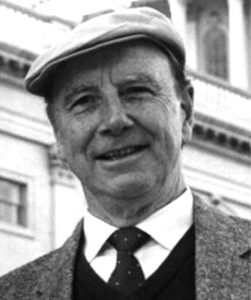
In 1968, after two decades in North America, Clancy returns to live in Carrick-on-Suir, where he purchases a dairy farm and breeds exotic cattle. When not on tour or working on his farm, he spends much of his time fishing, reading, and doing crossword puzzles. In the late 1990s, he is diagnosed with a brain tumor. The tumor is successfully removed, but he is also stricken with terminal lung cancer around the same time. He continues performing until his failing health prevents him from doing so any longer.
Patrick Clancy dies at home of lung cancer on November 11, 1998, at the age of 76. He is buried, wearing his trademark white cap, in the tiny village of Faugheen, near Carrick-on-Suir.
Although a Protestant country-gentleman, O’Brien supports Catholic Emancipation while remaining a supporter of British-Irish union. In 1843, in protest against the imprisonment of Daniel O’Connell, he joins O’Connell’s anti-union Repeal Association.
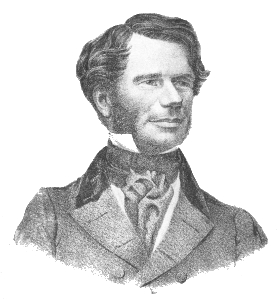
Three years later, O’Brien withdraws the Young Irelanders from the association. In January 1847, along with Thomas Francis Meagher, he founds the Irish Confederation, although he continues to preach reconciliation until O’Connell’s death in May 1847. He is active in seeking relief from the hardships of the famine. In March 1848, he speaks out in favour of a National Guard and tries to incite a national rebellion. He is tried for sedition on May 15, 1848, but is not convicted.
On July 29, 1848, O’Brien and other Young Irelanders lead landlords and tenants in a rising in three counties, with an almost bloodless battle against police at Ballingarry, County Tipperary. In O’Brien’s subsequent trial, the jury finds him guilty of high treason. He is sentenced to be hanged, drawn, and quartered. Petitions for clemency are signed by 70,000 people in Ireland and 10,000 people in England.
In Dublin on June 5, 1849, the sentences of O’Brien and other members of the Irish Confederation are commuted to transportation for life to Van Diemen’s Land, which is Tasmania in present-day Australia.
O’Brien attempts to escape from Maria Island off Tasmania but is betrayed by Captain Ellis of the schooner hired for the escape. He is sent to Port Arthur where he meets up with John Mitchel, who had been transported prior to the rebellion. The cottages which O’Brien lives in on Maria Island and Port Arthur have been preserved in their 19th century state as memorials.
Having emigrated to the United States, Ellis is tried by another Young Irelanders leader, Terence MacManus, at a lynch court in San Francisco for the betrayal of O’Brien. He is freed for lack of evidence.
In 1854, after five years in Tasmania, O’Brien is released on the condition he never return to Ireland. He settles in Brussels. In May 1856, he is granted an unconditional pardon and returns to Ireland that July. He contributes to The Nation newspaper but plays no further part in politics.
In 1864 he visits England and Wales, with the view of rallying his failing health, but no improvement takes place, and he dies at Bangor, Wales on June 16, 1864.
Delia Murphy Kiernan, singer and collector of Irish ballads, dies of a massive heart attack on February 11, 1971, five days before her 69th birthday. She records several 78 RPM records in the 1930s, 1940s, and 1950s. In 1962 she records her only LP record, The Queen of Connemara, for Irish Prestige Records, New York, on the cover of which her name appears alongside the LP title. Her notable voice gives her the nickname the “Queen of Connemara.”
Murphy is born on February 16, 1902, in Ardroe, Roundfort, County Mayo, to a well-off family. Her father, John Murphy, from nearby Hollymount, makes his fortune in the Klondike Gold Rush. While in America, he marries Ann Fanning from Roscrea, County Tipperary. They return to Ireland in 1901 and purchase the large Mount Jennings Estate in Hollymount. Murphy’s father encourages her interest in singing ballads from a young age. He also allows Irish travellers to camp on the estate. According to her own account, she learns her first ballads at their campfires.
Murphy is educated at Presentation Convent in Tuam, Dominican College in Dublin, and University College Galway (UCG), where she graduates with a Bachelor of Commerce degree. While at UCG she meets Dr. Thomas J. Kiernan, and they marry in 1924, on her 22nd birthday. Kiernan then joins the Irish diplomatic service, where his first posting is to London. While there Murphy sings at many venues including many gatherings of Irish emigrants and becomes quite well-known. In 1939 she records The Blackbird, The Spinning Wheel, and Three Lovely Lassies for HMV.
In 1941, Kiernan is appointed Irish Minister Plenipotentiary to the Holy See in Rome. The Irish legation is the only English-speaking legation to remain open after the United States enters World War II. Murphy becomes one of those who assist Monsignor Hugh O’Flaherty in saving the lives of 6,500 Allied soldiers and Jews. In 1943, when Italy changes sides, many escaped POWs are helped by the legation to leave Italy.
Kiernan later serves as Irish High Commissioner and later first Ambassador in Australia, and later to West Germany, Canada, and the United States. In 1961, while living in Ottawa, Murphy makes the recording of The Queen of Connemara produced by Ken Goldstein. Murphy and Kiernan purchase a farmhouse in Jasper, Ontario, near the Rideau Canal where she spends most of her time, even after Kiernan is posted to Washington, D.C. Tom Kiernan dies in December 1967.
By 1969 Murphy’s health is in decline. In November of that year, she sells her farmhouse in Canada and returns to Ireland. She lives in a cottage in Strawberry Beds, Chapelizod, County Dublin, until her death. During her lifetime she records upwards of 100 songs.
Gilbert is born in Grange, County Sligo, on February 17, 1821. Her family makes their residence at King House in Boyle, County Roscommon, until early 1823, when they journey to Liverpool, thence departing for India on March 14. Gilbert spends much of her childhood in India but is educated in Scotland and England. At age 19 she elopes with Lieutenant Thomas James. The couple separates five years later, and, in 1843, Gilbert launches a career as a dancer. Her London debut in June 1843 as “Lola Montez, the Spanish dancer” is disrupted when she is recognized as Mrs. James. The fiasco would probably have ended the career of anyone less beautiful and determined, but Gilbert receives additional dancing engagements throughout Europe. During her travels she reputedly forms liaisons with Franz Liszt and Alexandre Dumas, among many others.
Late in 1846, Gilbert dances in Munich and Ludwig I of Bavaria is so struck by her beauty that he offers her a castle. She accepts, becomes Baroness Rosenthal and Countess of Lansfeld, and remains as his mistress. Under Gilbert’s influence, Louis inaugurates liberal and anti-Jesuit governmental policies, but his infatuation with her helps to bring about the collapse of his regime in the revolution of 1848. In March of that year Ludwig abdicates in favour of his son. Gilbert flees to London, where in 1849 she marries Lieutenant George Heald, although she has never been divorced from James. Heald later leaves her.
From 1851 to 1853 Gilbert performs in the United States. Her third marriage, to Patrick P. Hull of San Francisco in 1853, ends in divorce soon after she moves to Grass Valley, California. There, among other amusements, she coaches young Lotta Crabtree in singing and dancing. She settles in New York City after an unsuccessful tour of Australia in 1855–1856 and gathers a following as a lecturer on such topics as fashion, gallantry, and beautiful women. An apparently genuine religious conversion leads her to take up various personal philanthropies.
Gilbert publishes Anecdotes of Love; Being a True Account of the Most Remarkable Events Connected with the History of Love; in All Ages and among All Nations (1858), The Arts of Beauty, or, Secrets of a Lady’s Toilet with Hints to Gentlemen on the Art of Fascination (1858), and Lectures of Lola Montez, Including Her Autobiography (1858). The international notoriety of her heyday persists long after her death and inspires numerous literary and balletic allusions.
Gilbert spends her last days in rescue work among women. By November 1859 she is showing the tertiary effects of syphilis, and her body begins to waste away. She dies at the age of 39 on January 17, 1861. She is buried in Green-Wood Cemetery in Brooklyn, New York.
The son of Edmund Thomas and Elsie Margaret (Coyle) Keneally, he grows up in Kempsey and is educated at St. Patrick’s College, Strathfield where, subsequently, a writing prize has been named after him. Keneally enters St. Patrick’s Seminary, Manly to train as a Catholic priest. Although he is ordained as a deacon while at the seminary, he leaves without being ordained into the priesthood. He works as a Sydney schoolteacher before his success as a novelist and is a lecturer at the University of New England from 1968–1970.
Keneally is known as “Mick” until 1964 but, upon the advice of his publisher to use his real first name, begins using the name Thomas when he starts publishing. He is most famous for writing Man Booker Prize winner Schindler’s Ark (1982) which is later republished as Schindler’s List, and is later adapted to Steven Spielberg‘s Schindler’s List, which wins the Academy Award for Best Picture. Many of Keneally’s novels are reworkings of historical material, although modern in their psychology and style.
Keneally is a strong advocate of an Australian republic, meaning the abolition of the Australian monarchy, and publishes a book, Our Republic, on the subject in 1993. Several of his Republican essays appear on the web site of the Australian Republican Movement.
In March 2009, the Prime Minister of Australia, Kevin Rudd, gives an autographed copy of Keneally’s biography Lincoln to President Barack Obama as a state gift. Recently Keneally has been a featured writer in the critically acclaimed Australian drama Our Sunburnt Country.
It takes its name in memory of King William of Orange of the house of Orange who fights at the Battle of the Boyne, brings about the Glorious Revolution and the Bill of Rights giving the Westminster parliament ultimate power of the country rather than the Monarch. The Independent Order is small compared to the main organisation with 1,500 to 2,000 members. It is largely based around north County Antrim in Northern Ireland but has lodges around the world, including England, Scotland, and Australia. Its annual main Twelfth of July demonstration is held in a north Antrim town or village.
The first notable effect after the formation of the Independent Order is a more liberal interpretation of the rules of the “Old Order.” In the early years of the Institution, many suffer the full wrath of the “powers that be,” who are opposed to any splitting of the Orange Order. Jobs are lost, homes are burned, and their headquarters in Belfast is bombed.
Independent Orangeism today maintains that it is essential for the Orange Institution to be kept free from politics and to guard the principles of Reformation Protestantism. They often express alarm when they believe these principles are endangered by conciliatory politicians. They are opposed to ecumenism and, while being opposed to Orangeism being linked to the Ulster Unionist Party, they are not apolitical and tend to work alongside unionist politicians and parties.
The Institution also promotes Ulster Protestant history and proclaims the principle of “Liberty of Conscience.” They declare their right to think and act independently without direction from political or clerical masters, they seek to strengthen the position of Orangeism, and they often warn of the danger of the development of a social and cultural Orangeism devoid of Protestant principle.
Born in Waterford, to master mariner James Kelly and the former Mary Grant, Kelly is educated at Christian Brothers in Enniscorthy and the Classical Academy in New Ross.
Kelly receives his seminary formation at St. Peter’s College in Wexford and the Irish College in Rome. He is ordained at Enniscorthy on November 1, 1872, by Bishop Thomas Furlong.
Kelly serves on the staff of the House of Missions in Wexford and is made vice-Rector of the Irish College in Rome in 1891. In 1894, he is made head of Irish College. Kelly also becomes a leader in the temperance movement.
Elected Archbishop of Achrida in Partibus Infidelium and coadjutor cum jure successionis of Sydney on July 20, 1901, Kelly is Consecrated Coadjutor Archbishop on August 15, 1901, at St. Joachim’s Church, Rome, by Cardinal Francesco Satolli.
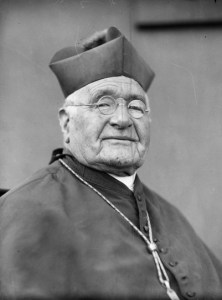
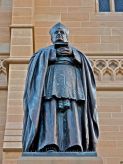
Kelly succeeds to the See of Sydney on August 16, 1911, upon the death of CardinalPatrick Francis Moran. Kelly continues his crusade for temperance in Australia. Fund-raising for schools is undertaken by Kelly, and it is estimated £12,000,000 is spent on scholastic and church properties from the time of Kelly’s arrival in Sydney until his death. St. Mary’s Cathedral is completed in 1928, and statues of Kelly and Moran stand in the main portal.
Kelly is named Bishop Assistant at the Papal Throne and Count of the Holy Roman Empire on June 25, 1926. Kelly dies in Sydney on March 8, 1940, at the age of 90. He is buried in the Kelly Memorial Chapel in the crypt of St. Mary’s Cathedral.
Due to public outcry for clemency, the men’s sentences are commuted to deportation for life. MacManus, along with O’Brien, Thomas Francis Meagher, and Patrick O’Donoghue, is transported to Van Diemen’s Land in Tasmania, Australia in 1849. They are assigned to different settlements to reduce their collaboration in the new land; however, the Irish men continue to meet secretly.
In 1852 MacManus and Meagher escape from Australia and make their way to San Francisco, California, where MacManus settles. Meagher goes on to New York City. Like other immigrants, the Irish revolutionaries carry their issues to the United States. A Captain Ellis, of a ship that is supposed to carry O’Brien to freedom, also emigrates to San Francisco. MacManus holds a lynch court of Ellis among Irish emigrants for his betrayal of O’Brien in his escape attempt from Van Diemen’s Land. The court-martial acquits Ellis for lack of evidence.
Failing to re-establish his career as a shipping agent, MacManus lives in San Francisco and dies in poverty in 1861. It is after his death, however, that he performs his most valuable service to the cause of Irish freedom. On learning of his death, American Fenian leaders decide to return his body to Ireland for burial. This foreshadows the treatment given to Jeremiah O’Donovan Rossa at his famous funeral in 1915. Crowds of Irish gather in New York as Archbishop John Hughes, like MacManus born in Ulster, blesses MacManus’ body. Thousands greet his body when it arrives in Cork and crowds gather at rail stations all the way to Dublin.
The church, in the person of Archbishop of DublinPaul Cullen, refuses permission for his body to lie-in-state at any church in Dublin. Thus, for a week MacManus’ body lies in the Mechanics’ Institute, while thousands pass by paying their respects. But Father Patrick Lavelle, a Fenian supporter, defies Cullen and performs the funeral ceremony on November 10, 1861. A crowd estimated at 50,000 follow the casket to Dublin’s Glasnevin Cemetery, and hundreds of thousands line the streets. The MacManus funeral is a seminal moment for the Fenian movement. It invigorates the nationalist movement in Ireland, just as Rossa’s funeral does 54 years later.
MacManus is notable for his statement in court in 1848 where he explains his actions by saying, “It was not because I loved England less, but because I loved Ireland more.”