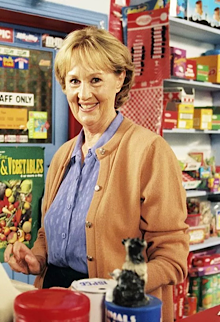
Joan O’Hara, Irish stage, film and television actress, dies in Dublin on July 23, 2007. She is one of Ireland’s most popular actresses and is, at the time of her death, recognisable to television viewers as Eunice Dunstan, a gossip in Fair City on RTÉ One.
More recently, O’Hara is best known for appearing in the popular Irish television soap operaFair City, broadcast on RTÉ One. She joins the soap in 1994, portraying the character Eunice Dunstan until her death in 2007. Thus, she is described as both one of Ireland’s most popular actresses and as one of the finest actors of her generation on her death. She admires in particular Samuel Beckett, Federico García Lorca and Ingmar Bergman. While she takes a no-nonsense approach to her craft, famously giving the advice that when in doubt, one should relate to the fireplace, she is educated at the Abbey School of Acting and has a deep appreciation and knowledge of theoretical approaches to acting and is an admirer of the European and American avant-garde. As actor Alan Stanford says after her death, “She had the most amazing energy. She was in the truest sense one of the last of the greats.”
Joan O’Hara Barry (she keeps her maiden name as her stage name) dies in Dublin on July 23, 2007, of complications from heart disease, aged 76. Her death is announced on RTÉ News the following day.
Davidson is the sixth of ten children of clerk of petty session, Edward Ellice Davidson, and Lucy Rising Davidson (née Doe). Her mother dies in 1888, and it is presumed that she receives a private education but as the family are not affluent, the details are unclear. She goes on to attend the Dublin Metropolitan School of Art (DMSA) from 1895 to 1905. While at the DMSA, she wins prizes in 1895 and 1896 and is awarded a scholarship and free studentship at the Royal Dublin Society (RDS) in 1897, the same year her father dies. She completes her studies in 1905. In the early 1910s, she is living in Rathmines and spends some time in England and Wales.
Davidson is commissioned by Switzer’s department store on Grafton Street to draw costumes in 1899. In 1909, her painting After Rain is exhibited by the Dublin Sketching Club, with her continuing to show work there until 1920. She exhibits The Bonfire with the Water Colour Society of Ireland in 1912, becoming a committee member in 1934 and continuing to exhibit with them until 1954. In 1914, she is one of the artists included in a sale of paintings to aid Belgian refugees. She is first exhibited at the Royal Hibernian Academy (RHA) in 1914, with The Student. Her painting exhibited by the RHA in 1916, The Harbour, St. Ives, demonstrates an influence from Stanhope Forbes and the Newlyn School, with a bright palette and contrasting illumination, which become characteristic of her work. She illustrates C. H. Bretherton’s collection of humorous poems and recollections about London Zoo, A Zoovenir (1919).
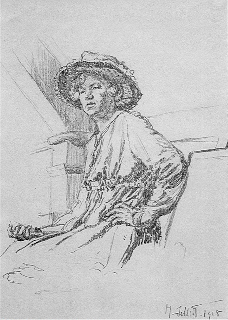
Davidson holds a joint exhibition with Mainie Jellett in 1920, at Mill’s Hall, Merrion Row, Dublin. Jellett produces a pencil portrait of Davison (pictured above), which shows her in a straw hat she frequently wears. The RHA exhibits Davidson’s oil painting, The Flax Pullers, in 1921. This work shows an influence from Paul Henry and French Impressionism in her use of colour-blocking. In the early 1920s, she travels to Switzerland, Belgium, and France, producing works such as Fish Market, Bruges. She lives in Paris in the late 1920s, exhibiting at the Salon de la Societé Nationale in 1924 and 1930. She places a self-portrait in her depiction of a peasant gathering, The Country Races. Reproductions of her drawing of Leinster House and Christ Church Cathedral by Bulmer Hobson are included in A Book of Dublin (1929). Her landscape, Low Tide, Wicklow, which is exhibited at the RHA in 1934, and Boats at Wicklow, Dusk show her ability to depict reflections in water. She continues to paint scenes of rural life, including Cottages – Keel, Achill, which shows an influence from Jack Butler Yeats in her use of space and colour. The fact that her family is not wealthy likely influences her choice of poorer people as her subjects, depicting them in a sympathetic manner. Her work is part of the painting event in the art competitions at the 1928 Summer Olympics.
Davidson’s paintings are exhibited at the Contemporary Picture Galleries, Dublin in 1930, alongside Yeats, Evie Hone, and Harry Kernoff. She is a member of the Picture Hire Club, 24 Molesworth Street, Dublin from 1941 to 1942, and is a frequent contributor to the Munster Fine Arts Club. Her work is exhibited at the Salon des Beaux Arts, Paris, the Royal Academy of Arts, London, and in Amsterdam. A large number of her works from the 1930s show the Irish-speaking area of Galway, Claddagh, such as Night in Claddagh, exhibited with the RHA in 1933. Her Irish landscapes, such as Claddagh Cottages, are included in the Oireachtas Art Exhibitions from 1932 to 1946. From around 1934, she is a member of the Society of Dublin Painters, exhibiting with them from 1939 to 1954. She influences the Society’s move toward the avant-garde in the 1940s. She is elected associate to the RHA in 1940 and continues to exhibit there until her death. Her 1946 work, Gorta, shows influence from Zola, Rilke, Dostoyevsky and Picasso.
Davidson teaches drawing at her studio at 1 Earlsfort Terrace, Dublin. Her pupils include Bea Orpen, Anne Yeats, and Mo Irwin. She also is a teacher at a number of Dublin schools, such as Belgrave school, Rathmines, Wesley College, St. Stephen’s Green, and Castle Park School, Dalkey. She travels to Abbeyleix, County Laois, once a week to teach at Glenbawn boarding school.
As well as painting, Davidson writes a number of plays, short stories, and monologues under a pseudonym, “Ulick Burke.” In 1927, a collection of her poems and Donegal rhymes is published. In 1931, Hilton Edwards directs her stage play Bride, at the Gate Theatre. Her short story, Her Only Son, is published in The Bell under a pseudonym in 1942. In 1935, she is a founder-member of the Torch Theatre, Dublin. She designs scenery, and is the co-director with Hugh Hyland in 1936, under the stage name “Jennifer Maude.”
Davidson dies at her home at 4 Wilton Terrace, Dublin on March 29, 1954. She is buried in an unmarked grave in Mount Jerome Cemetery. The National Gallery of Ireland (NGI) holds her 1938 portrait of Yeats, as well as her crayon drawing of Sarah Purser. She is a regular attendee at Purser’s “Second Tuesdays” gatherings. The Abbey Theatre holds her portrait of Joseph Holloway. She bequeaths The Golden Shawl to the Hugh Lane Gallery, which is a large self-portrait. Two of her works are included in the NGI’s 1987 exhibition, Irish Women Artists from the Eighteenth Century to the Present Day.
Seóirse Bodley, Irish composer and former associate professor of music at University College Dublin (UCD), is born George Pascal Bodley in Dublin on April 4, 1933. In 2008, he is the first composer to become a Saoi of Aosdána. He is widely regarded as one of the most important composers of twentieth-century art music in Ireland, having been “integral to Irish musical life since the second half of the twentieth century, not just as a composer, but also as a teacher, arranger, accompanist, adjudicator, broadcaster, and conductor.”
Bodley’s father is George James Bodley (1879–1956), an employee in the Dublin office of the London Midland & Scottish Railway Company, and later of the Ports and Docks Board. His mother, Mary (née Gough, 1891–1977), works for the Guinness Brewery. He attends schools in the Dublin suburbs of Phibsborough and Glasnevin before he moves at the age of nine to an Irish-speakingChristian Brothers school at Parnell Square. He later studies at the School of Commerce in Rathmines, where he obtains his Leaving Certificate.
Music is encouraged in his parents’ home, and Bodley receives initial lessons on the mandolin from his father and on the piano from his mother. He studies the piano, harmony and counterpoint at the Royal Irish Academy of Music and obtains a Licentiate in piano from Trinity College London (TCL). From the age of 13, he also enrolls for a time at the Brendan Smith Academy of Acting. While he is still at school, he receives his first lessons in composition privately from the Dublin-based German choral conductor Hans Waldemar Rosen (1904–94), which continues, on and off, until 1956. From his student days he performs as an accompanist to singers and takes part in chamber music performances. An important element in his musical education is the twice-weekly free concerts given by the Radio Éireann Symphony Orchestra in the Phoenix Hall, Dame Court, where he has the opportunity to hear leading Irish and international performers and conductors presenting both classics and modern repertory.
From 1952 Bodley studies for a Bachelor of Music degree from University College Dublin, mainly with Anthony Hughes. He obtains the degree in 1955. From 1957 to 1959 he studies composition (with Johann Nepomuk David) and conducting at the Württembergische Hochschule für Musik in Stuttgart, Germany, and a year later he obtains a Doctorate in Music from UCD. He also takes classes in conducting with Hans Müller-Kray and Karl Maria Zwißler, and in piano with Alfred Kreutz. He returns to Germany several times in the early 1960s to participate in courses at the Darmstädter Ferienkurse, which significantly expands his knowledge of avant-garde techniques.
From 1959 until his retirement in 1998, Bodley lectures at the university’s music department, becoming associate professor in 1984. During the 1960s, he is conductor of the Culwick Choral Society.
Bodley’s development as a composer sees several distinct phases. In the 1970s he merges avant-garde styles with elements from Irish traditional music and becomes a figure of national importance. He receives several prestigious commissions for large-scale works, such as Symphony No. 3 (1981), written for the opening of the National Concert Hall.
In 1982 Bodley becomes a founder-member of Aosdána and PresidentMary McAleese confers the distinction of Saoi on him in November 2008. McAleese says that Bodley “has helped us to recast what it means to be an artist in Ireland.”
Thomas F. Kilroy, Irish playwright and novelist, is born on September 23, 1934, in Green Street, Callan, County Kilkenny. He is a difficult writer to categorize, having written plays ranging from the conventional The Death and Resurrection of Mr. Roche to more technically innovative and avant-garde works such as Talbot’s Box and The Secret Fall of Constance Wilde. Nevertheless, common thematic concerns run throughout many of his plays, including the issue of personal and cultural—specifically, Irish versus English—identity and the mythologizing of the past. Best known as a playwright, he is also the author of the Booker Prize-shortlisted novel The Big Chapel (1971).
Kilroy is the son of Thomas and Mary (née Devine) Kilroy. He attends St. Kieran’s College and plays hurling for the school team, captaining the senior team in 1952. He studies at University College Dublin, where his first play, The Death and Resurrection of Mr. Roche, is produced to great success at the Olympia Theatre. In his early career he is play editor at the Abbey Theatre in Dublin. In the 1980s, he sits on the board of Field Day Theatre Company, founded by Brian Friel and Stephen Rea in 1980, and is Director of its touring company.
In 1978, Kilroy is appointed Professor of English at University College Galway, a post from which he resigns in 1989 to concentrate on writing.
In 2008, Kilroy receives the Irish PEN Award, given to honour an Irish-born writer who has made an outstanding contribution to Irish literature.
While some of Kilroy’s plays hit a lighter note than others, the common thread in most of them is his attempt to address some of the social upheavals that have occurred in Ireland in the past and present. This has been a concern of his since he was in his twenties and wrote in the 1959 essay “Groundwork for an Irish Theatre” that his contemporaries were “inclined to shirk the painful, sometimes tragic problems of a modern Ireland which is undergoing considerable social and ideological stress.” Although he has not been one of Ireland’s most prolific playwrights, his plays may certainly be considered important contributions to the modern stage.
Clarke is born in 83 Manor Street, Stoneybatter, Dublin, on May 9, 1896. His main contribution to Irish poetry is the rigour with which he uses technical means borrowed from classical Irish language poetry when writing in English. Effectively, this means writing English verse based not so much on metre as on complex patterns of assonance, consonance, and half rhyme. Describing his technique to Robert Frost, he says, “I load myself down with chains and try to wriggle free.”
Clarke’s early poetry clearly shows the influence of Yeats. His first book, The Vengeance of Fionn, is a long narrative poem retelling an Ossianic legend. It meets with critical acclaim and, unusually for a first book of poetry, goes to a second edition. Between this and the 1938 volume Night and Morning, he publishes a number of collections, all of which, to one extent or another, can be seen as being written in the shadow of Yeats. There is, however, one significant difference. Unlike the older poet, Clarke is a Catholic, and themes of guilt and repentance run through this early work.
Between 1938 and 1955, Clarke publishes no new lyric or narrative poetry. He is co-founder of the Lyric Theatre, Dublin and writes a number of verses plays for them. He also works as a journalist and has a weekly poetry programme on RTÉ radio. It seems likely that he also experiences some kind of personal crisis during this time, and this has significant consequences for his later poetry.
Clarke returns to publishing poetry with the 1955 collection Ancient Lights and is to continue writing and publishing prolifically for the remainder of his life. Although he continues to use the same Gaelic-derived techniques, this late poetry is markedly different from his earlier work. Many of the later poems are satires of the Irish church and state, while others are sensual celebrations of human sexuality, free of the guilt of the earlier poems. He also publishes the intensely personal Mnemosyne Lay in Dust, which is a poem sequence detailing the fictional Maurice Devanes’s nervous breakdown and subsequent recovery.
Clarke also comes to admire the work of more avant-garde poets like Ezra Pound and Pablo Neruda, both of whom he writes poems about. A number of the late long poems, such as, for instance, the 1971 Tiresias, show the effects of studying these poets and their looser formal structures. He sets up the Bridge Press to publish his own work, which allows him the freedom to publish work that many mainstream Irish publishers of the time might have been reluctant to handle. His Collected Poems is published in 1974 and a Selected Poems in 1976.
In addition to some twenty volumes of poetry and numerous plays, Clarke publishes three novels: The Bright Temptation (1932), The Singing Men at Cashel (1936), and The Sun Dances at Easter (1952). All of these are banned by the Censorship of Publications Board (Ireland). He also publishes two volumes of memoirs, Twice Round the Black Church (1962) and A Penny in the Clouds (1968), and a number of scattered critical essays and book reviews. While all of these prose writings are of interest, his reputation rests firmly on his poetry.
In 1920 Clarke marries Cornelia (Lia) Cummins. The marriage effectively lasts only a few days, and he spends several months in St. Patrick’s Hospital recovering from it, but they do not divorce before Cummins dies in 1943. He meets, has three sons with, and later marries (1945) Norah Esmerelda Patricia Walker (1900–1985), granddaughter of Matthew Harris, MP for East Galway from 1885 to 1890.
Clarke lives in Bridge House beside Templeogue Bridge which spans the River Dodder in the south Dublin suburb of Templeogue. After his death on March 19, 1974, there is a proposal to preserve the house and his library of 6,500 books as a memorial. This is not possible owing to long-term plans to demolish the house and widen the road. The old Templeogue Bridge, built in 1800, and Bridge House are removed. A new bridge is opened by CouncillorBernie Malone, Chairman Dublin City Council, on December 11, 1984, which is renamed Austin Clarke Bridge in his honour.
O’Hara is born and raised in Rosses Point, the daughter of Major John Charles O’Hara, an officer in the British Corps of Royal Engineers and his wife, Mai (née Kirwan). One of her sisters, Mary (born 1935), is a soprano/harpist. Her brother Dermot (born 1934) now lives with his family in Canada. She attends the same Ursulineconvent school as fellow actress and friend Pauline Flanagan.
More recently, O’Hara is best known for appearing in the popular Irish television soap operaFair City, broadcast on RTÉ One. She joins the soap in 1994, portraying the character Eunice Dunstan until her death in 2007. Thus, she is described as both one of Ireland’s most popular actresses and as one of the finest actors of her generation on her death. She admires in particular Samuel Beckett, Federico García Lorca and Ingmar Bergman. While she takes a no-nonsense approach to her craft, famously giving the advice that when in doubt, one should relate to the fireplace, she is educated at the Abbey School of Acting and has a deep appreciation and knowledge of theoretical approaches to acting and is an admirer of the European and American avant-garde. As actor Alan Stanford said after her death, “She had the most amazing energy. She was in the truest sense one of the last of the greats.”
Joan O’Hara Barry (she keeps her maiden name as her stage name) dies in Dublin on July 23, 2007, of complications from heart disease, aged 76. Her death is announced on RTÉ News the following day.
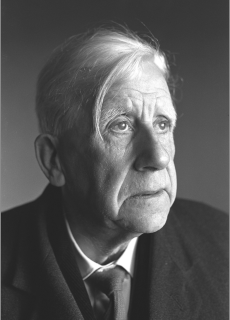
Austin Clarke, considered at his death to be the greatest poet of his generation after W. B. Yeats, is born in 83 Manor Street, Stoneybatter, Dublin, on May 9, 1896. He also writes plays, novels and memoirs. His main contribution to Irish poetry is the rigour with which he uses technical means borrowed from classical Irish language poetry when writing in English.
Effectively, this means writing English verse based not so much on metre as on complex patterns of assonance, consonance, and half rhyme. Describing his technique to Robert Frost, Clarke says, “I load myself down with chains and try to wriggle free.”
Clarke’s early poetry clearly shows the influence of Yeats. His first book, The Vengeance of Fionn, is a long narrative poem retelling an Ossianic legend. It meets with critical acclaim and, unusually for a first book of poetry, goes to a second edition. Between this and the 1938 volume Night and Morning, he publishes a number of collections, all of which, to one extent or another, can be seen as being written in the shadow of Yeats. There is, however, one significant difference. Unlike the older poet, Clarke is a Catholic, and themes of guilt and repentance run through this early work.
Between 1938 and 1955, Clarke publishes no new lyric or narrative poetry. He is co-founder of the Lyric Theatre, Dublin and writes a number of verse plays for them. He also works as a journalist and has a weekly poetry programme on RTÉ radio. It seems likely that he also experiences some kind of personal crisis during this time, and this has significant consequences for his later poetry.
Clarke returns to publishing poetry with the 1955 collection Ancient Lights and is to continue writing and publishing prolifically for the remainder of his life. Although he continues to use the same Gaelic-derived techniques, this late poetry is markedly different from his earlier work. Many of the later poems are satires of the Irish church and state, while others are sensual celebrations of human sexuality, free of the guilt of the earlier poems. He also publishes the intensely personal Mnemosyne Lay in Dust, which is a poem sequence detailing the fictional Maurice Devanes’s nervous breakdown and subsequent recovery.
Clarke also comes to admire the work of more avant-garde poets like Ezra Pound and Pablo Neruda, both of whom he writes poems about. A number of the late long poems, such as, for instance, the 1971 Tiresias, show the effects of studying these poets and their looser formal structures. He sets up the Bridge Press to publish his own work, which allows him the freedom to publish work that many mainstream Irish publishers of the time might have been reluctant to handle. His Collected Poems is published in 1974 and a Selected Poems in 1976.
In addition to some twenty volumes of poetry and numerous plays, Clarke publishes three novels: The Bright Temptation (1932), The Singing Men at Cashel (1936), and The Sun Dances at Easter (1952). All of these are banned by the Censorship of Publications Board (Ireland). He also publishes two volumes of memoirs, Twice Round the Black Church (1962) and A Penny in the Clouds (1968), and a number of scattered critical essays and book reviews. While all of these prose writings are of interest, his reputation rests firmly on his poetry.
In 1920 Clarke marries Cornelia (Lia) Cummins. The marriage effectively lasts only a few days, and he spends several months in St. Patrick’s Hospital recovering from it, but they do not divorce before Cummins dies in 1943. He meets, has three sons with, and later marries (1945) Norah Esmerelda Patricia Walker (1900–1985), granddaughter of Matthew Harris, MP for East Galway from 1885 to 1890.
Clarke lives in Bridge House beside Templeogue Bridge which spans the River Dodder in the south Dublin suburb of Templeogue. After his death on March 19, 1974, there is a proposal to preserve the house and his library of 6,500 books as a memorial. This is not possible owing to long-term plans to demolish the house and widen the road. The old Templeogue Bridge, built in 1800, and Bridge House are removed. A new bridge is opened by CouncillorBernie Malone, Chairman Dublin City Council, on December 11, 1984, which is renamed Austin Clarke Bridge in his honour.
Joyce is one of the ten children of Mary Jane “May” Murray and John Stanislaus Joyce, a professional singer and later rate-collector from a bourgeois Catholic family. He attends Clongowes Wood College, a Jesuit boarding school, until 1891, when his father’s financial worries mean they can no longer afford to send him there. He is temporarily home-schooled and spends a short time at a Christian Brothers school, before starting at Belvedere College, a Jesuit day school run by his old Clongowes headmaster, Father John Conmee.
Much of Joyce’s childhood is influenced by his charismatic, but increasingly alcohol-dependent and difficult father, whose ongoing financial troubles led to regular domestic upheaval. However, John Joyce’s passions, eccentricities, as well as his gift as a singer are celebrated in his son’s work. The death of the Irish Home Rule movement leader Charles Stewart Parnell in 1891 is a watershed moment in Joyce’s life and is the subject of an inflammatory argument during a Christmas dinner, in which John Joyce and his friend John Kelly passionately defend Parnell from the accusations of the pious Elizabeth Conway. Joyce recreates the scene in A Portrait of the Artist as a Young Man, portraying Kelly’s character, Mr. Casey, crying loudly with a “sob of pain,” “Poor Parnell! … My dead king!”
Joyce attends University College Dublin in 1899-1902, where he studies modern languages, with Latin and logic. In 1902 he goes to Paris with an intent of studying medicine but discovers, on arrival, that he does not have the necessary qualifications. He constantly struggles for money, relying on irregular work as a teacher, bank employee, cinema-owner and tweed-importer, and on patrons and supporters such as Harriet Shaw Weaver and Ezra Pound.
Joyce returns to Ireland in 1903 after his mother falls ill. She dies in August 1903. He refuses to take the sacraments or kneel at her deathbed, and the guilt he later feels is depicted in Ulysses when the ghost of Stephen’s mother returns to haunt him. On June 16, 1904, he meets Nora Barnacle, the woman with whom he spends the rest of his life. By autumn, he is convinced of the impossibility of remaining in Ireland and persuades Nora to travel with him. They arrive in Paris on October 9, 1904. He would not return to Ireland to live. He cultivates a sense of himself as an exile, living in Trieste, Zürich, Rome and Paris.
Joyce’s first publication in 1907 is the poetry collection Chamber Music. When he sends Pound a revised first chapter of Portrait of an Artist as a Young Man, along with the manuscript of his short story collection Dubliners, Pound arranges for Portrait to be published serially in the modernist magazine The Egoist between 1914 and 1915. His short story collection, Dubliners, had been delayed by years of arguments with printers over its contents, but is also published in 1914.
Joyce then begins work on Ulysses, an experimental account of a single day in Dublin. The novel is serialised between 1918 and 1920, but full publication is delayed due to problems with American obscenity laws. The work is finally published in book form by his friend Sylvia Beach in Paris in 1922. His play Exiles is first performed in German in 1919, and English in 1926. His last novel, Finnegans Wake (1939), is an innovative language experiment that contains over 40 languages and a huge variety of popular and arcane references.
On January 11, 1941, Joyce undergoes surgery in Zürich for a perforated duodenal ulcer. He falls into a coma the following day. He awakes at 2:00 AM on January 13, 1941, and asks a nurse to call his wife and son, before losing consciousness again. They are en-route when he dies 15 minutes later, less than a month short of his 59th birthday. He is buried in the Fluntern Cemetery, Zürich.
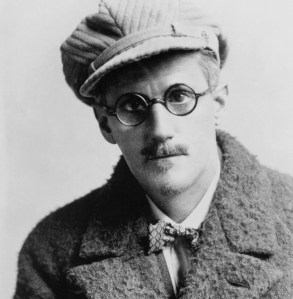
Joyce is born on February 2, 1882, in the wealthy Rathgar suburb of Dublin. The family is initially well off as Dublin merchants with bloodlines that connected them to old Irish nobility in the country. James’ father, John Stanislaus Joyce, is a fierce Irish Catholic patriot and his political and religious influences are most evident in Joyce’s two key works A Portrait of the Artist as a Young Man (1916) and Ulysses (1922).
The Joyce family is repeatedly forced to move to more modest residences due to their steadily diminishing wealth and income. John Joyce’s habitual unemployment as well as his drinking and spending habits make it difficult for the Joyces to retain their social standing. As a young man, Joyce is sent away to the renowned Clongowes Wood College in County Kildare in 1888, a Jesuit institution regarded as the best preparatory school in Ireland. The Clongowes school figures prominently in Joyce’s work, specifically in the story of his recurring character Stephen Dedalus. Joyce earns high marks both at the Clongowes School and at Belvedere College in Dublin where he continues his education. At this point in his life, it seems evident that Joyce is to enter the priesthood, a decision that would please his parents. However, as Joyce makes contact with various members of the Irish Literary Renaissance, his interest in the priesthood wanes. Joyce becomes increasingly critical of Ireland and its conservative elements, especially the Church.
Against his mother’s wishes, Joyce leaves Ireland in 1902 to pursue a medical education in Paris and does not return until the following year upon receiving news of his mother’s debilitation and imminent death. After burying his mother, Joyce continues to stay in Ireland, working as a schoolteacher at a boys’ school, another autobiographical detail that recurs in the story of Stephen Dedalus. After barely spending a year in Dublin, Joyce returns to the Continent, drifting in and out of medical school in Paris before taking up residence in Zurich. It is during this period that Joyce begins writing professionally.
In 1905, Joyce completes a collection of eight stories entitled Dubliners, although it is not actually printed until 1913. During these frustrating and impoverished years, Joyce heavily relies upon the emotional support of Nora Barnacle, his unmarried Irish lover, as well as the financial support of his younger brother, Stanislaus Joyce. Both Nora and Stanislaus remain as protective, supporting figures for the duration of Joyce’s life. During the eight years between Dubliners‘ completion and publication, Joyce and Barnacle have two children, a son named Giorgio, and a daughter named Lucia.
Joyce’s next major work, A Portrait of the Artist as a Young Man, appears in serialized form in 1914 and 1915. Joyce is “discovered” by Ezra Pound and the complete text is printed in New York City in 1916, and in London in 1917. It is with the assistance of Pound, a prominent literary figure of the time, that Joyce comes into contact with Harriet Shaw Weaver, who serves as both editor and patron while Joyce writes Ulysses.
When Ulysses is published in Paris in 1922, many immediately hail the work as genius. With his inventive narrative style and engagement with multiple philosophical themes, Joyce has established himself as a leading Modernist. The novel charts the passage of one day, June 16, 1904, as depicted in the life of an Irish Jew named Leopold Bloom, who plays the role of a Ulysses by wandering through the streets of Dublin. Despite the fact that Joyce is writing in self-imposed exile, living in Paris, Zurich, and Trieste while writing Ulysses, the novel is noted for the incredible amount of accuracy and detail regarding the physical and geographical features of Dublin.
Similar in theme to Joyce’s previous works, Ulysses examines the relationship between the modern man and his myth and history, focusing on contemporary questions of Irish political and cultural independence, the effects of organized religion on the soul, and the cultural and moral decay produced by economic development and heightened urbanization. While Joyce is writing it, there is serious doubt as to whether Ulysses will be completed. Midway through his writing, Joyce undergoes the first of eleven eye operations to salvage his ever-worsening eyesight. At one point, a disappointed Joyce casts the bulk of his manuscript into the fire, but Nora Barnacle immediately rescues it.
While Ulysses is hailed by some, the novel is banned in both the United Kingdom and the United States on obscenity charges. It is not until 1934 that Random House wins a court battle that grants permission to print and distribute Ulysses in the United States. The novel is legalized in Britain two years later.
By this time, Joyce is approaching the end of his public career and has concluded work on his final novel, Finnegan’s Wake (1939). Considered to be far more baffling and convoluted than Ulysses, Finnegan’s Wake is a critical failure. At the outbreak of World War II, Joyce remains in Paris until he is forced to move, first to Vichy, and then to Switzerland. On January 13, 1941, Joyce dies of a stomach ulcer at the age of 58 and is buried in Zurich’s Fluntern Cemetery.





 seamus dubhghaill