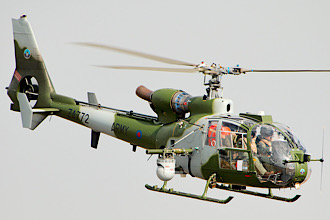
By early 1978, the British Army forces involved in Operation Banner have recently replaced their aging Bell H-13 Sioux helicopters for the more versatile Aérospatiale Gazelles. The introduction of the new machines increases the area covered on a reconnaissancesortie as well as the improved time spent in airborne missions. In the same period, the Provisional IRA receives its first consignment of M60 machine guns from the Middle East, which are displayed by masked volunteers during a Bloody Sunday commemoration in Derry. Airborne operations are crucial for the British presence along the border, especially in south County Armagh, where the level of IRA activity means that every supply and soldier has to be ferried in and out of their bases by helicopter since 1975.
The Royal Green Jackets have been in South Armagh since December 1977, and have already seen some action. Just a few days after arrival, two mortar rounds hit the C Company base at Forkhill, injuring a number of soldiers. In the aftermath of the attack, two Royal Ulster Constabulary (RUC) officers are wounded by a booby trap while recovering the lorry where the mortar tubes are mounted. Two days later, a patrol near the border suffers a bomb and gun attack, leaving the commanding sergeant with severe head wounds. The sergeant is picked up from the scene by helicopter. He is later invalided from the British Army as a result of his injuries.
On January 17, 1978, a Royal Green Jackets observation post deployed around the village of Jonesborough begins to take heavy fire from the “March Wall,” which draws parallel with the Irish border to the east, along the Dromad woods. The soldiers return fire, but the short distance to the border and the open ground prevents them from advancing.
The Commanding Officer, Lieutenant Colonel Ian Corden-Lloyd, along with Captain Philip Schofield and Sergeant Ives fly from the battalion base at Bessbrook Mill to assess the situation and provide information to the troops. They are escorted by a Scout helicopter with an Airborne Reaction Force (ARF), comprising a medic and three soldiers from the 2nd Battalion Light Infantry. While hovering over the scene of the engagement, the Aérospatiale Gazelle receives a barrage of 7.62 mm tracer rounds. The pilot loses control of the aircraft during a turn at high speed to avoid the stream of fire. The Aérospatiale Gazelle hits a wall and crashes in a field, some 2 km from Jonesborough. According to the crew and passengers of the Scout, the Aérospatiale Gazelle hits the ground twice after losing power, with its rotor blades trashing into the soil following the second impact, and then cartwheels across the field. The Scout lands the ARF while still under IRA fire. The soldiers rush to the wrecked helicopter, some 100 metres away from the site of the initial crash.
Corden-Lloyd is killed and the other two passengers are wounded. The machine comes to rest on its right side. The pilot remains trapped inside the wreckage, but he survives thanks to his helmet. The IRA later claim they had shot at the helicopter with an M60 machine gun. The IRA unit vanishes into the Dromad woods to the Republic of Ireland. Some Gardaí witness the attack from the other side of the border.
The gun battle and Aérospatiale Gazelle shootdown is displaced from the headlines by the deaths of twelve civilians in the La Mon restaurant bombing on the same day, some of whom are burned to death. Initially the British Army downplays the IRA’s claim as published by An Phoblacht, that the helicopter was shot down, on the basis that no hits were found on the wreckage, but finally they acknowledged that the IRA action had caused the crash.
The death of Corden-Lloyd, a former Special Air Service officer, is deeply regretted by the British Army, who regarded him as promising. He is awarded a posthumous mentioned in despatches “in recognition of gallant and distinguished service in Northern Ireland.” In 1973, Irish republicans had accused Corden-Lloyd and his subordinates of brutality against Belfast Catholics during an earlier tour of the Royal Green Jackets in 1971, at the time of Operation Demetrius.
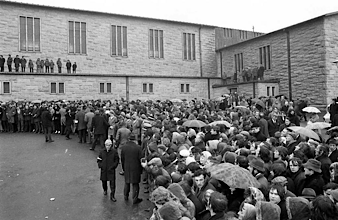
The funerals of eleven of those killed on Bloody Sunday take place on February 2, 1972. Prayer services are held across Ireland. In Dublin, over 30,000 march to the British Embassy, carrying thirteen replica coffins and black flags. They attack the Embassy with stones and bottles followed by petrol bombs. The building is eventually burned to the ground.
On the morning of Bloody Sunday, January 30, 1972, the 1st Battalion of the British Parachute Regiment enters Derry to assume their positions. The planned march is due to start at Bishop’s Field in the Cregganhousing estate and continue to the Guildhall in the city center, where the day is to end in a peaceful rally. Ten to fifteen thousand people set off at 2:45 p.m.
The march makes its way down William Street, but when it approaches the city center, the protestors find their way blocked by the British Army. At approximately 3:45 p.m., the organizers tell the protestors to change the direction of the march to go down Rossville Street, intending to hold the rally at Free Derry Corner instead. Most of the marchers follow the organizers’ instructions. At this point, some protestors break away from the march and start throwing stones at the soldiers handling the barriers. The soldiers fire rubber bullets, tear gas, and water cannons at the breakaway contingent. At this stage, witnesses report that the discord is no more violent than usual. Some of the rioters continue throwing rocks at the soldiers, but they are not close enough to the military men to inflict any damage. At about 3:55 p.m., the paratroopers start firing at the protestors. More than one hundred rounds are fired by the soldiers, who do not issue a warning before they open fire. In total, of the 26 civilians who are shot, 13 died that day, and one dies more than four months later.
On February 2, 1972, the funerals of eleven of the dead are held. Thousands of mourners gather at St. Mary’s Church for a mass funeral, with Northern IrelandMPBernadette Devlin in attendance. The event is a significant demonstration of the civil rights movement’s commitment to the cause of the victims and their families. The funeral procession is a symbol of the ongoing struggle for civil rights and justice in Northern Ireland.
The Republic of Ireland holds a national day of mourning, while a general strike is held the same day. The strike is the largest that Europe has seen since World War II in relation to the size of Ireland’s population. Catholic and Protestant churches as well as synagogues hold memorial services across Ireland. In Dublin, between 30,000 and 100,000 march to the British Embassy carrying thirteen coffins and black flags. A crowd later attacks the embassy, burning the Chancery down to the ground.
With a report due on Monday, January 31, and widely expected to state that the IRA is not ready to disarm, the Northern Ireland peace process appears headed for a fresh crisis. The report by Canadian Gen. John de Chastelain, head of the province’s independent commission overseeing the handing in of weapons, is expected to confirm that no arms have been turned in.
The Ireland on Sunday newspaper says de Chastelain will tell the British and Irish governments that the IRA has put most of its weapons into secret, sealed dumps in the Republic of Ireland. Such disclosures put enormous pressure on Adams, the leader of the Irish republican political party, Sinn Féin.
The UUP, the province’s main Protestant political group, has already threatened to pull out of Northern Ireland‘s fledgling power-sharing government if the IRA does not start disarming.
The UUP calls a top-level party meeting for February 12. A negative report from the decommissioning body will heighten fears that UUP leader David Trimble will make good on his threat to resign as leader of the new government, effectively allowing his party to shut down the province’s first government in 25 years.
Of Adams’s role in the disarmament process, Trimble says, “He asked us to create the circumstances to help him … we did that … we took the risk and created the situation he asked us to create. “Now we hope he now is able to demonstrate his good faith by responding.”
Adams says, “I am concerned at what appears to be an attempt by unionists to hijack the entire process, put up unilateral demands, perhaps in the course of that, tear down the institutions that are only two months in being. I understand why unionists want decommissioning. It is just not within my grasp to deliver it on their terms, and neither is it my responsibility.”
Adams says he can give no assurances that the IRA will hand over its weapons by May 22, the date set by the 1998 Good Friday Agreement for the completion of disarmament, although he stresses he is committed to decommissioning. “No, I can’t and it isn’t up to me,” Adams tells BBC Television when asked if he can guarantee disarmament by May.
Political insiders hint that the report will not be published until Monday (January 31) afternoon, suggesting the highly sensitive document is still being worked on by de Chastelain.
Any unionist pullout from the home-rule government on February 12 will create a political vacuum. Britain may intervene before that to suspend the fledgling executive, in the hope that it can be resurrected quickly if progress eventually is made on disarmament. Sinn Féin warns that either course of action could lead to the IRA breaking off contact with de Chastelain and the ending of disarmament prospects.
Meanwhile, on the eve of the report, thousands of Roman Catholics mark an event and day that symbolizes the province’s past troubles — Bloody Sunday.
Waving Irish flags, some 5,000 protesters retrace the steps of a civil rights march in Londonderry in 1972 that ended in bloodshed when British troops fired on unarmed protesters and killed thirteen people, mostly teenagers. A fourteenth man died later from his wounds. Victims’ relatives and local children carry fourteen white crosses, photos of the dead and a banner that reads, “Bloody Sunday, the day innocence died.” The march passes the scene of the killings and ends in front of Londonderry’s city hall — a spot where the 1972 march was supposed to have finished.
Organizers issue a message to British Prime MinisterTony Blair that they want a forthcoming inquiry not to end in the same way as a probe held within months of the killings, which exonerated the British soldiers by suggesting that some of the victims had handled weapons that day. “Twenty-eight years on from Bloody Sunday, there is still no recognition of the role the British government played in the premeditated attack on unarmed demonstrators,” Barbara de Brun, a top IRA official, tells the crowd.
Relatives of those killed are upset that soldiers who took part in the shootings would be allowed to remain anonymous during the new probe. They are also concerned about a newspaper report that the army recently destroyed thirteen of the rifles used by the soldiers, complicating any ballistics tests at the inquiry.
“Once again, the political and military establishment are up to their old tricks. We won’t accept a public relations exercise,” Alana Burke, who was injured by an armored car during the Bloody Sunday march, tells the crowd.
(From: “Hopes dim for IRA disarmament, peace accord” by Nic Robertson and Reuters, CNN, cnn.com, January 30, 2000)
The official statement at the end of the four-hour meeting states that progress has been made in “areas of consultation and co-operation.” The Taoiseach says they discussed industry, tourism, electricity supply, and trade, as well as tariff concessions, and “measures taken by both governments to prevent the spread of foot-and-mouth disease from Britain.”
Afterward, O’Neill returns to Northern Ireland by a different route in order to avoid any possible demonstration. Paisley has been developing a high profile for himself with his attacks on O’Neill in recent months. But he misses the opportunity to protest on this occasion. The next day he issues a statement regretting O’Neill’s return home. “I would advise Mr. Lynch to keep him,” Paisley announces.
Five years earlier, in 1963, O’Neill becomes Prime Minister of Northern Ireland. From very early on, he tries to break down sectarian barriers between the two Northern communities. He also seeks to improve relations with the Republic of Ireland by eradicating the impasse in relations that has existed since the 1920s. He invites then-Taoiseach Seán Lemass to meet him at Stormont on January 14, 1965. Lemass courageously accepts the invitation. At their initial meeting, when they are briefly alone, Lemass says to O’Neill, ”I shall get into terrible trouble for this!” The Northern premier replies, ”No, Mr. Lemass, it is I who will get into terrible trouble.”
O’Neill makes his return visit to Dublin on February 9, 1965, and the two leaders agree to co-operate on tourism and electricity. It is Lemass who makes the most significant concessions, because the Constitution of Ireland does not recognise the existence of the North. Article 2 of the Constitution actually claims sovereignty over the whole island. Thus, by formally meeting the Prime Minister of Northern Ireland, O’Neill claims that Lemass accorded him “a de facto recognition.”
The Taoiseach then bolsters this at their follow-up meeting in Iveagh House, Dublin, three weeks later. ”The place card in front of me at Iveagh House bore the inscription, Prime Minister of Northern Ireland,” O’Neill proudly explains. Surely this is tantamount to formal recognition. But many Unionists still have grave reservations about dealing with the Republic of Ireland.
In 1966, Ian Paisley establishes the Protestant Unionist Party (PUP) to oppose O’Neill. He rouses sectarian tension by holding mass demonstrations at which he brands O’Neill as the “Ally of Popery.” Nevertheless, public opinion polls indicate support for O’Neill’s leadership from both communities in the North.
After Jack Lynch replaced Lemass as Taoiseach in late 1966, O’Neill continues with his efforts to improve relations with the Dublin government by inviting Lynch to Stormont Castle. The Taoiseach travels to Belfast by car on December 11, 1967. There is no formal announcement of his visit, but word is leaked to Paisley after the Taoiseach’s car crosses the border.
Paisley arrives at Stormont with his wife and a handful of supporters, just minutes before the Taoiseach. With snow on the ground, two of Paisley’s church ministers, Rev. Ivan Foster and Rev. William McCrea, begin throwing snowballs at Lynch’s car. The Royal Ulster Constabulary (RUC) promptly grabs the two ministers. While they are being bundled into a police car, Paisley is bellowing, “No Pope here!” Lynch asks his traveling companion, T. K. Whitaker, “Which one of us does he think is the Pope?”
Paisley demands to be arrested by the RUC, and actually tries to get into the police car with his two colleagues, but he is pulled away. The two clergymen are taken to an RUC station and quickly released. Lynch ridicules the protest. “It was a seasonal touch,” he says. “It reminds me of what happens when I go through a village at home and the boys come and throw snowballs.”
Paisley says he had come to protest against “the smuggling” of Lynch into Stormont. If he had known about the visit earlier, he says that he would have brought along 10,000 people to protest. Denouncing O’Neill, as a “snake in the grass,” he goes on to accuse Lynch of being “a murderer of our kith and kin.” In an editorial, the Unionist Newsletter proclaims that ”there is no doubt that Capt. O’Neill has the full support of his colleagues and of the country.”
O’Neill’s four formal meetings with Lynch and his predecessor contribute to a thaw in relations at the summit between Belfast and Dublin, but the whole process is exploited by others to fan the flames of Northern sectarianism.
People do not realise it in early 1968, but Northern Ireland is about to explode. On October 5, 1968, people gather in Derry for a civil rights march that has been banned by Stormont. When the march begins, it is viciously attacked by the RUC. This ignites a series of further protests, which ultimately leads to Bloody Sunday, and the eruption of the Troubles for the next quarter of a century.
(From: “Meetings helped thaw relations before the North exploded,” Irish Examiner, http://www.irishexaminer.com, January 8, 2018)
McCartney takes part in the civil rights march in Derry on January 30, 1972, an event widely known as Bloody Sunday. One of his cousins, James Wray, is one of fourteen men shot and killed by the 1st Battalion, Parachute Regiment of the British Army on that march. As a result of this incident, he joins the Provisional IRA several months later. In 1974, Martin McGuinness, who commands the IRA in Derry, instructs him to beat up an Irish National Liberation Army (INLA) man, Patsy O’Hara, who McGuinness calls a “scumbag” and a “hood.” On January 12, 1979, at Belfast‘s Crown Court, he and another man, Eamonn MacDermott, are convicted of the murder of Detective Constable Patrick McNulty of the Royal Ulster Constabulary (RUC), who was shot several times outside a garage in Derry on January 27, 1977. He is also convicted of IRA membership and the murder of businessman Jeffery Agate in February 1977 and is sentenced to life imprisonment. The murder convictions are overturned in 2007.
McCartney spends 53 days on hunger strike, from October 27 to December 18. From 1989–91 he is Officer Commanding of the IRA prisoners in the H-Blocks and is released in 1994.
Following his release, McCartney is active with ex-prisoners’ groups Tar Abhaile and Coiste na n-Íarchimí, and is the first member of Sinn Féin to hear his own voice heard on television after the lifting of the British broadcasting ban in 1994. He is arrested on April 4, 2002, following a breach of security at Belfast’s police headquarters, but is released without charge the following day. Later that year, on September 5, he is the first former IRA member to appear before the Bloody Sunday Inquiry, and encourages anyone with information, including paramilitaries, to come forward. He is a member of the Legislative Assembly (MLA) for Foyle from July 15, 2004, until February 3, 2020.
On February 15, 2007, McCartney and MacDermott have their murder convictions quashed by the Court of Appeal, following an investigation by the Criminal Cases Review Commission (CCRC) in 2002. The Secretary of State for Northern Ireland declines to compensate McCartney and MacDermott on the grounds that they have not proven themselves innocent. The decision is appealed to the Supreme Court of the United Kingdom which, in May 2011, finds in favour of the applicants, opening the way for a substantial compensation claim from both for their prison terms of 15 and 17 years.
McKeague is born in 1930 at Messines Cottage, Bushmills, County Antrim, Northern Ireland, one of six children of Thomas McKeague and his wife, Isabella. The family operates a guesthouse in Portrush before moving to Belfast, where they open a stationer’s shop on Albertbridge Road. It is inherited by McKeague and in the late 1970s it becomes a confectioner’s shop and café.
In 1969, McKeague and his associates take over the nascent Shankill Defence Association (SDA), which had been formed to oppose a destructive redevelopment scheme. He becomes its chairman and, despite his outsider status and eccentricities, is given to strutting around wearing a helmet and brandishing a stick, often seen as offering communal defence against a perceived Catholic threat. The organisation acquires 1,000 members. In August 1969, he orchestrates mob attacks on Catholic enclaves in Belfast, including Bombay Street. He boasts of these activities, becoming a figure of hate for Catholics. In October 1969, he is arrested and charged with conspiracy to cause an explosion but is cleared in February 1970. The sentence is reduced to three months on appeal. He testifies before Justice Leslie Scarman‘s tribunal, appointed to inquire into the unrest. In the course of his evidence, he exults over the August 1969 riots and the tribunal’s report condemns him by name. He later further enrages Catholics by calling the events of Bloody Sunday in January 1972 “Good Sunday” in a television interview.
McKeague seeks publicity and power, but his eccentricity and unwillingness to participate where he cannot command dooms his political ambitions. In the 1970 United Kingdom general election he wins only 441 votes in Belfast North. He is expelled from the UPV after being prosecuted in February–March 1970 over the loyalist bombing campaign of 1969, even though he is acquitted. He and Ian Paisley exchange bitter invective and he subsequently supports William Craig‘s Vanguard movement. In 1971, he and two associates are prosecuted under the new Incitement to Hatred Act for publishing a Loyalist song book, which includes verses, probably composed by McKeague, reveling in the murder of Catholics. The defendants plead that the book is purely a historical record, and their acquittal vitiates the act. After he quarrels with the newly formed Ulster Defence Association (UDA), which is created by a federation of the SDA with other local vigilante groups, his elderly mother is burned alive when the UDA petrol-bombs the family shop on May 9, 1971.
Early in 1972 McKeague is expelled from the SDA. He founds the Red Hand Commandos (RHC), centered on east Belfast and north Down, which perpetrates numerous sectarian murders. As RHC leader, he allegedly participates in murders involving torture and mutilation. He aligns the RHC with the UVF in 1972 and in February 1973 he is one of the first loyalist internees. He is subsequently imprisoned for three years for armed robbery, although he always asserts his innocence of this charge. During his imprisonment he assumes a leadership role among loyalist prisoners, undertaking two short hunger strikes in protest against the Special Powers Act and prison conditions. Later, in December 1981, he acts as an intermediary during a loyalist prison protest. On his release in 1975, the RHC splits and thereafter he denies any connection with the organisation, threatening to sue newspapers that link him with it. Until his death he is co-chair of the Ulster Loyalist Central Co-ordinating Committee (ULCCC), a paramilitary umbrella group established in 1974. On October 6, 1975, a Catholic customer is killed and McKeague’s sister severely injured when his shop is bombed by the Irish Republican Army (IRA).
From the mid-1970s McKeague advocates negotiated independence for Northern Ireland, arguing that this can accommodate republican anti-British feeling and unionist fears of a united Ireland. “The days of the Orange card are gone forever,” he says (Sunday World, January 31, 1982). He is a founder and deputy leader of the minuscule Ulster Independence Association and suggests that the “Londonderry Air” become Ulster‘s national anthem. In talks with nationalists and republicans, he tells the Catholic priest Des Wilson that a united Ireland would be acceptable to Protestants, provided “we enter as a free people, even if we’re only independent for five minutes.” However, his record is an insuperable barrier to these initiatives.
In his last years, McKeague is chairman of the Frank Street–Cluan Place–Stormont Street Housing Association. He lobbies for a security wall to shield this Protestant district of Belfast from the Catholic Short Strand on which it borders. Construction of the wall begins just before his death. He is shot dead by the INLA at his shop on Albertbridge Road on January 29, 1982. Shortly before his death, he is linked to the rape and prostitution of teenage boys at Kincora Boys’ Home in east Belfast. He had apparently been an informer to the security forces, and it is sometimes suggested that his murder is part of an official cover-up. He is buried in Bushmills, with Church of Ireland rites.
McKeague exemplifies the social deviant who can gain prominence during political instability, projecting and legitimising his hatreds and obsessions through extremist politics. In his last years, he accepts that he will die violently. He says that if loyalists kill him, “I want . . . to be left in the Republican area so that they’re blamed” (Sunday World, January 31, 1972).
(From: “McKeague, John Dunlop” by Patrick Maume, Dictionary of Irish Biography, http://www.dib.ie, October 2009)
Logue grows up outside the village of Claudy in County Londonderry, the eldest of nine children born to Denis Logue, a bricklayer, and Kathleen (née Devine). He gains a scholarship to St. Columb’s College which he attends from 1961 to 1967. In 1967, he commences at St. Joseph’s Teacher Training college (Queen’s University) in Belfast from which he qualifies as a teacher of Mathematics in 1970. He first comes to prominence as a member of the executive of the Northern Ireland Civil Rights Association (NICRA), the only SDLP member of the executive. He stands as a candidate in elections to the new Northern Ireland Assembly in 1973 and is elected for Londonderry, at the age of 24, the youngest candidate elected that year. With John Hume and Ivan Cooper, he is arrested by the British Army during a peaceful demonstration in Londonderry in August 1971. Their conviction is ultimately overturned by the Law LordsR. (Hume) v Londonderry Justices (972, N.I.91) requiring the then British Government to introduce retrospective legislation to render legal previous British Army actions in Northern Ireland.
The Northern Ireland State Papers of 1980 show that together with John Hume and Austin Currie, Logue plays a key role in presenting the SDLP’S ‘Three Strands’ approach to the Thatcher Government’s Secretary of State for Northern IrelandHumphrey Atkins in April 1980. The “Three Strands” approach eventually becomes the basis for the Good Friday Agreement. The Irish State papers from 1980 reveal that he is a confidante of the Irish Government of that time, briefing it regularly on the SDLP’s outlook.
Logue is also known for his controversial comments at Trinity College Dublin at the time of the power sharingSunningdale Agreement, which many blame for helping to contribute to the Agreement’s defeat, to wit, that: [Sunningdale was] “the vehicle that would trundle Unionists into a united Ireland.” The next line of the controversial speech says, “the speed the vehicle moved at was dependent on the Unionist community.” In an article in The Irish Times in 1997 he claims that this implies that unity is always based on consent and acknowledged by Unionist Spokesman John Laird in the NI Assembly in 1973.
Logue unsuccessfully contests the Londonderry seat in the February 1974 and 1979 Westminster Elections. He is elected to the 1975 Northern Ireland Constitutional Convention and the 1982 Northern Ireland Assembly. He is a member of the New Ireland Forum in 1983. In the 1980s he is a member of the Irish Commission for Justice and Peace and plays a prominent part in its efforts to resolve the 1981 Irish hunger strike. His role is credited in Ten Men Dead: The Story of the 1981 Irish Hunger Strike by David Beresford, Biting the Grave by P. O’Malley and, more recently, in Blanketmen: An Untold Story of the H-block Hunger Strike (New Island Books, 2016) and Afterlives: The Hunger Strike and the Secret Offer that Changed Irish History (Lilliput Press, 2011) by former Provisional Irish Republican ArmyvolunteerRichard O’Rawe. Following the New Ireland Forum in 1984 and John Hume’s decision to represent the redrawn Londonderry constituency as Foyle and a safe seat, Logue leaves the Dublin-based, National Board for Science and Technology and joins the European Commission in 1984 in Brussels.
Following the 1994 Irish Republican Army (IRA) ceasefire, Logue, along with two EU colleagues, is asked by EU President Jacques Delors to consult widely throughout Northern Ireland and the Border regions and prepare recommendations for a Peace and Reconciliation Fund to underpin the peace process. Their community-based approach becomes the blueprint for the Peace Programme. In 1997, then EU President Jacques Santer asks the team, led by Logue, to return to review the programme and advise for a renewed Peace II programme. Papers published by National University Galway in 2016 from Logue’s archives indicate that he is the originator of the Peace Fund concept within the European Commission.
At the European Commission from 1984 to 1998, Logue creates Science and Technology for Regional Innovation and Development in Europe (STRIDE). In 1992, he is joint author with Giovanni de Gaetano, of RTD potential in the Mezzogiorno of Italy: the role of science parks in a European perspective and, with A. Zabaniotou and University of Thessaloniki, Structural Support For RTD.
Further publications by Logue follow: Research and Rural Regions (1996) and RTD potential in the Objective 1 regions (1997). With the fall of the Berlin Wall, his attention turns to Eastern Europe and in March 1998 publishes a set of studies Impact of the enlargement of the European Union towards central central and Eastern European countries on RTD- Innovation and Structural policies.
Logue convenes the first EU seminar on “Women in Science” in 1993 and jointly publishes with LM Telapessy Women in Scientific and Technological Research in the European Community, highlighting the barriers to women’s advancement in the Research world.
As the former vice-chairman of the North Derry Civil Rights Association, Logue gives evidence at the Saville Inquiry into Bloody Sunday. He is special adviser to the Office of First and Deputy First Minister from 1998 to 2002 and as an official of the European Commission. In 2002–03, he is a fellow of the Institute for British – Irish Studies at University College Dublin (UCD). In July 2006, he is appointed as a board member of the Irish Peace Institute, based at the University of Limerick and in 2009 is appointed Vice Chairman. He is a Life Member of the Institute of International and European Affairs.
On December 17, 2007, Logue is appointed as a director to InterTradeIreland (ITI), the North-South Body established under the Good Friday Agreement to promote economic development in Ireland. There he chairs the ITI’s Fusion programme, bringing north–south industrial development in Innovation and Research. Integrating Ireland economically is a theme of his writing throughout his career, most recently in The Irish Times and in earlier publications as economic spokesman for the SDLP. He is economist at the Dublin-based National Board for Science and Technology from 1981 to 1984.
Logue, after leaving the European Commission in 2005, becomes involved in Renewable Energy and is chairman of Priority Resources as well as a director of two companies, one in solar energy, the other in wind energy. In November 2011, he is elected to the main board of European Association of Energy (EAE).
In November 2023, Logue is awarded an honorary doctorate by the University of Galway in recognition of “a lifetime dedicated to civil rights, human rights, equality and peace in Northern Ireland, Ireland and Europe.” He donates an archive of material, more than 20 boxes of manuscripts, documents, photographs and political ephemera, on the development of the SDLP from the early 1970s to the University of Galway.
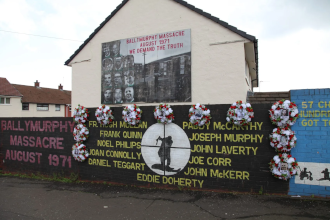
On the morning of Monday, August 9, 1971, the security forces launch Operation Demetrius, the main focus of which is to arrest and intern suspected members of the Provisional Irish Republican Army (IRA). The Parachute Regiment is selected to carry out the operation. The operation is chaotic and informed by poor intelligence, resulting in a number of innocent people being interned. By focusing solely on republicans, it excludes violence carried out by loyalistparamilitaries. Some nationalist neighbourhoods attempt to disrupt the army with barricades, petrol bombs and gunfire. In the Catholic district of Ballymurphy, ten civilians are shot and killed between the evening of August 9 and the morning of August 11, while another dies of heart failure.
Members of the Parachute Regiment state that they were shot at by republicans as they entered the Ballymurphy area and returned fire. The press officer for the British Army stationed in Belfast, Mike Jackson, later to become head of the British Army, includes a disputed account of the shootings in his autobiography, stating that those killed in the shootings were republican gunmen. This claim is strongly denied by the families of those killed in the shootings, including in interviews conducted during the documentary film The Ballymurphy Precedent. The claim is found to be without basis by a later coroner’s inquest, which establishes that those killed were “entirely innocent.”
The six civilians killed on August 9 are Francis Quinn (19), shot while going to the aid of a wounded man, Father Hugh Mullan (38), a Catholic priest, shot while going to the aid of a wounded man, reputedly while waving a white cloth to indicate his intentions, Joan Connolly (44), shot by three soldiers as she stands opposite the army base, Daniel Teggart (44), shot fourteen times mostly in the back as he lay injured on the ground, Noel Phillips (20) and Joseph Murphy (41), shot as they stand opposite the army base. Murphy is subsequently taken into army custody and after his release, as he is dying in hospital, he claims that he had been beaten and shot again while in custody. When his body is exhumed in October 2015, a second bullet is discovered in his body, which activists say corroborates his claim.
Edward Doherty (28), is shot and killed on August 10 while walking along Whiterock Road.
Another three civilians are shot on 11 August: John Laverty (20) and Joseph Corr (43) are shot at separate points at the top of the Whiterock Road. Laverty is shot twice, once in the back and once in the back of the leg. Corr is shot several times and dies of his injuries on August 27. John McKerr (49), is shot in the head by an unknown sniper while standing outside a Catholic church and dies of his injuries on August 20. While a number of eyewitnesses state that soldiers were seen shooting toward the area, the 2021 inquest cannot establish who had killed him. The coroner notes that a more specific finding is not possible, in large part, due to an “abject failing by the authorities to properly inquire into the death of [McKerr at the time].”
Paddy McCarthy (44), an eleventh civilian, dies on August 11 following an altercation with a group of soldiers. His family allege that an empty gun is put in his mouth and the trigger pulled, he suffers a heart attack and dies shortly after the alleged confrontation.
In February 2015, the conviction of Terry Laverty, younger brother of John Laverty, one of those killed, is quashed by the Criminal Cases Review Commission. He had been convicted of riotous behaviour and sentenced to six months on the eyewitness evidence of a private in the Parachute Regiment. The case is referred to court because the sole witness retracts his evidence.
In 2016, Sir Declan Morgan, the Lord Chief Justice of Northern Ireland, recommends an inquest into the killings as one of a series of “legacy inquests” covering 56 cases related to the Troubles. These inquests are delayed, as funding has not been approved by the Northern Ireland Executive. The Stormont first minister, Arlene Foster of the Democratic Unionist Party (DUP), defers a bid for extra funding for inquests into historic killings in Northern Ireland, a decision condemned by the human rights group Amnesty International. Foster confirms she has used her influence in the devolved power-sharing executive to hold back finance for a backlog of inquests connected to the conflict. The High Court says her decision to refuse to put a funding paper on the Executive basis is “unlawful and procedurally flawed.”
In January 2018, the coroner’s office announces that the inquest will begin in September 2018. On May 11, 2021, this coroner’s inquest finds that the ten civilians killed were innocent and that the use of lethal force by the British Army was “not justified.” The circumstances of the 11th death are not part of the inquest since Paddy McCarthy died from a heart attack, allegedly after being threatened by a soldier. Following the inquest verdict, Boris Johnson, the British prime minister, apologises for the deaths at Ballymurphy in a phone call to Foster and deputy First MinisterMichelle O’Neill. The lack of public apology is criticised by some relatives of the victims and Northern Irish politicians.
In May 2021, families of those shot dead by British soldiers in Ballymurphy urge the Irish government to oppose any attempt to prevent the prosecution of British soldiers alleged to have committed crimes during the Troubles.
The killings are the subject of the August 2018 documentaryThe Ballymurphy Precedent, directed by Callum Macrae and made in association with Channel 4.
On February 1, 1998, up to 40,000 people march from the nationalistCreggan estate to the Bogside area of Derry to commemorate the 26th anniversary of Bloody Sunday and to remember the 14 people who died after paratroopers opened fire during disturbances 26 years earlier. Organisers say it is one of the biggest Bloody Sunday marches to date.
Jean Heggarty, whose brother Kevin was among those killed on January 31, 1972, pays tribute to the families’ quest for truth. “The families have never doubted the truth would survive. Due to their determination 26 years later, Tony Blair stated in the House of Commons that he would establish the truth,” she says.
John Kelly, whose brother Michael was killed, says, “The families have had a long struggle but what Tony Blair has said has really surprised us. I think we are in a more jovial mood after that announcement.”
The Sinn Féin chief negotiator, Martin McGuinness, calls for prosecutions to result from the new Bloody Sunday inquiry. He says those commanding the paratroopers on the day should be called to account for their actions.
McGuinness includes in his remarks General Sir Robert Ford, who was Commander of Land Forces in Northern Ireland at the time of the killings. “I think the role of General Ford in particular is going to come under the microscope,” he says. “If people such as General Ford are found to be complicit in the killings then I think they should be subjected to proceedings in the courts. The implications of all that are enormous for the British establishment.”
In the immediate aftermath of the shootings, General Ford told the BBC that his men had returned only three shots after having between 10 and 20 rounds fired at them.
(From: “Special Report: Remembering Bloody Sunday,” BBC News, news.bbc.co.uk, February 1, 1998 | Pictured: In driving rain, relatives lay wreaths at the Bloody Sunday memorial)
The road and castle are on the northern bank of the Newry River, which marks the border between Northern Ireland and the Republic of Ireland. The Republic’s side of the river, the Cooley Peninsula in County Louth, is an ideal spot from which to launch an ambush. It is thickly wooded, which gives cover to the ambushers, and the river border prevents British forces from giving chase.
On the afternoon of August 27, a British Army convoy of one Land Rover and two four-ton lorries carrying soldiers of the 2nd Battalion, Parachute Regiment is driving from Ballykinlar Barracks to Newry. The British Army is aware of the dangers of using the stretch of road along the Newry River and often declares it out of bounds. However, they sometimes use it to avoid setting a pattern. At 4:40 p.m., as the convoy is driving past Narrow Water Castle, an 800-pound fertiliser bomb, hidden among bales of straw on a parked flatbed trailer, is detonated by remote control by IRA members watching from across the border in County Louth. The explosion catches the last lorry in the convoy, hurling it onto its side and instantly killing six paratroopers, whose bodies are scattered across the road. There are only two survivors amongst the soldiers traveling in the lorry, both of whom receive serious injuries. The lorry’s driver, Anthony Wood (19), is one of those killed. All that remains of his body is his pelvis, welded to the seat by the fierce heat of the blast.
According to the soldiers, immediately after the blast they are targeted by rifle fire from the woods on the Cooley Peninsula on the other side of the border, with this view supported by two part-time firefighters assisting the wounded. Shortly afterwards, the two IRA members arrested by the Garda Síochána and suspected of being behind the ambush, are found to have traces of gunsmoke residue on their hands and on the motorbike they are riding. The IRA’s first statement on the incident, however, denies that any shots had been fired at the troops, and according to Royal Ulster Constabulary (RUC) researchers, the soldiers might have mistaken the sound of ammunition cooking off for enemy gunfire. Nevertheless, at the official inquiry the soldiers declare on oath that they had been fired on.
The surviving paratroopers radio for urgent assistance, and reinforcements are dispatched to the scene by road. A rapid reaction unit is sent by Gazelle helicopter, consisting of Lieutenant Colonel David Blair, commanding officer of the Queen’s Own Highlanders, his signaler Lance Corporal Victor MacLeod, and army medics. Another helicopter, a Wessex, lands to pick up the wounded. Colonel Blair assumes command once at the site.
William Hudson, a 29-year-old from London, is killed by the British Army and his cousin Barry Hudson, a 25-year-old native of Dingle, is wounded when shots are fired across the Newry River into the Republic of Ireland about 3 km from the village of Omeath, County Louth.
The pair are partners in ‘Hudson Amusements’ and had been operating their amusements in Omeath for the duration of the Omeath Gala. When the first explosion is heard across the Lough, the pair go down to the shore to see what is unfolding. The pair makes their way to Narrow Water on the southern side of the border to get a better view of what is happening on the northern side. Barry Hudson is shot in the arm and as he falls to the ground he sees his cousin, who is the son of a coachman at Buckingham Palace, fall to the ground, shot in the head. He dies almost immediately.
The IRA had been studying how the British Army behaves after a bombing and correctly predicts that they would set up an incident command point (ICP) at the stone gateway on the other side of the road. At 5:12 p.m., thirty-two minutes after the first explosion, another 800-pound bomb hidden in milk pails explodes at the gateway, destroying it and hurling lumps of granite through the air. It detonates as the Wessex helicopter is taking off carrying wounded soldiers. The helicopter is damaged by the blast but does not crash.
The second explosion kills twelve soldiers, ten from the Parachute Regiment and the two from the Queen’s Own Highlanders. Lieutenant Colonel Blair is the second Lieutenant Colonel to be killed in the Troubles up until then, following Lieutenant Colonel Corden-Lloyd of the 2nd Battalion Royal Green Jackets in 1978. Only one of Colonel Blair’s epaulettes remains to identify him as his body had been vaporised in the blast. The epaulette is taken from the scene by BrigadierDavid Thorne to a security briefing with Prime MinisterMargaret Thatcher to “illustrate the human factor” of the attack. Mike Jackson, then a major in the Parachute Regiment, is at the scene soon after the second explosion and later describes seeing human remains scattered over the road, in the water and hanging from the trees. He is asked to identify the face of his friend, Major Peter Fursman, still recognisable after it had been ripped from his head by the explosion and recovered from the water by divers from the Royal Engineers.
Press photographer Peter Molloy, who arrives at the scene after the first explosion, comes close to being shot by an angry paratrooper who sees him taking photographs of the dead and dying instead of offering to help the wounded. The soldier is tackled by his comrades. Molloy says, “I was shouted at and called all sorts of things, but I understood why. I had trespassed on the worst day of these fellas’ lives and taken pictures of it.”
The Warrenpoint ambush is a victory for the IRA. It is the deadliest attack on the British Army during the Troubles and the Parachute Regiment’s biggest loss since World War II, with sixteen paratroopers killed. General Sir James Glover, Commander of British forces in Northern Ireland, later says it was “arguably the most successful and certainly one of the best planned IRA attacks of the whole campaign.” The ambush happens on the same day that Lord Mountbatten, a prominent member of the British royal family, is killed by an IRA bomb aboard his boat at Mullaghmore, County Sligo, along with three others.
Republicans portray the attack as retaliation for Bloody Sunday in 1972 when the Parachute Regiment shot dead 13 unarmed civilians during a protest march in Derry. Graffiti appears in republican areas declaring “13 gone and not forgotten, we got 18 and Mountbatten.” The day after the Mountbatten and Warrenpoint attacks, the Ulster Volunteer Force (UVF) retaliates by shooting dead a Catholic man, John Patrick Hardy (43), at his home in Belfast‘s New Lodge estate. Hardy is targeted in the mistaken belief that he is an IRA member.
Very shortly after the ambush, IRA volunteers Brendan Burns and Joe Brennan are arrested by the Gardaí. They are stopped while riding a motorbike on a road opposite Narrow Water Castle. They are later released on bail due to lack of evidence. Burns dies in 1988 when a bomb he is handling explodes prematurely. In 1998, former IRA member Eamon Collins claims that Burns had been one of those who carried out the Warrenpoint ambush. No one has ever been criminally charged.
According to Toby Harnden, the attack “drove a wedge” between the Army and the RUC. Lieutenant General Sir Timothy Creasey, General Officer Commanding Northern Ireland, suggests to Margaret Thatcher that internment should be brought back and that liaison with the Gardaí should be left in the hands of the military. Sir Kenneth Newman, the RUC Chief Constable, claims instead that the British Army practice since 1975 of supplying their garrisons in south County Armagh by helicopter gives too much freedom of movement to the IRA. One result is the appointment of Sir Maurice Oldfield to a new position of Co-ordinator of Security Intelligence in Northern Ireland. His role is to co-ordinate intelligence between the military, MI5 and the RUC. Another is the expansion of the RUC by 1,000 members. Tim Pat Coogan asserts that the deaths of the 18 soldiers hastens the move to Ulsterisation.




 seamus dubhghaill