The Rebellion comes about because of the resentment felt by the Irish Catholics, both Gael and Old English, in regard to the loss of their lands to Protestant settlers from England and Scotland.
Irish Catholics are frightened by reports that the Covenanter army in Scotland is considering an invasion of Ireland in order to eradicate the Catholic religion. At the same time, there is also a threat of invasion by Oliver Cromwell’s Puritans who are at war against King Charles I. It is hoped that the King would redress the complaints of the Catholics and halt or even reverse the policy of plantation. It is not an act of rebellion against the Royal domain.
The uprising is led by Rory O’ Moore from Leix, with Sir Phelim Roe O’ Neill and his brother Turlough of Tyrone, the Maguires of Fermanagh, the Magennis, O’ Reilly and the MacMahons. They plan to begin the rebellion on October 23, 1641, with attacks on Dublin and various other British strongholds throughout the country. However, their plans are betrayed to the British by a native Irish convert to Protestantism, Owen O’ Connolly.
As a result of this betrayal, Dublin does not fall. However, the rebellion proceeds in the north with the towns of Dungannon, Newry, and Castleblayney, along with the fort at Charlemont falling to the rebels.
Most of the province of Ulster comes under the control of the rebel leaders. The rebel army, consisting of 30,000 men, has been instructed to take no life except in battle, to arrest the gentry and to spare the Scottish planters as they are considered kindred. For a week after the rebellion, these instructions are adhered to but many of the rebels have lost their lands to the Protestant planters, and they want revenge. They attack farms and settlements, killing and turning many people away, robbing and stripping them of all their goods.
Sir Phelim O’ Neill has been himself thought to have ordered the murder of Protestants in Tyrone and Armagh. It is believed that about 12,000 people are slaughtered although contemporary reports put the death toll as much higher. It is thought that up to 30% of the Ulster planters lost their lives while 10% is the figure for the whole of Ireland.
As the rebellion progresses in Ulster there are uprisings in Leinster by November and thereafter throughout the whole of Ireland. In Munster, where many English settlers are planted, the rebels do not shed much blood, but they do turn out these settlers, many of whom flee back to England.
In 1642 the Scottish Covenanters invade the North and they, in turn, take to killing Catholics in revenge for the deaths of Protestants. The Covenanter Clan Campbell of Argyll takes the opportunity to attack and slaughter the Catholic Rathlin Islanders who belong to ancient enemies, Clan Mac Donald. The Covenanters also slaughter the approximately 3,000 Catholics on Islandmagee. Catholic prisoners and traders in Newry are murdered.
This ruthless slaughtering of civilians, by both sides, is only brought under control when Owen Roe O’ Neill arrives back from exile in France to take control of the Confederate army and, with Major General Robert Monroe in charge of the Covenanter Army, continues the war under the code of conduct that they had both learned on the Continent. However, the effects of the rebellion last to the present day, especially in Ulster where sectarian divide remains strong during The Troubles.
(Pictured: Depiction of the massacre of Ulster Protestants during the 1641 rebellion, The LIFE Picture Collection via Getty Images)
Henry Luttrell, Irish soldier known for his service in the Jacobite cause, is murdered in Dublin on October 22, 1717, a case that has never been solved. A career soldier, he serves James II in England until his overthrow in 1688. In Ireland he continues to fight for James, reaching the rank of General in the Irish Army.
Luttrell is born in 1655, the second son of Thomas Luttrell of Luttrellstown Castle in County Dublin, an Irish landowner of Catholic heritage. He spends his early life on the Continent, where he kills the so-called 3rd Viscount Purbeck in a duel at Liège.
Following the disintegration of the English Army and William’s capture of London, Luttrell goes to Ireland. He joins the Irish Army under the command of Richard Talbot, 1st Earl of Tyrconnell, which has remained loyal to James and is undergoing a major expansion. He and other Catholic officers flock to the army, while Protestants are purged. Protestant inhabitants in Ireland rise, proclaiming their loyalty to William of Orange. While an uprising at Bandon in County Cork is quickly put down, a lengthy Siege of Derry begins. He is given command of a cavalry regiment. He also sits in the Patriot Parliament called by King James, as a representative for County Carlow.
In 1689 Luttrell is made Governor of Sligo, which had recently been recaptured from the enemy by Patrick Sarsfield. He immediately sets about improving the town’s fortifications. He is a friend and supporter of Sarsfield and backs his policy of continued resistance following the Jacobite defeat the Battle of the Boyne in 1690.
Luttrell’s precipitate withdrawal with the cavalry of the left flank at the Battle of Aughrim gives rise to suspicions of disloyalty. During the Siege of Limerick, he is found to be in correspondence with the besiegers, and scarcely escapes hanging, bringing his regiment of horse over to the Williamite side after the surrender of the city. As a reward, he receives the forfeited estates of his elder brother, Simon Luttrell, including Luttrellstown, and is made a major general in the Dutch army.
Luttrell attempts to deprive his brother’s widow, Catherine, of her jointure by discreditable means, but is ultimately obliged to yield it to her.
On October 13, 1704, Luttrell marries Elizabeth Jones and has two sons: Robert Luttrell (d. 1727), and Simon Luttrell, 1st Earl of Carhampton (1713–1787).
Luttrell is shot and mortally wounded in his sedan chair on the night of October 21, 1717, on the Blind-quay in Dublin as he is proceeding from Lucas’ Coffee House on Cork-hill to his house in Stafford Street. He dies the following day, at the age of sixty-three. Despite large rewards, the murderers are never apprehended.
His grandson, Henry Luttrell, 2nd Earl of Carhampton, sells Luttrellstown Castle which the family had owned for almost 600 years in 1800. After Luttrellstown Castle is sold Luttrell’s grave is opened and the skull smashed.
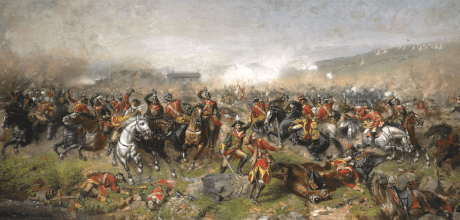
(Pictured: Depiction of the Battle of Aughrim (1691) by John Mulvany (c. 1839 – 1906). Luttrell’s conduct during the 1691 battle becomes a subject of historical debate.)
In 1783 FitzGerald visits the West Indies before returning to Ireland, where his brother, William FitzGerald, 2nd Duke of Leinster, has procured Edward’s election to the Irish Parliament as an MP for Athy, a seat he holds until 1790. In Parliament he acts with the small Opposition Irish Patriot Party group led by Henry Grattan but takes no prominent part in debate. In the spring of 1786, he takes the then unusual step for a young nobleman of entering the Military College, Woolwich, after which he makes a tour through Spain in 1787. Dejected by unrequited love for his cousin Georgina Lennox, he sails for New Brunswick to join the 54th Regiment with the rank of Major.
In April 1789, guided by compass, FitzGerald traverses the country with a brother officer from Fredericton, New Brunswick to Quebec, falling in with Indians by the way, with whom he fraternizes. He accomplishes the journey in twenty-six days and establishes a shorter practicable route than that hitherto followed. The route crosses the extremely rugged and heavily forested northern part of the present state of Maine. In a subsequent expedition he is formally adopted at Detroit by the Bear clan of the Mohawk with the name “Eghnidal,” and makes his way down the Mississippi River to New Orleans, whence he returns to England.
Finding that his brother has procured his election for Kildare County, a seat he holds from 1790 to 1798, and desiring to maintain political independence, FitzGerald refuses the command of an expedition against Cádiz offered him by William Pitt the Younger and devotes himself for the next few years to the pleasures of society and to his parliamentary duties. He is on terms of intimacy with his first cousin Charles Fox, with Richard Sheridan and other leading Whigs. According to Thomas Moore, FitzGerald is only one of numerous suitors of Sheridan’s first wife, Elizabeth, whose attentions are received with favour. She conceives a child by him, a baby girl who is born on March 30, 1792.
His Whig connections, together with his transatlantic experiences, predisposed FitzGerald to sympathize with the doctrines of the French Revolution, which he embraces enthusiastically when he visits Paris in October 1792. He lodges with Thomas Paine and listens to the debates in the Convention. While in Paris, he becomes enamoured of a young girl named Pamela whom he chances to see at the theatre, and who has a striking likeness to Elizabeth Sheridan. On December 27, 1792, he and Pamela are married at Tournai, one of the witnesses being Louis Philippe, afterwards King of the French. In January 1793 the couple reaches Dublin.
Ireland is by then seething with dissent which is finding a focus in the increasingly popular and revolutionary Society of the United Irishmen, which has been forced underground by the outbreak of war between France and Britain in 1793. FitzGerald, fresh from the gallery of the Convention in Paris, returns to his seat in the Irish Parliament and immediately springs to their defence. Within a week of his return, he is ordered into custody and required to apologise at the bar of the House of Commons for violently denouncing in the House a government proclamation which Grattan had approved for the suppression of the United-Irish attempt to revive the Irish Volunteer movement with a “National Guard.” However, it is not until 1796 that he joins the United Irishmen, who by now have given up as hopeless the path of constitutional reform and whose aim, after the recall of Lord Fitzwilliam in 1795, is nothing less than the establishment of an independent Irish republic.
In May 1796 Theobald Wolfe Tone is in Paris endeavouring to obtain French assistance for an insurrection in Ireland. In the same month, FitzGerald and his friend Arthur O’Connor proceed to Hamburg, where they open negotiations with the Directory through Reinhard, French minister to the Hanseatic towns. The Duke of York, meeting Pamela at Devonshire House on her way through London with her husband, tells her that his plans are known and advises that he should not go abroad. The proceedings of the conspirators at Hamburg are made known to the government in London by an informer, Samuel Turner. The result of the Hamburg negotiations is Louis Lazare Hoche‘s abortive expedition to Bantry Bay in December 1796.
In September 1797 the Government learns from the informer Leonard McNally that FitzGerald is among those directing the conspiracy of the United Irishmen, which is now quickly maturing. Thomas Reynolds, converted from a conspirator to an informer, keeps the authorities posted in what is going on, though lack of evidence produced in court delays the arrest of the ringleaders. But on March 12, 1798, Reynolds’ information leads to the seizure of a number of conspirators at the house of Oliver Bond. FitzGerald, warned by Reynolds, is not among them.
As a fellow member of the Ascendancy class, the Government are anxious to make an exception for FitzGerald, avoiding the embarrassing and dangerous consequences of his subversive activities. They communicate their willingness to spare him from the normal fate meted out to traitors. FitzGerald however refuses to desert others who cannot escape, and whom he has himself led into danger. On March 30 the government proclamation of martial law authorising the military to act as they see fit to crush the United Irishmen leads to a campaign of vicious brutality in several parts of the country.
FitzGerald’s social position makes him the most important United Irish leader still at liberty. On May 9 a reward of £1,000 is offered by Dublin Castle for his apprehension. Since the arrests at Bond’s house, he has been in hiding. The date for the rising is finally fixed for May 23 and FitzGerald awaits the day hidden by Mary Moore above her family’s inn in Thomas Street, Dublin.
Tipped off that the house is going to be raided, Moore turns to Francis Magan, a Catholicbarrister and trusted sympathiser, who agrees to hide Fitzgerald. Making its way to Magan’s house on May 18, Fitzgerald’s party is challenged by Major Henry Sirr and a company of Dumbarton Fencibles. Moore escapes with Fitzgerald and takes him back to Thomas Street to the house of Nicholas Murphy.
Moore explains to Magan what had happened and, unbeknownst to her, Magan informs Dublin Castle. The Moore house is raided that day. Mary, running to warn the Leinster Directory meeting nearby in James’s Gate, receives a bayonet cut across the shoulders. That same evening Sirr storms Murphy’s house where FitzGerald is in bed suffering from a fever. Alerted by the commotion, he jumps out of bed and, ignoring the pleas of the arresting officers to surrender peacefully, he stabs one and mortally wounds the other with a dagger in a desperate attempt to escape. He is secured only after Major Sirr shoots him in the shoulder.
FitzGerald is conveyed to New Prison, Dublin where he is denied proper medical treatment. After a brief detention in Dublin Castle he is taken to Newgate Prison, Dublin where his wound, which has become infected, becomes mortally inflamed. His wife, whom the government probably has enough evidence to convict of treason, has fled the country, never to see her husband again, but FitzGerald’s brother Henry and his aunt Lady Louisa Conolly are allowed to see him in his last moments. He dies at the age of 34 on June 4, 1798, as the rebellion rages outside. He is buried the next day in the cemetery of St. Werburgh’s Church, Dublin. An Act of Attainder confiscating his property is passed as 38 Geo. 3 c. 77 but is eventually repealed in 1819.
Maclaine is born in County Monaghan in 1724, second son among two sons and one daughter of the Rev. Lauchlin Maclaine, a Presbyterian minister from Scotland, and Elizabeth Maclaine (née Milling). His brother, Archibald Maclaine, later becomes a minister. Educated locally, he is reckless, headstrong, and dismissive of his parents’ attempts to make him respectable. When his father dies he squanders his inheritance on a dissolute lifestyle and is forced to find work in London.
Maclaine considers joining the Irish Brigade in the French Royal Army, but is told that he would make little progress with them unless he becomes a Roman Catholic, which he is unwilling to do. Instead he enlists in Lord Albemarle‘s horse troops. Again his propensity for fast living costs him dearly, and he suffers a thrashing after he is discovered having an affair with an officer’s wife.
Around 1746 Maclaine marries the daughter of a publican on Oxford Road, London, and with her dowry of five hundred pounds establishes himself as a grocer and chandler in Welbeck Street, Cavendish Square. His wife dies in 1748, leaving one daughter.
Frustrated by his lack of opportunities, Maclaine decides to embark on a life of crime. Together with William Plunkett, an Irish apothecary who had attended to his wife, he decides to find a rich heiress to marry. Pretending to be a high-living gentleman, with Plunkett as his liveried servant, he exhausts all his money dancing and gambling but has little success in his quest. Undaunted, he now turns his hand to robbery and becomes a highwayman. This proves extremely profitable and he takes lodgings at St. James’s Street, where he passes himself off as an Irish squire, with Plunkett again in attendance.
A dashing, handsome man, Maclaine soon becomes a popular figure in London. His most infamous adventure occurs in November 1749 when he robs the famous diarist and politician Horace Walpole at Hyde Park. For the first and only time in his career, he fires a shot, as one of his pistols discharges accidentally, scorching Walpole’s face. He later insists that he would have committed suicide if he had killed his victim. Walpole’s retort is that he would be satisfied if Maclaine just allowed himself to be hanged. Overcome with guilt, Maclaine afterwards sends two letters to Walpole apologising for the injury and suggesting a duel if he wants satisfaction. Walpole wisely ignores the correspondence.
After visiting his brother at The Hague, where he impresses with his extravagant gifts and lifestyle, Maclaine again decides to seek an heiress. Together with Plunkett, who is visiting Ireland, he sets his sights on a woman with an income of £40,000, but the scheme comes to nothing.
Returning to his career as a highwayman, Maclaine commits a number of daring robberies in the summer of 1750. On June 26, 1750, he and Plunkett hold up the coach of the Earl of Eglinton on Hounslow Heath, which proves to be his undoing. One passenger makes public a list of his stolen possessions, and when Maclaine sells some of the items on July 19 the crime is traced to him. On July 27 he is arrested and immediately breaks down in prison, confessing everything. Weeping in his cell, he consistently blames Plunkett, who evaded capture, for leading him astray.
Maclaine’s trial on September 13 attracts enormous interest, especially from women who are enamoured of his romantic image. The jury finds him guilty without leaving the box. Sentenced to death, he attempts to read a plea for mercy but loses his nerve and is only able to speak a few words. After a few minutes of embarrassed silence he cries, “My lord, I can go no further.” His brother denounces him, and from his cell he writes a number of letters expressing regret for his actions.
Maclaine is executed at Tyburn on October 3, 1750, having informed a minister that he went to his execution “without being daunted but rather with eagerness.” A great crowd attends the execution, before whom he maintains a steady composure, and his last words to them are, “O God, forgive my enemies, bless my friends and receive my soul!” A later publication tells that, as the cart is about to be drawn from under him, a witness hears him say, “I must never more behold this beauteous sun! Do thou, O sun of righteousness, shine on my departing soul.” After his death an enduring legend develops around the story of “the gentleman highwayman” and “the ladies’ hero.”
Frank Ryan, politician, journalist, intelligence agent and paramilitary activist, is born in the townland of Bottomstown, Elton, County Limerick, on September 11, 1902. A fascinating, somewhat mythical figure, he lives during turbulent times when Ireland finally disposes of tyrannical British rule in Ireland and becomes an icon for socialist republicans in Europe during the 1930s and 40s.
Ryan fights on the Anti-Treaty side in the Irish Civil War (1922-23) and is wounded and interned. In November 1923 he is released and returns to UCD. He secures his degree in Celtic Studies and further secures the editorship of An Phoblacht (The Republic), the newspaper of the anti-Treaty Irish Republican Army (IRA).
The split in the Irish independence party, Sinn Féin, results in regular fist fights between pro and anti-Treaty forces. Cumann na nGaedhael, the pro-Treaty political party in government, recruits the Army Comrades Association (Blueshirts) under former Garda CommissionerEoin O’Duffy to protect their members from anti-Treaty IRA protesters at annual Armistice Day and Wolfe Tone commemorations. Ryan is a forceful orator at these events and is frequently arrested and beaten up by the Gardai. The fractious politics results in Dáil members Sean Hales and Kevin O’Higgins being shot dead in public.
The outbreak of the Spanish Civil War (1936-39) inspires Ryan to lead the first contingent of Irish volunteers to support the Popular Front government of Republican Spain. A brave and inspiring leader, he serves with Italian and German Republican divisions. He is seriously wounded at the Battle of Jarama in February 1937. Following recuperation in Ireland, he is appointed adjutant to republican General José Miaja. During the Aragon Offensive he is captured with 150 of his men in April 1938 and sentenced to death. Irish President, Éamon de Valera, intervenes with General Francisco Franco and Ryan’s sentence is commuted to thirty years. His health suffers severely in Burgos Prison, Spain during his two-year incarceration.
Franco refuses to release Ryan because he is considered his most dangerous prisoner. In August 1940 he is transferred to Berlin, where he is re-united with IRA Chief of StaffSeán Russell. An attempt to return both men to Ireland by U-boat ends with Russell dying from a perforated ulcer. Ryan voluntarily returns to Germany where he serves as the unofficial IRA ambassador for German intelligence. Irishman Francis Stuart, son-in-law of Maud Gonne, who writes some of William Joyce’s propaganda, takes good care of Ryan until his untimely death at a hospital in Loschwitz in Dresden on June 10, 1944.
Ryan’s funeral in Dresden is attended by Elizabeth Clissmann, wife of Helmut Clissmann, and Francis Stuart. Clissmann eventually forwards details of Ryan’s fate to Leopold Kerney in Madrid. According to Stuart and Clissmann, the cause of death is pleurisy and pneumonia.
In 1963, historian Enno Stephan locates Ryan’s grave in Dresden. Three volunteers of the International Brigades, Frank Edwards, Peter O’Connor and Michael O’Riordan travel to East Germany as a guard of honour to repatriate Ryan’s remains in 1979. On June 21, 1979, his remains arrive in Whitefriar Street Carmelite Church, his local church when he lived in Dublin. The church is packed with all shades of Republican and left-wing opinion, as well as those from his past such as the Stuarts, the Clissmanns, Peadar O’Donnell, George Gilmore, and ex-comrades and sympathizers from all over the world. The cortège on its way to Glasnevin Cemetery halts at the GPO in memory of the dead of the 1916 Easter Rising. His coffin is borne to the grave in Glasnevin Cemetery by Irish veterans of the Spanish Civil War, Frank Edwards, Peter O’Connor, Michael O’Riordan and Terry Flanagan. Con Lehane delivers the funeral oration while a piper plays “Limerick’s Lamentation.” He is buried next to Éamonn Mac Thomáis.
Ryan leads a vicarious life in pursuit of human rights, socialism and republicanism. His life story remains more colourful than fiction.
Martin first meets John Mitchel while attending Dr. Henderson’s private school in Newry. He receives an Arts degree at Trinity College Dublin in 1832 and proceeds to study medicine but has to abandon this in 1835 when his uncle dies, and he has to return to manage the family landholding.
In 1847 Martin is moved by the Great Famine to join Mitchel in the Repeal Association but subsequently leaves it with Mitchel. He contributes to Mitchel’s journal, United Irishman, and then following Mitchel’s arrest on May 27, 1848, he continues with his own anti-British journal, The Irish Felon, and establishes “The Felon Club.” This leads to a warrant for his arrest, and he turns himself in on July 8, 1848. He is sentenced on August 18, 1848, to ten years transportation to Van Diemen’s Land.
Martin arrives on the Elphinstone with Kevin Izod O’Doherty in Hobart, Tasmania, in November 1849. He accepts a “ticket of leave” which allows him to live in relative freedom at Bothwell, provided he promises not to escape.
While in Tasmania, Martin continues to meet in secret with his fellow exiles Kevin Izod O’Doherty, Thomas Francis Meagher, William Smith O’Brien, and John Mitchel. He and Mitchel live together before the arrival of Mitchel’s wife, Jenny. He chooses not to join Mitchel when Mitchel revokes his ticket of leave and escapes. Instead, he remains in Tasmania until he is granted a “conditional pardon” in 1854. This allows him to leave for Paris, and he returns to Ireland on being granted a full pardon in 1856.
On return to Ireland Martin becomes a national organiser for the Tenant Right League. He begins to write for The Nation in 1860. He forms the National League with others in January 1864 – it is mainly an educational organisation but Fenians disrupt its meetings. He remains in contact with Mitchel in Paris through 1866. He opposes the Fenians’ support of armed violence, yet, together with Alexander Martin Sullivan in December 1867, he heads the symbolic funeral march honouring the Manchester Martyrs as it follows the MacManus route to Glasnevin Cemetery, Dublin. He is briefly arrested for these activities, but the charges are dropped.
Martin is in the United States in December 1869 when he is nominated by Isaac Butt and his nationalists as the Irish nationalist Home Rule candidate to oppose Reginald Greville-Nugent, who is supported by the Catholic clergy, in the Longfordby-election. Greville-Nugent initially wins the vote, but the result is nullified by Judge Fitzgerald on the grounds that voters had been illegally influenced in the non-secret voting process. In the May 1870 re-run, Butt’s second candidate, Edward Robert King-Harman, like Martin a Protestant landlord, is also defeated, but this time legally.
Contradictions and factionalism are symptomatic of the struggle for influence and leadership at the time between the waning Church of Ireland and the rising Irish Catholic Church. Hence a secular Protestant land-owning, non-violent elite reformist nationalist who desires Home Rule like Martin, can find himself both sympathetic to and at odds with a militant organisation like the Fenians with their Jacobin– and American-influenced ideas of revolutionary republicanism and different social roots. Until Charles Stewart Parnell, the Isaac Butt-originated Home Rule forces could not obtain the support of the Catholic Church under the anti-Fenian CardinalPaul Cullen or manage to achieve more than short-term tactical alliances with Fenians, leading to a split and uncoordinated opposition to British rule. Protestants such as Martin and John Mitchel, with their early political roots in Young Ireland, are, whatever their political ideals, not part of the majority Catholic mainstream, which consists largely of tenants rather than landlords.
In the January 1871 by-election, Martin is elected by a margin of 2–1 to the seat of Meath in the British parliament as the first Home Rule MP, representing first Isaac Butt’s Home Government Association and from November 1873 the Home Rule League. This is unusual for a Protestant in a Catholic constituency, and is a measure of the popular esteem Martin is held in. He retains his seat in the 1874 United Kingdom general election as one of 60 Home Rule members. He is commonly known as “Honest John Martin.” In parliament he speaks strongly for Home Rule for Ireland and opposes Coercion Bills.
Martin dies in Newry, County Down, on March 29, 1875, homeless and in relative poverty, having forgiven tenant fees during preceding years of inflation and low farm prices. His parliamentary seat of County Meath is taken up by Charles Stewart Parnell.
Martin marries Henrietta Mitchel, the youngest sister of John Mitchel, on November 25, 1868, after twenty years of courtship. She shares her husband’s politics, and after his death campaigns for home rule believing this to be a continuation of the Young Ireland mandate. After the split in the party, she sides with Charles Stewart Parnell. She dies at her home in Dublin on July 11, 1913, and is buried in Newry.
Sinn Féin President Gerry Adams announces on September 5, 2017, he will seek re-election as the party president in November and then outline his own future intentions as the former political wing of the Irish Republican Army (IRA) prepares to complete a generational shift in its leadership.
Adams, Sinn Féin leader for over thirty years, will seek re-election to the one-year post at the party’s annual conference and set out his future plans at that time. “I will be allowing my name to go forward for the position of Uachtaran Shinn Féin (President of Sinn Féin),” Adams says in a speech at a meeting of the party’s lawmakers. “And if elected I will be setting out our priorities and in particular our planned process of generational change, including my own future intentions.”
“We have no ambition to be part of the system. Our ambition is to change it. That means we must be in government – North and South,” Adams says.
Reviled by many as the face of the IRA during its campaign against British rule in Northern Ireland, Adams reinvented himself as a peacemaker in the troubled region and then as a populist opposition lawmaker in the Irish Republic. Around 3,600 people were killed during Northern Ireland’s “Troubles,” three decades of sectarian bloodshed between pro-British Protestantunionists and Catholicnationalists seeking a united Ireland that was ended by the 1998 Good Friday Agreement.
Whenever Adams decides to step down, he will almost certainly hand over to a successor with no direct involvement in the decades of conflict in Northern Ireland, say political analysts, making Sinn Féin a more palatable coalition partner in the Irish Republic where it has never been in power. Deputy leader Mary Lou McDonald, who has been at the forefront of a new breed of Sinn Féin politicians transforming the left-wing party’s image, is the clear favorite to take over. Michelle O’Neill, another Sinn Féin lawmaker in her 40s, succeeded Martin McGuinness as leader in Northern Ireland shortly before the former IRA commander’s death in March 2017.
With McGuinness, Adams turned Sinn Féin into the dominant nationalist party in Northern Ireland and the third largest party south of the border. Adams said the previous month that he intended to lead the party into the next parliamentary election in the Irish republic where suspicion of Sinn Féin’s role in the Northern Ireland troubles still runs deep among the main political parties.
The far larger ruling Fine Gael and main opposition Fianna Fáil, a more natural ally, have ruled out governing with Sinn Féin but analysts say a change of leader could soften that stance. The next election is expected in the next 12 months.
(From: “Sinn Féin’s Adams to outline succession plan in November” by Padraic Halpin | Photo: Sinn Féin President Gerry Adams speaks at an event in Gormanstown, Ireland, September 5, 2017, REUTERS/Clodagh Kilcoyne)
Marmion is born April 1, 1858, in Dublin, the seventh of nine children of William Marmion and Herminie Marmion (née Cordier). He attends St. Laurence O’Toole’s, a primary school run by the Augustinian Fathers of John’s Lane. On January 11, 1869, he transfers to Belvedere College, where he receives an excellent grounding in Greek and Latin from the Jesuit Fathers. From there, he proceeded in January 1874 to Clonliffe College, where he remains until December 1879, when the new Archbishop of Dublin, Dr. Edward MacCabe, selects him for further theological studies in Rome.
Marmion is in Rome at the Pontifical Irish College, studying theology at the Propaganda College, for eighteen months (December 1879 – July 1881). Although invited by the authorities at Propaganda to present himself for the doctorate degree, he turns down the offer for health reasons, on account of the necessary extra year in Rome which this would entail. On returning to Dublin, he spends the first year as curate in Dundrum parish. This is followed by four years (1882–86) as professor of philosophy at Clonliffe. On October 25, 1886, he receives from the newly appointed Archbishop of Dublin, Dr. William Walsh, his dimissorial letters, granting him permission to join the Benedictine order. On November 21, 1886, he enters the newly founded BelgianMaredsous Abbey, with which, by virtue of the Benedictine vow of stability, he is to be associated for the rest of his life.
The first thirteen years of his monastic life (1886–99) are spent at Maredsous Abbey itself. After an unsuccessful start in the abbey school as a kind of housemaster to the junior boys, he finds his feet within the community through congenial work, notably the teaching of Thomistic philosophy to the junior monks. He also gradually builds up a reputation as a spiritual guide through the exercise of ministry on a small scale in the surrounding area. The next decade (1899–1909) finds him in Leuven as prior and professor of dogmatic theology at Mont César Abbey, which is founded and staffed by Maredsous. This decade provides a wide outlet for his matured spiritual doctrine through his lectures on dogmatic theology in Mont César, his retreats to priests and religious, and his private correspondence. The third and final phase of his monastic life begins when the chapter of Maredsous elects him as its third abbot in 1909.
An invitation is received from the Belgian government from December 1909 to April 1910 to undertake a Benedictine foundation in Katanga, part of the Belgian Congo. In spite of pressure from government quarters the chapter of Maredsous refuses the offer, and Marmion accepts this negative decision. In 1913 the entire community of Anglican Benedictines of Caldey Island, Wales, transfer their allegiance from Canterbury to Rome. Marmion becomes deeply involved in the spiritual and canonical process of the reception of the community into the Catholic church.
The outbreak of World War I ushers in four years of grave anxiety for Marmion. Belgium is not completely occupied but retains sovereignty over an area extending inland about twenty miles to the Ypres Salient. This enables the young monks of Maredsous, for whom Marmion had found a temporary home in Edermine, County Wexford, to travel to and from the Western Front, where they are being called up to serve as stretcher bearers in the Belgian army. He does his utmost to maintain the unity of his community between those who had remained in Maredsous and the Edermine group.
The first of Marmion’s great spiritual books, Christ, the Life of the Soul, appears in 1916, and its phenomenal success has been described as a silent plebiscite. This is followed by Christ in His Mysteries (1919), Christ the Ideal of the Monk (1922), and Sponsa Verbi (1923). The books are able to appear in rapid succession since they are compiled from his existing conference notes.
One final piece of important monastic and ecclesiastical and even political business absorbs much of Marmion’s energies, although strictly speaking it is not of his remit. His strenuous efforts to install Belgian monks in the Abbey of the Dormition on Mount Zion in Jerusalem following the internment (November 1918) of the original German Benedictine community by the victorious British forces are of no avail, the question being finally settled by the reinstallation of the German (Beuronese) monks in 1921.
Marmion dies at Maredsous on January 30, 1923, following a brief illness which originates in a chill and is aggravated by influenza.
Marmion is beatified by Pope John Paul II on September 3, 2000. This is the outcome of a popular reputation for holiness which had increased steadily since his death and the procedures for beatification prompted in 1954 by Mgr. Montini, the future Pope Paul VI. The canonical steps are: diocesan process at Namur (1957–61); examination at Rome of Marmion’s writings (1960–73); a critical biography (1987–94), written by Mark Tierney, OSB, for the Roman process on the ‘heroicity’ of Marmion’s virtues which concluded in June 1999; and finally, an inexplicable cure of cancer through Marmion’s intercession, judged as miraculous by Rome on January 25, 2000.
The originality of Marmion’s spiritual doctrine lay in his truly central emphasis on the doctrine of our adoption as the children of God in baptism. Many of his predecessors had also emphasised this doctrine, but few had made it the focus from which everything radiated and to which everything returned. The second characteristic of Marmion’s teaching, a much more personal trait, is the conviction of authenticity communicated by his writings, of the greatness of our sharing in the sonship of the Word. This makes a deep and lasting impression on the reader and gives an infinitely sacred meaning to the title ‘children of God’ and thereby to the whole of life. The third characteristic of Marmion’s teaching is the simplicity with which the deepest theological truths are presented – truths which preachers often feel their people cannot ‘take,’ and hence are left unsaid. Marmion presents these truths directly from St. John and St. Paul, and not merely in familiar extracts but in the whole sweep of their texts.
(From: “Marmion, Dom Columba” by Placid Murray, Dictionary of Irish Biography, http://www.dib.ie)
Casement is born into an Anglo-Irish family, and lives his very early childhood at Doyle’s Cottage, Lawson Terrace, Sandycove. His father, Captain Roger Casement of the (King’s Own) Regiment of Dragoons, is the son of Hugh Casement, a Belfast shipping merchant who goes bankrupt and later moves to Australia. After the family moves to England, Casement’s mother, Anne Jephson (or Jepson), of a DublinAnglican family, purportedly has him secretly baptised at the age of three as a Roman Catholic in Rhyl, Wales.
The family lives in England in genteel poverty. Casement’s mother dies when he is nine years old. His father takes the family back to County Antrim in Ireland to live near paternal relatives. His father dies when he is thirteen years old. He is educated at the Diocesan School, Ballymena (later the Ballymena Academy). He leaves school at 16 and goes to England to work as a clerk with Elder Dempster Lines, a Liverpool shipping company headed by Alfred Lewis Jones.
Casement is a British consul in Portuguese East Africa (1895–98), Angola (1898–1900), Congo Free State (1901–04), and Brazil (1906–11). He gains international fame for revealing atrocious cruelty in the exploitation of native labour by white traders in the Congo and the Putumayo River region of Peru. His Congo report, published in 1904, leads to a major reorganization of Belgian rule in the Congo in 1908, and his Putumayo report of 1912 earns him a knighthood, which is ultimately forfeited on June 29, 1916.
Ill health forces Casement to retire to Ireland in 1912. Although he comes from an Ulster Protestant family, he has always sympathized with the predominantly Roman Catholic Irish nationalists. Late in 1913 he helps form the National Volunteers, and in July 1914 he travels to New York City to seek American aid for that anti-British force. After World War I breaks out in August, he hopes that Germany might assist the Irish independence movement as a blow against Great Britain. On arriving in Berlin in November 1914, he finds that the German government is unwilling to risk an expedition to Ireland and that most Irish prisoners of war would refuse to join a brigade that he intends to recruit for service against England.
Later, Casement fails to obtain a loan of German army officers to lead the Irish rising planned for Easter 1916. In a vain effort to prevent the revolt, he sails for Ireland on April 12 in a German submarine. Put ashore near Tralee, County Kerry, he is arrested on April 24 and taken to London, where, on June 29, he is convicted of treason and sentenced to death. An appeal is dismissed, and he is hanged at London’s Pentonville Prison on August 3, 1916, despite attempts by influential Englishmen to secure a reprieve in view of his past services to the British government. During this time, diaries reputedly written by Casement and containing detailed descriptions of homosexual practices are circulated privately among British officials. After years of dispute over their authenticity, the diaries are made available to scholars by the British home secretary in July 1959. It is generally considered that the passages in question are in Casement’s handwriting.
In 1965 Casement’s remains are repatriated to Ireland. Despite the annulment, or withdrawal, of his knighthood in 1916, the 1965 UK Cabinet record of the repatriation decision refers to him as “Sir Roger Casement.”
Casement’s last wish is to be buried at Murlough Bay on the north coast of County Antrim, in present-day Northern Ireland, but Prime MinisterHarold Wilson‘s government had released the remains only on condition that they could not be brought into Northern Ireland, as “the government feared that a reburial there could provoke Catholic celebrations and Protestant reactions.”
Casement’s remains lay in state at the Garrison Church, Arbour Hill (now Arbour Hill Prison) in Dublin for five days, close to the graves of other leaders of the 1916 Easter Rising. After a state funeral, his remains are buried with full military honours in the Republican plot in Glasnevin Cemetery in Dublin, alongside other Irish republicans and nationalists. The President of Ireland, Éamon de Valera, then the last surviving leader of the Easter Rising, attends the ceremony, along with an estimated 30,000 others.
The Provisional Irish Republican Army (IRA) announces a ceasefire on August 31, 1994, after a quarter century of what it calls its “armed struggle” to get the British out of Northern Ireland. The statement comes just after 11:00 a.m. BST and says there will be a “complete cessation of military operations” from midnight and that the organisation is willing to enter into inclusive talks on the political future of the Province.
The statement raises hopes for peace and an end to 25 years of bombing and shooting that led to the deaths of more than 3,000 people. There is scepticism from the loyalist community and celebration in the Catholic areas of Belfast and Derry.
But loyalists are suspicious of the declaration and fear it may lead to a sell-out in which Northern Ireland’s position within the United Kingdom is under threat. The Ulster Unionist Party (UUP) MPJames Molyneaux says no moves towards talks should begin until the IRA has added the word “permanent” to the ceasefire declaration.
The announcement comes 18 months after secret talks began between the British Government and Irish republicans. It leads to the Anglo-Irish Downing Street Declaration in December 1993 which states that any change in the partition of Ireland can only come with the consent of those living north of the border. It also challenges republicans to renounce violence.
Ian Paisley, leader of the hardline Democratic Unionist Party (DUP), rejects the wording of the declaration and says it is an “insult to the people [the IRA] has slaughtered because there was no expression of regret.”
Seven weeks later, on October 13, the loyalist terrorist groups announce their own ceasefire. On December 9, British officials meet Sinn Féin representatives for their first formal talks in 22 years.
The IRA ceasefire ends on February 9, 1996, when it plants a huge bomb in the London Docklands. It kills two, injures more than 100 and causes more than £85m of damage.
A new ceasefire is finally announced in July 1997.
(Pictured: (L to R) Sinn Féin President Gerry Adams, Taoiseach Albert Reynolds and Social Democratic and Labour Party leader John Hume)