Mary Ellen Cregan is born to Morgan Cregan and Ellen O’Shea. Her father is a stonemason from Limerick. The family are strong believers in the Gaelic revival movement and Cregan herself learns the Irish language and performs songs at Gaelic League concerts. Although she goes to primary school locally, she goes away to secondary school to St. Louis Convent in Carrickmacross, County Monaghan. After finishing school, she becomes a teacher, working in Goresbridge, County Kilkenny from 1911 to 1914.
In September 1914 Cregan goes to Dublin to study music in the Leinster School of Music, under Madame Coslett Heller. It is while she is in Dublin that she becomes friends with the Ryan family, who are strong nationalists as well as interested in the Gaelic League and Sinn Féin. She begins to sing for concerts which are fundraisers for the Irish Volunteers. The last concert is just two weeks before the Easter Rising.
During Easter week Cregan is sent to Tralee with “automatics and ammunition” by Seán Mac Diarmada. While she is carrying a violin case of munitions, she is also carrying details for the wireless technology needed for communicating with the SS Aud, the boat which is carrying more weapons for the rebellion. The communications with the SS Aud go wrong when the car carrying the Volunteers goes off a pier and the occupants are drowned. She is still in the area to assist with the surviving Volunteer, who unfortunately knows nothing of the details for the SS Aud. She is not easily able to get back to Dublin, because owing to the Rising the city is cut off. By the time she gets back, her friends have been arrested.
When Cregan is going to school in Dublin she is also working in a school in Rathmines. Like many of the teachers, she loses her job after the rising because of her connection to the rebels. However, she is able to get new positions over the next few years in both Ballyshannon and Portstewart until she marries. In Ballyshannon she experiences the early expressions of support and sympathy, but Portstewart is a Unionist enclave with many houses flying union flags on polling day in 1918.
Cregan is a member of Cumann na mBan and with them is active during the Irish War of Independence. She is given a medal for her participation. On July 23, 1919, she marries Dr. James Ryan in Athenry, County Galway. His entire family had been deeply involved in the Easter Rising, as well as the Irish War of Independence and the Irish Civil War. They have three children, Eoin, who becomes a Senator, Nuala (Colgan) and Seamus.
The family is initially based in Wexford during the War. The house is often raided when the British soldiers are looking for her husband and Cregan herself is arrested in February 1921 for refusing to put up martial law posters. Later the family sells the house and remains mobile while she works for the Sinn Féin government, and her husband is in prison. It is during this time that she works as a courier to the continent and to London. After the war, they purchase Kindlestown House in Delgany, County Wicklow, where they remain for the rest of their lives.
Cregan’s first book for children is Old John and gains her considerable international success and attention. Sean Eoin is also published in Irish and is illustrated by Jack Butler Yeats. Her work is also aired on the BBC and RTÉ. Rathina wins the Downey Award in the United States in 1943. She also writes two plays: Hunger strike (1933), based on experience of her husband’s involvement in such a strike, which is broadcast on Radio Éireann on May 5, 1936, and Curlew’s call (1940).
Cregan dies on November 9, 1975, in St. Vincent’s Hospital, Dublin, and is buried in Redford cemetery near her home in County Wicklow.
(Pictured: Máirín Cregan and her husband, Dr. James Ryan)
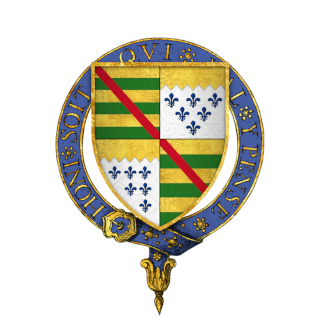
Robert Poynings is implicated in Jack Cade’s rebellion, and Edward is himself concerned in a Kentish rising against Richard III, which compels him to escape to Continental Europe. He attaches himself to Henry, Earl of Richmond, afterwards King Henry VII, with whom he returns to England in 1485.
Poynings is employed in the wars on the continent, and in 1493 he is made governor of Calais. In the following year he goes to Ireland as Lord Deputy under the viceroyalty of Prince Henry, afterwards King Henry VIII. He immediately sets about anglicizing the government of Ireland, which he thoroughly accomplishes, after inflicting punishment on the powerful Irish clans who support the imposture of Perkin Warbeck.
Poynings then summons the celebrated parliament of Drogheda, which meets in December 1494 and enacts the “Statutes of Drogheda,” famous in Irish history as “Poynings’s law,” which make the Irish legislature subordinate to, and completely dependent on, that of England, until its repeal in 1782.
After defeating Perkin Warbeck at Waterford and driving him out of Ireland, he returns to England in 1496, and is appointed warden of the Cinque Ports. He is employed both in military commands and in diplomatic missions abroad by Henry VII, and later by Henry VIII, his most important achievement being the successful negotiation of the “holy league” between England, Spain, the emperor, and the pope, in 1513. In 1520 Poynings is present at the Field of the Cloth of Gold, in the arrangement of which he has taken an active part. He is also present at Henry’s meeting with Emperor Charles V at Gravelines on July 10.
Poynings dies at Westenhanger in October 1521. By his wife, Elizabeth Scot, he leaves no surviving issue, and his estates pass through a collateral female line to the Earl of Northumberland. He has several illegitimate children, one of whom, Thomas Poynings, is created Baron Poynings in 1545, but dies in the same year without heirs.
Lever is the second son of James Lever, an architect and builder, and is educated in private schools. His escapades at Trinity College, Dublin (1823–1828), where he earns a degree in medicine in 1831, are drawn on for the plots of some of his novels. The character Frank Webber in the novel Charles O’Malley is based on a college friend, Robert Boyle, who later becomes a clergyman. He and Boyle earn pocket-money singing ballads of their own composing in the streets of Dublin and play many other pranks which he embellishes in the novels Charles O’Malley, Con Cregan and Lord Kilgobbin.
Before seriously embarking upon his medical studies, Lever visits Canada as an unqualified surgeon on an emigrant ship. Arriving in Canada, he journeys into the backwoods, where he is affiliated to a tribe of Native Americans but has to flee because his life is in danger, as later his character Bagenal Daly does in his novel The Knight of Gwynne.
Back in Europe, Lever pretends he is a student from the University of Göttingen and travels to the University of Jena and then to Vienna. He loves German student life and several of his songs, such as “The Pope He Loved a Merry Life,” are based on student-song models. His medical degree earns him an appointment to the Board of Health in County Clare and then as a dispensary doctor in Portstewart, County Londonderry, but his conduct as a country doctor earns him the censure of the authorities.
In 1833 Lever marries his first love, Catherine Baker, and in February 1837, after varied experiences, he begins publishing The Confessions of Harry Lorrequer in the recently established Dublin University Magazine. Before Harry Lorrequer appears in volume form (1839), he has settled on the strength of a slight diplomatic connection as a fashionable physician in Brussels.
In 1842 Lever returns to Dublin to edit the Dublin University Magazine and gathers round him a typical coterie of Irish wits. In June 1842 he welcomes William Makepeace Thackeray, the author of The Snob Papers, to Templeogue, four miles southwest of Dublin, on his Irish tour. The O’Donoghue and Arthur O’Leary (1845) make his native land an impossible place for Lever to continue in. Thackeray suggests London, but Lever requires a new field of literary observation and anecdote. His creative inspiration exhausted, he decides to renew it on the continent. In 1845 he resigns his editorship and goes back to Brussels, whence he starts upon an unlimited tour of central Europe in a family coach. Now and again, he halts for a few months and entertains to the limit of his resources in some ducal castle or other which he hires for an off season.
Depressed in spirit as Lever is, his wit is unextinguished. He is still the delight of the salons with his stories, and in 1867, after a few years’ experience of a similar kind at La Spezia, he is cheered by a letter from Lord Derby offering him the more lucrative consulship of Trieste. The $600 annual salary does not atone to Lever for the lassitude of prolonged exile. Trieste, at first “all that I could desire,” became with characteristic abruptness “detestable and damnable.”
Lever’s depression, partly due to incipient heart disease, partly to the growing conviction that he is the victim of literary and critical conspiracy, is confirmed by the death of his wife on April 23, 1870, to whom he is tenderly attached. He visits Ireland in the following year and seems alternately in high and low spirits. Death had already given him one or two runaway knocks, and, after his return to Trieste, he fails gradually, dying suddenly, however, and almost painlessly, from heart failure on June 1, 1872, at his home, Villa Gasteiger. His daughters, one of whom, Sydney, is believed to have been the real author of A Rent in a Cloud (1869), are well provided for.
After the Desmond defeat at Battle of Affane in 1565, the 14th Earl and his brother, John of Desmond, are detained in England. During their absence, FitzMaurice becomes captain general of County Desmond with the warrant of the Earl. This means he has authority over the soldiers retained in the service of the Desmond Fitzgeralds. In July 1568, he enters Clanmaurice, the territory of the lord of Lixnaw, to distrain for rent and assert the Desmond authority. Having seized 200 head of cattle and wasted the country, he is confronted by Lixnaw on the way home and utterly defeated.
At the end of 1568, the absent Earl of Desmond grants Sir Warham St. Leger a lease of the barony of Kerricurrihy, which cast FitzMaurice’s inheritance into confusion. In 1569 the Lord Deputy of Ireland, Sir Henry Sidney, is informed by FitzMaurice that he has assembled the people of Desmond to tell them that the Lord Deputy was unable to procure the release of the captive earl, who would be executed or perpetually imprisoned, and that the people should proclaim a new earl or captain. With one voice, the people cry out for FitzMaurice to be captain. The earl’s wife, Eleanor Butler, writes to her husband in November that FitzMaurice is seeking to bring the earl into further disrepute and to usurp his inheritance, “by the example of his father.”
To reassert Geraldine authority, FitzMaurice then launches what becomes known as the first of the Desmond Rebellions. The southern part of Ireland erupts into a general rebellion, owing in part to attempts at establishing plantations. In June 1569, FitzMaurice and the Earl of Clancarty (MacCarthy Mor) invade Kerrycurrihy, spoil the inhabitants, take the castle-abbey of Tracton, hang the garrison, and refuse to depart without the surrender to them of the custody of Lady St. Leger and Lady Grenville, the wives of the principal English colonists. FitzMaurice then joins in league with the turbulent brothers of the Earl of Ormond and enters a bond with the Earl of Thomond and John Burke, son of the Earl of Clanricard. He writes to the mayor and corporation of Cork in July ordering the abolition of the new heresy of Protestantism, at a time when he appears to have been taking instruction from Irish Jesuits.
By September 1569, Sidney has broken the back of the rebellion and leaves Sir Humphrey Gilbert behind to suppress FitzMaurice, who seeks refuge in the woods of Aherlow, and after Gilbert’s departure FitzMaurice raises a new force in February 1570 and by a surprise night attack, takes Kilmallock and after hanging the chief townsmen at the market cross, plunders its wealth and burns the town. In February 1571, Sir John Perrot lands at Waterford as Lord President of Munster and challenges FitzMaurice to a duel, which FitzMaurice declines with the remark, “For if I should kill Sir John Perrot the Queen of England can send another president into this province; but if he do kill me there is none other to succeed me or to command as I do.”
FitzMaurice attacks Perrot but retires on mistaking a small cavalry company for the advance party of a larger force. After a second and successful siege by Perrot of the Geraldine stronghold of Castlemaine, FitzMaurice sues for pardon, which is granted in February 1573, after he prostrates himself in Kilmallock church with the president’s sword point next to his heart. He swears fealty to the crown and gives up his son as hostage.
On the return to Ireland of the Earl of Desmond in 1573, FitzMaurice leaves for the continent, offering his reasons variously as a desire to gain pardon from the Queen through the French court, and the unkindness of the earl. In March 1575 he and his family, along with the Geraldine Seneschal of Imokilly, James Fitzedmund Fitzgerald, and the White Knight, Edmund FitzGibbon, sail on the La Arganys for Saint-Malo, Brittany where they are received by the governor. He has several interviews with Catherine de’ Medici in Paris, offering to help make Henry III of France king of Ireland, and is granted a pension of 5,000 crowns in 1576.
Early in the following year FitzMaurice leaves for the Spanish court, where he offers the crown to the brother of King Philip II, Don John. The king is cautious, however. FitzMaurice leaves his sons Maurice and Gerald with Cardinal Antoine Perrenot de Granvelle, and travels to Italy to meet Pope Gregory XIII.
At the papal court FitzMaurice meets adventurer Captain Thomas Stukley, and together they persuade the pope to underwrite the cost of 1,000 troops to invade Ireland, most of whom, according to Philip O’Sullivan Beare, are desperadoes the pope wishes to get out of Italy. Fitzmaurice and Stukley are to rendezvous in Lisbon and proceed to Ireland, however, Stukley decides to throw his troops and support to King Sebastian‘s expedition to Morocco, where he dies.
Following the diversion of Stukley to Morocco, FitzMaurice sets out with the nuncioNicholas Sanders, and Matthew de Oviedo from Ferrol in Galicia, Spain on June 17, 1579, with a few troops on his vessel and three Spanish shallops. They capture two English vessels in the channel and arrive at Dingle on July 16, 1579, launching the Second Desmond Rebellion.
On July 18 they cast anchor in Ard na Caithne, where they garrison at Dún an Óir (Fort of Gold), and are joined on July 25 by two galleys with 100 troops. Four days later their ships are captured by the English fleet under the command of Sir William Wynter. Having exhorted the Earl of Desmond and the Earl of Kildare, as Geraldine leaders, to fight the heretics, FitzMaurice leaves the fort to await the arrival of Stukley who, unknown to him, had been killed at the Battle of Alcácer Quibir in the previous year, during a campaign by King Sebastian of Portugal.
FitzMaurice goes to make a vow at the monastery of the Holy Cross in County Tipperary but becomes caught in a skirmish with the forces of his cousin, Theobald Burke, during which he is shot with a ball in the hollow of the chest, but cuts his way through to Burke and his brother William, both of whom he kills with single strokes of his sword.
The battle is won, but close to the scene his injuries overcome him. He makes his will and orders his friends to cut off his head after death in order that his enemies might not mutilate his body. He begs his attendants to attest that he had not turned tail on the enemy. They assure him and wish him to be quiet because hostile soldiers are closing in, but he insists, “My wounds are clear, my wounds are clear.” Upon his death, a kinsman orders the decapitation and then wraps the head in cloth. An attempt is made to conceal his trunk under a tree, but it is discovered by a hunter and brought to the town of Kilmallock. For weeks, the trunk is nailed to the gallows, until it is shattered by musket fire and collapses.
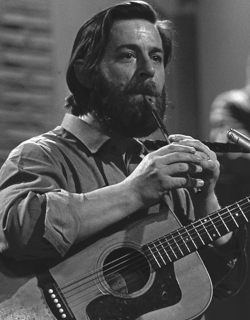
Although born in Dublin, Bourke lives most of his life in Tibradden, County Dublin. His father, a doctor, is in practice in the city. The children have an Irish-speaking nanny. His early exposure to Irish continues throughout his education, attending Colaiste Mhuire, Parnell Square, Dublin. He later attends University College Dublin for a course in Agricultural Science. He does not take his degree but always retains an interest in farming.
After leaving university Bourke meets two of his future bandmates in The Dubliners, Ronnie Drew and Barney McKenna, who invite him to join their sessions in O’Donoghue’s Pub where he plays tin whistle, mouth organ and guitar, and sings. Luke Kelly, who had been singing around the clubs in England, returns to Dublin and joins them, with the four gaining local popularity. Taking the name The Dubliners, the group puts together the first folk concert of its kind in Dublin. The concert is a success, then a theatrical production called “A Ballad Tour of Ireland” is staged at the Gate Theatre shortly afterwards. In 1964 fiddle player John Sheahan joins the band and this becomes known as the original Dubliners line-up.
Bourke is responsible for bringing a Gaelic element to The Dubliners’ music with songs such as “Peggy Lettermore” and “Sé Fáth Mo Bhuartha” being performed in the Irish language. He also sings a number of the group’s more lighthearted and humorous numbers such as “Jar of Porter,” “The Dublin Fusiliers,” “The Limerick Rake,” “Mrs. McGrath,” “Darby O’Leary,” “All For Me Grog” and “The Ballad of Ronnie’s Mare,” as well as patriotic songs such as “Roddy McCorley,” “The Enniskillen Dragoons,” “Take It Down From The Mast” and “Henry Joy.”
On April 5, 1974 The Dubliners travel to Eastbourne where they are to appear in concert. Kelly is worried by the way Bourke keeps moving his head about, as if trying to alleviate increasing pain. Four minutes into the second half, it is decided he cannot continue with the show. Kelly insists that a doctor should be phoned and instructs to await their return to the Irish Club at Eaton Square. The roadie for the trip, John Corry, thinks that it is better to drive straight to St. George’s Hospital in London, where the doctors diagnose a brain aneurysm. He is transferred to the Atkinson Morley Hospital in Wimbledon, while doctors wait for his wife to return from a trip to Ghana, to get her signature before operating. She is told that there is danger of further haemorrhaging. He is operated on at the earliest opportunity. The bleeding begins again while he is on the table which means that they cannot repair the damage, only staunch the bleeding. This leaves him paralysed down his left side and confused as to where he is and what has happened.
Bourke receives intensive therapy, attending a clinic in Dún Laoghaire, County Dublin. He is heartened by his progress and insists on rejoining The Dubliners on their next tour of the Continent in November that year.
Bourke’s continued insistence that he is fit enough to join them on the forthcoming German tour causes them considerable disquiet. They prefer he ease himself back to work, with a few small shows in Ireland. The tour gradually begins to take its toll on him, and it is decided that for the sake of his health he should return home. He flies from Brussels to Dublin.
Bourke makes his last public appearance on Ireland’s RTÉ One during The Late Late Show‘s tribute to The Dubliners in 1987. Despite his lingering paralysis he recites “The Lament for Brendan Behan” after which everyone in the studio, led by Ronnie Drew, sing “The Auld Triangle.”
Bourke dies on May 10, 1988, after a long illness. From 1974 until his death, he is continued to be paid by the band. A fifth member of the group is not recruited until after his death.
Once settled, Columba sets about converting most of pagan Scotland and northern England to the Christian faith. Iona’s fame as a missionary centre and outstanding place of learning eventually spreads throughout Europe, turning it into a place of pilgrimage for several centuries to come. Iona becomes a sacred isle where kings of Scotland, Ireland andNorway are buried.
Columba is born of royal blood in 521 AD in Ireland, or Scotia as it is then called. He is the grandson of the Irish King Niall. He leaves Ireland for Scotland not as a missionary but as an act of self-imposed penance for a bloody mess he had caused at home. He had upset the king of Ireland by refusing to hand over a copy of the Gospel he had illegally copied, leading to a pitched battle in which Columba’s warrior family prevailed. Full of remorse for his actions and the deaths he had ultimately caused, he flees, ultimately settling on Iona as it is the first place he finds from which he is unable to see his native Ireland. One of the features on the island is even called “The Hill with its back to Ireland.”
Columba, however, is not the shy retiring type and sets about building Iona’s original abbey from clay and wood. In this endeavour he displays some strange idiosyncrasies, including banishing women and cows from the island. The abbey builders have to leave their wives and daughters on the nearby Eilean nam Ban (Woman’s Island). Stranger still, he also banishes frogs and snakes from Iona, although how he accomplishes this feat is not well documented.
The strangest claim of all however is that Columba is prevented from completing the building of the original chapel until a living person has been buried in the foundations. His friend Oran volunteers for the job and is duly buried. It is said that Columba later requests that Oran’s face be uncovered so he can bid a final farewell to his friend. Oran’s face is uncovered and he is found to be still alive but utters such blasphemous descriptions of Heaven and Hell that Columba orders that he be covered up immediately.
Over the centuries the monks of Iona produce countless elaborate carvings, manuscripts and Celtic crosses. Perhaps their greatest work is the exquisite Book of Kells, which dates from 800 AD, currently on display in Trinity College, Dublin. Shortly after this, in 806 AD, come the first of the Viking raids and many of the monks are slaughtered and their work destroyed.
The Celtic Church, lacking central control and organisation, diminishes in size and stature over the years to be replaced by the much larger and stronger Roman Church. Even Iona is not exempt from these changes and in 1203 a nunnery for the Order of the Black Nuns is established and the present-day Benedictine abbey, Iona Abbey, is built. The abbey is a victim of the Reformation and lay in ruins until 1899 when restoration is started.
No part of Columba’s original buildings have survived, however on the left hand side of the abbey entrance can be seen a small roofed chamber which is claimed to mark the site of the Columba’s tomb.
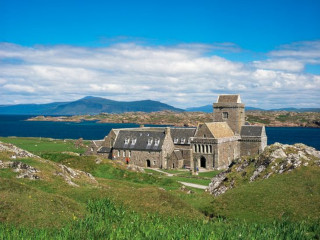
(From: “St. Columba and the Isle of Iona” by Ben Johnson, historic-uk.com, pictured is the Iona Abbey and Nunnery)
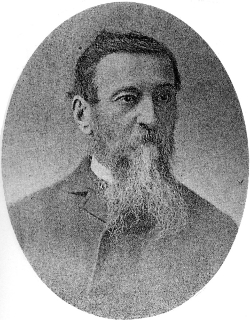
Luby is the son of a Church of Ireland clergyman from Templemore, County Tipperary, his mother being a Catholic. He is educated at Trinity College Dublin where he studies law and puts in the necessary number of terms in London and Dublin where he acquires a reputation as a scholar and takes his degree. He goes on to teach at the college for a time.
In 1851 Luby travels to France, where he hopes to join the French Foreign Legion to learn infantry tactics but finds the recruiting temporarily suspended. From France he goes to Australia for a year before returning to Ireland. From the end of 1855 he edits the Tribune newspaper founded by John E. Pigot who had been a member of The Nation group. During this time, he remains in touch with the small group of ’49 men including Philip Gray and attempts to start a new revolutionary movement. Luby’s views on social issues grow more conservative after 1848 which he makes clear to James Stephens whom he meets in 1856.
In the autumn of 1857 Owen Considine arrives with a message signed by four Irish exiles in the United States, two of whom are John O’Mahony and Michael Doheny. The message conveys the confidence they have in Stephens and asks him to establish an organisation in Ireland to win national independence. Considine also carries a private letter from O’Mahony to Stephens which is a warning, and which is overlooked by Luby and Stephens at the time. Both believe that there is a strong organisation behind the letter, only later to find it is rather a number of loosely linked groups. On December 23 Stephens dispatches Joseph Denieffe to America with his reply which is disguised as a business letter dated and addressed from Paris. In his reply, Stephen’s outlines his conditions and his requirements from the organisation in America.
On March 17, 1858, Denieffe arrives in Dublin with the acceptance of Stephens’s terms by the New York Committee and the eighty pounds. On that very evening the Irish Republican Brotherhood is established in Peter Langan’s timberyard in Lombard Street.
In mid-1863 Stephens informs his colleagues he wishes to start a newspaper, with financial aid from O’Mahony and the Fenian Brotherhood in America. The offices are established at 12 Parliament Street, almost at the gates of Dublin Castle. The first issue of the Irish People appears on November 28, 1863. The staff of the paper along with Luby are Charles J. Kickham and Denis Dowling Mulcahy as the editorial staff. Jeremiah O’Donovan Rossa and James O’Connor have charge of the business office, with John Haltigan being the printer. John O’Leary is brought from London to take charge in the role of Editor.
On July 15, 1865, American-made plans for a rising in Ireland are discovered. Superintendent Daniel Ryan, head of the G Division of the Dublin Metropolitan Police at Dublin Castle, has an informer within the offices of the Irish People who supplies him with an “action this year” message on its way to the IRB unit in Tipperary. With this information, Ryan raids the offices of the Irish People on Thursday, September 15, followed by the arrests of Luby, O’Leary and O’Donovan Rossa. Kickham is caught after a month on the run. Stephens is also caught with the support of Fenian prison warders. The last number of the paper is dated September 16, 1865.
After his arrest and the suppression of the Irish People, Luby is sentenced to twenty years of penal servitude. He is released in January 1871 but is compelled to remain away from Ireland until the expiration of his sentence.
Upon his release Luby goes first to the Continent and later settles in New York City. He lectures all over the country for years and writes for a number of Irish newspapers on political topics. At the memorial meeting on the death of John Mitchel, he delivers the principal address in Madison Square Garden.
Thomas Clarke Luby dies at 109½ Oak Street, Jersey City, New Jersey of paralysis, on November 29, 1901, and is buried in a grave shared with his wife in Bayview Cemetery in Jersey City. His epitaph reads: “Thomas Clarke Luby 1822–1901 He devoted his life to love of Ireland and quest of truth.”
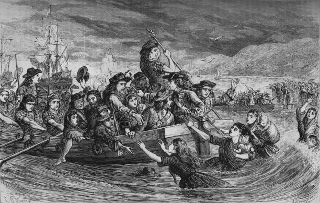
More broadly, the term “Wild Geese” is used in Irish history to refer to Irish soldiers who leave to serve in continental European armies in the 16th, 17th and 18th centuries, or even, poetically, Irish soldiers in British armies as late as World War I.
Irish recruitment for continental armies dries up after it is made illegal in 1745. In 1732 Sir Charles Wogan indicates in a letter to Jonathan Swift, Dean of St. Patrick’s Cathedral, Dublin, that 120,000 Irishmen have been killed and wounded in foreign service “within these forty years.” Swift later replies, “I cannot but highly esteem those gentlemen of Ireland who, with all the disadvantages of being exiles and strangers, have been able to distinguish themselves by their valour and conduct in so many parts of Europe, I think, above all other nations.”
It was some time before the British armed forces begin to tap into Irish Catholic manpower. In the late eighteenth century, the Penal Laws are gradually relaxed and in the 1790s the laws prohibiting Catholics bearing arms are abolished.
Sarsfield is honored to this day in the crest of County Limerick. The Flight of the Wild Geese is remembered in the poetic words… “War-battered dogs are we, Fighters in every clime, Fillers of trench and of grave, Mockers, bemocked by time. War-dogs, hungry and grey, Gnawing a naked bone, Fighters in every clime, Every cause but our own.”
(Pictured: ‘Irish Troops Leaving Limerick’, 1692, (Cassell Petter & Galpin, London, Paris & New York, c1880), Artist Unknown)
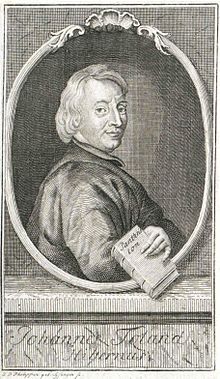
Very little is known of Toland’s early life. His parents are unknown. He later writes that he had been baptised Janus Junius, a play on his name that recalls both the Roman two-faced god Janus and Lucius Junius Brutus, reputed founder of the Roman Republic. According to his biographer, Pierre des Maizeaux, he adopts the name John as a schoolboy with the encouragement of his schoolteacher.
In Toland’s first and best-known book, Christianity not Mysterious (1696), he argues that the divine revelation of the Bible contains no true mysteries. Rather, all the dogmas of the faith can be understood and demonstrated by properly trained reason from natural principles. For this argument he is prosecuted by a grand jury in London. As he is a subject of the Kingdom of Ireland, members of the Parliament of Ireland propose that he should be burned at the stake. In his absence three copies of the book are burned by the public hangman in Dublin as the content is contrary to the core doctrines of the Church of Ireland. Toland bitterly compares the Protestant legislators to “Popish Inquisitors who performed that Execution on the Book, when they could not seize the Author, whom they had destined to the Flames.”
After his departure from Oxford, Toland resides in London for most of the rest of his life but is also a somewhat frequent visitor to Continental Europe, particularly Germany and the Netherlands. He lives on the Continent from 1707 to 1710.
John Toland dies in Putney on March 10, 1722. Just before he dies, he composes his own epitaph: “He was an assertor of liberty, a lover of all sorts of learning … but no man’s follower or dependent. Nor could frowns or fortune bend him to decline from the ways he had chosen.” The 1911 Encyclopædia Britannica says of him that at his death in London at age 51 “he died… as he had lived, in great poverty, in the midst of his books, with his pen in his hand.”
Very shortly after his death a lengthy biography of Toland is written by Pierre des Maizeaux.
Sterne is born to a British military officer stationed in County Tipperary. Following his father’s postings, the family moves briefly to Yorkshire before returning to Ireland, where they live largely in poverty and move frequently throughout the rest of Sterne’s youth. When the elder Sterne is dispatched to Jamaica, where he would die in 1731, he places his son with a wealthy uncle who supports the boy’s education.
Sterne attends Jesus College, Cambridge, following in the footsteps of his grandfather, Richard Sterne, who had been Master of the College. After being ordained as an Anglican priest, he takes up the vicarship of Sutton-on-the-Forest, where he marries Elizabeth Lumley. The couple lives there for the next 20 years.
Through his paternal family line, Sterne is connected to several powerful clergymen. His uncle, Archdeacon Jacques Sterne, encourages him to contribute to Whig political journals, and consequently he writes several articles supporting Sir Robert Walpole. However, when his political fervency fails to match his uncle’s, prompting him to abandon the role of political controversialist, Jacques Sterne cuts ties with his nephew and refuses to support his career. Nevertheless, Sterne continues writing.
Sterne’s first long work, a sharp satire of the spiritual courts entitled A Political Romance, makes him as many enemies as allies. Though the work is not widely distributed and indeed is burned at the request of those targeted by its Swiftian-style criticism, it represents Sterne’s first foray into the kind of humorous satire for which he would become famous. At age 46, he steps back from managing his parishes and turns his full attention to writing.
Sterne begins what becomes his best-known work, The Life and Opinions of Tristram Shandy, Gentleman, at a moment of personal crisis. He and his wife are both ill with tuberculosis and, in the same year that the first volumes of his long comic novel appear, his mother and uncle Jacques die. The blend of sentiment, humour and philosophical exploration that characterises his works matures during this difficult period. Tristram Shandy is an enormous success, and Sterne becomes, for the first time in his life, a famous literary figure in London. Still suffering from tuberculosis, he leaves England for Continental Europe, where his travels influence his second major work, A Sentimental Journey Through France and Italy (1768).
Sterne’s narrator in A Sentimental Journey is Parson Yorick, a sensitive but also comic figure who first appears in Tristram Shandy and who becomes Sterne’s fictive alter ego. In A Sentimental Journey, Parson Yorick wears a “little picture of Eliza around his neck,” and in the last year of his life Sterne writes the autobiographical Journal to Eliza under the pseudonym Yorick. Eliza is Eliza Draper, the wife of an East India Company official, and the literary and emotional muse of Sterne’s final years. After Draper returns to India, the two continue to exchange letters, some of which Draper allows to be published after Sterne’s death in the volume Letters from Yorick to Eliza.
In early 1768, less than a month after A Sentimental Journey is published, Sterne’s strength fails him and he dies in his lodgings at 41 Old Bond Street in London on March 18, 1768, at the age of 54. He is buried in the churchyard of St. George’s Hanover Square Church.
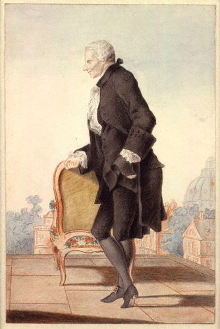
(Pictured: Laurence Sterne painted in watercolour by French artist Louis Carrogis Carmontelle, ca. 1762)




 seamus dubhghaill