seamus dubhghaill

Promoting Irish Culture and History from Little Rock, Arkansas, USA


Leave a comment

Birth of Terence MacSwiney, Playwright, Author & Lord Mayor of Cork

This image has an empty alt attribute; its file name is terence-macswiney.jpg

Terence James MacSwiney, Irish playwright, author, politician and Sinn Féin Lord Mayor of Cork during the Irish War of Independence, is born at 23 North Main Street, Cork, County Cork, on March 28, 1879.

MacSwiney is one of eight children of John and Mary MacSwiney. His father had volunteered in 1868 to fight as a papal guard against Giuseppe Garibaldi, had been a schoolteacher in London and later opened a tobacco factory in Cork. Following the failure of this business, John MacSwiney emigrates to Australia in 1885, leaving the children in the care of their mother and his eldest daughter.

MacSwiney is educated by the Christian Brothers at the North Monastery school in Cork but leaves at fifteen to help support the family. He becomes an accountancy clerk but continues his studies and matriculates successfully. He continues in full-time employment while he studies at the Royal University (now University College Cork), graduating with a degree in Mental and Moral Science in 1907.

In 1901 MacSwiney helps to found the Celtic Literary Society, and in 1908 he founds the Cork Dramatic Society with Daniel Corkery and writes a number of plays for them. His first play, The Last Warriors of Coole, is produced in 1910. His fifth play, The Revolutionist (1915), takes the political stand made by a single man as its theme.

Described as a sensitive poet-intellectual, MacSwiney’s writings in the newspaper Irish Freedom bring him to the attention of the Irish Republican Brotherhood. He is one of the founders of the Cork Brigade of the Irish Volunteers in 1913 and is President of the Cork branch of Sinn Féin. He founds a newspaper, Fianna Fáil, in 1914, but it is suppressed after only eleven issues. In April 1916, he is intended to be second in command of the Easter Rising in counties Cork and Kerry but stands down his forces on the order of Eoin MacNeill.

Following the rising, MacSwiney is imprisoned by the British Government under the Defence of the Realm Act 1914 in Reading and Wakefield Gaols until December 1916. In February 1917 he is deported from Ireland and imprisoned in Shrewsbury and Bromyard internment camps until his release in June 1917. It is during his exile in Bromyard that he marries Muriel Murphy of the Cork distillery-owning family. In November 1917, he is arrested in Cork for wearing an Irish Republican Army (IRA) uniform, and inspired by the example of Thomas Ashe, goes on a hunger strike for three days prior to his release.

In the 1918 Irish general election, MacSwiney is returned unopposed to the first Dáil Éireann as Sinn Féin representative for Mid Cork, succeeding the Nationalist MP D. D. Sheehan. After the murder of his friend Tomás Mac Curtain, the Lord Mayor of Cork, on March 20, 1920, he is elected as Lord Mayor. On August 12, 1920, he is arrested in Cork for possession of “seditous articles and documents,” and also possession of a cipher key. He is summarily tried by a court on August 16 and sentenced to two years’ imprisonment at Brixton Prison in England.

In prison MacSwiney immediately starts a hunger strike in protest of his internment and the fact that he was tried by a military court. Eleven other Irish Republican prisoners in Cork Jail go on hunger strike at the same time. On August 26, the British Government states that “the release of the Lord Mayor would have disastrous results in Ireland and would probably lead to a mutiny of both military and police in south of Ireland.”

MacSwiney’s hunger strike gains world attention. The British Government is threatened with a boycott of British goods by Americans, while four countries in South America appeal to Pope Benedict XV to intervene. Protests are held in Germany and France as well. An Australian member of Parliament, Hugh Mahon, is expelled from the Parliament of Australia for “seditious and disloyal utterances at a public meeting,” after protesting against the actions of the British Government. Two weeks later, the Spanish Catalan organization Autonomous Center of Employees of Commerce and Industry (CADCI) sends a petition to British Prime Minister David Lloyd George calling for his release and the newspaper of the organization, Acció (Acción in Spanish), begins a campaign for MacSwiney.

Food is often placed near MacSwiney to persuade him to give up the hunger strike. Attempts at force-feeding are undertaken in the final days of his strike. On October 20, 1920, he slips into a coma and dies in London’s Brixton Prison on October 25, after 73 days on hunger strike. His body lay in St. George’s Cathedral, Southwark in London where 30,000 people file past it. Fearing large-scale demonstrations in Dublin, the authorities divert his coffin directly to Cork, and his funeral in the Cathedral of St. Mary and St. Anne on October 31 attracts huge crowds. He is buried in the Republican plot in St. Finbarr’s Cemetery in Cork. Arthur Griffith delivers the graveside oration. His death brings him and the Irish Republican campaign to international attention.

Leave a comment

Birth of Anne Bonny, Irish Pirate

Anne Bonny, Irish pirate operating in the Caribbean and one of a few female pirates in recorded history, is said to be born in Old Head of Kinsale, near Cork, Kingdom of Ireland on March 8, 1697.

Bonny is the daughter of servant woman Mary Brennan and Brennan’s employer, lawyer William Cormac. Official records and contemporary letters dealing with her life are scarce, and most modern knowledge stems from Captain Charles Johnson‘s A General History of the Robberies and Murders of the most notorious Pyrates.

Bonny’s father, William Cormac, first moves to London to get away from his wife’s family, and he begins dressing his daughter as a boy and calling her “Andy.” When Cormac’s wife discovers William has taken in his illegitimate daughter and is bringing her up to be a lawyer’s clerk and dressing her as a boy, she stops giving him an allowance. Cormac then moves to the Province of Carolina, taking along his former serving girl, the mother of Bonny. At first, the family has a rough start in their new home, but Cormac’s knowledge of law and ability to buy and sell goods soon finances a townhouse and eventually a plantation just out of town. Bonny’s mother dies when she is 12. Her father attempts to establish himself as an attorney but does not do well. Eventually, he joins the more profitable merchant business and accumulates a substantial fortune.

It is recorded that Bonny has red hair and is considered a “good catch” but may have have a fiery temper as, at age 13, she supposedly stabs a servant girl with a knife. She marries a poor sailor and small-time pirate named James Bonny. He hopes to win possession of his father-in-law’s estate, but Bonny is disowned by her father. He does not approve of James Bonny as a husband for his daughter, and he kicks Anne out of their house. There is a story that Bonny sets fire to her father’s plantation in retaliation, but no evidence exists in support.

Sometime between 1714 and 1718, Bonny and her husband move to Nassau, on the island of New Providence, known as a sanctuary for English pirates called the Republic of Pirates. Many inhabitants receive a King’s Pardon or otherwise evade the law. It is also recorded that, after the arrival of Governor Woodes Rogers in the summer of 1718, James Bonny becomes an informant for the governor. He reports to Governor Rogers about the pirates in the area, which results in a multitude of these pirates being arrested. Bonny dislikes the work her husband does for Governor Rogers.

While in the Bahamas, Bonny begins mingling with pirates in the taverns. She meets John “Calico Jack” Rackham, and he becomes her lover. He offers money to her husband if he would divorce her, but her husband refuses and apparently threatens to beat Rackham. She and Rackham escape the island together, and she becomes a member of Rackham’s crew. She disguises herself as a man on the ship, and only Rackham and Mary Read are aware that she is a woman until it becomes clear that she is pregnant. Rackham then lands her at Cuba where she gives birth to a son. She then rejoins Rackham and continues the pirate life, having divorced her husband and married Rackham while at sea. Bonny, Rackham, and Read steal the ship William, then at anchor in Nassau harbor, and put out to sea. Rackham and the two women recruit a new crew. Their crew spends years in Jamaica and the surrounding area. Bonny takes part in combat alongside the men, and Governor Rogers names her in a “Wanted Pirates” circular published in The Boston News-Letter.

In October 1720, Rackham and his crew are attacked by a sloop captained by Jonathan Barnet under a commission from Nicholas Lawes, Governor of Jamaica. Most of Rackham’s pirates put up little resistance, as many of them are too drunk to fight. They are taken to Jamaica where they are convicted and sentenced by Governor Lawes to be hanged. According to Johnson, Bonny’s last words to Rackham are: “Had you fought like a man, you need not have been hang’d like a dog.”

Read and Bonny both “pleaded their bellies“, asking for mercy because they are pregnant, and the court grants them a stay of execution until after they give birth. Read dies in prison, most likely from a fever from childbirth. A ledger from a church in Jamaica lists her burial on April 28, 1721, “Mary Read, pirate.”

There is no record of Bonny’s release, and this has fed speculation as to her fate. A ledger lists the burial of an “Ann Bonny” on December 29, 1733, in the same town in Jamaica where she was tried. Charles Johnson writes in his book: “She was continued in Prison, to the Time of her lying in, and afterwards reprieved from Time to Time; but what is become of her since, we cannot tell; only this we know, that she was not executed.”

Other sources have stated that she may have returned to the United States after her imprisonment, dying in South Carolina in April 1782.


Leave a comment

Birth of Emmet Dalton, Soldier & Film Producer

James Emmet Dalton MC, Irish soldier and film producer, is born in Fall River, Massachusetts, on March 4, 1898. He serves in the British Army in World War I, reaching the rank of captain. However, on his return to Ireland he becomes one of the senior figures in the Dublin Brigade of the Irish Republican Army (IRA) which fights against British rule in Ireland.

Dalton is born to Irish American parents James F. and Katharine L. Dalton. The family moves back to Ireland when he is two years old. He grows up in a middle-class Catholic background in Drumcondra in North Dublin and lives at No. 8 Upper St. Columba’s Road. He is educated by the Christian Brothers at O’Connell School in North Richmond Street. He joins the nationalist militia, the Irish Volunteers, in 1913 and the following year, though only fifteen, is involved in the smuggling of arms into Ireland.

Dalton joins the British Army in 1915 for the duration of the Great War. His decision is not that unusual among Irish Volunteers, as over 20,000 of the National Volunteers join the British New Army on the urgings of Nationalist leader John Redmond. His father, however, disagrees with his son’s decision. He initially joins the 7th battalion of the Royal Dublin Fusiliers (RDF) as a temporary 2nd Lieutenant. By 1916 he is attached to the 9th Battalion, RDF, 16th (Irish) Division under Major-General William Hickie, which contains many Irish nationalist recruits.

During the Battle of the Somme in September 1916, Dalton is involved in bloody fighting during the Battle of Ginchy, in which over 4,000 Irishmen are killed or wounded. He is awarded the Military Cross for his conduct in the battle. Afterwards he is transferred to the 6th Battalion, Leinster Regiment, and sent to Thessaloniki then Palestine, where he commands a company and then supervises a sniper school in el-ʻArīsh. In 1918 he is re-deployed again to France, and in July promoted to captain, serving as an instructor.

On demobilisation in April 1919, Dalton returns to Ireland. There, finding that his younger brother Charlie had joined the IRA, he himself follows suit. He later comments on the apparent contradiction of fighting both with and against the British Army by saying that he had fought for Ireland with the British and fought for Ireland against them.

Dalton becomes close to Michael Collins and rises swiftly to become IRA Director of Intelligence and is involved in The Squad, the Dublin-based assassination unit. On May 14, 1921, he leads an operation with Paddy Daly that he and Collins had devised. It is designed to rescue Gen. Seán Mac Eoin from Mountjoy Prison using a hijacked British armoured car and two of Dalton’s old British Army uniforms.

Dalton follows Collins in accepting the Anglo-Irish Treaty in 1922 and is one of the first officers, a Major General, in the new National Army established by the Irish Provisional Government of the Irish Free State. The Treaty is opposed by much of the IRA and Civil War between pro and anti-treaty factions eventually results.

Dalton is in command of troops assaulting the Four Courts in the Battle of Dublin which marks the start of the war in June 1922. At Collins’ instigation he, as Military liaison officer with the British during the truce, takes control of the two 18 pounder guns from the British that are trained on the buildings. He becomes commander of the Free State Army under Richard Mulcahy‘s direction. He is behind the Irish Free State offensive of July–August 1922 that dislodges the Anti-Treaty fighters from the towns of Munster. He proposes seaborne landings to take the Anti-Treaty positions from the rear and he commands one such naval landing that takes Cork in early August. In spite of firm loyalty to the National Army, he is critical of the Free State’s failure to follow up its victory, allowing the Anti-Treaty IRA to regroup resuming the guerrilla warfare started in 1919.

On August 22, 1922, he accompanies Collins in convoy, touring rural west Cork. The convoy is ambushed near Béal na Bláth and Collins is killed in the firefight. He had advised Collins to drive on, but Collins, who is not an experienced combat veteran, insists on stopping to fight.

Dalton is married shortly afterwards, on October 9, 1922, to Alice Shannon in Cork’s Imperial Hotel. By December 1922 he has resigned his command in the Army. He does not agree with the execution of republican prisoners that mark the latter stages of the Civil War. After briefly working as clerk of the Irish Senate, Seanad Éireann, he leaves the job to work in the movie industry.

Over the following forty years, Dalton works in Ireland and the United States in film production. In 1958 he founds Irish Ardmore Studios in Bray, County Wicklow. His company helps produce films such as The Blue Max, The Spy Who Came In from the Cold and The Lion in Winter, all of which are filmed in Ireland. His daughter is Irish actress Audrey Dalton.

Dalton dies in his daughter Nuala’s house in Dublin on March 4, 1978, his 80th birthday, never having seen the film that Cathal O’Shannon of RTÉ had made on his life. During the making of the film, they visit the battlefields in France, Kilworth Camp in Cork, Béal Na Bláth, and other places that Dalton had not visited since his earlier years. He wishes to be buried as near as possible to his friend Michael Collins in Glasnevin Cemetery in Dublin and is buried there in March 1978 after a military funeral. None of the ruling Fianna Fáil government ministers or TDs attend.

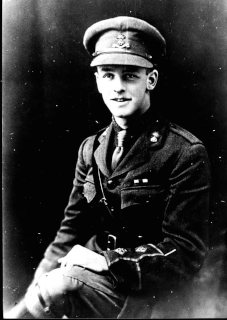
(Pictured: Dalton photographed in lieutenant’s uniform, Royal Dublin Fusiliers, taken circa. 1914-1918)


Leave a comment

The Upton Train Ambush

The Upton train ambush takes place on February 15, 1921, during the Irish War of Independence. The Irish Republican Army (IRA) mounts an attack on a train carrying British soldiers at Upton, County Cork. The action is a disaster for the IRA with three of its volunteers killed and two wounded. Six British soldiers are wounded, three seriously. Six civilian passengers are killed and ten wounded in the crossfire.

According to a study of the region, Cork is “by far the most violent county in Ireland” during the War of Independence and has several active guerrilla brigades. Of these, the 3rd Cork Brigade is one of the most effective and it is a unit from this Brigade that carries out the Upton ambush.

Up until the end of 1920, the British had been unable to move troops by train, due to a nationwide boycott by railway workers of trains carrying the British military. However, the strike is lifted in December 1920. While this helps the British military’s mobility, it also gives the IRA a new target: trains carrying soldiers. A week before the Upton ambush, the local IRA had made a successful attack on a train travelling from Killarney to Millstreet near Drishanbeg, killing one sergeant and wounding five more soldiers.

Five days after the Drishanbeg ambush, plans are made for an attack at Upton and Innishannon railway station on a train traveling between Cork city and Bandon. The ambushers, led by Charlie Hurley, are thirteen strong. Seven are armed with rifles and the remainder with revolvers or semi-automatic pistols. They take up position at the station ten minutes before the train pulls in, imprisoning the station master, clearing the station and taking cover behind sacks of grain and flour taken from a store.

The train is carrying approximately 50 British soldiers of the Essex Regiment, who are mingled with civilian passengers throughout the train’s carriages. The IRA party is therefore quite heavily outnumbered and out-gunned, but are unaware of this, as two IRA scouts, who were supposed to have been on the train and signaled to them the British numbers, never turn up. They also wrongly believe that the British troops are all in the central carriage. As a result, when the IRA opens fire on the train, there are heavy civilian casualties, including two commercial travelers killed by the first volley. The New York Times reports that “a shower of bullets was rained on the train, practically every compartment being swept.”

The firefight lasts only ten minutes, but in that time six civilian passengers are killed and ten wounded. Six British soldiers are injured, three of them seriously. Two IRA volunteers are killed outright and another is fatally wounded. Two more are badly wounded but survive. Charlie Hurley, who had led the ambush, is struck in the face by a bullet. IRA leader Tom Barry later writes, “Through some miracle, the nine unwounded and two wounded got away across country, in small parties, with the British following close behind.” Three civilian passengers, one unwounded and two wounded, are detained by the British on suspicion of belonging to the ambush party.

The Upton ambush is part of what Tom Barry describes as “twelve dark days” for the 3rd Cork Brigade of the IRA. Between February 4 and February 16, eleven members of the Brigade are killed. One is shot dead by British troops when they raid a safehouse on February 4, another dies in an accidental shooting on February 7, two more (brothers James and Timothy Coffey) are assassinated in their beds on February 14 by Black and Tans or Auxiliaries, three die at Upton on February 15 and four are killed on February 16 when they are arrested by the Essex Regiment in Kilbrittain while digging a trench and shot dead. Of the eleven dead, only those at Upton are killed in combat.

The Upton attack also highlights the dangers, and particularly the risk to civilians, of attacking trains carrying troops. Only a month later at the Headford Ambush in neighbouring County Kerry, an IRA column successfully attacks a train-load of troops, but again, there are civilian casualties alongside the IRA and British Army losses. One of the three men captured by the British at Upton is reported to give information leading to the 3rd Cork Brigade’s main column of over 100 fighters almost being encircled at the Crossbarry Ambush. Hurley is killed in this action.

The Upton ambush is later made famous in a popular 1960s Irish ballad titled “The Lonely Woods of Upton.”

(Pictured: A portion of the cover of an Italian magazine from 1921 that reported on the Upton ambush)


Leave a comment

Birth of Albert Rosen, Czech/Irish-Naturalized Conductor

Albert Rosen, Austrian-born and Czech/Irish-naturalised conductor associated with the National Symphony Orchestra of Ireland, the Wexford Festival Opera, the National Theatre in Prague and J. K. Tyl Theatre in Plzeň (Pilsen), is born in Vienna on February 14, 1924. He has a strong affinity with the works of Czech composers such as Bedřich Smetana, Antonín Dvořák, Bohuslav Martinů, and Leoš Janáček.

Rosen’s mother is Czech, while his father’s family is Austrian-Jewish. After Anschluss of Austria in 1938 they move to Bratislava, and after the Slovak version of Nuremberg Laws comes to force in September 1941, he escapes discrimination and genocide via the Danube and the sea to Israel (then Mandatory Palestine). There he works in the Shaʽar_HaGolan kibbutz, manually and as an amateur chorus master, until 1945, when he returns to Bratislava.

In 1946–47 Rosen studies piano, composition and conducting at the Vienna Academy of Music with Joseph Marx and Hans Swarowsky, and continues to study conducting at the Prague Conservatory under Pavel Dědeček and Alois Klíma (1947–48). He starts his career in J. K. Tyl Theatre in Plzeň (Pilsen) as a correpetiteur, assistant conductor and chorus master (1949–52) and conductor (1953–59), participating on the production of 11 operas, 19 ballets and, as the composer of stage music, 17 dramas. In 1960 he is engaged by National Theatre in Prague, to be appointed in 1964 the chief conductor of Smetana Theatre, the National Theatre’s opera stage. He holds this position until 1971, conducting 11 ballets and 9 opera productions.

In 1965 Rosen comes to Ireland for the first time to conduct the National Symphony Orchestra (under its former name, the Radio Telefís Éireann Symphony Orchestra) at the Wexford Festival. This leads to regular appearances at the festival until 1994, conducting 18 Wexford productions, more than anyone else. In 1969 he becomes the orchestra’s chief conductor, until he becomes principal guest conductor in 1981. In 1994 he is honoured with the title Conductor Laureate of the orchestra.

Rosen’s operatic repertoire includes standard works such as Carmen (Bizet), Tosca and Madama Butterfly (Puccini), Il trovatore and Don Carlos (Verdi), Lohengrin (Wagner), Lucrezia Borgia (Donizetti), Otello and L’italiana in Algeri (Rossini), Káťa Kabanová (Janáček), La Wally (Catalani), The Bartered Bride (Smetana), and Salome (Richard Strauss). He also conducted unusual works such as Smetana’s The Two Widows and The Kiss, and Dvořák’s Rusalka, The Devil and Kate and The Jacobin.

In October 1978, in Dublin and Cork, Rosen conducts the National Symphony Orchestra in only the second and third performances of André Tchaikowsky‘s 2nd Piano Concerto, Op. 4, which are the first performances with the composer as soloist. He is to record the work in 1982, again with Tchaikowsky at the piano, but the composer becomes ill, and the recording is cancelled. His other work with the NSO includes standard orchestral repertoire as well as major pieces such as Olivier Messiaen‘s Turangalîla-Symphonie and Gustav Mahler‘s Symphony No. 8 (Symphony of a Thousand). In 1992, the orchestra tours ten cities in Germany, having a major success with Die Fledermaus in Stuttgart.

Rosen makes his American debut at the San Francisco Opera in 1980, in Janáček’s Jenůfa. In Australia, he is chief conductor of the West Australian Symphony Orchestra from 1983 until 1985, and the Adelaide Symphony Orchestra in 1986. He conducts the British premiere of Nikolai Rimsky-Korsakov‘s opera Christmas Eve with English National Opera in 1988. He becomes music director of the Irish National Opera in 1993.

Rosen often conducts the National Youth Orchestra of Ireland during the 1990s, in challenging works such as the tone poems and An Alpine Symphony of Richard Strauss. Other opera orchestras he conducts included those of the Welsh National Opera, Scottish Opera, Vancouver Opera, San Diego Opera, and the Dublin Grand Opera Society.

Rosen becomes an Irish citizen by naturalisation. His own conducting students include John Finucane.

Rosen dies at the age of 73 in Dublin on May 23, 1997, of lung cancer.

(Pictured: Albert Rosen conducts the RTÉ Symphony Orchestra in St. Patrick’s Training College in Drumcondra, Dublin, in 1972)


Leave a comment

Birth of Rosaleen Brigid Ganly, Painter & Sculptor

Brigid Ganly HRHA, Irish painter and sculptor, is born Rosaleen Brigid O’Brien on January 29, 1909, in Dublin.

Ganly is one of five children born to Dermod O’Brien, a painter, and his wife Mabel Smiley. Her great-grandfather is the Irish Republican William Smith O’Brien. She grows up on a farm in Cahirmoyle, County Limerick, until the family moves to Fitzwilliam Square in Dublin. She goes on to attend the Metropolitan School of Art where she has the opportunity to study under Patrick Tuohy, Seán Keating and Oliver Sheppard. She is a talented sculptor and wins several awards, including the Taylor scholarship in 1929, for her allegorical male nude, Pity. She spends time in Paris in 1951 where she trains with André Lhote. She travels to Greece where Lhote continues to influence her work.

Ganly also studies painting in the Royal Hibernian Academy School where she has Margaret Clarke and Seán O’Sullivan as teachers. She is made an associate of the Royal Hibernian Academy (RHA) in 1928 and becomes a member in 1935 though, in 1969, resigns her membership in protest of the lack of young artists being given the opportunity to exhibit. In 1972 she is made an honorary member and returns.

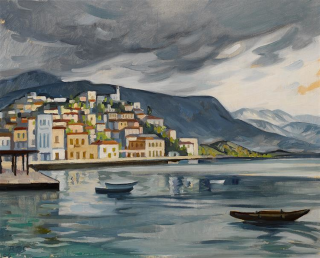
Ganly is a representational artist and while known as a portrait artist, she also paints landscapes, interiors and may be best known for her still lifes. Some of her best works are portraits of her husband, her sister Ethel, her father, and her friend Sheila Pim. She illustrates the book-jackets of Sheila Pim’s works. She has many exhibitions, with the RHA and the Water Colour Society of Ireland. There is a retrospective of her life in 1998 at the Hugh Lane Gallery and her works are in the collections there. She is also in the collections of the Waterford Municipal Gallery, Crawford Art Gallery, Cork and in The National Self-Portrait Collection of Ireland. She is part of the 2014 exhibition ‘Irish Women Artists: 1870-1970.’

Ganly’s sister-in-law is Kitty Wilmer O’Brien with whom she often exhibits. She marries Andrew Ganly, a dental surgeon and writer with a strong involvement in theatre, in 1936. He dies in 1982. They have two children, Eoghan and Phillida.

Brigid Ganly dies on March 25,2002.

(Pictured: “Storm Over Poros” (1964) by Rosaleen Brigid Ganly, HRHA)


Leave a comment

Birth of Charles McCarthy, Trade Unionist & Academic

Charles McCarthy, trade unionist and academic, is born on January 25, 1924, at 12 Annmount, Friars Walk, Cork, County Cork.

McCarthy is the second child of John George McCarthy of Cork, plumber, and Agnes Abina McCarthy (née O’Donoghue). He is educated at Presentation Brothers College, Cork, University College Dublin (UCD), and King’s Inns, where he enrolls in 1948. He is called to the bar in 1956.

On June 7, 1951, McCarthy marries Muriel, daughter of Liam Breslin. She becomes (1989) keeper of Marsh’s Library, Dublin, receives an honorary LL.D from National University of Ireland (NUI), and is also made an honorary lay canon of St. Patrick’s Cathedral, Armagh. They live at 367 Howth Road, Raheny, Dublin, and have one son and two daughters.

After graduating from UCD McCarthy briefly works as a clerk on a building site and as an insurance agent before becoming an actor with the Radio Éireann Repertory in 1947. During his time with Radio Éireann he also writes four plays, one of which, entitled Jericho’s trumpets, is based on his experiences in the insurance industry. He is later employed as a speech and drama teacher by Cork vocational educational committee. At the same time, he develops an interest in industrial relations as treasurer of the actors’ trade union Equity and then as secretary of the Civil Service Alliance. In 1956 he becomes full-time general secretary of the Vocational Teacher’s Association, which later becomes the Teachers’ Union of Ireland (TUI). Through this post he eventually becomes president (1963–64) of the Irish Congress of Trade Unions (ICTU) and sits on the executive committee for ten years. As secretary to the International Committee of Technical Teachers he organises conferences around the world and develops countless international contacts.

In 1968 McCarthy publishes his first book, The distasteful challenge. A damning indictment of the static nature of Irish society at the time, it stresses the need to face up to change, particularly in the areas of education, the civil service, and local government. This is followed in 1971 by Industrial democracy. The following year he takes a leave of absence from the TUI to become a research fellow at Trinity College Dublin (TCD). In 1973 his dedication to the arts is rewarded with a seat (1973–76) on the RTÉ Authority and in the same year he publishes Decade of upheaval, which documents the experiences of the trade union movement during the turbulent era of the 1960s. In 1977 he becomes a lecturer in industrial relations at TCD and his 670-page magnum opus, Trade unions in Ireland, 1894–1960, is published to critical acclaim. In 1979 he is appointed to the chair in industrial relations at TCD and becomes head of the school of business and administrative studies. He is later appointed dean of the faculty of economic and social studies and made a fellow of TCD.

McCarthy is a firm believer in resolving industrial relations problems through negotiation. Both unions and management alike respect his views and abilities and he is frequently called on by the private and public sectors, as well as governments, to use his expertise to bring an end to protracted disputes. He sits on numerous public bodies including the National Industrial & Economic Council and the Irish National Productivity Committee. In 1985 his ability to bridge the divide between management and unions is recognised with his election to the council of the Irish Management Institute. Despite his career in industrial relations he maintains his interest in drama and is an original shareholder in the new Abbey Theatre. In 1973 he is appointed to the board of the theatre, serving as chairman from 1982–85. He is also a member of the board of governors and guardians of Dr. Steevens’ Hospital, Dublin.

McCarthy dies on September 8, 1986 in Dublin of atherosclerosis of the coronary arteries.

(From: “McCarthy, Charles” contributed by Shaun Boylan, Dictionary of Irish Biography, http://www.dib.ie)


Leave a comment

Death of Patrick Hennessy, Irish Realist Painter

Patrick Anthony Hennessy RHA, Irish realist painter known for his highly finished still lifes, landscapes and trompe-l’œil paintings, dies in London on December 30, 1980. The hallmark of his style is his carefully observed realism and his highly finished surfaces, the result of a virtuoso painting technique.

Hennessy is born in Cork, County Cork, on August 28, 1915. The son of John Hennessy an army sergeant major from County Kerry and Bridget Hennessy from Cork. His father is killed in World War I at the Battle of Passchendaele in 1917. In 1921, when he is five years old, his mother remarries in Cork. Her second husband is a Scot named John Duncan and shortly afterwards the whole family moves to Arbroath, Scotland, where Duncan has relatives.

Hennessy is educated in Arbroath at St. Thomas RC Primary School followed by secondary education at Arbroath High School, where he begins to show an aptitude for art, leaving in 1933 with the Dux for Art and an accompanying medal. In the autumn of 1933 he enrolls at the Dundee of Jordanstone College of Art & Design, for a four-year Diploma course in Drawing and Painting under James McIntosh Patrick and Edward Baird. Here he meets Harry Robertson Craig who becomes his lifelong companion. He plays a full part in the social activities of the college, winning a fancy dress award at the Christmas revels in 1935 and producing a ballet “Paradise Lost” the following year. He gains a First Class Pass in each year of the course along with winning first prize in 1934 and 1936 for work done during the summer vacation. He graduates with a First Class Distinction in 1937.

Having gained a scholarship, Hennessy continues his studies at the Dundee of Jordanstone College of Art & Design for a further year by doing a Post-Graduate Diploma course in Drawing and Painting. Within a month of gaining his Post-Graduate Diploma he holds his first joint exhibition at the Art Galleries in Arbroath. In June 1938 he is awarded the Annual Travelling Scholarship for further studies in Paris and Italy. In Paris he meets up with the artists Robert Colquhoun and Robert MacBryde, whom he had met the previous year, the three travelling south together to Marseilles towards the end of that year. On his return to Scotland he is selected for the residential summer school course at Hospitalfield House near Arbroath under James Cowie. Two of his paintings, a still life and a self-portrait, are accepted that year by the Royal Scottish Academy for their Annual Exhibition. However, by the autumn of 1939 with war looming and feeling somewhat disenchanted on his return to Scotland, he decides to return to Ireland.

On arrival in Dublin Hennessy is offered an exhibition in December 1939 at the Country Shop on St. Stephen’s Green which is opened by Mainie Jellett. This attracts favourable attention. During the early 1940s he lives at various addresses in and around Dublin with frequent trips to Cork. In 1940 he is invited to join the Society of Dublin Painters and holds regular annual exhibitions of his work there during the 1940s and early 1950s. These exhibitions are supplemented by an eclectic mix of commissions, mostly portraits which he undertakes during this period. In 1941 he has three of his paintings accepted by the Royal Hibernian Academy (RHA) for their annual exhibition. This is the beginning of a long relationship with the RHA. He exhibits there virtually every year from 1941 until 1979, the year before his death.

From the early 1940s onwards, Hennessey’s work sometimes incorporates a homosexual visual subtext. He re-unites with Harry Robertson Craig in 1946 and soon after they move to Crosshaven, County Cork, and later to Cobh. In 1947, Time magazine selects him as one of Ireland’s outstanding painters, in recognition of the important position he has then attained in the art world. In 1948 he has an exhibition at the Victor Waddington Gallery, Dublin, and that same year is elected an associate of the Royal Hibernian Academy and a full member the following year. In 1950 his painting De Profundis is selected for the Contemporary Irish Painting exhibition that tours North America. As a result of this tour, the American public and critics begin to take notice of his work. In 1951 he visits Italy, taking in Venice and Sicily and returning to Dublin with many of his canvases painted abroad. One of these paintings, Bronze Horses of St. Marks, is exhibited at the Royal Academy of Arts in London in 1954.

In 1956, a friend of Hennessy, David Hendriks, opens the Ritchie Hendriks Gallery on St. Stephen’s Green, Dublin and it is this gallery that is to be the main outlet for his work over the following 22 years. In October 1956 the Thomas Agnew Gallery in London holds an exhibition of his work comprising 38 of his paintings. However, during the winter of 1959 he becomes seriously ill with pneumonia. As a consequence of this, in the autumn of that year he and Craig decide to winter in Morocco. This is the beginning of a new era in both their lives. They would never again spend a full year in Ireland. His exhibitions at the Ritchie Hendriks Gallery had for many years enjoyed favourable reviews from the art critics but in the 1960s this changes with critics claiming his paintings to be dull, repetitive and suggest he needs to explore new areas. Despite the barrage of criticism, in 1965 the Guildhall Gallery in Chicago offers him a major exhibition. Shortly after this exhibition takes place in 1966 he becomes one of the artists on permanent display at the gallery with an annual exhibition. The North American market is extremely lucrative for him and by the end of the decade he is selling more of his work in the United States than in Ireland. In 1968 he finally moves to Tangier, Morocco on a permanent basis and in 1970 sells his studio on Raglan Lane, Dublin.

In Morocco, Hennessy paints prolifically for nine years to keep up with demand from the Hendriks Gallery and Guildhall Gallery along with the RHA. In 1975 the Guildhall Gallery mounts a highly successful Retrospective of his work. In 1978 he has his last exhibition in Dublin at the Hendriks Gallery. By this time he has moved to the Algarve, Portugal and is beginning to have health problems.

In November 1980, with his health deteriorating, Craig brings Hennessy to a hospital in London for treatment. However, on December 30, 1980 he dies from cancer. Following cremation his ashes are buried in nearby Golders Green Crematorium. He leaves his entire estate to Harry Robertson Craig with the proviso that on Craig’s death the Royal Hibernian Academy should be the beneficiary. This legacy has been used to set up the annual Hennessy Craig Scholarship for aspiring artists.

Hennessy falls into the category of painter who develops a distinctive personal style, labelled at various times in his life as a Traditional Realist, Romantic, Photo Realist, Illusionary and Surrealist. However, he always remains intrinsically himself. His subjects range from still life and interiors to landscapes and portraits.

Examples of Hennessy’s work can be found in the public collections of the Crawford Art Gallery, the Dublin City Gallery The Hugh Lane, the Irish Museum of Modern Art (IMMA), the Limerick City Gallery of Art (LCGA), the National Gallery of Ireland (NGI), the National Self-Portrait Collection of Ireland (NSPCI) at the University of Limerick (UL), and in the collections of University College Cork (UCC) and University College Dublin (UCD).


Leave a comment

Birth of Diarmuid O’Hegarty, Civil Servant & Revolutionary

Diarmuid O’Hegarty (Ó hÉigeartuigh), civil servant and revolutionary, is born Jeremiah Stephen Hegarty on December 26, 1892, in Lowertown, Skibbereen, County Cork, the eldest of seven children of Jeremiah Hegarty (1856–1934) and his wife Eileen (née Barry), both teachers. He is educated at the Christian Brothers school, St. Patrick’s Place, Cork, joins the civil service in 1910 and is posted to the Department of Agriculture and Technical Instruction, acquiring invaluable administrative experience as private secretary to T. P. Gill, secretary of the department.

O’Hegarty is a member of the Keating branch of the Gaelic League and the closely associated Teeling circle of the Irish Republican Brotherhood (IRB). In 1913 he becomes secretary and stage manager of a troupe of Gaelic players, Na hAisteoirí, which includes several who later become prominent revolutionaries: Piaras Béaslaí, Gearóid O’Sullivan, Fionán Lynch, and Con Collins. As second lieutenant of F Company, 1st Battalion, Dublin Brigade, Irish Volunteers, during the Easter Rising, he is in charge of barricades in Church Street, Mary Lane, Mary’s Abbey, and Jameson Distillery, an area which sees fierce fighting. Imprisoned in Knutsford (May 1-18), he is released in error and returns to his post in the civil service. On his return he is a key figure in the reorganisation of the Volunteers and IRB, becoming a member of the executive of the IRB’s supreme council along with Michael Collins and Seán Ó Murthuile. He also becomes a central figure in Kathleen Clarke‘s prisoner support group, the Irish Volunteer Dependents Fund, and when it amalgamates with the more moderate Irish National Aid Association to form the INA&VDF in August 1916, he helps to ensure that it is dominated by republicans.

O’Hegarty is very close to Michael Collins and Harry Boland and in 1918 this IRB triumvirate exercises considerable control in the nomination of Sinn Féin candidates for the 1918 Irish general election. In the same year he is dismissed from the civil service for refusing to take the oath of allegiance, but his administrative talents find ample outlet in the secretariat of the revolutionary Dáil and later in the service of the Irish Free State to such an extent that he has been called ‘the civil servant of the revolution’ and ‘the Grey Eminence of the Free State Government.’ As clerk of the First Dáil and secretary to the Dáil cabinet (1919–21), he is largely responsible for its success, organising meetings of the clandestine parliament and coordinating the work of various departments from his offices on the corner of O’Connell Street and Abbey Street and later in Middle Abbey Street. He is determined that the Dáil will demonstrate its worth by ‘functioning as any progressive government would be expected to function.’ He records the minutes and handles all correspondence of the Dáil cabinet. As the conduit through which the Dáil’s ministers communicate, his role is central to the effective operation of government on the run. The influence this gives him within the revolutionary movement is bolstered by his senior role within the IRB and the positions of military significance which he occupies. He is a member of the Volunteer Executive (Jun 1916–Nov 1921), Irish Republican Army (IRA) Director of Communications (Jul 1918–Mar 1920), and Director of Organisation (Mar 1920–Apr 1921). When convicted of illegal assembly and jailed in Mountjoy Prison (Nov 1919–Feb 1920), he immediately wields power within the prison, ordering Noel Lemass off a hunger strike.

O’Hegarty resigns his military duties in April 1921 to concentrate on his work in the Dáil secretariat and serves as secretary to the Irish delegation during the Anglo–Irish Treaty negotiations in London (Oct–Dec 1921). He is a vital voice for the Treaty within the IRB and is appointed secretary to the cabinet of the Provisional Government in 1922, participating in the unsuccessful army unification talks of May 1922. During the Irish Civil War, he is briefly seconded from his civil service post to serve as military governor of Mountjoy Prison (Jul-Aug 1922), where he threatens that prisoners who persist in leaning out of windows and talking to the public outside the prison will be shot. Peadar O’Donnell, who is a prisoner there at the time, remembers him as the focus of much ‘republican bitterness.’ A member of the army council during the Irish Civil War, he serves as Director of Organisation (Jul–Dec 1922) and Director of Intelligence (Dec 1922–May 1923), leaving the army with the rank of lieutenant general on May 1, 1923, to resume his civil service career.

O’Hegarty is secretary to the Executive Council of the Irish Free State (1923–32) and principal private secretary to its president, W. T. Cosgrave. Again, he records the cabinet minutes and is the administrative pivot upon which government turns. He serves as secretary to numerous governmental delegations and is widely praised for his work in this role at the 1926 Imperial Conference and the 1930 Imperial Conference. In 1927 he goes to New York to represent the government at a hearing into the fate of republican funds in the United States. His career is the prime example of the influence of revolutionary veterans within the higher civil service in the early years of the state. After the change of government following the 1932 Irish general election, he is one of the very few senior civil servants who is effectively removed from his position. He is appointed to be a commissioner of public works, becoming chairman in 1949, a position he holds until his retirement in 1957. In 1939–40 he serves on the Economy Committee established by the government to advise on wartime spending, and in 1941 is a member of a tribunal of inquiry into public transport, which is principally concerned with the poor financial state of Great Southern Railways.

On April 27, 1922, with Michael Collins as his best man, O’Hegarty marries Claire Archer, daughter of Edward Archer, a post office telegraph inspector from Dublin, and Susan Archer (née Matthews). Her brother is William (Liam) Archer. They live at 9 Brendan Road, Donnybrook, Dublin.

O’Hegarty dies on March 14, 1958, in Dublin, leaving an estate of £5,441. His papers are in the University College Dublin (UCD) Archives.


Leave a comment

Birth of Anew McMaster, Anglo-Irish Stage Actor

Anew McMaster, Anglo-Irish stage actor, is born in Birkenhead, England, on December 24, 1891. During his nearly 45 year acting career he tours Ireland, Britain, Australia and the United States. For almost 35 years he tours as actor-manager of his own theatrical company performing the works of Shakespeare and other playwrights.

McMaster is born as Andrew McMaster, the son of Liverpool-born Andrew McMaster (1855–1940), a master stevedore, and Alice Maude née Thompson (1865–1895). A number of sources make the erroneous claims, based on details supplied by McMaster himself, that he is born in 1893 or 1894 or even 1895 in County Monaghan in Ireland but, according to the Birth Register and the 1901 United Kingdom Census, he is actually born in 1891 in Birkenhead, England. Like his future brother-in-law Micheál Mac Liammóir, who is born in London as Alfred Willmore but claims to have been born in Cork to Gaelic-speaking parents, McMaster reinvents himself as Irish and claims for himself the town of Monaghan as his birthplace, and Warrenpoint, County Down, as the scene of his earliest memories.

At the age of nineteen McMaster gives up a career in banking to pursue one on the stage. He moves to Ireland and tours the country with the O’Brien-Ireland theatrical company from 1910 to 1914. Success quickly follows with his appearance as Jack O’Hara in Paddy the Next Best Thing at the Savoy Theatre (1920). From 1921 he tours Australia in this and other plays, and in 1925 forms his own company, the McMaster Intimate Theatre Company, a ‘fit-up‘ company to tour in the works of Shakespeare, mainly in Ireland but also in Britain and Australia, touring with his theatrical company until 1959. One of the last actor-managers “of the old school – and an epitome of the type,” on occasions he persuades a ‘big name’ to act with his company as a draw for audiences. Frank Benson (1928), Sara Allgood (1929) and Mrs. Patrick Campbell appear with him.

In 1933 at the Shakespeare Memorial Theatre in Stratford-upon-Avon McMaster appears as Hamlet opposite Esme Church as Gertrude, Coriolanus, Macduff in Macbeth, Leonato in Much Ado About Nothing, Prince Escalus in Romeo and Juliet, and Petruchio in The Taming of the Shrew. His greatest roles are as Othello and as Shylock in The Merchant of Venice, to which he adds King Lear in 1952. Just before World War II he and his company appear at the Chiswick Empire in a Shakespeare season. He tours the United States as James Tyrone in Eugene O’Neill‘s Long Day’s Journey into Night in 1956. Having ‘a great organ voice,’ Harold Pinter, who acts in his company in Ireland from 1951 to 1953 and calls him ‘perhaps the greatest actor-manager of his time,’ later describes McMaster as ‘evasive, proud, affectionate, shrewd, merry.’ In his brief biography Mac (1968), Pinter recalls, “Mac gave about a half dozen magnificent performances of Othello while I was with him… At his best he was the finest Othello I have seen. [He] stood dead in the centre of the role, and the great sweeping symphonic playing would begin, the rare tension and release within him, the arrest, the swoop, the savagery, the majesty and repose.”

McMaster’s only film role is an uncredited appearance as the Judge in Sword of Sherwood Forest (1960).

In 1924 McMaster marries the actress and designer Marjorie Willmore (1894–1970), the sister of Micheál Mac Liammóir. They have two children, the actors John Christopher McMaster (1925–1995) and Mary-Rose McMaster (1926–2018).

Anew McMaster dies at the age of 70 at his home in Dublin on August 24, 1962. He is buried with his wife in Deans Grange Cemetery in County Dublin.

McMaster trains a generation of actors who tour with his company and go on to achieve success as actors. These include Pauline Flanagan, Milo O’Shea, T. P. McKenna, Kenneth Haigh, Henry Woolf, Harold Pinter, Donal Donnelly and Patrick Magee. It is while they are touring with McMaster’s company that the actor and dramatist Micheál Mac Liammóir and the actor and producer Hilton Edwards first meet and begin their lifelong partnership.

McMaster’s biography, A Life Remembered: A Memoir of Anew McMaster by his daughter Mary-Rose McMaster, is published in 2017. Harold Pinter also publishes a short biography, Mac, in 1968.