seamus dubhghaill

Promoting Irish Culture and History from Little Rock, Arkansas, USA


Leave a comment

Death of Arthur Griffith, Founder of Sinn Féin

Arthur Joseph Griffith, writer, newspaper editor and politician who founded the political party Sinn Féin, dies suddenly in Dublin on August 12, 1922. He leads the Irish delegation at the negotiations that produce the 1921 Anglo-Irish Treaty and serves as President of Dáil Éireann from January 1922 until his death.

Griffith, a Roman Catholic, is born at 61 Upper Dominick Street, Dublin on March 31, 1871, of distant Welsh lineage. He is educated by the Irish Christian Brothers. He works for a time as a printer before joining the Gaelic League (Conradh na Gaeilge), which is aimed at promoting the restoration of the Irish language.

After a short spell in South Africa, Griffith founds and edits the Irish nationalist newspaper The United Irishman in 1899. In 1904, he writes The Resurrection of Hungary: A Parallel for Ireland, which advocates the withdrawal of Irish members from the Parliament of the United Kingdom and the setting up of the institutions of government at home, a policy that becomes known as Sinn Féin (ourselves). On November 28, 1905, he presents “The Sinn Féin Policy” at the first annual Convention of the National Council. The occasion is marked as the founding date of the Sinn Féin party. Although the organization is still small at the time, Griffith takes over as president of Sinn Féin in 1911.

Griffith is arrested following the Easter Rising of 1916, despite not having taken any part in it. On his release, he works to build up Sinn Féin, which wins a string of by-election victories. At the party’s Ardfheis (annual convention) in October 1917, Sinn Féin becomes an unambiguously republican party, and Griffith resigns the presidency in favour of the 1916 leader Éamon de Valera, becoming vice-president instead. Griffith is elected as a member of parliament (MP) for East Cavan in a by-election in June 1918, and is re-elected in the 1918 Irish general election, when Sinn Féin wins a huge electoral victory over the Irish Parliamentary Party and, refusing to take their seats at Westminster, set up their own constituent assembly, Dáil Éireann.

In the Dáil, Griffith serves as Minister for Home Affairs from 1919 to 1921, and Minister for Foreign Affairs from 1921 to 1922. In September 1921, he is appointed chairman of the Irish delegation to negotiate a treaty with the British government. After months of negotiations, he and the other four delegates sign the Anglo-Irish Treaty, which creates the Irish Free State, but not as a republic. This leads to a split in the Dáil. After the Treaty is narrowly approved by the Dáil, de Valera resigns as president and Griffith is elected in his place. The split leads to the Irish Civil War.

Griffith enters St. Vincent’s Nursing Home, Leeson Street, Dublin, during the first week of August 1922, following an acute attack of tonsillitis. He is confined to his room by his doctors, who had observed signs of what they thought might be a subarachnoid hemorrhage. It is difficult to keep him quiet and he resumes his daily work in the government building. When about to leave for his office shortly before 10:00 AM on August 12, 1922, he pauses to retie his shoelace and falls down unconscious. He regains consciousness but collapses again with blood coming from his mouth. Three doctors render assistance, but to no avail. Father John Lee of the Marist Fathers administers extreme unction, and Griffith expires as the priest recites the concluding prayer. The cause of death, intracerebral hemorrhage, is also reported as being due to heart failure. He dies at the age of 51, ten days before Michael Collins‘s assassination in County Cork and two months after the outbreak of the Irish Civil War. He is buried in Glasnevin Cemetery four days later.


Leave a comment

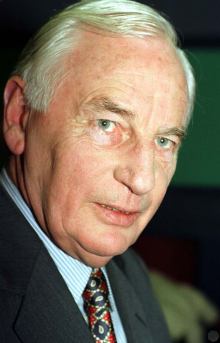
Birth of Peter Barry, Fine Gael Politician

Peter Barry, Fine Gael politician and businessman, is born in Blackrock, Cork, County Cork on August 10, 1928. He serves as Tánaiste from January 1987 to March 1987, Deputy Leader of Fine Gael from 1977 to 1987 and 1991 to 1993, Minister for Foreign Affairs from 1982 to 1987, Minister for the Environment from 1982 to 1981, Minister for Education from 1976 to 1977, Minister for Transport and Power from 1973 to 1976 and Lord Mayor of Cork from 1970 to 1971. He served as a Teachta Dála (TD) from 1969 to 1997.

Barry is the son of Anthony Barry, a Fine Gael TD and well-known businessman. He is educated at Christian Brothers College, Cork and then becomes the major shareholder in the family company, Barry’s Tea.

Barry is first elected to Dáil Éireann as a Fine Gael Teachta Dála (TD) for the Cork City South-East constituency at the 1969 Irish general election. He goes go on to win a Dáil seat at eight successive general elections, changing constituency to Cork City in 1977 and Cork South-Central in 1981. When Fine Gael comes to power following the 1973 Irish general election, he is appointed Minister for Transport and Power. In 1976, he becomes Minister for Education. In 1979, after Garret FitzGerald becomes leader of Fine Gael, he is elected deputy leader. From June 1981 to March 1982, he serves as Minister for the Environment.

From December 1982 to 1987, Barry is Minister for Foreign Affairs. In this capacity he is heavily involved in the negotiations which result in the 1985 Anglo-Irish Agreement. He also becomes the first joint chairman of the Anglo-Irish Intergovernmental Conference, established under the Agreement by the Irish and British governments. Following the Labour Party‘s withdrawal from the coalition government in 1987, he becomes Tánaiste, for a brief period. He is the first member of Fine Gael to hold the office of Tánaiste.

When FitzGerald resigns as Fine Gael leader after the 1987 Irish general election, Barry is one of three candidates, along with Alan Dukes and John Bruton, who contest the party leadership. Dukes is the eventual victor.

Barry retires at the 1997 Irish general election, at which his seat is held for Fine Gael by his daughter Deirdre Clune. She later serves as a Senator representing the Cultural and Educational Panel, but resigns in 2014, on being elected as a Member of the European Parliament for Ireland South.

Barry dies in Cork at the age of 88 on August 26, 2016, following a short illness. Irish President Michael D. Higgins says Barry will be deeply missed. “His view of Irish history was a long one and he brought all that wisdom to bear in his contributions to achieving the Anglo-Irish Agreement. As a person he was immensely popular across all parties and, of course, he had a deep commitment to Cork city and its heritage.”


Leave a comment

Birth of David James O’Donoghue, Biographer & Editor

David James O’Donoghue, Irish biographer, editor, and bookseller, is born in Chelsea, London, England on July 22, 1866.

O’Donoghue is born to Irish parents and grows up in the Hans Town area of Chelsea. He is the son of John O’Donoghue, a bricklayer from Kilworth, County Cork, and Bridget Griffin, who is from County Tipperary. He is the third of nine children, and has four brothers, Thomas, John, James, and Edmund, and four sisters, Mary, Ellen, Katherine, and Agnes. He is first an upholsterer‘s apprentice from the age of sixteen before becoming a journalist and author.

O’Donoghue attends a Catholic school and furthers his education at the British Museum. He begins his journalistic work by writing for the Dublin papers upon subjects relating to Irish music, art, and literature. A founder-member of the Irish Literary Society in London, he is also vice president of the National Literary Society, Dublin, and the compiler of a biographical dictionary, The Poets of Ireland (1891–93; revised edition, 1912), with entries on 2,000 authors. His published works also include Irish Poetry of the Nineteenth Century (1894), Humor of Ireland (1894), List of 1300 Irish Artists (1894), The Life and Writings of James Clarence Mangan (1897), Bibliographical Catalogue of Collections of Irish Music (1899), and Geographical Distribution of Irish Ability (1906).

O’Donoghue publishes an edition of James Fintan Lalor‘s writings (1895) and an edition of William Carleton‘s Traits and Stories of the Irish Peasantry (four volumes, 1896–97). He edits the works of Samuel Lover (six volumes, 1898–99) and the prose works (1903) and poems (1904) of James Clarence Mangan. He writes biographies on William Carleton (1896), Richard Pockrich (1899), and Robert Emmet (1902).

In 1896 O’Donoghue moves to Dublin. In 1909 he becomes librarian of University College Dublin. He is co-editor of Catalogue of the Gilbert Library (in Dublin; 1918). William Butler Yeats writes of him in his Autobiographies of William Butler Yeats (1938).

O’Donoghue dies suddenly on June 27, 1917, at his home on Auburn Avenue, Donnybrook, Dublin. He is buried in Dublin’s Glasnevin Cemetery.


Leave a comment

Birth of Architect Sir Thomas Newenham Deane

Sir Thomas Newenham Deane, Irish architect, is born in Dundanion, County Cork on June 15, 1828. He is the son of Sir Thomas Deane and Eliza Newenham, and the father of Sir Thomas Manly Deane. His father and son are also architects.

Deane is educated at Trinity College, Dublin, from 1845 to 1849. On January 29, 1850, he marries Henrietta Manly, daughter of Joseph H. Manly of Ferney, County Cork. He and his wife have several children.

Deane joins his father’s architecture practice in 1850, and in 1851, he becomes a partner along with Benjamin Woodward. Their work is primarily a Gothic style influenced by the principles of John Ruskin, and include the museum at Trinity College, Dublin, the Oxford University Museum of Natural History, the Pitt Rivers Museum, the Kildare Street Club in Dublin, and Queen’s College Cork, now University College Cork. He is known as a conservation architect, involved in the restoration, including the incorporation of the original twelfth-century Romanesque chancel, of St. Mary’s Cathedral, Tuam.

Deane’s work on the conservation of St. Canice’s Cathedral, Kilkenny, is less successful and brings him into conflict with the dean and chapter, and in particular with the treasurer James Graves. It is possibly his interest in the restoration of medieval buildings which leads to his appointment as the first Inspector of National Monuments under the Irish Board of Works after the disestablishment of the Church of Ireland brought ruined buildings under their care. His work includes St. Cronan’s Church, Roscrea, County Tipperary.

In contemporary circles, Deane’s partner Woodward is seen as the creative influence behind the business, and their practice suffers after his early death on May 15, 1861. Nevertheless, Deane continues to work with his son, Thomas Manly Deane, designing the National Museum of Ireland and National Library of Ireland in Kildare Street, Dublin. He is knighted in 1890.

On November 8, 1899, Deane dies suddenly in his office on St. Stephen’s Green, into which he had only just moved. He is buried in Deans Grange Cemetery, where his son Thomas designs and erects a cross in his memory.


Leave a comment

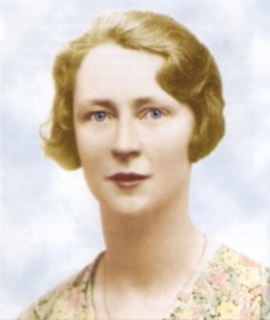
Birth of Elizabeth Bowen, Novelist & Short Story Writer

Elizabeth Dorothea Cole Bowen CBE, Anglo-Irish novelist and short story writer notable for her fiction about life in wartime London, is born at 15 Herbert Place in Dublin on June 7, 1899.

Bowen is baptised in St. Stephen’s Church on Upper Mount Street. Her parents, Henry Charles Cole Bowen and Florence (née Colley) Bowen, later bring her to Bowen’s Court at Farahy, near Kildorrery, County Cork, where she spends her summers. When her father becomes mentally ill in 1907, she and her mother move to England, eventually settling in Hythe. After her mother dies in 1912, she is raised by her aunts. She is educated at Downe House School under the headship of Olive Willis. After some time at art school in London she decides that her talent lay in writing. She mixes with the Bloomsbury Group, becoming good friends with Rose Macaulay who helps her seek out a publisher for her first book, a collection of short stories entitled Encounters (1923).

In 1923 Bowen marries Alan Cameron, an educational administrator who subsequently works for the BBC. The marriage has been described as “a sexless but contented union.” She has various extra-marital relationships, including one with Charles Ritchie, a Canadian diplomat seven years her junior, which lasts over thirty years. She also has an affair with the Irish writer Seán Ó Faoláin and a relationship with the American poet May Sarton. She and her husband first live near Oxford, where they socialize with Maurice Bowra, John Buchan and Susan Buchan, and where she writes her early novels, including The Last September (1929). Following the publication of To the North (1932) they move to 2 Clarence Terrace, Regent’s Park, London, where she writes The House in Paris (1935) and The Death of the Heart (1938). In 1937, she becomes a member of the Irish Academy of Letters.[3]

In 1930 Bowen becomes the first (and only) woman to inherit Bowen’s Court, but remains based in England, making frequent visits to Ireland. During World War II she works for the British Ministry of Information, reporting on Irish opinion, particularly on the issue of neutrality. Her political views tend towards Burkean conservatism. During and after the war she writes among the greatest expressions of life in wartime London, The Demon Lover and Other Stories (1945) and The Heat of the Day (1948). She is awarded the CBE the same year.

Bowen’s husband retires in 1952 and they settle in Bowen’s Court, where he dies a few months later. Many writers visit her at Bowen’s Court from 1930 onwards, including Virginia Woolf, Eudora Welty, Carson McCullers, Iris Murdoch, and the historian Veronica Wedgwood. For years Bowen struggles to keep the house going, lecturing in the United States to earn money. In 1957 her portrait is painted at Bowen’s Court by her friend, painter Patrick Hennessy. She travels to Italy in 1958 to research and prepare A Time in Rome (1960), but by the following year she is forced to sell her beloved Bowen’s Court, which is demolished in 1960. In the following months, she writes for CBS the narrative of the documentary titled Ireland the Tear and the Smile which is realized in collaboration with Robert Monks as cameraman and associate producer. After spending some years without a permanent home, she finally settles at “Carbery”, Church Hill, Hythe, in 1965.

Bowen’s final novel, Eva Trout, or Changing Scenes (1968), wins the James Tait Black Memorial Prize in 1969 and is shortlisted for the Man Booker Prize in 1970. Subsequently, she is a judge that awards the 1972 Man Booker Prize to John Berger for G. She spends Christmas 1972 at Kinsale, County Cork with her friends, Major Stephen Vernon and his wife, Lady Ursula, daughter of Hugh Grosvenor, 2nd Duke of Westminster, but is hospitalised upon her return. Here she is visited by Cyril Connolly, Lady Ursula Vernon, Isaiah Berlin, Rosamund Lehmann, and her literary agent, Spencer Curtis Brown, among others.

In 1972 Bowen develops lung cancer. She dies at the age of 73 in University College Hospital in London on February 22, 1973. She is buried with her husband in St. Colman’s churchyard in Farahy, close to the gates of Bowen’s Court, where there is a memorial plaque to the author at the entrance to St. Colman’s Church, where a commemoration of her life is held annually.


Leave a comment

Birth of Architect George Coppinger Ashlin

George Coppinger Ashlin, Irish architect particularly noted for his work on churches and cathedrals, is born in County Cork on May 28, 1837. He becomes President of the Royal Institute of the Architects of Ireland.

Ashlin is the son of J. M. Ashlin, J.P. He receives his early education at the Collège de St. Servais in Liège, Belgium. He later enrolls at St. Mary’s College, Oscott (1851-55) where he is subsequently a pupil of Edward Welby Pugin. It is during this time that he develops an interest in architecture. By 1858, he enters the Royal Academy Schools, London.

When Pugin receives the commission for SS Peter and Paul’s, Carey’s Lane, Cork, in 1859, he makes Ashlin a partner with responsibility for their Irish work. This partnership lasts until late 1868. In 1861 they open their office at St. Stephen’s Green, Dublin. The practice is primarily ecclesiastical, designing some 25 religious buildings. Their churches and Cathedrals are mainly located in the counties of Wexford, Cork and Kerry, and are all of similar design. By far the most important commission undertaken by this partnership is the building of St. Colman’s Cathedral, Cobh for Bishop William Keane.

In 1867 Ashlin marries Mary Pugin (1844-1933), sister of Edward Welby Pugin and daughter of Augustus Welby Pugin, the Gothic revivalist. Their only daughter, Miriam, is born ten years later.

The partnership with Pugin is dissolved in 1870. Thereafter Ashlin practises in his own right, branching out to cover the entire island nation. His works of this period include Ballycotten (1901), Ballybunion (1892), Church of the Most Holy Rosary, Midleton (1893) and the Munster & Leinster Bank, both of Midleton, and finally Kildare (1898).

Ashlin is a member of the Royal Hibernian Academy and Fellow of the Royal Institute of British Architects.

George Coppinger Ashlin dies at the age of 84 on December 10, 1921. He is buried at Glasnevin Cemetery in Dublin.


Leave a comment

Birth of William Trevor, Novelist, Playwright & Short Story Writer

William Trevor KBE, Irish novelist, playwright and short story writer, is born William Trevor Cox in Mitchelstown, County Cork, on May 24, 1928. One of the elder statesmen of the Irish literary world, he is widely regarded as one of the greatest contemporary writers of short stories in the English language.

Trevor is born to a middle-class, Anglo-Irish Protestant family. They move several times to other provincial towns, including Skibbereen, Tipperary, Youghal and Enniscorthy, as a result of his father’s work as a bank official. He is educated at St. Columba’s College, Dublin, and at Trinity College, Dublin, from which he receives a degree in history. He works as a sculptor under the name Trevor Cox after his graduation from Trinity College, supplementing his income by teaching. He marries Jane Ryan in 1952 and emigrates to Great Britain two years later, working as a copywriter for an advertising agency. It is during this time that he and his wife have their first son.

Trevor’s first novel, A Standard of Behaviour, is published in 1958 by Hutchinson of London, but has little critical success. He later disowns this work and, according to his obituary in The Irish Times, “refused to have it republished.” It was, in fact, republished in 1982 and in 1989.

In 1964, at the age of 36, Trevor wins the Hawthornden Prize for Literature for The Old Boys. The win encourages him to become a full-time writer. He and his family then move to Devon in South West England, where he resides until his death. In 2002, he makes honorary KBE for services to literature. Despite having spent most of his life in England, he considers himself to be “Irish in every vein.”

Trevor writes several collections of short stories that are well received. His short stories often follow a Chekhovian pattern. The characters in his work are typically marginalised members of society. The works of James Joyce influence his short-story writing, and “the odour of ashpits and old weeds and offal” can be detected in his work, but the overall impression is not of gloominess since, particularly in his early work, his wry humour offers the reader a tragicomic version of the world. He adapts much of his work for stage, television and radio. In 1990, Fools of Fortune is made into a film directed by Pat O’Connor, along with a 1999 film adaptation of Felicia’s Journey, which is directed by Atom Egoyan.

Trevor’s stories are set in both England and Ireland. They range from black comedies to tales based on Irish history and politics. His early books are peopled by eccentrics who speak in a pedantically formal manner and engage in hilariously comic activities that are recounted by a detached narrative voice. Instead of one central figure, the novels feature several protagonists of equal importance, drawn together by an institutional setting, which acts as a convergence point for their individual stories. The later novels are thematically and technically more complex. The operation of grace in the world is explored, and several narrative voices are used to view the same events from different angles.

Trevor wins the Whitbread Prize three times and is nominated five times for the Booker Prize, the last for his novel Love and Summer (2009), which is also shortlisted for the International Dublin Literary Award in 2011. His name is also mentioned in relation to the Nobel Prize in Literature. In 2014, he is bestowed Saoi by the Aosdána.

William Trevor dies peacefully in his sleep at the age of 88 on November 20, 2016, in Somerset, England.


Leave a comment

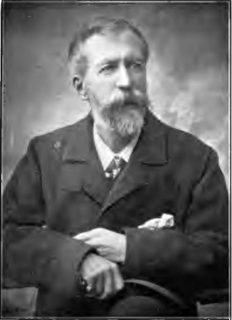
Birth of Richard Sankey, Officer in the Madras Engineer Group

Lieutenant-General Sir Richard Hieram Sankey KCB, officer in the Madras Engineer Group in the East India Company‘s army in British India, is born on March 22, 1829, at Rockwell Castle, County Tipperary.

Sankey is the fourth son of Eleanor and Matthew Sankey. His mother is herself from a family of military men, her father being Colonel Henry O’Hara, J.P of O’Hara Broom, County Antrim. His father is a barrister at Bawnmore, County Cork and Modeshil, County Tipperary. He does his schooling at Rev. Flynn’s School on Harcourt Street in Dublin and enters the East India Company’s Addiscombe Military Seminary at Addiscombe, Surrey in 1845. At Addiscombe he is awarded for his excellence at painting.

Sankey is commissioned as a second lieutenant in the Madras Engineer Group in November 1846 and is then trained in military engineering with the Royal Engineers at Chatham, Kent from January 1, 1847, holding temporary rank as an ensign in the British Army. He then arrives in India in November 1848. After two years of service at Mercatur, he officiates in 1850 as Superintending Engineer at Nagpur. During this time, he makes a small collection of fossils of Glossopteris from the Nagpur district and writes a paper on the geology of the region in 1854. The collection is moved from the Museum of Practical Geology to the British Museum in 1880.

In 1856, Sankey is promoted as the Superintendent of the East Coast Canal at Madras. In May 1857, he is promoted Under-Secretary of the Public Works Department under Col. William Erskine Baker in Calcutta. During the Indian Rebellion of 1857, he is commissioned as the Captain of the Calcutta Cavalry Volunteers but is soon despatched to Allahabad where he leads the construction of several embankments and bridges across the Yamuna and Ganges. He is involved in the construction of shelters to advancing troops along the Grand Trunk Road to aid the quelling of the Indian Rebellion of 1857. He arrives in course of this work at Cawnpore (now Kanpur) a day before the Second Battle of Cawnpore. He also is involved in crucial civil works that aid the quelling of the rebellion by bridging the Ghaghara and Gomti rivers at Gorakhpur and Phulpur that enable the Gurkha regiment to cross these rivers.

Sankey receives several commendations from his commanders here and later in the taking of the fort at Jumalpur, Khandua nalla and Qaisar Bagh, vital actions in the breaking of the Siege of Lucknow. For his actions at Jumalpur he is recommended for the Victoria Cross, although he does not receive this honour. He receives a medal for the Indian Rebellion of 1857 and is promoted to second captain on August 27, 1858, and given brevet promotion to major the following day for his services in the quelling of the rebellion. He is sent to the Nilgiris due to ill-health during this time.

Sankey spends a year in Burma as the executive engineer and Superintendent of the jail at Moulmein. On June 29, 1861, he is promoted to substantive captain and is posted as the Garrison Engineer at Fort William, Calcutta and later as the assistant to Chief Engineer, Mysore until 1864, when he is made the Chief Engineer. During this period, he creates a system within the irrigation department to deal with old Indian water catchment systems, surveying the catchment area and determining the area drained and the flows involved. Due to the reorganisation of the armed forces following the assumption of Crown rule in India he is transferred to the Royal Engineers on April 29, 1862.

In 1870, at the request of the Victorian Colonial Government in Australia, in view of his experience with hydrological studies in Mysore, Sankey is invited to be Chairman of the Board of Enquiry on Victorian Water Supply. During this visit, he also gives evidence to the Victorian Select Committee on Railways, as well as reports on the Yarra River Floods, and the Coliban Water Supply, and later contributes to the report on the North West Canal. While in Australia, he is also invited to the colony of South Australia to report on the water supply of Adelaide.

Sankey is appointed as an under-secretary to the Government of India in 1877, which earns him the Afghanistan Medal. In 1878, he is promoted as the Secretary in the public works department at Madras and is promoted substantive colonel on December 30. He is appointed Companion of the Order of the Bath on July 25, 1879, and also commands the Royal Engineers on the advance from Kandahar to Kabul during the Second Anglo-Afghan War. For about five years he is in Madras where he becomes a member of the legislative council in Madras and is elected as a Fellow of the University of Madras. He also helps in the creation and improvements of the Marina, the gardens and the Government House grounds. He is promoted major general on June 4, 1883, and retires from the army on January 11, 1884, with the honorary rank of lieutenant general. He also receives the distinguished service award in India.

After retirement, Sankey returns to Ireland, where he becomes the Chairman of the Board of Works. He is promoted Knight Commander of the Order of the Bath on May 25, 1892, for his work in Ireland. He also undertakes projects in Mexico. Later he settles in London where he dies at St. George’s Hospital on November 11, 1908, and is interred at Hove, East Sussex.

Sankey is memorialised in Phoenix Park, Dublin. A circle of trees bears the name Sankey’s Wood. A plaque dated 1894 lies half-hidden in the undergrowth there.


3 Comments

Birth of Isaac Weld, Writer, Explorer & Artist

Isaac Weld, Irish topographical writer, explorer, and artist, is born on Fleet Street, Dublin on March 15, 1774. He is a member of the Royal Dublin Society.

Weld’s name stems from his great-grandfather Nathanael Weld’s close friendship with Sir Isaac Newton, and as such both his grandfather and father are also named Isaac. His father is a close friend of Charles James Fox. His sister marries George Ensor, and their half-brother is Charles Richard Weld, traveler and author of A Vacation Tour in the United States and Canada (London, 1855), which is dedicated to his brother, Isaac. He is sent to the school of Samuel Whyte at Grafton Street and from there to another private school Barbauld at Palgrave near the town of Diss in Norfolk. From Diss he proceeds to Norwich as a private pupil of Dr. William Enfield. He leaves Norwich in 1793.

In 1795 he sails to Philadelphia from Dublin and spends two years traveling in the United States and Canada, partly as an adventure and partly as research into suitable countries to which the Irish can emigrate. He visits Monticello and Mount Vernon and meets George Washington and Thomas Jefferson. He travels on horseback, by coach and by canoe in Canada with local native guides. He returns in 1797 “without entertaining the slightest wish to revisit it.” He finds the Americans to be obsessed with material things and prefers Canada. His published Travels (1799) quickly goes into three editions and is translated into French, German, Italian, and Dutch.

Weld writes on slavery that “there will be an end to slavery in the United States…[as] negroes will not remain deaf to the inviting call of liberty forever.” With regard to Americans in general, he states, “Civility cannot be purchased from them on any terms; they seem to think that it is incompatible with freedom.” On Washington, D.C., he writes “If the affairs of the United States go on as rapidly as they have done, it will become the grand emporium of the West, and rival in magnitude and splendour the cities of the whole world.”

Weld visits Killarney, navigates the lakes in a boat he made from compressed brown paper, and publishes Scenery of Killarney (1807), illustrated with his own drawings. He is also well known for his drawings of American life and, in particular, the Niagara Falls.

In May 1815 Weld sails from Dún Laoghaire to London in the 14 horsepower (10 kW) steamboat Thames, the first such vessel to make the passage. He compiles the Statistical Survey of the County of Roscommon (1838) for the Royal Dublin Society, of which he is Honorary Secretary and Vice-President. In later life, he spends much time in Italy and particularly Rome, where he develops a friendship with Antonio Canova.

Weld dies at his home, Ravenswell, near Bray, County Wicklow, on August 4, 1856, and is buried in Mount Jerome Cemetery, Dublin.

Weld is part of the Weld family of New England. His ancestor, Thomas Welde, is a Puritan minister from Suffolk, England who is one of three brothers who emigrated to Roxbury, Massachusetts in 1632. His great-great-grandfather, Thomas Weld, helps to publish the Bay Psalm Book, the first book published in America. His great-grandfather, Nathaniel, is graduated at Harvard College. He leaves Massachusetts for Kinsale and then Blarney Castle, County Cork, in 1655 to be a Puritan Chaplain with Oliver Cromwell. He later moves to Dublin.

The family that stays in America grows in wealth and influence and includes such notables as Governor of Massachusetts William Weld, Isabel Weld Perkins, and Theodore Dwight Weld.


Leave a comment

Death of Hugh Coveney, Former Lord Mayor of Cork

Hugh Coveney, politician and former Lord Mayor of Cork, falls to his death from a headland near Roberts Cove, County Cork on March 14, 1998.

Coveney is born into one of Cork‘s prosperous “merchant prince” families on July 20, 1935. He is educated at Christian Brothers College, CorkClongowes Wood College and the Royal Institution of Chartered Surveyors. He works as a chartered quantity surveyor before entering politics.

Coveney is interested in yachting throughout most of his adult life. His yacht Golden Apple of The Sun, designed by Cork-based designer Ron Holland, is a successful competitor in the Admiral’s Cup in the 1970s. A later 50-foot yacht, Golden Apple, is used by the family for the “Sail Chernobyl” project. The family sails around the world to raise €650,000 for Chernobyl Children’s Project International, a charity which offers assistance to children affected by the 1986 Chernobyl disaster.

Coveney is Lord Mayor of Cork from 1982 to 1983. He is first elected to Dáil Éireann as a Fine Gael Teachta Dála (TD) for Cork South–Central constituency at the 1981 general election. He loses his seat in the first general election of 1982 but regains it in the second election in the same year. He loses his seat again in the 1987 general election and does not contest the 1992 general election. He is elected to the Dáil again in 1994 in a by-election.

Coveney is first appointed to the Cabinet in 1994 under John Bruton. He is appointed Minister for Defence and Minister for the Marine. However, he is demoted to a junior ministry the following year after allegations of improper contact with businessmen.

In March 1998 it becomes publicly known that the Moriarty Tribunal has questioned Coveney about whether he had a secret offshore account with Ansbacher Bank, a bank which had become notorious for facilitating tax evasion. Ten days later, on March 13, 1998, Coveney visits his solicitor to change his will. The following day, he dies in a fall from a seaside cliff while out walking alone. His son, Simon Coveney, insists that his father had never held an Ansbacher account. It later emerges that Hugh Coveney had $175,000 on deposit in the secret Cayman Islands-based bank. The account was closed in 1979.

The funeral of Hugh Coveney takes place at St. Michael’s Church in Blackrock, Cork on March 18, 1998. Simon Coveney is later elected to succeed his father in the resulting by-election on November 3, 1998.