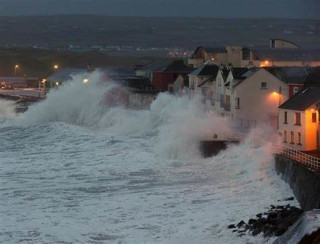
On December 24, 2015, the Electricity Supply Board networks says that around 6,000 customers are without power as a result of Storm Eva. The worst affected areas are Fermoy in County Cork and Kilcoole in County Wicklow. High winds and heavy rain batter the west and northwest as Storm Eva moves across the country.
Eva is the fifth storm to be officially named by Met Éireann on December 22, 2015. An orange wind warning is issued for counties Clare, Galway, Mayo, Sligo and Donegal on the same day. Gales are also expected in the northwest of the United Kingdom, with storm force winds over parts of the Outer Hebrides. There are fears that the storm could cause further disruption to Cumbria in England, where areas were already dealing with the aftermath of flooding from Storm Desmond and in some cases had been flooded twice already. The army and Environment Agency staff are called in to be on stand-by to bolster flood defences.
Rain associated with the passage of Eva causes disruption when rivers burst their banks in the Cumbrian towns of Appleby-in-Westmorland, Keswick and Kendal on the December 22. Appleby-in-Westmorland receives three to four feet of flood water. The village of Glenridding is flooded for the third time in the month. Six thousand houses in Ireland are left without power. In London, Secretary of State for Environment, Food and Rural AffairsLiz Truss convenes a Cabinet Office Briefing Rooms (COBR) meeting to decide on emergency measures, which include the deployment of soldiers from the 2nd Battalion, Duke of Lancaster’s Regiment to the affected areas. On December 24, flood defence gates are closed in Carlisle, Keswick and Cockermouth to limit the damage expected from rainfall and 20 water pumps and two kilometres of temporary flood barriers are transported to northern England. Ferries operating between Dublin and Holyhead are cancelled due to bad weather on the Irish Sea.
O’Sullivan is the son of Florence O’Sullivan and Margaret Aloysius O’Sullivan (née Barry) of Denis Quay, Kinsale, County Cork, who were married in Wicklow, County Wicklow in 1895. His father is a solicitor, practising in Kinsale.
O’Sullivan joins the Royal Naval Volunteer Reserve and is commissioned as a Temporary Lieutenant on June 8, 1918. He is sent for training to HMS Hermione, an Astraea-class cruiser, from where he is sent on August 22, 1918, to “Our Allies,” the mother ship for motor launches. He later serves on Motor Launches 386 and 530. While serving on a motor launch in the Mediterranean Sea, he is awarded the Military Cross for bravery during the Second Battle of Durazzo on October 2-3, 1918. He is demobilised on July 8, 1919, with the rank of Lieutenant, but this is later reversed as he had not yet reached the minimum age of 22.
O’Sullivan then qualifies as a solicitor and subsequently joins the Royal Irish Constabulary on July 24, 1920. He is appointed a District Inspector on October 1, 1920.
O’Sullivan is engaged to a Miss Moore, and he meets her near the General Post Office (GPO) on O’Connell Street in Dublin on December 17, 1920. They are walking down Henry Street when he is assassinated by a group of four men. One man shoots him in the head, but Miss Moore manages to grab the revolver from him. A second man shoots him as he lay on the ground. He dies one hour later in nearby Jervis Street Hospital. The cause of death is listed as shock and haemorrhage resulting from bullet wounds. His body is identified by his father. He is buried in the grave of his grandfather.
O’Sullivan had been identified by Ned Kelliher, possibly also from Kinsale, who had trailed him for a week. He points out O’Sullivan to members of Michael Collins‘s Squad, one of whom is Joe Byrne. Miss Moore states that she had been warned some time previously that O’Sullivan was “one of the Black and Tans” and she should have nothing to do with him. She had dismissed the threat.
O’Sullivan’s death is registered on January 7, 1921, on foot of a certificate received from a Military Court of Inquiry, following an inquest held on December 18, 1920.
The assassination is recorded by Joe Byrne in Witness Statement No. 461 to the Bureau of Military History, dated December 16, 1950. “I remember an evening in December 1920, when I was instructed, with others to proceed to Henry Street to assist in the shooting of D.I. O’Sullivan. About four of us comprised the party. A couple of us were detailed not to take part in the actual shooting but to cover off the men who were to do the job. I saw the D.I. being shot by a member of the Squad and when the shooting was over, we returned to Morelands.” Morelands is a shop on Abbey Street, Dublin, used as a base by The Squad.
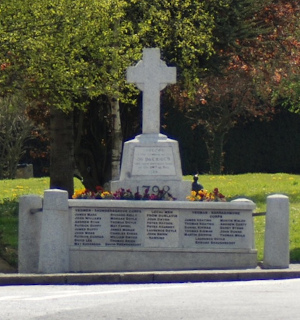
O’Sullivan’s name is included on the supplementary list of the Glasnevin Cemetery War Memorial.
(From: The Royal Irish Constabulary Forum, irishconstabulary.com | Pictured: Photograph of District Inspector Philip John O’Sullivan, Cork Examiner, December 21, 1920)
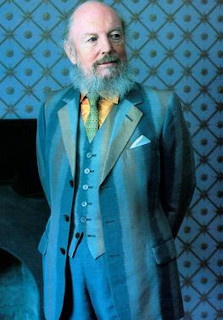
When in Ireland, Browne lives at Luggala, set deep in the Wicklow Mountains in County Wicklow. The house, which he inherited from his mother, has been variously described as a castle or hunting lodge of large proportions. He once states he would rather have not been born, calling it “frightful to bring anyone into this world.”
Browne is a leading proponent for the revival and preservation of traditional Irish music through his record label Claddagh Records which he founds with others in 1959. His former home, Woodtown Manor near Dublin, is for many years a welcoming place for Irish poets, writers and musicians. The folk-pop group Clannad makes many recordings of their music there.
Browne is instrumental in the formation of the traditional Irish folk group The Chieftains. In 1962, after setting up Claddagh Records, he asks his friend, the famed uileann piperPaddy Moloney, to form a group for a one-off album. Moloney responds with the first line-up for the band, which goes on to achieve international commercial success.
Browne is interviewed at length for the Grace Notes traditional music programme on RTÉ lyric fm on 18 March 2010. He is a friend and patron of British artist Francis Bacon and in January 2017 is featured in the BBC documentary Francis Bacon: A Brush with Violence.
Garech Browne dies at the age of 78 in London on March 10, 2018. In his will and testament, he bequeaths to the city of Galway the granite remains of a medieval “bow gate.” The location of this gate, which had otherwise gone unmentioned by Browne, remains a mystery for over a year following his death. It is discovered on the grounds of the Luggala estate in 2019. According to a Galway historian, the gate may have formed part of the city’s defences in the 17th century, and was later removed from the city by Browne’s father, when it was probably taken to the Browne family home at Castle MacGarrett, just outside Claremorris in County Mayo. The gate is one of a number of items left to the Irish State by Browne.
The British government had begun raising yeomanry forces from the local Irish population in 1796. The force, composed of both Catholics and Protestants, was raised to help defend against a possible French invasion of Ireland and to aid in the policing of the country. The Society of United Irishmen have long threatened a rebellion in Ireland, which finally occurs in late May 1798. Major uprisings of the rebellion only occur in Ulster, Wicklow and Wexford, a county in the province of Leinster. For several months prior to May 1798, Wicklow and many other areas of the country have been subject to martial law which had been imposed in an effort to prevent the long threatened rebellion.
The campaign extends against the military itself as some corps of yeomen and militia, especially those with Catholic members, are suspected as United Irish infiltrators who have joined to get training and arms. Several days after the outbreak of the rebellion, the yeomanry and militia at Dunlavin are called out on parade and informed by their commanding officer that he has information on the identities of those in the corps who are affiliated with the United Irishmen among them. The British do not actually have such information, but twenty-eight fall for their bluff and come forward in hopes of receiving clemency.
Those who come forward are immediately arrested and imprisoned while several are subjected to flogging in an effort to extract information about the rebels plans and organization. Those who are outed as affiliates of the United Irishmen are imprisoned in the Market House of Dunlavin, while the British officers decide what to do with them.
The following day, Captain William Ryves of the Rathsallagh yeomanry has his horse shot from under him by rebels while on patrol. Ryves rides to Dunlavin the next day and brings eight suspected rebels imprisoned by his corps with him. There he meets with Captain Saunders of the Saunders-grove yeomanry. It is decided that their prisoners, a total of 36 men, should be put to death. On May 26, Market Day, the 36 are taken to the green, lined up and shot in front of the townspeople, including, in some cases, their own families.
The firing squad returns to the Market House where others are flogged or hanged. Before the bodies of the shot men are removed, soldiers’ wives loot them of valuables. The bodies are either removed for burial by their families or interred in a common grave at Tournant cemetery. One man survives, despite grievous wounds, and lives to “an advanced age.” Two more men, either hanging or about to be, are saved by the intervention of a “respectable Protestant” and escape.
One loyalist account details the events leading up to the execution differently. According to this account, Captain Ryves, a yeomanry commander at Dunlavin, receives word that a large number of rebels are set to attack Dunlavin and he observes that many Protestant houses have been set on fire in the surrounding countryside. Under the circumstances, he expects that the rebels’ intention is a pogrom of Protestants and loyalists in the town and its environs. A foray by the troops into the countryside fails and the garrison’s officers are aware that they are outnumbered by the prisoners held in the Market House.
The executions appear to have been motivated by simple revenge and intimidation, rather than fear of the prisoners and the ongoing rebellion. Though the public exhibition may have been designed to intimidate and discourage rebels in the immediate area from taking to the field, news of the executions, as well as those at Carnew spread rapidly and play a part in the rapid mobilization of rebels in northern County Wexford over the next few days.
The story of Dunlavin Green is quickly commemorated in the famous ballad “Dunlavin Green,” which tells the story from the view of a sympathetic local eyewitness. In 1998, a commemorative stone was installed in St. Nicholas of Myra Roman Catholic church, adjacent to the green.
Clare Boylan, Irish author, journalist and critic for newspapers, magazines and many international broadcast media, is born in Dublin on April 21, 1948.
After leaving St. Louis convent, Boylan takes a job as a sales assistant in a bookshop before beginning her career as a journalist at The Irish Press, now defunct. In 1974 she wins the Journalist of the Year award when working in the city for the Evening Press. Later in her career she edits the glossy magazine Image, before largely giving up journalism to focus on a career as an author.
Boylan’s novels are Holy Pictures (1983), Last Resorts (1984), Black Baby (1988), Home Rule (1992), Beloved Stranger (1999), Room for a Single Lady (1997), which wins the Spirit of Light Award and is optioned for a film, and Emma Brown (2003). The latter work is a continuation of a 20-page fragment written by Charlotte Brontë before her death.
Boylan’s short stories are collected in A Nail on the Head (1983), Concerning Virgins (1990) and That Bad Woman (1995). The film Making Waves, based on her short story “Some Ladies on a Tour”, is nominated for an Oscar in 1988.
Boylan’s non-fiction includes The Agony and the Ego (1994) and The Literary Companion to Cats (1994). She writes introductions to the novels of Kate O’Brien and Molly Keane and adapts Keane’s novel Good Behaviour as the classic serial for BBC Radio 4 (2004). Her work has been translated as far afield as Russia and Hong Kong.
In later life, Boylan lives in County Wicklow with her husband Alan Wilkes. When she is diagnosed with ovarian cancer, she faces her illness with characteristic strength. She takes up kickboxing and spends time in France, shopping, cooking and entertaining friends. She succumbs to cancer at the age of 58 on May 16, 2006.
Power is born Jane O’Toole in Baltinglass, County Wicklow on May 1, 1858. In the 1880s she joins the Ladies’ Land League and finds herself immersed in their activities during the Land War. She compiles lists of those evicted from their homes and also organises the Land League in Wicklow and Carlow. In 1883 she marries John Wyse Power, a journalist who shares her political beliefs and is a member of the Irish Republican Brotherhood (IRB). They have four children together, a fact that does not interfere with her political work.
Power helps set up the Irish Women’s Franchise League and is also a founding member of Inghinidhe na hÉireann and Sinn Féin becoming Vice-President of both organisations. She is later on the Provisional Committee that sets up Cumann na mBan. She rises in the ranks to become one of the most important women of the revolution. In October 1914, she is elected the first President of Cumann na mBan. She is a successful businesswoman owning four branches of her Irish Farm Produce Company. The 1916 Proclamation of the Irish Republic is written in her home at 21 Henry Street, and she always maintains that the Military Council signed the proclamation in no particular order; they just signed as it was passed to each of the signatories, though, with James Connolly being eager to be the first to sign. Even the identity of the head of the Provisional Government was not altogether clear.
During the 1916 Easter Rising she supplies food to the Irish Volunteers. After the Rising she and her daughter, Nancy, help re-organise Cumann na mBan and distribute funds to families suffering hardships, as well as the Prisoners Dependants Fund. These funds had been sent by Clan na Gael in the United States. She is subsequently elected as one of five women members onto Dublin Corporation in 1920 for the Inns Quay – Rotunda District.
Power supports the Anglo-Irish Treaty and by the end of 1921, she is convinced that in doing so, will mean the need to leave Cumann na mBan to form a separate organisation. She helps set up Cumann na Saoirse (The League for Freedom), the pro-Treaty women’s organisation and becomes its Vice-President. She is a Free State Senator from 1922 until 1936 and is also a member of Cumann na nGaedheal.
Jennie Wyse Power dies on January 5, 1941, aged 82, at her home in Dublin. She is interred in Glasnevin Cemetery with her husband and daughter, Máire (who predeceased her). Her funeral is attended by many from both sides of the Dáil and the former revolutionary movement.
Childers is educated at Gresham’s School, Holt, and the University of Cambridge, hence his striking British upper-class accent. On November 24, 1922, when he is sixteen, his father, Robert Erskine Childers, is executed by the new Irish Free State on politically inspired charges of gun-possession. The pistol he had been found with had been given to him by Michael Collins. Before his execution, in a spirit of reconciliation, the elder Childers obtains a promise from his son to seek out and shake the hand of every man who had signed his death warrant.
Following his father’s funeral, he returns to Gresham’s, then two years later he goes on to Trinity College, Cambridge. He returns to Ireland in 1932 and becomes advertising manager of The Irish Press, the newly founded newspaper owned by the family of Éamon de Valera.
Childers is nominated as the presidential candidate of Fianna Fáil at the behest of de Valera, who pressures Jack Lynch in the selection of the presidential candidate. He is a controversial nominee, owing not only to his British birth and upbringing but to his Protestantism. However, on the campaign trail his personal popularity proved enormous, and in a political upset at the 1973 Irish presidential election, he is elected the fourth President of Ireland on May 30, 1973, defeating Tom O’Higgins by 635,867 (52%) votes to 578,771 (48%). He becomes the second Protestant to hold the office, the first being Douglas Hyde (1938–1945).
Prevented from transforming the presidency as he desires, Childers instead throws his energy into a busy schedule of official visits and speeches, which is physically taxing.
John Howard Kyan, inventor of the ‘kyanising’ process for preserving wood, is born on November 27, 1774, in Dublin. His father, also John Howard Kyan, is the owner of valuable copper mines in County Wicklow. He is educated to take part in the management of the mines, but soon after he enters the company its fortunes decline, and in 1804 his father dies almost penniless.
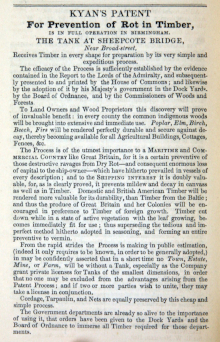
For a time, Kyan is employed at some vinegar works at Newcastle upon Tyne, but subsequently removes to London. The decay of the timber supports in his father’s copper mines had already directed his attention to the question of preserving wood, and as early as 1812 he begins experiments with a view to discovering a method of preventing the decay. Eventually he finds that bichloride of mercury or corrosive sublimate, as it is commonly called, gives the best results and, without revealing the nature of the process, he submits a block of oak impregnated with the substance to the Admiralty in 1828. It is placed in the ‘fungus pit’ at Woolwich, where it remains for three years exposed to all the conditions favourable to decay. When taken out in 1831, it is found to be perfectly sound, and after further trials it still remains unaffected.
Kyan patents his discovery in 1832 (Nos. 8263 and 6309), extending the application of the invention to the preservation of paper, canvas, cloth, cordage, etc. A further patent is granted in 1836 (No. 7001).
The process attracts great attention. Michael Faraday chooses it as the subject of his inaugural lecture at the Royal Institution on February 22, 1833, on his appointment as Fullerian professor of chemistry. Dr. George Birkbeck gives a lecture upon it at the Royal Society of Arts on December 9, 1834, and in 1835 the Admiralty publishes the report of a committee appointed by the board to inquire into the value of the new method.
In 1836, Kyan sells his rights to the Anti-Dry Rot Company, an Act of Parliament being passed which authorises the raising of a capital of £250,000. Tanks are constructed at Grosvenor Basin, Pimlico, at the Grand Surrey Canal Dock, Rotherhide, and at the City Road Basin.
Among the early applications of the process is the kyanising of the palings around the Inner Circle, Regent’s Park, which is carried out in 1835 as an advertisement with small brass plates being attached to the palings at intervals stating that the wood has been submitted to the new process. The plates soon disappear, but the original palings still remain in good condition.
It becomes evident that iron fastenings cannot be used in wood treated with corrosive sublimate, on account of the corrosive action, and it is said that the wood becomes brittle. The salt is somewhat expensive and Sir William Burnett‘s method of preserving timber by zinc chloride, and afterwards the application of creosote for that purpose, proves severe competitors. Doubts begin to be expressed as to the real efficiency of kyanising, and the process gradually ceases to be employed.
John Kyan dies on January 5, 1850, in New York City, where he is engaged on a plan for filtering the water supplied to that city by the Croton Aqueduct.
Parnell dies of pneumonia at half-past eleven on the night of October 6 at his residence at 10 Walsingham Terrace, Aldrington, near Brighton, England. He dies in the arms of his wife Katherine whom he had married just five months earlier.
Prior to the funeral, Parnell’s body lay in state for several hours and his death is the primary topic of conversation around Dublin. The belief that his demise would close the chasm in the Irish ranks is no longer tenable. His death makes it too wide even to be bridged. His old opponents may have felt inclined to forget and forgive, but this spirit is crushed almost before it is born, and his old adherents are simply ferocious in their enmity.
The city is astir at an unusually early hour, and there is a crowd of thousands in and around the Westland Row Station before seven o’clock. In front, as a guard of honor, stands a body of the Gaelic Athletic Association, armed with camans, around which are bound crape and green ribbon. It is nearly eight o’clock when Parnell’s body is placed in a hearse drawn by four black horses. The Gaels march in front. Thousands join the cortège, which includes several bands and fife corps.
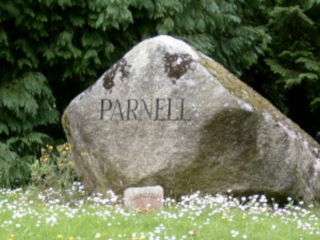
Though an Anglican, Parnell’s funeral at the Irish National nondenominational Glasnevin Cemetery in Dublin is attended by more than 200,000 people. His notability is such that his gravestone of unhewn Wicklow granite, erected in 1940, reads only “Parnell.”
Parnell is buried amid warring elements and in the presence of an immense assemblage. As a scene of great but suppressed excitement, and of still greater impressiveness, the funeral and its surroundings will never be forgotten by those who witness it, and it will long furnish a landmark in history for Ireland.
The Irish government declares a National Day of Mourning on September 14, 2001. Schools, businesses, and shops are shut down in an unprecedented gesture of sympathy following the attack on the World Trade Center in New York City three days earlier.
Thousands of people queue for hours in front of the United States Embassy in Ballsbridge, Dublin, waiting patiently to sign one of the many books of condolences to be presented to the U.S. government in the aftermath of the attack. At John F. Kennedy’s ancestral home in Dunganstown, County Wexford, the U.S. flag flies at half-mast and the house is closed to visitors.
As it was on the day that Kennedy was assassinated, everyone remembers where they were on September 11. But on September 14 in Ireland, the churches are full and the offices, shops and pubs dark and silent as the country mourns with its American relatives, colleagues and friends.
Bouquets of flowers, teddy bears, candles and messages are left at the Embassy, as thousands stand with heads bowed. The building’s facade is turned into a shrine to those who died in New York, Washington, D.C. and Pennsylvania. There are both tears and applause when 250 firefighters from all over Ireland parade past the Embassy as a mark of respect to the hundreds of firefighters lost in New York. People weep openly as they hear of the casualties and more details emerge of that terrible morning.
The nation prays as industrial and commercial life comes to a halt and offices, government departments and all places of entertainment close for mourning. In every parish and diocese religious services are held, with the biggest, an ecumenical service in Dublin, attended by TaoiseachBertie Ahern, PresidentMary McAleese and many other cabinet members. At least 2,000 people attempt to squeeze into St. Mary’s Pro-Cathedral, which holds only 1,500. Outside, a group of U.S. students break into the American national anthem and the crowd falls silent.
The bells of Christ Church Cathedral ring muffled for 90 minutes to mark the occasion, and at 11:00 AM towns and villages fall silent as the people join in a European-wide three minutes of silence. At noon, all trains stop for five minutes, and special services are held in practically every town in the country. In Bray, County Wicklow, so many people show up that the church runs out of communion. A number of people approaching the altar are given a blessing instead.
In Dublin’s universities in the months following the attacks, Irish students who were present in New York at the time are offered free counseling to help them deal with the “nightmares and flashbacks.”
(From: “Ireland’s National Day of Mourning” by Irish America staff, http://www.irishamerica.com, December/January 2002 | Pictured: Taoisearch Bernie Ahern and Tanaiste Mary Harney with members of the Irish Cabinet sign the book of condolences in the U.S. Embassy in Dublin three days after the terrorist attacks)


 The
The 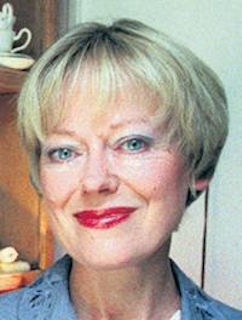


 The funeral and burial of

