seamus dubhghaill

Promoting Irish Culture and History from Little Rock, Arkansas, USA


Leave a comment

Birth of Thomas Reynolds, United Irishman and Informant

Thomas Reynolds, United Irishman, informant, consul and heir to a fortune, is born at his father’s house, 9 West Park Street, Dublin, on March 12, 1771.

Reynolds’s family history is well documented. His great-great-grandfather was Connor Reynolds of Rhynn Castle, County Leitrim, who married the daughter of Sir Robert Nugent, by whom he leaves three sons, Conor, George Nugent and Thomas. The second of these renounces his family’s Catholicism and becomes a Protestant in order to obtain possession of the greater part of the family estates and was grandfather of the George Nugent Reynolds who was killed in a duel in 1786. The third son, Thomas, a successful wool-stapler in Dublin, married Margaret Lacy, the sister of the famous Austrian general, Franz Moritz von Lacy, and by her had three sons and one daughter. Thomas’s eldest son, James, inherited his business and was one of the seven Catholics who in 1757 met at the Globe coffee-house, Essex Street, to form a committee to request the removal of legal disabilities imposed on Catholics. Thomas’s second son, also Thomas, a manufacturer of woolen poplins, had three daughters, whose marriages connected him with several distinguished Catholic families, and an only son, Andrew, father of the main subject of this article. Andrew Reynolds, admitted into partnership with his father, later developed a new poplin “by having the warp of silk and the weft, or shoot, of worsted.” These poplins came to be “prized in foreign countries as Irish tabinets.” He had an annual turnover of £100,000 to £150,000 and eventually made profits of £15,000 to £20,000 a year. On April 20, 1767, Andrew Reynolds married as his second wife, a second-cousin, Rose Fitzgerald, eldest daughter of Thomas Fitzgerald of Kilmead, County Kildare, a distant kinsman and substantial creditor of the Duke of Leinster, and his wife Rose, daughter of Francis Lacy of Inns Quay, Dublin. By Rose he had two sons and twelve daughters.

Until the age of eight, Reynolds, the future United Irishman and the only son to survive to adulthood, lives at the seat of his maternal grandfather in the care of a Catholic priest, William Plunkett. He is then moved to the school of a Protestant clergyman named Crawford at Chiswick near London and by the age of twelve he spends all vacations in the house of Sir Joshua Reynolds, who appears to take pleasure in teaching him the first principles of drawing. From Chiswick, he moves to Liège in 1783 to be educated by Catholics priests, former Jesuits, returning to Ireland shortly before his father’s death, at the age of 44, on May 8, 1788.

After 1784, the introduction of cottons to Ireland spoiled Andrew Reynolds’s trade. Loans to his nephews, the O’Reilly brothers (Thomas, Patrick and Andrew), iron-smelters at Arigna, County Roscommon, worsen his losses, which reach £200,000 at the time of his death. Lodging with his mother in Dublin, 17-year-old Reynolds mixes with “dissipated idlers” such as Simon Butler and Valentine Lawless. He revisits the Continent and is in Paris in July 1789 when the Bastille is stormed. At the behest of his mother, he becomes a member of the Catholic Committee in succession to his father on February 9, 1791, and attends the Catholic Convention as a delegate of the Dublin parish of St. Nicholas Without in December 1792. He chooses not to enter his late father’s business, preferring, despite his small income, the carefree life of a gentleman, doing the rounds of his well-to-do country relations. On March 25, 1794, he marries Harriet Witherington, fourth daughter of William Witherington, a Dublin woolen merchant, and a younger sister of Matilda Tone. His mother thereupon assigns to him half of the capital in the family business – now carried on by a relation, Thomas Warren, formerly clerk to Andrew Reynolds – and one third of the profits. He has other property as well and expectations of more, including a life-interest in an estate in Jamaica and the promise from the Duke of Leinster of the reversion of Kilkea Castle in County Kildare. A poor manager, Warren is forced out and later testifies against him in a judicial process. He still has £18,500 in assets and in 1797 obtains possession of Kilkea Castle and winds up his business affairs.

On the eve of the rebellion of 1798, Reynolds is a gentleman “of ample fortune and of the first connexions in the country.” In January or February 1797, he is drawn into the United Irish organisation by Peter Sullivan, a confidential clerk in the Reynolds family business, who refers him to Richard Dillon, a Catholic linen-draper, and to Oliver Bond, in whose house in Bridge Street he is sworn in, believing, according to his son, that the sole objects of the organisation are Catholic emancipation and the reform of parliament. Soon he is attending meetings of a baronial committee, but only after meeting Lord Edward FitzGerald in November 1797 achieves a position of importance, that of County Kildare treasurer and membership of the Leinster provincial committee. After being informed of a plan for an insurrection and for the assassination of approximately eighty individuals, some of them his own relations, and knowing the provincial committee is to meet on March 12 at the house of Oliver Bond to decide finally on a general rising, he communicates the United Irishmen’s plan to Dublin Castle through William Cope, a merchant. Those present at Bond’s house are arrested and so the plan is spoiled. He resigns as county treasurer on March 18, to be replaced by John Esmonde. Known to the United Irish leadership as an informant and in danger of his life – at least two unsuccessful attempts on his life are made – but known to Dublin Castle only as an influential United Irishman, he suffers the ransacking of his house at Kilkea on April 20 by dragoons and militia, who believe FitzGerald is concealed there. Finally, he is arrested and is to face a court-martial at Athy but, his true identity being disclosed to Dublin Castle by Cope, he is delivered to a grateful Irish privy council on May 5.

During the rebellion, Kilkea Castle, which had been renovated by Reynolds in 1797 at an expense of over £2,500 and contains priceless paintings, is garrisoned by troops and attacked by insurgents, rendering it uninhabitable for many years. It is refitted in the late 1830s. He is the principal prosecution witness in the trials of John McCann, William Michael Byrne and Bond. There being few other grounds of defence, the defence counsel, John Philpot Curran, seeks to impeach his character and motives, which, with adverse remarks by Thomas Moore in his Life and Death of Lord Edward Fitzgerald (1831) and a hostile obituary in The Morning Chronicle, gives rise after his death to a two-volume apologia by his son, Thomas, based on family papers and a remarkably detailed source for the history of the Reynolds family. For his action in coming forward at a critical period to save Ireland from the wicked plans of the conspirators, he is honoured by Dublin Corporation with the Freedom of the City on October 19, 1798.

His life threatened, Reynolds resides for some months in Leinster Street, Dublin, then moves with his family to Britain, spending some time in Monmouthshire before settling in London in 1803. In 1810, he is appointed British postmaster-general in Lisbon, an onerous but lucrative appointment owing to the Peninsular War. In September 1814 he returns to England. In July 1817, favoured by Lord Castlereagh, he goes to Copenhagen as consul to Iceland. He has to visit that remote island part of the kingdom of Denmark only once (June–August 1818) and in January 1820 finally leaves Copenhagen leaving his younger son, Thomas, in charge of consular affairs. With his wife and daughters, he settles in Paris. There in 1825, his elder son, Andrew Fitzgerald, fights a duel with Thomas Warren, a French army officer and son of Thomas Warren who had been Reynolds’s clerk, and is later a United Irishman. In 1831, he undergoes a religious experience and embraces evangelical Protestantism.

Reynolds dies in Paris on August 18, 1836, and is buried in a vault in the churchyard at Welton, near Brough, East Riding of Yorkshire.

(From: “Reynolds, Thomas” by C. J. Woods, Dictionary of Irish Biography, http://www.dib.ie, October 2009)


Leave a comment

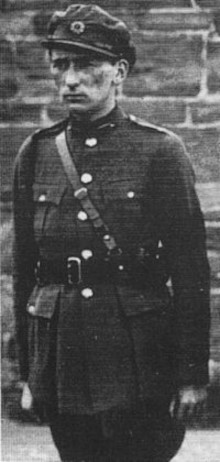
Death of Paddy Daly, IRA Volunteer & National Army Officer

Paddy Daly, sometimes referred to as Paddy O’Daly, dies at his home in County Dublin on January 16, 1957. He serves in the Irish Republican Army (IRA) during the Irish War of Independence (1919–1921) and subsequently holds the rank of major general in the Irish National Army from 1922 to 1924.

Daly is born in Dublin in 1888. He fights in the 1916 Easter Rising under the command of his namesake Edward Daly, leading the unsuccessful attempt to destroy the Magazine Fort in the Phoenix Park. He is later wounded in the particularly vicious fighting near the Linenhall. He is subsequently interned in Frongoch internment camp for his part in the rebellion until 1918, when he is released as part of a general amnesty for Irish prisoners.

During the Irish War of Independence, Daly serves as leader of the “Squad,” Michael Collins‘ assassination unit.

On December 19, 1919, Daly along with Dan Breen lead an abortive ambush, at Ashtown railway station near the Phoenix Park, on the British Viceroy, Lord Lieutenant of Ireland and Supreme Commander of the British Army in Ireland, Lord French, as he returns from a private party which he had hosted the previous evening at his country residence in Frenchpark, County Roscommon. Lord French escapes the ambush, but Martin Savage is shot dead.

Daly and the men under his command are responsible for the killing of many British intelligence officers, in particular District Inspector Redmond, who had been putting increasing pressure on the Squad. Daly himself personally kills several people, including Frank Brooke, director of Great Southern and Eastern Railway, who serves on an advisory council to the British military, in June 1920. He does not directly lead any of the attacks on Bloody Sunday but is on standby in one of the Squad’s safe houses. In the aftermath, November 23, 1920, he is arrested and interned in Abercorn Barracks in Ballykinler, County Down.

Daly is released on parole from Ballykinler in March 1921, the British apparently being unaware of his senior position within the Dublin Brigade of the IRA. After his release, he, along with Emmet Dalton, is also involved in the attempt to free Seán Mac Eoin from Mountjoy Prison on May 14, 1921. He and his men hijack a British Army Peerless armoured car in Clontarf at the corporation abattoir, while it is escorting a consignment of meat to a barracks and shoot dead two soldiers in the process. The plan involves Dalton and Joe Leonard impersonating two British army officers and using forged documents to “transfer” MacEoin to Dublin Castle. They gain entry to Mountjoy but are discovered before they can free MacEoin and have to shoot their way out. They later abandon the armoured car after removing the Hotchkiss machine guns and setting fire to what they can. Toward the end of the war, in May 1921, the two principal fighting units of the IRA’s Dublin Brigade, the “Squad” and the “Active Service Unit” are amalgamated after losses suffered in the burning of the Custom House. Daly is named Officer Commanding (OC) of this new unit, which is named the Dublin Guard.

Daly’s own account of his activities during the Irish War of Independence is held at the Bureau of Military History in Cathal Brugha Barracks.

After the Anglo-Irish Treaty splits the IRA, Daly and most of his men side with the pro-treaty party, who go on to found the Irish Free State. He is appointed to the rank of brigadier in the newly created Irish National Army, which is inaugurated in January 1922. When the Irish Civil War breaks out in June 1922, he commands the Free State’s troops who secure Dublin, after a week of fighting.

In August 1922, during the Irish Free State offensive that re-takes most of the major towns in Ireland, Daly commands a landing of 450 troops of the Dublin Guard at Fenit, County Kerry, which goes on to capture Tralee from the anti-treaty forces. Acting with severe brutality in Kerry, he comments that, “nobody had asked me to take kid-gloves to Kerry, so I didn’t.” As the Civil War develops into a vicious guerrilla conflict, he and his men are implicated in a series of atrocities against anti-treaty prisoners, culminating in a series of killings with land mines in March 1923. Daly, and others under his command, claim that those killed were accidentally blown up by their own mines. Statements by the Garda Síochána, two Free State lieutenants on duty, W. McCarthy and Niall Harrington, and one survivor, Stephen Fuller, maintain the claims are fabricated.

Daly resigns from the Free State army in 1924 after an incident in Kenmare, County Kerry, concerning the daughters of a doctor. A court martial is held but collapses as no one is prepared to give evidence. He volunteers his services for the Irish Army again in 1940 and is appointed as a Captain to the non-combatant Construction Corps.

Daly is a carpenter by trade. He marries Daisy Gillies in 1910. His brother James (Seamus) marries Daisy’s sister Nora, a Cumann na mBan activist, in a joint wedding ceremony. After Daisy’s death in 1919, Daly marries Bridget Murtagh, also a Cumann na mBan activist, in 1921. Murtagh and Nora O’Daly carry out intelligence gathering for the planned attack on the Magazine Fort in 1916. She is a sister of Elizabeth Murtagh, the first wife of Commandant Michael Love who serves with Daly in the Collins Squad of the IRA, in the Irish Free State Army of the 1920s and during the Emergency period. Murtagh dies in childbirth in 1930. Daly subsequently marries Norah Gillies, his first wife’s niece.

On his death on January 16, 1957, Daly is buried with full military honours in Mount Jerome Cemetery. He is survived by his brothers, Comdt Seamus O’Daly and Capt Frank O’Daly, his sons Patrick and Colbert, and his daughters Brede and Philomena.


Leave a comment

Birth of Robert Byrne, Trade Unionist & IRA Volunteer

Robert “Bobby” Byrne, Irish trade unionist, Republican and member of the Irish Republican Army (IRA), is born at 5 Upper Oriel Street, Dublin, on November 28, 1899. He is the first Irish Republican to be killed in the Irish War of Independence (1919-21).

Byrne is born to Robert Byrne and Annie Hurley as one of nine children. His cousin Alfred “Alfie” Byrne later becomes Lord Mayor of Dublin. Shortly after his birth his family moves to Town Wall Cottage, near St. John’s Hospital in Limerick, County Limerick.

After experiencing the political and social turmoil in Ireland after the 1913 Dublin lock-out and the 1916 Easter Rising, Byrne becomes an active member of the Postal Trade Union. In 1918 he loses his position as a telegraph operator in Limerick’s general post office because of his political activities, his attendance at the funeral of John Daly and an anti-conscription meeting at Limerick Town Hall in 1918. In 1919, he holds the rank of battalion adjutant of 2 Battalion, Mid Limerick Brigade of the IRA.

After a raid on Byrne’s home by the Royal Irish Constabulary (RIC), Byrne is arrested and charged for the possession of a revolver with corresponding ammunition and binoculars in front of a court-martial. Because he does not recognize the legitimacy of British Officers holding court over an Irish citizen, he denies entering a plea or even participating in the trial itself. Ignoring his protests, the court finds him guilty and sentences him to twelve months in prison and hard labour. Directly after the verdict is spoken, he is transferred to Limerick Prison to start his sentence.

As a prisoner, Byrne and sixteen other republican prisoners started a campaign, demanding status as political prisoners. As this is denied, they began barricading themselves in their cells, singing republican songs and damaging the interior and furniture of the cells. These protests are so loud that after a short while, onlookers and supporters start gathering outside the prison in support of the prisoners. The RIC reacts to these developments with physical violence and solitary confinement. As a last resort, in February 1919, the prisoners go on hunger strike to continue their protest. After his health deteriorates because of the hunger strike, in mid-March 1919, he is transferred to the Limerick Union Hospital, where he is placed in an ordinary ward under armed guard.

On April 6, 1919, two IRA companies under the lead of John Gallagher (D Company) and Michael Stack (E Company), the only two who bring arms to the rescue attempt, go into the hospital disguised as ordinary visitors and attempt a rescue operation. Around twenty volunteers go to the station on which Byrne is lying and after a signal whistle is blown, attack and attempt to overwhelm the two RIC officers that are posted as guards. The RIC officers quickly realize the attempt and RIC constable James Spillane shoots at Byrne, who wants to stand up from his bed, from close range, hitting him in the lung. Michael Stack, in response, shoots at constable James Spillane, injuring him, and his colleague constable Martin O`Brien, killing him.

The volunteers leave the hospital with the gravely injured Byrne, but the escape car and driver have in the meantime been ordered to another IRA operation. Instead, they stop a horse carriage at Hasset’s Cross. The occupants of the carriage, John Ryan and his wife of Knockalisheen, Meelick, County Clare, bring the bleeding and injured Byrne to their house, put him to bed and call for medical and clerical assistance. Dr. John Holmes arrives and examines Byrne, finding a large bullet wound on the left side of his body, which has perforated his lung and his abdomen. Byrne dies from his wounds in the evening of April 7, 1919.

After Byrne’s body is discovered by the authorities, the RIC place Limerick under martial law and declare it a “Special Military Area.” In response, the trade unions in Limerick start a “general strike against British militarism.” This strike is called the “Limerick Soviet” by foreign journalists who report from Limerick.

On the evening of April 8, 1919, Byrne’s funeral is held. He is not able to be buried in his IRA uniform, because the RIC had removed it from him. Nevertheless, the funeral procession is accompanied by huge crowds and his remains, which lay in state in front of the high altar in St. John’s Cathedral, are visited by thousands from Limerick and surrounding areas.


Leave a comment

Birth of Liam Tobin, Irish Army Officer

Liam Tobin, officer in the Irish Army and the instigator of the Irish Army Mutiny in March 1924, is born William Joseph Tobin at 13 Great Georges Street in Cork, County Cork, on November 15, 1895. During the Irish War of Independence, he serves as an Irish Republican Army (IRA) intelligence officer for Michael CollinsSquad.

Tobin is the eldest son of Mary Agnes (nee Butler) and David Tobin, a hardware clerk. He has two younger siblings, Katherine and Nicholas Augustine Tobin, also born in Cork. His family moves to John Street in Kilkenny and then to Dublin. He goes to school in Kilkenny and is an apprentice in a hardware shop at the time of the 1916 Easter Rising. As a participant in the Rising, he fights in the Four Courts garrison under Edward Daly. He is arrested, court martialed, and sentenced to death but his sentence is commuted to life imprisonment. He is a prisoner in Kilmainham, Mountjoy, Lewes, Dartmoor, Broadmoor and Pentonville prisons. He is released in June 1917.

In early 1919 Tobin becomes Collins’ chief executive in the Intelligence Directorate handling the many spies in Dublin Castle, including double agent David Neligan. Nancy O’Brien works for Under-Secretary for Ireland James Macmahon, decoding messages sent from London. Each day between 2:30 and 3:30 she passes any information acquired to either Tobin, Joseph McGrath, or Desmond FitzGerald. Tobin is involved in planning the assassinations of British soldiers, informants, members of the Royal Irish Constabulary, the Dublin Metropolitan Police, and operatives of MI5. He constructs detailed profiles of everyone remotely connected to the British government, often using Who’s Who, The Morning Post, and The Times, a newspaper that describes him as “one of the most formidable of [the] Twelve Apostles.”

In October 1921, Tobin travels with the Irish Treaty Delegation as part of Collins’ personal staff.

Tim Pat Coogan and James Mackay have examined Tobin’s involvement in the assassination of British Field Marshal Sir Henry Wilson. Wilson’s public tirades about Collins is evidence of mutual personal dislike between the two men. In May 1922 Collins tells Tobin “We’ll kill a member of that bunch” to the news of “bloody pogroms” in Belfast. Wilson is intimately involved with the Ulster loyalist cause, including the Curragh Mutiny and the establishment of the Ulster Special Constabulary. Just before the shooting, Coogan places Tobin in London. He meets courier Peig Ni Braonain at Euston Station collecting a document that has been sent from Dublin. Returning to Dublin before the incident, he is jubilant when he tells defence minister Richard Mulcahy about Wilson’s death. Mulcahy is appalled and threatens to resign.

Following the Anglo-Irish Treaty, Tobin is appointed deputy director of intelligence in the new state and assigned to the Criminal Investigation Department based at Oriel House. However Collins soon replaces him with Joseph McGrath. Tobin is placed on the Army Council and is Director of Intelligence from September 1922 until his appointment as Senior Aide-de-Camp to the new GovernorGeneral of the Irish Free State, Tim Healy, in November 1922. The position provides an apartment in Viceregal Lodge.

In October 1922, Tobin’s brother Nicholas, a Free State captain, is accidentally shot dead by his own troops during the raid and capture of a bomb making factory at number 8 Gardiner’s Place, Dublin.

Tobin believes in the steppingstone doctrine which sees the Treaty as a stage towards full independence. With the outbreak of the Irish Civil War he remains loyal to Collins and takes the Pro-Treaty side. He leads in the fight against the Anti-Treaty IRA in the south. Disillusioned with the continuing hostilities and in the aftermath of the death of Collins, he forms an association called the IRA Organisation (IRAO) or “Old Irish Republican Army” to distinguish themselves from the anti-treaty insurgents.

Richard Mulcahy, the new Irish defence minister, proposes to reduce the army from 55,000 to 18,000 men in the immediate post- Civil-War period. Tobin knows his own position is to be affected and shares the perception that the Irish Army treats former British officers better than former IRA officers. On March 7, 1924, Tobin, together with Colonel Charlie Dalton, sends an ultimatum to President of the Executive Council of the Irish Free State W. T. Cosgrave demanding an end to the army demobilisation. The immediate response is an order for the arrest of the two men on a charge of mutiny. The cabinet, already wary of the Irish Army, orders an inquiry and appoints Garda Commissioner Eoin O’Duffy to the army command.

On March 18, the mutineers assemble with hostile intent at a Dublin pub. An order is made to arrest the mutineers and the cabinet demands the resignation of the army council. The generals resign, affirming the subservience of the military to the civilian government of the new state.

In later years, Tobin rebuilds relations with his Civil War foes and joins Éamon de Valera‘s Anti-Treaty Fianna Fáil party. He joins up with Joseph McGrath to form the Irish Hospitals’ Sweepstake in the 1930s. Many other former army comrades find work in this lottery. He leaves the Sweep in 1938. After World War II, he becomes Superintendent of the Oireachtas for the Irish Dáil.

On October 14, 1929, Tobin marries Monica “Mona” Higgins at the Church of the Holy Family, Aughrim Street, Dublin. They have two daughters, Máire and Anne Tobin. Following the death of his father, David, in 1956, Tobin’s health declines, resulting in his death in Dublin on April 30, 1963.

Tobin is portrayed by actor Brendan Gleeson in Neil Jordan‘s biopic Michael Collins.


Leave a comment

69th Infantry Regiment Refuses to March in Parade for the Prince of Wales

On October 11, 1860, all the militia units of New York City are ordered to turned out to march in in a parade in honor of the visiting Prince of Wales, the 19-year-old Albert Edward, heir to the English throne, who is visiting New York City at the time. Colonel Michael Corcoran, a native of Carrowkeel, near Ballysadare, County Sligo, refuses to march his 69th Infantry Regiment in the parade to protest against British rule in Ireland. He is removed from command and a court martial is pending over the matter when the American Civil War begins.

Five days earlier, Corcoran refuses tickets to a ball in the prince’s honor, telling those who invited him that he is “not desirous of joining in the festivity.”

As for the order to march, Corcoran says he refuses to ask the sons of Erin to honor the son of “a sovereign under whose reign Ireland was made a desert and her sons forced to exile.” He is also heard to refer to the prince as “the bald-faced son of our oppressor.”

Corcoran’s actions cause a firestorm of outrage around the country and especially in New York. U.S. citizens, most completely ignorant of the conditions under which many of these men had lived in British-controlled Ireland, see the actions of the men of the 69th Infantry Regiment as an insult to American hospitality in welcoming these immigrants to their adopted country, though in truth, the welcome is much less than lukewarm.

Corcoran has written his name forever in the pantheon of Irish heroes in America. New York’s Irish present the regiment with a green flag commemorating the event.

Corcoran is arrested and stripped of his command by New York and a court martial is planned. But before he can be tried on the charge, Fort Sumter is fired upon, and the country is more worried about saving the Union than honoring visiting princes. With the outbreak of war, the court martial is dropped and Corcoran is restored to his command because he had been instrumental in bringing other Irish immigrants to the Union cause.

Corcoran leads the 69th Infantry Regiment to Washington, D.C. and serves for a time in the Washington defenses building Fort Corcoran. On July 21, 1861, he leads the regiment into action at the First Battle of Bull Run with what is now called the “Prince of Wales Flag” flying proudly above his men.

After promotion to brigadier general, Corcoran leaves the 69th Infantry Regiment and forms the Corcoran Legion, consisting of at least five other New York regiments.

The Mayor of New York City, Michael Bloomberg, unveils Ireland’s national monument to the Fighting 69th in Ballymote, County Sligo, on August 22, 2006. The monument is sculpted by Philip Flanagan. The inscription around the top of the monument reads “Michael Corcoran 1827–1863” Around the base is inscribed “New York Ballymote Creeslough Bull Run.” Underneath the monument is a piece of steel from the World Trade Center, donated by the family of Michael Lynch, who died in the tower on September 11, 2001. Lynch’s family are from County Sligo.

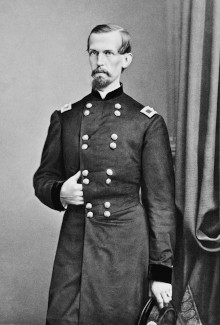
(Pictured: Michael Corcoran, Irish American general in the Union Army during the American Civil War and a close confidant of President Abraham Lincoln)


Leave a comment

The Execution of Roddy McCorley, Irish Nationalist

Roddy McCorley, Irish nationalist, is executed on February 28, 1800. He is alleged to be a member of the United Irishmen and claimed as a participant in their rebellion of 1798.

McCorley, the son of a miller, and is born near Toome in the civil parish of Duneane, County Antrim, in what is now Northern Ireland. A few years before the Irish Rebellion of 1798, his father is believed to have been executed for stealing sheep. These charges appear to be politically motivated in an attempt to remove a troublesome agitator at a time of great social unrest. Following his father’s execution, his family is evicted from their home.

There is uncertainty as to whether McCorley is actually actively involved with the predominantly Presbyterian United Irishmen or the predominantly Catholic Defenders. His role in the 1798 rebellion itself is unrecorded. In a ballad called “Roddy McCorley” written in the 1890s by Ethna Carbery, he is claimed to have been one of the leaders of the United Irishmen at the Battle of Antrim, however there is no contemporary documentary evidence to support this claim or prove that he was even active in the rebellion.

After the rebellion, McCorley joins a notorious outlaw gang known as Archer’s Gang, made up of former rebels and led by Thomas Archer. Some of these men had been British soldiers who changed sides in the conflict, and as such are guilty of treason and thus exempt from the terms of amnesty offered to the rank and file of the United Irishmen. This means that they are always on the run in an attempt to evade capture. This “quasi-rebel” group are claimed to have attacked loyalists and participated in common crime. It is believed that McCorley is caught while in hiding, having been betrayed by an informer.

After McCorley is arrested he is tried by court martial in Ballymena on February 20, 1800, and sentenced to be hanged “near the Bridge of Toome,” in the parish of Duneane. His execution occurs on February 28, 1800. The bridge had been partially destroyed by rebels in 1798 to prevent the arrival of loyalist reinforcements from west of the River Bann.

McCorley’s body is then dismembered and buried under the gallows, on the main Antrim to Derry road. A letter published in the Belfast News Letter a few days after his execution gives an account of the execution and how he was viewed by some. In it he is called Roger McCorley, which may be his proper Christian name.

His great-grandson, Roger McCorley, is an officer in the Irish Republican Army in the Irish War of Independence (1919–1921).

In addition to Ethna Carbery’s ballad, historian Guy Beiner uncovers earlier references to McCorley in Presbyterian folklore, which he shows to have been repeatedly forgotten and obscured on the background of mainstream Presbyterian identification with Unionism.

Carbery’s ballad is re-popularised by The Clancy Brothers and Tommy Makem, The Dubliners, The Kingston Trio, and others during the folk music revival of the 1960s. It is recorded in 1995 by Shane MacGowan and The Popes for their album The Snake and has also been recorded by other contemporary artists, such as Heather Dale on her 2006 album The Hidden Path. The melody for “Roddy McCorley” is reused in 1957 for “Sean South,” about a failed operation that year during the IRA’s border campaign.

An account of McCorley’s career compiled in the early twentieth century from local traditions and correspondence with his descendants, Who Fears to Speak of ’98?, is written by the Belfast antiquary and nationalist Francis Joseph Bigger. It contains an edited version of an early 19th-century ballad about Roddy McCorley’s fate.


Leave a comment

State Funeral in Honour of the “Forgotten Ten”

On October 14, 2001, the first multiple state funeral is held in honour of the “Forgotten Ten,” a term applied to ten Irish Republican Army (IRA) volunteers who were executed by British forces in Mountjoy Prison, Dublin, following courts martial for their role in the Irish War of Independence.

Based upon military law at the time, they are buried within the prison precincts, their graves unmarked in the unconsecrated ground. The names of the Forgotten Ten are Kevin Barry, Thomas Whelan, Patrick Moran, Patrick Doyle, Bernard Ryan, Thomas Bryan, Frank Flood, Thomas Traynor, Edmond Foley, and Patrick Maher. The hangman is John Ellis.

Following the Irish War of Independence, Mountjoy Prison is transferred to the control of the Irish Free State, which becomes the State of Ireland in 1937. In the 1920s, the families of the dead men request their remains be returned to them for proper burial. This effort is joined in the later 1920s by the National Graves Association. Through the efforts of the Association, the graves of the men are identified in 1934, and in 1996 a Celtic cross is erected in Glasnevin Cemetery, Dublin, to commemorate them.

The campaign to rebury the men drags on for 80 years from their deaths. Following an intense period of negotiations, the Irish government relents. Plans to exhume the bodies of the ten men are announced on November 1, 2000, the 80th anniversary of the execution of Kevin Barry. On October 14, 2001, the Forgotten Ten are afforded full state honours, with a private service at Mountjoy Prison for the families of the dead, a Requiem Mass at St. Mary’s Pro-Cathedral and burial in Glasnevin Cemetery.

According to The Guardian, some criticise the event as glorifying militant Irish republicanism. It coincides with the Fianna Fáil Ardfheis. The progress of the cortège through the centre of Dublin is witnessed by crowds estimated as being in the tens of thousands who break into spontaneous applause as the coffins pass. On O’Connell Street, a lone piper plays a lament as the cortège pauses outside the General Post Office (GPO), the focal point of the 1916 Easter Rising. In his homily during the Requiem Mass, Cardinal Cahal Daly, a long-time critic of the IRA campaign in Northern Ireland, insists that there is a clear distinction between the conflict of 1916–22 and the paramilitary-led violence of the previous 30 years:

“The true inheritors today of the ideals of the men and women of 1916 to 1922 are those who are explicitly and visibly committed to leaving the physical force tradition behind… Surely this state funeral can be an occasion for examination of conscience about the ideals of the men who died, and about our responsibility for translating those ideals into today’s realities.”

In his graveside oration Taoiseach Bertie Ahern echoes these sentiments and also pays tribute to the Ten:

“These 10 young men were executed during the War of Independence. The country was under tremendous pressure at the time. There was a united effort. Meanwhile, elected by the people, Dáil Éireann was developing, in spite of a war going on. Democracy was being put to work. Independent civic institutions, including the Dáil courts, were beginning to function. Before their deaths, the ten had seen the light of freedom. They understood that Ireland would be free and independent.”

The state funeral, broadcast live on national television and radio, is only the 13th since independence. Patrick Maher is not reburied with his comrades. In accordance with his wishes, and those of his family, he is reinterred in Ballylanders, County Limerick.

A feature length Irish language documentary on the re-interments, An Deichniúr Dearmadta (The Forgotten Ten) airs on TG4 on March 28, 2002.

(Pictured: The grave of nine of the Forgotten Ten in Glasnevin Cemetery, Dublin)


Leave a comment

The North King Street Ambush

Three British soldiers are killed, the first in the city since the Easter Rising of 1916, and two more wounded in a short exchange of gunfire with an Irish Republican Army (IRA) unit on the morning of September 20, 1920, at the corner North King Street and Church Street in Dublin.

Just before 11 o’clock, fifteen soldiers of the Duke of Wellington’s Regiment arrive in a motor lorry at Monks’ Bakery, North King Street, to acquire a supply of bread for Collinstown aerodrome. What happens next is disputed. Soldiers involved in the incident testify later that the volunteers began the shooting, after shouting “Hands Up!” and demanding they hand over their rifles.

Two key testimonies tally. The driver of the truck, Private C. Barnes, testifies at IRA volunteer Kevin Barry‘s court martial that he had been looking under the bonnet of the vehicle when he saw a civilian carrying a pistol walk up, shout “Hands Up!,” and fire a single round into the air. Decades later, the officer commanding the IRA unit that day, Seamus Kavanagh, tells the Bureau of Military History that it was indeed one of his men, but not Barry, that had fired the first shot, perhaps due to “overanxiety.”

Kavanagh sees the soldiers in the truck immediately rise to their feet, rifles in hand. The plan has fallen apart at the first hurdle, the element of surprise is lost, and there are no guns captured that day. He says he then gives the order to open fire, and retreat from the bakery. The exchange lasts four or five minutes.

In the last seconds of the ambush, Barry is in trouble. His gun has jammed twice, and has only fired two shots. Trying to clear the second jam, he fails to realise the rest of the unit has retreated, leaving him alone. He rolls under the lorry to hide, but a woman in the crowd of onlookers points him out to the soldiers, actually out of concern that he might be run over. He is taken prisoner and brought to the nearest base, at the North Dublin Union.

One reporter who attends the scene counts 22 bullet marks on walls, doors and windows in nearby homes and shops and adds that the military lorry is also riddled with bullet holes.

The three dead soldiers are identified as 18 year-old Private Harold Washington, who is found dead at the scene, Private Marshall Whitehead and Private Thomas Humphries who both die subsequently in King George V Hospital in Stoneybatter. The two wounded are Private William Smith and Private Frank Noble, neither of whom is armed.

It is rumoured that one or two of the attackers are killed, but this is not confirmed. Several volunteers are slightly wounded, but get away. Bob Flanagan’s wound is the most serious, a bullet literally parting his scalp. One onlooker expresses disbelief that the episode did not result in further fatalities given how close the soldiers and their assailants were to each other.

One person is understood to have been arrested in connection with the incident, however, according to eyewitnesses, the civilian in question has nothing to do with the attack and is taking shelter under a dray when arrested.

(Pictured: The funeral of the soldiers killed in the North King Street ambush, Irish Life, October 1, 1920)


Leave a comment

Death of Henry Joy McCracken, Founding Member of the United Irishmen

Henry Joy McCracken, Irish Republican, industrialist and a founding member of the Society of United Irishmen, is hanged from gallows erected in front of the Market House on Belfast‘s High Street on July 17, 1798, on land his grandfather had donated to the city.

McCracken is born in Belfast on August 31, 1767, into two of the city’s most prominent Presbyterian industrial families. He is the son of a shipowner, Captain John McCracken and Ann Joy, daughter of Francis Joy, of French Huguenot descent. The Joy family makes their money in linen manufacture and founds the News Letter. He is the older brother of political activist and social reformer Mary Ann McCracken, with whom he shares an interest in Irish traditional culture.

In 1792, McCracken helps organise the Belfast Harp Festival which gathers aged harpists from around Ireland and helps preserve the Irish airs by having them transcribed by Edward Bunting. Bunting, who lodges in the McCracken’s Rosemary Lane home, is a classically trained musician.

McCracken becomes interested in republican politics from an early age and along with other Protestants forms the Society of United Irishmen in 1795 which quickly makes him a target of the authorities. He regularly travels throughout the country using his business as a cover for organising other United Irish societies but is arrested in October 1796 and imprisoned in Kilmainham Gaol in Dublin. While imprisoned with other leaders of the United Irishmen, he falls seriously ill and is released on bail in December 1797.

Following the outbreak of the Irish Rebellion of 1798 in Leinster in May 1798, the County Antrim organisation meets on June 3 to decide on their response. The meeting ends inconclusively with a vote to wait for French aid being passed by a narrow margin. A new meeting of delegates is held in Templepatrick on June 5 where McCracken is elected general for Antrim, and he quickly begins planning military operations.

McCracken formulates a plan for all small towns in Antrim to be seized after which rebels will converge upon Antrim town on June 7 where the county’s magistrates are to hold a crisis meeting. Although the plan meets initial success and McCracken leads the rebels in the attack on Antrim, the Catholic Defenders group whom he expects assistance from are conspicuous by their absence. The mainly Ulster Scots rebels led by McCracken are defeated by the English forces and his army melts away.

Although McCracken initially escapes with James Hope, James Orr, and James Dickey and is supported in his month-long period of hiding by his sister Mary Ann, a chance encounter with men who recognize him from his cotton business leads to his arrest. He is offered clemency if he testifies against other United Irishmen leaders, but he refuses to turn on his compatriots.

McCracken is court martialed and hanged at Corn Market, Belfast, on land his grandfather had donated to the city, on July 17, 1798. According to historian Guy Beiner, his corpse is spared the indignity of decapitation in order not to provoke renewed agitation. He is buried in the Parish Church of St. George in Belfast, but a few years later the grave is demolished.

McCracken’s remains are believed to have been re-interred by Francis Joseph Bigger in 1909 at Clifton Street Cemetery, Belfast, alongside his sister Mary Ann. His illegitimate daughter Maria, whose mother is speculated to have been Mary Bodell, is raised by her aunt Mary Ann McCracken.


Leave a comment

Death of Liam Tobin, Irish Army Officer & IRA Intelligence Officer

Liam Tobin, officer in the Irish Army and the instigator of the Irish Army Mutiny in March 1924, dies in Dublin on April 30, 1963. During the Irish War of Independence, he serves as an Irish Republican Army (IRA) intelligence officer for Michael CollinsSquad.

Tobin is born William Joseph Tobin at 13 Great Georges Street in Cork, County Cork, on November 15, 1895, the eldest son of Mary Agnes (nee Butler) and David Tobin, a hardware clerk. He has two younger siblings, Katherine and Nicholas Augustine Tobin, also born in Cork. His family moves to John Street in Kilkenny and then to Dublin. He goes to school in Kilkenny and is an apprentice in a hardware shop at the time of the 1916 Easter Rising. As a participant in the Rising he fights in the Four Courts garrison under Edward Daly. He is arrested, court martialed, and sentenced to death but his sentence is commuted to life imprisonment. He is a prisoner in Kilmainham, Mountjoy, Lewes, Dartmoor, Broadmoor and Pentonville prisons. He is released in June 1917.

In early 1919 Tobin becomes Collins’ chief executive in the Intelligence Directorate handling the many spies in Dublin Castle, including double agent David Neligan. Nancy O’Brien works for Under-Secretary for Ireland James Macmahon, decoding messages sent from London. Each day between 2:30 and 3:30 she passes any information acquired to either Tobin, Joseph McGrath, or Desmond FitzGerald. Tobin is involved in planning the assassinations of British soldiers, informants, members of the Royal Irish Constabulary, the Dublin Metropolitan Police, and operatives of MI5. He constructs detailed profiles of everyone remotely connected to the British government, often using Who’s Who, The Morning Post, and The Times, a newspaper that describes him as “one of the most formidable of [the] Twelve Apostles.”

In October 1921, Tobin travels with the Irish Treaty Delegation as part of Collins’ personal staff.

Tim Pat Coogan and James Mackay have examined Tobin’s involvement in the assassination of British Field Marshal Sir Henry Wilson. Wilson’s public tirades about Collins is evidence of mutual personal dislike between the two men. In May 1922 Collins tells Tobin “We’ll kill a member of that bunch” to the news of “bloody pogroms” in Belfast. Wilson is intimately involved with the Ulster loyalist cause, including the Curragh Mutiny and the establishment of the Ulster Special Constabulary. Just before the shooting, Coogan places Tobin in London. He meets courier Peig Ni Braonain at Euston Station collecting a document that has been sent from Dublin. Returning to Dublin before the incident, he is jubilant when he tells defence minister Richard Mulcahy about Wilson’s death. Mulcahy is appalled and threatens to resign.

Following the Anglo-Irish Treaty, Tobin is appointed deputy director of intelligence in the new state and assigned to the Criminal Investigation Department based at Oriel House. However Collins soon replaces him with Joseph McGrath. Tobin is placed on the Army Council and is Director of Intelligence from September 1922 until his appointment as Senior Aide-de-Camp to the new GovernorGeneral of the Irish Free State, Tim Healy, in November 1922. The position provides an apartment in Viceregal Lodge.

In October 1922, Tobin’s brother Nicholas, a Free State captain, is accidentally shot dead by his own troops during the raid and capture of a bomb making factory at number 8 Gardiner’s Place, Dublin.

Tobin believes in the stepping stone doctrine which sees the Treaty as a stage towards full independence. With the outbreak of the Irish Civil War he remains loyal to Collins and takes the Pro-Treaty side. He leads in the fight against the Anti-Treaty IRA in the south. Disillusioned with the continuing hostilities and in the aftermath of the death of Collins, he forms an association called the IRA Organisation (IRAO) or “Old Irish Republican Army” to distinguish themselves from the anti-treaty insurgents.

Richard Mulcahy, the new Irish defence minister, proposes to reduce the army from 55,000 to 18,000 men in the immediate post- Civil-War period. Tobin knows his own position is to be affected and shares the perception that the Irish Army treats former British officers better than former IRA officers. On March 7, 1924, Tobin, together with Colonel Charlie Dalton, sends an ultimatum to President of the Executive Council of the Irish Free State W. T. Cosgrave demanding an end to the army demobilisation. The immediate response is an order for the arrest of the two men on a charge of mutiny. The cabinet, already wary of the Irish Army, orders an inquiry and appoints Garda Commissioner Eoin O’Duffy to the army command.

On March 18, the mutineers assemble with hostile intent at a Dublin pub. An order is made to arrest the mutineers and the cabinet demands the resignation of the army council. The generals resign, affirming the subservience of the military to the civilian government of the new state.

In later years, Tobin rebuilds relations with his Civil War foes and joins Éamon de Valera‘s Anti-Treaty Fianna Fáil party. He joins up with Joseph McGrath to form the Irish Hospitals’ Sweepstake in the 1930s. Many other former army comrades find work in this lottery. He leaves the Sweep in 1938. After World War II, he becomes Superintendent of the Oireachtas for the Irish Dáil.

On October 14, 1929, Tobin marries Monica “Mona” Higgins at the Church of the Holy Family, Aughrim Street, Dublin. They have two daughters, Máire and Anne Tobin. Following the death of his father, David, in 1956, Tobin’s health declines, resulting in his death in Dublin on April 30, 1963.

Tobin is portrayed by actor Brendan Gleeson in Neil Jordan‘s biopic Michael Collins.