seamus dubhghaill

Promoting Irish Culture and History from Little Rock, Arkansas, USA


Leave a comment

Death of John MacHale, Catholic Archbishop of Tuam

John MacHale, Irish Roman Catholic Archbishop of Tuam and Irish nationalist, dies in Tuam, County Galway on November 7, 1881.

MacHale is born in Tubbernavine, near Lahardane, County Mayo on March 6, 1791, to Patrick and Mary Mulkieran MacHale. He is so feeble at birth that he is baptised at home by Father Andrew Conroy. By the time he is five years of age, he begins attending a hedge school. Three important events happen during his childhood: the Irish Rebellion of 1798, the landing at Killala of French troops, whom the boy, hidden in a stacked sheaf of flax, watches marching through a mountain pass to Castlebar, and a few months later the brutal hanging of Father Conroy on a false charge of high treason.

Being destined for the priesthood, at the age of thirteen, he is sent to a school at Castlebar to learn Latin, Greek, and English grammar. In his sixteenth year the Bishop of Killala gives him a bursarship at St. Patrick’s College, Maynooth. At the age of 24, he is ordained a priest by Daniel Murray, Archbishop of Dublin. In 1825, Pope Leo XII appoints him titular bishop of Maronia, and coadjutor bishop to Dr. Thomas Waldron, Bishop of Killala.

With his friend and ally, Daniel O’Connell, MacHale takes a prominent part in the important question of Catholic emancipation, impeaching in unmeasured terms the severities of the former penal code, which had branded Catholics with the stamp of inferiority. During 1826 his zeal is omnipresent. He calls on the Government to remember how the Act of Union in 1800 was carried by William Pitt the Younger on the distinct assurance and implied promise that Catholic emancipation, which had been denied by the Irish Parliament, should be granted by the Parliament of the Empire.

Oliver Kelly, Archbishop of Tuam, dies in 1834, and the clergy selects MacHale as one of three candidates, to the annoyance of the Government who despatches agents to induce Pope Gregory XVI not to nominate him to the vacant see. Disregarding their request, the pope appoints MacHale Archbishop of Tuam. He is the first prelate since the Reformation who has received his entire education in Ireland. The corrupt practices of general parliamentary elections and the Tithe War cause frequent rioting and bloodshed and are the subjects of denunciation by the new archbishop, until the passing of a Tithes bill in 1838. He also leads the opposition to the Protestant Second Reformation, which is being pursued by evangelical clergy in the Church of Ireland, including the Bishop of Tuam, Killala and Achonry, Thomas Plunket.

The repeal of the Acts of Union 1800, advocated by O’Connell, enlists MacHale’s ardent sympathy and he assists the Liberator in many ways, and remits subscriptions from his priests for this purpose. In his zeal for the cause of the Catholic religion and of Ireland, so long downtrodden, but not in the 1830s, he frequently incurs from his opponents the charge of intemperate language, something not altogether undeserved. In his anxiety to reform abuses and to secure the welfare of Ireland, by an uncompromising and impetuous zeal, he makes many bitter and unrelenting enemies, particularly British ministers and their supporters.

The Great Famine of 1846–47 affects his diocese more than any. In the first year he announces in a sermon that the famine is a divine punishment on his flock for their sins. Then by 1846 he warns the Government as to the state of Ireland, reproaches them for their dilatoriness, and holds up the uselessness of relief works. From England as well as other parts of the world, cargoes of food are sent to the starving Irish. Bread and soup are distributed from the archbishop’s kitchen. Donations sent to him are acknowledged, accounted for, and disbursed by his clergy among the victims.

The death of O’Connell in 1847 is a setback to MacHale as are the subsequent disagreements within the Repeal Association. He strongly advises against the violence of Young Ireland. Over the next 30 years he becomes involved in political matters, particularly those involving the church. Toward the end of his life, he becomes less active in politics.

MacHale attends the First Vatican Council in 1869. He believes that the favourable moment has not arrived for an immediate definition of the dogma of papal infallibility. Better to leave it a matter of faith, not written down, and consequently he speaks and votes in the council against its promulgation. Once the dogma had been defined, he declares the dogma of infallibility “to be true Catholic doctrine, which he believed as he believed the Apostles’ Creed“. In 1877, to the disappointment of the archbishop who desires that his nephew should be his co-adjutor, Dr. John McEvilly, Bishop of Galway, is elected by the clergy of the archdiocese, and is commanded by Pope Leo XIII after some delay, to assume his post. He had opposed this election as far as possible but submits to the papal order.

Every Sunday MacHale preaches a sermon in Irish at the cathedral, and during his diocesan visitations he always addresses the people in their native tongue, which is still largely used in his diocese. On journeys he usually converses in Irish with his attendant chaplain and has to use it to address people of Tuam or the beggars who greet him whenever he goes out. He preaches his last Irish sermon after his Sunday Mass, April 1881. He dies in Tuam seven months later, on November 7, 1881, and is buried in the cathedral at Tuam on November 15.

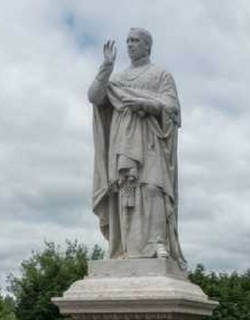
A marble statue perpetuates his memory on the grounds of the Cathedral of the Assumption of the Blessed Virgin Mary, Tuam. MacHale Park in Castlebar, County Mayo and Archbishop McHale College in Tuam are named after him. In his birthplace the Parish of Addergoole, the local GAA Club, Lahardane MacHales, is named in his honour. The Dunmore GAA team, Dunmore MacHales, is also named after him.

Leave a comment

Death of Sir Thomas Farrell, Irish Sculptor

Sir Thomas Farrell, Irish sculptor, dies at his home, Redesdale House, Stillorgan, County Dublin, on July 2, 1900.

Farrell is born in 1827 in Mecklenburgh Street (later called Railway Street) in Summerhill, Dublin, one of six sons of Terence Farrell, sculptor, and Maria Farrell (née Ruxton). He trains as a sculptor in his father’s workshops. In 1842 he enters the modelling school of the Royal Dublin Society, where he is awarded the prize for “Original design in clay” the following year. He is awarded premiums by the Royal Irish Art Union in 1844 and 1846. As a student he becomes acquainted with the neoclassical sculpture of John Flaxman and John Hogan. His first commission is a monument to Archbishop Daniel Murray in St. Mary’s Pro-Cathedral in Dublin.

One of the first works that make Farrell prominent is the bas-relief representing the last charge at Waterloo, designed for the Wellington Monument in the Phoenix Park. His work is accepted after public competition. Another of his early works is his memorial to Captain John McNeil Boyd in St. Patrick’s Cathedral, Dublin. He enters the competition for the monument to Daniel O’Connell in 1864, but the commission is awarded to John Henry Foley.

His statue of William Smith O’Brien, the Young Ireland leader, formerly at the head of D’Olier Street, is now in O’Connell Street, as is another statue by him, that of Sir John Gray, the surgeon and politician who is instrumental in giving Dublin its water supply.

Throughout his career, Farrell remains actively involved in the Royal Hibernian Academy (RHA). He is elected directly as a full member in 1860 rather than undergoing an initial phase of associate membership. He exhibits almost annually with the academy until his death. He holds a number of posts, including professor of sculpture and treasurer, before being elected president in 1893, being the first sculptor to be so honoured. His achievements are recognised with a knighthood in May 1894.

Farrell dies at his residence, Redesdale House, in Stillorgan, County Dublin, on July 2, 1900. He is a shy, retiring man, and his death is not announced to the public for three days, in keeping with his wishes to avoid any sort of elaborate display on his behalf. Intensely private, he never marries and lives a life immersed in his work. Contemporary accounts describe him as constantly dissatisfied with his work despite consistent public approval for it.


Leave a comment

Death of Edmund Ignatius Rice, Missionary & Educationalist

Edmund Ignatius Rice, Catholic missionary and educationalist, dies on August 29, 1844, at Mount Sion, Waterford, County Waterford, after living in a near-comatose state for more than two years.

Rice is born on June 1, 1766, at Westcourt, Callan, County Kilkenny, the fourth of seven sons of Robert Rice, a farmer, and his wife, Margaret Tierney. His education begins at a local hedge school. He subsequently transfers to a school in Kilkenny before being apprenticed in 1779 to his uncle, a prosperous merchant at Waterford. He amasses a fortune in the lucrative provisioning trade of the city, and in 1785 he marries Mary Elliott, the daughter of a local tanner. Their only child, Mary, has intellectual disabilities and Rice suffers additional heartbreak with the death of his wife in 1789 following an accident, possibly by a fever that set in afterwards.

The death of his wife clearly affects Rice’s life. While he continues in trade and is an active member of the Catholic committee in the city, his priorities are radically changed. From this point he becomes increasingly involved in pious and charitable pursuits. He assists in the foundation of the Trinitarian Orphan Society in 1793 and the Society for the Relief of Distressed Roomkeepers in 1794. He joins religious confraternities and devotes considerable attention to the plight of prisoners. His endeavours become more focused in 1797 when, in response to a controversial pastoral of Bishop Thomas Hussey of Waterford and Lismore, he embraces the cause of Catholic education. In 1802, he establishes a religious community of laymen who set out to do for the neglected poor boys of Waterford what Nano Nagle had done for poor girls in Cork. His community is the genesis of both the Presentation Brothers and the Irish Congregation of Christian Brothers. Rice’s “monks” follow a variation of the Presentation rule, and his school curriculum is a pragmatic combination of best practice of the time overlaid by an uncompromisingly Catholic emphasis. By the time of his death in 1844, the Christian Brothers run forty-three schools, including six in England.

Rice is pivotal in the revival of Irish Catholicism following the severe dislocation of the penal era. Among the urban poor the Brothers make a landmark contribution in widening the social base of the institutional church. Through their teaching and catechetical instruction, they introduce the poor to the new forms of devotion which become the hallmark of nineteenth-century Catholicism. This effort brings a previously marginalised class within the ranks of the institutional church, which in time becomes the backbone of the emerging Catholic Ireland. The Brothers also play a determined role in the Catholic response to the proselytising efforts of the protestant Second Reformation in the country. Rice’s Brothers assist in the moulding of a distinctively Catholic urban working class, by promoting literacy alongside piety and instilling in their pupils the middle-class virtues of personal discipline, hard work, and sobriety.

Rice collaborates closely with other Catholic leaders of his age. His congregation is central to the success of Theobald Mathew‘s temperance movement. In 1828, at the height of the emancipation campaign, he invites Daniel O’Connell to lay the foundation stone of the Brothers’ model school at North Richmond Street, Dublin. This “monster meeting” attracts an attendance of 100,000, before which O’Connell hails Rice as the “patriarch of the monks of the west.” During the Repeal campaign, too, the Brothers frequently host the Liberator. Reflecting on their efforts, O’Connell declares that “education to be suited to this country must be Catholic and Irish in its tone, having as its motto Faith and Fatherland.”

Rice’s uncompromising adherence to these principles is not without difficulty. It leads to a predictably acrimonious relationship with the secular national board and his eventual withdrawal of the Brothers’ schools from the system in 1836. Rejection of the national board imposes serious financial burdens on the Christian Brothers which are relieved only by the bounties provided by the Intermediate Education Act (1878). Withdrawal also serves to alienate many friends and benefactors, including Daniel Murray, Archbishop of Dublin, who is a commissioner of national education. But the bishops gradually adopt Rice’s stance. After 1838 they become increasingly hostile to the national board, and the Brothers’ schools, with their acclaimed textbooks, are recognised as a bulwark against non-denominational education. For similar reasons, the Brothers become closely associated with Irish nationalism. In 1892, the MP William O’Brien observes that “the Christian Brothers system was regarded in Ireland as the really national system.”

The 1830s bring a rapid deterioration in Rice’s health. Financial difficulties frustrate his plans, and the plight of the three Dublin foundations is particularly acute. Rice resigns as superior general of his congregation in 1838, but fraught relations with his successor, Br. Michael Paul Riordan, blights his later years.

From this time on, Rice spends an increasing proportion of his time at Mount Sion and the adjoining school, showing a continued interest in the pupils and their teachers. He also takes a short walk each day on the slope of Mount Sion, but his increasingly painful arthritis leads the community superior, Joseph Murphy, to purchase a wheelchair for his benefit. At Christmas time in 1841, his health takes a turn for the worse and even though expectations of his imminent death do not turn out to be justified, he is increasingly confined to his room.

After living in a near-comatose state for more than two years and in the constant care of a nurse since May 1842, Rice dies on August 29, 1844, at Mount Sion, Waterford, where his remains lie in a casket to this day. Large crowds fill the streets around his house in Dublin to honour him. He is beatified by Pope John Paul II in 1996.

(From: “Rice, Edmund Ignatius” by Dáire Keogh, Dictionary of Irish Biography, http://www.dib.ie, October 2009)


Leave a comment

Death of Daniel Murray, Roman Catholic Archbishop of Dublin

Daniel Murray, Roman Catholic Archbishop of Dublin, dies in Dublin on February 26, 1852.

Murray is born on April 18, 1768, at Sheepwalk, near Arklow, County Wicklow, the son of Thomas and Judith Murray, who are farmers. At the age of eight he goes to Thomas Betagh‘s school at Saul’s Court, near Christ Church Cathedral, Dublin. At sixteen, Archbishop John Carpenter sends him to the Irish College at Salamanca, completing his studies at the University of Salamanca. He is ordained priest in 1792 at the age of twenty-four.

After some years as curate at St. Paul’s Church, Dublin, Murray is transferred to Arklow and is there in 1798 when the rebellion breaks out. The yeomanry shoots the parish priest in bed and Murray, to escape a similar fate, flees to the city where for two years he serves as curate at St. Andrew’s Chapel on Hawkins Street. As a preacher, he is said to be particularly effective, especially in appeals for charitable causes, such as the schools. He is then assigned to the Chapel of St. Mary in Upper Liffey Street where Archbishop John Troy is the parish priest.

In 1809, at the request of Archbishop Troy, Murray is appointed coadjutor bishop and consecrated on November 30, 1809. In 1811 he is made Administrator of St. Andrew’s. That same year he helps Mary Aikenhead establish the Religious Sisters of Charity. While coadjutor he fills for one year the position of president of St. Patrick’s College, Maynooth.

Murray is an uncompromising opponent of a proposal granting the British government a “veto” over Catholic ecclesiastical appointments in Ireland, and in 1814 and 1815, makes two separate trips to Rome concerning the controversy.

Murray becomes Archbishop of Dublin in 1825 and on November 14, 1825, celebrates the completion of St. Mary’s Pro-Cathedral. He enjoys the confidence of successive popes and is held in high respect by the British government. His life is mainly devoted to ecclesiastical affairs, the establishment and organisation of religious associations for the education and relief of the poor. With the outbreak of cholera in the 1830s, in 1834 he and Mother Aikenhead found St. Vincent’s Hospital. He persuades Edmund Rice to send members of the Christian Brothers to Dublin to start a school for boys. The first is opened in a lumber yard on the city-quay. He assists Catherine McAuley in founding the Sisters of Mercy, and in 1831 professes the first three members.

Edward Bouverie Pusey has an interview with Murray in 1841, and bears testimony to his moderation, and John Henry Newman has some correspondence with him prior to Newman’s conversion from the Anglican Church to the Roman Catholic Church in 1845. A seat in the privy council at Dublin, officially offered to him in 1846, is not accepted. He takes part in the synod of the Roman Catholic clergy at Thurles in 1850.

Towards the end of his life, Murray’s eyesight is impaired, and he reads and writes with difficulty. Among his last priestly functions is a funeral service for Richard Lalor Sheil who had died in Italy, and whose body had been brought back to Ireland for burial. Murray dies in Dublin on February 26, 1852, at the age of eighty-four. He is interred in the St. Mary’s Pro-Cathedral, Dublin, where a marble statue of him has been erected in connection with a monument to his memory, executed by James Farrell, president of the Royal Hibernian Academy of Fine Arts.

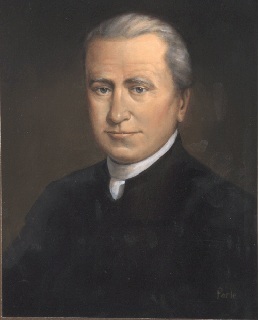
(Pictured: Portrait of Daniel Murray, Archbishop of Dublin, by unknown 19th century Irish portrait painter)


Leave a comment

Birth of Daniel Murray, Archbishop of Dublin

Daniel Murray, Roman Catholic Archbishop of Dublin, is born on April 18, 1768, at Sheepwalk, near Arklow, County Wicklow.

Murray is the son of Thomas and Judith Murray, who are farmers. At the age of eight he goes to Thomas Betagh‘s school at Saul’s Court, near Christ Church Cathedral, Dublin. At sixteen, Archbishop John Carpenter sends him to the Irish College at Salamanca, completing his studies at the University of Salamanca. He is ordained priest in 1792 at the age of twenty-four.

After some years as curate at St. Paul’s Church in Dublin, Murray is transferred to Arklow and is there in 1798 when the rebellion breaks out. The yeomanry shoots the parish priest in bed and Murray, to escape a similar fate, flees to the city where for two years he serves as curate at St. Andrew’s Chapel on Hawkins Street. As a preacher, he is said to be particularly effective, especially in appeals for charitable causes, such as the schools. He is then assigned to the Chapel of St. Mary in Upper Liffey Street where Archbishop John Troy is the parish priest.

In 1809, at the request of Archbishop Troy, Murray is appointed coadjutor bishop and consecrated on November 30, 1809. In 1811 he is made Administrator of St. Andrew’s. That same year he helps Mary Aikenhead establish the Religious Sisters of Charity. While coadjutor he fills for one year the position of president of St. Patrick’s College, Maynooth.

Murray is an uncompromising opponent of a proposal granting the British government a “veto” over Catholic ecclesiastical appointments in Ireland, and in 1814 and 1815, makes two separate trips to Rome concerning the controversy.

Murray becomes Archbishop of Dublin in 1825 and on November 14, 1825, celebrates the completion of St. Mary’s Pro-Cathedral. He enjoys the confidence of successive popes and is held in high respect by the British government. His life is mainly devoted to ecclesiastical affairs, the establishment and organisation of religious associations for the education and relief of the poor. With the outbreak of cholera in the 1830s, in 1834 he and Mother Aikenhead found St. Vincent’s Hospital. He persuades Edmund Rice to send members of the Christian Brothers to Dublin to start a school for boys. The first is opened in a lumber yard on the city-quay. He assists Catherine McAuley in founding the Sisters of Mercy, and in 1831 professes the first three members.

Edward Bouverie Pusey has an interview with Murray in 1841, and bears testimony to his moderation, and John Henry Newman has some correspondence with him prior to Newman’s conversion from the Anglican Church to the Roman Catholic Church in 1845. A seat in the privy council at Dublin, officially offered to him in 1846, is not accepted. He takes part in the synod of the Roman Catholic clergy at Thurles in 1850.

Towards the end of his life, Murray’s eyesight is impaired, and he reads and writes with difficulty. Among his last priestly functions is a funeral service for Richard Lalor Sheil who had died in Italy, and whose body had been brought back to Ireland for burial. Murray dies in Dublin on February 26, 1852, at the age of eighty-four. He is interred in the St. Mary’s Pro-Cathedral, Dublin, where a marble statue of him has been erected in connection with a monument to his memory, executed by James Farrell, president of the Royal Hibernian Academy of Fine Arts.

(Pictured: Portrait of Daniel Murray, Archbishop of Dublin, by unknown 19th century Irish portrait painter)


Leave a comment

Death of Sister Catherine McAuley, Founder of the Sisters of Mercy

Catherine Elizabeth McAuley, Irish religious sister who founds the Sisters of Mercy in 1831, dies in Dublin on November 11, 1841. The Sisters of Mercy has always been associated with teaching, especially in Ireland, where the sisters teach Catholics, and at times Protestants, at a time when education is mainly reserved for members of the established Church of Ireland.

McAuley is born on September 29, 1778, at Stormestown House in Dublin to James and Elinor (née Conway) McAuley. Her father dies in 1783 when she is five and her mother dies in 1798. She first goes to live with a maternal uncle, Owen Conway, and later joins her brother James and sister Mary at the home of William Armstrong, a Protestant relative on her mother’s side. In 1803, she becomes the household manager and companion of William and Catherine Callaghan, an elderly, childless, and wealthy Protestant couple and friends of the Armstrongs, at their estate in Coolock, a village northeast of Dublin. For 20 years she gives catechetical instruction to the household servants and the poor village children. Catherine Callaghan, who is raised in the Quaker tradition, dies in 1819. When William Callaghan dies in 1822, McAuley becomes the sole residuary legatee of their estate.

McAuley inherits a considerable fortune and chooses to use it to build a house where she and other compassionate women can take in homeless women and children to provide care and education for them. A location is selected at the junction of Lower Baggot Street and Herbert Street in Dublin, and in June 1824, the cornerstone is laid by the Rev. Dr Blake. As it is being refurbished, she studies current educational methods in preparation for her new endeavour. On the feast of Our Lady of Mercy, September 24, 1827, the new institution for destitute women, orphans, and schools for the poor is opened and McAuley, with two companions, undertake its management.

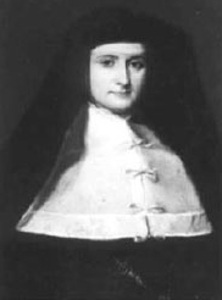
For three years, McAuley and her companions continue their work as lay women. She never intends to found a community of religious women. Her initial intention is to assemble a lay corps of Catholic social workers. In 1828 Archbishop of Dublin Daniel Murray permits the staff of the institute to assume a distinctive dress and to publicly visit the sick. The uniform adopted is a black dress and cape of the same material reaching to the belt, a white collar and a lace cap and veil – such a costume as is now worn by the postulants of the congregation. In the same year the archbishop desires McAuley to choose some name by which the little community might be known, and she chooses that of “Sisters of Mercy,” having the design of making the works of mercy the distinctive feature of the institute.

McAuley is desirous that the members should combine with the silence and prayer of the Carmelites, with the active labours of a Sister of Charity. The position of the institute is anomalous, its members are not bound by vows nor are they restrained by rules. The clergy and people of the church of the time, however, are not supportive of groups of laywomen working independently of church structures. The main concern is for the stability and continuity of the works of mercy which the women had taken on. Should any of them get married or lose interest, the poor and the orphans whom they are caring for would then be at a loss.

McAuley’s clerical mentor urges her to form a religious institute. Along with two other women, Mary Ann Doyle and Mary Elizabeth Harley, she enters the novitiate of the Presentation Sisters to formally prepare for life as women religious in September 1830. On December 12, 1831, they profess vows and return to the House of Mercy. The Sisters of Mercy consider December 12, 1831, as the day of their founding as a religious community. Archbishop Murray assists McAuley in founding the Sisters of Mercy and professes the first three members. He then appoints her Mother Superior.

Between 1831 and 1841 McAuley founds additional Convents in Tullamore, Charleville, Cork, Carlow, Galway, Limerick, Birr, Bermondsey and Birmingham and branch houses in Kingstown and Booterstown. A cholera epidemic hits Dublin in 1832, and she agrees to staff a cholera hospital on Townsend Street.

The rule of the Sisters of Mercy is formally confirmed by Pope Gregory XVI on June 6, 1841. McAuley lives only ten years as a Sister of Mercy, Sister Mary Catherine.

McAuley dies of tuberculosis at the age of sixty-three on November 11, 1841, at Baggot Street. She is buried at Baggot Street Cemetery. At the time of her death, there are 100 Sisters of Mercy in ten foundations. Shortly thereafter, small groups of sisters leave Ireland to establish new foundations on the east and west coasts of the United States, in Newfoundland, Australia, New Zealand, and Argentina.

Total worldwide membership consists of about 5,500 Sisters of Mercy, 5,000 Associates, and close to half a million partners in ministry. The Mercy International Centre in Dublin is the international “home” of Mercy worldwide and the mercyworld.org website is the virtual home.

In 1978, the cause for the beatification of the Servant of God Catherine McAuley is opened by Pope Paul VI. In 1990, upon recognition of her heroic virtues, Pope John Paul II declares her Venerable.


Leave a comment

Birth of John MacHale, Archbishop of Tuam

John MacHale, Irish Roman Catholic Archbishop of Tuam and Irish nationalist, is born in Tubbernavine, near Lahardane, County Mayo on March 6, 1791.

MacHale’s parents are Patrick and Mary Mulkieran MacHale. He is so feeble at birth that he is baptised at home by Father Andrew Conroy. By the time he is five years of age, he begins attending a hedge school. Three important events happen during his childhood: the Irish Rebellion of 1798, the landing at Killala of French troops, whom the boy, hidden in a stacked sheaf of flax, watches marching through a mountain pass to Castlebar, and a few months later the brutal hanging of Father Conroy on a false charge of high treason.

Being destined for the priesthood, at the age of thirteen, he is sent to a school at Castlebar to learn Latin, Greek, and English grammar. In his sixteenth year the Bishop of Killala gives him a busarship at St. Patrick’s College, Maynooth. At the age of 24, he is ordained a priest by Daniel Murray, Archbishop of Dublin. In 1825, Pope Leo XII appoints him titular bishop of Maronia, and coadjutor bishop to Dr. Thomas Waldron, Bishop of Killala.

With his friend and ally, Daniel O’Connell, MacHale takes a prominent part in the important question of Catholic emancipation, impeaching in unmeasured terms the severities of the former penal code, which had branded Catholics with the stamp of inferiority. During 1826 his zeal is omnipresent. He calls on the Government to remember how the Act of Union in 1800 was carried by William Pitt the Younger on the distinct assurance and implied promise that Catholic emancipation, which had been denied by the Irish Parliament, should be granted by the Parliament of the Empire.

Oliver Kelly, Archbishop of Tuam, dies in 1834, and the clergy selects MacHale as one of three candidates, to the annoyance of the Government who despatches agents to induce Pope Gregory XVI not to nominate him to the vacant see. Disregarding their request, the pope appoints MacHale Archbishop of Tuam. He is the first prelate since the Reformation who has received his entire education in Ireland. The corrupt practices of general parliamentary elections and the Tithe War cause frequent rioting and bloodshed and are the subjects of denunciation by the new archbishop, until the passing of a Tithes bill in 1838. He also leads the opposition to the Protestant Second Reformation, which is being pursued by evangelical clergy in the Church of Ireland, including the Bishop of Tuam, Killala and Achonry, Thomas Plunket.

The repeal of the Acts of Union 1800, advocated by O’Connell, enlists MacHale’s ardent sympathy and he assists the Liberator in many ways, and remits subscriptions from his priests for this purpose. In his zeal for the cause of the Catholic religion and of Ireland, so long downtrodden, but not in the 1830s, he frequently incurs from his opponents the charge of intemperate language, something not altogether undeserved. In his anxiety to reform abuses and to secure the welfare of Ireland, by an uncompromising and impetuous zeal, he makes many bitter and unrelenting enemies, particularly British ministers and their supporters.

The Great Famine of 1846–47 affects his diocese more than any. In the first year he announces in a sermon that the famine is a divine punishment on his flock for their sins. Then by 1846 he warns the Government as to the state of Ireland, reproaches them for their dilatoriness, and holds up the uselessness of relief works. From England as well as other parts of the world, cargoes of food are sent to the starving Irish. Bread and soup are distributed from the archbishop’s kitchen. Donations sent to him are acknowledged, accounted for, and disbursed by his clergy among the victims.

The death of O’Connell in 1847 is a setback to MacHale as are the subsequent disagreements within the Repeal Association. He strongly advises against the violence of Young Ireland. Over the next 30 years he becomes involved in political matters, particularly those involving the church. Toward the end of his life he becomes less active in politics.

MacHale attends the First Vatican Council in 1869. He believes that the favourable moment has not arrived for an immediate definition of the dogma of papal infallibility. Better to leave it a matter of faith, not written down, and consequently he speaks and votes in the council against its promulgation. Once the dogma had been defined, he declares the dogma of infallibility “to be true Catholic doctrine, which he believed as he believed the Apostles’ Creed“. In 1877, to the disappointment of the archbishop who desires that his nephew should be his co-adjutor, Dr. John McEvilly, Bishop of Galway, is elected by the clergy of the archdiocese, and is commanded by Pope Leo XIII after some delay, to assume his post. He had opposed this election as far as possible but submits to the papal order.

Every Sunday MacHale preaches a sermon in Irish at the cathedral, and during his diocesan visitations he always addresses the people in their native tongue, which is still largely used in his diocese. On journeys he usually converses in Irish with his attendant chaplain and has to use it to address people of Tuam or the beggars who greet him whenever he goes out. He preaches his last Irish sermon after his Sunday Mass, April 1881. He dies in Tuam seven months later, on November 7, 1881.

A marble statue perpetuates his memory on the grounds of the Cathedral of the Assumption of the Blessed Virgin Mary, Tuam. MacHale Park in Castlebar, County Mayo and Archbishop McHale College in Tuam are named after him. In his birthplace the Parish of Addergoole, the local GAA Club, Lahardane MacHales, is named in his honour. The Dunmore GAA team, Dunmore MacHales, is also named after him.


Leave a comment

Birth of Mother Frances Mary Teresa Ball

frances-teresa-ball

Mother Frances Mary Teresa Ball, foundress of the Irish Branch of the Institute of the Blessed Virgin Mary (IBVM), is born in Dublin on January 9, 1794.

Ball is the youngest of six children born to John and Mable Clare Bennet Ball. Her father is a wealthy silk weaver. Catholicism is still suppressed in Ireland at this time. She is therefore sent to England at the age of nine to the Bar Convent in York. Henry James Coleridge describes her as “a bright, quiet, high-spirited girl, fond of fun, and with much depth of character.” In these times students do not return home for Easter, Christmas or summer holidays. They stay at the school, and live like religious people, until they leave school, usually in their late teens.

In 1807, her eldest sister, Cecilia is professed at the Ursuline convent in Cork. Ball travels from Dublin to Cork for the ceremony, where she meets Mary Aikenhead. Cecilia Ball takes the name of Sister Francis Regis and is within a few years made Superior of the convent in Cork. Upon the death of her father in 1808, Ball returns to Dublin. She is expected to make an admirable wife for the son and heir of some rich Catholic Dublin merchant family.

In June 1814, under the direction of Dr. Daniel Murray, Archbishop of Dublin, Ball returns to York and enters the novitiate of the Institute of the Blessed Virgin Mary. There she receives her religious training, and makes her profession in September 1816, taking, in religion, the name of Mary Teresa.

Recalled by Archbishop Murray, Ball returns to Dublin in 1821 with two novices to establish the Irish Branch of the Institute of the Blessed Virgin Mary for the instruction of children. They stay with Mary Aikenhead and the Irish Sisters of Charity in Stanhope Street while Rathfarnham House is being renovated. In 1822 she opens the first institution of the order in Ireland, in Rathfarnam House, four miles from Dublin. She decides to call the house “Loreto” after the village in Italy to which the Nazareth house of the Holy Family is said to have been miraculously transported.

Ball is a woman of great piety and administrative ability. Her energies are devoted to the establishment of schools and to the development of the sisterhood which now has members in many countries. The first offshoot is planted in Navan, County Meath, in the year 1833. The year 1840 is marked by the erection of the first church in Ireland dedicated to the Sacred Heart, in Loretto Abbey, Rathfarnham. In addition to the boarding and day schools the sisters conduct orphanages.

For almost forty years after bringing the IBVM to Ireland, Ball establishes a wide network of convents and schools across Ireland, as well as in India, Mauritius and Canada. The nuns are usually called Sisters of Loreto after the shrine at Loreto, Marche in Italy.

Mother Mary Teresa Ball dies at Rathfarnham Abbey on May 19, 1861, after a long illness.