seamus dubhghaill

Promoting Irish Culture and History from Little Rock, Arkansas, USA


Leave a comment

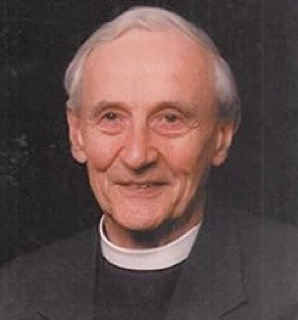
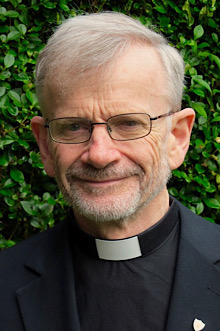
Birth of George Simms, Archbishop in the Church of Ireland

George Otto Simms, an archbishop in the Church of Ireland, and a scholar, is born in Dublin on July 4, 1910.

AboutSimms is born to John Francis A. Simms and Ottilie Sophie Stange, who are both, according to his birth certificate, from LiffordCounty Donegal. He attends the Prior School in Lifford for a time and later Cheltenham College, a public school in England. He goes on to study at Trinity College Dublin, where in 1930 he is elected a Scholar and graduates with a BA in Classics in 1932 and a Bachelor of Divinity degree in 1936. He completes a PhD in 1950.

Simms is ordained a deacon in 1934 and a priest in 1936, beginning his ministry as a curate at St. Bartholomew’s Church, Clyde Road, Dublin, under Canon W. C. Simpson. In 1937, he takes a position in Lincoln Theological College but returns to Dublin in 1939 to become Dean of Residence in Trinity College Dublin and Chaplain Secretary of the Church of Ireland College of Education

He is appointed Dean of Cork in 1952. Consecrated a bishop, he serves as Bishop of Cork, Cloyne and Ross, between 1952 and 1956. At forty-two, he is the youngest Church of Ireland clergyman appointed to a bishopric since John Gregg in 1915. He serves as Archbishop of Dublin from 1956 to 1969. During this time, he maintains a courteous relationship with John Charles McQuaid, his Roman Catholic counterpart as Archbishop of Dublin. From 1969 to 1980, he serves as Archbishop of Armagh

Alongside Cardinal William Conway, Simms chairs the first official ecumenical meeting between the leaders of Ireland’s Protestant Churches and the Catholic Church in Ballymascanlon Hotel, DundalkCounty Louth, on September 26, 1973, an important meeting amidst the increasing violence in Northern Ireland. The meeting is protested by Ian Paisley.

Simms is a scholar, and publishes research on topics including the history of the Church of Ireland, and theological reflections on key texts including the Book of KellsSaint Patrick’s Breastplate, and the Sarum Primer. He is also a fluent speaker of the Irish language.

Simms is also an accomplished journalist, and the author of many newspaper obituaries. His weekly Thinking Aloud column in The Irish Times is a popular reflection, and runs continuously for thirty-eight years. He also works on the research, preparation, and even performs the presentation, of a number of television programmes.

In 1978, Simms is made an honorary fellow of Trinity College Dublin.

Simms is the uncle of mathematician David J. Simms. In 1941, he marries Mercy Felicia Gwynn. They have five children. He dies in Dublin on November 15, 1991. He is interred with his wife in the cemetery attached to St. Maelruain’s ChurchTallaghtCounty Dublin.


Leave a comment

Death of Basil Maturin, Catholic Priest & Writer

Basil William Maturin, Irish-born Anglican priest, preacher and writer who later converts to Catholicism, dies aboard the RMS Lusitania after it is torpedoed by a German U-boat and sinks on May 7, 1915.

Maturin is born on February 15, 1847, at All Saints’ vicarage, Grangegorman, Dublin, the third of the ten children of the Rev. William Basil Maturin and his wife, Jane Cooke (née Beatty). The Maturins, a prominent Anglo-Irish family of Huguenot ancestry, have produced many influential Church of Ireland clergymen over the generations, the most notable being Maturin’s grandfather, the writer Charles Robert Maturin. His own father, whose tractarian convictions are considered too “high church” for many in Dublin, is a somewhat controversial figure in the church. Religion plays a huge part in the Maturin children’s lives. Two of his brothers enter the church and two sisters become nuns. As a young man, he assists in training the choir and playing the organ at his father’s church. Educated at home and at a Dublin day school, he goes on to attend Trinity College Dublin (TCD), from where he graduates BA in 1870.

Though he initially intends to make a career in the army as an engineer, a severe attack of scarlet fever around 1868, and the death of his brother Arthur, changes his outlook on life, and he decides to become a clergyman. He is ordained a deacon in 1870 and later that year goes as a curate to Peterstow, Herefordshire, England, where his father’s friend Dr. John Jebb is rector. He subsequently joins the Society of St. John the Evangelist, entering the novitiate at Cowley, Oxford, in February 1873. As a Cowley father he is sent in 1876 to establish a mission in Philadelphia, Pennsylvania, where he works as an assistant priest and, from 1881, as rector of Saint Clement’s Church. Though he proves to be an effective clergyman and popular preacher, his growing religious doubts and increasing interest in Catholicism results in his returning to Oxford in 1888. Then follows a six-month visit in 1889–90 to a society house in Cape Town, South Africa. He returns to Britain, where he preaches, and conducts retreats around the country and occasionally on the continent. In 1896 he produces the first in a series of religious publications, Some Principles and Practices of Spiritual Life.

Maturin’s continuing religious anxieties eventually lead to his conversion to Catholicism on March 5, 1897, at the Jesuit Beaumont College outside London. He then studies theology at the Canadian College, Rome, and is ordained there in 1898. Following his return to England he lives initially at Archbishop’s House, Westminster, and undertakes missionary work. He then serves at St. Mary’s, Cadogan Street, in 1901. He becomes parish priest of Pimlico and, in 1905, having joined the newly established Society of Westminster Diocesan Missionaries, organises the opening of St. Margaret’s chapel on St. Leonard’s Street, where huge crowds come to hear his sermons. As a Catholic priest, he returns to Ireland on several occasions, and frequently preaches at the Carmelite church, Clarendon Street, Dublin. His attempt, at the age of sixty-three, to enter into monastic life at the Benedictine monastery at Downside, in 1910, proves unsuccessful. He returns to London and begins working in St. James’s, Spanish Place, while maintaining his preaching commitments. He continues to write, publishing Self-Knowledge and Self-Discipline (1905), Laws of the Spiritual Life (1907) and his autobiographical The Price of Unity (1912), in which he traces his gradual move toward Catholicism. His sermons, like his approach when hearing confessions, are said to have much appeal for their integrity. Despite his influence as a preacher, he seems often feel that his life and vocation lack real purpose and at times he suffers from depression.

After a brief visit to the United States in 1913, Maturin accepts the post of Catholic chaplain at the University of Oxford in 1914. He travels to New York in 1915 and, after preaching there throughout the spring, boards the RMS Lusitania in May to return to England. The liner is torpedoed and sinks on May 7, 1915, off the southern coast of Ireland. He assists his fellow passengers in the last minutes, and it is presumed that he refuses a life jacket, as they are in short supply. His body washes ashore. A service is held for him at Westminster Cathedral.

Maturin’s friend Wilfrid Philip Ward edits a collection of his spiritual writings, Sermons and Sermon Notes, in 1916.

(From: “Maturin, Basil William” by Frances Clarke, Dictionary of Irish Biography, http://www.dib.ie, October 2009)


Leave a comment

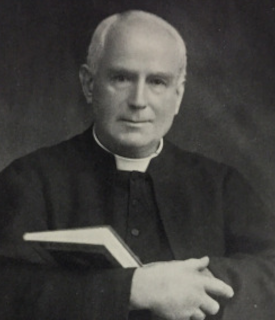
Birth of Robert Gwynn, Church of Ireland Clergyman & Academic

Robert Malcolm Gwynn, Church of Ireland clergyman and academic whose entire working life is spent at Trinity College Dublin (TCD), is born in Ramelton, County Donegal, on April 26, 1877. In his youth, he is also an outstanding cricketer.

Gwynn is one of eight brothers and two sisters born to the Reverend John Gwynn, Dean of Raphoe, and Lucy Josephine Gwynn, daughter of the Irish patriot William Smith O’Brien.

Gwynn is educated at St. Columba’s College, Dublin, and Trinity College Dublin. In 1896 he heads the list of Foundation Scholars in Classics at TCD. In 1898 he graduates Bachelor of Arts, gaining a “first of firsts” with gold medals in Classics and Modern Literature.

In 1900, along with his brother Edward Gwynn and others, Gwynn founds the Social Services (Tenements) Company to provide housing for poor families in Dublin. He subsequently spends many periods working with the poor in Dublin’s slums. He is instrumental in founding the Trinity Mission, which serves slum dwellers in Belfast, and is for many years actively involved in the Dublin University Fukien Mission (later the Dublin University Far Eastern Mission), eventually becoming its chairman and president.

He is ordained deacon in 1906, achieving full priesthood two years later. He is the only one of Rev. John Gwynn’s sons to be ordained, and he never serves in a parish. That same year, he proceeds to MA and is elected a Fellow of Trinity College Dublin.

In 1907 Gwynn is appointed Lecturer in Divinity and Tutor. He remains Lecturer in Divinity until 1919 and continues as Tutor until 1937. He is appointed Chaplain of TCD in 1911, retaining that post until 1919.

In January 1909 he is appointed Acting Warden of his old school, St. Columba’s College, which is facing a major financial crisis. He keeps the institution afloat until a new warden is appointed.

Horrified by the brutality of the Dublin Metropolitan Police (DMP) toward strikers during the lockout in 1913, Gwynn becomes a prominent advocate of the workers’ cause and joins the Industrial Peace Committee. On November 12, 1913, when the committee is barred from holding its meeting at the Mansion House, he invites the members to his college rooms at No. 40, New Square. It is this meeting that leads to the foundation of the Irish Citizen Army (ICA). In their history of Trinity College McDowell and Webb observe, “Gwynn’s support for the ‘army’ concept was based simply on the idea that military-style discipline would keep unemployed men fit and give them self-respect. ‘Sancta simplicitas!'”

In 1914 Gwynn marries Dr. Eileen Gertrude Glenn, a rector’s daughter from Pomeroy, County Tyrone. They have six children.

In 1916 Gwynn is appointed Professor of Biblical Greek, a post he holds for forty years (1916-56). During those four decades, he holds a number of other, often overlapping, academic appointments at the university, including Professor of Hebrew (1920-37), Registrar (1941), Vice-Provost (1941-43), Senior Lecturer (1944-50), and Senior Tutor (1950-56). In 1937 he is co-opted to Senior Fellowship. He is made an honorary fellow in 1958.

When the Dublin University Fabian Society is formed. Gwynn becomes one of its vice-presidents.

Like several of his brothers, Gwynn is a fine cricket player, in his youth captaining both his school XI and the Dublin University XI. A right-handed batsman and right-arm slow bowler, he plays once for the Ireland cricket team in 1901. He also plays four first-class matches for Dublin University in 1895. He retains a lifelong interest in the sport, and John V. Luce portrays him as President of the Dublin University Cricket Club, with his “tall rangy figure … a familiar sight at matches in College Park.”

Gwynn is tall and athletic, but in later life suffers from deafness. To aid his hearing he carries a large ear trumpet with him and this, together with his height and glowing white hair, makes him an impressive and instantly recognizable figure around Trinity College. In character, he is patient, kind and wise, but at the same time resolute and tough. His nephew-in-law, the late Archbishop of Armagh, George Simms, remarks that his “gentle humility inspired trust and drew confidences, his stubborn integrity brought surprises for those who mistook charity for easy-going indifference,” and spoke of his “Athanasian courage.”

Gwynn dies in Dublin at the age of 85 on June 25, 1962. He is buried in Whitechurch churchyard.


Leave a comment

Birth of Patrick Brontë, Anglican Priest & Author

Patrick Brontë, Irish Anglican priest and author, is born at Drumballyroney, near RathfrilandCounty Down, on March 17, 1777. He is the father of the writers Charlotte, Emily, Anne and Branwell Brontë.

Brontë is the first of ten children born to Hugh Brunty, a farm labourer, and Alice McClory. At one point in his adult life, he formally changes the spelling of his name from Brunty to Brontë. He spends most of his adult life in England.

Brontë has several apprenticeships until he becomes a teacher in 1798. He moves to England in 1802 to study theology at St. John’s College, Cambridge, and receives his BA degree in 1806. He is then appointed curate at Wethersfield, Essex, where he is ordained a deacon of the Church of England in 1806, and into the priesthood in 1807.

In 1809, Brontë becomes assistant curate at Wellington, Shropshire, and in 1810 his first published poem, Winter Evening Thoughts, appears in a local newspaper, followed in 1811 by a collection of moral verses, Cottage Poems. He moves to the West Riding of Yorkshire in 1811 as assistant curate at Hartshead, where he serves until 1815. In the meantime he is appointed a school examiner at a Wesleyan academy, Woodhouse Grove School, near Guiseley. In 1815 he moves again on becoming perpetual curate of Thornton. At Guiseley, Brontë meets Maria Branwell, whom he marries on December 29, 1812.

Brontë is offered the perpetual curacy of St. Michael and All Angels’ Church, Haworth in June 1819, and he takes the family there in April 1820. His sister-in-law Elizabeth Branwell, who had lived with the family at Thornton in 1815, joins the household in 1821 to help to look after the children and to care for Maria Brontë, who is suffering the final stages of uterine cancer. She decides to move permanently to Haworth to act as housekeeper.

After several attempts to seek a new spouse, Brontë comes to terms with widowhood at the age of 47, and spends his time visiting the sick and the poor, giving sermons, communion, and extreme unction, leaving his children alone with their aunt and a maid, Tabitha Aykroyd (Tabby), who tirelessly recounts local legends in her Yorkshire dialect while preparing the meals.

Brontë is responsible for the building of a Sunday school in Haworth, which he opens in 1832. He remains active in local causes into his old age, and between 1849 and 1850 organises action to procure a clean water supply for the village, which is eventually achieved in 1856.

In August 1846, Brontë travels to Manchester, accompanied by Charlotte, to undergo surgery on his eyes. On August 28 he is operated upon, without anaesthetic, to remove cataracts. Surgeons do not yet know how to use stitches to hold the incision in the eye together and as a consequence the patient is required to lie quietly in a darkened room for weeks after the operation. Charlotte uses her time in Manchester to begin writing Jane Eyre, the book which is to make her famous.

Following the death of his last surviving child, Charlotte, nine months after her marriage, he co-operates with Elizabeth Gaskell on the biography of his daughter. He is also responsible for the posthumous publication of Charlotte’s first novel, The Professor, in 1857. Charlotte’s husband, Arthur Bell Nicholls, who had been Brontë’s curate, stays in the household until he returns to Ireland after Patrick Brontë’s death, at the age of 84, on June 7, 1861 in Haworth, Yorkshire, England. Brontë outlives not only his wife (by 40 years) but all six of his children.


Leave a comment

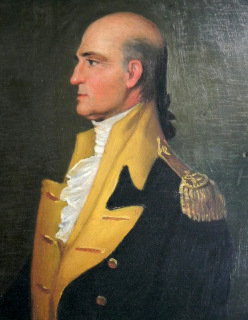
Birth of Edward Hand, Soldier, Physician & Politician

Edward Hand, Irish soldier, physician, and politician who serves in the Continental Army during the American Revolutionary War, is born in Clyduff, King’s County (now County Offaly) on December 31, 1744. He rises to the rank of general and later is a member of several Pennsylvania governmental bodies.

Hand, the son of John Hand, is baptised in Shinrone. Among his immediate neighbours are the Kearney family, ancestors of United States President Barack Obama. He is a descendant of either the families of Mag Fhlaithimh (of south Ulaidh and Mide) or Ó Flaithimhín (of the Síol Muireadaigh) who, through mistranslation became Lavin or Hand.

Hand earns a medical certificate from Trinity College, Dublin. In 1767, he enlists as a Surgeon’s Mate in the 18th (Royal Irish) Regiment of Foot. On May 20, 1767, he sails with the regiment from Cobh, County Cork, arriving at Philadelphia on July 11, 1767. In 1772, he is commissioned an ensign. He marches with the regiment to Fort Pitt, on the forks of the Ohio River, returning to Philadelphia in 1774, where he resigns his commission.

In 1774, Hand moves to Lancaster, Pennsylvania, where he practices medicine. On March 13, 1775, he marries Catherine Ewing. Lancaster is the region of some of the earliest Irish and Scotch-Irish settlements in Pennsylvania. As a people, they are well known for their anti-English and revolutionary convictions. He is active in forming the Lancaster County Associators, a colonial militia. He is a 32nd degree Freemason, belonging to the Montgomery Military Lodge number 14.

Hand enters the Continental Army in 1775 as a lieutenant colonel in the 1st Pennsylvania Regiment under Colonel William Thompson. He is promoted to colonel in 1776 and placed in command of the 1st Continental, then designated the 1st Pennsylvania. Promoted to brigadier general in March 1777, he serves as the commander of Fort Pitt, fighting British loyalists and their Indian allies. He is recalled, after over two years at Fort Pitt, to serve as a brigade commander in Major General La Fayette‘s division.

In 1778, Hand attacks the Lenape, killing Captain Pipe‘s mother, brother, and a few of his children during a military campaign. Failing to distinguish among the Native American groups, he had attacked the neutral Lenape while trying to reduce the Indian threat to settlers in the Ohio Country, because other tribes, such as the Shawnee, had allied with the British.

After a few months, he is appointed Adjutant General of the Continental Army and serves during the Siege of Yorktown in that capacity. In recognition of his long and distinguished service, he is promoted by brevet to major general in September 1783. He resigns from the Army in November 1783.

Hand returns to Lancaster and resumes the practice of medicine. A Federalist, he is also active in civil affairs. Beginning in 1785, he owns and operates Rock Ford plantation, a 177-acre farm on the banks of the Conestoga River, one mile south of Lancaster, Pennsylvania. The Georgian brick mansion remains today, and the farm is a historic site open to the public.

Hand dies from typhoid fever, dysentery or pneumonia at Rock Ford on September 3, 1802, although medical records are unclear with some sources stating he died of cholera. There is no evidence Lancaster County suffered from a cholera epidemic in 1802. He is buried in St. James’s Episcopal Cemetery in Lancaster, the same church where he had served as a deacon.


Leave a comment

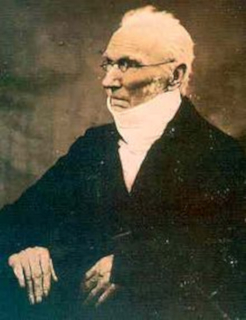
Birth of George Salmon, Mathematician & Theologian

Rev. Prof. George Salmon, distinguished and influential Irish mathematician and Anglican theologian, is born in Dublin on September 25, 1819. After working in algebraic geometry for two decades, he devotes the last forty years of his life to theology. His entire career is spent at Trinity College Dublin.

Salmon, the son of Michael Salmon and Helen Weekes, spends his boyhood in Cork, where his father is a linen merchant. There he attends Hamblin and Porter’s Grammar School before attending Trinity College in 1833, graduating with First Class Honours in mathematics in 1839. In 1841 he attains a paid fellowship and teaching position in mathematics at Trinity. In 1845 Salmon is additionally appointed to a position in theology at the university, after having been ordained a deacon in 1844 and a priest in the Church of Ireland in 1845.

In the late 1840s and the 1850s Salmon is in regular and frequent communication with Arthur Cayley and J. J. Sylvester. The three of them together with a small number of other mathematicians develop a system for dealing with n-dimensional algebra and geometry. During this period, he publishes about 36 papers in journals.

In 1844 Salmon marries Frances Anne Salvador, daughter of Rev. J. L. Salvador of Staunton-upon-Wye in Herefordshire, with whom he has six children, of which only two survive him.

In 1848 Salmon publishes an undergraduate textbook entitled A Treatise on Conic Sections. This text remains in print for over fifty years, going through five updated editions in English, and is translated into German, French and Italian. From 1858 to 1867 he is the Donegall Lecturer in Mathematics at Trinity.

In 1859 Salmon publishes the book Lessons Introductory to the Modern Higher Algebra. This is for a while simultaneously the state-of-the-art and the standard presentation of the subject, and goes through updated and expanded editions in 1866, 1876 and 1885, and is translated into German and French. He also publishes two other mathematics texts, A Treatise on Higher Plane Curves (1852) and A Treatise on the Analytic Geometry of Three Dimensions (1862).

In 1858 Salmon is presented with the Cunningham Medal of the Royal Irish Academy. In June 1863 he is elected a Fellow of the Royal Society followed in 1868 by the award of their Royal Medal. In 1889 he receives the Copley Medal of the society, the highest honorary award in British science, but by then he has long since lost his interest in mathematics and science.

From the early 1860s onward Salmon is primarily occupied with theology. In 1866 he is appointed Regius Professor of Divinity at Trinity College, at which point he resigns from his position in the mathematics department. In 1871 he accepts an additional post of chancellor of St. Patrick’s Cathedral, Dublin.

Salmon is Provost of Trinty College from 1888 until his death in 1904. The highlight of his career is likely when in 1892 he presides over the great celebrations marking the tercentenary of the College, which had been founded by Queen Elizabeth I. His deep conservatism leads him to strongly oppose women receiving degrees from the University.

Salmon dies at the Provost’s House on January 22, 1904, and is buried in Mount Jerome Cemetery, Dublin. An avid reader throughout his life, his obituary refers to him as “specially devoted to the novels of Jane Austen.”

Salmon’s theorem [ru] is named in honor of George Salmon.


Leave a comment

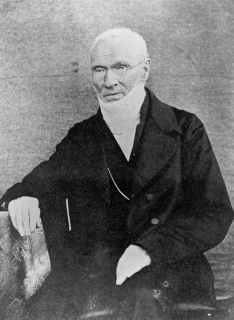
Death of Anglican Priest & Author Patrick Brontë

File source: http://commons.wikimedia.org/wiki/File:Patrickbronte.jpg

Patrick Brontë, Irish Anglican priest and author who spends most of his adult life in England, dies in Haworth, Yorkshire, England on June 7, 1861. He is the father of the writers Charlotte, Emily, Anne and Branwell Brontë.

Brontë is the first of ten children born to Hugh Brunty, a farm labourer, and Alice McClory, in Drumballyroney, County Down. At one point in his adult life, he formally changes the spelling of his name from Brunty to Brontë.

Brontë has several apprenticeships until he becomes a teacher in 1798. He moves to England in 1802 to study theology at St. John’s College, Cambridge, and receives his BA degree in 1806. He is then appointed curate at Wethersfield, Essex, where he is ordained a deacon of the Church of England in 1806, and into the priesthood in 1807.

In 1809, Brontë becomes assistant curate at Wellington, Shropshire, and in 1810 his first published poem, Winter Evening Thoughts, appears in a local newspaper, followed in 1811 by a collection of moral verses, Cottage Poems. He moves to the West Riding of Yorkshire in 1811 as assistant curate at Hartshead, where he serves until 1815. In the meantime he is appointed a school examiner at a Wesleyan academy, Woodhouse Grove School, near Guiseley. In 1815 he moves again on becoming perpetual curate of Thornton. At Guiseley, Brontë meets Maria Branwell, whom he marries on December 29, 1812.

Brontë is offered the perpetual curacy of St. Michael and All Angels’ Church, Haworth in June 1819, and he takes the family there in April 1820. His sister-in-law Elizabeth Branwell, who had lived with the family at Thornton in 1815, joins the household in 1821 to help to look after the children and to care for Maria Brontë, who is suffering the final stages of uterine cancer. She decides to move permanently to Haworth to act as housekeeper.

After several attempts to seek a new spouse, Brontë comes to terms with widowhood at the age of 47, and spends his time visiting the sick and the poor, giving sermons, communion, and extreme unction, leaving his children alone with their aunt and a maid, Tabitha Aykroyd (Tabby), who tirelessly recounts local legends in her Yorkshire dialect while preparing the meals.

Brontë is responsible for the building of a Sunday school in Haworth, which he opens in 1832. He remains active in local causes into his old age, and between 1849 and 1850 organises action to procure a clean water supply for the village, which is eventually achieved in 1856.

In August 1846, Brontë travels to Manchester, accompanied by Charlotte, to undergo surgery on his eyes. On August 28 he is operated upon, without anaesthetic, to remove cataracts. Surgeons do not yet know how to use stitches to hold the incision in the eye together and as a consequence the patient is required to lie quietly in a darkened room for weeks after the operation. Charlotte uses her time in Manchester to begin writing Jane Eyre, the book which is to make her famous.

Following the death of his last surviving child, Charlotte, nine months after her marriage, he co-operates with Elizabeth Gaskell on the biography of his daughter. He is also responsible for the posthumous publication of Charlotte’s first novel, The Professor, in 1857. Charlotte’s husband, Arthur Bell Nicholls, who had been Brontë’s curate, stays in the household until he returns to Ireland after Brontë’s death, at the age of 84, on June 7, 1861. Brontë outlives not only his wife (by 40 years) but all six of his children.


Leave a comment

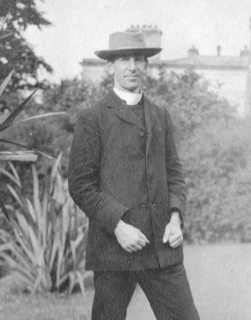
Birth of Cosslett Quinn, Priest & Linguist

cosslett-o-cuinn-book

The Rev. Canon Cosslett Quinn (in Irish Cosslett Ó Cuinn), scholar, linguist, and priest of the Church of Ireland who translates the New Testament into Irish, is born in Derriaghy, County Antrim in what is now Northern Ireland on February 27, 1907.

Quinn is born to Charles Edward Quinn, rector of Derriaghy, and Edith Isobel Wadell. He studies at Campbell College in Belfast, and later at Trinity College Dublin, where he receives his Bachelor of Divinity in Theology in 1940.

Quinn is a poet, theologian, critic, biblical scholar, member of the ecumenical movement, and a scholar of the Irish language. During his studies, he develops a strong interest in Ulster Irish and often visits the Irish-speaking Gola Island and Derrybeg. He also publishes articles in Éigse: A Journal of Irish Studies on the dialects of Irish spoken on Rathlin Island and Kilkenny. He compiles the folklore of native Irish speakers from the islands of Tory and Arranmore off the coast of County Donegal.

While working in Belfast and Inishowen in 1931, Quinn is promoted to the post of deacon. In 1961, he is appointed professor of Biblical Greek at Trinity College and begins work on a new translation of the New Testament. He also translates the Book of Psalms and the Prayer Book of the Church of Ireland into Irish, as well as several Spanish works. Although it is unusual in his lifetime for Protestants to hold leading positions in the Irish language movement, Quinn is for a time President of Oireachtas na Gaeilge. He is made a canon of St. Patrick’s Cathedral in 1966, before retiring from the ministry in 1971.

Cosslett Quinn dies on December 6, 1995.


Leave a comment

Birth of William King, Archbishop of Dublin

william-king

William King, Anglican divine in the Church of Ireland and Archbishop of Dublin from 1703 to 1729, is born in County Antrim on May 1, 1650. He is an author and supports the Glorious Revolution. He has considerable political influence in Ireland, including for a time what amounts to a veto on judicial appointments.

King is educated at The Royal School, Dungannon, County Tyrone, and thereafter at Trinity College, Dublin, graduating BA on 23 February 23, 1670, and MA in 1673.

On October 25, 1671, King is ordained a deacon as chaplain to John Parker, Archbishop of Tuam, and on July 14, 1673, Parker gives him the prebend of Kilmainmore, County Mayo. King, who lives as part of Parker’s household, is ordained a priest on April 12, 1674.

King’s support of the Glorious Revolution in 1688 serves to advance his position. He becomes Bishop of Derry in 1691. His years as a bishop are marked by reform and the building of churches and glebe houses, and by the dispensing of charity. His political influence is considerable. He is always consulted on judicial appointments and at times seems to have an effective veto over candidates he considers unsuitable.

He is advanced to the position of Archbishop of Dublin in 1703, a post he holds until his death. He gives £1,000 for the founding of “Archbishop King’s Professorship of Divinity” at Trinity College in 1718. His influence declines after the appointment of Hugh Boulter as Archbishop of Armagh in 1724.

William King dies in May 1729. Much of his correspondence survives and provides a historic resource for the study of the Ireland of his time.