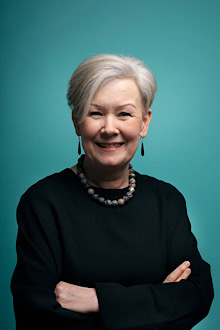
Clarke sings in a women’s choir from age 14 and is an outstanding piano pupil at the College of Music (now the DIT Conservatory of Music and Drama), Dublin. She studies music at University College Dublin (UCD), earning a Teacher’s Diploma in 1978 and a BMus in 1980. She teaches at a number of schools in the Dublin area. When she participates in the Ennis Composition Summer School in 1985, she is introduced to the music of continental composers such as Luciano Berio and Witold Lutoslawski, which leaves a lasting impression.
Some of Clarke’s early works receive awards, such as the Six Short Piano Pieces (1982), which wins the composition prize of the Feis Ceoil, and the choral work Suantraí Ghráinne (1983), which wins the Seán Ó Riada Memorial Trophy at the 1984 Cork International Choral Festival. For Sisyphus (1985) for flute, clarinet and string trio she receives the Varming Prize, which is awarded only every four years to an Irish composer under the age of thirty. She completes her first orchestral score in 1991 (A Great Rooted Tree). In 1992, she receives a Ph.D. from Queen’s University Belfast (QUB). She is a lecturer in music at St. Patrick’s College, Dublin City University (DCU).
Clarke receives commissions from RTÉ, the Cork International Choral Festival, Concorde, Music Network and the National Concert Hall, among others. Her work is performed and broadcast throughout Ireland and worldwide. In January 2014, she is the featured composer in the Horizon Series of contemporary music by the Irish national broadcaster RTÉ. For this event, the RTÉ National Symphony Orchestra commissions her orchestral composition SHIFT (2013). Since 2009 she has been collaborating with visual artist Marie Hanlon, including short experimental films with music, live music with visual projections and joint exhibitions, one example being the joint exhibition DIC TAT at the Gallery Draíocht, Blanchardstown, Dublin, July-September 2014.
Clarke is a member of Aosdána, Ireland’s state-sponsored academy of creative artists.
Clarke’s output includes choral, chamber, orchestral and electronic works. Her calm and evocative music in the early Suantraí Ghráinne creates some curiosity at its 1984 performance. Early chamber works such as Sisyphus (1985) and Purple Dust are characterised by wide-spaced harmonic settings of a rather sparse tonal material. Some aleatoric passages alternate with more strictly notated pitches and a rather limited degree of dissonance. In Gloria Deo (1988) for soprano, mixed chorus and orchestra she combines modal influences from Renaissance music with free atonality. Since the early 1990s she has been exploring the possibilities of electroacoustic music, winning an award at the 1992 Dublin Film Festival for her electronic score Whaling Afloat and Ashore. Her recent orchestral score SHIFT reflects her experiences in electroacoustic processes: “Extended techniques, deliberately avoided in previous work, are embraced here using harmonics and noise elements in strings, and bowed, timbral effects on percussion. In a single, fifteen-minute movement, transformations in colour and texture vary from slow and intense in the opening section, to sudden and harsh later in the piece.”
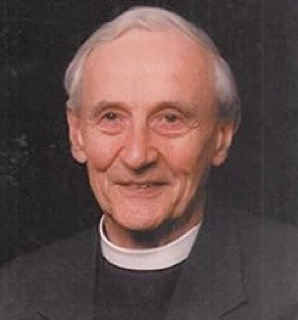
He is appointed Dean of Cork in 1952. Consecrated a bishop, he serves as Bishop of Cork, Cloyne and Ross, between 1952 and 1956. At forty-two, he is the youngest Church of Ireland clergyman appointed to a bishopric since John Gregg in 1915. He serves as Archbishop of Dublin from 1956 to 1969. During this time, he maintains a courteous relationship with John Charles McQuaid, his Roman Catholic counterpart as Archbishop of Dublin. From 1969 to 1980, he serves as Archbishop of Armagh.
Alongside CardinalWilliam Conway, Simms chairs the first official ecumenical meeting between the leaders of Ireland’s Protestant Churches and the Catholic Church in Ballymascanlon Hotel, Dundalk, County Louth, on September 26, 1973, an important meeting amidst the increasing violence in Northern Ireland. The meeting is protested by Ian Paisley.
Simms is a scholar, and publishes research on topics including the history of the Church of Ireland, and theological reflections on key texts including the Book of Kells, Saint Patrick’s Breastplate, and the Sarum Primer. He is also a fluent speaker of the Irish language.
Simms is also an accomplished journalist, and the author of many newspaper obituaries. His weekly Thinking Aloud column in The Irish Times is a popular reflection, and runs continuously for thirty-eight years. He also works on the research, preparation, and even performs the presentation, of a number of television programmes.
In 1978, Simms is made an honorary fellow of Trinity College Dublin.
Simms is the uncle of mathematician David J. Simms. In 1941, he marries Mercy Felicia Gwynn. They have five children. He dies in Dublin on November 15, 1991. He is interred with his wife in the cemetery attached to St. Maelruain’s Church, Tallaght, County Dublin.
Three years after moving to the United States, Moloney co-founds Green Fields of America, an ensemble of Irish musicians, singers, and dancers which tour across the country on several occasions. He also serves as the artistic director for several major arts tours. One of these is the 1985 festival in Manhattan titled “Cherish the Ladies” to highlight female musicians in the area of Irish traditional music, which had been dominated by men until that decade. He produces an album for the female group by the same name titled Irish Women Musicians in America. The group’s leader, Joanie Madden, is one of several future fellows of the National Endowment for the Arts (NEA) to be mentored by Moloney. He produces and performs on over 70 albums and serves as advisor for numerous festivals and concerts across America, with ethnomusicologist and musician Daniel T. Neely putting the figure as high as 125 albums.
In addition to music performance, Moloney writes Far from the Shamrock Shore: The Story of Irish American History Through Song, which is published by Crown Publications in February 2002 with a supplementary CD on Shanachie Records. He hosts three nationally syndicated series covering folk music on American Public Television (APT). He works as a consultant, performer, and interviewee on the RTÉ special Bringing It All Back Home, and is also a participant, consultant, and music arranger for Out of Ireland, a documentary film by PBS. He performs on the PBS special The Irish in America: Long Journey Home.
Moloney is married three times over the course of his life. His first marriage is to Miriam Murphy. His second marriage is to Philomena Murray. Together, they have one child but eventually divorce. His third marriage to Judy Sherman also ends in divorce. He is in a domestic partnership with Sangjan Chailungka at the time of his death. During his later years, he divides his time between Bangkok, where he resides with Chailungka, and his apartment in Greenwich Village. In Bangkok, he volunteers as a music therapist and teacher for abandoned children with HIV at the Mercy Center in the Khlong Toei district, which is founded by the Redemptorist priest Joseph H. Maier.
Moloney dies at the age of 77 on July 27, 2022, at his home in Manhattan, having played at the Maine Celtic Festival less than a week before. The cause of death is not announced.
Leventhal is born Abraham Jacob Leventhal in Lower Clanbrassil Street, Dublin, on May 9, 1896. His parents are Moses (Maurice) Leventhal and Rosa (née Levenberg). His father is a draper, and his mother is a poet. She is a Zionist, who is a founding member of the Women’s Zionist Society. He lives in the “Little Jerusalem” area of Dublin, the area around the South Circular Road, in his youth. He attends Wesley College, Dublin, and then Trinity College Dublin (TCD) to study modern languages. He edits the TCD student magazine in 1918. It is in TCD that he acquires the nickname “Con,” an allusion to his father’s job as a “Continental” agent. He joins the first Zionist commission and travels to Palestine after World War I and helps to found the newspaper Palestine Weekly. He is then invited to join the Jewish National Fund‘s London office and begins working on the Zionist Review. He returns to Dublin to complete his degree in 1920, and in 1921 travels to Paris where he meets James Joyce.
Leventhal marries Gertrude Zlotover in October 1922. He works with his father-in-law, Joseph Zlotover, at the family furniture business on Mary Street for a time. After, he starts a number of unsuccessful businesses of his own, including the Irish Book Shop on Dawson Street from 1924 to 1925. It is possibly his business failures that inspire the idea of the TCD Students Appointment Association, which would give students pragmatic business skills. TCD accepts this proposal and employes him as the first administrator.
Leventhal completes a PhD in contemporary French literature, and in 1932 is appointed to the staff of the French department at TCD. He replaces his friend Samuel Beckett. During his time in TCD, he is an assistant editor to Hermathena, to which he also contributes his translations of French poetry. He is associated with a number of progressive cultural movements in Dublin of the 1920s and 1930s. He is a regular attendee at meetings held to promote Jewish culture and nationalism and lectures this group on Joyce. Through his interest in Joyce, he becomes an associate of Seumas O’Sullivan, and The Dublin Magazine. When the printers refuse to set his review of Ulysses in 1923 for The Dublin Magazine, he is moved to found his own magazine, The Klaxon, in response to the censorship. The only issue of the magazine publishes a shortened version of the review under the pseudonym “Lawrence K. Emery.” He is also associated with Francis Stuart‘s Tomorrow magazine. He is also interested in drama and is a member of the avant-garde Dublin Drama League, occasionally performing with them. Among his close friends are Daisy Bannard Cogley, Micheál Mac Liammóir, and Lennox Robinson. From 1943 to 1958 his column, “Dramatic commentary”, is published in The Dublin Magazine. He is also published in The Irish Times, The Irish Press, The Listener, Westminster Weekly, Financial Times, and International Herald Tribune. He is a regular contributor to Radio Éireann and BBC broadcasts.
Leventhal begins a long-term relationship with Ethna MacCarthy, marrying her after the death of his first wife in 1956. She dies in 1959. He retires from TCD in 1963 and moves to Paris, where he becomes Beckett’s literary assistant. He lives on Boulevard du Montparnasse with his partner Marion Leigh.
Leventhal dies of cancer in Paris on October 3, 1979. There are two known portraits of Leventhal, one by John Russell (1920) and a second by Avigdor Arikha. The Leventhal Scholarship at TCD is founded in his memory. TCD and the Harry Ransom Center hold papers relating to Leventhal.
Hayes-McCoy is born to Thomas Hayes-McCoy and Mary Kathleen Hayes-McCoy (née Wallace). His grandfather, Thomas Hayes-McCoy, is a Dubliner who as a child came to Galway in 1834 and is later a well-known Parnellite. His maternal grandfather, Thomas Burke, is a Galway artist. He grows up on Eyre Square where his father runs a gentleman’s hairdressing business. His two older siblings are Ignatius and Marguerite. The latter receives a PhD-degree in History at University College Galway (UCG), and later teaches at the Galway Technical School.
Hayes-McCoy receives his early education from the Patrician Brothers, Galway. His earliest notebook of 1927 and a manuscript history of Poland of the same year, now at the National Library of Ireland (NLI), testify to an early interest in history and heritage. From 1928 to 1932 he is a student scholarship holder at University College Galway, graduating in 1932 with a Bachelor of Commerce, and a Bachelor of Arts, with first-class honours in both, and a specialisation in “History, Ethics, Politics” for the latter. Mary Donovan O’Sullivan is one of his professors of history, and Liam Ó Briain, professor of Romance languages, is a stimulating influence. At this time, Hayes-McCoy is a member of the Republican Club, a committee member of the Literary and Debating Society, and in 1931 he is one of the founding members of a new Irish Students’ Association.
Hayes-McCoy pursues his PhD at the University of Edinburgh, and then spends two years at the Institute of Historical Research, London, in the Tudor seminar of J. E. Neale, rewriting his PhD and eventually publishing it as Scots mercenary forces in Ireland, 1565–1603 (Dublin and London, 1937), with a foreword by Eoin MacNeill. This is characterised by meticulous archival research, and it anticipates by sixty years the much-vaunted New British History of the late twentieth century by tracing the interconnections between events in England, Ireland, and Scotland.
In the absence of an academic post, Hayes-McCoy becomes an assistant keeper in the Art and Industrial Division at the National Museum of Ireland (1939–1959), with a responsibility for the Military History, and the Irish War of Independence collections. One of his first tasks is to prepare a standing exhibition on Irish history before 1916. His research, long-standing personal interest in the military, and his curatorial experience, helps form an expert knowledge of historical Irish warfare. This leads to his role in co-founding The Military History Society of Ireland in 1949 whose journal, The Irish Sword, he edits. He describes the vagaries of setting up such a body, its reception, and the historiographical considerations attendant on it, in a paper published posthumously in The Irish Sword.
On August 19, 1941, Hayes-McCoy marries Mary Margaret “May” O’Connor, daughter of C.J. and M.B. O’Connor of New Ross/Enniscorthy. They have three daughters and two sons: Mary, Ann, Ian, Robert, Felicity. The family home is in Dublin.
Earning high reputation by continued research and by publishing leads to Hayes-McCoy’s receipt of the D.Litt. degree from the National University, and to his membership in the Royal Irish Academy in 1950. In his professional career, apart from the broad spectrum of press publications, he publishes prolifically. The works that are judged most influential, are his Scots mercenary forces in Ireland 1565–1603 (1937), the papers “The early history of guns in Ireland” (1938–1939), “Strategy and tactics in Irish warfare, 1593–1601” (1941), “The army of Ulster, 1593–1601” (1951), the controversial “Gaelic society in Ireland in the late sixteenth century” (1963), and the monographs “Irish battles” (London 1969), and “A history of Irish flags from earliest times” (Dublin 1979). A member of the Irish Manuscripts Commission, his most notable contribution is the publication “Ulster and other Irish maps, c.1600” (Dublin 1964).
In 1946, Hayes-McCoy is appointed to a committee of eight historians to advise on setting up the Bureau of Military History, a body established for the creation and compilation of material on the history of the Irish movements for independence, 1913–1921, specifically from witness statements. The committee is also to further offer guidance and oversee progress of the Bureau in coordination with the Ministry of Defence. It subsequently expresses concerns about the state’s role and methods in the collection of statements.
Having begun writing for the press at an early stage, Hayes-McCoy’s public position at the Museum encourages him to go further. He has broad involvement with local history groups to whom he presents papers, and also works for newspapers and for radio and television. To the national and Galway press he usually contributes articles on military aspects of Irish history, as well as book reviews, but he also uses them as a platform to engage with what he sees are flaws in the education of history in Ireland which during his lifetime is constrained by a certain degree of political and cultural state control.
During the 1940s and 1950s, Hayes-McCoy becomes involved in a number of paratheatrical events of national significance one of which – the “Pageant of St.Patrick” for which he writes the script (An Tóstal 1954) – is realised on an immense scale. He scripts these works to begin with and is later principally engaged as historical consultant. In that capacity, he collaborates in 1955 and 1956 with Micheál Mac Liammóir and Denis Johnston on their scripts for pageants on St. Patrick and on the Táin Bó Cuailgne, at times finding it difficult to square the historical liberties taken by these artists with his own role.
On Irish radio and television Hayes-McCoy is most active in the mid-1960s, editing and contributing to Thomas Davis lectures series, writing scripts for a series of thirty children’s programmes on all aspects of Irish history, and preparing/contributing on air to the television series “Irish battles” and “The long winter.” As well as writing for RTÉ, Ireland’s national broadcaster, he contributes scripts to BBC Northern Ireland‘s schools radio programmes.
In 1959, Hayes-McCoy succeeds to the chair of his former history professor at UCG with the full remit of lecturing, administering examinations to undergraduates, and supervising postgraduate theses. Among his students who continue in the field of history are Nicholas Canny, Martin Coen, Patrick Melvin, Peter Toner, Tony Claffey, and Breandán Ó Bric. After his appointment to UCG, the family home remains in Dublin, and he commutes to Galway weekly during term time.
In the early 1960s, Hayes-McCoy becomes a spokesperson for the movement rekindled by the Old Galway Society to preserve the landmark “Lion’s Tower” in the city. The ultimate failure of the campaign informs his regret, expressed a year later, that Ireland is forgetful about its past and that “we don’t bother to find out about it or to maintain our ancient heritage,” and, on a perceived spirit of conformity, “take my own city of Galway, it is now more prosperous than it was, but it is no longer distinctive. I do not believe that it is essential for progress that we should lose our heritage.”
While at one time member and secretary of the London Sinn Féin office and informed by a pride of country and place, Hayes-McCoy’s professional and private outlook are marked by a distrust of nationalism or of any antagonising national agendas compromising genuine scholarship. In a paper drafted on tendencies in modern historical studies, he criticises the two historiographical extremes, each to be avoided, each unfortunately characteristic of the moment – extreme de-bunking and extreme “adding for effect.” “A history is a record of fact; to add pseudo-facts is as grave a sin as to leave out real facts that may change the colour of the whole.”
Hayes-McCoy’s abiding pastime is drawing. Among his papers in the James Hardiman Library, NUI Galway are approximately 40 items with predominantly maritime subjects, and he has a special regard for the history of ships, and a romantic liking of the sea. He also has a lifelong interest in Robert Louis Stevenson, Sir Walter Scott, and their works, and in the Pre-Raphaelite movement.
Hayes-McCoy’s middle age is marked by intermittent ill health. He dies on November 27, 1975, in his room at the Great Southern Hotel, Eyre Square, Galway.
Hayes-McCoy’s papers are held at the James Hardiman Library, National University of Ireland, Galway.
Thornley is the youngest child of Welshman Frederick Edward Thornley and Dublin-born Maud Helen Thornley (née Browne). His parents, both civil servants, meet while working in Inland Revenue in Dublin in the 1910s.
Thornley receives a BA and PhD at Trinity College Dublin. His PhD is entitled “Isaac Butt and the creation of an Irish Parliamentary Party (1868–1879)” and is written under the supervision of Theodore William Moody. Working as a presenter on 7 Days since 1963, he is appointed Associate professor of Trinity in 1968. In 1964, he publishes the book Isaac Butt and Home Rule.
In December 1972, Thornley calls for the immediate release of Seán Mac Stíofáin, then leader of the Provisional Irish Republican Army. He is re-elected at the 1973 Irish general election. In April 1976, he loses the Labour Party whip after appearing on a Sinn Féin platform during Easter Rising commemorations. In September 1976, he votes for the Criminal Justice (Jurisdiction) Bill despite misgivings. He tells The Irish Times, “When I get very depressed, I drink too much. When I voted for the Criminal Justice (Jurisdiction Bill) I went on the batter for a forthnight [sic].” In February 1977, he is re-admitted to the Labour Parliamentary Party. He loses his seat at the 1977 Irish general election.
In 1978, Thornley joins the newly formed Socialist Labour Party (SLP) stating that he has done so because “There is no man in politics that I respect more than Noël Browne, despite our occasional differences. If the SLP is good for him, it’s good enough for me.”
Overweight, afflicted with undiagnosed diabetes, his judgement increasingly erratic, from the early 1970s Thornley suffers a steady deterioration of health, compounded by his heavy drinking, on which he relies to cope with stress and emotional depression. On one occasion he collapses in the Dáil and is attended by party colleague Dr. John O’Connell. He dies at the age of 42 on June 18, 1978, one week after admission into Jervis Street private nursing home. After a sung Latin Requiem Mass in St. Andrew’s Church, Westland Row, Dublin, he is buried in Bohernabreena Cemetery, County Dublin.
The Trinity College Labour Branch is formerly named the David Thornley Branch in his honour.
Long comes from a carpentry and blacksmithing background. In 1959, he enters Queen’s University Belfast to study civil engineering. He graduates with first class honours and then takes a PhD at Queens. In 1967, he moves to Canada, working as a bridge designer for Fenco Engineering in Toronto.
Long, however, spends only a year in Canada, returning to Belfast in 1968 to become an associate professor of civil engineering at Queen’s University Belfast. In 1976, he is promoted to a full professorship. His work is largely in the field of concrete structures, particularly in chloride resistance, maintenance problems and arch bridge structures. He publishes twenty papers in journals managed by the Institution of Civil Engineers and wins eight of the institution’s medals for these, including the ICE Gold Medal.
From 1997 Long works on the FlexiArch, a precast concrete arch in which the individual voussoirs are joined by a flexible polymeric membrane. The arch arrives to site flat packed and when lifted into position by a crane, the gaps between the voussoirs close under gravity and form the correct arch profile. He patents the product, which is produced by Irish precast manufacturer Macrete, in 2004. The product can be constructed within a day and, containing no corrodible elements, has been stated to have a design lifespan of 300 years. More than fifty FlexiArch bridges have been constructed in the UK and Ireland and spans up to 30m are possible.
By 2002, Long is appointed dean of the faculty of engineering at QUB. In November of that year, he is appointed president of the ICE for the 2002–2003 session, the first Northern Irish person to hold that position. He is also a Fellow of the Royal Academy of Engineering and of the Institute for the Advancement of Engineering.
Long is appointed an officer of the Order of the British Empire in the 2006 New Year Honours for services to higher education and civil engineering. He resigns as professor at QUB in 2006 but remains there as an emeritus professor in the School of Natural and Built Environment. Since 2015, the ICE Northern Ireland awards the Adrian Long medal to the best paper in an ICE journal to be authored by a Northern Ireland member. The medal features a bust of Long.
There are commercially available recordings of over fifty of Wilson’s works on labels including Diatribe Records, Riverrun, RTÉ Lyric fm, Black Box, Timbre, Guild, Meridian and Chandos Records. His music is published by Ricordi (London) and Universal Edition.
Bowman is brought up in Ballsbridge in south Dublin. His father works for Great Southern Railways (later CIÉ) and his mother is a nurse, originally from County Monaghan. He is educated at Belvedere College and Trinity College Dublin where he receives a bachelor’s degree in history and political science in 1970 and a PhD in political science in 1980. He joins Radio Éireann in 1962, later becoming the presenter and commentator on numerous current affairs programmes, as well as an analyst of political developments and interviewer of politicians on radio and later on television. In the 1980s, he presents the current affairs programme Today Tonight, the precursor to Prime Time.
Bowman wins Jacob’s Awards in 2013 and 2016 for his radio broadcasting, the former for his presentation of the current affairs programme, Day by Day. In April 2008, he comments on RTÉ television coverage of the state funeral of Patrick Hillery, a former President of Ireland.
Bowman chairs the audience-participation political programme Questions and Answers on RTÉ One television for 21 years, the final edition airing on June 29, 2009. He is the presenter of Bowman: Sunday: 8.30 (previously Bowman Saturday) on radio, a weekly compilation of material from broadcasting archives at home and abroad.
Bowman writes a history of RTÉ Television called Window and Mirror. RTÉ Television: 1961-2011. It is launched by TaoiseachEnda Kenny at the National Museum of Ireland in Dublin on November 23, 2011.
Bowman is married to psychiatrist Eimer Philbin Bowman and they have have four children: Jonathan, Emma, Abie and Daniel. His eldest son, Jonathan Philbin Bowman, a journalist, television and radio presenter, dies in an accident in March 2000. His daughter, Emma Philbin Bowman, works in Dublin as a psychotherapist. His middle son, Abie Philbin Bowman, is a columnist for The Dubliner magazine and a stand-up comedian, while in 2005 his youngest son, Daniel, initiates Be Not Afraid, a charity wristband campaign which raises over €80,000 in aid of Turning the Tide of Suicide and the Irish Red Cross and later sets up a youth marketing firm, Spark.
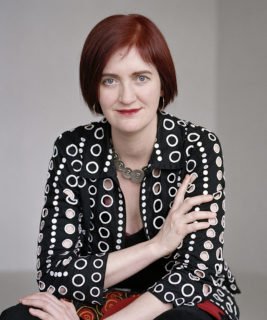
Donoghue is the youngest of eight children, the daughter of Frances (née Rutledge) and academic and literary critic Denis Donoghue. She has a first-class honours Bachelor of Arts degree from University College Dublin (UCD) in English and French as well as a PhD in English from Girton College, Cambridge. While at Cambridge she lives in a women’s co-operative, an experience which inspires her short story “The Welcome.” Her thesis is on friendship between men and women in 18th-century fiction.
At Cambridge, she meets her future wife, Christine Roulston, a Canadian who is now professor of French and Women’s Studies at the University of Western Ontario. They move permanently to Canada in 1998 and Donoghue becomes a Canadian citizen in 2004. She lives in London, Ontario, with Roulston and their two children.
Donoghue has spoken of the importance of the writing of Emily Dickinson, of Jeanette Winterson‘s novel The Passion and Alan Garner‘s Red Shift in the development of her work. She says that she aims to be “industrious and unpretentious” about the process of writing, and that her working life has changed since having children.
Donoghue’s novels include Stir Fry (1994), a finalist for the Lambda Literary Award in 1994, Slammerkin (2000), a finalist in the 2001 Irish Times Irish Literature Prize for Fiction and winner of the 2002 Ferro-Grumley Award for Lesbian Fiction, Landing (2007), The Sealed Letter (2008), joint winner of the 2009 Lambda Literary Award for Lesbian Fiction, Room (2010), winner of the Irish Book Award 2010, Frog Music (2014), The Wonder (2016), shortlisted for the Scotiabank Giller Prize, Akin (2019), The Pull of the Stars (2020), longlisted for the Giller Prize in 2020, and Haven (2022).



 seamus dubhghaill