seamus dubhghaill

Promoting Irish Culture and History from Little Rock, Arkansas, USA


Leave a comment

Birth of Thomas Clarke Luby, Irish Revolutionary

thomas-clarke-luby

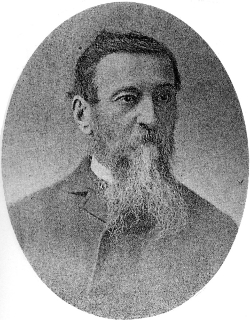
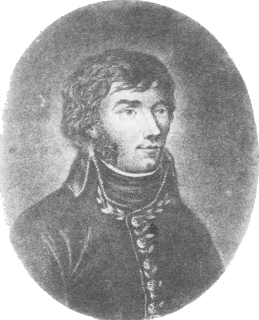
Thomas Clarke Luby, Irish revolutionary, author, journalist and one of the founding members of the Irish Republican Brotherhood, is born in Dublin on January 16, 1822.

Luby is the son of a Church of Ireland clergyman from Templemore, County Tipperary, his mother being a Catholic. He is educated at Trinity College Dublin where he studies law and puts in the necessary number of terms in London and Dublin where he acquires a reputation as a scholar and takes his degree. He goes on to teach at the college for a time.

Luby supports the Repeal Association and contributes to The Nation newspaper. After the breach with Daniel O’Connell, he joins the Young Irelanders in the Irish Confederation. He is deeply influenced by James Fintan Lalor at this time. Following the suppression of the Young Ireland Rebellion of 1848, he with Lalor and Philip Gray attempt to revive the fighting in 1849 as members of the secret Irish Democratic Association. This, however, ends in failure.

In 1851 Luby travels to France, where he hopes to join the French Foreign Legion to learn infantry tactics but finds the recruiting temporarily suspended. From France he goes to Australia for a year before returning to Ireland. From the end of 1855 he edits the Tribune newspaper founded by John E. Pigot who had been a member of The Nation group. During this time, he remains in touch with the small group of ’49 men including Philip Gray and attempts to start a new revolutionary movement. Luby’s views on social issues grow more conservative after 1848 which he makes clear to James Stephens whom he meets in 1856.

In the autumn of 1857 Owen Considine arrives with a message signed by four Irish exiles in the United States, two of whom are John O’Mahony and Michael Doheny. The message conveys the confidence they have in Stephens and asks him to establish an organisation in Ireland to win national independence. Considine also carries a private letter from O’Mahony to Stephens which is a warning, and which is overlooked by Luby and Stephens at the time. Both believe that there is a strong organisation behind the letter, only later to find it is rather a number of loosely linked groups. On December 23 Stephens dispatches Joseph Denieffe to America with his reply which is disguised as a business letter dated and addressed from Paris. In his reply, Stephen’s outlines his conditions and his requirements from the organisation in America.

On March 17, 1858, Denieffe arrives in Dublin with the acceptance of Stephens’s terms by the New York Committee and the eighty pounds. On that very evening the Irish Republican Brotherhood is established in Peter Langan’s timberyard in Lombard Street.

In mid-1863 Stephens informs his colleagues he wishes to start a newspaper, with financial aid from O’Mahony and the Fenian Brotherhood in America. The offices are established at 12 Parliament Street, almost at the gates of Dublin Castle. The first issue of the Irish People appears on November 28, 1863. The staff of the paper along with Luby are Charles J. Kickham and Denis Dowling Mulcahy as the editorial staff. Jeremiah O’Donovan Rossa and James O’Connor have charge of the business office, with John Haltigan being the printer. John O’Leary is brought from London to take charge in the role of Editor.

On July 15, 1865, American-made plans for a rising in Ireland are discovered. Superintendent Daniel Ryan, head of the G Division of the Dublin Metropolitan Police at Dublin Castle, has an informer within the offices of the Irish People who supplies him with an “action this year” message on its way to the IRB unit in Tipperary. With this information, Ryan raids the offices of the Irish People on Thursday, September 15, followed by the arrests of Luby, O’Leary and O’Donovan Rossa. Kickham is caught after a month on the run. Stephens is also caught with the support of Fenian prison warders. The last number of the paper is dated September 16, 1865.

After his arrest and the suppression of the Irish People, Luby is sentenced to twenty years of penal servitude. He is released in January 1871 but is compelled to remain away from Ireland until the expiration of his sentence.

Upon his release Luby goes first to the Continent and later settles in New York City. He lectures all over the country for years and writes for a number of Irish newspapers on political topics. At the memorial meeting on the death of John Mitchel, he delivers the principal address in Madison Square Garden.

Thomas Clarke Luby dies at 109½ Oak Street, Jersey City, New Jersey of paralysis, on November 29, 1901, and is buried in a grave shared with his wife in Bayview Cemetery in Jersey City. His epitaph reads: “Thomas Clarke Luby 1822–1901 He devoted his life to love of Ireland and quest of truth.”
Leave a comment

Death of General Jean Joseph Amable Humbert

jean-joseph-amable-humbert

General Jean Joseph Amable Humbert, French soldier and French Revolution participant who leads a failed invasion of Ireland to assist Irish rebels in the Irish Rebellion of 1798, dies on January 3, 1823, in New Orleans, Louisiana.

Born in the townland of La Coâre Saint-Nabord, outside Remiremont Vosges, Humbert is a sergeant in the National Guard of Lyon. He rapidly advances through the ranks to become brigadier general on April 9, 1794, and fights in the Western campaigns before being allocated to the Army of the Rhine.

In 1794, after serving in the Army of the Coasts of Brest, Humbert serves under Louis Lazare Hoche in the Army of the Rhin-et-Moselle. Charged to prepare for an expedition against Ireland, he takes command of the Légion des Francs under Hoche, sailing in the ill-fated Expédition d’Irlande against Bantry Bay in 1796, and is engaged in actions at sea against the Royal Navy. Contrary weather and enemy action force this expedition to withdraw. The trip home ends in a naval battle, the Action of 13 January 1797, during which Humbert, on the French ship Droits de l’Homme (1794), narrowly escapes death. As the ship is destroyed and sinks, hundreds of men perish, but Humbert is among the last to escape.

On his return to France, Humbert serves in the Army of the Sambre-et-Meuse, before being appointed to command the troops in another attempt to support a rising in Ireland in 1798. His command chiefly consists of infantry of the 70th demi-brigade with a few artillerymen and some cavalry of the 3rd Hussars, however by the time he arrives off the Irish coast the United Irish rising has already suffered defeat. The expedition is able to land in Ireland at Killala on Thursday August 23, 1798, meeting with initial success in the Battle of Castlebar where he routs the Irish Militia. Humbert subsequently declares a Republic of Connacht, with hopes of taking Dublin. However, Humbert’s small force is defeated at the Battle of Ballinamuck by the Irish Royal Army, and he is taken as a prisoner of war by the authorities. The British send the French officers home in two frigates and then massacre their Irish supporters. Humbert makes no attempt to save the Irish who bravely supported him.

Humbert is shortly repatriated in a prisoner exchange and appointed in succession to the Armies of Mayence, Danube and Helvetia, with which he serves at the Second Battle of Zurich. He then embarks for Santo Domingo and participates in several Caribbean campaigns for Napoleon Bonaparte before being accused of plundering by General Brunet. It is also rumored that he engages in an affair with Pauline Bonaparte, the wife of his commanding officer Charles Leclerc. He is returned to France by order of General Leclerc in October 1802, for “prevarications, and liaison relationships with organisers of the inhabitants and with leaders of brigands.” A committed Republican, his displeasure at Napoleon’s Imperial pretensions lead to him being dismissed in 1803 and he retires to Morbihan in Brittany.

In 1810, after brief service in the Army of the North, Humbert emigrates to New Orleans, where he makes his acquaintance with French pirate Jean Lafitte. In 1813, Humbert joins the revolutionary Juan Bautista Mariano Picornell y Gomila in an unsuccessful attempt to foment rebellion in Spanish Mexico, but the effort fails. In 1814, Humbert again leaves New Orleans and joins the rebelling forces of Buenos Aires, briefly commanding a corps, before returning home. Humbert last fights the British at the Battle of New Orleans, as a volunteer private soldier in U.S. ranks, in the War of 1812, wearing his Napoleonic uniform. General Andrew Jackson thanks him for his assistance there after the American victory in January 1815. Thereafter Humbert lives peacefully as a schoolteacher until his death on January 3, 1823.

A monument to General Humbert depicting Mother Ireland stands on Humbert Street, Ballina, County Mayo. In 1989, sculptor Carmel Gallagher unveils a bust of General Humbert in Killala, Ireland, to mark the upcoming bicentennial of the Irish Rebellion of 1798.


Leave a comment

The Flight of the Wild Geese

flight-of-the-wild-geese

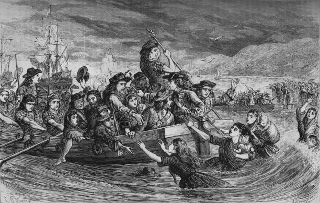
Patrick Sarsfield sails to France on December 22, 1691, leading 19,000 of his countrymen to enter the French service in the first phase of the military denuding of Ireland known as the Flight of the Wild Geese, as agreed in the Treaty of Limerick on October 3, 1691, following the end of the Williamite War in Ireland.

More broadly, the term “Wild Geese” is used in Irish history to refer to Irish soldiers who leave to serve in continental European armies in the 16th, 17th and 18th centuries, or even, poetically, Irish soldiers in British armies as late as World War I.

Irish recruitment for continental armies dries up after it is made illegal in 1745. In 1732 Sir Charles Wogan indicates in a letter to Jonathan Swift, Dean of St. Patrick’s Cathedral, Dublin, that 120,000 Irishmen have been killed and wounded in foreign service “within these forty years.” Swift later replies, “I cannot but highly esteem those gentlemen of Ireland who, with all the disadvantages of being exiles and strangers, have been able to distinguish themselves by their valour and conduct in so many parts of Europe, I think, above all other nations.”

It was some time before the British armed forces begin to tap into Irish Catholic manpower. In the late eighteenth century, the Penal Laws are gradually relaxed and in the 1790s the laws prohibiting Catholics bearing arms are abolished.

Thereafter, the British begin recruiting Irish regiments for the Crown Forces – including such famous units as the Connaught Rangers. Several more Irish units are created in the 19th century. By 1914 specifically Irish infantry regiments in the British Army comprise the Prince of Wales’s Leinster Regiment, the Royal Dublin Fusiliers, the Irish Guards, the Royal Irish Regiment, the Royal Inniskilling Fusiliers, the Royal Irish Rifles, the Royal Irish Fusiliers, the Connaught Rangers and the Royal Munster Fusiliers. With the creation of the Irish Free State in 1922 five of the above regiments are disbanded, with most of the remainder undergoing a series of amalgamations between 1968 and 2006. The United Kingdom still retains three Irish regiments: the Irish Guards, the Royal Irish Regiment, and the London Irish Rifles.

Sarsfield is honored to this day in the crest of County Limerick. The Flight of the Wild Geese is remembered in the poetic words… “War-battered dogs are we, Fighters in every clime, Fillers of trench and of grave, Mockers, bemocked by time. War-dogs, hungry and grey, Gnawing a naked bone, Fighters in every clime, Every cause but our own.”

(Pictured: ‘Irish Troops Leaving Limerick’, 1692, (Cassell Petter & Galpin, London, Paris & New York, c1880), Artist Unknown)


2 Comments

Birth of Con Cremin, Irish Diplomat

con-cremin

Cornelius Christopher Cremin, Irish diplomat, is born in Kenmare, County Kerry on December 6, 1908.

One of four children, Cremin is born to a family that operates a drapery business. His brother, Francis Cremin, becomes a leading academic canon lawyer who frames a number of key church documents. He is educated at St. Brendan’s College, Killarney and from 1926 at University College Cork, where he graduates with a first-class degree in Classics and Commerce.

Around 1929 Cremin is awarded the post-graduate University College Cork Honan scholarship. By 1930 he has attained a degree in economics and accountancy. For the following three years he studies in Athens, Munich and Oxford, having attained a traveling scholarship in Classics. He subsequently enters the Department of External Affairs, having succeeded in the competition for third secretary in 1935.

In April 1935 Cremin marries Patricia O’Mahony. His first position in Dublin involves working with Frederick Henry Boland on the League of Nations portfolio. In 1937 he is sent abroad on his first posting to Paris. There he works under the “Revolutionary Diplomat” Art O’Brien, until the latter retires in 1938. Sean Murphy later becomes his Minister. Ireland declares neutrality on the outbreak of World War II and Murphy and Cremin report on the developments in France throughout the Phoney War.

After the fall of France, the Irish legation is the last to leave Paris except for the American Ambassador, on June 11, 1940. After traveling to Ascain the legation eventually makes its way to the new French Capital, Vichy, where it sets about looking after the needs of Irish citizens, many of whom have been interned, as they have British passports and have been sending political reports. The political reports are of the highest value and ensure that Irish continue to observe pro-Allied neutrality throughout the war.

In 1943 Cremin is sent to Berlin to replace William Warnock. Prior to his arrival the Legation is bombed. As Chargé d’affaires in Berlin, he is responsible for sending back political reports and looking after the interests of Irish citizens. He attempts, unsuccessfully, to assist some European Jews. He does however send full reports on the Nazi treatment of the Jews in Europe. Warned to leave Berlin before the Soviets arrive, he spends the last weeks of the war near the Swiss border.

In 1945 Cremin is sent to Lisbon, where he meets authoritarian president António de Oliveira Salazar and attempts to revive Irish trade as well as reporting on the various unsuccessful coups against Salazar.

After returning to Ireland in 1946 he is involved in preparing Ireland’s Marshall Plan application and tracing the development of Ireland’s post war foreign policy. He has a distinguished career representing Ireland in many foreign missions and at the United Nations.

After retiring Cremin remains chairman of the Irish delegation to the United Nations Convention on the Law of the Sea. After his first wife dies, he marries again in 1979. He dies in Kenmare on April 19, 1987, survived by his wife, three daughters, and a son.


Leave a comment

Death of Saint Columbanus

saint-columbanus

Columbanus, Irish missionary notable for founding a number of monasteries on the European continent from around 590 in the Frankish and Lombard kingdoms, dies on November 21, 615. He is one of the earliest identifiable Hiberno-Latin writers.

Columbanus is born in 543 in the Kingdom of Meath, now part of Leinster. Well-born, handsome and educated, he is torn between a desire for God and easy access to the pleasures of the world. Acting on advice of a holy anchoress, he decides to withdraw from the world. His family opposes the choice, his mother going so far as to block the door. He leaves home and studies Scripture extensively under Sinell, Abbot of Cluaninis in Lough Erne. He then moves to Bangor Abbey on the coast of Down, where Saint Comgall is serving as the abbot. He stays at Bangor until his fortieth year, when he receives Comgall’s permission to travel to the continent.

In middle age, Columbanus feels a call to missionary life. With twelve companions (Saint Attala, Columbanus the Younger, Cummain, Deicolus, Eogain, Eunan, Saint Gall, Gurgano, Libran, Lua, Sigisbert and Waldoleno) he travels to Scotland, England, and then to France in 585. The area, though nominally Christian, has fallen far from the faith, but are ready for missionaries, and they have some success. They are warmly greeted at the court of King Gontram of Burgundy, and the king invites the band to stay. They choose the half-ruined Roman fortress of Annegray in the Vosges Mountains for their new home with Columbanus as their abbot.

The simple lives and obvious holiness of the group draws disciples to join them and the sick to be healed by their prayers. Columbanus, to find solitude for prayer, often lives for long periods in a cave seven miles from the monastery, using a messenger to stay in touch with his brothers. When the number of new monks over-crowds the old fortress, King Gontram gives them the Gallo-Roman castle called Luxovium in present-day Luxeuil-les-Bains, some eight miles from Annegray, in 590. Soon after, a third house called Ad-fontanas is founded at present-day Fontaine-lès-Luxeuil. Columbanus serves as master of them all, and writes a Rule for them. It incorporates many Celtic practices, is approved by the Council of Mâcon in 627, but is superseded by the Benedictine.

Problems arise early in the 7th century. Many Frankish bishops object to a foreign missionary with so much influence, to the Celtic practices he brought, especially those related to Easter, and his independence from them. In 602 he is summoned to appear before them for judgment. Instead of appearing, he sends a letter advising them to hold more synods and to concern themselves with more important things than which rite he uses to celebrate Easter. The dispute over Easter continues for years, with Columbanus appealing to multiple popes for help. It is only settled when Columbanus abandons the Celtic calender when he moves to Italy.

In addition to his problems with the bishops, Columbanus speaks out against vice and corruption in the royal household and court, which is in the midst of a series of complex power grabs. Brunhilda of Austrasia stirs up the bishops and nobilty against the abbot. Theuderic II orders him to conform to the local ways and shut up. Columbanus refuses and is briefly imprisoned at Besançon, but he escapes and returns to Luxeuil. Theuderic II and Brunhilda send an armed force to force him and his foreign monks back to Ireland. As soon as his ship sets sail, a storm drives them back to shore. The captain takes it as a sign and sets the monks free.

They make their way to King Chlothar II at Soissons, Neustria and then the court of King Theudebert II of Austrasia in 611. Columbanus travels to Metz, France, then Mainz, Germany, where he sails up the Rhine to the lands of the Suebi and Alamanni, and finally Lake Zurich. Their evangelization work there is unsuccessful and the group passes on to Arbon, then Bregenz on Lake Constance. Saint Gall, who knows the local language best, takes the lead in this region. Many are converted to the faith and the group founds a new monastery as their home and base. However, a year later political upheaval causes Columbanus to cross the Alps into Italy, arriving in Milan in 612. The Christian royal family treats him well, and he preaches and writes against Arianism and Nestorianism. In gratitude, King Agilulf, the king of the Lombards, gives him a tract of land called Bobbio between Milan and Genoa in Italy. There he rebuilds a half-ruined church of Saint Peter, and around it he founds an abbey that is to be the source for evangelization throughout northern Italy for centuries to come.

Columbanus always enjoys being in the forests and caves, and as he walks through the woods, birds and squirrels ride on his shoulders. Toward the end of his life comes word that his old enemies are dead and his brothers want him to come back north, but he declines. Knowing that his time is almost done, he retires to his cave on the mountainside overlooking the Trebbia River. Columbanus dies of natural causes at Bobbio, Italy on November 21, 615.

Columbanus’ influence continues for centuries as those he converted hand on the faith, the brothers he taught evangelize untold numbers more, and his brother monks found over one hundred monasteries to protect learning and spread the faith.

(Pictured: Saint Columbanus stained glass window, Bobbio Abbey crypt)


Leave a comment

The Death of Theobald Wolfe Tone

theobald-wolfe-tone

Theobald Wolfe Tone, Irish republican and rebel who sought to overthrow English rule in Ireland and who led a French military force to Ireland during the Irish Rebellion of 1798, dies at Provost’s Prison, Dublin on November 19, 1798, from a stab wound to his neck which he inflicted upon himself on November 12. His attempted suicide is the result of being refused a soldier’s execution by firing squad and being sentenced to death by hanging.

Wolfe Tone is born in Dublin on June 20, 1763. The son of a coach maker, he studies law and is called to the Irish bar in 1789 but soon gives up his practice. In October 1791 he helps found the Society of United Irishmen, initially a predominantly Protestant organization that works for parliamentary reforms, such as universal suffrage and Roman Catholic emancipation. In Dublin in 1792 he organizes a Roman Catholic convention of elected delegates that forces Parliament to pass the Catholic Relief Act of 1793. He himself, however, is anticlerical and hopes for a general revolt against religious creeds in Ireland as a sequel to the attainment of Irish political freedom.

By 1794 Wolfe Tone and his United Irishmen friends begin to seek armed aid from Revolutionary France to help overthrow English rule. After an initial effort fails, he goes to the United States and obtains letters of introduction from the French minister at Philadelphia to the Committee of Public Safety in Paris. In February 1796 he arrives in the French capital, presents his plan for a French invasion of Ireland, and is favourably received. The Directory then appoints one of the most brilliant young French generals, Lazare Hoche, to command the expedition and makes Tone an adjutant in the French army.

On December 16, 1796, Wolfe Tone sails from Brest with 43 ships and nearly 14,000 men. But the ships are badly handled and, after reaching the coast of west Cork and Kerry, are dispersed by a storm. He again brings an Irish invasion plan to Paris in October 1797, but the principal French military leader, Napoleon Bonaparte, takes little interest. When insurrection breaks out in Ireland in May 1798, Wolfe Tone can only obtain enough French forces to make small raids on different parts of the Irish coast. In September he enters Lough Swilly, Donegal, with 3,000 men and is captured there.

At his trial in Dublin on November 10, Wolfe Tone defiantly proclaims his undying hostility to England and his desire “in fair and open war to produce the separation of the two countries.” He is found guilty and is sentenced to be hanged. Early in the morning of November 12, 1798, the day he is to be hanged, he cuts his throat with a penknife and dies at the age of 35 in Provost’s Prison, Dublin, not far from where he was born. He is buried in Bodenstown, County Kildare, near his birthplace, and his grave is in the care of the National Graves Association.


Leave a comment

Death of Saint Laurence O’Toole

st-laurence-o-toole

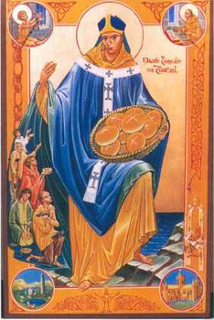
Lorcán Ua Tuathail, also known as Saint Laurence O’Toole, Archbishop of Dublin at the time of the Norman invasion of Ireland, dies in Eu, Normandy, France on November 14, 1180.

O’Toole is born in Castledermot in what is now County Kildare in 1128. His father is Maurice O’Toole, King of Hy Murray. It is common practice in the day for princes of one clan to be given as hostages to another clan, as a guarantee of peace. When he is ten years old O’Toole is given as hostage to Dermot McMurrough, King of Leinster, who treats him very badly. He is sent in chains to a remote place, where he gets very little to eat and does not have enough clothes to keep him warm in the winter. For two years, even though he is a king’s son, he learns what it is like to be poor and to be oppressed.

After two years, it is agreed that O’Toole is to be released. He is sent to a monastery at Glendalough, and the monks make him welcome. It is agreed that his father is to come and collect him there. But he soon comes to love Glendalough and likes joining the monks in prayer. After his two years as a hostage, he realises that wealth and power are not important. He feels very close to God in Glendalough. He asks his father’s permission to stay there and become a monk, to which his father agrees. At the age of only 25 years old, he is elected Abbot of the monastery. As the leader of the community, he encourages the monks in their learning. There is always a welcome in the monastery for the poor. When there is a famine in the area, he sells some of the treasures of Glendalough to provide food for those who are hungry.

In 1162 O’Toole becomes the first Irish-born Archbishop of the Danish city of Dublin. In those days, many of the people of Dublin do not take their Christian religion very seriously. He encourages them to become real Christians. He brings monks to Dublin from France, and they live at Christ Church Cathedral. They help many people to come back to Mass and the Sacraments. O’Toole himself never forgets his own days of poverty. He continues to care for the poor, especially homeless children. He makes room for them in his own house, and they share the food at his table.

The Normans land in Ireland in 1169. The following year they besiege Dublin under their leader, Strongbow. O’Toole meets Strongbow to arrange peace but the Normans attack while the talks are going on. They seize the city and begin killing the citizens and looting their houses. O’Toole saves the lives of many people.

As Archbishop of Dublin, O’Toole participates in the Third Council of the Lateran in Rome in 1179, with some of the other Irish bishops. Pope Alexander III knows that Ireland has been going through a bad time. He knows that many people, including priests, are no longer taking their religion seriously. He entrusts to O’Toole the task of reforming the Church in Ireland.

A new dispute breaks out between the King of England and the Irish Kings. In the spring of 1180, O’Toole leaves Ireland to see if he can help settle the dispute. The English King, Henry II, does not have much time for bishops. He has already arranged to have the Archbishop of Canterbury, Thomas Becket, murdered. He does not welcome O’Toole. He sees a chance to get rid of O’Toole as Archbishop of Dublin and does not let him return to Ireland. Henry has control of Normandy as well as England. O’Toole follows him there. As long as there is a chance of peace, he would not give up trying.

In 1180, O’Toole becomes seriously ill. The monks at Eu in Normandy look after him in their monastery but on November 14, 1180, at the age of 52, he dies. His tomb is in the crypt under the Collegial Church at Eu. Many people still go there to pray. Laurence O’Toole is canonized in 1225 by Pope Honorius III.

(From “St. Laurence O’Toole: a spiritual leader for difficult times,” CatholicIreland.net, November 30, 1999)


Leave a comment

Birth of Sophie Mary Peirce-Evans, Irish Aviator

lady-heath

Sophie Mary Peirce-Evans, Lady Heath, Irish aviator, is born on November 10, 1896, in Knockaderry, County Limerick, near the town of Newcastle West. She is one of the best-known women in the world for a five-year period from the mid-1920s.

When Peirce-Evans is one year old, her father, John Peirce-Evans, bludgeons her mother, Kate Theresa Dooling, to death with a heavy stick. He is found guilty of murder and declared insane. She is taken to the home of her grandfather in Newcastle West where she is brought up by two maiden aunts, who discourage her passion for sports.

After schooldays in Rochelle School in Cork, Princess Garden Belfast and St. Margaret’s Hall on Mespil Road in Dublin, where she plays hockey and tennis, Peirce-Evans enrolls in the Royal College of Science for Ireland. The college is designed to produce the educated farmers which the country then needs. One of the few women in the college, she duly takes a top-class degree in science, specialising in agriculture. She also plays with the college hockey team and contributes to a student magazine, copies of which are held in the National Library of Ireland.

Before becoming a pilot, Peirce-Evans has already made her mark. She spends two years as a dispatch rider during World War I, based in England and later France. By that time, she has married the first of her three husbands, Major William Elliot Lynn, and, as Sophie Mary Eliott-Lynn, is one of the founders of the Women’s Amateur Athletic Association after her move to London in 1922. She is Britain’s first women’s javelin champion and sets a disputed world record for the high jump. Alleging cruelty, her marriage to Elliot Lynn ends in divorce.

In 1925, Elliot-Lynn takes her first flying lessons and two years later becomes the first woman to hold a commercial flying licence in Britain. Along the way, she set records for altitude in a small plane and later a Shorts seaplane and is the first woman to parachute from an aeroplane.

In an era when the world has gone aviation-mad due to the exploits of Charles Lindbergh and Amelia Earhart, Elliot-Lynn is more than able to hold her own. “Britain’s Lady Lindy,” as she is known in the United States, makes front-page news as the first pilot, male or female, to fly a small open-cockpit aircraft from Cape Town to London. A scale model of the plane is on display at The Little Museum of Dublin. She writes about the experience later in the book Woman and Flying, which she co-authors with Stella Wolfe Murray. After her great flight from the Cape, she takes a mechanic’s qualification in the United States, the first woman to do so.

On October 11, 1927, Peirce-Evans marries Sir James Heath at Christ Church in Mayfair, London, and assumes the title Lady Heath. In July 1928, she spends a few weeks volunteering as a co-pilot with a civil airline, KLM. She is hoping to be appointed to the newly created Batavia route, which would make her the first female pilot with a commercial airline. The world is not ready for female pilots and her hope is not fulfilled.

In 1929, just when her fame is at its height, with her life a constant whirl of lectures, races and long-distance flights, Lady Heath is badly injured in a crash just before the National Air Races in Cleveland, Ohio. Before the accident Lady Heath applies for American citizenship, intending to remain in the United States where she has made a good living on the lecture circuit and as an agent for Cirrus engines. She is never the same after her accident.

Lady Heath divorces Sir James Heath in Reno, Nevada in January 1930. On 12 November 12, 1931, in Lexington, Kentucky, she marries G.A.R Williams, a horseman and pilot of Caribbean origin. They return to Ireland, and she becomes involved in private aviation, briefly running her own company at Kildonan, near Dublin in the mid-1930s, and helping produce the generation of pilots that would help establish the national airline Aer Lingus.

Lady Heath dies in St Leonard’s Hospital, Shoreditch, London on May 9, 1939, following a fall inside a double-decker tram. Although alcoholism had been a problem in previous years, a pathologist finds no evidence of alcohol but detailed evidence of an old blood clot which might have caused the fall. On May 15, 1939, according to newspaper reports, her ashes are scattered over Surrey from an aircraft flown by her estranged husband although legend has it that her ashes are returned to Ireland where they are scattered over her native Newcastle West.


Leave a comment

Birth of Painter Nathaniel Hone the Younger

nathaniel-hone-the-younger

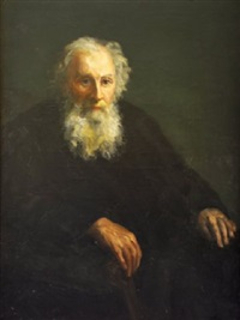
Nathaniel Hone the Younger, Irish painter and great-grand-nephew of painter Nathaniel Hone the Elder, is born in Fitzwilliam Place, Dublin on October 26, 1831. He is the son of Brindley Hone, a merchant and director of the Midland Great Western Railway.

Though a member of a very artistic family, Hone’s initial training is as an engineer at Trinity College Dublin followed by a brief period of work for the Irish Railway before going to Paris in 1853 to study painting. He first studies under Adolphe Yvon, the French military painter, and later Thomas Couture, who is one of the earliest exponents of realism and from whom he learns principles which influence his work throughout his career.

Most of Hone’s later paintings are landscapes, very often enlivened with animals and occasionally with figures. In France he is influenced by the painter Gustav Courbet who is taking a new and quite revolutionary realistic approach. His closest painting tips are, however, from another French impressionist, Jean-Baptiste-Camille Corot. He becomes a close friend of one of Corot’s followers at the Barbizon school of landscape painting. At Barbizon he learns to appreciate colour, texture and tone in the landscape and applies it in strong and confident brushworks to the painting of Irish subjects on his return. In Paris he also works closely with artist Édouard Brandon, also a follower of Corot.

Hone’s paintings which are completed in France have many similarities to those that he completes at his country farm in County Dublin, but the finish is perhaps more polished and professional in the later Irish works.

From 1876, except for four years, Hone exhibits at the Royal Hibernian Academy (RHA). He is elected a full member in 1880 and in 1894 becomes Professor of Painting. His exhibition with John Butler Yeats in 1901 is one of the turning points for the history of Irish art as it is their paintings which convince Sir Hugh Lane that Dublin should have a gallery of modern art.

Nathaniel Hone dies in Dublin on October 14, 1917. After his death his widow bequeaths the contents of his studio to the National Gallery of Ireland. He rarely dates his work, so it is difficult to establish chronology. The similarity of many of his motifs and subjects often make it difficult to tell whether a view is Irish or French. Equally it is difficult to chart his developments on stylistic grounds alone.

(Pictured: Nathaniel Hone, the younger, self-portrait as an old man)


Leave a comment

Thornton’s Awarded Jameson Restaurant of the Year

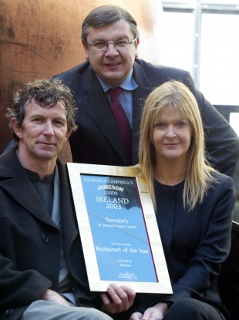
kevin-and-muriel-thorntonThornton’s in St. Stephen’s Green, Dublin, is awarded the “Jameson Restaurant of the Year” on October 23, 2002. It is among the national award winners announced to coincide with the launch of Georgina Campbell’s Jameson Guide: Ireland 2003.

Originally located on Portobello Road since 1989, Thornton’s is opened in the Fitzwilliam Hotel on St. Stephen’s Green in 2002. A fine dining restaurant, it holds a one-star Michelin rating in the periods 1996-2000 and 2006-2015. In the period 2001-2005 it holds a two-star rating.

Head chef Kevin Thornton is the first Irish chef to achieve two Michelin stars and is named Food & Wine Magazine’s Chef of the Year for Ireland in 2007. Patrick Guilbaud receives his second star first but is born in France.

Thornton’s is embroiled in a controversy in 2007 surrounding Kevin Thornton’s alleged refusal to sell chips to his restaurant customers, sparking comparisons to British chef Gordon Ramsay. A customer requests the food but, upon receiving it, he changes his mind and sends them back to the kitchen. Thornton then allegedly emerges from the kitchen with the chips and slams them down on the man’s table, with the remark, “They were cooked specially for you, so you eat them, you dickhead.” He later is alleged to have called them “wankers” before removing them from his restaurant.

Asked about the incident by broadcaster Joe Duffy on his RTÉ Radio 1 Liveline programme, Thornton stresses that he had not so much been infuriated by the request of chips, as he supposedly provides them for younger customers on a regular basis, but that he had been aggravated by the attitude of this particular customer. The incident has since seen Thornton become associated with a dislike of chips and, as recently as 2009, has been crafted as a pun by the Irish media for any other outlet which does not serve the food. Thornton has also spoken out against serving food such as pizza in his restaurant.

Thornton’s permanently closes its doors on October 29, 2016. According to the Thontons the closure is due to the loss of the restaurant’s only Michelin star, which reduced the influx of international tourists, and high rent prices.

(Pictured: Kevin and Muriel Thornton, who win Jameson Restaurant of the Year 2003, with Chief Executive Officer of Irish Distillers Philippe Savinel)