Cusack is born on the eastern fringe of the Burren to Irish speaking parents in Carran, County Clare on September 20, 1847, during the Great Famine. He becomes a national school teacher and in 1874, after teaching in various parts of Ireland, becomes a professor at Blackrock College, then known as the French College. In 1877, he establishes his own civil service academy, Cusack’s Academy, in Dublin which proves successful in preparing pupils for the civil service examinations.
A romantic nationalist, Cusack is also reputed to have been associated with the Fenian movement. He is active in the Gaelic revival, initially as a member of the Society for the Preservation of the Irish Language which is founded in 1876, and later the Gaelic League who in 1879 breaks away from the Society. Also in 1879, he meets Pat Nally, who is a member of the Irish Republican Brotherhood and a leading nationalist and athlete. He finds that he and Nally agree on the influence of British landlordism on Irish athletics.
He would recall how both Nally and himself, While walking through Phoenix Park in Dublin and seeing only a handful of people playing sports in the park so depresses Cusack and Nally that they agree it is time to “make an effort to preserve the physical strength of [their] race.” Nally organises a National Athletics Sports meeting in County Mayo in September 1879 which is a success, with Cusack organising a similar event which is open to artisans in Dublin the following April.
Irish Press Ltd. is officially registered on September 4, 1928, three years before the paper is first published, to create a newspaper independent of the existing media where the Independent Newspapers group is seen as supporting Cumann na nGaedheal/Fine Gael, and The Irish Times being pro-union, and with a mainly middle-class or Protestant readership.
The paper’s first issue is published on the eve of the 1931 All-Ireland Senior Hurling Championship Final between Cork and Kilkenny. Other newspapers do not cover GAA sports in any detail at the time. Margaret Pearse, the mother of Patrick and Willie Pearse, presses the button to start the printing presses. The initial aim of its publisher is to achieve a circulation of 100,000 which it quickly accomplishes. It goes on to list 200,000 subscribers at its peak.
The money to launch the Irish Press is raised in the United States during the Irish War of Independence by a bond drive to finance the First Dáil. Five million dollars is raised; however, 60 percent of this money is left in various banks in New York City. No one knows why de Valera ordered the bulk of the money to be left in New York when he returned to Ireland in late 1920.
In 1927, as a result of legal action between the Irish Free State government and de Valera, a court in New York orders that the bond holders be paid back outstanding money due to them. However, de Valera’s legal team has anticipated the ruling and has prepared for the outcome. A number of circulars are sent to the bond holders asking them to sign over their holdings to de Valera. The bond holders are paid 58 cents to the dollar. This money is then used as startup capital to launch the Irish Press. Following the 1933 Irish General Election, de Valera uses his Dáil Éireann majority to pass a measure allowing the bond holders to be paid the remaining 42 percent of the money still owed.
In December 1931, editor Frank Gallagher is prosecuted by an Irish Free State military tribunal for publishing articles alleging that Garda Síochána had mistreated the Anti-Treaty republicans of the Irish Free State government. This is facilitated by Amendment 17 of the Constitution of the Irish Free State and Gallagher is convicted and fined £50. An example of animosity from those who support Independent Newspapers and the Free State government is that the Irish Press is excluded from the special train which delivers newspapers from Dublin to the countryside. As a result, it is circulated throughout Ireland by a specially rented train.
The Irish Press sustains itself with its own resources until The Sunday Press is founded in 1949. In its heyday, the Irish Press has a number of first-rate reporters and columnists. One notable section, New Irish Writing is edited by David Marcus.
In the 1970s, the Minister for Posts and Telegraphs, Conor Cruise O’Brien, tries to use and amend The Emergency Powers Act and Section 31 of the Broadcasting Authority Act, to censor coverage of the Troubles in Northern Ireland. The Irish Press editor, Tim Pat Coogan, publishes editorials attacking the Bill. The Fine Gael/Labour Coalition Government tries to prosecute the Irish Press for its coverage of the maltreatment of republican prisoners by the Garda “Heavy Gang,” with the paper winning the case.
The Irish Press starts two further newspapers, the Evening Press (1954), and The Sunday Press. The Evening Press is aimed at an urban readership and achieves a daily circulation of 100,000. The new newspapers subsidise the Irish Press when its circulation sags. Its adoption of a tabloid format does not rescue its declining circulation.
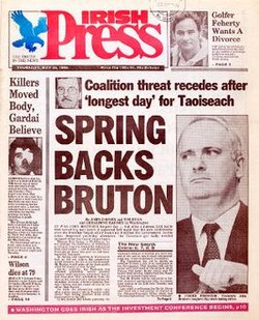
The final issue of the Irish Press and Evening Press is on Thursday, May 25, 1995. The newspapers close because of a bizarre industrial dispute over the sacking of the group business editor, Colm Rapple. The group has not been in a healthy financial state for several years. When it eventually closes, with indebtedness of £20 million, 600 people lose their jobs.
(Pictured: Cover of last ever edition of the Irish Press from May 25, 1995)
As of June 1900, the world record for the long jump is held by Myer Prinstein of Syracuse University, at 24′ 7-1/4″. In 1900 and 1901, competing with the Irish Amateur Athletic Association (IAAA), a rival association to the GAA, O’Connor sets several unofficial world records in the long jump. He sets an officially recognised world record of 24′ 9″ at the Royal Dublin Society’s grounds in Dublin on May 27, 1901. On August 5, 1901 he jumps 24′ 11-3/4″ in Dublin. This is the first IAAF-recognised long jump world record. It causes a sensation at the time, being only a fraction short of the 25-foot barrier, and remains unbeaten for 20 years, a longevity surpassed only by Jesse Owens‘s 25-year record and Bob Beamon‘s 23-year record. It remains an Irish record for a remarkable 89 years.
In 1906 O’Connor and two other athletes, Con Leahy and John Daly, are entered for the Intercalated Games in Athens by the IAAA and GAA, representing Ireland. However, the rules of the games are changed so that only athletes nominated by National Olympic Committees are eligible. Ireland does not have an Olympic Committee, and the British Olympic Council claims the three. On registering for the Games, O’Connor and his fellow athletes find that they are listed as Great Britain, not Irish, team members.
In the long jump competition, O’Connor finally meets Myer Prinstein of the Irish American Athletic Club who is competing for the U.S. team and whose world record O’Connor had broken five years previously. The only judge for the competition is Matthew Halpin, who is manager of the American team. O’Connor protests, fearing bias, but is overruled. He continues to protest Halpin’s decisions through the remainder of the competition. When the distances are announced at the end of the competition, Prinstein is declared the winner, with O’Connor in Silver Medal position.
At the flag-raising ceremony, in protest of the flying of the Union Flag for his second place, O’Connor scales a flagpole in the middle of the field and waves the Irish flag, while the pole is guarded by Con Leahy.
In the hop, step and jump competition two days later, O’Connor beats his fellow countryman, Con Leahy, to win the Gold Medal. At 34 he is the oldest ever Gold Medal winner in this event. Prinstein, the champion in 1900 and 1904, did not medal.
O’Connor wins no more titles after 1906. He remains involved in athletics all his life. He is a founder member and first Vice-President of Waterford Athletic Club, and attends later Olympics both as judge and spectator. He practises as a solicitor in Waterford and is married with nine children. He dies in Waterford on November 9, 1957.
A force of one hundred IRA members under the leadership of Barry are involved in a major skirmish with up to 1,000 British troops at Crossbarry. English intelligence has determined that Barry’s West Cork Brigade is based near Crossbarry and plans a major encirclement and assault. Poor planning and timing ensures that the British forces get separated before attacking Barry’s men. Barry is a brilliant guerrilla fighter and strategist who directs an attack against an initial force of approximately 140 men, before he orders his men to break out.
Charlie Hurley, one of the Brigade commanders who is injured during the Upton train ambush, is staying in a house with a pro-republican family, where he is recuperating from serious wounds he had received at Upton a month earlier. When he realises that he is surrounded by the British forces, he flees the house, as Tom Barry comments in his book, to reduce the danger to those in the house. He is shot dead by the pursuing troops. Barry remarks that Hurley “went to meet his death like a true Irishman.” A ballad exists that commemorates him. In addition, the Gaelic Athletic Association (GAA) grounds in Bandon, County Cork are named after him.
Reports as to casualties differ. The IRA claims that over thirty British are killed while official British figures are ten killed and six IRA men killed. Whatever the numbers, it is probably the largest single military engagement in the Irish War of Independence as the IRA knew major battles with British troops would be a disaster for them and rarely got involved in full frontal action. While the casualties may not seem that large, Crossbarry is a major morale victory for the IRA who had “defeated” a British force of over one thousand. Prime MinisterDavid Lloyd George states that the Crossbarry and Kilmichael ambushes convinced him of the need for a truce and a treaty with the Irish rebels.
(Pictured: Crossbarry Ambush Memorial, Crossbarry, County Cork)
Redmond is born to an old prominent Catholic family in Kilrane, County Wexford on September 1, 1856. Several relatives are politicians. He takes over control of the minority IPP faction loyal to Charles Stewart Parnell after Parnell dies in 1891. He is a conciliatory politician who achieves the two main objectives of his political life: party unity and, in September 1914, the passing of the Irish Home Rule Act.
The Irish Home Rule Act grants limited self-government to Ireland, within the United Kingdom. However, implementation of Home Rule is suspended by the outbreak of the World War I. Redmond calls on the National Volunteers to join Irish regiments of the New British Army and support the British and Allied war effort to restore the “freedom of small nations” on the European continent, thereby to also ensure the implementation of Home Rule after a war that is expected to be of short duration. However, after the Easter Rising of 1916, Irish public opinion shifts in favour of militant republicanism and full Irish independence, resulting in his party losing its dominance in Irish politics.
In sharp contrast to Parnell, Redmond lacks charisma. He works well in small committees but has little success in arousing large audiences. Parnell had always chosen the nominees to Parliament. Now they are selected by the local party organisations, giving Redmond numerous weak MPs over whom he has little control. He is an excellent representative of the old Ireland but grows increasingly old-fashioned because he pays little attention to the new forces attracting younger Irishmen, such as Sinn Féin in politics, the Gaelic Athletic Association in sports, and the Gaelic League in cultural affairs.
Redmond never tries to understand the unionist forces emerging in Ulster. He is further weakened in 1914 by the formation of the Irish Volunteers by Sinn Féin members. His enthusiastic support for the British war effort alienates many Irish nationalists. His party has been increasingly hollowed out, and a major crisis, notably the Easter Rising, is enough to destroy it.
Redmond is increasingly eclipsed by ill-health after 1916. An operation in March 1918 to remove an intestinal obstruction appears to progress well initially, but he then suffers heart failure. He dies a few hours later at a London nursing home on March 6, 1918.
Condolences and expressions of sympathy are widely expressed. After a funeral service in Westminster Cathedral his remains are interred, as requested in a manner characteristic of the man, in the family vault at the old Knights Templars‘ chapel yard of Saint John’s Cemetery, Wexford, amongst his own people rather than in the traditional burial place for Irish statesmen and heroes in Glasnevin Cemetery. The small, neglected cemetery near the town centre is kept locked to the public. His vault, which has been in a dilapidated state, has been only partially restored by Wexford County Council.
Eoghan Corry, Irish journalist and author regarded as the most extensively traveled writer in Ireland, averaging over 30 countries a year, is born in Dublin on January 19, 1961.
He begins his journalistic career as a sportswriter with The Irish Times and Sunday Tribune where he wins several awards and becomes sports editor. Determined to pursue a career outside of sports journalism, he joins The Sunday Press as a feature writer in 1985 and becomes features editor of The Irish Press in 1986, bringing younger writers and a more contemporary, polemical and literary style to the paper. He revives the literary and travel sections of the paper and is an adjudicator of the Dublin Theatre Festival awards.
When The Irish Press closes in 1995, he becomes Features Editor of the short-lived Evening News, storylines the Gaelic Athletic Association (GAA) museum in Croke Park in 1998 and is founding editor of High Ball magazine. Since then, he has been a columnist, first with The Sunday Business Post and then with the Evening Herald and Irish Independent. As a journalism lecturer in the Dublin Institute of Technology he tells students that “journalism is about pissing people off.”
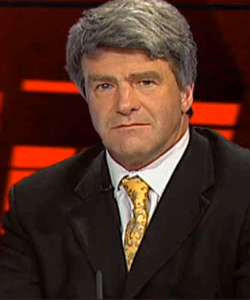
Since 2002 Corry has edited Ireland’s biggest circulation travel publication, Travel Extra. He has fronted travel shows broadcast in Ireland and the Middle East and is a regular commentator on travel affairs to Raidió Teilifís Éireann (RTÉ) and TG4, and an occasional guest contributor to BBC Northern Ireland. He writes the ten-part series GAA@125, screened on Irish television station TG4 in 2009. He appears on Tonight with Vincent Browne from time to time to preview the next day’s newspapers.
Corry is awarded a lifetime “contribution to the industry” award at the Irish Travel Industry Awards in Dublin on January 22, 2016. He receives the Business Travel Journalist of the year award in London in October 2015. Previous awards include Irish sportswriter of the year, young journalist of the year, Seamus Kelly award, MacNamee award for coverage of Gaelic Games and is short listed for sports book of the year.
O’Duffy does an apprenticeship as an engineer in Wexford before working as an engineer and architect in Monaghan. In 1919 he becomes an auctioneer. He is a leading member of the Gaelic Athletic Association in Ulster in the 1910s. In 1912 he is appointed secretary of the Ulster provincial council. He is also a member of Harps’ Gaelic Football Club.
Professionally, O’Duffy becomes the second Commissioner of the Garda Síochána, the police force of the new Irish Free State, after the Civic Guard Mutiny and the subsequent resignation of Michael Staines. He holds this post until 1933, when he is dismissed by Éamon de Valera. In his political life O’Duffy is an early member of Sinn Féin, founded by Arthur Griffith. He is elected as a Teachta Dála (TD) for his home county of Monaghan during the 1921 election.
After a split in 1923 he becomes associated with Cumann na nGaedheal and becomes head of a veteran’s group then known as the Army Comrades Association. O’Duffy changes its name to “National Guard” and begins to stage fascist-style rallies and adopts a fascist salute. Its members begin to wear blue uniform shirts and become known as the Blueshirts. When government opposition groups form Fine Gael in September 1933, he becomes its first president, reaching the apex of his political power.
Subsequently, the government bans O’Duffy’s National Guard, as well as the group he creates to replace it, the Young Ireland Association, which he in turn replaces with the League of Youth, but their blue shirts indicate its continued fascist ideology. Fine Gael’s other leaders soon tire of his inflammatory rhetoric and the frequent violent behavior of the Blueshirts but are still surprised when their opposition causes him to resign his party leadership in September 1934. He is then ousted as leader of the Blueshirts as well but does retain a small loyal following.
Eoin O’Duffy takes no further part in Irish politics and dies in Dublin on November 30, 1944. In spite of his later politics, he is given a state funeral for his earlier contributions to the Irish government. He is buried in Dublin’s Glasnevin Cemetery.
The Irish language has largely retreated from Meath when O’Growney is born, and neither of his parents speak it. He becomes interested in the language when he chances upon the Irish lessons in the nationalist newspaper Young Ireland. He has help at first from a few old people who speak the language, and while at St. Patrick’s Pontifical University, Maynooth, where he continues his studies for the priesthood from the year 1882, he spends his holidays in Irish-speaking areas in the north, west and south. He gets to know the Aran Islands and writes about them in the bilingual Gaelic Journal (Irisleabhar na Gaedhilge), which he is later to edit. He is ordained in 1888. His proficiency in the language leads him to be appointed in the re-established Chair of Irish at Maynooth in 1891. He is editor of the Gaelic Journal between 1894 and 1899 and during his tenure ensures that more material is published in Irish.
For O’Growney language, nationality and religion are closely linked. In 1890, writing in the Irish Ecclesiastical Review, he describes literature in Irish as “the most Catholic literature in the world.” He is aware, however, of its other aspects, adding that “even if Irish were to perish as a spoken language, it would remain valuable from the pure literature point of view.”
His Simple Lessons in Irish, first published in the newspaper The Weekly Freeman, proves so popular that they are published in booklet form. There are five books in the series and 320,000 copies have been sold by 1903. In a foreword he states:
“The following course of simple lessons in Irish has been drawn up chiefly for the use of those who wish to learn the old language of Ireland, but who are discouraged by what they have heard of its difficulties… But the difficulties of Irish pronunciation and construction have always been exaggerated. A I myself was obliged to study Irish as a foreign language, and as I have been placed in circumstances which have made me rather familiar with the language as now spoken, I have at least a knowledge of the difficulties of those who, like myself, have no teacher.”
O’Growney is a founding member of the Gaelic League, which is created in Dublin in 1893 “for the purpose of keeping the Irish language spoken in Ireland,” and later becomes its vice-president.
In 1894, failing health causes him to go to Arizona and California, where he dies in Los Angeles on October 18, 1899. Some years later, with the aid of Irish sympathisers in the United States, his body is returned to Ireland. His funeral, held on September 26, 1903 at the St. Mary’s Pro-Cathedral, Dublin, is attended by 6,000 people, including members of the trade guilds, clerics, politicians, members of the nationalist Gaelic Athletic Association and students. He is buried at Maynooth.
(Pictured: Statue of Fr. Eugene O’Growney on the grounds of St. James’ Church in Athboy, courtesy of http://www.athboyparish.ie)
Croke gains the good opinion of the Irish ecclesiastical authorities and is rewarded in 1870 by his promotion to Bishop of Auckland in New Zealand. His former professor, Paul Cullen, by then Cardinal Archbishop of Dublin, is largely responsible for filling the Australasian Catholic church with fellow Irishmen. His strong recommendations lead to Croke’s appointment. Croke arrives at Auckland on December 17, 1870, on the City of Melbourne. During his three years as bishop, he restores firm leadership to a diocese left in disarray by his predecessor, Bishop Jean Baptiste Pompallier. He devotes some of his considerable personal wealth to rebuilding diocesan finances and also takes advantage of Auckland’s economic growth following the development of the Thames goldfields to further his aims, ensuring that all surplus income from parishes at Thames and Coromandel is passed on to him, and he institutes a more rigorous system for the Sunday collection at St. Patrick’s Cathedral. He imports Irish clergy to serve the growing Catholic community, and with Patrick Moran, the first Catholic Bishop of the Diocese of Dunedin, he tries unsuccessfully to secure an Irish monopoly on future episcopal appointments in New Zealand. Croke supports separate Catholic schools and their right to state aid and voices his opposition to secular education as Auckland’s Catholic schools are threatened by the provincial council’s Education Act 1872, which helps to create a free, secular and compulsory education system. However, generally, Croke’s image is uncontroversial. On January 28, 1874, after barely three years in office, Croke departs for Europe, on what is ostensibly a 12-month holiday, and he does not return to New Zealand.
Croke becomes a member of the Irish hierarchy when he is translated to be Archbishop of Cashel, one of the four Catholic Irish archbishoprics in 1875. Archbishop Croke is a strong supporter of Irish nationalism, aligning himself with the Irish National Land League during the Land War, and with the chairman of the Irish Parliamentary Party, Charles Stewart Parnell. In an 1887 interview he explains that he had opposed the League’s “No rent manifesto” in 1881, preferring to stop payment of all taxes.
Croke also associates himself with the Temperance Movement of Fr. Theobald Mathew and Gaelic League from its foundation in 1893. Within Catholicism he is a supporter of Gallicanism, as opposed to the Ultramontanism favoured by the Archbishop of Dublin, Cardinal Cullen. His support of nationalism causes successive British governments and Lord Lieutenant of Ireland‘s governments in Dublin to be deeply suspicious of him, as are some less politically aligned Irish bishops.
Following the scandal that erupts over Parnell’s relationship with Katharine O’Shea, the separated wife of fellow MP Captain William O’Shea, Archbishop Croke withdraws from active participation in nationalist politics.
O’Hehir is educated at St. Patrick’s National School in Drumcondra before later attending the O’Connell School. He later studies electrical engineering at University College Dublin, however, he abandons his studies after just one year to pursue a full-time career in broadcasting.
At the age of eighteen O’Hehir writes to Radio Éireann asking to do a test commentary. He is accepted and is asked to do a five-minute microphone test for a National Football League game between Wexford and Louth. His microphone test impresses the director of broadcasting so much that he is invited to commentate on the entire second half of the match.
Two months later, in August 1938, O’Hehir makes his first broadcast – the All-Ireland football semi-final between Monaghan and Galway. The following year he covers his first hurling final – the famous “thunder and lightning final” between Cork and Kilkenny.
By the mid-1940s O’Hehir is recognised as one of Ireland’s leading sports broadcasters. In 1947 he faces his most challenging broadcast to date when he has to commentate on the All-Ireland Football Final from the Polo Grounds in New York City with over 1,000,000 people listening to the broadcast back in Ireland.
In 1944 O’Hehir joins the staff of Independent Newspapers as a sports sub-editor, before beginning a seventeen-year career as racing correspondent in 1947.
In 1961 Ireland’s first national television station, Telefís Éireann, is founded and O’Hehir is appointed head of sports programmes. In addition to his new role O’Hehir continues to keep up a hectic schedule of commentaries.
O’Hehir’s skills do not just confine him to sports broadcasting and, in November 1963, he faces his toughest broadcast. By coincidence he is on holidays with his wife Molly in New York City when U.S. PresidentJohn F. Kennedy is assassinated. O’Hehir is asked by Telefís Éireann to provide the commentary for the funeral. The live five-hour broadcast proves a huge challenge for him, as he has had no association with political or current affairs broadcasting up to that point and lacks the resources available to more established television stations. O’Hehir’s commentary, however, wins widespread acclaim in Ireland and shows a different side of his nature.
In August 1985 O’Hehir is preparing to commentate on the All-Ireland hurling final between Offaly and Galway. It would be a special occasion as it would mark his 100th commentary on an All-Ireland final. Two weeks before the game he suffers a stroke which leaves him in a wheelchair and with some speaking difficulties. This denies him the chance to reach the century milestone. He hopes to return to broadcasting one day to complete his 100th final, however, this never happens.
In 1987, the centenary All-Ireland football final takes place Croke Park. The biggest cheer of the day is reserved for O’Hehir when he is pushed onto the field in a wheelchair by his son Peter. Nobody expects the standing ovation and the huge outpouring of emotion from the thousands of fans present and from O’Hehir himself.
Over the next few years O’Hehir withdraws from public life. He returns briefly in 1996 when his autobiography, My Life and Times, is published. Michael O’Hehir dies in Dublin on November 24, 1996.






 seamus dubhghaill