seamus dubhghaill

Promoting Irish Culture and History from Little Rock, Arkansas, USA


Leave a comment

Birth of Joe Clarke, Irish Republican Politician

Joseph Christopher Clarke (Irish: Seosamh Ó Clérigh), Irish republican politician, is born on December 22, 1882, in Rush, Dublin.

Clarke is the son of William Clarke, merchant seaman, and Margaret Clarke (née Austin). Educated locally, he leaves school at the age of eleven and begins work as a kitchen porter, later becoming a boot-shop assistant, a harness maker and a van driver. Influenced by a series of lectures at the Oliver Bond Club, Parnell Square, and by the writings of Arthur Griffith, he commits himself to the republican cause, joining the Irish Republican Brotherhood (IRB) in 1913 and subsequently the Irish Volunteers.

Clarke works for the Sinn Féin Bank and is active in the 1916 Easter Rising. On Easter Monday morning, on April 24, 1916, he is one of thirteen volunteers who hold the Mount Street Bridge for nine hours against the overwhelming forces of the Sherwood Foresters regiment of the British Army. When captured, he is shot in the head, but survives, and is instead imprisoned in Liverpool Prison, Wakefield Prison and then Frongoch internment camp.

On his return to Ireland, Clarke acts as the courier for the First Dáil and serves as an usher at the first meeting of the First Dáil. He is interned from January 1921. Released in 1923, he acts as caretaker of the Sinn Féin headquarters on Harcourt Street and founds the Irish Book Bureau. Although the Anti-Treaty Sinn Féin rejects participation in the Dáil, they continue to contest local elections, and Clarke sits on Dublin City Council.

Although jailed many times between 1922 and 1940, Clarke remains an active republican campaigner, supporting the Irish Republican Army (IRA) initiatives of the 1940s and 1950s, taking a prominent role at republican meetings, and publicising the conditions of republican prisoners.

Clarke is a founder member of Comhairle na Poblachta in 1929. In 1937, he works with Brian O’Higgins to establish the Wolfe Tone Weekly as a light-hearted party newspaper. In August 1939, he is interned at Arbour Hill Prison, then later at Cork County Jail.

Although Clarke had served under Éamon de Valera during the Easter Rising, the two become implacable opponents. He is ejected from an official commemoration of the fiftieth anniversary of the First Dáil for interrupting de Valera’s speech in order to raise the complaints of the Dublin Housing Action Committee (DHAC). He vows to outlive de Valera and succeeds in this endeavour by outliving him a year.

Clarke is elected as a Vice-President of Sinn Féin in 1966. In the split of 1970, he supports the provisional wing, remaining Vice-President. In 1973 he is deported from Britain upon his arrival at Heathrow Airport.

Despite crippling arthritis, Clarke continues his work, refusing an IRA pension as he considers himself still on active service. He dies on April 22, 1976, at St. James’s Hospital, Dublin, and is buried in Glasnevin Cemetery close to the republican plot.

Clarke marries Anne, daughter of Thomas Hughes, sawyer, on July 25, 1909. They have two sons and one daughter. After her death, he marries Elizabeth Delaney on May 30, 1949.

The Dublin South West Inner City cumann of Sinn Féin is named for Clarke.

(Pictured: Joe Clarke selling Easter Lilies on Dublin’s O’Connell Street in 1966)


Leave a comment

Death of P. S. O’Hegarty, Writer, Editor & Historian

Patrick Sarsfield O’Hegarty (Irish: Pádraig Sáirséal Ó hÉigeartaigh), Irish writer, editor and historian and a member of the Supreme Council of the Irish Republican Brotherhood, dies on December 17, 1955.

O’Hegarty is born on December 29, 1879, at Carrignavar, County Cork, to John and Katherine (née Hallahan) Hegarty. His parents’ families emigrate to the United States after the Great Famine, and his parents are married in Boston, Massachusetts. His father is a member of the Irish Republican Brotherhood (IRB).

He is educated at North Monastery CBS, where he forms an enduring friendship with Terence MacSwiney. In 1888, his father dies of tuberculosis at the age of 42. Left destitute, his mother pawns her wedding ring to pay for an advertisement looking for work, and eventually becomes a cook.

He joins the postal service in Cork in 1897. Along with J. J. Walsh, he plays on the Head Post Office hurling team. He joins the IRB and represents Munster on the IRB Supreme Council. He starts writing for Arthur Griffith‘s United Irishman and the Shan van Vocht, a periodical established by Alice Milligan and Ethna Carbery.

He serves at the main Postal Sorting Office in Mount Pleasant, London, from 1902 to 1913. Along with J. J. Walsh, he spends three years at King’s College London, studying for the Secretary’s Office. While he succeeds in his studies, Walsh does not and returns to Ireland. O’Hegarty becomes the IRB representative for South East England and joins the Gaelic League and Sinn Féin and becomes a strong advocate of the Irish language. In 1905, he is elected secretary of the local Dungannon Club, which draws in as members Robert Lynd, Herbert Hughes and George Cavan. In 1907, as Sinn Féin’s London Secretary, he approves and signs the membership card of Michael Collins, later becoming friend and mentor to Collins.

He has to return to Ireland for a break due to overwork in 1909 and gives up some of his work for the Gaelic League. However, he takes over as editor of the IRB publication, Irish Freedom. It is in this publication that he famously writes, concerning the visit of King George V to Ireland in 1911: “Damn your concessions, England: we want our country!” In 1912, at the height of the Playboy riots, he writes four articles entitled “Art and the Nation” in Irish Freedom, which take a very liberal and inclusionist approach to Anglo-Irish literature and art in general but invokes the wrath of many of the paper’s readers.

In 1913, he is re-posted to Queenstown (present-day Cobh) as postmaster. He continues editing nationalist newspapers such as Irish Freedom (founded in 1910 and suppressed in December 1914 on account of its seditious content) and An tÉireannach and joins the Irish Volunteers. At the outbreak of war he is moved to Shrewsbury, probably on account of his political activities. In 1915, he marries Wilhelmina “Mina” Smyth, a schoolteacher and suffragist, and is then moved to Welshpool, Montgomeryshire. In the aftermath of the 1916 Easter Rising, he is opposed to physical force. In 1918, he refuses to take the British Oath of Allegiance and resigns his position in the Post Office.

O’Hegarty feels that the Abbey Theatre is “doing good for Ireland” and supports W. B. Yeats against attacks from Arthur Griffith and like-minded Nationalists. He opposes the extremist views of D. P. Moran, who seeks a Roman Catholic Irish-speaking Ireland.

He is Secretary of the Irish Department of Post and Telegraphs from 1922 to 1945. He is elected a member of the Irish Academy of Letters in 1954.

His son, Seán Ó hÉigeartaigh, is a founder of the Irish-language publishing house Sáirséal agus Dill. His daughter Gráinne, a harpist, marries Senator Michael Yeats, son of W. B. Yeats.

O’Hegarty’s papers are acquired by the Kenneth Spencer Research Library at the University of Kansas. This includes an outstanding collection of books, pamphlets and periodicals of W. B. Yeats.

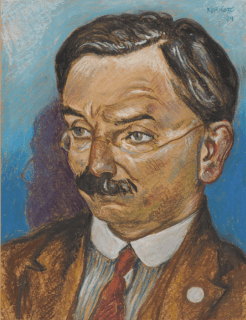
(Pictured: “P. S. O’Hegarty, 1929,” pastel on paper by Harry Kernoff, RHA, property from the Yeats family)


Leave a comment

Death of W. T. Cosgrave, First President of the Free State Executive Council

William Thomas Cosgrave, Irish Fine Gael politician who serves as the first president of the Executive Council of the Irish Free State (1922-32), dies in The Liberties, Dublin, on November 16, 1965. He also serves as Leader of the Opposition in both the Free State and Ireland (1932-44), Leader of Fine Gael (1934-44), founder and leader of Fine Gael’s predecessor, Cumann na nGaedheal (1923-33), Chairman of the Provisional Government of the Irish Free State (August 1922-December 1922), the President of Dáil Éireann (September 1922-December 1922), the Minister for Finance (1922-23) and Minister for Local Government (1919-22). He serves as a Teachta Dála (TD) (1921-44) and is a member of parliament (MP) for the North Kilkenny constituency (1918-22).

Cosgrave is born at 174 James’s Street, Dublin, on June 5, 1880, to Thomas Cosgrave, grocer, and Bridget Cosgrave (née Nixon). He is educated at the Christian Brothers School at Malahide Road, Marino, Dublin, before entering his father’s publican business. He first becomes politically active when he attends the first Sinn Féin convention in 1905.

At an early age, Cosgrave is attracted to the Irish nationalist party Sinn Féin. He becomes a member of the Dublin Corporation in 1909 and is subsequently reelected to represent Sinn Féin interests. He joins the Irish Volunteers in 1913, although he never joins the Irish Republican Brotherhood (IRB) because he does not believe in secret societies. When the group splits in 1914 upon the outbreak of World War I, he sides with a radical Sinn Féin minority against the constitutional nationalists led by John Redmond, who supports the British war effort.

Cosgrave takes part in the 1916 Easter Rising and is afterward interned by the British for a short time. In 1917, he is elected to Parliament for the city of Kilkenny. In the sweeping election victory of Sinn Féin in the 1918 United Kingdom general election, he becomes a member of the First Dáil. He is made Minister for Local Government in the first republican ministry, and during the Irish War of Independence (1919–21) his task is to organize the refusal of local bodies to cooperate with the British in Dublin.

Cosgrave is a supporter of the 1921 Anglo-Irish Treaty settlement with Great Britain, and he becomes Minister of Local Government in Ireland’s provisional government of 1922. He replaces Michael Collins as Chairman of the Provisional Government when the latter becomes commander-in-chief of the National Army in July 1922. He also replaces Arthur Griffith as president of the Dáil after Griffith’s sudden death on August 12, 1922. As the first president of the Executive Council of the Irish Free State, he, who had helped found the political party Cumann na nGaedheal in April 1923 and became its leader, represents Ireland at the Imperial Conference in October 1923. A month earlier he is welcomed as Ireland’s first spokesman at the assembly of the League of Nations.

Cosgrave’s greatest achievement is to establish stable democratic government in Ireland after the Irish Civil War (1922–23). In the Dáil there is no serious opposition, since the party headed by Éamon de Valera, which refuses to take the oath prescribed in the treaty, abstains from attendance. But neither Cosgrave nor his ministry enjoy much popularity. Order requires drastic measures, and taxation is heavy and sharply collected. He seems sure of a long tenure only because there is no alternative in sight.

In July 1927, shortly after a general election, the assassination of Kevin O’Higgins, the vice president, produces a crisis. The Executive Council introduces a Public Safety Act, which legislates severely against political associations of an unconstitutional character and introduces a bill declaring that no candidature for the Dáil should be accepted unless the candidate declares willingness to take a seat in the Dáil and to take the oath of allegiance. The result of this measure is that de Valera and his party decide to attend sessions in the Dáil, and, since this greatly alters the parliamentary situation, Cosgrave obtains leave to dissolve the assembly and hold a general election. The September 1927 Irish general election leaves his party numerically the largest in the Dáil but without an overall majority. He continues in office until de Valera’s victory at the 1932 Irish general election. Cumann na nGaedheal joins with two smaller opposition parties in September 1933 to form a new party headed by Cosgrave, Fine Gael (“Irish Race”), which becomes Ireland’s main opposition party. In 1944 he resigns from the leadership of Fine Gael.

Cosgrave dies on November 16, 1965, at the age of 85. The Fianna Fáil government under Seán Lemass awards him the honour of a state funeral, which is attended by the Cabinet, the leaders of all the main Irish political parties, and Éamon de Valera, then President of Ireland. He is buried in Goldenbridge Cemetery in Inchicore, Dublin. Richard Mulcahy says, “It is in terms of the Nation and its needs and its potential that I praise God who gave us in our dangerous days the gentle but steel-like spirit of rectitude, courage and humble self-sacrifice, that was William T. Cosgrave.”

While Cosgrave never officially holds the office of Taoiseach (prime minister), Ireland considers him to be its first Taoiseach due to having been the Free State’s first head of government.

Cosgrave’s son, Liam, serves as a TD (1943-81), as leader of Fine Gael (1965-77) and Taoiseach (1973-77). His grandson, also named Liam, also serves as a TD and as Senator. His granddaughter, Louise Cosgrave, serves on the Dún Laoghaire–Rathdown County Council (1999-2009).

In October 2014, Cosgrave’s grave is vandalised, the top of a Celtic cross on the headstone being broken off. It is again vandalised in March 2016.


Leave a comment

Birth of Con Colbert, Irish Rebel & Fianna Éireann Pioneer

Cornelius Bernard “Con” Colbert, Irish rebel and pioneer of Fianna Éireann, is born on October 19, 1888, in the townland of Moanleana, Mahoonagh, County Limerick. For his part in the Easter Rising of 1916, he is shot by firing squad in Kilmainham Gaol, Dublin, on May 8, 1916.

Colbert is the fourth youngest of thirteen children of Michael Colbert, a farmer, and Honora McDermott. His family moves to the village of Athea when he is three years old. He is educated at the local national school. In 1901, his family is living in the townland of Templeathea West. A younger brother, James, and a cousin, Michael Colbert, later serve as Teachtaí Dála (TDs).

Colbert leaves Athea at the age of 16 and goes to live with his sister Catherine in Ranelagh, County Dublin. He continues his education at a Christian Brothers school in North Richmond Street. He is employed as a clerk in the offices of Kennedy’s Bakery in Dublin. In 1911, he is living with Catherine, two other siblings and two boarders at a house on Clifton Terrace, Rathmines. He is a deeply religious Catholic and refrains from smoking or drinking.

Colbert is sworn into the Irish Republican Brotherhood (IRB) by his cousin Art O’Donnell in Art’s home in 1908. He joins Fianna Éireann at its inaugural meeting in 1909 and rises to Chief Scout. The following year he becomes a drill instructor at St. Enda’s School, founded by Patrick Pearse. In 1912, he becomes head of an IRB circle within the Fianna started by Bulmer Hobson. During 1913 he is one of a number of Fianna who conduct military training at the Forester’s Hall in Rutland Square (now Parnell Square), and in November of that year he joins the Provisional Committee of the newly formed Irish Volunteers.

In the weeks leading up to the Rising, Colbert acts as bodyguard for Thomas Clarke. Before the Rising, because he lives out of the city, he stays with the Cooney family in the city centre. During Easter Week, he fights at Watkin’s Brewery, Jameson’s Distillery and Marrowbone Lane. Thomas MacDonagh surrenders to Brigadier General William Lowe at 3:15 p.m. on Sunday, April 30. MacDonagh then goes around the garrisons under his command to arrange for their surrender.

Colbert surrenders with the Marrowbone Lane Garrison along with the South Dublin Union Garrison, which had been led by Éamonn Ceannt. When the order to surrender is issued, he assumes the command of his unit to save the life of his superior officer, who is a married man.

They are marched to Richmond Barracks, where Colbert is later court-martialed. Transferred to Kilmainham Gaol, he is told on Sunday, May 7, that he is to be shot the following morning. He writes no fewer than ten letters during his time in prison. During this time in detention, he does not allow any visits from his family. Writing to his sister, he says a visit “would grieve us both too much.”

The night before his execution Colbert sends for Mrs. Ó Murchadha, who is also being held prisoner. He tells her he is “proud to die for such a cause. I will be passing away at the dawning of the day.” Holding his Bible, he tells her he is leaving it to his sister. He hands her three buttons from his volunteer uniform, telling her, “They left me nothing else.” He then asks her to say a Hail Mary for the souls of the departed when she hears the volleys of shots in the morning for Éamonn Ceannt, Michael Mallin and himself. The soldier who is guarding the prisoner begins crying according to Mrs. Ó Murchadha, and records him as saying, “If only we could die such deaths.”

The next morning, May 8, 1916, Colbert is shot by firing squad.

Colbert Railway Station in Limerick, Con Colbert Road in Dublin and the Fianna Fáil cumann in the University of Limerick are named in his honor. Colbert Street in his native Athea, County Limerick, is named after him, as is the local community hall. Colbert Avenue and Colbert Park Janesboro, Limerick, are also named after him.

On May 4, 1958, a plaque is erected over a bed in Barringtons Hospital, County Limerick. The plaque has since disappeared.

In May 2016, one hundred years after his execution, a full-scale limestone sculpture of Colbert is unveiled at the gable of his one-time house in Moanleana, County Limerick.


Leave a comment

Birth of Liam Ó Briain, Irish Language Expert & Political Activist

Liam Ó Briain, Irish language expert and political activist, is born at 10 Church Street, North Wall, Dublin, on September 16, 1888.

Christened as William O’Brien, the seventh child of Arthur O’Brien, clerk, and Mary O’Brien (née Christie), who is from County Meath, Ó Briain takes an interest in the Irish language from an early age and begins learning Irish by himself from a grammar book, as it is not encouraged by his teachers at the Christian BrothersO’Connell School nor spoken by his parents. While still at the O’Connell School, he starts using the Irish version of his name. He also attends meetings of the Gaelic League, then attends University College Dublin (UCD) on a scholarship, where he studies French, English and Irish, receiving a BA (1909) and an MA (1910).

UCD decides to start awarding one annual scholarship for overseas travel in 1911, and Ó Briain wins the first one, using it to visit Germany and study under Kuno Meyer and Rudolf Thurneysen. After three years, he returns home, where he rejoins the Gaelic League and begins teaching French at UCD. He also joins the Irish Volunteers then, the following year, Seán T. O’Kelly convinces him to join the Irish Republican Brotherhood (IRB).

During the 1916 Easter Rising, Ó Briain sees action with the Irish Citizen Army. He comes into conflict with his commander, Michael Mallin, as he wants to pursue a strategy without the Dublin brigade being “cooped up in the city.” However, Mallin overrules him and insists they should focus on taking Dublin Castle. He spends two months in Wandsworth Prison in London and six months in Frongoch internment camp in Wales before being released to discover that he has been fired from his job. However, he quickly obtains a professorship in Romance languages at University College Galway (UCG).

Around this time, Ó Briain joins Sinn Féin, and he stands unsuccessfully for the party in Mid Armagh at the 1918 United Kingdom general election in Ireland, taking 5,689 votes. His campaign leads, indirectly, to his arrest and three months in jail in Belfast. In 1920, following his release, he is appointed a judge in the then-illegal republican court system in Galway, and visits both France and Italy to try to source weapons for the Irish Republican Army (IRA). In November 1920, he is arrested in the UCG dining room by Black and Tans, and is imprisoned for thirteen months, first in Galway and then in the Curragh camp in County Kildare, thereby missing the conclusion of the Irish War of Independence. By the time he is released, the Anglo-Irish Treaty has been signed. He supports the treaty and takes no further part in militant activity.

In the newly independent Ireland, Ó Briain remains a professor at Galway. He also stands in the 1925 Seanad election, although he is not successful. He is the founding secretary of the Taibhdhearc na Gaillimhe theatre, also acting in many of its productions, and spends much time translating works from English and the Romance languages into Irish. He stands to become president of UCG in 1945, but is not elected, and in the 1940s and 1950s is best known for his many appearances on television and radio.

From his retirement in 1959, Ó Briain lives in Dublin. In 1974, the National University of Ireland (NUI) confers an honorary doctorate on him. He dies on August 12, 1974, at St. Gabriel’s Hospital, Cabinteely, County Dublin. His funeral to Glasnevin Cemetery is almost a state occasion, with a huge attendance of public figures, and a military firing party at the graveside, where the oration is given by Micheál Mac Líammóir and a lesson is read by Siobhán McKenna. For days after his death, the newspapers carry tributes to his many-sided career and personality. On the one hundredth anniversary of his birth, Proinsias Mac Aonghusa and Art Ó Beoláin write commemorative articles in Feasta.

On September 1, 1921, Ó Briain marries Helen Lawlor, of Dublin, who dies two years before him. The couple’s only child is Eibhlín Ní Bhriain, who is a journalist for The Irish Times and other periodicals.


Leave a comment

The Founding of Na Fianna Éireann

Na Fianna Éireann (The Fianna of Ireland), known as the Fianna (“Soldiers of Ireland”), an Irish nationalist youth organization, is founded by Constance Markievicz on August 16, 1909, with later help from Bulmer Hobson. Fianna members are involved in setting up the Irish Volunteers and have their own circle of the Irish Republican Brotherhood (IRB). They take part in the 1914 Howth gun-running and, as Volunteer members, in the 1916 Easter Rising. They are active in the Irish War of Independence, and many take the anti-Treaty side in the Irish Civil War.

An earlier “Fianna” is organised “to serve as a Junior Hurling League to promote the study of the Irish Language” on June 26, 1902, at the Catholic Boys’ Hall, Falls Road, in West Belfast, the brainchild of Bulmer Hobson. Hobson, a Quaker influenced by suffragism and nationalism, joins the Irish Republican Brotherhood in 1904 and is an early member of Sinn Féin during its monarchist-nationalist period, alongside Arthur Griffith and Constance Markievicz. Hobson later relocates to Dublin and the Fianna organisation collapses in Belfast. Markievicz, inspired by the rapid growth of Robert Baden-Powell‘s Boy Scouts, forms sometime before July 1909 the Red Branch Knights, a Dublin branch of Irish National Boy Scouts. After discussions involving Hobson, Markievicz, suffragist and labour activist Helena Molony and Seán McGarry, the Irish National Boy Scouts change their name to Na Fianna Éireann at a meeting in 34 Lower Camden Street, Dublin, on August 16, 1909, at which Hobson is elected as president, thus ensuring a strong IRB influence, Markievicz as vice-president and Pádraig Ó Riain as secretary. Seán Heuston is the leader of the Fianna on Dublin’s north side, while Cornelius “Con” Colbert is the leader on the south side. The Fianna forms as a Nationalist alternative to Powell’s Scouts with the aim to achieve the full independence of Ireland by training and teaching scouting and military exercises, Irish history, and the Irish language.

The Fianna finds its first years difficult and by 1912 has barely 1,000 members and a skeleton structure outside of the cities of Dublin, Cork, Belfast and Galway. But in the next couple of years the momentum of events carries the Fianna forward. It is involved in initiating the militarisation of the IRB, the launch of the Irish Volunteers and showing solidarity with the striking Irish Transport and General Workers’ Union (ITGWU). It is also crucial to the success of the Howth and Kilcoole gun-running operations. Alongside these headline-grabbing activities, the Fianna continues with classes, drilling, camps and protests and reaps the benefits of an expanding membership and structure. When the fighting starts, the Fianna are not found wanting either. In 1916, Na Fianna members are present in all areas that mobilise and fight alongside all the other Republican organisations. They continue to fight throughout the Irish War of Independence and Irish Civil War. Seeing comrades being killed in action or executed or suffering imprisonment does not dim their enthusiasm for the fight. In Na Fianna Éireann’s March 1922 Árd Fheis, the 187 delegates representing 30,000 members vote unanimously to reject the Anglo-Irish Treaty.

The Fianna are declared an illegal organisation by the government of the Irish Free State in 1931. This is reversed when Fianna Fáil comes to power in 1932 but re-introduced in 1938. During the splits in the Republican movement of the later part of the 20th century, the Fianna and Cumann na mBan support Provisional Sinn Féin in 1969 and Republican Sinn Féin in 1986. The Fianna have been a proscribed organisation in Northern Ireland since 1920.

While the events in which the Fianna members are involved over the revolutionary years have a special place in Irish history, the specific role of the Fianna is absent from most written histories. This, allied with the failure to adequately commemorate the organisation’s centenary, marks a kind of revisionism of omission.


Leave a comment

Death of Joseph Whitty, Irish Republican Army Hunger Striker

Michael Joseph Whitty, a Volunteer in the Irish Republican Army (IRA), dies on hunger strike at the Curragh Camp hospital on August 2, 1923. At 19 years of age, he is the youngest of the twenty-two Irish republicans to die while on hunger strike in the 20th century. He fights with the IRA in the Irish War of Independence (1919-21), on the Anti-Treaty side in the Irish Civil War (1922-23) and dies while under internment by the Irish Free State government. Decades after his death another Volunteer, Kieran Doherty, also dies on August 2 during the 1981 Irish hunger strike.

Whitty is born in on January 7, 1904, in Newbawn, County Wexford. He is a Volunteer in the IRA, who serves in the South Wexford Brigade during the Irish War of Independence. After the signing of the 1921 Anglo-Irish Treaty, he joins the Anti-Treaty side in the Irish Civil War.

In late October 1922, Whitty is arrested (although never charged or convicted of any crime) in a roundup of dissidents. He is initially interned by Irish Free State troops at Wexford Prison and from there is transferred to the Curragh Camp. It has been asserted that his arrest was in revenge for the actions of his brothers who are deeply involved with the IRA. The authorities are unable to locate his brothers, so he is arrested instead.

While at the Curragh Camp, Whitty decides to independently start a hunger strike and dies as a result on August 2, 1923, at the Curragh Camp hospital. At the time, hunger strikes are not an official policy of the IRA and are not directed by its General Headquarters. Instead, each hunger striker makes an individual decision to strike. Due to the newly formed Irish Free State government’s news embargo on conditions in prisons at the time, very little is published on Whitty’s motivations and the circumstances of his hunger strike and death, including the number of days of his strike.

Earlier, the high-profile hunger strike deaths of Thomas Ashe, president of the Irish Republican Brotherhood (IRB) in 1917 and Terence MacSwiney, Lord Mayor of Cork in 1920, bring international attention to the Republicans’ cause. The Irish Government’s news embargo prevents the embarrassment of having to publicly announce the death by hunger strike of a 19-year-old internee. From 1922, hunger strikes are of value only when a government is likely to be embarrassed sufficiently by the death of a prisoner.

With the ending of the 1923 Irish Hunger Strikes in late November 1923, the news embargo is relaxed. The November 20, 1923 death of Denny Barry from County Cork and the November 22, 1923 death of Andy O’Sullivan from County Cavan are widely reported in the media, while Whitty’s earlier death in August remains largely unreported.

After Whitty’s non-sanctioned hunger strike and death, Michael Kilroy, the Officer Commanding (OC) of IRA prisoners in Mountjoy Prison announces that 300 men will go on hunger strike on October 13, 1923. By late 1923, thousands of Irish republican prisoners are on hunger strike in multiple prisons and internment camps across Ireland. The mass hunger strikes of October/November 1923 see around 8,000 of the 12,000 Anti-Treaty republican prisoners on hunger strikes in Irish prisons, protesting internment without charge/trial, poor prison conditions and demanding immediate release of all political prisoners. Previously, the Irish Free State government had passed a motion outlawing the release of prisoners on hunger strike.

With the death of Whitty and two other recent Irish republican hunger strikers, Michael Fitzgerald (died October 17, 1920) and Joe Murphy (died October 25, 1920) and the large numbers of Irish republican prisoners on hunger strike, the Irish Free State Government sends a delegation to speak with IRA leadership in late October 1923. On November 23, 1923, the day after Andy O’Sullivan’s death, the hunger strike is called off, eventually setting off a release program for many of the prisoners, although some are not released until as late as 1932. The mass hunger strike of 1923 lasts for 41 days and met with little success.

Whitty is buried at Ballymore Cemetery. Killinick, County Wexford. The inscription on his grave reads: “In Memory of Joseph Whitty, Connolly St, Wexford. South Wexford Brigade who died for Ireland 2nd August 1923.”

The Sinn Féin Cumann (Association) in Wexford is named after Joe Whitty. The annual Joe Whitty Commemoration is held each year on Easter Saturday evening in Ballymore, County Wexford.


Leave a comment

Death of John Joe Rice, Sinn Féin Politician & Republican Activist

John Joe Rice, Sinn Féin politician and republican activist who serves as a Teachta Dála (TD) for the Kerry South constituency from 1957 to 1961, dies on July 24, 1970.

Rice is born in Cork, County Cork, on June 19, 1893, but is raised in the townland of Kilmurry near Kenmare, County Kerry. He is the son of George Rice, a draper’s assistant, and Ellen Rice (née Ring). After national school he becomes a clerk with the Great Southern and Western Railway company working at stations in Kenmare, Killorglin, and Killarney.

Rice joins the Irish Volunteers in 1913 but does not take part in the 1916 Easter Rising. For a time, he shares lodgings in Rock Street, Tralee, with Austin Stack, and like Stack he is a Gaelic Athletic Association (GAA) member, playing hurling with Kenmare. At the outbreak of the Irish War of Independence (1919-1921), he becomes Officer Commanding of the 5th Battalion of the Kerry No. 2 Brigade. He also holds the post of second in command of that brigade, under Humphrey Murphy. On April 26, 1921, he attends the meeting in Kippagh, County Tipperary, that sees the establishment of the First Southern Division. After the truce, Murphy is transferred to command Kerry No. 1 Brigade, and Rice becomes commanding officer of Kerry No. 2.

Rice opposes the Anglo-Irish Treaty and leads the brigade throughout the Irish Civil War (1922-1923). When Michael Collins comes to Killarney on April 22, 1922, to speak in favour of the agreement, he is met at the train station by a group of fifty men, led by Rice, who attempt to prevent him from speaking. The meeting goes ahead despite several attempts by the group to stop it. During the civil war he leads his men into Limerick, briefly seizing Rathkeale, but for the most part they are on the defensive. In September he commands a force of seventy republicans to take Kenmare. This is a rare and morale-boosting success. When the First Southern Division council meets on February 26-28, 1923, he is one of only two senior officers, among a group of eighteen, who feel that it is worth fighting on.

Shortly after the civil war, Rice marries Nora Aherne, a Cumann na mBan member; they have one son, George. After the war he continues to be active in the Irish Republican Army (IRA) and Sinn Féin. He attends IRA executive meetings in 1923 and is involved in attempts to reorganise the IRA in 1924. He is a delegate to the Sinn Féin ardfheis in 1926, opposing the proposal of Éamon de Valera that abstention be a matter of policy rather than principle. He is elected as a Sinn Féin TD for the Kerry South constituency at the 1957 Irish general election. He does not take his seat in the Dáil due to the Sinn Féin policy of abstentionism. He is one of four Sinn Féin TDs elected at the 1957 Irish general election, the others being Ruairí Ó Brádaigh, John Joe McGirl and Eighneachán Ó hAnnluain. During his time as a TD, he campaigns against the Special Powers Act, which grants the Irish state extra abilities to deal with and punish suspected members of the IRA. He is defeated at the 1961 Irish general election.

In 1966, Rice and fellow Kerry Republican John Joe Sheehy are expelled from Sinn Féin, as are many others, by the new Marxist-Leninist party leadership that had recently come into power. This move both foreshadows and fuels the split in 1969/1970 of both the IRA and Sinn Féin, which leads to the creation of the Marxist-Leninist Official IRA and the more traditional but still left-wing Provisional IRA, and in parallel Sinn Féin – The Workers’ Party and “Provisional” Sinn Féin. Rice gives his support to the Provisionals.

Rice drives an oil lorry for a time and then becomes manager of the Tralee branch of Messrs Nash, mineral-water manufacturers and bottlers. He remains in this position until his retirement in 1965. He dies on July 24, 1970, at his son’s residence in Oakview, Tralee.

Rice’s sister, Rosalie, is a member of Cumann na mBan during the 1916 Easter Rising and is arrested for sending a telegram alerting the Irish Republican Brotherhood (IRB) in the United States to the rising. His cousins Eugene and Timothy Ring are members of the IRB and are also involved with the telegram. His grandfather, Timothy Ring, was a Fenian who fought in the uprising. Two of his cousins are members of the Royal Irish Constabulary (RIC) who both help the republican side during the Irish revolutionary period.


Leave a comment

Birth of Florence O’Donoghue, Historian & IRA Member

Florence O’Donoghue, historian and head of intelligence of the Cork No. 1 Brigade of the Irish Republican Army (IRA) during the Irish War of Independence, is born in Rathmore, County Kerry, on July 22, 1894, the son of farmer Patrick O’Donoghue and Margaret Cronin. He moves to Cork in 1910, where he works as an apprentice in the drapery trade.

The 1916 Easter Rising is a watershed in O’Donoghue’s life. In December 1916, he joins the Cork branch of the Irish Volunteers. In early 1917, he is elected unanimously First Lieutenant of the Cyclist Company and as a result devotes all his spare time to Volunteer work. He begins writing weekly for two years for The Irish World newspaper. By May 1917, he is sworn into the Irish Republican Brotherhood (IRB) and in October, Tomás Mac Curtain appoints him head of communications of the Cork Brigade. He replaces Pat Higgins as Brigade Adjutant in February 1917. He is a key organiser in the sensational jailbreak of Captain Donnchadh Mac Niallghuis on Armistice Day 1918 and takes personal responsibility for his protection. Michael Collins is the last officer from Volunteers General Headquarters to visit Cork shortly after Christmas 1919, until the truce in 1921.

O’Donoghue builds up an intelligence network and agents which includes his future wife, Josephine Marchment. She is head female clerk at the 6th Division Headquarters at Victoria Barracks, Cork, and passes on secret British Army correspondence to him. He recruits people to open letters, tap phone lines and intercept telegrams. The Irish Republican Army has 2,000 active members in Cork which are also used for intelligence gathering. By March 1920, after killing a Royal Irish Constabulary (RIC) Inspector, he is on the run and serving full-time in the IRA. In November of that year, the Cork Brigade kills six British Army officers and executes five Cork civilians on suspicion of spying.

After two and a half years of fighting, a truce is agreed upon on July 11, 1921. When the Dáil approves the Anglo-Irish Treaty, in January 1922, the IRA splits into pro- and anti-Treaty camps. Over the coming months and after being elected to the army’s executive as Adjutant General, O’Donoghue warns of the dangers of an Irish Civil War. In June 1922, he resigns from the army’s national executive and a month later, on July 3, 1922, from the army. Civil war does break out on June 28, 1922, between pro- and anti-Treaty factions, much to his dismay.

During the Irish Civil War, O’Donoghue remains neutral and tries to organise a truce to end the fighting. In December 1922, he forms a group called the “Neutral IRA”, along with Seán O’Hegarty, composed of pro-truce IRA men. He claims he has 20,000 members in this group. He campaigns for a month’s truce between the two sides, so that a political compromise could be reached. However, his efforts come to nothing and in March 1923, he winds up the “Neutral IRA,” judging that its objectives cannot be achieved. The Irish Civil War ends on May 24, 1923.

O’Donoghue serves as major in the Irish Army from 1939-1946. He forms a Supplementary Intelligence Service that is to remain behind enemy lines in the event of an invasion. He also teaches guerrilla warfare tactics to new army recruits.

O’Donoghue marries Josephine Brown (née Marchment) in April 1921, and they have four children. The couple also adopts two children from Josephine’s first marriage, including Reggie Brown, whom O’Donoghue kidnaps from his grandparents in Wales in 1920. He becomes a rate collector and remains outside politics.

In later years O’Donoghue becomes a respected historian. While in the army he edits An Cosantóir, the Irish Army’s magazine. He convinces Éamon de Valera to establish the Bureau of Military History to record personal accounts from the Irish War of Independence. He is a recording officer until 1948. His most famous work is his biography on Liam Lynch, entitled No Other Law.

O’Donoghue dies on December 18, 1967, in Mercy University Hospital, Cork, County Cork. Tom Barry gives the graveside oration. His papers are in the National Library of Ireland (NLI) and his statement to the Bureau of Military History is in the Military Archives.


Leave a comment

Death of John Daly, Leading Member of the Irish Republican Brotherhood

John Daly, Irish republican and a leading member of the Irish Republican Brotherhood (IRB), dies in Limerick, County Limerick, on June 30, 1916. He is uncle to Kathleen Clarke, wife of Tom Clarke who is executed for his part in the 1916 Easter Rising and who is a leading member of the IRB, and her brother Edward “Ned” Daly who is also executed in 1916. Daly briefly serves as a member of the British Parliament but is resented for having previously been convicted for treason against the British state. He also serves as Mayor of Limerick for three years at the turn of the century.

Daly is born in Limerick on October 18, 1845. His father works in James Harvey & Son’s Timber Yard. At the age of sixteen, he joins his father working as a lath splitter. At eighteen he is sworn in as a member of the IRB, also known as the Fenians, and becomes fully involved in Republican activities. When he is refused absolution in confession because he admits to being a Fenian, he decides that from then on, his loyalty will no longer be to “faith and Fatherland” but to “God and Fatherland.”

On November 22, 1866, Daly and his brother Edward are arrested at their family home having been betrayed by an informer, for running a munitions factory in the Pennywell district close to their home. He is released on bail in February 1867 toughened and more dedicated by the experience.

On March 5, 1867, the ill-prepared Fenian Rising takes place. Daly takes charge of the Limerick detachment of the IRB. Limerick is one of the few areas where the Fenians are able to make some show of force, however weak. Through lack of numbers, they fail to make a significant impact on the vastly superior forces arrayed against them. Moving out of the city, he moves his men into the country and joins up with other Fenians in an attack on the Royal Irish Constabulary (RIC) barracks at Kilmallock. The attack is repelled, and Daly disperse his men.

After this Daly flees the country by stowing away first on a boat, the Hollywood, to England, and from London then on board the Cornelius Grenfel to the United States.

Life in America for working class immigrants is particularly tough and Daly’s first job on leaving the ship is digging a cellar. He then obtains work in a white lead factory and works for a while as a mason’s helper before getting a reasonably good job as a brakeman on a tram system. He is to recall these experiences in his Recollections of Fenians and Fenianism.

In 1869, Daly return to Ireland and takes up his old job in the timber yard, and also his Republican activities. He begins to help reorganise the IRB and takes part in a number of agitations to keep the IRB agenda in the public view. He becomes a leading voice in the Amnesty Association to help in the release of those Fenians still in jail.

In November 1869, a major tenants’ right meeting takes place in the city. The IRB objects to the meeting because the issue of the prisoners is not on the agenda. In what comes to be known as “The Battle of the Markets,” the IRB charges the platform and succeeds in dismantling it. Though the organisers of the meeting attempt to hold some form of gathering, Daly and the IRB refuse to relent. It is Daly’s opinion that “it was one of the greatest moral victories ever achieved.” The issue of the political prisoners is to keep him occupied for much of the 1870s. In 1876, he is again arrested for disturbing another home rule gathering, though on being brought before the court he is acquitted.

During the Land War Daly is a member of the Supreme Council of the IRB and becomes organiser for Connacht and Ulster.

In the summer of 1883, Daly moved to Birmingham, England, and settles in the home of James Egan, an old friend from Limerick and a generally inactive IRB man. E.G. Jenkinson, head of Special Branch, is informed that Daly is on his way to Britain from the United States. He has been asked by the Supreme Council to deliver the graveside oration at the funeral of Charles J. Kickham while in the United States. When he arrives, a plain-clothes detective is assigned to follow him at all times. As a result of this, Special Branch are alerted to the importance of John Torley in Glasgow, Robert Johnston in Belfast and Mark Ryan in London of the IRB.

Jenkinson uses agent provocateurs in his attempts to convict Republicans. One such recruit is a publican and local IRB man named Dan O’Neill. Both Jenkinson and a Major Nicholas Gosselin persuade O’Neill to betray Daly. O’Neill then asks Daly to deliver sealed cases to some associates in London, and on April 11, he is arrested as he is about to board the train for London, and explosives are found in the case he is carrying. The police then raid the home of James Egan where explosives are “allegedly found buried” in Egan’s garden in addition to some documents.

In Chatham prison Daly becomes friends with Tom Clarke, who would later marry his niece Kathleen and who was a leader of the 1916 Easter Rising. While in prison he claims that he is being poisoned with belladonna which causes an investigation by a commission of inquiry in 1890. It is admitted by prison officials as an error by a warder. A series of articles in the Daily Chronicle in 1894 analyse prison methods. Daly gives an interview to the Chronicle which appears on September 12, 1896.

Daly is elected unopposed as a member of parliament (MP) for Limerick City at the 1895 United Kingdom general election in Ireland, as a member of the Parnellite Irish National League (INL). However, he is disqualified on August 19, 1895, as a treason-felon. In August 1896, he goes on a lecture tour of England with Maud Gonne and in 1897 on a tour of the United States which is organised by John Devoy. He later founds a prosperous bakery business in Limerick and goes on to become Mayor of his native city.

Daly is elected three times as Mayor of Limerick City, from 1899 to 1901. He jointly finances with Patrick McCartan the IRB newspaper Irish Freedom in 1910.

Daly dies on June 30, 1916, at his home, 15 Barrington Street, Limerick. He never marries. A tall, energetic, and gregarious man, he is a simple but often effective propagandist for the separatist cause.

In 1928, Madge Daly, a niece of Daly, presents the Daly cup to William P. Clifford, the then-chairman of the Limerick GAA county board. Since then, the Daly cup is presented to the winners of the Limerick Senior Hurling Championship.

(Pictured: Irish Republican and Fenian John Daly in the ceremonial garb of the Mayor of Limerick, circa 1900)