Sirr is born in Dublin Castle on November 25, 1764, the son of Major Joseph Sirr, the Town Major of Dublin from 1762 to 1767. He serves in the British Army from 1778 until 1791 and is thereafter a wine merchant. In 1792 he marries Eliza D’Arcy, the daughter of James D’Arcy. He is the father of Rev. Joseph D’Arcy Sirr, MRIA and of Henry Charles Sirr.
In 1796, upon the formation of yeomanry in Dublin, Sirr volunteers his services, and is appointed acting Town Major, and is thenceforward known as the chief agent of the Castle authorities. In 1798 he is promoted to the position of Town Major, and receives, in accordance with precedent, a residence in Dublin Castle.
Sirr is active in the efforts of the Castle to suppress the republican and insurrectionary Society of United Irishmen. In the months prior to their rising in May and June 1798, he is prominent in the arrests of Peter Finnerty, the editor of their Dublin paper, The Press, on October 31, 1797, and of their leaders Thomas Russell and the popular Lord Edward Fitzgerald. It is the capture of FitzGerald on May 19, 1798, that brings him before the public.
In 1802, in a lawsuit, Hevey v. Sirr, presided over by Arthur Wolfe, 1st Viscount Kilwarden, Sirr is fined £150 damages, and costs, for the assault and false imprisonment of John Hevey. His lawyer in this case refers to his “very great exertions and laudable efforts” to crush the Irish Rebellion of 1798. The opposing lawyer, John Philpot Curran, tells a long tale of a grudge held by Sirr against Hevey, the latter a prosperous businessman and a Yeoman volunteer against the Rebellion, who has happened to be in court during a treason case brought by Sirr. Hevey recognises the witness for the prosecution, describes him in court “a man of infamous character,” and convinces the jury that no credit is due to the witness. The treason case collapses. Sirr and his colleague had then subjected Hevey to wrongful arrest, imprisonment incommunicado, extortion of goods and money, and condemnation to hanging. Curran implies that these techniques are typical of the methods used by Sirr and by others to suppress the Rebellion.
On August 25, 1803, Sirr is instrumental in the arrest of Robert Emmet, in the course of who’s abortive rising the previous month in Dublin, Kilwarden had been murdered.
In 1808 the Dublin police is re-organised and Sirr’s post is abolished, but he is allowed to retain the title. Niles’ Register of March 24, 1821 remarks that “Several persons have been arrested at a public house in Dublin, by major Sirr, charged with being engaged in a treasonable meeting, and committed to prison. We thought that this old sinner, given to eternal infamy by the eloquence of Curran, had gone home.”
Sirr is an avid collector of documents and curios. He sells McCormac’s Cross and other valuable antiquities in exchange for second-rate copied paintings. The remains are given by his older son, Joseph, to Trinity College, Dublin at some time between 1841 and 1843. It now forms the Sirr Collection of the Trinity College Library, Dublin.
Henry Charles Sirr dies on January 7, 1841, in Dublin Castle. He is buried in the churchyard of St. Werburgh’s Church, while his victim, Lord Edward FitzGerald, is buried in the vaults of the same church.
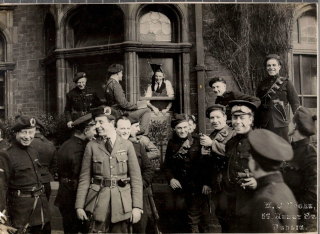
Recruitment begins for the Black and Tans (Irish: Dúchrónaigh), Britain’s unofficial auxiliary army, on January 2, 1920. They are constables recruited into the Royal Irish Constabulary (RIC) as reinforcements during the Irish War of Independence. Recruitment begins in Great Britain and about 10,000 men enlist during the conflict. The vast majority are unemployed former British soldiers who had fought in World War I. Some sources count a small number of Irishmen as Black and Tans.
The British administration in Ireland promotes the idea of bolstering the RIC with British recruits. They are to help the overstretched RIC maintain control and suppress the Irish Republican Army (IRA), although they are less well trained in ordinary policing. The nickname “Black and Tans” arises from the colours of the improvised uniforms they initially wear, a mixture of dark green RIC (which appears black) and khaki British Army. They serve in all parts of Ireland, but most are sent to southern and western regions where fighting is heaviest. By 1921, Black and Tans make up almost half of the RIC in County Tipperary, for example.
The Black and Tans gain a reputation for brutality and become notorious for reprisal attacks on civilians and civilian property, including extrajudicial killings, arson and looting. Their actions further sway Irish public opinion against British rule and draw condemnation in Britain.
The Black and Tans are sometimes confused with the Auxiliary Division, a counterinsurgency unit of the RIC, also recruited during the conflict and made up of former British officers. However, sometimes the term “Black and Tans” covers both groups. The Ulster Special Constabulary (USC) is founded to reinforce the RIC in Northern Ireland.
More than a third leave the service before they are disbanded along with the rest of the RIC in 1922, an extremely high wastage rate, and well over half receive government pensions. Over 500 members of the RIC die in the conflict and more than 600 are wounded. Some sources state that 525 police, including 152 Black and Tans and 44 Auxiliaries, are killed in the conflict.
Many Black and Tans are left unemployed after the RIC is disbanded and about 3,000 are in need of financial assistance after their employment in Ireland is terminated. About 250 Black and Tans and Auxiliaries, among over 1,300 former RIC personnel, join the Royal Ulster Constabulary. Another 700 join the Palestine Police Force which is led by former British Chief of Police in Ireland, Henry Hugh Tudor. Others are resettled in Canada or elsewhere by the RIC Resettlement branch. Those who return to civilian life sometimes have problems re-integrating. At least two former Black and Tans are hanged for murder in Britain, and another wanted for murder commits suicide before the police can arrest him.
Due to the Tans’ behaviour in Ireland, feelings continue to run high regarding their actions. The term can still stir bad reactions because of their remembered brutality. One of the best-known Irish Republican songs is Dominic Behan‘s “Come Out, Ye Black and Tans.” The Irish War of Independence is sometimes referred to as the “Tan War” or “Black-and-Tan War.” This term is preferred by those who fought on the anti-Treaty side in the Irish Civil War and is still used by Republicans today. The “Cogadh na Saoirse” (“War of Independence”) medal, awarded since 1941 by the Irish government to IRA veterans of the War of Independence, bears a ribbon with two vertical stripes in black and tan.
Some sources say the Black and Tans were officially named the “RIC Special Reserve”, but this is denied by other sources, which say they were not a separate force but “recruits to the regular RIC” and “enlisted as regular constabulary.” Canadian historian D. M. Leeson has not found any historical documents that refer to the Black and Tans as the “Royal Irish Constabulary Special Reserve.”
(Pictured: A group of Black and Tans and Auxiliaries outside the London and North Western Hotel in Dublin following an attack by the IRA, April 1921)
At the age of 20, O’Hanlon is killed on January 1, 1957, along with Seán South while taking part in an attack on the Royal Ulster Constabulary barracks in Brookeborough, County Fermanagh, during the border campaign. Several other IRA members are wounded in the botched attack. The IRA flees the scene in a dumper truck. They abandon it near the border. They leave South and O’Hanlon, both then unconscious, in a cow byre, and crossed into the Republic of Ireland on foot for help for their comrades. The wounded IRA men are treated as “car crash victims” by sympathetic staff in the Mater Misericordiae Hospital in Dublin.
O’Hanlon’s mother remains firmly committed to the IRA and is hurt by the suggestion that there was an alternative to IRA activity or that her son was anything other than an Irish hero.
A marble monument now stands at the spot where South and O’Hanlon lost their lives. An annual lecture has been held in memory of O’Hanlon since 1982, and approximately 500 people attended a 50th commemoration of the men’s deaths in January 2007 in Limerick.
In 1971, a monument is unveiled to O’Hanlon in his hometown on a hill overlooking the Clones Road on which he had made his last journey home. A Gaelic football team is founded in Monaghan in 2003 and called the Fergal O’Hanlons.
Browne grows up in the Bogside area of Derry. The Browne family also lives in Athlone and Ballinrobe for a period of time. His mother Mary Therese (née Cooney) is born in 1885 in Hollymount, County Mayo. His father Joseph Brown, a Royal Irish Constabulary (RIC) sergeant, later works as an inspector for the National Society for the Prevention of Cruelty to Children and, partly as a result of this work, all of the Browne family becomes infected with tuberculosis. Both parents die of the disease during the 1920s. His father is the first to die, leaving only £100 behind to support a wife and seven children. Fearing that if she and the children remain in Ireland they will be forced into a workhouse, Mary sells all their possessions and takes the family to London. Within two days of their arrival, Mary is dead, later buried in a pauper’s grave. Of her seven children, six contract tuberculosis. Noël is only one of two Browne children to survive into adulthood after those bouts with TB.
In 1929, Browne is admitted free of charge to St. Anthony’s, a preparatory school in Eastbourne, England. He then wins a scholarship to Beaumont College, the Jesuitpublic school near Old Windsor, Berkshire, where he befriends Neville Chance, a wealthy boy from Dublin. Neville’s father, the eminent surgeon Arthur Chance, subsequently pays Browne’s way through medical school at Trinity College Dublin.
In 1940, while still a student, Browne suffers a serious relapse of tuberculosis. His treatment at a sanatorium in Midhurst, Sussex is paid for by the Chance family. He recovers, passes his medical exams in 1942, and starts his career as a medical intern at Dr. Steevens’ Hospital in Dublin, where he works under Bethel Solomons. He subsequently works in numerous sanatoria throughout Ireland and England, witnessing the ravages of the disease. He soon concludes that politics is the only way in which he can make an attack on the scourge of tuberculosis.
The poverty and tragedy that had shaped Browne’s childhood deeply affects him. He considers both his survival and his level of education a complete fluke, a stroke of random chance that saved him when he was seemingly destined to die unknown and in poverty like the rest of his family. He finds this completely distasteful and is moved to enter politics as a means to ensure no one else would suffer the same fate that had befallen his family.
A ‘White Paper’ on proposed healthcare reforms had been prepared by the previous government, and results in the 1947 Health Act. In February 1948, Browne becomes Minister for Health and starts the reforms advocated by the Paper and introduced by the Act.
The health reforms coincide with the development of a new vaccine and of new drugs (e.g., BCG and penicillin) that help to treat a previously untreatable group of medical conditions. Browne introduces mass free screening for tuberculosis sufferers and launches a huge construction program to build new hospitals and sanitoria, financed by the income and accumulated investments from the Department of Health-controlled Hospital Sweeps funds. This, along with the introduction of Streptomycin, helps dramatically reduce the incidence of tuberculosis in Ireland.
As Minister for Health Browne comes into conflict with the bishops of the Catholic Church and the medical profession over the Mother and Child Scheme. This plan, also introduced by the 1947 Health Act, provides for free state-funded healthcare for all mothers and children aged under 16, with no means test, a move which is regarded as radical at the time in Ireland, but not in the rest of Europe. Virtually all doctors in private practice oppose the scheme, because it would undermine the “fee for service” model on which their income depended.
The Church hierarchy, which controls many hospitals, vigorously opposes the expansion of “socialised medicine” in the Irish republic. They claim that the Mother and Child Scheme interferes with parental rights, and fear that the provision of non-religious medical advice to mothers will lead to birth control contrary to Catholic teaching. They greatly dislike Browne, seeing him as a “Trinity Catholic,” one who has defied the Church’s ruling that the faithful should not attend Trinity College Dublin, which had been founded by Protestants and for many years did not allow Catholics to study there.
Under pressure from bishops, the coalition government backs away from the Mother and Child Scheme and forces Browne’s resignation as Minister for Health. Following his departure from government, he embarrasses his opponents by arranging for The Irish Times to publish TaoiseachJohn A. Costello‘s and MacBride’s correspondence with the Catholic hierarchy, which details their capitulation to the bishops.
The controversy over the Mother and Child Scheme leads to the fall of the coalition government in which Browne had served as a Minister. But Church opposition to socialised medicine continues under the subsequent Fianna Fáil-led government. The hierarchy does not accept a no-means-test mother-and-infant scheme even when Fianna Fáil reduces the age limit from sixteen years to six weeks, and the government again backs down.
After his resignation as Minister for Health, Browne leaves Clann na Poblachta, but is re-elected to the Dáil as an Independent TD from Dublin South-East in the subsequent election.
Browne joins Fianna Fáil in 1953 but loses his Dáil seat at the 1954 Irish general election. He fails to be selected as a candidate for the 1957 Irish general election and he resigns from the party. He is re-elected at that election for Dublin South-East as an Independent TD.
In 1977 Browne is the first Irish parliamentarian to call for law reforms in regard to homosexuality, which is illegal at the time, and in 1979 is one of the few Irish politicians to attend the opening of the Hirschfeld Centre, Dublin’s first full-time LGBT community space.
In 1990, a number of left-wing representatives within the Labour Party, led by Michael D. Higgins, approach Browne and suggest that he should be the party’s candidate in the presidential election due later that year. Though in failing health, Browne agrees. However, the offer horrifies party leader Dick Spring and his close associates for two reasons. Firstly, the leadership had secretly decided to run Mary Robinson, a barrister and former senator. Secondly, many around Spring are “appalled” at the idea of running Browne, believing he has “little or no respect for the party” and is “likely in any event to self-destruct as a candidate.” When Spring informs Browne by telephone that the party’s Administrative Council has chosen Robinson over him, Browne hangs up the telephone.
Browne spends the remaining seven years of his life constantly criticising Robinson who had gone on to win the election, thus becoming the seventh President of Ireland, and who is considered highly popular during her term. During the campaign he also indicates support for the rival Fine Gael candidate, Austin Currie.
After retiring from politics, Browne moves with his wife Phyllis to Baile na hAbhann, County Galway. He dies at the age of 81 in the Regional Hospital, Galway, on May 21, 1997. He is buried in a small graveyard near Baile na hAbhann.
Mulcahy is born in Manor Street, Waterford, County Waterford, on May 10, 1886, the son of post office clerk Patrick Mulcahy and Elizabeth Slattery. He is educated at Mount Sion Christian Brothers School and later in Thurles, County Tipperary, where his father is the postmaster.
Mulcahy is second-in-command to Thomas Ashe in an encounter with the armed Royal Irish Constabulary (RIC) at Ashbourne, County Meath, during the 1916 Easter Rising, one of the few stand-out victories won by republicans in that week and generally credited to Mulcahy’s grasp of tactics. In his book on the Rising, Charles Townshend principally credits Mulcahy with the defeat of the RIC at Ashbourne, for conceiving and leading a flanking movement on the RIC column that had engaged with the Irish Volunteers. Arrested after the Rising, he is interned at Knutsford and at the Frongoch internment camp in Wales until his release on December 24, 1916.
Mulcahy and Michael Collins are largely responsible for directing the military campaign against the British during the Irish War of Independence. During this period of upheaval in 1919, he marries Mary Josephine (Min) Ryan, sister of Kate and Phyllis Ryan, the successive wives of Seán T. O’Kelly. Her brother is James Ryan. O’Kelly and Ryan both later serve in Fianna Fáil governments.
Mulcahy supports the Anglo-Irish Treaty of December 1921. Archive film shows that Mulcahy, as Minister of Defence, is the Irish officer who raises the Irish tricolour at the first hand-over of a British barracks to the National Army in January 1922. He is defence minister in the Provisional Government on its creation and succeeds Collins, after the latter’s assassination, as Commander-in-Chief of the Provisional Government’s forces during the subsequent Irish Civil War.
Mulcahy earns notoriety through his order that anti-Treaty activists captured carrying arms are liable for execution. A total of 77 anti-Treaty prisoners are executed by the Provisional Government. He serves as Minister for Defence in the new Free State government from January 1924 until March 1924, but resigns in protest because of the sacking of the Army Council after criticism by the Executive Council over the handling of the “Army Mutiny,” when some National Army War of Independence officers almost revolt after he demobilises many of them at the end of the Irish Civil War. He re-enters the cabinet as Minister for Local Government and Public Health in 1927.
After the resignation of W. T. Cosgrave as Leader of Fine Gael in 1944, Mulcahy becomes party leader while still a member of the Seanad. Thomas F. O’Higgins is parliamentary leader of the party in the Dáil at the time and Leader of the Opposition. Facing his first general election as party leader, Mulcahy draws up a list of 13 young candidates to contest seats for Fine Gael. Of the eight who run, four are elected. He is returned again to the 12th Dáil as a TD for Tipperary at the 1944 Irish general election. While Fine Gael’s decline had been slowed, its future is still in doubt.
Following the 1948 Irish general election Mulcahy is elected for Tipperary South, but the dominant Fianna Fáil party finishes six seats short of a majority. However, it is 37 seats ahead of Fine Gael, and conventional wisdom suggests that Fianna Fáil is the only party that can possibly form a government. Just as negotiations get underway, however, Mulcahy realises that if Fine Gael, the Labour Party, the National Labour Party, Clann na Poblachta and Clann na Talmhan band together, they would have only one seat fewer than Fianna Fáil and, if they can get support from seven independents, they will be able to form a government. He plays a leading role in persuading the other parties to put aside their differences and join forces to consign the then Taoiseach and Fianna Fáil leader Éamon de Valera, to the opposition benches.
Mulcahy initially seems set to become Taoiseach in a coalition government. However, he is not acceptable to Clann na Poblachta’s leader, Seán MacBride. Many Irish republicans had never forgiven him for his role in the Irish Civil War executions carried out under the Cosgrave government in the 1920s. Consequently, MacBride lets it be known that he and his party will not serve under Mulcahy. Without Clann na Poblachta, the other parties would have 57 seats between them — 17 seats short of a majority in the 147-seat Dáil. According to Mulcahy, the suggestion that another person serve as Taoiseach comes from Labour leader William Norton. He steps aside and encourages his party colleague John A. Costello, a former Attorney General of Ireland, to become the parliamentary leader of Fine Gael and the coalition’s candidate for Taoiseach. For the next decade, Costello serves as the party’s parliamentary leader while Mulcahy remained the nominal leader of the party.
Mulcahy goes on to serve as Minister for Education under Costello from 1948 until 1951. Another coalition government comes to power at the 1954 Irish general election, with Mulcahy once again stepping aside to become Minister for Education in the Second Inter-Party Government. The government falls in 1957, but he remains as Fine Gael leader until October 1959. In October the following year, he tells his Tipperary constituents that he does not intend to contest the next election.
Mulcahy dies from natural causes at the age of 85 in Dublin on December 16, 1971. He is buried in Littleton, County Tipperary.
The INLA is founded by former members of the Official Irish Republican Army who oppose that group’s ceasefire. It is initially known as the “People’s Liberation Army” or “People’s Republican Army.” The INLA wages a paramilitary campaign against the British Army and Royal Ulster Constabulary (RUC) in Northern Ireland. It is also active to a lesser extent in the Republic of Ireland, Great Britain and Continental Europe. High-profile attacks carried out by the INLA include the Droppin Well bombing (1982), the Shankill Road killings (1994) and the assassinations of Airey Neave (1979) and Billy Wright (1997). However, the INLA is smaller and less active than the main republican paramilitary group, the Provisional Irish Republican Army (IRA). It is also weakened by feuds and internal tensions. Members of the group use the covernames People’s Liberation Army, People’s Republican Army, and Catholic Reaction Force for attacks its volunteers carry out but for which the INLA does not want to claim responsibility. The INLA becomes a proscribed group in the United Kingdom on July 3, 1979, under the 1974 Prevention of Terrorism Act.
After a 24-year armed campaign, the INLA declares a ceasefire on August 22, 1998. In August 1999, it states that “There is no political or moral argument to justify a resumption of the campaign.” On October 11, 2009, speaking at the graveside of its founder Seamus Costello in Bray, the INLA formally announces an end to its armed campaign, stating the current political framework allows for the pursuit of its goals through peaceful, democratic means and begins decommissioning its weapons.
The IRSP supports a “No First Strike” policy, that is allowing people to see the perceived failure of the Northern Ireland peace process for themselves without military actions.
The INLA is a proscribed organisation in the United Kingdom under the Terrorism Act 2000 and an illegal organisation in the Republic of Ireland.
(Pictured: INLA logo consisting of the Starry Plough and the Flag of Ireland with a red star and a fist holding an AK-47-derivative rifle)
Stack is born to William Stack, an attorney’s clerk, and Nanette O’Neill. He is educated at the Christian Brothers School in Tralee. At the age of fourteen, he leaves school and becomes a clerk in a solicitor‘s office. A gifted Gaelic footballer, he captains the Kerry team to All-Ireland victory in 1904. He also serves as President of the Kerry Gaelic Athletic Association County Board.
Stack becomes politically active in 1908 when he joins the Irish Republican Brotherhood (IRB). In 1916, as commandant of the Kerry Brigade of the Irish Volunteers, he makes preparations for the landing of arms by Roger Casement. He is made aware that Casement was arrested on Easter Saturday and was being held in Tralee. He makes no attempt to rescue him from Ballymullen Barracks.
Stack, as part of his role as Minister for Home Affairs, is widely credited with the creation and administration of the Dáil Courts. These are courts run by the Irish Republican Army (IRA) in parallel and opposition to the judicial system being run by the British government. The IRA and Sinn Féin are highly successful in both getting the civilian population of Ireland to use the courts and accept their rulings. The success of this initiative gives Sinn Féin a large boost in legitimacy and supports their goals in creating a “counter-state” within Ireland as part of their overarching goals in the Irish War of Independence.
Stack opposes the Anglo-Irish Treaty of 1921 and takes part in the subsequent Irish Civil War. He is captured in 1923 and goes on hunger strike for forty-one days before being released in July 1924.
In 1925, Stack marries Winifred (Una) Gordon, (née Cassidy), the widow of a Royal Irish Constabulary (RIC) district inspector, Patrick Gordon.
Stack’s health never recovers following his hunger strike and he dies at the age of 49 in a Dublin hospital on April 27, 1929.
Austin Stack Park in his hometown of Tralee, one of the Gaelic Athletic Association’s stadiums, is named in his honour, as is the Austin Stacks GAA hurling and Gaelic football club.
O’Connor is educated in St. Mary’s College, Dublin, and then in Clongowes Wood College, County Kildare, a public school run by the Jesuit order. It is also attended by the man who later condemns O’Connor to death, his close friend Kevin O’Higgins. He studies experimental physics, logic, and metaphysics. He also attends the College of Science, Merrion Street. He takes a BA (1906) and receives a B.Eng (1911). In 1910, he takes his Bachelor of Engineering and Bachelor of Arts degrees at University College Dublin (UCD), then known as the National University. Prominent in the university’s Literary and Historical Society, he advocates militant constitutional nationalism as one of the many society members active in the Young Ireland branch of the United Irish League.
During the subsequent Irish War of Independence (1919-21) O’Connor is Director of Engineering of the Irish Republican Army (IRA), a military organisation descended from the Irish Volunteers. The specialist skills of engineering and signaling are essential to the development of the 5th Battalion, Dublin Brigade. Its men are forbidden frontline duty as their contribution is regarded as vital, their number too small. But units only expand on an incremental local basis, disappointing General Richard Mulcahy.
O’Connor is also involved in the Republican breakout from Strangeways Prison in Manchester, England, on October 25, 1919. Michael Collins takes a particular interest in the escape and actually visits Austin Stack in the prison under a false name to finalise the arrangements. IRA men hold up traffic while a ladder is propped up against the outside of a prison wall. In all six prisoners escape, among them Piaras Beaslaí.
O’Connor refuses to accept the Anglo-Irish Treaty of 1921, which establishes the Irish Free State. It is ratified by a narrow vote in Dáil Éireann, the Irish parliament. He and many like him feel that the Treaty copper-fastens the partition of the six counties of Northern Ireland and undermines the Irish Republic declared in 1916.
On January 10, a meeting is held at O’Connor’s home in Monkstown, Dublin. In attendance are all senior anti-Treaty IRA officers except Liam Mellows. O’Connor is appointed to chair this grouping, known as the Republican Military Council. It is agreed that an IRA convention should be called without delay; failing this, a separate GHQ will be formed. At a further meeting in O’Connor’s office on March 20, a temporary IRA GHQ staff is elected under Liam Lynch as chief of staff. O’Connor remains in charge of engineering.
On March 26, 1922, the anti-Treaty officers of the IRA hold a convention in Dublin, in which they reject the Treaty and repudiate the authority of the Dáil. However, they are prepared to discuss a way forward. The convention meets again on April 9. It creates a new army constitution and places the army under a newly elected executive of 16 men, including O’Connor, that are to choose an army council and headquarters staff. Asked by a journalist if this development means the anti-Treatyites ware proposing a “military dictatorship” in Ireland, O’Connor replies, “You can take it that way if you want.”
On April 14, 1922, O’Connor is one of a number of IRA leaders in a 200-strong force that occupies the Four Courts building in the centre of Dublin in defiance of the Provisional Government. They intend to provoke the British troops, who are still in the country, into attacking them, which they believe will restart the war with Britain and re-unite the IRA against their common enemy. They also occupy other smaller buildings regarded as being associated with the former British administration, such as the Ballast Office and the Freemasons‘ Hall in Molesworth Street, but the Four Courts remains the focus of interest. On June 15, O’Connor sends out men to collect the rifles that belong to the mutineers of the Civic Guards.
Michael Collins tries desperately to persuade the IRA men to leave the Four Courts. At the Third IRA Convention on June 18, the Executive is split over whether the Irish Government should demand that all British troops leave within 72 hours. A motion to this effect, opposed by Lynch, is narrowly defeated, whereupon O’Connor and others leave the meeting to set up a separate GHQ. The IRA effectively splits into two factions opposed to the government.
On June 22, 1922, Sir Henry Wilson is assassinated in London by two IRA men, Reginald Dunne and Joseph O’Sullivan, each a former British soldier. Some now argue that this was done on the orders of Michael Collins, who had been a close friend of Dunne’s in the London Irish Republican Brotherhood (IRB). Prime MinisterDavid Lloyd George writes an angry letter to Collins, which includes the line “…still less can Mr. Rory O’Connor be permitted to remain his followers and his arsenal in open rebellion in the heart of Dublin… organizing and sending out from this centre enterprises of murder not only in the area of your Government…”
On June 28, 1922, after the Four Courts garrison has kidnapped J. J. “Ginger” O’Connell, a general in the National Army, Collins gives orders for the shelling of the Four Courts with borrowed artillery lent by Winston Churchill. The shelling leads to the Four Courts catching fire, damaging parts of the building in addition to destroying numerous government documents. O’Connor is one of 130 men that surrender on June 30, some of whom are arrested and imprisoned in Mountjoy Prison. This incident marks the official start of the Irish Civil War, as fighting breaks out openly around the country between pro- and anti-Treaty factions.
On December 8, 1922, along with three other republicans, Liam Mellows, Richard Barrett and Joe McKelvey, captured with the fall of the Four Courts, O’Connor is executed by firing squad in reprisal for the anti-Treaty IRA’s killing of Free State Teachta Dála (TD) Sean Hales. The execution order is signed by Kevin O’Higgins. O’Connor had been best man at O’Higgins’s wedding on October 27, 1921. Their deaths remain a symbol of the bitterness and division of the Irish Civil War. O’Connor, one of 77 republicans executed by the Provisional Government, is seen as a martyr by the Republican movement in Ireland.
On O’Connor’s execution, the equestrienne Joan de Sales La Terriere, a close friend of his, names her son in his honour. “Rory O’Connor Place” in Arklow is named in his honour. There is also a pub in Crumlin, Dublin, named after him and a housing estate near Dún Laoghaire, County Dublin, called “Rory O’Connor Park.” A Sinn Féincumann (UCD) is named after him.
(Pictured: Rory O’Connor addressing members of the IRA’s Dublin City Brigade at Smithfield, April 1922)
Dirrane is born in Oatquarter in the townland of Kilmurvey on Inishmore, Aran Islands, County Galway on November 15, 1894. She is the youngest child of Joseph Gillan and Maggie (née Walsh). Her father is a weaver of flannel cloth and has a small farm. She has four brothers and three sisters. Her oldest brother is a fisherman, who dies at age 21 in 1901, and her father dies before 1911. Despite this hardship, all of the children go to school, with one of her brothers becoming an Irish teacher, and later an Irish inspector. The family speaks Irish at home, but they are all bilingual with English. She is schooled at the national school in Oatquarter until the age of 14. She leaves to work in local homes, looking after children. When she writes her memoirs late in life, she claims to have met Joseph Plunkett, Éamonn Ceannt, Thomas MacDonagh, Thomas Ashe and Patrick Pearse when they visited the island, visiting a house where she looked after the children, discussing politics and plans for the Easter Rising with them. She is a republican, becoming a member of Cumann na mBan in 1918 while she is working for Fr. Matthew Ryan as a housekeeper. She is involved in drilling and assisting fugitives from the authorities. Because of their known republican sympathies, the Black and Tans raid the Gillan family homes.
Dirrane moves to Dublin in 1919 to train in Saint Ultan’s Children’s Hospital as a nurse. She is still under surveillance, being arrested alongside her employer, Claude Chavasse, when she is working as a nurse in his house. She is held in Dublin’s Bridewell Garda Station for two days before being transferred to Mountjoy Prison. In the time of her imprisonment, she is not charged or put on trial. Her refusal to speak English angers the guards, culminating in her going on hunger strike for a number of days in 1920 until she is released. She takes part in the Cumann na mBan vigil outside of Mountjoy Prison in November 1920, when Kevin Barry is hanged.
Dirrane works in Richard Mulcahy‘s house for two years, before emigrating to the United States in 1927 to continue her career as a nurse. She works in Boston where she is an active member of the Irish emigrant community alongside former neighbours from the Aran Islands and some relatives. She works in a hotel for a time but returns to nursing after her marriage to Edward ‘Ned’ Dirrane in November 1932 in the Jamaica Plain section of Boston. Ned, a labourer in Boston and also from Inishmore, dies from heart failure in 1940. Dirrane continues her career nursing in hospitals and as a district nurse. On May 13, 1940, she naturalises as U.S. citizen. During World War II, she works as a nurse in a munitions factory, and at a U.S. Army Air Forcesbomber base in Mississippi. She canvases for John F. Kennedy in the Irish community in South Boston when he runs for president in 1960. Jean Kennedy Smith visits Dirrane in 1997 in Galway to acknowledge her contribution. She also meets Senator Edward Kennedy.
Following her retirement, Dirrane lives with her nephew, but she returns to the Aran Islands in 1966 at age 72. There she lives with her brother-in-law, Pat Dirrane, a widower with three grown sons. They marry in a private ceremony on April 27, 1966. She continues to live on the island after Pat’s death on February 28, 1990, living with her stepson. She eventually moves into a nursing home in Newcastle in the suburbs of Galway. When she celebrates her 100th birthday, she funds a statue of Our Lady Mary at a holy well in Corough on Inishmore. At age 103, the matron of her nursing home arranges for a local writer, Jack Mahon, to record her memories and collate the information into a book. The book, A Woman of Aran, is published in 1997 and is a bestseller for several weeks. She is awarded an honorary degree, an MA honoris causa, from NUI Galway in May 1998, the oldest person to ever receive one.
Dirrane dies at age 109 on December 31, 2003, in Galway. She is buried on Inishmore.
O’Riordan joins the Communist Party of Ireland in 1935 while still in the IRA and works on the communist newspaper The Irish Workers’ Voice. In 1937, following the urgings of Peadar O’Donnell, several hundred Irishmen, mostly IRA or ex-IRA men, go to fight for the Spanish Republic in the Spanish Civil War with the XVth International Brigade. They are motivated in part by enmity towards the 800 or so Blueshirts, led by Eoin O’Duffy who go to Spain to fight on the “nationalist” side in the Irish Brigade. He accompanies a party led by Frank Ryan. In the Republic’s final offensive of July 25, 1938, he carries the flag of Catalonia across the River Ebro. On August 1, he is severely injured by shrapnel on the Ebro front. He is repatriated to Ireland the following month, after the International Brigades are disbanded.
In 1938 O’Riordan is offered an Irish Army commission by the Irish Free State but chooses instead to train IRA units in Cork. As a result of his IRA activities during World War II, or the Emergency as it is known in neutral Ireland, he is interned in the Curragh internment camp from 1939 until 1943 where he is Officer Commanding of the Cork Hut and partakes in Máirtín Ó Cadhain’s Gaelic League classes as well as publishing Splannc (Irish for “Spark,” named after Vladimir Lenin‘s newspaper).
In 1944 O’Riordan is founding secretary of the Liam Mellows Branch of the Labour Party and in 1945 is a founding secretary of the Cork Socialist Party, whose other notable members include Derry Kelleher, Kevin Neville and Máire Keohane-Sheehan.
In 1947, O’Riordan is a founding secretary of the Irish Workers’ League and general secretary thereafter, and of its successor organisation the Irish Workers’ Party from 1962–70.
In all O’Riordan runs for election five times, campaigning throughout for the establishment of a socialist republic in Ireland but given Ireland’s Catholic conservatism and fear of communism, he does so without success. He does, however, receive playwright Sean O’Casey‘s endorsement in 1951.
O’Riordan’s participation in the Spanish Civil War is always an important part of his political identity. In 1966 he attends the International Brigades’ Reunion in Berlin and is instrumental in having Frank Ryan’s remains repatriated from Germany to Ireland in 1979.
O’Riordan is a member of the Irish Chile Solidarity Committee and attends the 1st Party Congress of the Communist Party of Cuba in 1984. He also campaigns on behalf of the Birmingham Six and attends their Appeal trial in 1990. He serves as General Secretary of the Communist Party of Ireland (1970–83) and as National Chairman of the party (1983–88). He publishes many articles under the auspices of the CPI.
O’Riordan’s last major public outing comes in 2005 at the re-dedication of the memorial outside Dublin’s Liberty Hall to the Irish veterans of the Spanish Civil War. He and other veterans are received by President of IrelandMary McAleese. He is also presented with Cuba’s Medal of Friendship by the Cuban Consul Teresita Trujillo to Ireland on behalf of Cuban President Fidel Castro.
In 1969, according to Soviet dissident Vasili Mitrokhin, O’Riordan is approached by IRA leaders Cathal Goulding and Seamus Costello with a view to obtaining guns from the Soviet KGB to defend Irish republican areas of Belfast during the communal violence that marks the outbreak of the Troubles. Mitrokhin alleges that O’Riordan then contacts the Kremlin, but the consignment of arms does not reach Ireland until 1972. The operation is known as Operation Splash. The IRA splits in the meantime between the Provisional IRA and the Official IRA and it is the latter faction who receives the Soviet arms. Mitrokhin’s allegations are repeated in Boris Yeltsin‘s autobiography.
O’Riordan’s book, Connolly Column – The Story of the Irishmen who fought for the Spanish Republic 1936–1939, is published in 1979 and deals with the Irish volunteers of the International Brigade who fought in support of the Spanish Republic against Francisco Franco in the Spanish Civil War (1936–1939). An updated version of the book is reprinted in 2005 and is launched by the Lord Mayor of Dublin, Cllr. Michael Conaghan at a book launch at SIPTU headquarters, Liberty Hall. The book is the inspiration for Irish singer-songwriter Christy Moore‘s famous song “Viva la Quinta Brigada.”
In 1991, O’Riordan’s wife dies at the age of 81 at their home. He continues to live in their family home before moving to Glasnevin in 2000 to be close to his son Manus who lives nearby. He lives there until falling ill in November 2005 and is taken to the Mater Hospital. His health rapidly deteriorates, and he quickly develops Alzheimer’s disease. Soon afterwards he is moved to St. Mary’s Hospital in the Phoenix Park where he spends the final few months of his life, before his death at the age of 88 on May 18, 2006.
O’Riordan’s funeral at Glasnevin Crematorium is attended by over a thousand mourners. Following a wake the previous night at Finglas Road, hundreds turn up outside the house of his son Manus and traffic grounds to a halt as family, friends and comrades – many of whom are waving the red flag of the Communist Party of Ireland – escort O’Riordan to Glasnevin Cemetery. A secular ceremony takes place led by Manus O’Riordan, Head of Research at SIPTU, with contributions from O’Riordan’s family, Communist Party general secretary Eugene McCartan and IBMT representative Pauline Frasier.