Cahir Healy, Irish nationalist politician, is born in Mountcharles, County Donegal, on December 2, 1877. He is a leader of northern Nationalists and is a self educated man who makes major contributions to Ireland’s cultural and literary heritage.
Healy is re-elected in 1923, but remains in custody until the following year, in which he does not defend his seat. Instead, he is elected to represent the seat in the House of Commons of Northern Ireland in the 1925 Northern Ireland general election, but does not take his seat until 1927 due to the Nationalist abstentionist policy. In 1928 he becomes a founder of the National League of the North. In 1929, with the break-up of the large Fermanagh and Tyrone constituency, he switches to sit for the new seat of South Fermanagh. In a 1931 Fermanagh and Tyrone by-election he is again elected for Fermanagh and Tyrone to the British Parliament, but stands down again in 1935.
Healy becomes an insurance official but continues to write, his output including journalism, poetry and short stories. He is interned by the United Kingdom government for a year during World War II under Defence Regulation 18B. In 1950 he is elected to the British House of Commons for a third time, on this occasion representing Fermanagh and South Tyrone. He finally sits in the British Parliament in 1952, and holds the seat until he stands down in 1955. He leaves the Northern Ireland House of Commons in 1965, by which point he is the Father of the House.
Healy dies on February 8, 1970, at the age of 92 at Enniskillen, County Fermanagh.
(Pictured: Portrait of Cahir Healy by Lafayette, half-plate nitrate negative, July 7, 1932, given by Pinewood Studios via Victoria and Albert Museum, 1989, National Portrait Gallery, London)
Pádraic Ó Conaire, Irish writer and journalist whose production is primarily in the Irish language, dies in Dublin on October 6, 1928. In his lifetime he writes 26 books, 473 stories, 237 essays and 6 plays. His acclaimed novel Deoraíocht has been described by Angela Bourke as “the earliest example of modernist fiction in Irish.”
Ó Conaire is born in the Lobster Pot public house on the New Docks in Galway, County Galway, on February 28, 1882. His father is a publican, who owns two premises in the town., and his mother is Kate McDonagh. He is orphaned by the age of eleven. He spends a period living with his uncle in Gairfean, Ros Muc, Connemara. The area is in the Gaeltacht (Irish-speaking area) and Ó Conaire learns to speak Irish fluently.
Ó Conaire emigrates to London in 1899 where he gets a job with the Board of Education and becomes involved in the work of the Gaelic League. A pioneer in the Gaelic revival in the last century, he and Pádraig Pearse are regarded as being the two most important Irish language short story writers during the first decades of the 20th century.
Ó Conaire marries Molly Ní Mhanais, with whom he has four children: Eileen (b. 22 Feb 1905), Patrick (b. 3 Nov 1906), Kathleen (b. 24 Feb 1909), and Mary Josephine (b. 28 Jul 1911), who dies of diphtheria in 1922.
Ó Conaire returns to Ireland in 1914, leaving his family in London. Living mostly in Galway, he earns a meagre living through writing, teaching at Gaeltacht summer schools, and as an occasional organiser for the Gaelic League.
Ó Conaire dies at the age of 46 on October 6, 1928, while on a visit to Dublin, after complaining of internal pains while at the head office of the Gaelic League. His fellow poet Frederick Robert Higgins writes a celebrated Lament for Pádraic Ó Conaire.
Ó Conaire has family still living to this day in England, as well as in Galway and Canada. The Ó Conaire surname is still strong in the Ros Muc area.
Ó Conaire’s short story M’asal Beag Dubh is the inspiration for an Internet-based satire on the football transfer market. The fictitious character Masal Bugduv is created. The name sounds similar to the Gaelic pronunciation of M’asal Beag Dubh. Journalists who did not fact check quite as thoroughly as they should have missed the satire and tell the world of the up-and-coming Moldovan star.
A statue of Ó Conaire’s is unveiled in 1935 by Éamon de Valera in Eyre Square in the heart of Galway City. It is popular with tourists until it is decapitated by four men in 1999. It is repaired at a cost of £50,000 and moved to Galway City Museum in 2004. A bronze replica of the statue is unveiled in Eyre Square in November 2017.
Guinness is born Hermione Maria-Gabrielle von Urach, the only child of the marriage of Albrecht von Urach, from Lichtenstein Castle, a member of the royal house of Wurtemberg, and Rosemary Blackadder (1901–1975) from Berwickshire in Scotland, a journalist and artist, who are married in Oslo, Norway in 1931. For the first few months of her life, she is very ill. In 1934, her parents, both working as journalists, move the family to Venice. They later move again to Japan. Her mother develops depression, and in 1937 tries to gain uninvited access to Emperor Hirohito‘s palace with her daughter. This results in her mother being arrested, sedated, and deported, which is the beginning of a decline in her mental health which culminates in a lobotomy in 1941 and spending the rest of her life in private mental institutions. Urach is returned to Europe, where she is raised by her godmother, Hermione Ramsden, in Surrey and Norway. She is educated by as many as seventeen governesses, with brief spells in boarding schools. Until the age of eighteen she is known as Gabrielle.
Urach meets Desmond Guinness in 1951, when she is nineteen, and they are married in Oxford in 1954. They have two children, Patrick (born 1956) and Marina (born 1957).
The couple moves to Ireland in 1955 where they rent Carton House, County Kildare. They share a love of Georgian architecture which results in them buying Leixlip Castle in 1958 and establishing the Irish Georgian Society on February 21 of the same year. Through the society they campaign for the restoration and protection of architectural sites such as Mountjoy Square, the gateway to the Dromana estate in County Waterford, the Tailors’ Hall in Dublin, and Conolly’s Folly in County Kildare. In 1967 they purchase Castletown House, also in County Kildare, with a plan to restore it, and make it a base for the Irish Georgian Society.
During the 1960s Leixlip Castle is a hub for those interested in architecture and conservation, and the Guinnesses work hands-on on a range of projects. By 1969, their marriage is in difficulties and Guinness moves to London. She later moves to Glenarm, County Antrim to live with Hugh O’Neill, and when that relationship ends, she returns to Leixlip Castle, but a divorce is finalised in 1981. Having lived in Dublin for a time, she rents Tullynisk House, the dower house of Birr Castle in County Offaly in 1983. Guinness becomes isolated and develops a problem with alcohol. While returning to Ireland from Wales on a car ferry on May 8, 1989, she has a massive heart attack which is compounded by a reaction to an injection of penicillin. She is buried at Conolly’s Folly.
Through Patrick, Guiness becomes grandmother of the fashion model Jasmine Guinness. Her daughter Marina is a patron of the arts and of Irish musicians including Glen Hansard, Damien Rice, and the band Kíla. Marina has three children of her own: Patrick (by Stewart Copeland of The Police), Violet (by photographer Perry Ogden), and Finbar (by record producer Denny Cordell).
In 2020, a new film on Guinness’s life and work, entitled Memory of Mariga, receives its United States premiere as part of the Elizabethtown Film Festival on Saturday, September 19, at the Crowne Pointe Theatre in Elizabethtown, Kentucky. In 2021, the same film receives its Irish premiere at the Fastnet Film Festival.
O’Donoghue is born to Irish parents and grows up in the Hans Town area of Chelsea. He is the son of John O’Donoghue, a bricklayer from Kilworth, County Cork, and Bridget Griffin, who is from County Tipperary. He is the third of nine children, and has four brothers, Thomas, John, James, and Edmund, and four sisters, Mary, Ellen, Katherine, and Agnes. He is first an upholsterer‘s apprentice from the age of sixteen before becoming a journalist and author.
O’Donoghue attends a Catholic school and furthers his education at the British Museum. He begins his journalistic work by writing for the Dublin papers upon subjects relating to Irish music, art, and literature. A founder-member of the Irish Literary Society in London, he is also vice president of the National Literary Society, Dublin, and the compiler of a biographical dictionary, The Poets of Ireland (1891–93; revised edition, 1912), with entries on 2,000 authors. His published works also include Irish Poetry of the Nineteenth Century (1894), Humor of Ireland (1894), List of 1300 Irish Artists (1894), The Life and Writings of James Clarence Mangan (1897), Bibliographical Catalogue of Collections of Irish Music (1899), and Geographical Distribution of Irish Ability (1906).
In 1896 O’Donoghue moves to Dublin. In 1909 he becomes librarian of University College Dublin. He is co-editor of Catalogue of the Gilbert Library (in Dublin; 1918). William Butler Yeats writes of him in his Autobiographies of William Butler Yeats (1938).
Moloney, aged 55, who lives alone at Portobello Place on the south side of Dublin, is on his way home when he is attacked. He is punched in the side of the head and falls to the ground as the two men in their 20s attack him. The incident is caught on CCTV and police make quick arrests just hours after the murder. Officers believe Moloney may have been robbed as he lay unconscious on the ground, as his wallet and identification are missing.
A murder investigation is launched after a post mortem examination confirms that Moloney had died from serious head injuries as a result of the assault.
Formerly with The Irish News in Belfast and the Irish Independent in Dublin, Moloney had been freelancing on his return from a spell teaching in Vietnam. His final article, on the Ulster Bank IT crisis, appears in the Irish edition of the Daily Mail just hours before his death.
Group Managing Editor of Independent Papers Ireland Ltd. Michael Denieffe pays tribute to Moloney in telling the Irish Independent, “On behalf of Independent Newspapers, I want to express our shock at the untimely death of our former colleague, Eugene Moloney. He was a resourceful and fearless journalist. It is a tragic irony that Eugene has died in an incident similar to many he would have recorded in his years working for the Evening Herald and the Irish Independent. Our sympathies go to his family and friends.”
The Irish News editor Noel Doran tells the paper he is deeply shocked by the death of his good friend Eugene Moloney. “Eugene and I studied journalism together at the former College of Business Studies in Belfast in the late 1970s, and went on to share flats over a number of years. Eugene was a talented and respected reporter with The Irish News during the height of the Troubles and was also the paper’s music columnist for a lengthy period.”
(From: “Journalist Eugene Moloney murdered as attempted robbery goes wrong in Dublin” by Patrick Counihan, IrishCentral, http://www.irishcentral.com, June 25, 2012)
Article 38 of the Constitution of Ireland empowers Dáil Éireann to establish “special courts” with wide-ranging powers when the “ordinary courts are inadequate to secure the effective administration of justice.” The Offences against the State Act 1939 leads to the establishment of the Special Criminal Court for the trial of certain offences. The scope of a “scheduled offence” is set out in the Offences Against the State (Scheduled Offences) Order 1972.
On May 26, 1972, the Government of Ireland exercises its power to make a proclamation pursuant to Section 35(2) of the Offences against the State Act 1939 which leads to the establishment of the Special Criminal Court for the trial of certain offences. The current court is first established by the Dáil under the Offences against the State Act 1939 to prevent the Irish Republican Army (IRA) from subverting Ireland’s neutrality during World War II and the Emergency. The current incarnation of the Special Criminal Court dates from 1972, just after the Troubles in Northern Ireland began.
Although the court is initially set up to handle terrorism-related crime, its remit has been extended and it has been handling more organised crime cases after the Provisional Irish Republican Armyceasefire in the 1990s. For instance, members of the drugs gang which murdered journalistVeronica Guerin were tried in the Special Criminal Court.
Section 35(4) and (5) of the Offences against the State Act 1939 provide that if at any time the Government or the Parliament is satisfied that the ordinary courts are again adequate to secure the effective administration of justice and the preservation of public peace and order, a rescinding proclamation or resolution, respectively, shall be made terminating the Special Criminal Court regime. To date, no such rescinding proclamation or resolution has been promulgated. Following the introduction of a regular Government review and assessment procedure on January 14, 1997, reviews taking into account the views of the relevant State agencies are carried out on February 11, 1997, March 24, 1998, and April 14, 1999, and conclude that the continuance of the Court is necessary, not only in view of the continuing threat to State security posed by instances of violence, but also of the particular threat to the administration of justice, including jury intimidation, from the rise of organised and ruthless criminal gangs, principally involved in drug-related and violent crime.
The Special Criminal Court has been criticised by the Irish Council for Civil Liberties, Amnesty International and the United Nations Commission on Human Rights for its procedures and for being a special court, which ordinarily should not be used against civilians. Among the criticisms are the lack of a jury and the increasing use of the court to try organised “ordinary” crimes rather than the terrorist cases it was originally set up to handle. Critics also argue that the court is now obsolete since there is no longer a serious terrorist threat to the State, although others disagree and cite the continuing violence from dissident republican terrorism, international terrorism and serious gangland crime.
Under the law, the court is authorised to accept the opinion of a Garda Síochána chief-superintendent as evidence that a suspect is a member of an illegal organisation. However, the court has been reluctant to convict on the word of a garda alone, without any corroborating evidence.
The Sinn Féin political party in the past has stated that it is their intention to abolish the Special Criminal Court as they believed it was used to convict political prisoners in a juryless court, however Sinn Féin are no longer in favour of its abolition. Some prominent Sinn Féin members, including Martin Ferris and Martin McGuinness, have been convicted of offences by it. In 1973 McGuinness was tried at the SCC, which he refused to recognise, after being arrested near a car containing 250 pounds (110 kg) of explosives and nearly 5,000 rounds of ammunition. He was convicted and sentenced to six months imprisonment.
(Pictured: The Criminal Courts of Justice complex in Dublin where Special Criminal Court (SCC) sittings are usually held)
Austin Clarke, considered at his death to be the greatest poet of his generation after W. B. Yeats, is born in 83 Manor Street, Stoneybatter, Dublin, on May 9, 1896. He also writes plays, novels and memoirs. His main contribution to Irish poetry is the rigour with which he uses technical means borrowed from classical Irish language poetry when writing in English.
Effectively, this means writing English verse based not so much on metre as on complex patterns of assonance, consonance, and half rhyme. Describing his technique to Robert Frost, Clarke says, “I load myself down with chains and try to wriggle free.”
Clarke’s early poetry clearly shows the influence of Yeats. His first book, The Vengeance of Fionn, is a long narrative poem retelling an Ossianic legend. It meets with critical acclaim and, unusually for a first book of poetry, goes to a second edition. Between this and the 1938 volume Night and Morning, he publishes a number of collections, all of which, to one extent or another, can be seen as being written in the shadow of Yeats. There is, however, one significant difference. Unlike the older poet, Clarke is a Catholic, and themes of guilt and repentance run through this early work.
Between 1938 and 1955, Clarke publishes no new lyric or narrative poetry. He is co-founder of the Lyric Theatre, Dublin and writes a number of verse plays for them. He also works as a journalist and has a weekly poetry programme on RTÉ radio. It seems likely that he also experiences some kind of personal crisis during this time, and this has significant consequences for his later poetry.
Clarke returns to publishing poetry with the 1955 collection Ancient Lights and is to continue writing and publishing prolifically for the remainder of his life. Although he continues to use the same Gaelic-derived techniques, this late poetry is markedly different from his earlier work. Many of the later poems are satires of the Irish church and state, while others are sensual celebrations of human sexuality, free of the guilt of the earlier poems. He also publishes the intensely personal Mnemosyne Lay in Dust, which is a poem sequence detailing the fictional Maurice Devanes’s nervous breakdown and subsequent recovery.
Clarke also comes to admire the work of more avant-garde poets like Ezra Pound and Pablo Neruda, both of whom he writes poems about. A number of the late long poems, such as, for instance, the 1971 Tiresias, show the effects of studying these poets and their looser formal structures. He sets up the Bridge Press to publish his own work, which allows him the freedom to publish work that many mainstream Irish publishers of the time might have been reluctant to handle. His Collected Poems is published in 1974 and a Selected Poems in 1976.
In addition to some twenty volumes of poetry and numerous plays, Clarke publishes three novels: The Bright Temptation (1932), The Singing Men at Cashel (1936), and The Sun Dances at Easter (1952). All of these are banned by the Censorship of Publications Board (Ireland). He also publishes two volumes of memoirs, Twice Round the Black Church (1962) and A Penny in the Clouds (1968), and a number of scattered critical essays and book reviews. While all of these prose writings are of interest, his reputation rests firmly on his poetry.
In 1920 Clarke marries Cornelia (Lia) Cummins. The marriage effectively lasts only a few days, and he spends several months in St. Patrick’s Hospital recovering from it, but they do not divorce before Cummins dies in 1943. He meets, has three sons with, and later marries (1945) Norah Esmerelda Patricia Walker (1900–1985), granddaughter of Matthew Harris, MP for East Galway from 1885 to 1890.
Clarke lives in Bridge House beside Templeogue Bridge which spans the River Dodder in the south Dublin suburb of Templeogue. After his death on March 19, 1974, there is a proposal to preserve the house and his library of 6,500 books as a memorial. This is not possible owing to long-term plans to demolish the house and widen the road. The old Templeogue Bridge, built in 1800, and Bridge House are removed. A new bridge is opened by CouncillorBernie Malone, Chairman Dublin City Council, on December 11, 1984, which is renamed Austin Clarke Bridge in his honour.
Williams is descended on his father’s side from the yeomen of Worcestershire who grew their orchards and tilled their land in the parishes of Tenbury and Mamble. His mother’s side descended from Scottish settlers who planted Ulster in 1610. He is educated at Belfast Academy in Belfast and at a Greenwich private school. Later on, he goes to the southern United States for health purposes and takes part in a filibustering expedition to Nicaragua, where he sees some hard fighting and reportedly earns the reputation of a blockade runner. He is separated from his party and is lost in the forest for six days. Fevered, he discovers a small boat and manages to return to the nearest British settlement. He serves in the London Irish Rifles with the rank of Sergeant.
Williams returns to England in 1859, where he becomes a volunteer, and a leader writer for the London Evening Herald. In October 1859, he begins a connection with The Standard which lasts until 1884. From 1860 until 1863, he works as a first editor for the Evening Standard and from 1882 until 1884, as editor of The Evening News.
Williams is best known for being a war correspondent. For The Standard, he is at the headquarters of the Armée de la Loire, a French army, during the Franco-Prussian War in 1870. He is also one of the first correspondents in Strasbourg, where the French forces are defeated. In the summer and autumn of 1877, he is a correspondent to Ahmed Muhtar Pasha who commands the Turkish forces in Armenia during the Russo-Turkish War (1877-78). He remains constantly at the Turkish front, and his letters are the only continuous series that reaches England. In 1878, he publishes this series in a revised and extended form as The Armenian Campaign: A Diary of the Campaign on 1877, in Armenia and Koordistan, which is a large and accurate record of the war, even though it is pro-Turkish. From Armenia, he follows Muhtar Pasha to European Turkey and describes his defence of the lines of Constantinople against the Imperial Russian Army. He is with General Mikhail Skobelev at the headquarters of the Imperial Russian Army when the Treaty of San Stefano is signed in March 1878.
At the end of 1878, Williams is in Afghanistan reporting the war, and in 1879 publishes the Notes on the Operations in Lower Afghanistan, 1878–9, with Special Reference to Transport.
Williams dies in Brixton, London on February 9, 1904, and is buried in Nunhead Cemetery in London. His funeral is well attended by the press as well as members of the military including Field Marshal Sir Evelyn Wood.
(Pictured: Portrait of Charles Frederick Williams, London President, The Institute of Journalists, from The Illustrated London News, September 30, 1893 issue)
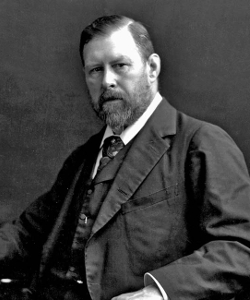
Stoker is born on November 8, 1847, in Clontarf, Dublin. During his lifetime, he is better known as the personal assistant of actor Henry Irving and business manager of the Lyceum Theatre, London, which Irving owns.
Stoker’s father, Abraham Stoker, is a civil servant and his mother, Charlotte Mathilda Blake Thornley, is a charity worker and writer. Stoker is a sickly child and is bedridden with an unknown illness until he starts school at the age of seven, when he makes a complete recovery. Growing up his mother tells him a lot of horror stories which may have influence on his later writings.
In 1864 Stoker enters Trinity College, Dublin. While attending college he begins working as an Irish civil servant. He also works part time as a free lance journalist and drama critic. In 1876 he meets Henry Irving, a famous actor, and they soon become friends. Not long after that, Stoker meets and falls in love with an aspiring actress named Florence Balcombe whom he marries on December 4, 1878 at St. Anne’s Parish Church, Dublin. In 1878 he accepts a job working in London as Irving’s personal secretary.
On December 9, Stoker and his new wife move to England to join Irving. His first book The Duties of Clerks of Petty Sessions in Ireland, though written while he is still in Dublin, is published in 1879. On December 30, 1879 Stoker and his wife have their only child, a son Noel. While in England Stoker also writes several novels and short stories. His first book of fiction, Under the Sunset, is published in 1881.
Stoker visits the English coastal town of Whitby in 1890, a visit that is said to be part of the inspiration for Dracula. Before writing Dracula, he meets Ármin Vámbéry, a Hungarian writer and traveler. Dracula likely emerges from Vámbéry’s dark stories of the Carpathian Mountains. Stoker then spends several years researching European folklore and mythological stories of vampires.
Dracula is an epistolary novel, written as a collection of realistic but completely fictional diary entries, telegrams, letters, ship’s logs, and newspaper clippings, all of which add a level of detailed realism to the story, a skill which Stoker develops as a newspaper writer. At the time of its publication, Dracula is considered a “straightforward horror novel” based on imaginary creations of supernatural life.
The original 541-page typescript of Dracula is believed to have been lost until it is found in a barn in northwestern Pennsylvania in the early 1980s. It consists of typed sheets with many emendations, plus handwritten on the title page is “THE UN-DEAD.” The author’s name is shown at the bottom as Bram Stoker. The typescript is purchased by Microsoft co-founder Paul Allen.
After suffering a number of strokes, Abraham “Bram” Stoker dies at No. 26 St. George’s Square, London on April 20, 1912. Some biographers attribute the cause of death to tertiary syphilis, others to overwork. He is cremated and his ashes are placed in a display urn at Golders Green Crematorium in north London.
As a member of the Irish Confederation during the Great Famine, Reilly together with John Mitchel and James Fintan Lalor advocate the refusal to pay rents, retention of crops by small tenant farmers and labourers to feed their own families, and the breaking up of bridges and tearing up of railway lines to prevent the removal of food from the country.
Reilly is involved in the failed Young Ireland Rebellion of 1848 and is forced to flee to the United States where he becomes active in U.S. political affairs in support of Irish independence. He is reported to be the founder of The People newspaper in New York City which folds after six months in 1849.
James Connolly claims that as the editor of the Protective Union labour rights newspaper for the printers of Boston, Reilly is a pioneer of American labour journalism and that Horace Greeley believed of his series of articles in The American Review on the European situation “that if collected and published as a book, they would create a revolution in Europe.”
It is possible that Connolly confuses The United States Magazine and Democratic Review, which is known for its political activism, with The American Review, which for a time had Edgar Allan Poe as an editorial assistant. Other sources refer to Reilly as being editor of the New York Democratic Review and later the Washington Union.
Thomas Devin Reilly dies at the age of 30 on March 5, 1854. He is buried at Mount Olivet Cemetery in Washington, D.C., together with his infant child Mollie and wife Jennie Miller from Enniskillen.