seamus dubhghaill

Promoting Irish Culture and History from Little Rock, Arkansas, USA


2 Comments

Birth of James Patrick Mahon, Journalist, Barrister & Parliamentarian

James Patrick Mahon, Irish nationalist journalist, barrister, parliamentarian and international mercenary, is born into a prominent Roman Catholic family in Ennis, County Clare, on March 17, 1803.

Mahon, the eldest of four children, is the son of Patrick Mahon of New Park, who took part in the Irish Rebellion of 1798, and Barbara, a considerable heiress and the only daughter of James O’Gorman of Ennis. He studies at Clongowes Wood College, where he is one of the earliest pupils, and at Trinity College Dublin, where he takes his BA in 1822 and his MA in law in 1832. Following his father’s death in 1821, he inherits half the family property and becomes a magistrate for Clare.

In 1830, Mahon marries Christina, the daughter of John O’Brien of Dublin. She is an heiress and has property valued at £60,000 in her own right, which gives him the resources to seek election to parliament. The couple spends little time together, and she dies apart from him in Paris in 1877. They have one son who dies in 1883.

In 1826, Mahon joins the newly formed Catholic Association. He encourages fellow member Daniel O’Connell to stand for election at the 1828 Clare by-election. O’Connell’s election, in which Mahon plays a large role, persuades the British Government to pass the Roman Catholic Relief Act 1829, which finalises the process of Catholic Emancipation and permitted Roman Catholics to sit in the British Parliament.

As a result, when Mahon is elected for Clare at the 1830 United Kingdom general election, he is entitled to take his seat. However, during the election campaign he quarrels with O’Connell, and after his election he is unseated for bribery. He is subsequently acquitted and stands again at the 1831 United Kingdom general election, but is defeated by two O’Connell-backed candidates, one of whom is his old schoolfriend Maurice O’Connell, Daniel O’Connell’s son. He gives up on politics, becomes deputy lieutenant of Clare, and captain of the local militia.

Mahon becomes a barrister in 1834, but the following year, he leaves for Paris. There he associates with Charles Maurice de Talleyrand-Périgord, becoming a favourite at Louis Philippe‘s court and working as a journalist. He travels the world, spending time in both Africa, where he befriends Ferdinand de Lesseps, engineer of the Suez Canal, and South America, before returning to Ireland in 1846.

At the 1847 United Kingdom general election, Mahon is elected for Ennis and declares himself a Whig in favour of Irish Repeal. However, he opposes the Young Irelanders and narrowly loses his seat at the 1852 United Kingdom general election.

Following his defeat in the 1852 election, Mahon returns to Paris, then travels on to Saint Petersburg, where he serves in the Imperial Bodyguard. During this period, he journeys through lands from Finland to Siberia. He then travels across China, India and Arabia. His finances largely exhausted, he serves as a mercenary in the Ottoman and Austrian armies before returning to England in 1858. Late that year, he leaves for South America, where he attempts to finance the construction of a canal through Central America.

After exploits abroad Mahon returns to Ireland in 1871 and is a founding member of the Home Rule League. Nearly ruined by his ventures, he even ends up at the Old Bailey as a consequence of his dealings but is acquitted. He is defeated in Ennis at the 1874 United Kingdom general election, and also at the 1877 Clare by-election. Finally, he wins the 1879 Clare by-election and holds the seat at the 1880 United Kingdom general election.

Mahon is a close associate of Charles Stewart Parnell, who he successfully nominates for the leadership of the League in 1880 but is dropped in 1885 as a party candidate because of his age and his tendency to vote with the Liberal Party in Parliament. He is also embroiled in a court case disputing the will of his son.

Parnell personally ensures Mahon is a candidate at the 1887 County Carlow by-election, which he wins at the age of 87 as a Liberal. By this point, he is the oldest MP in the House of Commons of the United Kingdom. He dies at his home in South Kensington, London on June 15, 1891, while still in office.

Mahon had served alongside William O’Shea as an MP, and the two were close friends. He introduced him and Katharine O’Shea, his wife, to Parnell. After Parnell is named in the O’Sheas’ divorce case in 1890, Mahon splits with Parnell, siding with the Irish National Federation. However, Parnell attends Mahon’s funeral in Glasnevin Cemetery a few months later.

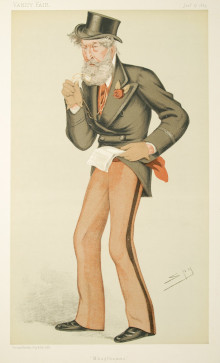
(Pictured: Caricature of James Patrick Mahon by Sir Leslie Matthew Ward under the pseudonym “Spy” published in Vanity Fair in 1885)

Leave a comment

Death of William O’Brien, Journalist & Politician

William O’Brien, Irish nationalist, journalist, agrarian agitator, social revolutionary, politician, party leader, newspaper publisher, author and Member of Parliament (MP) in the House of Commons of the United Kingdom of Great Britain and Ireland, dies suddenly on February 25, 1928, at the age of 75 while on a visit to London with his wife.

O’Brien, who is for several years second only to Charles Stewart Parnell among Irish Nationalist leaders, is born on October 2, 1852, in Mallow, County Cork. He is perhaps most important for his Plan of Campaign (1886), by which Irish tenant farmers withhold all rent payments from landlords who refuse to lower their rents and instead pay the money into a mutual defense fund on which evicted tenants can draw.

O’Brien shares his primary education with a townsman with whom he is later to have a close political connection, Canon Patrick Augustine Sheehan of Doneraile. He enjoys his secondary education at the Cloyne diocesan college, which results in his being brought up in an environment noted for its religious tolerance. He greatly values having had this experience from an early age, which strongly influences his later views for the need of such tolerance in Irish national life.

A journalist from 1869, O’Brien is appointed editor of the Irish Land League’s weekly United Ireland by Parnell in 1881. In October of that year the British authorities suppress the paper and put O’Brien in Kilmainham Gaol in Dublin, along with Parnell and others. There he draws up a No Rent Manifesto, which, when read at a Land League meeting, results in the outlawing of the League. Released from prison in 1882, he resumes the editorship of United Ireland, and in 1883 he is elected to the British House of Commons, remaining there until 1895. His “plan of campaign” is disavowed by Parnell but nonetheless stirs up fierce agitation. To suppress the movement, the British government passes the Criminal Law and Procedure (Ireland) Act 1887, under which O’Brien is jailed again.

For some time following the Katherine O’Shea divorce case (1889–90), in which Parnell is correspondent, O’Brien attempts to mediate between the Parnellites and their opponents, although he sides with the majority in rejecting Parnell’s continued leadership of the Irish Home Rule struggle. In 1902 he supports the Land Conference, which secures agreement between landlords and tenants’ representatives and results in George Wyndham‘s Land Purchase Act (1903), which is designed to turn Irish tenant farmers into occupying owners.

In 1898 O’Brien founds the United Irish League, and in 1910, after control of that group passes to the Parnellite John Redmond, he establishes the All-for-Ireland League in opposition to the older organization. Most of his personal following, however, join Arthur Griffith’s Sinn Féin party by the end of World War I.

Retiring from political life, O’Brien contents himself with writing and declines Éamon de Valera‘s offer to stand for Fianna Fáil in the 1927 general election. He dies suddenly at the age of 75 on February 25, 1928, while on a visit to London with his wife. His remains rest in Mallow, and one of the principal streets in the town bears his name to this day. His head-bust overlooks the town Council’s Chamber Room and one of his finest portraits hangs in University College Cork.


Leave a comment

Death of Author Benedict “Ben” Kiely

Benedict “Ben” Kiely, Irish writer and broadcaster, dies in St. Vincent’s University Hospital in Dublin on February 9, 2007.

Kiely is born in Dromore, County Tyrone on August 15, 1919, the youngest of six children. In 1920, the family moves from Dromore to Omagh. After living for a short time in Castle Street and Drumragh, the family finally settles in St. Patrick’s Terrace in the Gallows Hill area of Omagh. This area is to be a lasting inspiration for Kiely.

Kiely begins to feel the urge to become a writer during his teenage years. He has a keen interest in the work of George Bernard Shaw, H. G. Wells and Jonathan Swift. In 1936, after completing his education at Mount St. Columba Christian Brothers School in Omagh, he goes to work as a sorting clerk in the Omagh Post Office.

However, Kiely soon realises that the post office will not provide him with the life of the scholar which he so desires. In the spring of 1937, he leaves Omagh and begins a new life in Emo Park, Portarlington, County Laois, where he decides to train as a Jesuit priest. His life as a Jesuit is not meant to be for, exactly a year later, in the spring of 1938, he suffers a serious spinal injury, which results in a lengthy stay in Cappagh National Orthopaedic Hospital in Finglas, Dublin. During his hospitalisation, he is given plenty of time to think about the course his life has already taken, and about a course it might take. He also realises that he lacks a vocation to the priesthood and abandons his training as a Jesuit.

When Kiely gets out of hospital in 1939, he returns to Omagh to recover from his back problem. The following year, he begins working as a part-time journalist in the weekly Catholic Standard newspaper. In 1943, he graduates from National University of Ireland with a B.A. in History and Letters.

In 1945, Kiely begins working for the Irish Independent, where he is employed as a journalist and critic. In 1950, he joins The Irish Press as a literary editor. In 1964, he moves to the United States where, over a period of four years, he is a Writer-in-Residence at Emory University, visiting professor at the University of Oregon, and Writer-in-Residence at Hollins College (Virginia). In 1968, he returns to Ireland. In the spring of 1976, he is Distinguished Visiting Professor at the University of Delaware. He continues to receive acclaim for his writing and journalism, a career which spans over six decades, receiving the Award for Literature from the Irish Academy of Letters. By now, he is one of Ireland’s best-known writers. In 1996, he is named Saoi of Aosdána, the highest honour given by the Arts Council of Ireland.

Kiely visits Omagh in 2001 which is marked by the unveiling of a plaque outside his childhood home on Gallows Hill by Omagh’s Plain Speaking Community Arts group. Every September an event is held in Omagh called The Benedict Kiely Literary Weekend to celebrate his many achievements.

Benedict Kiely dies in St. Vincent’s University Hospital in Dublin on February 9, 2007.


Leave a comment

Death of Michael Dwyer, Journalist & Film Critic

Michael Dwyer, journalist and film critic who writes for The Irish Times for more than 20 years, dies following a lengthy illness on January 1, 2010. He previously fills this role for the Sunday Tribune, The Sunday Press and the magazine In Dublin.

Born on May 2, 1951, Dwyer is originally from Saint John’s Park in Tralee, County Kerry. His mother, Mary, outlives him. He has two sisters, Anne and Maria. As a young man in the early 1970s he takes part in the Tralee Film Society, for which he provides notes to The Kerryman. At this time, he is employed by the County Library in Tralee. He begins working for In Dublin followed by the Sunday Tribune and The Sunday Press.

Dwyer first travels to the Cannes Film Festival in 1982 and attends every one until 2009, months before his death. In 1985, he co-founds the Dublin Film Festival and directs it until the mid-1990s. In 2002, he co-founds the Dublin International Film Festival, of which he is the chairman. In later life he serves on the board of the Irish Museum of Modern Art.

In the 1990s, Dwyer presents the film show Freeze Frame for public service broadcaster RTÉ. The show results from a friendship he had formed with Alan Gilsenan and Martin Mahon of Yellow Asylum Films. He is also known for his appearances on the radio shows Morning Ireland and The Marian Finucane Show. The editor of The Irish Times, Geraldine Kennedy, speaking after Dwyer’s death, says he was an “enthusiastic advocate” of both national and international cinema and had once said he was “one of those lucky people in life who was able to pursue his interests and call them work.”

Dwyer becomes unwell following a trip to the Cannes Film Festival in May 2009. He takes a break from writing for The Irish Times, returning in December 2009 to contribute his first, and what is to be his last ever, piece in six months to weekly entertainment supplement The Ticket. The article is a review of cinema in 2009 and of the 2000s, and in his contribution, he references the ill health which had haunted him for much of the previous year and which had prevented him from viewing any cinema releases between June and September.

Dwyer dies at the age of 58 on January 1, 2010. His partner of 24 years, Brian Jennings, survives him. Irish Minister for Arts, Sport and Tourism Martin Cullen says Dwyer was “the most singular, significant influence on cinema in Ireland for more than three decades.” President of the Labour Party Michael D. Higgins says his work was “incalculable […] he was an activist in promoting a knowledge and appreciation of film in all its forms.” Ireland’s former Director of Film Classification at the Irish Film Classification Office John Kelleher says it was “a huge loss for the world of Irish film.” There are tributes from Gabriel Byrne, Daniel Day-Lewis, Brendan Gleeson, Jonathan Rhys Meyers, Cillian Murphy and Jim Sheridan. The Irish Times publishes tribute pieces on his life.

A ceremony takes place at the Church of the Holy Name in Ranelagh where Dwyer lived. The event is attended by notable politicians, journalists, artists, actors, writers and musicians. RTÉ newsreader Aengus Mac Grianna, a colleague of Jennings, reads a tribute to Dwyer. Daniel Day-Lewis gives a very special tribute at the church service to his dear friend of over 20 years, calling for the Jameson International Dublin Film Festival to be renamed in Dwyer’s honour.

Dwyer is cremated after the funeral on January 5, 2010.


Leave a comment

Birth of John Mitchel, Nationalist Activist & Journalist

John Mitchel, Irish nationalist activist, author, and political journalist, is born in Camnish, near Dungiven, County Derry on November 3, 1815.

Mitchel is the son of a Presbyterian minister. At the age of four, he is sent to a classical school, run by an old minister named Moor, nicknamed “Gospel Moor” by the students. He reads books from a very early age. When a little over five years old, he is introduced to Latin grammar by his teacher and makes quick progress. In 1830, not yet 15 years old, he enters Trinity College, Dublin and obtains a law degree in 1834.

In the spring of 1836 Mitchel meets Jane Verner, the only daughter of Captain James Verner. Though both families are opposed to the relationship, they become engaged in the autumn and are married on February 3, 1837, by the Rev. David Babington in Drumcree Church, the parish church of Drumcree.

Mitchel works in a law office in Banbridge, County Down, where he eventually comes into conflict with the local Orange Order. He meets Thomas Davis and Charles Gavan Duffy during visits to Dublin. He joins the Young Ireland movement and begins to write for The Nation. Deeply affected by the misery and death caused by the Great Famine, he becomes convinced that nothing will ever come of the constitutional efforts to gain Irish freedom. He then forms his own paper, United Irishmen, to advocate passive resistance by Ireland’s starving masses.

In May 1848, the British tire of Mitchel’s open defiance. Ever the legal innovators in Ireland, they invent a crime especially for the Young Irelanders – felony-treason. They arrest him for violating this new law and close down his paper. A rigged jury convicts him, and he is deported first to Bermuda and then to Australia. However, in June 1853, he escapes to the United States.

Mitchel works as a journalist in New York City and then moves to the South. When the American Civil War erupts, he is a strong supporter of the Southern cause, seeing parallels with the position of the Irish. His family fully backs his commitment to the Southern cause. He loses two sons in the war, one at the Battle of Gettysburg in 1863 and another at the Battle of Fort Sumter in 1864, and another son loses an arm. His outspoken support of the Confederacy causes him to be jailed for a time at Fort Monroe, where one of his fellow prisoners is Confederate President Jefferson Davis.

In 1874, the British allow Mitchel to return to Ireland and in 1875 he is elected in a by-election to be a member of the Parliament of the United Kingdom representing the Tipperary constituency. However, his election is invalidated on the grounds that he is a convicted felon. He contests the seat again in the resulting by-election and is again elected, this time with an increased vote.

Unfortunately, Mitchel, one of the staunchest enemies to English rule of Ireland in history, dies in Newry on March 20, 1875, and is buried there. Thirty-eight years later, his grandson, John Purroy Mitchel, is elected Mayor of New York City.


Leave a comment

Geraldine Kennedy Appointed Editor of The Irish Times

Geraldine Kennedy, Irish journalist and politician, is appointed editor of The Irish Times on October 11, 2002, becoming the first female editor of a national daily newspaper.

Kennedy is born on September 1, 1951, in Tramore, County Waterford. She studies at Dublin Institute of Technology and begins her journalistic career with a regional newspaper, The Munster Express. She moves to The Cork Examiner after less than a year but spends only a few years there before joining The Irish Times.

On the foundation of the Sunday Tribune in 1980, Kennedy joins it as the paper’s political correspondent. The paper’s publisher, John Mulcahy, had become familiar with her when she had contributed to his journal Hibernia. When the Tribune briefly ceases production, she moves to the Sunday Press.

In 1982, Kennedy’s telephone, along with those of two other journalists, is tapped by former Minister for Justice Seán Doherty. Early in 1987, Kennedy successfully sues the incumbent Charles Haughey-led Fianna Fáil government for illegally tapping her phone. The revelation in 1992 that Haughey had ordered the phone taps leads to his resignation as Taoiseach.

Kennedy stands in the 1987 Irish general election as a candidate for the newly formed Progressive Democrats party in Dún Laoghaire. She comes third in the poll, winning 9.4% of the first-preference vote. She is one of fourteen Progressive Democrats TDs elected to Dáil Éireann in that election — a feat the party never achieves again. She is appointed the party’s spokesperson for foreign affairs. She stands again in the 1989 Irish general election and wins 9% of the first-preference vote but fails to retain her seat.

Following her election defeat, Kennedy returns to The Irish Times, then edited by Conor Brady, whom she had worked with at the Tribune when he was the editor. She avoids party-political journalism for several years, but she returns to covering politics in the early 1990s and becomes The Irish Times‘ political editor in 1999. She becomes the newspaper’s first female editor upon the departure of Conor Brady in October 2002. One of her rivals for the editor’s chair is the paper’s high-profile columnist, Fintan O’Toole.

Kennedy is paid more than the editor of Britain’s top non-tabloid newspaper The Daily Telegraph, which has a circulation of about nine times that of The Irish Times. Later columnist Fintan O’Toole tells the Sunday Independent, “We as a paper are not shy of preaching about corporate pay and fat cats but with this there is a sense of excess. Some of the sums mentioned are disturbing. This is not an attack on Ms. Kennedy, it is an attack on the executive level of pay. There is double standard of seeking more job cuts while paying these vast salaries.”

In September 2006, Kennedy approves the publication of an article in The Irish Times giving confidential details of investigations being made into payments purported to have been made in 1993 to Taoiseach Bertie Ahern. She refuses, upon request of the investigating Mahon Tribunal, to provide details of the source of the printed information. She responds that the documents have since been destroyed. Her refusal causes the Tribunal to seek High Court orders compelling her to provide details of the source. On October 23, 2007, the High Court grants the orders compelling her to go before the Tribunal and answer all questions. In its judgment, the High Court, criticising her decision to destroy the documents, says it is an “astounding and flagrant disregard of the rule of law.” In 2009, however, the Supreme Court of Ireland overturns this ruling, holding that the High Court had not struck the correct balance between the journalists’ right to protect their source and the tribunal’s right to confidentiality.

Kennedy announces on March 12, 2011, her intention to retire from The Irish Times by September, after a nine-year term as editor. She actually retires in June, and is succeeded by news editor, Kevin O’Sullivan, who succeeds her as editor on June 23, 2011.

In August 2012, Kennedy is appointed Adjunct Professor of Journalism at the University of Limerick. She has been awarded five honorary doctorates from Irish universities.


Leave a comment

Birth of Edmond Malone, Shakespearean Scholar

Edmond Malone, Shakespearean scholar and editor of the works of William Shakespeare, is born on October 4, 1741 in Dublin.

Malone is born to Edmond Malone Sr. (1704–1774), MP of the Irish House of Commons and judge of the Court of Common Pleas in Ireland, and Catherine Collier, the niece of Robert Knight, 1st Earl of Catherlough. He has two sisters, Henrietta and Catherine, and an older brother, Richard (later Lord Sunderlin). His father is a successful lawyer and politician in England, but his practice fails and he returns to Ireland. Little is known of his childhood and adolescence except that in 1747 he is sent to Dr. Ford’s preparatory school in Molesworth Street, Dublin. The next record of his education is ten years later, in 1757, when he enters Trinity College, Dublin. He receives his BA degree on February 23, 1762.

After practicing in Ireland as a lawyer and journalist, Malone settles in London in 1777. There he numbers among his literary friends Samuel Johnson, Horace Walpole, and the ballad collector Thomas Percy, the Bishop of Dromore. He also is an associate of the statesmen Edmund Burke and George Canning and of the dean of English painters, Sir Joshua Reynolds, who paints his portrait and whose literary works he collects and publishes (1797). The portrait now resides in the National Portrait Gallery, London.

In the following months Malone sends a steady stream of notes and corrections to George Steevens, who, by then the inheritor, from Samuel Johnson, of the editor’s mantle for the Jacob Tonson edition of Shakespeare’s collected works, is busy preparing a second edition. His main contribution appears in the first volume as “An Attempt to Ascertain the Order in Which the Plays Attributed to Shakspeare Were Written.”

Malone’s three supplemental volumes (1780–1783) to Steevens’ edition of Johnson’s Shakespeare, containing apocryphal plays, textual emendations, and the first critical edition of the sonnets, are landmarks in Shakespearean studies. His “Historical Account of the Rise and Progress of the English Stage, and of the Economy and Usages of the Ancient Theatres in England” (1800) is the first treatise on English drama based on original sources. His own edition of Shakespeare in 11 volumes appears in 1790. A new octavo edition, unfinished at his death, is completed by James Boswell, the son of Samuel Johnson’s biographer, and published in 1821 in 21 volumes. This work, which includes a memoir of Malone, is the standard edition of Shakespeare’s writings for more than a century.

Malone dies at the age of 70 in London on May 25, 1812.

(Pictured: Portrait of Edmond Malone by Joshua Reynolds (1778), National Portrait Gallery)


Leave a comment

Death of Tom Kettle, Economist, Journalist, Politician & Soldier

thomas-michael-kettle

Thomas Michael “Tom” Kettle, Irish economist, journalist, barrister, writer, war poet, soldier and Home Rule politician, dies on September 9, 1916, during the World War I Battle of the Somme in France.

Kettle is born on February 9, 1880, in Malahide or Artane, Dublin, the seventh of twelve children of Andrew J. Kettle (1833–1916), a leading Irish nationalist politician, progressive farmer, agrarian agitator and founding member of the Irish National Land League, and his wife, Margaret (née McCourt). One of his brothers is the industrial pioneer, Laurence Kettle. He is influenced considerably through his father’s political activities.

Like his brothers, Kettle is educated at the Christian Brothers‘ O’Connell School at Richmond Street, Dublin, where he excels. In 1894 he goes to study with the Jesuits at Clongowes Wood College in County Kildare, known as a wit and a good debater. He enjoys athletics, cricket and cycling and attains honours in English and French when leaving. He enters University College Dublin in 1897.

As a member of the Irish Parliamentary Party, Kettle is Member of Parliament (MP) for East Tyrone from 1906 to 1910 at Westminster. He is a much-admired old comrade of James Joyce, who considers him to be his best friend in Ireland, as well as the likes of Francis Sheehy-Skeffington, Oliver St. John Gogarty and Robert Wilson Lynd. He joins the Irish Volunteers in 1913 and upon the outbreak of World War I in 1914 enlists for service in the British Army.

Kettle is killed in action with ‘B’ Company of the 9th Battalion of the Royal Dublin Fusiliers in an attack on German lines on September 9, 1916, near the village of Ginchy during the Somme Offensive in France. During the advance he is felled when the Dublin Fusiliers are “struck with a tempest of fire,” and having risen from the initial blow, he is struck again and killed outright. His body is buried in a battlefield grave by the Welsh Guards, but the location of the grave is subsequently lost. His name is etched on the monumental arched gateway for the missing of the Somme at Thiepval.

Kettle is one of the leading figures of the generation who, at the turn of the twentieth century, give new intellectual life to Irish party politics, and to the constitutional movement towards All-Ireland Home Rule. A gifted speaker with an incisive mind and devastating wit, his death is regarded as a great loss to Ireland’s political and intellectual life.

As G. K. Chesterton surmises, “Thomas Michael Kettle was perhaps the greatest example of that greatness of spirit which was so ill rewarded on both sides of the channel […] He was a wit, a scholar, an orator, a man ambitious in all the arts of peace; and he fell fighting the barbarians because he was too good a European to use the barbarians against England, as England a hundred years before has used the barbarians against Ireland.”


Leave a comment

Birth of Joseph Thomas Sheridan Le Fanu, Journalist & Novelist

joseph-sheridan-le-fanu

Joseph Thomas Sheridan Le Fanu, journalist, novelist, and short story writer, often called the father of the modern ghost story, is born in Dublin on August 28, 1814. He is the leading ghost story writer of the nineteenth century and is central to the development of the genre in the Victorian era. His best-known works include Uncle Silas (1864), a suspense story, and The House by the Churchyard (1863), a murder mystery. His vampire story Carmilla, which influences Bram Stoker’s Dracula, has been filmed several times.

Le Fanu is born at 45 Lower Dominick Street in Dublin to Thomas Philip Le Fanu and Emma Lucretia Dobbin, a literary family of Huguenot, Irish, and English descent. Within a year of his birth the family moves to the Royal Hibernian Military School in Phoenix Park where his father, a Church of Ireland clergyman, is appointed to the chaplaincy of the establishment.

In 1826, the family moves to Abington, County Limerick, where Le Fanu’s father takes up his second rectorship. Le Fanu uses his father’s library to educate himself and by the age of fifteen he was writing poetry.

The disorders of the Tithe War (1831–1836) affect the region in 1832 and the following year the family temporarily moves back to Dublin, where Le Fanu works on a government commission. Although Thomas Le Fanu tries to live as though he is well-off, the family is in constant financial difficulty. At his death, Thomas has almost nothing to leave to his sons and the family has to sell his library to pay off some of his debts.

Le Fanu studies law at Trinity College, Dublin, where he is elected Auditor of the College Historical Society. He is called to the bar in 1839 but never practices and soon abandons law for journalism. In 1838 he begins contributing stories to the Dublin University Magazine, including his first ghost story, The Ghost and the Bone-Setter (1838). He becomes owner of several newspapers from 1840, including the Dublin Evening Mail and the Warder.

In 1847, Le Fanu supports John Mitchel and Thomas Francis Meagher in their campaign against the indifference of the government to the Irish Famine. Others involved in the campaign include Samuel Ferguson and Isaac Butt. Butt writes a forty-page analysis of the national disaster for the Dublin University Magazine in 1847. Le Fanu’s support costs him the nomination as Tory Member of Parliament (MP) for County Carlow in 1852.

In 1856 the family moves from Warrington Place to the house of his wife Susanna’s parents at 18 Merrion Square. His personal life becomes difficult at this time, as his wife suffers from increasing neurotic symptoms. She suffers from anxiety after the deaths of several close relatives, including her father two years previous. In April 1858, Susanna suffers a “hysterical attack” and dies the following day. She is buried in the Bennett family vault in Mount Jerome Cemetery beside her father and brothers. He does not write any fiction from this point until the death of his mother in 1861.

He becomes the editor and proprietor of the Dublin University Magazine in 1861 and begins to take advantage of double publication, first serializing in the Dublin University Magazine, then revising for the English market. He publishes both The House by the Churchyard and Wylder’s Hand in this manner. After lukewarm reviews of The House by the Churchyard, which is set in the Phoenix Park area of Dublin, Le Fanu signs a contract with Richard Bentley, his London publisher, which specifies that future novels be stories “of an English subject and of modern times,” a step Bentley thinks necessary for Le Fanu to satisfy the English audience. Le Fanu succeeds in this aim in 1864, with the publication of Uncle Silas, which is set in Derbyshire. In his very last short stories, however, Le Fanu returns to Irish folklore as an inspiration and encourages his friend Patrick Kennedy to contribute folklore to the Dublin University Magazine.

Le Fanu dies in his native Dublin on February 7, 1873, at the age of 58. Today there is a road and a park in Ballyfermot, near his childhood home in south-west Dublin, named after him.


Leave a comment

Birth of Novelist & Screenwriter Brian Moore

brian-moore

Brian Moore, novelist and screenwriter who is acclaimed for the descriptions in his novels of life in Northern Ireland after World War II, is born in Belfast, Northern Ireland on August 25, 1921. He has been described as “one of the few genuine masters of the contemporary novel.”

Moore is born into a large Roman Catholic family. His father, James Bernard Moore, is a prominent surgeon and the first Catholic to sit on the senate of Queen’s University Belfast. His mother, Eileen McFadden Moore, a farmer’s daughter from County Donegal, is a nurse. His uncle is the prominent Irish nationalist, Eoin MacNeill, founder of Conradh na Gaeilge and Professor of Irish at University College Dublin. He is educated at St. Malachy’s College, Belfast. He leaves the college in 1939, having failed his senior exams.

Moore is a volunteer air raid warden during World War II and serves during the Belfast Blitz in April and May 1941. He goes on to serve as a civilian with the British Army in North Africa, Italy and France. After the war ends, he works in Eastern Europe for the United Nations Relief and Rehabilitation Administration.

In 1948 Moore emigrates to Canada to work as a reporter for the Montreal Gazette and becomes a Canadian citizen. While eventually making his primary residence in California, he continues to live part of each year in Canada up to his death.

Moore lives in Canada from 1948 to 1958, where he meets his first wife, Jacqueline (“Jackie”) Sirois, a French Canadian and fellow journalist. They marry in 1952. He moves to New York City in 1959 to take up a Guggenheim Fellowship and remains there until his divorce in October 1967. He then moves to the west coast of the United States, settling in Malibu, California, with his new wife Jean Denney, a former commentator on Canadian TV. There he teaches creative writing at UCLA.

Moore writes his first novels in Canada. His earliest novels are thrillers, published under his own name or using the pseudonyms Bernard Mara or Michael Bryan. His first novel outside the genre, Judith Hearne, remains among his most highly regarded. The book is rejected by ten American publishers before being accepted by a British publisher. It is made into a film, with British actress Maggie Smith playing the lonely spinster who is the book/film’s title character.

Other novels by Moore are adapted for the screen, including Intent to Kill, The Luck of Ginger Coffey, Catholics, Black Robe, Cold Heaven, and The Statement. He co-writes the screenplay for Alfred Hitchcock‘s Torn Curtain, and writes the screenplay for The Blood of Others, based on the novel Le Sang des autres by Simone de Beauvoir.

Some of Moore’s novels feature staunchly anti-doctrinaire and anti-clerical themes, and in particular he speaks strongly about the effect of the Church on life in Ireland. A recurring theme in his novels is the concept of the Catholic priesthood. On several occasions he explores the idea of a priest losing his faith. At the same time, several of his novels are deeply sympathetic and affirming portrayals of the struggles of faith and religious commitment, Black Robe most prominently.

Moore dies at his Malibu home, which is celebrated in Seamus Heaney‘s poem Remembering Malibu, on January 11, 1999, from pulmonary fibrosis. His widow, Jean, lives on in the house until it is destroyed in 2018 in the Woolsey Fire.

At the time of his death, Moore is working on a novel about the 19th-century French symbolist poet Arthur Rimbaud. His last published work before his death is an essay entitled “Going Home.” It is a reflection inspired by a visit he made to the grave in Connemara of his family friend, the Irish nationalist Bulmer Hobson. The essay is commissioned by Granta and published in The New York Times on February 7, 1999.

In 1996, the Brian Moore Short Story Awards is launched by the Creative Writers Network in Northern Ireland and is open to all authors of Irish descent. Previous judges have included Glenn Patterson, Lionel Shriver, Carlo Gébler and Maeve Binchy.

In 1975 Moore arranges for his literary materials, letters and documents to be deposited in the Special Collections Division of the University of Calgary Library, an inventory of which is published by the University of Calgary Press in 1987. His archives, which include unfilmed screenplays, drafts of various novels, working notes, a 42-volume journal (1957–1998), and his correspondence, are housed at the Harry Ransom Center at the University of Texas at Austin.