Johnson is born on May 17, 1872, in Liverpool, England. He works on the docks for an Irish fish merchant, spending much of his time in Dunmore East and Kinsale. It is this way that he picks up ideas about socialism and Irish nationalism, joining a Liverpool branch of the Independent Labour Party in 1893. In 1900 he starts work as a commercial traveller, then moves in 1903 with his family to Belfast where he becomes involved in trade union and labour politics.
In 1907, Johnson helps James Larkin organise a strike in the port, but has to watch in dismay as the strike, which begins with remarkable solidarity between labour, Orange, and nationalist supporters, collapses in sectarian rioting. At various times he is the president, treasurer and secretary of the Irish Trades Union Congress (ITUC) which is, at the time, also the Labour Party in Ireland, until officially founded in 1912 by James Connolly and James Larkin. Johnson becomes Vice-President of the ITUC in 1913, and President in 1915.
Johnson sympathizes with the Irish Volunteers, many of whom are sacked from their jobs, for illegal activities. During the Easter Rising, he notes in his diary that people in Ireland paid little heed to the fate of the defeated revolutionaries. He succeeds as leader of the Labour Party from 1917, when the party does not contest the 1918 Irish general election. When the British government tries to enforce conscription in Ireland in 1918, he leads a successful strike in conjunction with other members of the Irish anti-conscription movement.
Johnson is later elected a TD for Dublin County to the Third Dáil at the 1922 Irish general election and remains leader of the Labour Party until 1927. As such, he is Leader of the Opposition in the Dáil of the Irish Free State, as the anti-treaty faction of Sinn Féin refuses to recognise the Dáil as constituted. He issues a statement of support for the Government of the 4th Dáil when the Irish Army Mutiny threatens civilian control in March 1924.
Johnson is the only Leader of the Labour Party who serves as Leader of the Opposition in the Dáil. He loses his Dáil seat at the September 1927 Irish general election, and the following year he is elected to Seanad Éireann, where he serves until the Seanad’s abolition in 1936.
In 1896 he meets Marie Tregay, then a teacher in St. Multose’s National school, outside Kinsale. A native of Cornwall, she has advanced political views. They marry in 1898 in Liverpool. Their only son, Frederick Johnson, is born in 1899, and becomes a well-known actor. Johnson dies on January 17, 1963, at 49 Mount Prospect Avenue, Clontarf, Dublin.
Each summer, Labour Youth holds the “Tom Johnson Summer School” to host panel discussions, debates and workshops.
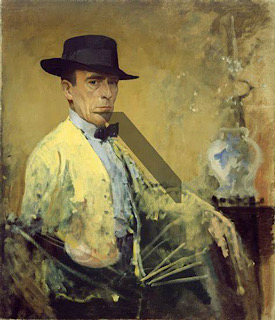
Whelan is awarded many prizes in the Royal Dublin Society (RDS) Taylor art competitions, including one in 1912 for a portrait of his sister Lena, entitled On the Moors, rendered in a strongly academic technique. In 1916, he wins the Taylor scholarship for the Royal Hibernian Academy (RHA) schools for his finest early work, The Doctor’s Visit, an adroitly executed composition of contrasting shadows and light. Typical of many of his genre interiors, the painting depicts a room in the family home, with relatives as models: Whelan’s mother sits by the bed watching over his ill cousin, while his sister, dressed in a Mater hospital nurse’s uniform, is in the background opening the door for the doctor. The subtly evoked atmosphere of restrained emotion foreshadowed a hallmark of his mature style.
Whelan exhibits annually at the RHA for forty-five years (1911–56), averaging six works per year. He is elected an RHA associate in 1920, becoming a full member in 1924. He participates in the Exposition d’art irlandais at the Galerie Barbazanges in Paris in 1922. A visiting teacher at the RHA schools in 1924, he also teaches in the DMSA for a time. He has studios at 64 Dawson Street (1914–27) and 7 Lower Baggot Street (1931–56). Beginning in the 1910s, he receives regular commissions for portraits, constituting his primary source of income. Having become the family’s main breadwinner following his parents’ deaths in the 1920s, he concentrates most of his production on this lucrative activity, portraying numerous leading figures in the spheres of politics, academia, religion, society, medicine, and law.
Situated securely in the academic tradition, in most of his portraits Whelan favours a sombre, restricted palette, with the sitter placed, in grave demeanour, against a monotone background with few accessories. In a 1943 interview he asserts that twentieth-century portraiture suffers from the drabness of modern costume, for which the artist must compensate by careful rendition of the subject’s hands. He tends to depart from his prevailing portrait style when painting women, whom he characteristically depicts in meticulously observed interiors, a notable example being his portrait of Society hostess Gladys Maccabe (c.1946; NGI).
Whelan’s commercial concentration on portraiture notwithstanding, he expresses his true talent in genre compositions, especially kitchen interiors, in which he emulates the technique of the Dutch painter Johannes Vermeer. Two of the most accomplished of these depict his sister Frances in the basement kitchen of the family home: The Kitchen Window (1927; Crawford Art Gallery, Cork) demonstrates a particularly skillful use of light, while Interior of a Kitchen (1935) is notable for the dexterous handling of objects of varied shapes and textures. His genre works include both urban and rural scenes, with a distinctive interest in portraying occupations and other activities. Gypsy (1923), an Orpenesque composition of a shawled woman in a west-of-Ireland landscape with a caravan in the background, receives wide contemporary critical acclaim. Jer (c.1925), depicting a man seated by the fire in a cottage interior, is reproduced in J. Crampton Walker’s Irish Art and Landscape (1927). The Fiddler (c.1932), a naturalistic, sensitively characterised study, is first shown at an Ulster Academy exhibition at Stranmillis, Belfast. A Kerry Cobbler is reproduced in Twelve Irish Artists (1940), introduced by Thomas Bodkin, as among the works denoting the development of a distinctively Irish school of painting.
In 1929, Whelan designs the first Irish Free State commemorative stamp, a portrait of Daniel O’Connell for the centenary of Catholic emancipation. Commissioned by the Thomas Haverty trust to paint an incident from the life of Saint Patrick for the 1932 Eucharistic Congress, he executes The Baptism by St. Patrick of Ethna the Fair and Fedelmia the Ruddy, Daughters of the Ard Rí Laoghaire, a work highly conservative in style. He rapidly completes an oil study of the papal legate, Lorenzo Lauri, also for the Eucharistic Congress. He is represented in the art competitions at the 1932 Summer Olympics in Los Angeles. His depiction of Saint Brigid, shown at the Academy of Christian Art exhibition (1940), becomes a familiar image owing to the wide circulation of reproductions.
Whelan’s political portraits are influential in creating a strong, assured image of the newly formed Irish state, and thus retain an historical significance. His posthumous portrait, The Late General Michael Collins, exhibited at the RHA in 1943 and now held in Leinster House, is an iconic, heroic image of the fallen leader. His portraits of Arthur Griffith and Kevin O’Higgins – commissioned posthumously, as is the Collins, by Fine Gael – also hang in Leinster House, while that of John A. Costello, exhibited at the RHA in 1949, is now held in the King’s Inns, Dublin. He paints two presidents, Douglas Hyde and Seán T. O’Kelly, both works currently in Áras an Uachtaráin. A portrait of Éamon de Valera, painted in 1955 when the sitter is Leader of the Opposition, is in Leinster House. In 1954, he designs a second commemorative stamp, picturing a reproduction of a portrait bust of John Henry Newman, to mark the centenary of the Catholic University of Ireland.
Whelan is elected an honorary academician of both the Ulster Academy of Arts (1931), and the Royal Ulster Academy (1950). He becomes a member of the United Arts Club in 1934. As a representative of the RHA, he sits on the board of governors of the National Gallery of Ireland for many years, and is on the advisory committee of the Municipal Gallery of Modern Art. Unmarried, he resides until his death at the Eccles Street address, with two sisters who continue to manage the family hotel. He dies on November 6, 1956, from leukemia at the Mater private nursing home in Dublin. He is buried in Glasnevin Cemetery.
(From: “Whelan, (Michael) Leo,” by Carmel Doyle, Dictionary of Irish Biography, http://www.dib.ie, October 2009)
The son of a local school teacher, Noonan is raised in Loughill, County Limerick. He is educated at the local National School and St. Patrick’s Secondary School in Glin, before studying to be a primary school teacher at St. Patrick’s College, Drumcondra, Dublin. He subsequently completes a BA and H.Dip. in English and Economics at University College Dublin (UCD). He begins to work as a secondary school teacher in Dublin. He develops an interest in politics from his mother, whose family had been heavily involved in Fine Gael at the local level in Limerick, and joins the Dublin branch of the party after graduating from university.
Having been involved in the local Fine Gael organisation in Limerick since the late 1960s, Noonan first holds political office in 1974, when he is elected as a member of Limerick County Council. Having built up a local profile he contests the 1981 Irish general election for the party and secures a seat in Limerick East. Upon taking his Dáil seat, he becomes a full-time politician, giving up his teaching post and resigning his seat on Limerick County Council. Though Fine Gael forms a coalition government with the Labour Party, as a first time Teachta Dála (TD), he remains on the backbenches. He serves as a TD from 1981 to 2020.
Noonan marries Florence Knightley, a native of Castlemaine, County Kerry and a primary school teacher, in 1969. They have three sons (Tim, John and Michael) and two daughters (Orla and Deirdre). In May 2010, Noonan appears on RTÉ‘s The Frontline to talk about his wife’s battle with Alzheimer’s disease. Florence Noonan dies on February 23, 2012 of pneumonia.
Mulcahy is second-in-command to Thomas Ashe in an encounter with the armed Royal Irish Constabulary (RIC) at Ashbourne, County Meath, during the 1916 Easter Rising, one of the few stand-out victories won by republicans in that week and generally credited to Mulcahy’s grasp of tactics. In his book on the Rising, Charles Townshend principally credits Mulcahy with the defeat of the RIC at Ashbourne, for conceiving and leading a flanking movement on the RIC column that had engaged with the Irish Volunteers. Arrested after the Rising, he is interned at Knutsford and at the Frongoch internment camp in Wales until his release on December 24, 1916.
Mulcahy and Michael Collins are largely responsible for directing the military campaign against the British during the Irish War of Independence. During this period of upheaval in 1919, he marries Mary Josephine (Min) Ryan, sister of Kate and Phyllis Ryan, the successive wives of Seán T. O’Kelly. Her brother is James Ryan. O’Kelly and Ryan both later serve in Fianna Fáil governments.
Mulcahy supports the Anglo-Irish Treaty of December 1921. Archive film shows that Mulcahy, as Minister of Defence, is the Irish officer who raises the Irish tricolour at the first hand-over of a British barracks to the National Army in January 1922. He is defence minister in the Provisional Government on its creation and succeeds Collins, after the latter’s assassination, as Commander-in-Chief of the Provisional Government’s forces during the subsequent Irish Civil War.
Mulcahy earns notoriety through his order that anti-Treaty activists captured carrying arms are liable for execution. A total of 77 anti-Treaty prisoners are executed by the Provisional Government. He serves as Minister for Defence in the new Free State government from January 1924 until March 1924, but resigns in protest because of the sacking of the Army Council after criticism by the Executive Council over the handling of the “Army Mutiny,” when some National Army War of Independence officers almost revolt after he demobilises many of them at the end of the Irish Civil War. He re-enters the cabinet as Minister for Local Government and Public Health in 1927.
After the resignation of W. T. Cosgrave as Leader of Fine Gael in 1944, Mulcahy becomes party leader while still a member of the Seanad. Thomas F. O’Higgins is parliamentary leader of the party in the Dáil at the time and Leader of the Opposition. Facing his first general election as party leader, Mulcahy draws up a list of 13 young candidates to contest seats for Fine Gael. Of the eight who run, four are elected. He is returned again to the 12th Dáil as a TD for Tipperary at the 1944 Irish general election. While Fine Gael’s decline had been slowed, its future is still in doubt.
Following the 1948 Irish general election Mulcahy is elected for Tipperary South, but the dominant Fianna Fáil party finishes six seats short of a majority. However, it is 37 seats ahead of Fine Gael, and conventional wisdom suggests that Fianna Fáil is the only party that can possibly form a government. Just as negotiations get underway, however, Mulcahy realises that if Fine Gael, the Labour Party, the National Labour Party, Clann na Poblachta and Clann na Talmhan band together, they would have only one seat fewer than Fianna Fáil and, if they can get support from seven independents, they will be able to form a government. He plays a leading role in persuading the other parties to put aside their differences and join forces to consign the then Taoiseach and Fianna Fáil leader Éamon de Valera, to the opposition benches.
Mulcahy initially seems set to become Taoiseach in a coalition government. However, he is not acceptable to Clann na Poblachta’s leader, Seán MacBride. Many Irish republicans had never forgiven him for his role in the Irish Civil War executions carried out under the Cosgrave government in the 1920s. Consequently, MacBride lets it be known that he and his party will not serve under Mulcahy. Without Clann na Poblachta, the other parties would have 57 seats between them — 17 seats short of a majority in the 147-seat Dáil. According to Mulcahy, the suggestion that another person serve as Taoiseach comes from Labour leader William Norton. He steps aside and encourages his party colleague John A. Costello, a former Attorney General of Ireland, to become the parliamentary leader of Fine Gael and the coalition’s candidate for Taoiseach. For the next decade, Costello serves as the party’s parliamentary leader while Mulcahy remained the nominal leader of the party.
Mulcahy goes on to serve as Minister for Education under Costello from 1948 until 1951. Another coalition government comes to power at the 1954 Irish general election, with Mulcahy once again stepping aside to become Minister for Education in the Second Inter-Party Government. The government falls in 1957, but he remains as Fine Gael leader until October 1959. In October the following year, he tells his Tipperary constituents that he does not intend to contest the next election.
McDonald is born into a middle-class family in south Dublin. Her father Patrick McDonald, a builder and surveyor, and her mother Joan, separate when she is nine years old, and she stays with her mother in Rathgar. She has three siblings, one older and two younger. Her great-uncle, James O’Connor, was a member of the Anti-Treaty IRA and was executed at the Curragh Camp during the Irish Civil War.
She works as a researcher for the Institute of European Affairs, a consultant for the Irish Productivity Centre, a human resources consultancy that is jointly operated by Ibec and Irish Congress of Trade Unions (ICTU), and a trainer in the Partnership Unit of the Educational and Training Services Trust.
McDonald starts her political career by first joining Fianna Fáil in 1998 but leaves the party after a year due to core policy differences, particularly in relation to Northern Ireland and social justice. She quickly realises that Sinn Féin is a more appropriate party for her Republican views after meeting Sinn Féin members through the Irish National Congress.
She first runs for office at the 2002 Irish general election when she unsuccessfully contests the Dublin West constituency for Sinn Féin, polling 8.02% of first preference votes.
In 2004, McDonald becomes Sinn Féin’s first Member of the European Parliament (MEP) in Ireland, when she is elected at the 2004 European Parliament election in Ireland for the Dublin constituency, receiving over 60,000 first preference votes. She serves until 2009 and is a prominent member of the Employment and Social Affairs committee and Civil Liberties committee.
McDonald contests the Dublin Central constituency again at the 2011 Irish general election, this time picking up 13.1% of first preference votes. She is successful in taking the last seat in the constituency. Following the election, she becomes Sinn Féin’s Spokesperson for Public Expenditure and Reform and is a member of the Public Accounts Committee from then until 2017.
After her re-election to the Dáil at the 2016 Irish general election, in which she tops the poll in Dublin Central, she becomes Sinn Féin’s All-Ireland Spokesperson for Mental Health and Suicide Prevention, which she holds until being elected president of Sinn Féin in 2018.
At a Sinn Féin party conference on November 18, 2017, Gerry Adams is re-elected party leader but announces that he will ask party leadership to call for a special Ard Fheis to be held within three months to choose a new president, and that he will not stand for re-election as TD for the Louth constituency in the next election.
At the close of nominations to succeed Adams on January 20, 2018, McDonald is announced as the president-elect of Sinn Féin, as she is the sole nominee to enter the race. She is confirmed as president at a special Ard Fheis on February 10, 2018, in Dublin.
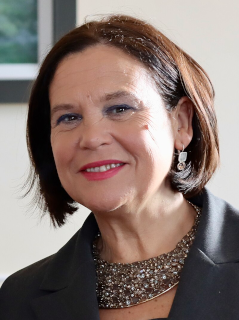
McDonald is nominated as Taoiseach on February 20, 2020, but is defeated 45 to 84. On June 26, 2020, Fianna Fáil, Fine Gael, and the Green Party form a coalition government, leaving Sinn Féin as the largest opposition party, and McDonald as Leader of the Opposition. She dismisses the coalition agreement as a “marriage of convenience,” and accuses Fianna Fáil and Fine Gael of conspiring to exclude Sinn Féin from government.
At the 2024 Irish general election, McDonald is re-elected to the Dáil topping the poll in Dublin Central with Sinn Féin increasing their seat share by two seats, remaining the second largest party by representation in the Dáil and attaining 19% of the first preference votes, a fall of 5.5% from 2020 and fall behind Fianna Fáil by 2.9% and Fine Gael by 1.8%.
McDonald is again nominated as Taoiseach on December 18, 2024, but is defeated 44 to 110.
McDonald’s husband, Martin Lanigan, works as a gas control superintendent for the emergency dispatch division of Gas Networks Ireland, a state infrastructure provider. They have two children and live in Cabra, Dublin.
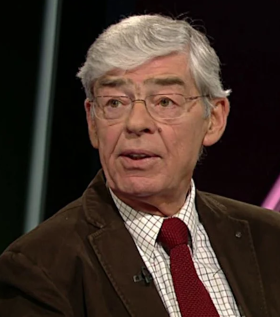
Alan Martin Dukes, former Fine Gaelpolitician, is born in Drimnagh, Dublin, on April 20, 1945. He holds several senior government positions and serves as a Teachta Dála (TD) from 1981 to 2002. He is one of the few TDs to be appointed a minister on their first day in the Dáil.
The Dukes family originally comes from the north of England. His grandfather serves with the Royal Engineers in World War I and settles in County Cork and then County Kerry afterward where he works with the Post Office creating Ireland’s telephone network.
Dukes is educated by the Christian Brothers at Coláiste Mhuire, Dublin, and is offered several scholarships for third level on graduation, including one for the Irish language. His interest in the Irish language continues to this day, and he regularly appears on Irish-language television programmes.
On leaving school he attends University College Dublin (UCD), where he captains the fencing team to its first-ever Intervarsity title.
In the 1979 European Parliament election, Dukes stands as a Fine Gael candidate in the Munster constituency. He has strong support among the farming community, but the entry of T. J. Maher, a former president of the IFA, as an independent candidate hurts his chances of election. Maher tops the poll.
This minority Fine Gael–Labour Partycoalition government collapses in February 1982 on the budget but returns to power with a working majority in December 1982. Dukes is again appointed to cabinet, becoming Minister for Finance less than two years into his Dáil career.
He faces a difficult task as finance minister. Ireland is heavily in debt while unemployment and emigration are high. Many of Fine Gael’s plans are deferred while the Fine Gael–Labour Party coalition disagrees on how to solve the economic crisis. The challenge of addressing the national finances is made difficult by electoral arithmetic and a lack of support from the opposition Fianna Fáil party led by Charles Haughey. He remains in the Department of Finance until a reshuffle in February 1986 when he is appointed Minister for Justice.
This is a difficult time for the country. Haughey’s Fianna Fáil runs on promises to increase spending and government services, and attacking the cutbacks favoured by Fine Gael. However, on taking office, the new Taoiseach and his finance minister Ray MacSharry immediately draw up a set of cutbacks including a spate of ward and hospital closures. This presents a political opportunity for the opposition to attack the government.
However, while addressing a meeting of the TallaghtChamber of Commerce, Dukes announces, in what becomes known as the Tallaght Strategy that: “When the government is moving in the right direction, I will not oppose the central thrust of its policy. If it is going in the right direction, I do not believe that it should be deviated from its course, or tripped up on macro-economic issues.”
This represents a major departure in Irish politics whereby Fine Gael will vote with the minority Fianna Fáil Government if it adopts Fine Gael’s economic policies for revitalising the economy. The consequences of this statement are huge. The Haughey government is able to take severe corrective steps to restructure the economy and lay the foundations for the economic boom of the nineties. However, at a snap election in 1989, Dukes does not receive electoral credit for this approach, and the party only makes minor gains, gaining four seats. The outcome is the first-ever coalition government for Fianna Fáil, whose junior partner is the Progressive Democrats led by former Fianna Fáil TD Desmond O’Malley.
Initially, Fianna Fáil’s Brian Lenihan Snr is the favourite to win. However, after several controversies arise, relating to the brief Fianna Fáil administration of 1982, and Lenihan’s dismissal as Minister for Defence midway through the campaign, the Labour Party’s Mary Robinson emerges victorious. To many in Fine Gael, the humiliation of finishing third is too much to bear and a campaign is launched against Dukes’ leadership. He is subsequently replaced as party leader by John Bruton.
Bruton brings Dukes back to the front bench in September 1992, shortly before the November 1992 Irish general election. In February 1994, Dukes becomes involved in a failed attempt to oust Bruton as leader and subsequently resigns from the front bench. Bruton becomes Taoiseach in December 1994 and Dukes is not appointed to cabinet at the formation of the government.
In 2001, Dukes backs Michael Noonan in his successful bid to become leader of Fine Gael.
After 21 years, Dukes loses his Dáil seat at the 2002 Irish general election. This contest sees many high-profile casualties for Fine Gael, including Deputy LeaderJim Mitchell, former deputy leader Nora Owen and others. Many local commentators feel that Dukes’ loss is due to a lack of attention to local issues, as he is highly involved in European projects and has always enjoyed a national profile.
He retires from frontline politics in 2002 and is subsequently appointed Director General of the Institute of International and European Affairs. He remains active within Fine Gael and serves several terms as the party’s vice-president. From 2001 to 2011, he is President of the Alliance française in Dublin, and in June 2004, the French Government appoints him an Officer of the Legion of Honour. In April 2004, he is awarded the Commander’s Cross of the Order of Merit of the Republic of Poland.
In December 2008, Dukes is appointed by Finance Minister Brian Lenihan Jnr as a public interest director on the board of Anglo Irish Bank. The bank is subsequently nationalised, and he serves on the board until the Irish Bank Resolution Corporation (IBRC) is liquidated in 2013.
Dukes has lived in Kildare since first being elected to represent the Kildare constituency in 1981. His wife Fionnuala (née Corcoran) is a former local politician and serves as a member of Kildare County Council from 1999 until her retirement in 2009. She serves as Cathaoirleach of the council from 2006 to 2007, becoming only the second woman to hold the position in the body’s one-hundred-year history. They have two daughters.
Costello is born on June 20, 1891, in Fairview, Dublin, the younger son of John Costello senior, a civil servant, and Rose Callaghan. He is educated at St. Joseph’s, Fairview, and then moves to O’Connell School, for senior classes, and later attends University College Dublin (UCD), where he graduates with a degree in modern languages and law. He studies at King’s Inns to become a barrister, winning the Victoria Prize there in 1913 and 1914. He is called to the Irish Bar in 1914, and practises as a barrister until 1922.
In 1922, Costello joins the staff at the office of the Attorney General in the newly established Irish Free State. Three years later he is called to the inner bar, and the following year, 1926, he becomes Attorney General of Ireland, upon the formation of the Cumann na nGaedheal government, led by W. T. Cosgrave. While serving in this position he represents the Free State at Imperial Conferences and League of Nations meetings.
Costello is also elected a Bencher of the Honourable Society of King’s Inns. He loses his position as Attorney General of Ireland when Fianna Fáil comes to power in 1932. The following year, however, he is elected to Dáil Éireann as a Cumann na nGaedheal TD. Cumann na nGaedheal soon merges with other parties to form Fine Gael.
During the Dáil debate on the Emergency Powers Act 1939, Costello is highly critical of the Act’s arrogation of powers, stating that “We are asked not merely to give a blank cheque, but to give an uncrossed cheque to the Government.” He loses his seat at the 1943 Irish general election but regains it when Éamon de Valera calls a snap election in 1944. From 1944 to 1948, he is the Fine Gael front-bench Spokesman on External Affairs.
In 1948, Fianna Fáil has been in power for sixteen consecutive years and has been blamed for a downturn in the economy following World War II. The 1948 Irish general election results show Fianna Fáil short of a majority, but still by far the largest party, with twice as many seats as the nearest rival, Fine Gael. It appears that Fianna Fáil is headed for a seventh term in government. However, the other parties in the Dáil realise that between them, they have only one seat fewer than Fianna Fáil, and if they band together, they would be able to form a government with the support of seven Independent deputies. Fine Gael, the Labour Party, the National Labour Party, Clann na Poblachta and Clann na Talmhan join to form the first inter-partygovernment in the history of the Irish state.
While it looks as if cooperation between these parties will not be feasible, a shared opposition to Fianna Fáil and Éamon de Valera overcomes all other difficulties, and the coalition government is formed.
Since Fine Gael is the largest party in the government, it has the task of providing a suitable candidate for Taoiseach. Naturally, it is assumed that its leader, Richard Mulcahy, will be offered the post. However, he is an unacceptable choice to Clann na Poblachta and its deeply republican leader, Seán MacBride. This is due to Mulcahy’s record during the Irish Civil War. Instead, Fine Gael and Clann na Poblachta agree on Costello as a compromise candidate. Costello had never held a ministerial position nor was he involved in the Civil War. When told by Mulcahy of his nomination, Costello is appalled, content with his life as a barrister and as a part-time politician. He is persuaded to accept the nomination as Taoiseach by close non-political friends.
During the campaign, Clann na Poblachta had promised to repeal the Executive Authority (External Relations) Act 1936 but does not make an issue of this when the government is being formed. However, Costello and his Tánaiste, William Norton of the Labour Party, also dislike the act. During the summer of 1948, the cabinet discusses repealing the act, however, no firm decision is made.
In September 1948, Costello is on an official visit to Canada when a reporter asks him about the possibility of Ireland leaving the British Commonwealth. For the first time, he declares publicly that the Irish government is indeed going to repeal the External Relations Act and declare Ireland a republic. It has been suggested that this is a reaction to offence caused by the Governor General of Canada at the time, Harold Alexander, 1st Earl Alexander of Tunis, who is of Northern Irish descent and who allegedly arranges to have placed symbols of Northern Ireland in front of Costello at an official dinner. Costello makes no mention of these aspects on the second reading of the Republic of Ireland Bill on November 24 and, in his memoirs, claims that Alexander’s behaviour had in fact been perfectly civil and could have had no bearing on a decision which had already been made.
The news takes the Government of the United Kingdom and even some of Costello’s ministers by surprise. The former had not been consulted and following the declaration of the Republic in 1949, the UK passes the Ireland Act that year. This recognises the Republic of Ireland and guarantees the position of Northern Ireland within the United Kingdom for so long as a majority there want to remain in the United Kingdom. It also grants full rights to any citizens of the Republic living in the United Kingdom. Ireland leaves the Commonwealth on April 18, 1949, when The Republic of Ireland Act 1948 comes into force. Frederick Henry Boland, Secretary of the Department of External Affairs, says caustically that the affair demonstrates that “the Taoiseach has as much notion of diplomacy as I have of astrology.” The British envoy, John Maffey, 1st Baron Rugby, is equally critical of what he calls a “slipshod and amateur” move.
Many nationalists now see partition as the last obstacle on the road to total national independence. Costello tables a motion of protest against partition on May 10, 1949, without result.
In 1950, the independent-minded Minister for Health, Noël Browne, introduces the Mother and Child Scheme. The scheme would provide mothers with free maternity treatment and their children with free medical care up to the age of sixteen, which is the normal provision in other parts of Europe at that time. The bill is opposed by doctors, who fear a loss of income, and Roman Catholic bishops, who oppose the lack of means testing envisaged and fear the scheme could lead to birth control and abortion. The cabinet is divided over the issue, many feeling that the state cannot afford such a scheme priced at IR£2,000,000 annually. Costello and others in the cabinet make it clear that in the face of such opposition they will not support the Minister. Browne resigns from the government on April 11, 1951, and the scheme is dropped. He immediately publishes his correspondence with Costello and the bishops, something which had hitherto not been done. Derivatives of the Mother and Child Scheme are introduced in Public Health Acts of 1954, 1957 and 1970.
The Costello government has a number of noteworthy achievements. A new record is set in housebuilding, the Industrial Development Authority and Córas Tráchtála are established, and the Minister for Health, Noel Browne, with the then new Streptomycin, bring about an advance in the treatment of tuberculosis. Ireland also joins a number of organisations such as the Organization for European Economic Co-operation and the Council of Europe. However, the government refuses to join NATO, allegedly because the British remain in Northern Ireland. The scheme to supply electricity to even the remotest parts of Ireland is also accelerated.
While the “Mother and Child” incident does destabilise the government to some extent, it does not lead to its collapse as is generally thought. The government continues; however, prices are rising, a balance of payments crisis is looming, and two TDs withdraw their support for the government. These incidents add to the pressure on Costello and so he decides to call a general election for June 1951. The result is inconclusive but Fianna Fáil returns to power. Costello resigns as Taoiseach. It is at this election that his son Declan is elected to the Dáil.
Over the next three years while Fianna Fáil is in power a dual-leadership role of Fine Gael is taking place. While Richard Mulcahy is the leader of the party, Costello, who has proved his skill as Taoiseach, remains as parliamentary leader of the party. He resumes his practice at the Bar. In what is arguably his most celebrated case, the successful defence of The Leader against a libel action brought by the poet Patrick Kavanagh, dates from this period. Kavanagh generously praises Costello’s forensic skill, and the two men become friends.
At the 1954 Irish general election Fianna Fáil loses power. A campaign dominated by economic issues results in a Fine Gael-Labour Party-Clann na Talmhan government coming to power. Costello is elected Taoiseach for the second time.
The government can do little to change the ailing nature of Ireland’s economy, with emigration and unemployment remaining high, and external problems such as the Suez Crisis compounding the difficulty. Measures to expand the Irish economy such as export profits tax relief introduced in 1956 would take years have sizable impact. Costello’s government does have some success with Ireland becoming a member of the United Nations in 1955, and a highly successful visit to the United States in 1956, which begins the custom by which the Taoiseach visits the White House each Saint Patrick’s Day to present the U.S. President with a bowl of shamrock. Although the government has a comfortable majority and seems set for a full term in office, a resumption of Irish Republican Army (IRA) activity in Northern Ireland and Great Britain causes internal strains. The government takes strong action against the republicans.
In spite of supporting the government from the backbenches, Seán MacBride, the leader of Clann na Poblachta, tables a motion of no confidence, based on the weakening state of the economy and in opposition to the government’s stance on the IRA. Fianna Fáil also tables its own motion of no confidence, and rather than face almost certain defeat, Costello again asks PresidentSeán T. O’Kelly to dissolve the Oireachtas. The general election which follows in 1957 gives Fianna Fáil an overall majority and starts another sixteen years of unbroken rule for the party. Some of his colleagues questioned the wisdom of his decision to call an election. The view is expressed that he was tired of politics and depressed by his wife’s sudden death the previous year.
Following the defeat of his government, Costello returns to the bar. In 1959, when Richard Mulcahy resigns the leadership of Fine Gael to James Dillon, he retires to the backbenches. He could have become party leader had he been willing to act in a full-time capacity. He remains as a TD until 1969, when he retires from politics, being succeeded as Fine Gael TD for Dublin South-East by Garret FitzGerald, who himself goes onto to become Taoiseach in a Fine Gael-led government.
During his career, Costello is presented with a number of awards from many universities in the United States. He is also a member of the Royal Irish Academy from 1948. In March 1975, he is made a freeman of the city of Dublin, along with his old political opponent Éamon de Valera. He practises at the bar until a short time before his death at the age of 84, in Ranelagh, Dublin, on January 5, 1976. He is buried at Dean’s Grange Cemetery in Dublin.
Cosgrave is born at 174 James’s Street, Dublin, on June 5, 1880, to Thomas Cosgrave, grocer, and Bridget Cosgrave (née Nixon). He is educated at the Christian Brothers School at Malahide Road, Marino, Dublin, before entering his father’s publican business. He first becomes politically active when he attends the first Sinn Féin convention in 1905.
At an early age, Cosgrave is attracted to the Irish nationalist party Sinn Féin. He becomes a member of the Dublin Corporation in 1909 and is subsequently reelected to represent Sinn Féin interests. He joins the Irish Volunteers in 1913, although he never joins the Irish Republican Brotherhood (IRB) because he does not believe in secret societies. When the group splits in 1914 upon the outbreak of World War I, he sides with a radical Sinn Féin minority against the constitutional nationalists led by John Redmond, who supports the British war effort.
Cosgrave takes part in the 1916 Easter Rising and is afterward interned by the British for a short time. In 1917, he is elected to Parliament for the city of Kilkenny. In the sweeping election victory of Sinn Féin in the 1918 United Kingdom general election, he becomes a member of the First Dáil. He is made Minister for Local Government in the first republican ministry, and during the Irish War of Independence (1919–21) his task is to organize the refusal of local bodies to cooperate with the British in Dublin.
Cosgrave is a supporter of the 1921 Anglo-Irish Treaty settlement with Great Britain, and he becomes Minister of Local Government in Ireland’s provisional government of 1922. He replaces Michael Collins as Chairman of the Provisional Government when the latter becomes commander-in-chief of the National Army in July 1922. He also replaces Arthur Griffith as president of the Dáil after Griffith’s sudden death on August 12, 1922. As the first president of the Executive Council of the Irish Free State, he, who had helped found the political party Cumann na nGaedheal in April 1923 and became its leader, represents Ireland at the Imperial Conference in October 1923. A month earlier he is welcomed as Ireland’s first spokesman at the assembly of the League of Nations.
Cosgrave’s greatest achievement is to establish stable democratic government in Ireland after the Irish Civil War (1922–23). In the Dáil there is no serious opposition, since the party headed by Éamon de Valera, which refuses to take the oath prescribed in the treaty, abstains from attendance. But neither Cosgrave nor his ministry enjoy much popularity. Order requires drastic measures, and taxation is heavy and sharply collected. He seems sure of a long tenure only because there is no alternative in sight.
In July 1927, shortly after a general election, the assassination of Kevin O’Higgins, the vice president, produces a crisis. The Executive Council introduces a Public Safety Act, which legislates severely against political associations of an unconstitutional character and introduces a bill declaring that no candidature for the Dáil should be accepted unless the candidate declares willingness to take a seat in the Dáil and to take the oath of allegiance. The result of this measure is that de Valera and his party decide to attend sessions in the Dáil, and, since this greatly alters the parliamentary situation, Cosgrave obtains leave to dissolve the assembly and hold a general election. The September 1927 Irish general election leaves his party numerically the largest in the Dáil but without an overall majority. He continues in office until de Valera’s victory at the 1932 Irish general election. Cumann na nGaedheal joins with two smaller opposition parties in September 1933 to form a new party headed by Cosgrave, Fine Gael (“Irish Race”), which becomes Ireland’s main opposition party. In 1944 he resigns from the leadership of Fine Gael.
Cosgrave dies on November 16, 1965, at the age of 85. The Fianna Fáil government under Seán Lemass awards him the honour of a state funeral, which is attended by the Cabinet, the leaders of all the main Irish political parties, and Éamon de Valera, then President of Ireland. He is buried in Goldenbridge Cemetery in Inchicore, Dublin. Richard Mulcahy says, “It is in terms of the Nation and its needs and its potential that I praise God who gave us in our dangerous days the gentle but steel-like spirit of rectitude, courage and humble self-sacrifice, that was William T. Cosgrave.”
While Cosgrave never officially holds the office of Taoiseach (prime minister), Ireland considers him to be its first Taoiseach due to having been the Free State’s first head of government.
Cosgrave’s son, Liam, serves as a TD (1943-81), as leader of Fine Gael (1965-77) and Taoiseach (1973-77). His grandson, also named Liam, also serves as a TD and as Senator. His granddaughter, Louise Cosgrave, serves on the Dún Laoghaire–Rathdown County Council (1999-2009).
In October 2014, Cosgrave’s grave is vandalised, the top of a Celtic cross on the headstone being broken off. It is again vandalised in March 2016.
Patterson is born on October 5, 1938, in Clonmel, County Tipperary. As a boy Patterson performs with his local parish choir and is involved in maintaining the annual tradition of singing with the “Wrenboys.” He sings in the local St. Mary’s Choral Society and at a production of The Pirates of Penzance performed with both his parents. His interests extend beyond music and as a boy he represents Marlfield GAAhurling club, plays tennis at Hillview and golf at the Mountain Road course. He quits school at an early stage to work in the printing business of his mother’s family. He moves to Dublin in 1961 to enroll at the National Academy of Theatre and Allied Arts where he studies acting while at the same time receiving vocal training from Hans Waldemar Rosen. In 1964, he enters the Feis Ceoil, a nationwide music competition, in which he wins several sections including oratorio, lieder and the German Gold Cup.
Patterson gives classical recitals around Ireland and wins scholarships to study in London, Paris and in the Netherlands. While in Paris, he signs a contract with Philips Records and releases his first record, My Dear Native Land. He works with conductors and some of the most prestigious orchestras in Europe including the London Symphony Orchestra and Orchestre de Paris. He also gains a reputation as a singer of Handel, Mozart, and Bach oratorios and German, Italian and French song. He has a long-running programme on RTÉ titled For Your Pleasure.
In the early 1980s Patterson moves to the United States, making his home in rural Westchester County, New York. A resurgence of interest in Irish culture encourages him to turn towards a more traditional Irish repertoire. He adds hymns, ballads, and traditional as well as more popular tunes to his catalogue. In March 1988, he is featured host in a Saint Patrick’s Day celebration of music and dance at New York City’s famous Radio City Music Hall. He also gives an outdoor performance before an audience of 60,000 on the steps of the United States Capitol in Washington, D.C. with the National Symphony Orchestra.
Patterson is equally at home in more intimate settings. His singing in the role of the Evangelist in Bach’s St. John Passion is given fine reviews. Further recordings follow, of Beethoven arrangements, Irish songs, Berlioz songs, Purcell songs and others, all on the Philips label.
Patterson performs sold-out concerts from London’s Royal Albert Hall to New York’s Carnegie Hall, and with his family he presents two concerts at the White House, for presidents Ronald Reagan in 1982 and Bill Clinton in 1995. He records over thirty albums in six languages, wins silver, gold and platinum discs and is the first Irish singer to host his own show in Radio City Music Hall in New York.
Rising to greater prominence with the new popularity of Celtic music in the 1990s, Patterson sees many of his past recordings reissued for American audiences, and in 1998 he stars in the PBS special Ireland in Song. His last album outsells Pavarotti.
In 1999, Patterson learns he has a brain tumor. He has several operations in the following year and his condition appears to stabilise. He is diagnosed with a recurrence of his illness on May 7, 2000. He briefly recuperates and resumes performing. His last performance is on June 4, 2000, at Regis College in the Boston suburb of Weston, Massachusetts. Shortly thereafter he is admitted to the Memorial Sloan Kettering Cancer Center in New York where he lapses into a coma and dies on June 10, 2000, at the age of 61.
The Army Mutiny is an Irish Army crisis that begins on March 7, 1924, provoked by a proposed reduction in army numbers in the immediate post-Civil War period. A second grievance concerns the handling of the Northern Boundary problem. As the prelude to a coup d’état, the decisions made by influential politicians and soldiers at the time have continuing significance for the Government of Ireland.
In December 1922, following Collins’s death, Liam Tobin forms the Irish Republican Army Organisation (IRAO), taking in Dublin Guard and other Irish Army officers who share his view that “higher command…was not sufficiently patriotic.” President of the Executive Council of the Irish Free StateW. T. Cosgrave, head of the government, attempts to appease the IRAO. He meets with them several times before the 1923 Irish general election and persuades the opposing IRB faction of generals under Richard Mulcahy to keep quiet.
With the election over, Mulcahy now ignores the IRAO as he starts the process of demobilising 37,000 men. In November, sixty IRA officers mutiny and are dismissed without pay. The IRAO now pressures the Government into establishing a committee to supervise future demobilisation. The committee, consisting of Eoin MacNeill, Ernest Blythe, and IRAO sympathiser Joseph McGrath, effectively undermines the authority of the Army Council.
On March 7, 1924, a representative of the IRAO hands a demand to end demobilisation to W. T. Cosgrave. The ultimatum is signed by senior Army officers, Major-General Liam Tobin and Colonel Charles Dalton. Tobin knows his own position is to be scrapped in the demobilisation. Frank Thornton and Tom Cullen are also involved. That morning 35 men of the 36th Infantry Battalion refuse to parade, and the preceding week officers had absconded with arms from the McCan Barracks in Templemore, Gormanston Camp in County Meath, Baldonnel Aerodrome in Baldonnel, Dublin, and Roscommon. The immediate response is an order for the arrest of the two men on a charge of mutiny. This causes alarm throughout Dublin when announced.
On March 8, General Mulcahy makes an announcement to the Army:
“Two Army officers have attempted to involve the Army in a challenge to the authority of the Government. This is an outrageous departure from the spirit of the Army. It will not be tolerated…officers and men…will stand over their posts and do their duty today in this new threat of danger in the same wonderful, determined spirit that has always been the spirit of the Army.”
Leader of the Opposition, Thomas Johnson, issues a statement of support for the Government. In contrast, Minister for Industry and Commerce, Joseph McGrath, whose home Mulcahy orders to be searched, resigns because of dissatisfaction with the government’s attitude to the IRAO officers and support for their perception that the Irish Army treats former British officers better than former IRA officers. Fearing an incendiary speech by McGrath, Cosgrave first offers the IRAO an inquiry and an amnesty before then taking sick leave thus making Minister for Justice, Kevin O’Higgins, de facto head of the Government.
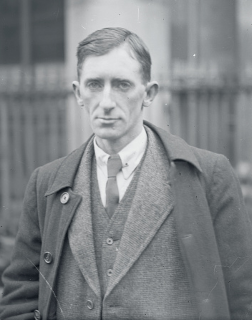
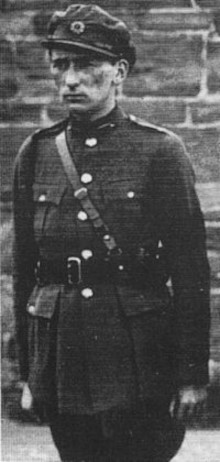
(Pictured: Major General Liam Tobin, a leading figure in the Army Mutiny)





 seamus dubhghaill