seamus dubhghaill

Promoting Irish Culture and History from Little Rock, Arkansas, USA


Leave a comment

Birth of Composer Geoffrey Molyneux Palmer

Geoffrey Molyneux Palmer (Irish: Seathrún de Pámar), Irish composer, is born to Protestant Irish parents in Staines, Middlesex, England, on October 8, 1882. His compositions consist mainly of operas and vocal music, among them the first musical settings of poems by James Joyce.

Palmer grows up in South Woodford, an area of East London, where his father, Abram Smythe Palmer, is vicar at Holy Trinity Church. He studies at the University of Oxford where, in 1901, he is the youngest Bachelor of Music (BMus) in college history. Between 1904 and 1907 he studies composition with Charles Villiers Stanford at the Royal College of Music, London. He moves to Ireland in 1910 where he is initially active as a church organist in Dublin suburbs. From his early twenties he suffers from multiple sclerosis, which makes a professional independence increasingly difficult.

Palmer’s music includes at least three operas, a number of choral pieces and many songs. His strong interest in opera comes during a politically difficult period in Irish history. Ireland is struggling for independence, and cultural politicians often regard opera (and classical music in general) as alien to Irish culture. Initially, however, he is successful, his earliest stage work being Finn Varra Maa (a transliteration from the Gaelic meaning “good Finbar”), subtitled The Irish Santa Claus. It survives as a libretto only, published in a drama series by Talbot Press, Dublin, in 1917. Contrary to what the (sub-)title may suggest, the work is a political satire that is much criticised for its nationalismSruth na Maoile (“The Sea of Moyle”) is first performed in July 1923 and restaged by the O’Mara Opera Company in the cultural by-programme of the Tailteann Games in August 1924. Its story is based on the legend of the Children of Lir, while the music relies on numerous references to Irish traditional music, including the song Silent O Moylefrom Thomas Moore‘s Irish Melodies. A third work, Grania Goes (1924), conceived as a light, comic opera, cannot be performed in the years following Irish independence. The manuscript scores of the Sruth na Maoile and Grania Goes are in the National Library of Ireland.

Between 1925 and 1930, Palmer embarks on a cycle of three full-scale operas on the Cuchullain cycle to words by William Mervyn Crofton. In one of them, Deirdre of the Sorrows (1925), Crofton acknowledges Palmer’s “beautiful music.” Despite this, Palmer’s illness prevents the completion of the score, which is later handed over to the composer Staf Gebruers (1902–70), but they are never performed. The manuscript scores of the operas Cuchullain and Deirdre of the Sorrows composed by Gebruers are held by his son Adrian. Unfortunately, despite extensive searching, the score of The Wooing of Emer has not been located, though it is referenced in Gebruers’ own inventories and mentioned as being of three hours duration. In addition, there is a copy of The King’s Song, also composed by Gebruers with lyrics by Crofton and described as from Act 1 of The Black Hag, but whether or not this has any connection with Palmer is unknown.

Palmer is mainly known as the composer of light songs and ballads, often in a folkloristic style, that find publishers in England and are frequently performed. “They show a skilled hand with a talent for vocal harmony but little originality.” His choral music is mainly on a similar miniature scale, an exception being the early cantata The Abbot of Innisfallen (1909). There are some isolated examples of orchestral music performed by the orchestra of Radio Éireann, but the surviving references may not give a full picture of his output.

In the last decades of his life, Palmer was confined to a wheelchair and depends upon the care of his two sisters, who were running Hillcourt, a private girls’ boarding school in Glenageary, near their home in Sandycove (south Dublin). Palmer dies in Dublin on November 29, 1957.


Leave a comment

Birth of Janet McNeill, Novelist & Playwright

Janet McNeill, prolific Irish novelist and playwright, is born on September 14, 1907, in Dublin. Author of more than 20 children’s books, as well as adult novels, plays, and two opera libretti, she is best known for her children’s comic fantasy series My Friend Specs McCann.

McNeill is born to Rev. William McNeill, a minister at Adelaide Road Presbyterian Church, and Jeannie Patterson (Hogg) McNeill. In 1913, the family moves to Birkenhead, Merseyside, England, where her father becomes minister at Trinity Road Church. She attends public school in Birkenhead and studies classics at the University of St. Andrews in St. Andrews, Scotland, completing a MA degree in 1929. While at university, she is involved in writing and acting with the College Players. In 1924, the family returns to Ireland due to her father’s failing health, and Rev. McNeill becomes the minister of a village church in Rostrevor, County Down, Northern Ireland, while Janet joins the Belfast Telegraph as a secretary.

In 1933, McNeill marries Robert Alexander, the chief engineer in the Belfast city surveyor’s department, and the couple settles in Lisburn, where they raise their four sons. One son is the zoologist Professor Robert McNeill Alexander, CBE, FRS. Though she plans to write her first novel early on, she finds it impossible to write seriously until the children grow up, saying, “It was four years before I had a baby and twenty-five before I produced the book.”

In 1946, McNeill wins a prize in a BBC competition for her play Gospel Truth. She begins writing radio dramas, which are broadcast by the BBC. She suffers an intracerebral hemorrhage in 1953. During her recovery, she begins writing novels both for adults and children, producing a large body of work between 1955 and 1964. Her popular children’s character, Specs McCann, who debuts in a 1955 book and makes several reappearances, also inspires a newspaper cartoon strip by Rowel Friers, a Belfast artist and friend of hers.

Her 1944 novel The Maiden Dinosaur is her first to be published in the United States, twenty-two years later. She also has three writing credits on television with series and plays. Several of her plays are staged at the Ulster Group Theatre.

In 1964, McNeill’s husband retires, and the couple moves to Bristol, South West England. She writes one more novel after she leaves Northern Ireland but continues to write children’s books for another decade. During this time, she writes her only children’s play, published as Switch On, Switch Off, and other plays (1968), which presents different moral themes in scenes set in “domestic and workplace settings in contemporary England.” Her children’s book The Battle of St. George Without is televised by the BBC in 1969.

In her adult fiction, McNeill focuses on the lifestyle and social mores of Belfast and Ulster in the mid-twentieth century. Her characters are primarily “menopausal, middle-aged, middle-class Protestants.” She depicts the “dreary, Ulster religiosity” of ministers and laymen alike, and the class conventions and sexual repression of middle-aged, upper-middle-class women. The theme of suppressing self-identity and goals, both by wives in deference to their husbands and parents on behalf of their children, pervades her adult novels.

McNeill has a number of health problems and dies in Bristol in October 1994.


Leave a comment

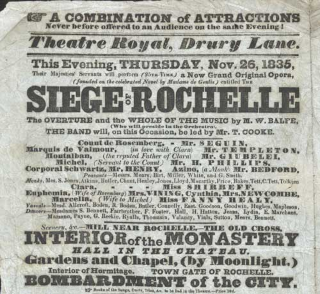
“The Siege of Rochelle” First Performed at Drury Lane Theatre

Irish composer Michael William Balfe‘s opera The Siege of Rochelle is first performed at the Drury Lane Theatre in London on October 29, 1835.

The opera is originally prepared for the English Opera House but for some reason the theatrical manager, Samuel James Arnold, does not want it. Instead, Alfred Bunn, the manager of Drury Lane Theatre, seizes the opportunity and begins what is a very fruitful collaboration with Balfe that lasts a decade. Balfe is to become the mainstay of English Opera for almost the next 30 years with a succession of popular operas.

The opera runs for 70 nights on its initial run and is revived in the following three seasons with Balfe singing the role of Michel. Queen Victoria sees the opera on November 15, 1837, her first state visit to a theatre during her reign. In 1836, the opera is reported as staged in Leeds, York, Sheffield, Manchester, Liverpool, Bath and Dublin with Abigail Betts as Clara. John Wilson, who sings in the initial run of the opera, also sings in, at least, some of these. Madame Balfe chooses the opera for her benefit in 1841, and Bunn opens his 1843 season with it on September 30. Emma Romer uses it to open her 1853 season at the Surrey Theatre, although it is being described by then as “somewhat hacknied.”

October 1875 sees a revival of the opera by the Carl Rosa Opera Company at the Princess’s Theatre, and it is then included in the company’s repertoire that tours to Manchester in 1875, Liverpool in 1876, Birmingham in 1877 and Dublin in 1879. The Turner Company tours it in 1893. This is possibly the opera’s last performance until the Wexford Festival Opera performances in 1963. The overture and songs from the opera, such as “When I beheld the anchor weigh’d” continue to retain a place in the concert hall and the home into the 20th century.

In 1838, the opera is performed by the Caradori-Allan troupe at the Park Theatre in New York but fails although it appears to be retained in the repertory. In 1839, it is performed again in Dublin with Balfe as Michel and in Sydney in 1848.

The opera’s production sparks an acrimonious argument between a correspondent in The Examiner accusing Balfe of plagiarism from Luigi Ricci‘s 1832 opera, Chiara di Rosemberg, and, in defence, Frederick Beale, from Balfe’s publishers, and Balfe. The matter seems to be settled in Balfe’s favour when the score of Chiara di Rosemberg is displayed at music publisher Cramer, Beale and Co. so that people can compare the two for themselves. While Edward Fitzball probably uses Ricci’s libretto as the basis for his, it does not seem to have been a straight translation, as some allege, but similarities would help to feed the accusations of plagiarism, bolstered by the Italian training and approach of both composers and the fact that Balfe had sung in Chiara di Rosemberg in Italy in 1834.

Balfe is said to have been paid £5 a night by Bunn and 400 guineas for the score by the publishers Cramer, Beale and Co. In 1871, the Bury and Norwich Post (April 11, 1871) report that the copyright has sold for £156 and just over ten years later the Aberdeen Evening Express (May 8, 1883) notes that the copyright has been sold again for approximately £20, adding “So much for Balfe’s ‘popularity.”


Leave a comment

Death of Irish Writer Denis Johnston

Irish writer (William) Denis Johnston dies on August 8, 1984, at Ballybrack, County Dublin. He writes mostly plays, but also works of literary criticism, a book-length biographical essay of Jonathan Swift, a memoir and an eccentric work on cosmology and philosophy. He also works as a war correspondent and as both a radio and television producer for the BBC.

Johnston is born in Dublin on June 18, 1901, the only child of William John Johnston from Magherafelt, a barrister and later an Irish Supreme Court judge, and his wife Kathleen (née King), a teacher and singer from Belfast. They are Presbyterians and liberal home rulers. He sees the family home in Dublin occupied by rebels during the 1916 Easter Rising.

Johnston is educated at St. Andrew’s College, Dublin (1908–15, 1917–19), and Merchiston Castle School, Edinburgh (1915–16). In 1918, he attempts to join Sinn Féin, offering to supply the party with weapons taken from his Officers’ Training Corps. In 1922, while reading history and law at Christ’s College, Cambridge (1919–23) he tries to enlist in the civil war Free State army. He goes on to study at the Harvard Law School (1923–24) and enters King’s Inns in Dublin and the Inner Temple in London.

In London, developing his interest in the theatre, Johnston abandons plans for a legal and political career.

Johnston is a protégé of W. B. Yeats and George Bernard Shaw, and has a stormy friendship with Seán O’Casey. He is a pioneer of television and war reporting. He works as a lawyer in the 1920s and 1930s before joining the BBC as a writer and producer, first in radio and then in the fledgling television service. His broadcast dramatic work includes both original plays and adaptation of the work of many different writers.

Johnston’s first play, The Old Lady Says “No!”, helps establish the worldwide reputation of Dublin’s Gate Theatre. His second play, The Moon in the Yellow River, has been performed around the globe in numerous productions featuring such storied names as James Mason, Jack Hawkins, Claude Rains, Barry Fitzgerald, James Coco and Errol Flynn. Later plays deal with the life of Jonathan Swift, the 1916 Rebellion, the pursuit of justice, and the fear of death. He writes two opera libretti and a pageant.

“Passionate in his radical skepticism and loathing of what he saw as the pernicious influence of the Roman Catholic Church,” at the end of 1933, Johnston joins the trade unionist John Swift, the Dublin novelist Mary Manning, and fellow northerner, the libertarian socialist Jack White, in forming The Secular Society of Ireland. “Convinced that clerical domination in the community is harmful to advance,” the society seeks “to establish in this country complete freedom of thought, speech and publication, liberty for mind, in the widest toleration compatible with orderly progress and rational conduct.” Among other things it aims to terminate the clerically-dictated ban on divorce, the Censorship of Publications Act and the system of clerical management, and consequent sectarian teaching, in schools.

This is at a time of heightened clerical militancy and as soon the meeting place of the Society (from which it distributed the British journal The Freethinker) is exposed, it has to shift to private houses outside of Dublin. In 1936, Johnston and the other members disband the society and donate the proceeds to the government of the beleaguered Spanish Republic. He has become a recognised man of the left. In 1930 he joins the Irish Friends of Soviet Russia, and though never a party member, until as late as the 1950s he professes faith in a communist future.

During World War II he serves as a BBC war correspondent, reporting from El Alamein, through the Italian campaign, to Buchenwald and Adolf Hitler‘s Berghof. For this he is awarded an OBE, a mention in dispatches, and the Yugoslav Partisans Medal. He then becomes Director of Programmes for the television service.

Johnston later moves to the United States and teaches at Mount Holyoke College, Smith College and other universities. He keeps extensive diaries throughout his life, now deposited in the Library of Trinity College, Dublin, and these together with his many articles and essays give a distinctive picture of his times and the people he knew. Another archive of his work is held at the library of Ulster University at Coleraine. He receives honorary degrees from Ulster University and Mount Holyoke College and is a member of Aosdána.

Johnston and actress Shelah Richards are the parents of Jennifer Johnston, a respected novelist and playwright, and a son, Micheal. His second wife is the actress Betty Chancellor, with whom he has two sons, Jeremy and Rory.

Johnston dies on August 8, 1984, at Ballybrack, County Dublin, and is buried in St. Patrick’s Cathedral close. His epitaph is a quotation from The Old Lady Says “No!” – Emmet’s lines praising Dublin “the strumpet city.”

Johnston’s war memoir, Nine Rivers from Jordan, reaches The New York Times‘ Best Seller list and is cited in the World Book Encyclopedia‘s 1950s article on World War II under “Books to Read,” along with Winston Churchill, Dwight D. Eisenhower, et al. Joseph Ronsley cites an unnamed former CBS Vietnam War correspondent who called the book the “Bible,” carrying it with him constantly, “reading it over and over in the field during his tour of duty.” In a profile in The New Yorker in 1938, Clifford Odets is quoted as saying that the only playwrights he admires are John Howard Lawson, Sean O’Casey, and Denis Johnston.

The Denis Johnston Playwriting Prize is awarded annually by Smith College Department of Theatre for the best play, screenplay or musical written by an undergraduate at Smith College, Mount Holyoke College, Amherst College, Hampshire College and the University of Massachusetts Amherst. The prize is endowed by his former student at Smith, Carol Sobieski.


Leave a comment

Death of Poet Laureate Nahum Tate

nahum-tate

Nahum Tate, Irish poet, hymnist, and lyricist, who becomes Poet Laureate of the United Kingdom in 1692,  dies on July 30, 1715. Tate is best known for The History of King Lear, his 1681 adaptation of William Shakespeare‘s King Lear.

Tate is born in Dublin in 1652 and comes from a family of Puritan clergymen. He is the son of Faithful Teate, an Irish clergyman who was rector of Castleterra, Ballyhaise, until his house is burned and his family attacked after he passes on information to the government about plans for the Irish Rebellion of 1641. After living at the provost’s lodgings in Trinity College, Dublin, Faithful Teate moves to England. He becomes the incumbent at East Greenwich around 1650, and “preacher of the gospel” at Sudbury from 1654 to 1658 before returning to Dublin by 1660. He publishes a poem on the Trinity entitled Ter Tria, as well as some sermons, two of which he dedicates to Oliver and Henry Cromwell.

Nahum Teate follows his father to Trinity College, Dublin in 1668, and graduates BA in 1672. By 1676 he moves to London and is writing for a living. He publishes a volume of poems in London in 1677 and becomes a regular writer for the stage. He also adopts the spelling Tate, which remains until his death.

Tate then turns to make a series of adaptations from Elizabethan dramas. His version of William Shakespeare’s Richard II alters the names of the characters and changes the text so that every scene, to use his own words, is “full of respect to Majesty and the dignity of courts.” In spite of these precautions The Sicilian Usurper (1681), as his rewrite is called, is suppressed on the third performance on account of a possible political interpretation.

In 1682, Tate collaborates with John Dryden to complete the second half of his epic poem Absalom and Achitophel. Tate also writes the libretto for Henry Purcell‘s opera Dido and Aeneas, which is given its first known performance in 1689. Tate’s name is also connected with the famous New Version of the Psalms of David (1696), for which he collaborates with Nicholas Brady.

Nahum Tate dies in Southwark, London, England, on July 30, 1715, and is buried at St. George Southwark on August 1, 1715.