
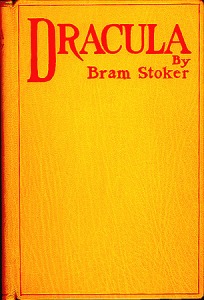
The Gothic horror novel Dracula, written by Bram Stoker of Dublin, is first published on May 26, 1897. The novel tells the story of Dracula’s attempt to move from Transylvania to England so that he may find new blood and spread the undead curse, and of the battle between Dracula and a small group of men and women led by Professor Abraham Van Helsing.
Between 1879 and 1898, Stoker is a business manager for the world-famous Lyceum Theatre in London, where he supplements his income by writing a large number of sensational novels, including the vampire tale Dracula. Parts of the novel are set around the town of Whitby, where he spends summer holidays.
Throughout the 1880s and 1890s, authors such as H. Rider Haggard, Rudyard Kipling, Robert Louis Stevenson, Arthur Conan Doyle, and H. G. Wells write many tales in which fantastic creatures threaten the British Empire. Invasion literature is at a peak, and Stoker’s formula of an invasion of England by continental European influences is very familiar by 1897 to readers of fantastic adventure stories. Victorian readers enjoy Dracula as a good adventure story like many others, but it does not reach its iconic legendary status until later in the 20th century when film versions begin to appear.
Before writing Dracula, Stoker spends seven years researching European folklore and stories of vampires, being most influenced by Emily Gerard‘s 1885 essay Transylvania Superstitions. Later he also claims that he has a nightmare, caused by eating too much crab meat covered with mayonnaise sauce, about a “vampire king” rising from his grave.
Despite being the most widely known vampire novel, Dracula is not the first. It is preceded and partly inspired by Sheridan Le Fanu‘s 1871 Carmilla, about a lesbian vampire who preys on a lonely young woman, and by Varney the Vampire, a lengthy penny dreadful serial from the mid-Victorian period by James Malcolm Rymer. John Polidori creates the image of a vampire portrayed as an aristocratic man, like the character of Dracula, in his tale The Vampyre in 1819.
The Lyceum Theatre where Stoker works between 1878 and 1898 is headed by actor-manager Henry Irving, who is Stoker’s real-life inspiration for Dracula’s mannerisms and who Stoker hopes would play Dracula in a stage version. Irving never does agree to do a stage version, but Dracula’s dramatic sweeping gestures and gentlemanly mannerisms draw their living embodiment from Irving.
The Dead Un-Dead is one of Stoker’s original titles for Dracula, and the manuscript is entitled simply The Un-Dead up until a few weeks before publication. Stoker’s notes for Dracula show that the name of the count is originally “Count Wampyr”, but Stoker becomes intrigued by the name “Dracula” while doing research, after reading William Wilkinson‘s book An Account of the Principalities of Wallachia and Moldavia with Political Observations Relative to Them (London 1820), which he finds in the Whitby Library and consults a number of times during visits to Whitby in the 1890s. The name Dracula is the patronym of the descendants of Vlad II of Wallachia, who takes the name “Dracul” after being invested in the Order of the Dragon in 1431. In the Romanian language, the word dracul can mean either “the dragon” or, especially in the present day, “the devil.”
Dracula is copyrighted in the United States in 1899 with the publication by Doubleday & McClure of New York. However, when Universal Studios purchases the rights, it comes to light that Bram Stoker has not complied with a portion of U.S. copyright law, placing the novel into the public domain. In the United Kingdom and other countries following the Berne Convention on copyrights, the novel is under copyright until April 1962, fifty years after Stoker’s death.
F. W. Murnau‘s unauthorized film adaptation Nosferatu is released in 1922, and the popularity of the novel increases considerably, owing to the controversy caused when Stoker’s widow tries to have the film removed from public circulation. Florence Stoker sues the film company and wins; however, the company is bankrupt, and Stoker only recovers her legal fees and an order by the court for all copies of the film to be destroyed. Some copies survive and find their way into theatres. Eventually, Florence Stoker simply gives up the fight against public displays of the film.
Dracula has been assigned to many literary genres including vampire literature, horror fiction, gothic fiction, and invasion literature. Stoker does not invent the vampire, but he defines its modern form, and the novel has spawned numerous theatrical, film, and television interpretations.



 seamus dubhghaill