seamus dubhghaill

Promoting Irish Culture and History from Little Rock, Arkansas, USA


Leave a comment

The Rotunda Hospital Opens in Dublin

The Rotunda Hospital, legally the Hospital for the Relief of Poor Lying-in Women, Dublin, is opened by the Lord Lieutenant of Ireland, John Russell, 4th Duke of Bedford, on December 8, 1757. It is a maternity hospital on Parnell Street in Dublin, now managed by RCSI Hospitals. The eponymous Rotunda in Parnell Square is no longer a part of the hospital complex.

The hospital is founded by Bartholomew Mosse, a surgeon and midwife who is appalled at the conditions that pregnant women have to endure, in George’s Lane in March 1745. It is granted by Royal Charter on December 2, 1756 by King George II. Lying-in is an archaic term for childbirth, referring to the month-long bed rest prescribed for postpartum confinement. The venture is very successful and Mosse raises money through concerts, exhibitions and even a lottery to establish larger premises. The hospital moves to new premises, designed by Richard Cassels, where it becomes known as “The New Lying-In Hospital” in December 1757. The Church of Ireland Chapel is opened in 1762. Open to the public, it provides a healthy income to the hospital annually, Dr. Mosse successfully encouraging wealthy Protestant Dubliners to attend service there.

Records indicate that around 1781, “when the hospital was imperfectly ventilated, every sixth child died within nine days after birth, of convulsive disease; and that after means of thorough ventilation had been adopted, the mortality of infants, within the same, in five succeeding years, was reduced to one in twenty.” This issue is not limited to the Lying-In-Hospital. In the era, ventilation improvement is a general issue in patient care, along with other issues of sanitation and hygiene, and the conditions in which surgeons such as Robert Liston in Britain and elsewhere, have to operate. Florence Nightingale famously works on the design of safe and healthy hospitals.

The first Caesarean section in Ireland is undertaken at the hospital in 1889.

The eponymous Rotunda is a rotunda designed by James Ensor, which is completed just in time for a reception hosted by James FitzGerald, Marquess of Kildare, in October 1767. The extensive Rotunda Rooms, designed by Richard Johnston and built adjacent to the rotunda, are completed in 1791. By the early 19th century the hospital has become known as the Rotunda Hospital, after its most prominent architectural feature. The Rotunda becomes a theatre, where the Irish Volunteers first public meeting is held in 1913, and later the Ambassador Cinema. The Rotunda Rooms now house the Gate Theatre.

The Rotunda Hospital, as both a maternity hospital and also as a training centre (affiliated with Trinity College, Dublin) is notable for having provided continuous service to mothers and babies since inception, making it the oldest continuously operating maternity hospital in the world. It is estimated that over 300,000 babies have been born there.

In 2000 the Rotunda is one of two Dublin maternity hospitals found to have illegally retained organ tissue from babies without parental consent. The tissue removed in postmortem examinations is retained for some years. The Rotunda Hospital admits that that permission should have been sought for this process to be allowed to take place.

A medical negligence award is approved in 2020 for a young boy who develops cerebral palsy as a result of complications with his delivery at the hospital in 2004.


Leave a comment

Birth of John Toler, 1st Earl of Norbury

John Toler, 1st Earl of Norbury PC, KC, Irish lawyer, politician and judge known as The Lord Norbury between 1800 and 1827, is born at Beechwood, Nenagh, County Tipperary, on December 3, 1745. A greatly controversial figure in his time, he is nicknamed the “Hanging Judge” and is considered to be one of the most corrupt legal figures in Irish history. He is Chief Justice of the Common Pleas for Ireland between 1800 and 1827.

Toler is the youngest son of Daniel Toler, MP, and Letitia, daughter of Thomas Otway (1665–1724), of Lissenhall, Nenagh, County Tipperary. His elder brother Daniel Toler is also a politician, serving as High Sheriff for Tipperary and also as MP for Tipperary. The Toler family is originally from Norfolk, East Anglia, England, but settles in County Tipperary in the 17th century. He is educated at Kilkenny College and at Trinity College, Dublin.

After graduating from university Toler enters the legal profession and is called to the Irish Bar in 1770. In 1781 he is appointed a King’s Counsel. He is returned to the Parliament of Ireland for Tralee in 1773, a seat he holds until 1780, and later represents Philipstown between 1783 and 1790 and Gorey from 1790 until the Acts of Union 1800. In 1789 he is appointed Solicitor-General for Ireland, which he remains until 1798 when he is promoted to Attorney-General for Ireland and sworn of the Privy Council of Ireland. In his role as Attorney-General he is responsible for the prosecution of those involved in the Irish Rebellion of 1798. According to the Dictionary of National Biography “his indifference to human suffering … disgusted even those who thought the occasion called for firmness on the part of government.” In 1799, he brings forward a law which gives the Lord Lieutenant of Ireland power to suspend the Habeas Corpus Act and to impose martial law.

In 1800 Toler is appointed Chief Justice of the Common Pleas for Ireland and raised to the Peerage of Ireland as Baron Norbury, of Ballycrenode in the County of Tipperary. His appointment to the bench is controversial and John FitzGibbon, 1st Earl of Clare, the Lord Chancellor of Ireland, is said to have quipped, “Make him a bishop, or even an archbishop, but not a chief justice.” His tenure as Chief Justice lasts for 27 years, despite the fact that, the Dictionary of National Biography opines, “his scanty knowledge of the law, his gross partiality, his callousness, and his buffoonery, completely disqualified him for the position. His court was in constant uproar owing to his noisy merriment. He joked even when the life of a human being was hanging in the balance.” This earns him the nickname the “Hanging Judge.” His most famous trial is that of Irish nationalist leader Robert Emmet. He interrupts and abuses Emmet throughout the trial before sentencing him to death. In spite of this, with his strong belief in the Protestant Ascendancy, he is considered to have had great influence over the government in Ireland in the early part of the nineteenth century.

However, Toler’s position eventually becomes untenable even to his strongest supporters, especially with the British government‘s aim of establishing a better relationship with the Catholic majority. His reputation is tainted in 1822, when a letter written to him by William Saurin, the Attorney-General for Ireland, is discovered, in which Saurin urges him to use his influence with the Irish Protestant gentry which makes up local juries against the Catholics. Saurin is dismissed soon afterwards. He finds his greatest adversary in Daniel O’Connell, to whom Toler is “an especial object of abhorrence.” At O’Connell’s instigation the case of Saurin’s letter is brought before the House of Commons of the United Kingdom by Henry Brougham. Toler survives this as well as an 1825 petition drawn up by O’Connell, which calls for his removal on the grounds of him falling asleep during a murder trial and later being unable to present any account of the evidence given. However, it is not until George Canning becomes Prime Minister in 1827 that Toler, then 82, is finally induced to resign. His resignation is sweetened by him being created Viscount Glandine and Earl of Norbury, of Glandine in King’s County, in the Peerage of Ireland. Unlike the barony of Norbury these titles are created with remainder to his second son Hector John. His eldest son Daniel is then considered mentally unsound.

Toler marries Grace, daughter of Hector Graham, in 1778. They have two sons and two daughters. In 1797 Grace is raised to the Peerage of Ireland as Baroness Norwood, of Knockalton in the County of Tipperary, in honour of her husband. She dies in 1822 and is succeeded in the barony by her eldest son, Daniel. Toler survives her by nine years and dies at the age of 85 at his Dublin home at 3 Great Denmark Street on July 27, 1831. He is succeeded in the barony of Norbury by his eldest son Daniel and in the viscountcy and earldom according to the special remainder by his second son, Hector. In 1832 the latter also succeeds his elder brother in the baronies of Norwood and Norbury. He is considered to be the father of the astronomer John Brinkley.

(Pictured: John Toler, 1st Earl of Norbury, coloured etching by unknown artist, early 19th century, National Portrait Gallery, NPG D9303)


2 Comments

Execution of William Orr, Member of the United Irishmen

William Orr, a member of the United Irishmen, is executed by the British on October 14, 1797, in what is widely believed at the time to be “judicial murder” and whose memory leads to the rallying cry “Remember Orr” during the Irish Rebellion of 1798. He is regarded as the first United Irish martyr.

Little is known of Orr’s early life. He is born in 1766 to a Presbyterian farming family and bleach-green proprietor, at Ferranshane outside Antrim town. The family is in comfortable circumstances and, as a result, he receives a good education. His appearance and manner are at the time considered noteworthy as he stands 6′ 2″ in height and is always carefully and respectably dressed, a familiar feature in his apparel being a green necktie, which he wears “even in his last confinement.” His popularity amongst his countrymen is also noted, particularly among the Northern Presbyterian patriots. He becomes active in the Irish Volunteers and then joins the United Irishmen. Sometime in the mid-1790s, he contributes several articles to their newspaper, the Northern Star.

Orr is charged at Carrickfergus Town Hall with administering the United Irishmen oath to a soldier named Hugh Wheatly, an offence which had recently been deemed a capital charge under the 1796 Insurrection Act. The offence is aggravated from a legal point of view because of the allegation that it is a serving soldier whom he is alleged to have administered the oath to. The prosecution makes the most of this “proof” of the “treasonable” aim of the United Irishmen to “seduce from their allegiance” the “men who are the Kingdom’s only safeguard against the foreign foe.”

The United Irishmen know from the evidence of some of their own number that Orr had not administered the oath on the occasion alleged. They also have the evidence of another eyewitness, James “Jemmy” Hope. The soldier witness Wheatly perjures himself and it is proved he is of bad character. The person who did tender the oath is a well-known member of the Society, William McKeever, who subsequently escapes to the United States. It is widely believed at the time that the authorities wish to make an example of Orr to act as a deterrent to potential United Irishmen recruits.

The actual case, which does not appear in the course of the proceedings but everyone, according to T. A. Jackson, is “in the know” and fully aware that the United Irishmen’s oath had been administered to a soldier “whether it was Orr or another who administered the oath was merely incidental.”

Orr is represented by John Philpot Curran, and the trial leads to a speech, which, according to T. A. Jackson, “is among the most remarkable of his many remarkable speeches.” It is a charge of libel against the Press newspaper, the journal founded by Arthur O’Connor to replace the Northern Star. The Press had published an open letter to the Viceroy, remarking scornfully on his refusal to show clemency to Orr. Curran’s defence is a counter-attack — an indictment of the Government, root and branch.

The only evidence used against Orr is the unsupported evidence of the soldier Wheatly and after hearing Curran’s defence of the prisoner, “there could be no possible doubt of his innocence.” Even the presiding judge, Barry Yelverton, 1st Viscount Avonmore, is said to have shed tears at the passing of the death sentence, although Orr’s friend, the poet and United Irishman William Drennan expresses his disgust at this display with the words “I hate those Yelvertonian tears.”

The sentence was hardly passed on Orr when regret is to seize on those who had aided in securing that verdict. The witness Wheatly, who subsequently goes insane and is believed to have died by his own hand, makes an affidavit before a magistrate admitting that he had sworn wrongly against Orr. Two members of the jury make depositions stating that they had been “induced to join in the verdict of guilty while under the influence of drink,” while two others swear that they had “been terrified into the same course by threats of violence.”

These particulars are placed before the Viceroy, but Lord Camden, the Lord Lieutenant of Ireland, is “deaf to all appeals” (including from his sister Lady Londonderry). “Well might Orr exclaim within his dungeon” he said “that the Government had laid down a system having for its object murder and devastation.”

Though his execution is postponed three times, Orr is hanged in the town of Carrickfergus on October 14, 1797, surrounded by an extra strong military guard. It is said that the population of the town, to express their sympathy with the “patriot” being “murdered by law,” and to mark their repugnance of the conduct of the Government towards him, quit the town on the day of his execution.

Orr’s fate “excited the deepest indignation throughout the country” and it is commented on “in words of fire” by the national writers of the period, and for many years after the rallying cry of the United Irishmen is “Remember Orr.” The journalist Peter Finnerty, who publishes an attack on Yelverton and Camden for their conduct in the matter, is later convicted of seditious libel, despite an eloquent defence by Curran.

(Pictured: William Orr from a sketch by E. A. Morrow)


Leave a comment

Death of Thomas Butler, 6th Earl of Ossory

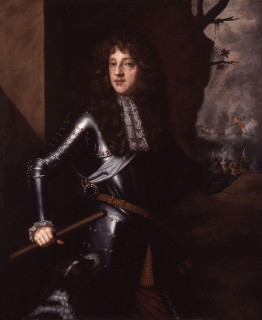
Vice Admiral Thomas Butler, 6th Earl of Ossory, KG, PC, PC (Ire), Irish soldier and politician, dies in London on July 30, 1680.

Thomas is born on July 8, 1634, at Kilkenny Castle, the eldest son and one of ten siblings of James Butler, 1st Duke of Ormond and his wife Elizabeth Preston. His father is then the 12th Earl of Ormond but would be raised to marquess and duke. His family, the Butler dynasty, is Old English and descends from Theobald Walter, who had been appointed Chief Butler of Ireland by Henry II of England in 1177. His mother is a second cousin once removed of his father as she is a granddaughter of Thomas Butler, 10th Earl of Ormond. Her father, however, is Scottish, Richard Preston, 1st Earl of Desmond, a favourite of James I. Both parents are Protestants.

As the eldest living son, he is the heir apparent and is styled with the corresponding courtesy title, which at first is Viscount Thurles but changed to Earl of Ossory when his father becomes marquess in 1642. His early years are spent in Ireland until 1647 when he accompanies his father to England. In 1648 his father renews his support for the royalist cause and he and his son have to flee to France, arriving in Caen in February 1648. Lady Ormond also moves to Caen, where she arrives on June 23, 1648, with his siblings.

Butler is an accomplished athlete and a good scholar. Having come to London in 1652 he is rightly suspected of sympathising with the exiled royalists, and in 1655 is jailed by Oliver Cromwell. After his release about a year later he goes into exile to the Netherlands where Charles II has his exile court at the time.

On November 17, 1659, while in exile, Butler marries Emilia van Nassau, the second daughter of Louis of Nassau, Lord of De Lek and Beverweerd. They have eleven children.

Butler accompanies Charles II back to England in 1660. In 1661 he becomes a member of both the English and the Irish houses of commons, representing in the former Bristol and Dublin University in the latter.

In 1662 Butler is called to the Irish House of Lords under a writ of acceleration as the Earl of Ossory. His father holds the title “5th Earl of Ossory” as one of his subsidiary titles. The acceleration makes Thomas Butler the 6th Earl of Ossory. This is the only substantive title he ever holds, as he predeceases his father and therefore never succeeds to his father’s titles.

Butler holds several military appointments including lieutenant-general of the army in Ireland, created an English peer as Lord Butler in 1666, and Lord of the Bedchamber to Charles II (appointed in 1660 and held until his death).

In 1665 a fortunate accident allows Butler to take part in the Battle of Lowestoft against the Dutch, and in May 1672, being now in command of a ship, he fights against the same enemies in the Battle of Solebay, serving with great distinction on both occasions. While visiting France in 1672 he rejects the liberal offers made by Louis XIV to induce him to enter the service of France and returning to England he adds to his high reputation by his conduct during the Battle of Texel in August 1673. From 1677 until 1679, he serves alongside his father as a Lord of the Admiralty.

Butler is intimate with William II, Prince of Orange, and in 1677 he joins the allied army in the Netherlands, commanding the British contingent and winning great fame at the siege of Mons in 1678. He acts as deputy for his father, who is Lord Lieutenant of Ireland. In 1680 he is appointed governor of English Tangier, but his death prevents him from taking up his new duties.

Butler dies on July 30, 1680, at Arlington House in London. He is buried provisionally in Westminster Abbey on July 31, 1680. The ceremony of burial is performed belatedly on November 13, 1680. Some say his body is later taken to Ireland and reburied in the family vault in St. Canice’s Cathedral, Kilkenny. James, his eldest son, succeeds him as the 7th Earl of Ossory and becomes the 2nd Duke of Ormond in 1688.

(Pictured: “Thomas Butler, Earl of Ossory,” painting by Peter Lely, circa 1678, Source: National Portrait Gallery)


Leave a comment

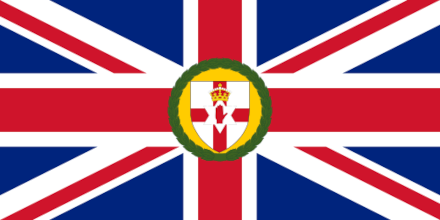
Office of Governor of Northern Ireland Abolished

The mainly ceremonial office of Governor of Northern Ireland is abolished on July 18, 1973 under Section 32 of the Northern Ireland Constitution Act 1973. The Secretary of State for Northern Ireland, a cabinet office created in 1972, takes over the functions of the Governor on December 20, 1973 under Letters Patent.

The office of the Governor of Northern Ireland is established on 9 December 9, 1922 under Letters Patent to “do and execute in due manner as respects Northern Ireland all things which by virtue of the [1920] Act and our said Letters Patent of 27 April 1921 or otherwise belonged to the office of Lord Lieutenant at the time of the passing of the Irish Free State Constitution Act 1922.”

The 1922 “Instructions” sent alongside the letters patent establishing the office require the Governor of Northern Ireland to get the monarch’s permission to leave Northern Ireland, and empowers the Governor in such cases to issue letters patent under the Great Seal of Northern Ireland appointing a “Deputy or Deputies, Justice or Justices” during his absence. This emulates the practice of appointing Lords Justices of Ireland when the Lord Lieutenant is absent from Ireland. Each new Governor upon taking office selects a slate of eligible deputies from among the Privy Council of Northern Ireland, and at each of his subsequent absences a subset of these are sworn in for its duration. Many are Lord Chief Justice or Lord Justice of Appeal, including Denis Henry, William Moore, James Andrews, Anthony Babington, John MacDermott, Baron MacDermott, and Samuel Clarke Porter. Others are Senators and/or county lieutenants, including Robert Sharman-Crawford, Robert David Perceval-Maxwell, Henry Armstrong, Sir Thomas Dixon, 2nd Baronet, Maurice McCausland, and Francis Needham, 4th Earl of Kilmorey.

The Governor has possession of the Great Seal of Northern Ireland and is the successor to the Lord Lieutenant of Ireland in Northern Ireland, itself established on May 3, 1921. The official residence of the Governor of Northern Ireland is Hillsborough Castle in County Down. Following refurbishment of the Castle, James Hamilton, 3rd Duke of Abercorn, takes up residence in 1925. It remained the official residence until the abolition of the office of governor in 1973. Henceforth it has been the official residence of the Secretary of State for Northern Ireland.


Leave a comment

Death of Michael Davitt, Founder of the Irish National Land League

Michael Davitt, Irish republican and agrarian agitator, dies in Elphis Hospital in Dublin from blood poisoning on May 30, 1906. He is the founder of the Irish National Land League, which organizes resistance to absentee landlordism and seeks to relieve the poverty of the tenant farmers by securing fixity of tenure, fair rent, and free sale of the tenant’s interest.

Davitt is born in Strade, County Mayo, on March 25, 1846, the son of an evicted tenant farmer. Following their eviction, the family emigrates to England. In 1856, at the age of 10, he starts work in a cotton mill, where he loses an arm in a machinery accident a year later. As is typical for the era, he does not receive any compensation.

In 1865, Davitt joins the revolutionary Fenian Brotherhood, an international secret society that seeks to secure political freedom for Ireland. He becomes secretary of its Irish analogue, the Irish Republican Brotherhood (IRB), in 1868. Arrested in Paddington Station in London for sending firearms to Ireland on May 14, 1870, he is sentenced to 15 years in Dartmoor Prison and there lays plans to link Charles Stewart Parnell’s constitutional reform with Fenian activism to achieve political-agrarian agitation.

Paroled from prison in 1877, Davitt rejoins the IRB and goes to the United States, where the Fenian movement originated. There he is deeply influenced by Henry George’s ideas about the relationship between land monopoly and poverty.

Back in Ireland, using funds raised by John Devoy and Clan na Gael in the United States, Davitt wins Parnell’s cooperation in organizing the Irish National Land League in 1879, which leads, however, to his expulsion from the supreme council of the IRB in 1880. He is also imprisoned for seditious speeches in 1881 and 1883. He is elected to Parliament representing North Meath in the 1892 United Kingdom general election, but his election is overturned on petition because he had been supported by the Roman Catholic hierarchy. He stands unopposed for North East Cork at a by-election in February 1893, making his maiden speech in favour of the Home Rule Bill in April, which passes the House of Commons but is defeated in the House of Lords in September.

Because of his public championing of Henry George’s theories of land reform, Parnell repudiates him. Davitt actively defends the Nationalists before the Parnell Commission, which meets between 1887 and 1889. When the Irish party splits in 1890 over Parnell’s involvement in Capt. William Henry O’Shea’s divorce case, Davitt is among the first to oppose Parnell’s continuance as leader. He is elected again, for South Mayo in 1895, but resigns in 1899 in protest against the Second Boer War.

Davitt dies in Elphis Hospital, Dublin on May 30, 1906, at the age of 60, from blood poisoning. The fact that the Lord Lieutenant of Ireland attends his funeral is a public indication of the dramatic political journey this former Fenian prisoner has taken. There is no plan for public funeral, and hence Davitt’s body is brought quietly to the Carmelite Friary, Clarendon Street, Dublin. However, the next day over 20,000 people file past his coffin. His remains are taken by train to Foxford, County Mayo, and buried in the grounds of Strade Abbey at Strade, near his place of birth.

Davitt’s book, The Fall of Feudalism in Ireland (1904), is a valuable record of his time.


Leave a comment

Death of Charles Leslie, Jacobite Propagandist & Non-Juror

Charles Leslie, former Church of Ireland priest who becomes a leading Jacobite propagandist after the 1688 Glorious Revolution, dies in Glaslough, County Monaghan on April 13, 1722. One of a small number of Irish Protestants to actively support the Stuarts after 1688, he is best remembered today for his role in publicising the 1692 Massacre of Glencoe.

Leslie is born on July 27, 1650, in Dublin, the sixth son and one of eight surviving children of John Leslie (1571-1671) and Katherine Conyngham (or Cunningham), daughter of Dr. Alexander Cunningham, Dean of Raphoe. He is allegedly named after the executed Charles I and educated at Enniskillen school and Trinity College, Dublin. After his father dies in 1671, he studies law in London before changing career and being ordained as an Anglican priest in 1681. Shortly afterwards, he returns to the family estate at Glaslough in County Monaghan and marries Jane Griffith. They have a daughter, Vinigar Jane, who appears to have died young and two sons, Robert (1683-1744) and Henry who are also Jacobites and spend time in exile.

Leslie is appointed assistant curate for the Church of Ireland parish of Donagh but as most of his parish is Roman Catholic or Presbyterian, he has few duties. His father had been chaplain to Charles I and a key supporter of Caroline religious reforms, first in Scotland, then in Ireland as Bishop of Raphoe in 1633, while the estate at Glaslough was granted by Charles II in 1660 as a reward for his service. With this background, Leslie is a firm supporter of the Stuart dynasty, although deeply hostile to Catholicism and soon becomes involved in political and theological disputes.

When the Catholic James II becomes King in 1685, his brother-in-law Henry Hyde, 2nd Earl of Clarendon, is appointed Lord Lieutenant of Ireland. In July 1686, Leslie’s legal training results in Clarendon making him chancellor of Connor cathedral and later Justice of the Peace. Clarendon’s authority is overshadowed by his Catholic deputy Richard Talbot, 1st Earl of Tyrconnell, who begins undermining legal restrictions on Catholics embodied in the Test Act. Clarendon employs Leslie’s polemical skills to oppose the appointment of Catholics to public office, but he is recalled in 1687. When James is deposed by the Glorious Revolution in December 1688, Leslie is in the Isle of Wight.

Shortly afterwards, Leslie becomes Clarendon’s personal chaplain and like his patron refuses to take the oath of allegiance to William III and Mary II. Like other non-jurors, he is deprived of his Church offices and becomes instead one of the most prominent Jacobite and Tory propagandists. This includes a long dispute with his Trinity College contemporary William King, who supports the Revolution. Gilbert Burnet, Bishop of Salisbury, later names him ‘the violentest Jacobite’ active in England during these years.

Much of Leslie’s early writing focuses on Scotland, where the 1690 Settlement ends Episcopacy and restores a Presbyterian kirk. He uses this to inspire concern about William’s intentions towards the Church of England. Ironically, his modern fame now rests primarily on a pamphlet written in 1695, called Gallienus Redivivus, or Murther will out, &c. Being a true Account of the De Witting of Glencoe, Gaffney. The focus of this is William’s alleged complicity in the 1672 death of Dutch Republican leader Johan de Witt, with other crimes including Glencoe included as secondary charges. During the Jacobite rising of 1745, Charles Stuart orders Leslie’s pamphlet and the 1695 Parliamentary minutes of the investigation to be reprinted in the Edinburgh Caledonian Mercury.

During the 1690s, Leslie serves as a messenger between James’ court in exile at Château de Saint-Germain-en-Laye and the Non-Juror community in England, including the non-juror bishops Jeremy Collier, Thomas Ken and George Hickes. He defends Collier and two other non-juror priests when they become involved in a furor over the execution of Sir John Friend and Sir William Parkyns for their role in the 1696 Jacobite plot to assassinate William. Immediately prior to the execution, the clergymen declare the two absolved of their sins, effectively declaring the correctness of their actions, while also performing a rite not recognised by the Church of England.

In 1702, the accession of Queen Anne, the last Stuart monarch, causes a resurgence in Jacobite activity and in 1704, Leslie begins a weekly periodical initially called The Observator, later The Rehearsal of Observator and finally The Rehearsal. Although his Tory readership shares his High Church principles, he is primarily a Jacobite and violently opposes the common practice of ‘occasional conformity.’ The Rehearsal is forced to close in 1709 and he falls out with his former allies, including Henry Sacheverell whose trial helped the Tories win a landslide victory in the 1710 British general election.

Despite his Tory allies now being in government, a warrant is issued for Leslie’s arrest for his tract The Good Old Cause, or, Lying in Truth. In 1711 he escapes to Paris, where James Francis Edward Stuart has succeeded his father as the Stuart heir in 1701. He continues to write polemics and act as a Jacobite agent. However, after the failed Jacobite rising of 1715, France withdraws support for the Stuarts who are forced to leave France, eventually being invited to settle in Rome by Pope Benedict XIV. The Spanish-sponsored 1719 Rising in Scotland is judged to have done more damage to the Jacobite cause than otherwise, one of its leaders concluding “it bid fair to ruin the King’s Interest and faithful subjects in these parts.”

Despite these failures, Leslie remains a dedicated Jacobite but his lifelong antipathy towards Catholicism makes living in Rome as a Papal pensionary difficult, while hopes of converting James to Anglicanism fades due to his devout personal Catholicism. He returns to Paris in 1717 and in 1719 publishes a two folio-volume edition of his Theological Works. It is later claimed these placed him ‘very high in the list of controversial authors, the ingenuity of the arguments being equalled only by the keenest and pertinacity with which they are pursued.’ He invites friends and supporters to subscribe to these and by 1721, over 500 members of the House of Lords and House of Commons have pledged a total of £750. Charles Spencer, 3rd Earl of Sunderland finally allows him to return home, with the stipulation he cease his political activities.

Charles Leslie dies at Glaslough on April 13, 1722. His grandchildren include Charles Leslie MP, whose son in turn is John Leslie, Bishop of Kilmore, Elphin and Ardagh.

(Pictured: Charles Leslie, mezzotint by Unknown artist, National Portrait Gallery, NPG D5066)


Leave a comment

Death of Jim Larkin, Union Leader & Socialist Activist

James (Jim) Larkin, Irish trade union leader and socialist activist, dies in his sleep in Dublin on January 30, 1947. He is one of the founders of the Irish Labour Party, the Irish Transport and General Workers’ Union (ITGWU), the Workers’ Union of Ireland and the Irish Citizen Army (ICA).

Larkin is born to Irish parents in Liverpool, England, on January 21, 1876. He and his family later move to a small cottage in Burren, County Down. Growing up in poverty, he receives little formal education and begins working in a variety of jobs while still a child.

In 1905, Larkin is one of the few foremen to take part in a strike on the Liverpool docks. He is elected to the strike committee, and although he loses his foreman’s job as a result, his performance so impresses the National Union of Dock Labourers (NUDL) that he is appointed a temporary organiser.

Larkin moves to Belfast in 1907 to organise the city’s dock workers for the NUDL. He succeeds in unionising the workforce, and as employers refuse to meet the wage demands, he calls the dockers out on strike in June. Carters and coal men soon join in, the latter settling their dispute after a month.

In 1908, Larkin moves south and organises workers in Dublin, Cork, and Waterford, with considerable success. His involvement, against union instructions, in a dispute in Dublin results in his expulsion from the NUDL. The union later prosecutes him for diverting union funds to give strike pay to Cork workers engaged in an unofficial dispute. After trial and conviction for embezzlement in 1910, he is sentenced to prison for a year. This is widely regarded as unjust, and the Lord Lieutenant of Ireland, Lord Aberdeen, pardons him after he has served three months in prison.

After his expulsion from the NUDL, Larkin founds the Irish Transport and General Workers’ Union (ITGWU) at the end of December 1908. The organisation exists today as the Services Industrial Professional & Technical Union (SIPTU). In early 1909, Larkin moves to Dublin, which becomes the main base of the ITGWU and the focus of all his future union activity in Ireland.

In June 1911, Larkin establishes a newspaper, The Irish Worker and People’s Advocate, as a pro-labour alternative to the capitalist-owned press. In 1912, in partnership with James Connolly, Larkin helps form the Irish Labour Party.

In early 1913, Larkin achieves some successes in industrial disputes in Dublin. Two major employers, Guinness and the Dublin United Tramway Company, are the main targets of Larkin’s organising ambitions. The chairman of the Dublin United Tramway Company, industrialist and newspaper proprietor William Martin Murphy, is determined not to allow the ITGWU to unionise his workforce. On August 15, he dismisses 40 workers he suspects of ITGWU membership, followed by another 300 over the next week. On August 26, 1913, the tramway workers officially go on strike.

The resulting industrial dispute is the most severe in Ireland’s history. Employers in Dublin engage in a sympathetic lockout of their workers when the latter refuses to sign the pledge, employing blackleg labour from Britain and from elsewhere in Ireland. Guinness, the largest employer in Dublin, refuses the employers’ call to lock out its workers but it sacks 15 workers who struck in sympathy.

For seven months the lockout affects tens of thousands of Dublin workers and employers, with Larkin portrayed as the villain by Murphy’s three main newspapers, the Irish Independent, the Sunday Independent, and the Evening Herald, and by other bourgeois publications in Ireland. The lockout eventually concludes in early 1914 when calls by James Connolly and Larkin for a sympathetic strike in Britain are rejected by the British Trades Union Congress (TUC). Larkin’s attacks on the TUC leadership for this stance also lead to the cessation of financial aid to the ITGWU.

Some months after the lockout ends, Larkin leaves for the United States. He intends to recuperate from the strain of the lockout and raise funds for the union. Once there he becomes a member of the Socialist Party of America and is involved in the Industrial Workers of the World union (the Wobblies). He becomes an enthusiastic supporter of the Soviet Union and is expelled from the Socialist Party of America in 1919 along with numerous other sympathisers of the Bolsheviks during the Red Scare of that year.

Upon his return to Ireland in April 1923, Larkin receives a hero’s welcome and immediately sets about touring the country meeting trade union members and appealing for an end to the Irish Civil War. In September 1923, Larkin forms the Irish Worker League (IWL), which is soon afterwards recognised by the Communist International as the Irish section of the world communist movement.

James Larkin dies in his sleep on January 30, 1947, in the Meath Hospital in Dublin. Fr. Aloysius Travers, OFM, who had administered last rites to James Connolly in 1916, also administers extreme unction to Larkin. His funeral mass is celebrated by the Catholic Archbishop of Dublin, John Charles McQuaid, who had visited him in hospital before he died, and thousands line the streets of the city as the hearse passes through on the way to Glasnevin Cemetery.

Today a statue of “Big Jim” stands on O’Connell Street in Dublin, completed by Oisín Kelly and unveiled in 1979.


Leave a comment

Death of Edmund Mortimer, 3rd Earl of March

Edmund Mortimer, 3rd Earl of March and jure uxoris Earl of Ulster, is killed at Cork on December 27, 1381. His sudden death leaves the colony without effective leadership and prompts a military crisis.

Mortimer, the son of Roger Mortimer, 2nd Earl of March, by his wife Philippa, daughter of William Montagu, 1st Earl of Salisbury and Catherine Grandison, is born on February 1, 1352. An infant at the death of his father, as a ward of the crown he is placed by Edward III of England under the care of William of Wykeham and Richard FitzAlan, 3rd Earl of Arundel. The position of the young earl, powerful on account of his possessions and hereditary influence in the Welsh marches, is rendered still more important by his marriage on August 24, 1369 at the age of 17 to the 14-year-old Philippa, the only child of the late Lionel of Antwerp, 1st Duke of Clarence, the second son of Edward III.

Lionel’s late wife, Elizabeth, had been daughter and heiress of William Donn de Burgh, 3rd Earl of Ulster, and Lionel had himself been created Earl of Ulster before his marriage. Mortimer inherits the title Earl of Ulster on Lionel’s death. Therefore, the Earl of March not only represents one of the chief Anglo-Norman lordships in Ireland in right of his wife Philippa, but Philippa’s line is also the second most senior line of descent in the succession to the crown, after Edward the Black Prince and his son, King Richard II of England. John of Gaunt, younger brother of Prince Edward, had become the 1st Duke of Lancaster and thus the source of the House of Lancaster‘s claim to the throne.

This marriage has, therefore, far-reaching consequences in English history, ultimately giving rise to the claim of the House of York to the crown of England contested in the Wars of the Roses between the Yorks and the Lancasters; Edward IV being descended from the second adult son of Edward III as great-great-grandson of Philippa, countess of March, and in the male line from Edmund of Langley, 1st Duke of York and the fourth adult son of Edward III. Mortimer’s son, Roger Mortimer, 4th Earl of March, becomes heir presumptive to the English crown during the reign of Richard II.

Mortimer, now styled Earl of March and Ulster, becomes Earl Marshal of England in 1369, and is employed in various diplomatic missions during the following years. He is a member of the committee appointed by the Peers to confer with the Commons in 1373, the first instance of such a joint conference since the institution of representative parliaments on the question of granting supplies for John of Gaunt’s war in France.

Mortimer participates in the opposition to Edward III and the court party, which grows in strength towards the end of the reign, taking the popular side and being prominent in the Good Parliament of 1376 among the lords who support the Prince of Wales and oppose the Court Party and John of Gaunt. The Speaker of the House of Commons in this parliament is Mortimer’s steward, Peter de la Mare, who firmly withstands John of Gaunt in stating the grievances of the Commons, in supporting the impeachment of several high court officials, and in procuring the banishment of the king’s mistress, Alice Perrers. Mortimer is a member of the administrative council appointed by the same parliament after the death of Edward, the Black Prince, to attend the king and advise him in all public affairs.

Following the end of the Good Parliament its acts are reversed by John of Gaunt, Mortimer’s steward is jailed, and he himself is ordered to inspect Calais and other remote royal castles as part of his duty as Marshal of England. He instead chooses to resign the post.

On the accession of Richard II in 1377, Mortimer becomes a member of the standing council of government; though as husband of the heir-presumptive to the crown he wisely refrains from claiming any actual administrative office. The richest and most powerful person in the realm is, however, the king’s uncle John of Gaunt, whose jealousy leads Mortimer to accept the office of Lord Lieutenant of Ireland in 1379. He succeeds in asserting his authority in eastern Ulster, but fails to subdue the O’Neill dynasty farther west. Proceeding to Munster to put down the turbulent southern chieftains, he is killed at Cork on December 27, 1381. He is buried in Wigmore Abbey, of which he had been a benefactor, and where his wife Philippa is also interred.

(Pictured: Coat of Arms of the House of Mortimer)


6 Comments

The Hearts of Steel Storm Belfast Barracks

The Hearts of Steel, also known as the Steelboys, an exclusively Protestant movement originating in County Antrim due to grievances about the sharp rise of rent and evictions, is involved in conflict in Ulster on December 23, 1770. Five hundred members of the Hearts of Steel force the release a prisoner in Belfast.

The Hearts of Steel arise in 1769 in opposition to unjust and exorbitant rents, chiefly exacted by middlemen, speculators or “forestallers,” who take lands from absentee landlords at greatly increased rents and make their own profit by doubling the rents on the poor tenants.

In 1770 in Templepatrick, County Antrim, a local landlord evicts tenants and replaces them with speculators who can outbid the locals for the land. At some point a local is arrested and charged with maiming cattle belonging to a merchant from Belfast, which spurs the farmers of Templepatrick to take up arms and march on Belfast to demand his release. The protestors surround the barracks and threaten to burn the house of Waddell Cunningham, who is one of the new speculators in Templepatrick. The soldiers in the barracks fire upon the protestors killing several and wounding others. The protestors eventually set fire to Cunningham’s house and as the fire threatens to spread and destroy the town of Belfast itself, the mayor decides to free the prisoner.

Further consternation is caused by the sharp increase of rents throughout Ulster. At the same time the leases expire for Lord Donegall‘s south County Antrim estate. While he keeps his rent at the old prices, he greatly increases their renewal fee. These coincide with several years of severe harvest failures which result in high bread prices. The result of this is that people are unable to support themselves or their families, being left in the utmost state of deprivation and destitution, with many evicted from their land for failure to pay.

The Hearts of Steel protests and uprisings quickly spread throughout the county and into counties Armagh, Down, and Londonderry, which are also subject to the Hearts of Oak protest movement with which it merges. One tactic of the protestors is the “houghing” of cattle, which involves laming cattle by cutting the leg tendons. They also force farmers to sell food at prices they set, and demand anyone letting out land to do so at the cost of 12 shillings per acre. Landlords are threatened that if they try to collect the cess from anyone that their houses will be destroyed.

The disturbances are so widespread in the affected counties that the Irish government passes legislation to severely punish the “wicked and disorderly persons.” By the later half of 1772 they send the army into Ulster to crush them. Men are hanged while many others are said to have drowned trying to flee across the sea to Scotland. The Lord Lieutenant of Ireland, Lord Townshend, privately blames the landlords and their actions for the disturbances and so issues a general pardon in November 1772.

(Pictured: The Hearts of Steel storming the barracks at Belfast, December 1770 | Linen Hall Library)