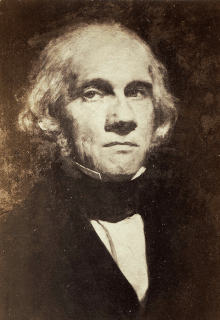
Born into an Ulster Scots family, Thomson is the fourth son of Agnes Nesbit and James Thomson, a small farmer, at Annaghmore, near Ballynahinch, County Down, in Ulster. His early education is from his father. At the age of 11 or 12 he finds out for himself the art of dialling. His father sends him to a school at Ballykine, near Ballynahinch, kept by Samuel Edgar, father of John Edgar. Here he soon rises to be an assistant.
Wishing to become a minister of the Presbyterian church, Thomson enters the University of Glasgow in 1810, where he studies for several sessions, supporting himself by teaching in the Ballykine school during the summer. He graduates MA in 1812, and in 1814 he is appointed headmaster of the school of arithmetic, bookkeeping, and geography in the newly established Royal Belfast Academical Institution. In 1815 he is Professor of Mathematics in its collegiate department. Here he proves himself as a teacher. In 1829 the honorary degree of LL.D. is conferred upon him by the University of Glasgow, where in 1832 he is appointed Professor of Mathematics. He holds this post until his death on January 12, 1849.
Thomson is buried with his family on the northern slopes of the Glasgow Necropolis to the east of the main bridge entrance. The grave is notable due to the modern memorial to Lord Kelvin at its side.
Thomson is the author of schoolbooks that have passed through many editions including Arithmetic (1819), Trigonometry, Plane and Spherical (1820), Introduction to Modern Geography (1827), The Phenomena of the Heavens (1827), The Differential and Integral Calculus (1831), and Euclid (1834).
A paper, “Recollections of the Battle of Ballynahinch, by an Eye-witness,” which appears in the Belfast Magazine for February 1825, is from his pen.
Thomas (Tom) Steele, engineer and political activist, is born on November 3, 1788, at Derrymore, County Clare, the son of William Steele, gentleman, and Catherine Steele (née Bridgeman).
In July 1805 Steele enters Trinity College Dublin, graduating BA in the spring of 1810. He then studies at Magdalene College, Cambridge, where he graduates MA in 1820, becoming an associate member of the Institution of Civil Engineers in the same year. In 1821 he inherits Cullane House, near Craggaunowen, County Clare, on the death of his uncle. Of an enthusiastic and adventurous nature, in 1823 he decides to support the cause of the liberals in Spain who had rebelled against the autocratic rule of Ferdinand VII in 1820. Mortgaging the house and lands at Cullane, he purchases a large quantity of arms and ships them to Spain on board the ship Iris. Commissioned in the Legion Estrenjera of the liberal army, he distinguishes himself in the Battle of Trocadero and the defence of Madrid. He later publishes an account of his experiences, Notes on the war in Spain (London, 1824).
Returning from Spain with his fortunes ruined, Steele begins experiments with underwater diving apparatus, patenting “Steele’s improved diving-bell” in 1825. In the same year he becomes a partner in the Vigo Bay Co., which attempts to recover gold and silver bullion from Spanish ships which sank in Vigo Bay in 1702. After extensive diving operations using Steele’s diving-bell, the company is wound up at an acrimonious meeting of shareholders in September 1826. Despite claims by some of the shareholders that bullion had been found, the scheme is a total failure.
Steele is involved in the Catholic Association and, a close friend of Daniel O’Connell, is active in the emancipation campaign although himself a protestant. In 1828 he seconds O’Connell’s nomination for Clare in the general election of that year. Appointed by O’Connell as ‘Head Pacificator,’ he tours the country collecting weapons and discouraging the rural population from engaging in faction fighting. There is a certain irony in this appointment, as Steele’s own volatile temper is well known. A noted duelist, he fights an inconclusive duel in 1829 with William Smith O’Brien, who had opposed O’Connell’s second candidature for County Clare. In 1828 he is a founder of the Limerick Independent Club.
An associate of the diving pioneers John and Charles Deane, Steele dives on the wreck of the Intrinsic, off the Clare coast in January 1836, using their new diving helmet. He then begins developing equipment to provide underwater illumination, and in 1840 dives with the Deane brothers off Plymouth on the wreck of Henry VIII‘s ship, the Mary Rose. Yet he is in serious financial difficulties, which are not helped by some of his more eccentric building projects. It is said of him that “he seemed utterly incapable of rationally estimating the value of money in his own case.” He begins renovating, at great expense, a ruined castle that stands on his land at Cullane. He also later has a large standing stone, known as the ‘Umbilicus Hiberniae’ (‘Navel of Ireland’), removed from Birr, King’s County (now County Offaly), and taken to his house. At Cullane it is set up as an altar and used for mass whenever O’Connell or members of the Catholic Association visit. It is not returned to Birr until 1974.
Known as “Honest Tom Steele,” Steele is deeply devoted to O’Connell, and is one of his key lieutenants during the repeal campaigns of the 1830s and 1840s. He takes his title and responsibilities as O’Connell’s “Head Pacificator” so seriously and generally expresses himself with such long-winded pomposity that he becomes something of a figure of fun for opponents of O’Connell and for many of the younger men in the Repeal Association. Tried on conspiracy charges after the prohibition of the Clontarf monster meeting, he is one of the six “traversers” imprisoned with O’Connell in Richmond jail from May to September 1844. Strongly supporting O’Connell’s repudiation of physical force, he chairs and takes a prominent part in the peace resolution debates of July 1846 in which the Young Ireland group walks out of the Repeal Association.
After the death of O’Connell on May 15, 1847, Steele falls into a deep depression and, financially ruined, jumps from Waterloo Bridge in London on April 19, 1848. Pulled from the river by a Thames boatman, he survives for a number of weeks. Former political opponents, including Lord Brougham, offer financial help but he refuses. He dies on June 15, 1848, and his remains are taken to Dublin, where he is waked at Conciliation Hall, the headquarters of the Repeal Association, on Burgh Quay. He is buried in Glasnevin Cemetery, beside O’Connell’s tomb. He appears as one of the figures on the O’Connell memorial in O’Connell Street, Dublin.
Steele never marries but harbours an unrequited passion for a Miss Eileen Crowe of Ennis, County Clare, and is often to be seen standing on a large rock, which comes to be known as “Steele’s Rock,” on the banks of the River Fergus in Ennis as he tries to catch a glimpse of Miss Crowe, who lives across the river.
(From: “Steele, Thomas (Tom)” by David Murphy, Dictionary of Irish Biography, http://www.dib.ie | Pictured: (L to R) Thomas Steele, Daniel O’Connell and O’Gorman Mahon by Joseph Patrick Haverty)
The son of a shipyard worker, McWhirter is raised in a large extended family on the Shankill Road in Belfast. He and his extended family spend the war years and then weekends and the summers at their seaside bungalow in Carnalea, now a suburb of Bangor, County Down. In 1957 he begins a “combined scholarship” studying English and Spanish at Queen’s University Belfast, and education at Stranmillis University College, Belfast. His tutor at Queen’s is the poet Laurence Lerner, and he is a classmate with the future literary critic Robert Dunbar and the poets Seamus Heaney and Seamus Deane.
McWhirter is associated with PRISM International magazine from 1968 to 2005. He is the author and editor of numerous books and the recipient of many awards. His first book of poetry, Catalan Poems, is a joint winner of the first Commonwealth Poetry Prize with Chinua Achebe‘s Beware, Soul Brother. He is made a life member of the League of Canadian Poets in 2005 and is also a member of the Writers’ Union of Canada and PEN International. In March 2007, he is named Vancouver’s inaugural Poet Laureate for a two-year term.
McWhirter currently writes full-time and lives in Vancouver with his wife. They have two children and three grandchildren.
Rolleston is the youngest child among three sons and a daughter of Charles Rolleston-Spunner, barrister and county court judge for Tipperary, and his wife Elizabeth, daughter of John Richards, judge and baron of the Court of Exchequer, Ireland. He attends St. Columba’s College, Rathfarnham, where he is head boy, and Trinity College Dublin (TCD), graduating with an MA in 1878. His literary ambitions first emerge at university, where he wins the vice-chancellor’s prize for English verse in 1876.
In 1879 Rolleston marries Edith Caroline, daughter of Rev. William de Burgh of Naas, County Kildare. She suffers from rheumatism, and this encourages the couple to live in Germany from 1879 to 1883. During this period, he develops a fascination for German philosophy and literature and begins a correspondence with the American poet Walt Whitman, whose work he knows through Edward Dowden. In 1881 he offers to translate into German, with S. K. Knortz, Whitman’s Leaves of Grass. This is published as Grashalme in 1889. In that year he also publishes a biography of the German philosopher Gotthold Lessing, and in 1892 delivers the Taylorian Lectures at the University of Oxford on this subject.
In the meantime, Rolleston has returned to Ireland and co-founds the Dublin University Review (DUR) with Charles Hubert Oldham in February 1885. In March 1885, under their stewardship the DUR is the first to publish W. B. Yeats. The poetry of Katharine Tynan and the first English translations of Ivan Turgenev also appear in the magazine. He has a fondness for clubs and at this time is associated with the Contemporary Club, where he becomes friendly with fellow member Douglas Hyde, and the Young Ireland Society, where he is vice-president and a disciple of John O’Leary. He writes the dedication to O’Leary in Poems and ballads of Young Ireland (1888) and is encouraged by the older man in his editing of The prose writing of Thomas Davis (1890). Under O’Leary’s influence he flirts with Fenianism, perhaps even joining the Irish Republican Brotherhood (IRB) for a time and is strongly critical of the prominent involvement of Catholic clergy in the home rule movement.
After the demise of the DUR in December 1886 Rolleston moves to London but remains involved in Irish literary activity. Although unenthusiastic in his assessment of The Wanderings of Oisín (1889), he is friendly with Yeats, and they instigate the Rhymers’ Club (1890). He is a much better critic and organiser than poet but contributes to The Book of the Rhymers’ Club (1892) and The Second Book of the Rhymers’ Club (1894). His work appears in a number of contemporary journals and anthologies, and he has one collection published, Sea Spray (1909).
Rolleston is first secretary of the Irish Literary Society (1892) and attends the foundation of its sister organisation in Dublin, the National Literary Society. These societies are soon riven by a dispute for control between Yeats and Charles Gavan Duffy, centred on the political and literary agenda of the movement. Rolleston at least acquiesces in, if not actively contributes to, Yeats’s defeat. They remain on reasonable terms, but Yeats is resentful. Rolleston edits the famous anthology, Treasury of Irish Poetry (1900), with the Rev. Stopford Augustus Brooke, whose daughter, Maud, he had married in October 1897. They have four children. His first marriage also produces four children, and he is godfather to Robert Graves, whose father, Alfred Perceval Graves, is a friend.
In 1894 Rolleston returns to Dublin, becoming managing director and secretary of the Irish Industries Association (1894–7) and honorary secretary of the Arts and Crafts Society of Ireland (1898–1908). A central figure in the latter as an organiser, propagandist, and critic rather than a practitioner, lecturing regularly and editing the journal of the society, he seeks to integrate the arts and crafts revival with other contemporary developments, cooperating with the Congested Districts Board for Ireland to organise classes. He is a supporter of the co-operative movement of Horace Plunkett, and a member of the Recess Committee. On the foundation of the Department of Agriculture and Technical Instruction (DATI), he is employed by Plunkett and T. P. Gill as organiser of lectures (1900–05). In this capacity he manages the Irish historic collection at the St. Louis exhibition of 1904 and publicly supports Plunkett in his dispute with the DATI in 1908. Convinced that the development of Irish industry is central to national progress, he believes that the Irish Parliamentary Party (IPP) failed to offer a clear practical programme for Irish nationalism. By 1900, however, his own nationalism is tempered by a belief in the importance of the imperial connection, and he opposes the pro-Boer stance taken by many Irish nationalists. In later years he publishes pamphlets urging economic development as a means of quelling Irish demands for home rule.
Rolleston is a sporadic member of the Gaelic League, writing the lyrics for the ‘Deirdre cantata,’ which wins first prize at the first Feis Ceoil in Dublin in 1897. At one point he suggests the foundation of a separate Gaelic League for Protestants and provokes controversy in 1896 by suggesting that scientific ideas cannot be represented in the Irish language. Later, he concedes that he is wrong. In 1909 he settles in London when offered the job of editor of the German language and literature section of The Times Literary Supplement, a position he holds until his death. He reinvolves himself in the Irish Literary Society and publishes a number of volumes based on Irish myth, including the influential Myths and Legends of the Celtic Race (1911), and Richard Wagner‘s Der Ring des Nibelungen. He is a founder of the India Society of London (1910). During the World War I he is librarian for the ministry of information and utilises his knowledge of Irish in the Obscure Languages section of the censor’s department.
Like many involved in cultural activities at this time Rolleston is satirised by George Moore in Hail and Farewell, but he remains very friendly with Moore, who dedicates the 1920 edition of Esther Waters to him. Rolleston dies suddenly on December 5, 1920, at his home in Hampstead, London. His widow donates many of his books to Cork Public Library.
(From: “Rolleston, Thomas William Hazen (T. W.)” contributed by William Murphy, Dictionary of Irish Biography, http://www.dib.ie)
Finucane contributes humanitarian aid during the Nigerian Civil War (also known as the “Nigerian-Biafran War”), from 1967 to 1970. The Nigerian government had blocked food supplies to the successionist state of Biafra causing starvation in the country. This is reported on international television stations and receives worldwide condemnation.
In an effort to save the population from starvation, Finucane organizes food to be sent through makeshift airstrips, including one at Uli, Bafaria, and cargo trips with other Dublin-based workers. This leads to the formation of the organisation Concern Worldwide in 1968. He works with Concern for 41 years and views his mission as “love in action.”
Finucane dies of cancer at the age of 77 on October 6, 2009, in a Dublin Spiritan Fathers’ nursing home in Kimmage Manor. His funeral is held at the Church of the Holy Spirit, Kimmage and is attended by hundreds. The Minister for Foreign Affairs, Micheál Martin, and Minister for Overseas Development, Peter Power, dub him as a “tireless force for good across the globe for more than four decades.” He is buried at Dardistown Cemetery, in the Spiritan plot.
Finucane’s biography, Aengus Finucane: In the Heart of Concern, written by Deirdre Purcell is published by New Island Books in January 2015.
Logan is born to Ulster ScotsQuaker parents Patrick Logan (1640–1700) and Isabella, Lady Hume (1647–1722), who marry in early 1671 in Midlothian, Scotland. His father has a Master of Arts degree from the University of Edinburgh, and originally is an Anglican clergyman before converting to Quakerism, or the Society of Friends. Although apprenticed to a Dublin linen-draper, he receives a good classical and mathematical education, and acquires a knowledge of modern languages not common at the period. The Williamite War in Ireland (1688–1691) obliges him to follow his parents, first to Edinburgh, and then to London and Bristol, England where, in 1693, he replaces his father as schoolmaster. In 1699, he comes to the colony of Pennsylvania aboard the Canterbury as William Penn’s secretary.
Later, Logan supports proprietary rights in Pennsylvania and becomes a major landowner in the growing colony. After advancing through several political offices, including commissioner of property (1701), receiver general (1703), clerk (1701), and member (1703) of the provincial council, he is elected mayor of Philadelphia in 1722. During his tenure as mayor, he allows Irish Catholic immigrants to participate in the city’s first public Mass. He later serves as the colony’s chief justice from 1731 to 1739, and in the absence of a governor of Pennsylvania, becomes acting governor from 1736 to 1738.
As acting governor, Logan opposes Quaker pacifism and war tax resistance, and encourages pacifist Quakers to give up their seats in the Pennsylvania General Assembly so that it can make war requisitions. On October 9, 1736, he responds to requests from Native American leaders to control the sale of alcohol, which is creating serious social problems, by prohibiting the sale of rum in indigenous communities, but as the penalty 1s only a fine of ten pounds and the law is poorly enforced, it does not have a significant effect.
During his tenure as acting governor, Logan plays an active role in the territorial expansion of the colony. Whereas William Penn and his immediate successors had pursued a policy of friendly relations with the Leni Lenape (Delaware) peoples, Logan and other colony proprietors (notably the indebted brothers John, Richard and Thomas Penn) pursue a policy of land acquisition. Such efforts to expand are spurred by increased immigration to the colony and fears that the New York Colony is infringing on Pennsylvania’s northern borders in the Upper Delaware river valley. In addition, many proprietors (including Logan and the Penn brothers) had engaged in extensive land speculation, selling off lands occupied by the Lenape to new colonists before concluding an official treaty with the tribe.
As part of his efforts to expand Pennsylvania, Logan signs the Walking Treaty of 1737, commonly referred to as the Walker Purchase, with the Lenape, forcing the tribe to vacate lands in the Upper Delaware and Lehigh valleys under the auspices of the tribe having sold the lands to William Penn in 1686, a treaty whose ratifying document is considered by some sources to have been a fabrication. Under the terms of the treaty, the Lenape agree to cede as much territory as a man could walk in one and one-half days to the Pennsylvania colony. However, Logan uses the treaty’s vague wording, the Lenape’s unclear diplomatic status, and a heavily influenced “walk” to claim a much larger territory than is originally expected by the Lenape. In addition, he negotiates with the powerful Iroquois Confederacy to allow for the treaty to take place. As a result, the Iroquois (nominally the diplomatic overlords and protectors of the Lenape people) rebuff Lenape attempts to have the Iroquois intervene on their behalf. The net result of the Walker Treaty increases the colony’s borders by over 1,200,000 acres but leads to the diplomatic isolation of the Lenape people and a breakdown in relations between the Pennsylvania colony and the tribe.
Meanwhile, Logan engages in various mercantile pursuits, especially fur trading, with such success that he becomes one of the wealthiest men in the colonies. He writes numerous scholarly papers published by the American Philosophical Society and European journals. He is also a natural scientist whose primary contribution to the emerging field of botany is a treatise that describes experiments on the impregnation of plant seeds, especially corn. He tutors John Bartram, the American botanist, in Latin and introduces him to Carl Linnaeus.
Logan’s mother comes to live with him in Philadelphia in 1717. She dies on January 17, 1722, at Stenton, Logan’s country home. His daughter, Sarah, marries merchant and statesman Isaac Norris. Logan dies at the age of 77 on October 31, 1751, at Stenton, near Germantown, at the age of 77, and is buried at the site of Arch Street Friends Meeting House (built in 1804).
In Philadelphia, the Logan neighborhood and the landmark Logan Circle are named for him. His 1730 estate “Stenton” (now a National Historic Landmark, operated as a museum) is located in Logan area.
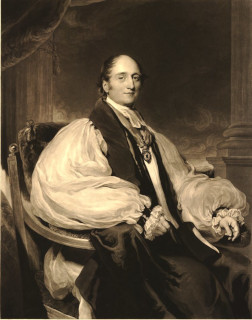
Beresford employs Lewis Nockalls Cottingham, one of the most skilled architects at that time, to restore St. Patrick’s Cathedral, Armagh. Cottingham removes the old, stunted spire and shores up the belfry stages while he rebuilds the piers and arches under it. The arcade walls which had fallen away as much as 21 inches from the perpendicular on the south side and 7 inches on the north side, are straightened by means of heated irons, and the clerestory windows which had long been concealed, are opened out and filled with tracery.
Beresford dies on July 18, 1862, at Woburn, Bedfordshire, England, the home of his niece, in the parish of Donaghadee and is buried in the cathedral. There is a memorial to him in the south aisle at St. Patrick’s Cathedral, Armagh.
John Bligh, 3rd Earl of Darnley and former Member of Parliament (MP) for Athboy, who suffers from the delusion that he is a teapot, marries suddenly and unexpectedly on September 11, 1766 at nearly 50 years of age. Suffering from the delusion that he is a teapot, from the date of his marriage until his death in 1781 he fathers at least seven children “in spite of his initial alarm that his spout would come off in the night.”
Bligh is born on October 1, 1719 near Gravesend, Kent, the son of John Bligh, 1st Earl of Darnley and Lady Theodosia Hyde, later Baroness Clifton (in her own right). At the age of eight he is sent to Westminster School. He matriculates at Merton College on May 13, 1735 and is created MA on July 13, 1738.
Outwardly, Bligh appears “solid” and “capable,” a man “terribly conscious of his own dignity.” His eccentricities do not stop him becoming MP for Athboy, which he represents from 1739 until 1748, and for Maidstone, Kent, which he serves from 1741 to 1747.
After failing to be elected MP for Tregony, Cornwall, in 1754, Bligh never stands again for parliament, either in England or Ireland. The seat that he gains in the House of Lords, in 1765, gives him the opportunity to return to Ireland more frequently.
In Dublin, on September 11, 1766, the “ageing nobleman” of almost 48-years-old, suddenly marries eighteen-year-old Mary Stoyte, a wealthy heiress and only child of John Stoyte, a leading barrister from Streete, County Westmeath. The unexpected marriage, between a sworn bachelor and a young woman, shocks Dublin society.
The new Countess of Darnley has to cope with the odd private behaviour of her touchy husband. According to a manuscript in the possession of the Tighe family, on the night of his marriage, Bligh “imagined himself to be a fine China tea pot, and was under great fears, lest the spout should be broken off before morning!”
In spite of his nocturnal fears, the earl manages to father at least seven children: John (1767), Mary (1768), Edward (1769), Theodosia (1771), Sarah (1772), Catherine (1774), and William (1775).
Each summer, Bligh takes his family to Weymouth, where the seawater is believed to strengthen weak constitutions and help brace nerves.
Despite every precaution, in 1781 Bligh catches malaria. Attempts to treat him with quinine and peppermint-water purges fail, and on July 31, 1781, he dies at the age of 61, his spout supposedly still intact. Mary lives on until 1803.
In 1990 Wilson challenges Brian Lenihan for the Fianna Fáil nomination for the 1990 presidential election. Lenihan wins the nomination but fails to be elected President and is also sacked from the government. Wilson is then appointed Tánaiste. He remains in the cabinet until retirement in 1993. Although the 26th Dáil Éireann is dissolved in December 1992, he serves in Government until the new government takes office.
John Wilson dies at St. James Hospital, Dublin on July 9, 2007, one day after his 84th birthday. His funeral takes place at the Good Shepherd Church at Churchtown, Dublin. President Mary McAleese is one of a number of prominent figures among the mourners, while Taoiseach Bertie Ahern is represented by his Aide-de-Camp.
King’s support of the Glorious Revolution in 1688 serves to advance his position. He becomes Bishop of Derry in 1691. His years as a bishop are marked by reform and the building of churches and glebe houses, and by the dispensing of charity. His political influence is considerable. He is always consulted on judicial appointments and at times seems to have an effective veto over candidates he considers unsuitable.
He is advanced to the position of Archbishop of Dublin in 1703, a post he holds until his death. He gives £1,000 for the founding of “Archbishop King’s Professorship of Divinity” at Trinity College in 1718. His influence declines after the appointment of Hugh Boulter as Archbishop of Armagh in 1724.
William King dies in May 1729. Much of his correspondence survives and provides a historic resource for the study of the Ireland of his time.