seamus dubhghaill

Promoting Irish Culture and History from Little Rock, Arkansas, USA


Leave a comment

The 1992 Coalisland Riots

The 1992 Coalisland riots are a series of clashes in the town of Coalisland, County Tyrone, Northern Ireland, on May 12 and 17, 1992, between local Irish nationalist civilians and British Army soldiers of the 3rd Battalion, Parachute Regiment and the King’s Own Scottish Borderers (KOSB). The Third Battalion 1992 tour’s codename is “Operation Gypsy.”

On May 12, 1992, a unit of the Provisional Irish Republican Army (IRA) East Tyrone Brigade launches a bomb attack on a British Army foot patrol near the republican stronghold of Cappagh, County Tyrone. One soldier of the Parachute Regiment, Alistair Hodgson, loses both legs as a result. The improvised land mine is described in an IRA statement as an “anti-personnel device.” Other paratroopers receive lesser wounds, according to the same statement. The incident triggers a rampage by members of the Parachute Regiment in the nearby, overwhelmingly Irish nationalist town of Coalisland, some ten miles to the east. The IRA attack is described as a “provocation” tactic, devised to produce an over-reaction by troops to make them even more unpopular among local nationalists.

The deployment of the paratroopers, which begins in April has already been criticised by republican activist and former Member of Parliament Bernadette Devlin McAliskey, who denounces beatings, shootings and damages to property reportedly carried out by the troops. These previous incidents include the destruction of fishing gear and boats in the townland of Kinturk, near Ardboe, and a brawl on April 22 between soldiers and motorists at a checkpoint in Stewartstown, in which plastic bullets are fired that end with a civilian and two paratroopers wounded. Unionist politician and Ulster Defence Regiment (UDR) officer Ken Maginnis, then-Member of Parliament for the area, calls for the withdrawal of the regiment after receiving a large number of complaints about their behaviour.

On May 12, two hours after the IRA ambush at Cappagh, members of the regiment seal off the town of Coalisland, ten miles east of Cappagh. According to a Social Democratic and Labour Party (SDLP) politician, the soldiers fabricate a bogus bomb warning, while the Royal Ulster Constabulary (RUC) states that the operation began when a joint police/military patrol was stoned by a crowd. Two pubs are ransacked by the troops and a number of civilian cars are damaged. Several people are allegedly hit with sticks. Following this, a lieutenant is suspended from duty and the regiment is removed from patrol duties in Coalisland.

On the evening of May 17, a fistfight begins at Lineside Road, where a group of young men are having a drink. A passing four-man patrol of the King’s Own Scottish Borderers regiment is challenged to a “boxing match” by the residents. The soldiers set aside their weapons and engage the youths. Noncritical injuries are reported on both sides. The official claim is that the patrol was attacked by a mob of at least 30 people. In the melée, a rifle and a light machine gun are stolen. The rifle is later recovered nearby. The youths smash a backpack radio which is left behind by the troops. Two KOSB soldiers are hospitalised, while in the end seven other soldiers, including paratroopers, receive lesser injuries, one of them hit by a car that crashes through two roadblocks set up by the British Army.

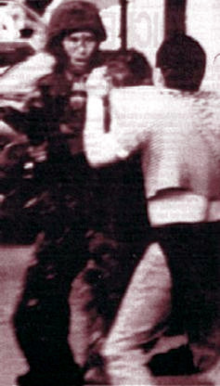
The Parachute Regiment is called to the scene again, and at 8:30 p.m., a major riot starts outside The Rossmore pub between local people and about 20 to 25 paratroopers. The soldiers claim one of their colleagues is isolated and dragged by the crowd. Some witnesses claim paratroopers were in a frenzy, showing their guns and inviting civilians to try to take them. Suddenly, shots are fired by the troops — first into the air and then toward the people outside the pub. Three civilians are rushed to hospital in Dungannon with gunshot wounds, while the soldiers return to their barracks. Another four civilians suffer minor injuries. The paratroopers claim that a “member of the growing crowd” attempted to fire the stolen machine gun at them, but the weapon jammed. One of the wounded is the brother of IRA volunteer Kevin O’Donnell, who had been killed by the Special Air Service (SAS) in February during an ambush at the nearby hamlet of Clonoe, shortly after carrying out a machine-gun attack on the local RUC base.

About 500 people attend a protest rally in Coalisland on May 19, and the wisdom of deploying the troops to patrol the town is questioned by members of the Dáil in Dublin. The Minister for Foreign Affairs of the Republic of Ireland, David Andrews, asks the British Government to withdraw the regiment. As a result, the paratroopers are redeployed outside the urban areas. The RUC claims that the stolen machine gun is found 11 days later at a farmhouse near Cappagh, along with another light machine gun and an AK-47 rifle. The IRA denies they had the machine gun in their possession. Republicans question whether the weapon had really been stolen, suggesting this was merely an excuse for the soldiers’ rampage in Coalisland. Bernardette McAliskey goes even further, suggesting that the recovery of the machine gun near Cappagh, where the initial IRA attack had taken place, was actually staged by the security forces as a publicity stunt. British officials accuse Sinn Féin of being the instigators of the riots, while Michael Mates, then Minister of State at the Northern Ireland Office, states that the incidents were due to “a gang of thugs motivated by the IRA.” Eventually the battalion’s 1992 tour in Northern Ireland is scaled down, with the patrols suspended before the official end of the deployment. The Third Brigade’s commander, Brigadier Tom Longland, is replaced by Brigadier Jim Dutton. This is the first occasion that a high-ranking officer is disciplined in such a way during the Troubles.

The last patrol takes place on June 27, when two paratroopers drown while crossing the River Blackwater. The same day there are further clashes with local residents, this time in the town of Cookstown, when a group of people that the Belfast News Letter calls “drunken hooligans” assault a number of paratroopers trying to help an elderly man who is suffering a heart attack.

The 3rd Battalion of the Parachute Regiment is replaced by the 1st Battalion of the Coldstream Guards.

Six soldiers face criminal charges for their roles in the May riots but are acquitted one year later. Five are bound over. Maurice McHugh, the presiding magistrate, avers that the soldiers were “not entirely innocent,” while Sinn Féin sources dub the ruling “a farce.” Dungannon priest Father Denis Faul is of the opinion that the soldiers should have been charged with conspiracy. The Ulster Television documentary Counterpoint of June 1993 claims that Director of Public Prosecutions for Northern Ireland, Sir Alasdair Fraser, returned the case file to the RUC recommending no prosecution. The programme also interviews Alistair Hodgson, the soldier maimed at Cappagh, who says that “had another member of my unit been injured in the way that I was, I would have been with the rest of the lads attacking the locals.” Authors Andrew Sanders and Ian S. Wood suggest that the deployment of the battalion in Coalisland and elsewhere hindered the British policy of police primacy in Northern Ireland.

Fresh clashes between local residents and troops are reported at Coalisland on March 6, 1994, a few months before the first IRA ceasefire, when a crowd assaults two soldiers after the RUC searched a car. Plastic bullets are fired, and three civilians and two soldiers are slightly injured.

(Pictured: Confrontation between a British paratrooper and a civilian in Coalisland, May 1992)

Leave a comment

Ceremony Marks the Centennial of First Easter Rising Executions

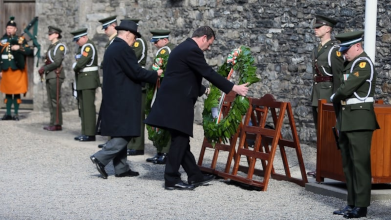
On Tuesday, May 3, 2016, ceremonies to mark the 100th anniversary of the executions of Tom Clarke, Patrick Pearse and Thomas MacDonagh are held in the Stonebreakers’ Yard in Kilmainham Gaol, the first executions of the leaders of the Easter Rising. Pearse, Clarke and MacDonagh are remembered in similar but distinct commemorations which take place on the spot where they died on May 3, 1916.

The transcripts of the short courts-martial are read aloud. In the case of Tom Clarke, who offered no defence and made no statement prior to his execution, the proceedings take only a few minutes to recount.

The presence of Capuchin friars from Church Street lends a sense of continuity to proceedings. Their predecessors had been there for the men in their final hours and their testimony is read aloud by their contemporaries.

The Government is represented by Minister for the Environment Alan Kelly, Minister for Foreign Affairs Charles Flanagan and Minister of State at the Department of Heritage Joe McHugh. Kelly speaks of living up to the ideals of the Proclamation of the Irish Republic, namely a nation that “cherishes all of the children equally.” He says Pearse was well aware of the effect on his family of his pending execution and had written his poem “The Mother” foreseeing his death.

Capuchin friar Adrian Kearns recalls the testimony of Fr. Columbus Murphy, who ministered to Pearse in his final hours. He did not “quail before the possibility of death . . . but faced his last moments with dignity and with grace.” Fr. Murphy remembered Pearse being a “sad, forlorn figure weighed down by the sense of responsibility” who lamented the loss of life and hoped it would not be in vain.

A wreath is laid on behalf of the Pearse family by his namesake Patrick Pearse, a great grandnephew.

Brother Peter Rogers recalls that Clarke was defiant rather than melancholic in his last hours. Fr. Murphy visited him as well. Clarke, the friar recalls, was “relieved that he was to be executed. His one dread was that he would be sent to prison again.” There is no member of Clarke’s family present to represent him at the commemorations, so a wreath is laid on behalf of the family by the staff of Kilmainham Gaol.

Several of MacDonagh’s surviving grandchildren are present. His granddaughter, Barbara Cashin, lays a wreath on behalf of the family. Her father Donagh and her aunt Barbara are left orphans a year after the Easter Rising when MacDonagh’s wife Muriel drowns off the coast of Skerries in July 1917. Cashin says her father had mixed feelings about the Rising, given the double tragedy that befell him and his sister a short time afterwards. “He had a horrendous childhood. He had a strange upbringing and hated to talk about it,” she says. “He had a split mind about it. I remember asking him as a child about it and saying he must be proud. Weren’t they wonderful. He said, ‘they may have been fools as well.’”

The ceremony takes place with full military honours. The “Last Post” and “Reveille” are played, and the service concludes with the national anthem of Ireland, “Amhrán na bhFiann.”

The commemorations are repeated the following day for the next four to have been executed: Joseph Plunkett, Edward Daly, Michael O’Hanrahan and Willie Pearse. Similar events are scheduled through May 12 to mark the exact centenary of the executions of the remaining eight men killed by a British Army firing squad at the Stonebreakers’ Yard.

Meanwhile, President Michael D. Higgins formally renames the East-Link Toll Bridge in Dublin the Tom Clarke Bridge.

(From: “Executed Rising rebels honoured at Kilmainham Gaol” by Ronan McGreevy, The Irish Times, http://www.irishtimes.com, May 3, 2016)


Leave a comment

The Statute of Westminster 1931 Receives Royal Assent

The Statute of Westminster 1931, an act of the Parliament of the United Kingdom that sets the basis for the relationship between the Dominions (now called Commonwealth realms) and the Crown, receives royal assent on December 11, 1931.

The statute increases the sovereignty of the self-governing Dominions of the British Empire from the United Kingdom. It also binds them all to seek each other’s approval for changes to monarchical titles and the common line of succession. The statute is effective either immediately or upon ratification. It thus becomes a statutory embodiment of the principles of equality and common allegiance to the Crown set out in the Balfour Declaration of 1926. As the statute removes nearly all of the British parliament’s authority to legislate for the Dominions, it is a crucial step in the development of the Dominions as separate, independent, and sovereign states.

The Irish Free State never formally adopts the Statute of Westminster, its Executive Council (cabinet) taking the view that the Anglo-Irish Treaty of 1921 has already ended Westminster‘s right to legislate for the Irish Free State. The Constitution of the Irish Free State gives the Oireachtas “sole and exclusive power of making laws.” Hence, even before 1931, the Irish Free State does not arrest British Army and Royal Air Force deserters on its territory, even though the UK believes post-1922 British laws give the Free State’s Garda Síochána the power to do so. The UK’s Irish Free State Constitution Act 1922 says, however, “[n]othing in the [Free State] Constitution shall be construed as prejudicing the power of [the British] Parliament to make laws affecting the Irish Free State in any case where, in accordance with constitutional practice, Parliament would make laws affecting other self-governing Dominions.”

Motions of approval of the Report of the Commonwealth Conference had been passed by Dáil Éireann and Seanad Éireann in May 1931 and the final form of the Statute of Westminster includes the Irish Free State among the Dominions the British Parliament cannot legislate for without the Dominion’s request and consent. Originally, the UK government wants to exclude from the Statute of Westminster the legislation underpinning the 1921 treaty, from which the Free State’s constitution had emerged. Executive Council President (Prime Minister) W. T. Cosgrave objects, although he promises that the Executive Council will not amend the legislation unilaterally. The other Dominions back Cosgrave and, when an amendment to similar effect is proposed at Westminster by John Gretton, parliament duly votes it down. When the statute becomes law in the UK, Patrick McGilligan, the Free State Minister for External Affairs, states, “It is a solemn declaration by the British people through their representatives in Parliament that the powers inherent in the Treaty position are what we have proclaimed them to be for the last ten years.” He goes on to present the statute as largely the fruit of the Free State’s efforts to secure for the other Dominions the same benefits it already enjoys under the treaty. The Statute of Westminster has the effect of granting the Irish Free State internationally recognised independence.

Éamon de Valera leads Fianna Fáil to victory in the 1932 Irish general election on a platform of republicanising the Free State from within. Upon taking office, he begins removing the monarchical elements of the Constitution, beginning with the Oath of Allegiance. De Valera initially considers invoking the Statute of Westminster in making these changes, but John J. Hearne advises him to not do so. Abolishing the Oath of Allegiance in effect abrogates the 1921 treaty. Generally, the British believe that this is morally objectionable but legally permitted by the Statute of Westminster. Robert Lyon Moore, a Southern Unionist from County Donegal, challenges the legality of the abolition in the Irish Free State’s courts and then appeals to the Judicial Committee of the Privy Council (JCPC) in London. However, the Free State has also abolished the right of appeal to the JCPC. In 1935, the JCPC rules that both abolitions are valid under the Statute of Westminster. The Irish Free State, which in 1937 is renamed Ireland, leaves the Commonwealth in 1949 upon the coming into force of The Republic of Ireland Act 1948.

The Statute of Westminster’s modified versions are now domestic law in Australia and Canada. It has been repealed in New Zealand and implicitly in former Dominions that are no longer Commonwealth realms.


Leave a comment

The Maastricht Treaty Comes into Effect

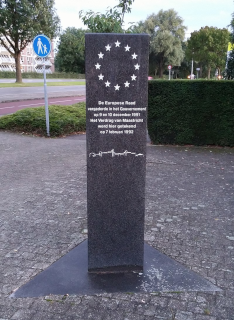
The Treaty on European Union, commonly known as the Maastricht Treaty, comes into effect on November 1, 1993, formally establishing the European Union (EU).

The international agreement is approved by the heads of government of the states of the European Community (EC) in Maastricht, Netherlands, in December 1991. Ratified by all EC member states (voters in Denmark reject the original treaty but later approve a slightly modified version), the treaty is signed on February 7, 1992. The treaty is signed on Ireland’s behalf by Minister for Foreign Affairs Gerry Collins and Minister for Finance Bertie Ahern.

Concluded in 1992 between the then-twelve member states of the European Communities, the treaty announces “a new stage in the process of European integration.” The treaty establishes a European Union (EU), with EU citizenship granted to every person who is a citizen of a member state. EU citizenship enables people to vote and run for office in local and European Parliament elections in the EU country in which they live, regardless of their nationality. The treaty also provides for the introduction of a central banking system and a common currency (the euro), commits members to implement common foreign and security policies, and calls for greater cooperation on various other issues, including the environment, policing, and social policy.

Although these provisions are widely seen to presage a “federal Europe,” the focus of constitutional debate shifts to the later 2007 Treaty of Lisbon. In the wake of the European debt crisis unfolding from 2009, the most enduring reference to the Maastricht Treaty has been to the rules of compliance – the “Maastricht criteria” – for the currency union.

Against the background of the end of the Cold War and the reunification of Germany, and in anticipation of accelerated globalisation, the treaty negotiates tensions between member states seeking deeper integration and those wishing to retain greater national control. The resulting compromise faces what is to be the first in a series of EU treaty ratification crises.

The twelve members of the European Communities signing the Treaty are represented by:

(Pictured: Stone memorial in front of the entry to the Limburg Province government building in Maastricht, Netherlands, commemorating the signing of the Maastricht Treaty)


Leave a comment

Death of George Colley, Fianna Fáil Politician

George Colley, an Irish Fianna Fáil politician, dies suddenly in London on September 17, 1983.

Colley is born in the Dublin suburb of Fairview on October 18, 1925, the son of Harry and Christina Colley. His father is a veteran of the 1916 Easter Rising and a former adjutant in the Irish Republican Army (IRA), who is elected to Dáil Éireann in 1944, as a Fianna Fáil candidate. He is educated at St. Joseph’s Secondary C.B.S. in Fairview, where one of his classmates and closest friends is Charles Haughey, who later becomes his political archrival. He studies law at University College Dublin (UCD) and qualifies as a solicitor in the mid-1940s. He remains friends with Haughey after leaving school and, ironically, encourages him to become a member of Fianna Fáil in 1951. Haughey is elected to Dáil Éireann in the 1957 Irish general election, ousting Colley’s father in the process. This puts some strain on the relationship between the two young men.

Colley is elected to the Dáil at the 1961 Irish general election, reclaiming his father’s old seat in the Dublin North-East constituency. Furthermore, he is elected in the same constituency as Haughey, thereby accentuating the rivalry. Thereafter, he progresses rapidly through the ranks of Fianna Fáil. He becomes a member of the Dáil at a time when a change from the older to the younger generation is taking place, a change facilitated by Taoiseach Seán Lemass.

Colley is active in the Oireachtas as chairman of some of the Joint Labour Committees, which are set up under the Labour Court, to fix legally enforceable wages for groups of workers who have not been effectively organised in trade unions. He is also leader of the Irish parliamentary delegation to the Consultative Assembly of the Council of Europe. His work as a backbencher is rewarded by his appointment as Parliamentary Secretary to the Minister for Lands in October 1964.

Following the return of Lemass’s government at the 1965 Irish general election, Colley joins the cabinet as Minister for Education. He introduces a plan to establish comprehensive schools, set up an advisory council on post-primary school accommodation in Dublin, and introduces a school psychological service.

Colley is promoted as Minister for Industry and Commerce in a cabinet reshuffle in July 1966, and he continues the government policy of economic expansion that had prevailed since the late 1950s.

In November 1966, Seán Lemass resigns suddenly as party leader. Colley contests the subsequent leadership election. He is the favoured candidate of party elders such as Seán MacEntee and Frank Aiken, the latter managing Colley’s campaign. Charles Haughey and Neil Blaney also declare their interest in the leadership; however, both withdraw when the Minister for Finance, Jack Lynch, announces his candidacy. Colley does not back down, and the leadership issue goes to a vote for the first time in the history of the Fianna Fáil party. The leadership election takes place on November 9, 1966, and Lynch beats Colley by 59 votes to 19. When the new Taoiseach announces his cabinet, Colley retains the Industry and Commerce portfolio.

In the wake of the Arms Crisis in 1970, a major reshuffle of the cabinet takes place, with four Ministers either removed, or resigned, or simply retired from the government due to the scandal. Colley remains loyal to the party leader and is rewarded by his appointment as Minister for Finance, the second most important position in government.

In 1973, Fianna Fáil are ousted after sixteen years in government when the national coalition of Fine Gael and the Labour Party come to power. Colley is appointed opposition Spokesman on Finance, in the new Fianna Fáil front bench. As the 1977 Irish general election approaches, Colley and Martin O’Donoghue are the main architects of Fianna Fáil’s election manifesto.

Fianna Fáil sweeps to power at the 1977 Irish general election, with a 20-seat Dáil majority, contrary to opinion polls and political commentators. Colley is re-appointed as Minister for Finance and Minister for the Public Service, and is also appointed as Tánaiste, establishing him firmly as the heir apparent to Taoiseach Jack Lynch.

In December 1979, Jack Lynch resigns unexpectedly as Taoiseach and as Fianna Fáil leader. Colley and Charles Haughey seek the leadership position and are evenly matched. A secret ballot is taken on December 7, 1979. The Minister for Foreign Affairs, Michael O’Kennedy, announces his support for Haughey on the eve of the election. This apparently swings the vote, and Haughey beats Colley by 44 votes to 38. Colley remains as Tánaiste but demands and receives a veto on Haughey’s ministerial appointments to the departments of Justice and Defence.

Fianna Fáil loses power at the 1981 Irish general election. Haughey delays naming a new opposition front bench, but Colley remains a key member of the Fianna Fáil hierarchy. The party regains office at the February 1982 Irish general election. He demands the same veto as before on Haughey’s Defence and Justice appointments but is refused. When it is revealed that Ray MacSharry is to be appointed Tánaiste in his stead, he declines another ministerial position. This effectively brings his front bench political career to an end, but he remains a vocal critic of the party leadership from the backbenches.

When the Fianna Fáil government collapses and are replaced by another coalition government after the November 1982 Irish general election, a number of TDs and Senators express lack of confidence in Haughey’s leadership once again. Several unsuccessful leadership challenges take place in late 1982 and early 1983, with Colley now supporting Desmond O’Malley and the Gang of 22 who oppose Haughey.

Colley dies suddenly on September 17, 1983, aged 57, while receiving treatment for a heart condition at Guy’s Hospital, Southwark, London. He is survived by his wife, three sons, and four daughters, one of whom, Anne Colley, becomes a TD as a member of the Progressive Democrats party.


Leave a comment

Birth of Garret FitzGerald, Eighth Taoiseach of Ireland

Garret Desmond FitzGerald, Fine Gael politician, economist and barrister who serves twice as Taoiseach (1981 to 1982 and 1982 to 1987), is born into a very politically active family in Ballsbridge, Dublin on February 9, 1926, during the infancy of the Irish Free State. He serves as Senator for the Industrial and Commercial Panel from 1965 to 1969, a Teachta Dála (TD) from 1969 to 1992, Minister for Foreign Affairs from 1973 to 1977, Leader of Fine Gael from 1977 to 1987 and twice Leader of the Opposition between 1977 and 1982.

FitzGerald’s father, Desmond FitzGerald, is the Free State’s first Minister for External Affairs. He is educated at the Jesuit Belvedere College, University College Dublin and King’s Inns, Dublin, and qualifies as a barrister. Instead of practicing law, however, in 1959 he becomes an economics lecturer in the department of political economy at University College, Dublin, and a journalist.

FitzGerald joins Fine Gael, attaching himself to the liberal wing of the party. and in 1969 is elected to Dáil Éireann, the lower house of the Oireachtas, the Irish parliament. He later gives up his university lectureship to become Minister for Foreign Affairs in the coalition government of Liam Cosgrave (1973–1977). When the coalition government is resoundingly defeated in the 1977 Irish general election, Cosgrave yields leadership of Fine Gael to FitzGerald. In his new role as Leader of the Opposition and party leader, he proceeds to modernize and strengthen the party at the grass roots. He briefly loses power in 1982 when political instability triggers two snap elections.

By the time of the 1981 Irish general election, Fine Gael has a party machine that can easily match Fianna Fáil. The party wins 65 seats and forms a minority coalition government with the Labour Party and the support of a number of Independent TDs. FitzGerald is elected Taoiseach on June 30, 1981. To the surprise of many FitzGerald excludes Richie Ryan, Richard Burke and Tom O’Donnell, former Fine Gael stalwarts, from the cabinet.

In his prime ministry, FitzGerald pushes for liberalization of Irish laws on divorce, abortion, and contraception and also strives to build bridges to the Protestants in Northern Ireland. In 1985, during his second term, he and British Prime Minister Margaret Thatcher sign the Anglo-Irish (Hillsborough) Agreement, giving Ireland a consultative role in the governing of Northern Ireland. After his party loses in the 1987 Irish general election, he resigns as its leader and subsequently retires in 1992.

On May 5, 2011, it is reported that FitzGerald is seriously ill in a Dublin hospital. Newly elected Fine Gael Taoiseach Enda Kenny sends his regards and calls him an “institution.” On May 6 he is put on a ventilator. On May 19, after suffering from pneumonia, he dies at the Mater Private Hospital in Dublin at the age of 85.

In a statement, Irish President Mary McAleese hails FitzGerald as “a man steeped in the history of the State who constantly strove to make Ireland a better place for all its people.” Taoiseach Enda Kenny pays homage to “a truly remarkable man who made a truly remarkable contribution to Ireland.” Henry Kissinger, the former United States Secretary of State, who serves as an opposite number to FitzGerald in the 1970s, recalls “an intelligent and amusing man who was dedicated to his country.”

FitzGerald’s death occurs on the third day of Queen Elizabeth II‘s state visit to the Republic of Ireland, an event designed to mark the completion of the Northern Ireland peace process that had been “built on the foundations” of FitzGerald’s Anglo-Irish Agreement with Margaret Thatcher in 1985. In a personal message, the Queen offers her sympathies and says she is “saddened” to learn of FitzGerald’s death.

On his visit to Dublin, United States President Barack Obama offers condolences on FitzGerald’s death. He speaks of him as “someone who believed in the power of education; someone who believed in the potential of youth; most of all, someone who believed in the potential of peace and who lived to see that peace realised.”

FitzGerald is buried at Shanganagh Cemetery in Shankill, Dublin.

FitzGerald is the author of a number of books, including Planning in Ireland (1968), Towards a New Ireland (1972), Unequal Partners (1979), All in a Life: An Autobiography (1991), and Reflections on the Irish State (2003).


Leave a comment

Birth of George Colley, Fianna Fáil Politician

George Colley, an Irish Fianna Fáil politician, is born in the Dublin suburb of Fairview on October 18, 1925.

Colley is the son of Harry and Christina Colley. His father is a veteran of the 1916 Easter Rising and a former adjutant in the Irish Republican Army (IRA), who is elected to Dáil Éireann in 1944, as a Fianna Fáil candidate. He is educated at St. Joseph’s Secondary C.B.S. in Fairview, where one of his classmates and closest friends is Charles Haughey, who later becomes his political archrival. He studies law at University College Dublin (UCD) and qualifies as a solicitor in the mid-1940s. He remains friends with Haughey after leaving school and, ironically, encourages him to become a member of Fianna Fáil in 1951. Haughey is elected to Dáil Éireann in the 1957 Irish general election, ousting Colley’s father in the process. This puts some strain on the relationship between the two young men.

Colley is elected to the Dáil at the 1961 Irish general election, reclaiming his father’s old seat in the Dublin North-East constituency. Furthermore, he is elected in the same constituency as Haughey, thereby accentuating the rivalry. Thereafter, he progresses rapidly through the ranks of Fianna Fáil. He becomes a member of the Dáil at a time when a change from the older to the younger generation is taking place, a change facilitated by Taoiseach Seán Lemass.

Colley is active in the Oireachtas as chairman of some of the Joint Labour Committees, which are set up under the Labour Court, to fix legally enforceable wages for groups of workers who have not been effectively organised in trade unions. He is also leader of the Irish parliamentary delegation to the Consultative Assembly of the Council of Europe. His work as a backbencher is rewarded by his appointment as Parliamentary Secretary to the Minister for Lands in October 1964.

Following the return of Lemass’s government at the 1965 Irish general election, Colley joins the cabinet as Minister for Education. He introduces a plan to establish comprehensive schools, set up an advisory council on post-primary school accommodation in Dublin, and introduces a school psychological service.

Colley is promoted as Minister for Industry and Commerce in a cabinet reshuffle in July 1966, and he continues the government policy of economic expansion that had prevailed since the late 1950s.

In November 1966, Seán Lemass resigns suddenly as party leader. Colley contests the subsequent leadership election. He is the favoured candidate of party elders such as Seán MacEntee and Frank Aiken, the latter managing Colley’s campaign. Charles Haughey and Neil Blaney also declare their interest in the leadership; however, both withdraw when the Minister for Finance, Jack Lynch, announces his candidacy. Colley does not back down, and the leadership issue goes to a vote for the first time in the history of the Fianna Fáil party. The leadership election takes place on November 9, 1966, and Lynch beats Colley by 59 votes to 19. When the new Taoiseach announces his cabinet, Colley retains the Industry and Commerce portfolio.

In the wake of the Arms Crisis in 1970, a major reshuffle of the cabinet takes place, with four Ministers either removed, or resigned, or simply retired from the government due to the scandal. Colley remains loyal to the party leader and is rewarded by his appointment as Minister for Finance, the second most important position in government.

In 1973, Fianna Fáil are ousted after sixteen years in government when the national coalition of Fine Gael and the Labour Party come to power. Colley is appointed opposition Spokesman on Finance, in the new Fianna Fáil front bench. As the 1977 Irish general election approaches, Colley and Martin O’Donoghue are the main architects of Fianna Fáil’s election manifesto.

Fianna Fáil sweeps to power at the 1977 Irish general election, with a 20-seat Dáil majority, contrary to opinion polls and political commentators. Colley is re-appointed as Minister for Finance and Minister for the Public Service, and is also appointed as Tánaiste, establishing him firmly as the heir apparent to Taoiseach Jack Lynch.

In December 1979, Jack Lynch resigns unexpectedly as Taoiseach and as Fianna Fáil leader. Colley and Charles Haughey seek the leadership position and are evenly matched. A secret ballot is taken on December 7, 1979. The Minister for Foreign Affairs, Michael O’Kennedy, announces his support for Haughey on the eve of the election. This apparently swings the vote, and Haughey beats Colley by 44 votes to 38. Colley remains as Tánaiste but demands and receives a veto on Haughey’s ministerial appointments to the departments of Justice and Defence.

Fianna Fáil loses power at the 1981 Irish general election. Haughey delays naming a new opposition front bench, but Colley remains a key member of the Fianna Fáil hierarchy. The party regains office at the February 1982 Irish general election. He demands the same veto as before on Haughey’s Defence and Justice appointments but is refused. When it is revealed that Ray MacSharry is to be appointed Tánaiste in his stead, he declines another ministerial position. This effectively brings his front bench political career to an end, but he remains a vocal critic of the party leadership from the backbenches.

When the Fianna Fáil government collapses and are replaced by another coalition government after the November 1982 Irish general election, a number of TDs and Senators express lack of confidence in Haughey’s leadership once again. Several unsuccessful leadership challenges take place in late 1982 and early 1983, with Colley now supporting Desmond O’Malley and the Gang of 22 who oppose Haughey.

Colley dies suddenly on September 17, 1983, aged 57, while receiving treatment for a heart condition at Guy’s Hospital, Southwark, London. He is survived by his wife, three sons, and four daughters, one of whom, Anne Colley, becomes a TD as a member of the Progressive Democrats party.


Leave a comment

The Provisional Irish Republican Army Ceasefire Announcement

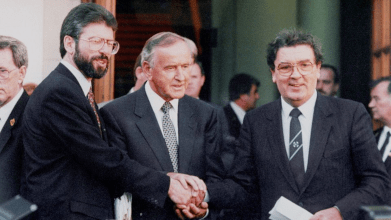
The Provisional Irish Republican Army (IRA) announces a ceasefire on August 31, 1994, after a quarter century of what it calls its “armed struggle” to get the British out of Northern Ireland. The statement comes just after 11:00 a.m. BST and says there will be a “complete cessation of military operations” from midnight and that the organisation is willing to enter into inclusive talks on the political future of the Province.

The statement raises hopes for peace and an end to 25 years of bombing and shooting that led to the deaths of more than 3,000 people. There is scepticism from the loyalist community and celebration in the Catholic areas of Belfast and Derry.

The Irish Minister for Foreign Affairs, Dick Spring, says the statement is historic and meets his government’s demand for an unconditional end to IRA violence. The Irish Taoiseach (Prime Minister), Albert Reynolds, calls on loyalist paramilitaries to follow suit.

But loyalists are suspicious of the declaration and fear it may lead to a sell-out in which Northern Ireland’s position within the United Kingdom is under threat. The Ulster Unionist Party (UUP) MP James Molyneaux says no moves towards talks should begin until the IRA has added the word “permanent” to the ceasefire declaration.

The announcement comes 18 months after secret talks began between the British Government and Irish republicans. It leads to the Anglo-Irish Downing Street Declaration in December 1993 which states that any change in the partition of Ireland can only come with the consent of those living north of the border. It also challenges republicans to renounce violence.

Social Democratic and Labour Party (SDLP) leader John Hume MP, who has been negotiating with Sinn Féin leader Gerry Adams, is “very pleased.” However, British Prime Minister John Major is cautious in his reaction to the IRA announcement. “We are beyond the beginning,” he says, “but we are not yet in sight of the end.”

Ian Paisley, leader of the hardline Democratic Unionist Party (DUP), rejects the wording of the declaration and says it is an “insult to the people [the IRA] has slaughtered because there was no expression of regret.”

Seven weeks later, on October 13, the loyalist terrorist groups announce their own ceasefire. On December 9, British officials meet Sinn Féin representatives for their first formal talks in 22 years.

The IRA ceasefire ends on February 9, 1996, when it plants a huge bomb in the London Docklands. It kills two, injures more than 100 and causes more than £85m of damage.

A new ceasefire is finally announced in July 1997.

(Pictured: (L to R) Sinn Féin President Gerry Adams, Taoiseach Albert Reynolds and Social Democratic and Labour Party leader John Hume)


Leave a comment

Birth of Simon Coveney, Minister of Foreign Affairs & Deputy Leader of Fine Gael

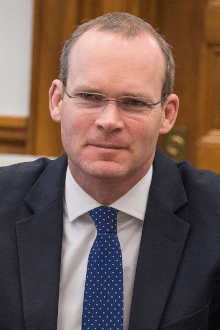
Simon Coveney, Fine Gael politician who has served as Minister for Foreign Affairs and Deputy Leader of Fine Gael since 2017 and Minister for Defence since 2020, is born in Cork, County Cork, on June 16, 1972.

Coveney is born to Hugh Coveney, a chartered quantity surveyor and later a TD, and Pauline Coveney. His uncle is Archbishop Patrick Coveney. His brother, Patrick, is chief executive of the food corporation Greencore. He is educated locally in Cork, before later attending Clongowes Wood College, County Kildare. He is expelled from the college in Transition Year but ultimately is invited back to complete his full six years there. He repeats his Leaving Certificate in Bruce College in Cork. He subsequently attends University College Cork and Gurteen College, County Tipperary, before completing a BSc in Agriculture and Land Management from Royal Agricultural College, Gloucestershire.

A keen fan of all competitive sport, Coveney plays rugby for Garryowen, Cork Constitution and Crosshaven Rugby Club. In 1997-98, he leads the “Sail Chernobyl Project” which involves sailing a boat 30,000 miles around the world and raising €650,000 for charity. He is a qualified sailing instructor and lifeguard. He spends several years working as an agriculture adviser and farm manager.

Coveney is first elected to Dáil Éireann in a 1998 by-election as a Fine Gael candidate for Cork South-Central. He holds Shadow Ministries in the areas of Drugs and Youth Affairs, Communications, Marine and Natural Resources, and Transport. He chairs the Fine Gael Policy Development Committee prior to the 2011 Irish general election.

Coveney is a member of Cork County Council and the Southern Health Board from 1999 to 2003.

Coveney is elected to the European Parliament in 2004 and is a member of the EPP-ED group. He is a member of the Committee on Foreign Affairs and the Internal Market and Consumer Protection Committee. He is the author of the European Parliament’s Annual Report on Human Rights in the World for the year 2004 and again for 2006.

Coveney is named Tánaiste by Leo Varadkar, replacing Frances Fitzgerald, on November 30, 2017, a position he holds until June 27, 2020. He also serves as Minister for Housing, Planning and Local Government as well as Minister for Agriculture, Food and the Marine. For the six-month period ending June 2013, he chairs the EU Council of Agriculture & Fisheries Ministers where he is at the forefront regarding EU efforts in respect of Common Agricultural (CAP) as well as Common Fisheries (CFP) Policy reforms. Under his chairmanship both dossiers are progressed significantly, with a reform package for CFP agreed in May 2013 and a reform package for CAP agreed at the end of the Irish Presidency in July. The Defence portfolio is added to his brief on July 11, 2014.

In July 2008, Simon marries his long-time girlfriend Ruth Furney, an IDA Ireland employee. They have three daughters and currently live in Carrigaline, County Cork.


Leave a comment

Birth of Aengus Finucane, Roman Catholic Missionary

Aengus Finucane, Roman Catholic missionary of the Spiritan Fathers order, is born on April 26, 1932, in Limerick, County Limerick. He organizes food shipments from Ireland to the Igbo people during the Nigerian Civil War. His younger brother, Jack Finucane, also becomes a Holy Ghost priest, and a sister of theirs becomes a nun.

Finucane is educated by the Congregation of Christian Brothers until 1950. He joins the Holy Ghost Fathers in Kimmage Manor, and studies Philosophy, Theology and Education at University College Dublin. He is ordained in Clonliffe College in 1958.

Finucane contributes humanitarian aid during the Nigerian Civil War (also known as the “Nigerian-Biafran War”), from 1967 to 1970. The Nigerian government had blocked food supplies to the successionist state of Biafra causing starvation in the country. This is reported on international television stations and receives worldwide condemnation.

In an effort to save the population from starvation, Finucane organizes food to be sent through makeshift airstrips, including one at Uli, Bafaria, and cargo trips with other Dublin-based workers. This leads to the formation of the organisation Concern Worldwide in 1968. He works with Concern for 41 years and views his mission as “love in action.”

Finucane is banished from Nigeria in January 1970. Following this, he gains a diploma in development studies and a Master of Arts degree in Third World poverty studies from the Swansea University. In 1971, he is again giving food supplies to the population during the operations which are ongoing in Bangladesh and flies often with Mother Teresa during the drop-offs.

The United Nations High Commissioner for Refugees (UNHCR) invites Finucane to lead a survey of people displaced in Southeast Asia. During the 1980s and 1990s he leads Concern Worldwide, becoming involved in the response to famine in Ethiopia, Sudan, Somalia and Rwanda. While in Somalia, he is in a convoy that is attacked and results in the death of nurse Valerie Place.

Finucane dies of cancer at the age of 77 on October 6, 2009, in a Dublin Spiritan Fathers’ nursing home in Kimmage Manor. His funeral is held at the Church of the Holy Spirit, Kimmage and is attended by hundreds. The Minister for Foreign Affairs, Micheál Martin, and Minister for Overseas Development, Peter Power, dub him as a “tireless force for good across the globe for more than four decades.” He is buried at Dardistown Cemetery, in the Spiritan plot.

Finucane’s biography, Aengus Finucane: In the Heart of Concern, written by Deirdre Purcell is published by New Island Books in January 2015.