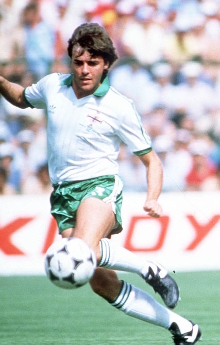
Originally from west Belfast, Donaghy begins his football career as a goalkeeper with little-known Down and Connor League side team St. Agnes before moving on to play as an outfield player for works team Post Office Social Club. After barely six months, he is on the move again, this time joining Amateur League side Cromac Albion, where his blossoming talent is spotted by then Larne F.C. boss Brian Halliday.
Donaghy’s rapid rise in the game continues when, after just 20 matches with the Inver Park club, he is transferred to Luton Town F.C. in June 1978 for a fee of £20,000.
Donaghy spends ten years at Luton Town F.C., overseeing the most successful era of their history to date. He collects a Second Division title winner’s medal in 1982, enabling him to experience First Division football for the first time. He helps Luton Town F.C. retain their First Division status and is a key part of the team that finishes a club record high of seventh in the 1986–87 season. In 1987–88, he helps Luton Town F.C. win their first major trophy as they achieve a shocking 3–2 win over Arsenal F.C. in the 1988 Football League Cup Final.
In October 1988, Donaghy departs from Kenilworth Road in a £650,000 move to his boyhood heroes Manchester United F.C. It is at the time a big risk for Alex Ferguson to pay out a large sum of money for a 31-year-old, but Donaghy repays the United manager’s faith in him with some consistent performances in not only his favoured central defensive position but also as a full-back.
Immediately after joining United, Donaghy is the club’s first choice left-back for the 1988–89 season, missing only the League Cup game for which he is cup-tied. However, his opportunities are limited in the 1989–90 season, and he is unable to make even the substitutes bench for the 1990 FA Cup final triumph over Crystal Palace F.C. However, he does make the substitutes bench for the 1991 European Cup Winners’ Cup final triumph.
United are First Division runners-up in 1991–92 and win their first-ever League Cup, but Donaghy’s first-team chances continue to be restricted, and he is also left out of the side that beats Nottingham Forest F.C. in the League Cup final.
Donaghy’s next move is in August 1992 when, just a month short of his 35th birthday, Chelsea F.C. manager Ian Porterfield pays £100,000 for his services. He helps Chelsea finish 11th in the inaugural Premier League season and helps them reach the 1994 FA Cup final, although he does not make the squad for the team that loses 4–0 to double-winners Manchester United F.C. At the end of the season, he announces his retirement from club football.
Donaghy makes his final appearance for Northern Ireland against the Mexico national football team in Miami in June 1994, three months before his 37th birthday.
Shortly after his playing career ends, Donaghy returns to the province with his family and after a brief spell as manager at Newry City F.C., he has stints as a coach with Cliftonville F.C. and as a Youth Development Officer back on his home pitch with Donegal Celtic F.C. In 2000, he is appointed manager for the Northern Ireland national under-19 team. He serves in this capacity until 2008.
The first of Donaghy’s 91 international caps comes in May 1980 at Windsor Park in the 1–0 British Home Championship victory over Scotland. He further enhances his reputation during the 1982 and 1986 World Cup finals. In the former tournament, he plays in four of Northern Ireland’s five games. He is sent off after 60 minutes of the famous 1–0 win over Spain in Valencia, for the offence of shoving Spain’s José Antonio Camacho, but returns for Northern Ireland’s final match, a 4–1 defeat by France in Madrid.
Twomey is born on November 5, 1919, on Marchioness Street in Belfast, and lives at 6 Sevastopol Street in the Falls district. Known as “Thumper” owing to his short temper and habit of banging his fist on tables, he receives little education and is a bookmaker‘s “runner.” His father is a volunteer in the 1920s. In Belfast he lives comfortably with his wife, Rosie, whom he marries in 1946. Together they have sons and daughters.
Twomey begins his involvement with the Irish Republican Army in the 1930s and is interned in Northern Ireland during the 1940s on the prison ship HMS Al Rawdah and later in Crumlin Road Gaol in Belfast. Rosie, his wife, is also held prisoner at the women prison, Armagh Jail, in Northern Ireland. He opposes the left-wing shift of Cathal Goulding in the 1960s, and in 1968, helps set up the breakaway Andersonstown Republican Club, later the Roddy McCorley Society.
In 1969, Twomey is prominent in the establishment of the Provisional Irish Republican Army. By 1972, he is Officer Commanding (OC) of the Provisional IRA Belfast Brigade when it launches its bomb campaign of the city, including Bloody Friday when nine people are killed. During the 1970s, the leadership of the Belfast Brigade of the IRA is largely in the hands of Twomey and Ivor Bell.
In March 1973, Twomey is first appointed IRA Chief of Staff after the arrest of Joe Cahill. He remains in this position until his arrest in October 1973 by the Garda Síochána. Three weeks later, on October 31, 1973, the IRA organises the helicopter escape of Twomey and his fellow IRA members J. B. O’Hagan and Kevin Mallon, when an active service unit hijacks and forces the pilot at gunpoint to land the helicopter in the training yard of Mountjoy Prison. After his escape, he returns to his membership of IRA Army Council.
By June/July 1974, Twomey is IRA Chief of Staff for a second time. He takes part in the Feakle talks between the IRA and Protestant clergymen in December 1974. In the IRA truce which follows in 1975, he is largely unsupportive and wants to fight on in what he sees as “one big push to finish it once and for all.”
IRA informer Sean O’Callaghan claims that on January 5, 1976, Twomey and Brian Keenan give the go-ahead for the sectarian Kingsmill massacre, when ten unarmed Ulster Protestant workmen are executed by the Provisional IRA in retaliation for a rash of loyalist killings of Catholics in the area. It is Keenan’s view, O’Callaghan claims, that “The only way to knock the nonsense out of the Prods is to be ten times more savage.”
Twomey is dedicated to paramilitarism as a means of incorporating Northern Ireland into the Republic of Ireland. In an interview with French television on July 11, 1977, he declares that although the IRA had waged a campaign for seven years at that point, it can fight on for another 70 against the British state in Northern Ireland and in England. He supports the bombing of wealthy civilian targets, which he justifies on class lines. On October 29, 1977, for example, a no-warning bomb at an Italian restaurant in Mayfair kills one diner and wounds 17 others. Three more people are killed in similar blasts in Chelsea and Mayfair the following month. He says, “By hitting Mayfair restaurants, we were hitting the type of person that could bring pressure to bear on the British government.”
In December 1977, Twomey is captured in Sandycove, Dublin, by the Garda Síochána, who had been tipped off by Belgian police about a concealed arms shipment, to be delivered to a bogus company with an address in the area. They swoop on a house in Martello Terrace to discover Twomey outside in his car, wearing his trademark dark glasses. After a high-speed pursuit, he is recaptured in the centre of Dublin. The Gardaí later find documents in his possession outlining proposals for the structural reorganisation of the IRA according to the cell system. His arrest ends his tenure as IRA chief of staff. In the 1986 split over abstentionism, Twomey sides with the Gerry Adams leadership and remains with the Provisionals.
After a long illness from a heart condition, Twomey dies in Dublin on September 12, 1989. He is buried in the family plot in Milltown Cemetery, Belfast. His funeral is attended by about 2,000 people.
In 1971, during the Troubles, after two years engaged in violence based on a defensive strategy in Irish communal districts of Northern Ireland, the Provisional IRA launches an offensive against the United Kingdom. At a meeting of the IRA Army Council in June 1972 the organization’s Chief of Staff, Seán Mac Stíofáin, first proposes making bombing attacks in England. The Army Council does not at first agree to the suggestion, but in early 1973 after its negotiations with the British Government for a truce the previous year had failed to advance the political objective of the removal of Northern Ireland from the United Kingdom by the application of the threat of violence, it re-engages its paramilitary campaign and sanctions Mac Stíofáin’s proposal. Mac Stíofáin had put the strategy forward on the basis that extending the urban paramilitary violence of the Northern Ireland state into England would help to relieve pressure being exerted by the British Army on the IRA’s strongholds of Irish communal support in districts in the province, such as west Belfast and Derry, by diverting British security strength from them back into England, while at the same time increasing strategic pressure upon the British Government to resolve the conflict by political concessions to the IRA’s demands. He also believes that a successful bombing campaign in London, as the capital city of the United Kingdom, will offer substantial propaganda value for paramilitary Irish Republicanism, and provide a morale boost to its supporters.
The effects of the previous 1973 Old Bailey bombing appear to give some credence to the idea of the propaganda value of extending violence into London as, although it is considered almost routine in Northern Ireland by the mid-1970s and draws only brief media notice, being carried out instead in London, a global capital city, makes the event world news headlines. However, although the bombing of the Old Bailey is successfully carried out, and gains media attention, increasing political pressure upon the British Government to address the issue of the conflict in Northern Ireland with more urgency, it is costly to the IRA, as 10 out of the 11-man active service unit that carry it out are arrested by the British police while trying to leave England before the bombs they had planted detonate. Drawing the tactical lesson that large teams are a security liability, for the second wave of bombings in England later in 1973, instead of sending a large team to carry it out with orders to withdraw back to Ireland immediately afterwards, smaller detached “cell” units of 3-4 personnel are sent to carry out the operation, with instructions to remain in England afterward and wage a campaign of bombings around England upon a variety of targets.
There are bombings on September 8, 1973, including one at London Victoria station which injures four civilians.
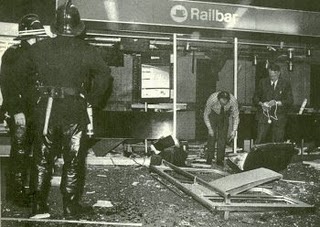
On September 10, 1973, a bomb (with no warning issued beforehand) explodes at King’s Cross railway station in the booking hall at 12:24 p.m. when a youth of around 16 to 17 years of age walks up to the entrance of the station’s old booking hall and throws a bag into it which contains a 3 lb. (1.4 kg) device, which detonates, shattering glass throughout the hall and throwing a baggage trolley several feet into the air. The youth then flees into the station’s crowd and escapes the scene.
Approximately 45 minutes after the attack at King’s Cross, after a telephone call warning to the Press Association five minutes beforehand by a man with an Irish accent, a second bomb detonates in a snack bar at Euston railway station, injuring another eight civilians. One witness at Euston says, “I saw a flash and suddenly people were being thrown through the air – it was a terrible mess, they were bleeding and screaming.” A total of 13 civilians are injured in the two attacks. The Metropolitan Police issue a photofit picture of a 5 ft. 2 in. (157 cm) tall youth they are seeking in regard to the King’s Cross attack.
On September 12, 1973, two more bombs explode, one in Oxford Street and another in Sloane Square, targeting retail shopping centres. Police subsequently announce that they are looking for five people in connection with this second wave of bomb attacks in England.
Judith Ward is later wrongly convicted of having been involved in the late 1973 London bombings, along with the M62 coach bombing. She is later acquitted. No one else is brought to trial for this IRA bombing campaign.
A knee injury during a night training exercise in Omagh makes McDowell ineligible for active military service and he becomes a weapons instructor. The accident also leads to him meeting his future wife, Margaret Telfer, the physiotherapist who treats him in hospital in Bangor, County Down.
McDowell rises to the rank of major and is part of the Allied forces in occupied Austria following the end of the war, taking part in joint patrols in Vienna with Russian, American and French officers. In the post-war period, he is given two years to finish his college course and spends a summer studying law with a tutor before passing the English bar and returning to the British Army.
After a further military posting to Edinburgh, McDowell’s legal qualification brings him to the army legal service in the War Office in London. With little prospect of further promotion and every chance of being posted abroad without his young family, he decides to leave the army. He is offered a job as legal adviser in London to James North Ltd, a company which makes protective clothing. With no experience of industry, he asks to be given a managerial role at first. The company suggests a managing position in its operations in Dublin. He slots easily into the city’s old business establishment, joining the Kildare Street Club, becoming a director of Pim’s department store, and setting his career firmly on a commercial rather than a legal path.
McDowell’s involvement with newspapers comes about through the recognition of his business acumen. He is asked by some acquaintances to take a look at the financial troubles of the Evening Mail, which is bought subsequently by The Irish Times, adding to the latter’s own financial difficulties.
McDowell is asked later by The Irish Times to see if Roy Thomson, the Canadian-born British press baron whom he had met while they both looked separately at the Evening Mail, might be interested in taking it over. Thomson passes and the company then asks McDowell himself to take charge as chief executive in 1962. Among his first actions are to close the Evening Mail and the Sunday Review, a short-lived tabloid that is ahead of its time. A year later, another problem is resolved when Douglas Gageby, who had been hired as managing director of The Irish Times shortly before McDowell’s arrival, takes over as editor.
Thus, what had begun as a slightly awkward relationship, turns into a highly successful partnership as Gageby sets about broadening the newspaper’s editorial appeal and McDowell sets it on a successful commercial course. McDowell always credits Gageby and his successors as editor with the success of the newspaper. Although he has a close relationship with editors, especially Gageby, he does not interfere in the editorial running of the newspaper.
By the early 1970s, the circulation of The Irish Times has almost doubled in a decade to 60,000 and it is making money. Some of the directors indicate an interest in selling the company. McDowell proposes instead that it be turned into a trust. It is a period when several newspapers in Ireland and Britain have changed hands or are seen as being vulnerable to takeovers. His aims are to protect the newspaper’s independence, make it as difficult as possible for anyone to take over, and formalise its aims in a guiding trust.
McDowell works on the trust document for many months, going through 28 drafts before he is satisfied with the result. The five directors of the company, including McDowell and Gageby, transfer their shares in the company to a solicitor in the autumn of 1973 in anticipation of announcing the trust at the end of that year. Further delays in finalising the trust terms result in its announcement in April 1974, on the eve of the introduction of capital gains tax. The timing gives rise to suggestions that the directors are taking their cash (£325,000 each) out of the company before the new tax takes effect. McDowell always denies that this is the case, maintaining that the timing is coincidental. He is also adamant that the motivation behind the formation of the trust itself is altruistic.
The formation of the trust leaves the newspaper with a large bank debt, used to buy out the directors/shareholders, at what turns out to be a difficult economic period after the first oil crisis hits the western world in the autumn of 1974. McDowell successfully guides The Irish Times‘ financial fortunes through the subsequent recession and into further periods of growth throughout the 1980s and 1990s.
McDowell stands down as chief executive of the company in 1997 and retires from the chairmanship of The Irish Times Trust in 2001. He is given the title President for Life in recognition of his huge contribution to the newspaper.
McDowell is a private person and never seeks or exploits the public status or limelight that goes with being a newspaper publisher. During his visit to the new The Irish Times offices on Tara Street in June 2008 for the unveiling of a portrait of him by Andrew Festing, he describes the newspaper and his family as the two loves of his life.
McDowell dies unexpectedly at the age of 87 on September 9, 2009. His funeral takes place in Whitechurch Parish Church, Rathfarnham, followed by burial in the adjoining churchyard.
McCorley is one of three children born to Roger Edmund McCorley, a meat carver in a hotel, and Agnes Liggett. He has two elder brothers, Vincent and Felix. He joins the Fianna in his teens. His family has a very strong republican tradition, and he claims to be the great-grandson of the United Irishmen folk hero Roddy McCorley, who was executed for his part in the Irish Rebellion of 1798.
McCorley is noted for his militancy, as he is in favour of armed attacks on British forces in Belfast. The Brigade’s leaders, by contrast, in particular, Joe McKelvey, are wary of sanctioning attacks for fear of loyalist reprisals on republicans and the Catholic population in general. In addition, McCorley is in favour of conducting an armed defense of Catholic areas, whereas McKelvey does not want the IRA to get involved in what he considers to be sectarian violence. McCorley writes later that in the end, “the issue settled itself within a very short space of time, when the Orange mob was given uniforms, paid for by the British, and called the Ulster Special Constabulary (USC).” The role of the USC, a temporary police force raised for counter-insurgency purposes, in the conflict is still debated, but republicans maintain that the organization was responsible for the indiscriminate killings of Catholics and nationalists.
On January 26, 1921, McCorley, is involved in the fatal shooting of three Auxiliary Division officers in their beds in the Railway View hotel in central Belfast. Shortly afterwards, he and another IRA man, Seamus Woods, organize an active service unit (ASU) within the first battalion of the Belfast Brigade, with the intention of carrying out attacks, with or without the approval of the Brigade leadership. The unit consists of 32 men. McCorley later writes, “I issued a general order that, where reprisal gangs [State forces] were cornered, no prisoners were to be taken.” In March 1921, he personally leads the ASU in the killing of three Black and Tans in Victoria Street in central Belfast. He is responsible for the deaths of two more Auxiliaries in Donegall Place in April. In reprisal for these shootings, members of the RIC assassinate two republican activists, the Duffin brothers in Clonard Gardens in west Belfast. On June 10, 1921, both and Woods and McCorley units are involved in the killing a RIC man who is suspected in the revenge killings of the Duffin brothers. Two RIC men and a civilian are also wounded in that attack.
Thereafter, there is what historian Robert Lynch has described as a “savage underground war” between McCorley’s ASU and RIC personnel based in Springfield Road barracks and led by an Inspector Ferris. Ferris is accused of murdering the Lord Mayor of Cork Thomas MacCurtain and had been posted to Lisburn for his safety. Ferris himself is among the casualties, being shot in the chest and neck, but surviving. McCorley claims to have been one of the four IRA men who shot Ferris. In addition, his men bomb and burn a number of businesses including several cinemas and a Reform Club. In May 1921, however, thirteen of his best men are arrested when surrounded by British troops during an operation in County Cavan. They are held in Crumlin Road Gaol and sentenced to death.
On June 3, McCorley organizes an attack on Crumlin Road Gaol in an attempt to rescue the IRA men held there before they are executed. The operation is not a success; however, the condemned men are reprieved after a truce is agreed between the IRA and British forces in July 1921. On Bloody Sunday (July 10, 1921), he is a major leader in the defense of nationalist areas from attacks by both the police and loyalists. On that day twenty people are killed before he negotiates a truce beginning at noon on July 11. At least 100 people are wounded, about 200 houses are destroyed or badly damaged – most of them Catholic homes, leaving 1,000 people homeless.
In April 1922, McCorley becomes leader of the IRA Belfast Brigade after Joe McKelvey goes south to Dublin to join other IRA members who are against the Anglo-Irish Treaty. With McKelvey’s departure, Seamus Woods becomes Officer Commanding of the IRA’s 3rd Northern Division, which has up to 1,000 members, with McCorley designated as Vice Officer Commanding. McCorley for his part, supports the Treaty, despite the fact that it provides for the partition of Ireland and the continued British rule in Northern Ireland. The reason for this is that Michael Collins and Eoin O’Duffy have assured him that this is only a tactical move and indeed, Collins sends men, money and weapons to the IRA in the North throughout 1922.
However, McCorley’s command sees the collapse of the Belfast IRA. In May 1922, the IRA launches an offensive with attacks all across Northern Ireland. In Belfast, he carries out an assault on Musgrave Street RIC barracks. He also conducts an arson campaign on businesses in Belfast. His men also carry out a number of assassinations, including that of Ulster Unionist PartyMPWilliam J. Twaddell, which causes the internment of over 200 Belfast IRA men.
To escape from the subsequent repression, McCorley and over 900 Northern IRA men flee south, to the Irish Free State, where they are housed in the Curragh. McCorley is put in command of these men. In June 1922, the Irish Civil War breaks out between Pro and Anti-Treaty elements of the IRA. He takes the side of the Free State and Michael Collins. After Collins is killed in August 1922, his men are stood down. About 300 of them join the National Army and are sent to County Kerry to put down anti-Treaty guerrillas there. In the Spring of 1923, bitterly disillusioned by the brutal counterinsurgency against fellow republicans, he resigns his command.
McCorley later asserts that he “hated the Treaty” and only supported it because it allowed Ireland to have its own armed forces. Both he and Seamus Woods are severe critics of the Irish Free State inertia towards Northern Ireland after the death of Michael Collins. He comments that when Collins was killed “the Northern element gave up all hope.”
In 1936 McCorley is instrumental in the establishment of the All-Ireland Old IRA Men’s Organization, serving as Vice-President with President Liam Deasy (Cork No. 3 Brigade) and Secretary George Lennon (Waterford No. 2 Brigade).
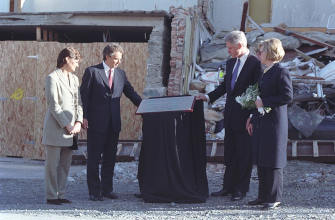
Following the unveiling, they walk through the town’s main street, Market Street, which bore the brunt of the explosion. Clinton, First LadyHillary Clinton, who earlier placed a wreath at the newly-unveiled plaque, Blair and his wife Cherie meet and shake hands with many of the crowd, who are clearly pleased to see them. They also visit Watterson’s drapers shop, where three members of staff had been killed, and lay a wreath.
Earlier, in the town’s leisure centre, they meet the victims of the Omagh bombing, and the family and friends of those who died. Blair and Clinton spend about an hour talking to people in Omagh. They meet some of the people who had been injured in the blast, including a group who have been released from hospital for the day especially to meet the president. Una McGurk is discharged from the Altnagelvin Area Hospital in Derry, and sisters Laura and Nicola Hamilton from the Ulster Hospital in Dundonald, on the outskirts of east Belfast. Thirty-four people remain in hospital, three – two women and a man – in critical conditions.
Downing Street later says the Blairs and Clintons were “deeply moved” by their meeting in the gymnasium. The prime minister’s official spokesman says Blair found the courage and determination of the people he met “positively inspirational.”
The first person Clinton speaks to is a young girl who has both eyes covered with bandages. He also meets a boy wearing a Leeds United F.C. shirt who is unable to shake the president’s hand because both his hands are still bandaged.
Before arriving in Omagh, Clinton puts the issue of decommissioning at the top of his priorities for change in Northern Ireland. He says these priorities are “To decommission weapons of war that are obsolete in a Northern Ireland at peace, to move forward with a formation of an executive council, adapt your police force so it has the confidence, respect and support of all the people, to end street justice, because defining crime, applying punishment and enforcing the law, must be left to the peoples’ elected representatives, the courts and the police, and to pursue early release for prisoners whose organisations have truly abandoned violence and to help them find a productive, constructive place in society.”
(From: “Clinton consoles bomb victims,” BBC News, news.bbc.co.uk, September 4, 1998)
Brian Robinson, loyalist militant from Belfast, Northern Ireland, and member of the Ulster Volunteer Force (UVF), is shot dead by two members of an undercover British Army unit on September 2, 1989. His death is one of the few from the alleged shoot-to-kill policy in Northern Ireland to have involved a loyalist victim.
Robinson is born in Belfast in 1962 to Rab and Margaret Robinson, and brought up a Protestant on Disraeli Street in the staunchly loyalist Woodvale district of the Shankill Road. It is unknown when he becomes a member of the local Ulster Volunteer Force. He holds the rank of volunteer in its B Company, 1st Battalion Belfast Brigade. By the time of his death he has moved to Forthriver Crescent in the Glencairn estate, an area immediately northwest of Woodvale.
On September 2, 1989, Robinson and fellow UVF member Davy McCullough are travelling on a motorbike, with Robinson as the passenger armed with a gun, in Belfast’s Crumlin Road, close to the Irish nationalist area of Ardoyne. Upon seeing Paddy McKenna, a Catholic civilian, walking along the street, Robinson opens fire, hitting McKenna a total of eleven times and killing him. Unbeknownst to the two UVF members, an undercover British Army unit, linked to the Special Air Service, is in the area. Giving chase in a Vauxhall Astra car and a Fiat, the soldiers ram the motorbike, forcing both men off the road. Robinson is shot twice in his torso, then twice more in the back of the head by a female soldier standing over him. He is 27-years-old. Upon hearing the news of her son’s death, Robinson’s mother, Margaret, suffers a fatal heart attack. The two are buried on the same day.
The UVF leadership in west Belfast later claims that the intelligence leading to Robinson’s death had been provided by one of their own men, Colin “Crazy” Craig, who allegedly had been a police informer for several years. Craig is killed by the Irish National Liberation Army (INLA) on June 16, 1994, along with fellow UVF members Trevor King and David Hamilton. A UVF commander is quoted as mourning King and Hamilton, but adding that Craig was in line to be shot by the UVF anyway. Republican sources claim that the security forces infiltration of the UVF is even deeper, including Trevor King and “the most senior UVF figure in the North.”
Robinson’s funeral is well-attended as it leaves his home in Forthriver Crescent. Despite his membership in the UVF there are no paramilitary displays at the funeral, and the coffin is covered in the Union Jack instead of a UVF standard. Robinson is a member of the “Old Boyne Heroes” lodge of the Orange Order, and several members wearing their sashes flank the coffin. The cortege then meets up with Margaret Robinson’s funeral as it leaves her home in Crimea Street. A lorry carrying floral tributes leads the cortege. Both mother and son are buried in Roselawn Cemetery. A death notice from Robinson’s Orange lodge is published in the local press, which causes controversy.
Robinson’s death is commemorated annually in a band parade attended by loyalist bands in the Belfast area. One band, Star of the Shankill, has “In Memory of Brian Robinson” written on its crest and emblazoned upon its bass drum. The band also attracts controversy when it appears at a parade organised by the Apprentice Boys of Derry that passes near the area in which Robinson killed his victim. In 2010, Rab Robinson, the brother of Brian, issues an appeal to the parades organisers to postpone the parade that year, owing to the death of his younger brother earlier that year.
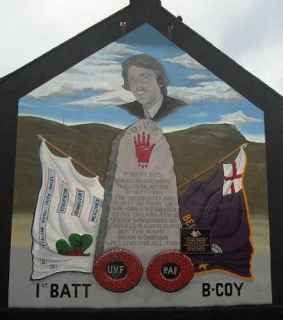
Robinson is commemorated in a mural on Disraeli Street, off Woodvale Road in Belfast.
In 2015, Robinson’s son Robert removes a Special Air Service flag that had been erected by the loyalists at the Twaddell Avenue protest camp. The Shankill UVF is later said to be reviewing its policy of flying the flag.
(Pictured: Mural commemorating Brian Robinson on Disraeli Street, off Woodvale Road in Belfast)
Accused by The Sunday Times of directing an IRA bombing campaign in Britain, in 1987 Murphy unsuccessfully sues the paper for libel in Dublin. The original verdict is overturned by the court of appeal because of omissions in the judge’s summing up and there is a retrial, which he also loses. At the retrial, both Sean O’Callaghan and Eamon Collins, former members of the Provisional Irish Republican Army, testify against Murphy, as do members of the Gardaí, Irish customs officials, British Army and local TDBrendan McGahon. Collins, who had also written a book about his experiences, Killing Rage, is beaten and killed by having a spike driven through his face near his home in Newry eight months later. In 1998, a Dublin court dismisses Murphy’s case after a high-profile trial, during which Murphy states that he has “never been a member of the IRA, no way” and claims not to know where the Maze prison is located. The jury rules, however, that he is an IRA commander and a smuggler.
The Sunday Times subsequently publishes statements given by Adrian Hopkins, the skipper who ferries weapons from Libya to the IRA, to the French authorities who intercept the fifth and final Eksund shipment. Hopkins details how Murphy met a named Libyan agent in Greece, paid for the weapons to be imported, and helped unload them when they arrived in Ireland. According to A Secret History of the IRA by Ed Moloney, Murphy has been the IRA Army Council’s chief of staff since 1997. Toby Harnden’s Bandit Country: The IRA & South Armagh also details Murphy’s IRA involvement.
On September 20, 2016, the BBC‘s Spotlight airs a programme in which an alleged British spy who had infiltrated the IRA claims that in 2006, Murphy had demanded the killing of Denis Donaldson, an IRA member and British informer, in order to maintain discipline. The BBC says it had tried to contact Murphy but had received no reply. He has yet to respond to the allegation. On September 23, 2016, the Donaldson family’s solicitor says that the allegation is “absolute nonsense.”
In October 2005, officers of the British Assets Recovery Agency and the Irish Criminal Assets Bureau carry out raids on a number of businesses in Manchester and Dundalk. It is extensively reported in the media that the investigation is aimed at damaging the suspected multi-million-pound empire of Murphy, who according to the BBC’s Underworld Rich List, has accumulated up to £40 million through smuggling oil, cigarettes, grain and pigs, as well as through silent or partial ownership in legitimate businesses and in property.
A large, purpose-built underground chamber that Gardaí believes the IRA used for interrogation is discovered close to Murphy’s home.
In his first-ever press release, issued on October 12, 2005, Murphy denies he owned any property and denies that he had any links with co-accused Cheshire businessman Dermot Craven. Furthermore, he claims that he had to sell property to cover his legal fees after his failed libel case against The Sunday Times, and that he made a living from farming.
On March 9, 2006, police, soldiers and customs officials from both sides of the Irish border launch a large dawn raid on Murphy’s house and several other buildings in the border region. Three persons are arrested by the Gardaí but are released three days later. A fleet of tankers, computers, documents, two shotguns, more than 30,000 cigarettes and the equivalent of 800,000 euros in sterling bank notes, euro bank notes and cheques are seized. Four diesel laundering facilities attached to a major network of storage tanks, some of which are underground, are also found. The Irish Criminal Assets Bureau later obtains seizure orders to take possession of euro cash and cheques and sterling cash and cheques, together worth around one million Euros.
Sinn Féin President Gerry Adams makes a public statement in support of Murphy following the March 2006 raids. Under political and media pressure over allegations of the IRA’s continued presence in South Armagh, Adams says, “Tom Murphy is not a criminal. He’s a good republican and I read his statement after the Manchester raids, and I believe what he says and also and very importantly he is a key supporter of Sinn Féin’s peace strategy and has been for a very long time.” He adds, “I want to deal with what is an effort to portray Tom Murphy as a criminal, as a bandit, as a gang boss, as someone who is exploiting the republican struggle for his own ends, as a multimillionaire. There is no evidence to support any of that.”
Murphy is arrested in Dundalk, County Louth, on November 7, 2007, by detectives from the Criminal Assets Bureau, on charges relating to alleged revenue offences. The following day, he is charged with tax evasion under the Tax Consolidation Act. He is later released on his own bail of €20,000 with an independent surety of €50,000.
On October 17, 2008, in an agreed legal settlement, Murphy and his brothers pay over £1 million in assets and cash to the authorities in Britain and the Republic in settlement of a global crime and fraud investigation relating to proceeds of crime associated with smuggling and money laundering. After an investigation involving the Irish Criminal Assets Bureau and the UK’s Serious Organised Crime Agency, more than 625,000 euros (£487, 000) in cash and cheques is confiscated by the Republic’s courts, while nine properties in North West England worth £445,000 are confiscated by British courts. Murphy is still fighting a claim in the Republic’s courts for tax evasion, relating to non-completion of tax returns for eight years from 1996. On April 26, 2010, he is further remanded on bail.
In 2011, there are claims that Murphy had become disillusioned with the Northern Ireland peace process and that he had fallen out with Sinn Féin. However, there is no evidence to support he is sympathetic to any dissident republican groups. In March 2013, the Garda and the Police Service of Northern Ireland (PSNI), along with members of the Irish Customs Authority and HM Revenue and Customs (HMRC), raid his farm on the Louth-Armagh border. The Sunday World reports that two hours prior to the raid, at approximately 4:00 a.m., fire is seen coming from Murphy’s yard. There are serious concerns within the Garda and PSNI that a mole may have tipped off Murphy about the raid hours earlier as laptops, computer disks and a large amount of documentation is destroyed in the fires. As a result, an internal Garda investigation takes place.
On December 17, 2015, Murphy is found guilty on nine charges of tax evasion by a three-judge, non-jury Special Criminal Court trial sitting in Dublin, lasting nine weeks. He is tried under anti-terrorist legislation due to the belief by the Director of Public Prosecutions (DPP) that there would not be a fair trial because of the potential of the intimidation of prosecution witnesses and jurors, and the security surrounding the trial.
Murphy is found guilty on all charges of failing to furnish tax returns on his income as a “cattle farmer” between 1996 and 2004. He is prosecuted following a 14-year-long Criminal Assets Bureau investigation, which during a raid of his property uncovers bags with more than €250,000 and more than £111,000 sterling in cash, along with documents, diaries and ledgers. He is remanded on bail until early 2016 for sentencing.
On February 26, 2016, Murphy is sentenced to 18 months in prison. None of the jail term is suspended. Following sentencing, he is immediately transferred from court to Ireland’s highest-security prison, Portlaoise Prison, reserved for terrorists, dissident republicans and serious gangland criminals, under a heavily armed Garda and Irish Army escort due to security concerns.
Murphy appeals the conviction in November 2016. His lawyer, John Kearney, claims that the tax Murphy had not paid had in fact been paid by his brother, Patrick. The Court of Appeal dismisses the appeal on all grounds in January 2017.
MacEntee is the son of James McEntee, a publican, and his wife, Mary Owens, both of whom are from Monaghan. James McEntee is a prominent Nationalist member of Belfast Corporation and a close friend of Joseph DevlinMP.
MacEntee is educated at St. Mary’s Christian Brothers’ Grammar School, St. Malachy’s College and the Belfast Municipal College of Technology where he qualifies as an electrical engineer. His early political involvement is with the Irish Socialist Republican Party in Belfast. He quickly rises through the ranks of the trade union movement becoming junior representative in the city’s shipyards. Following his education, he works as an engineer in Dundalk, County Louth, and is involved in the establishment of a local corps of the Irish Volunteers in the town. He mobilises in Dundalk and fights in the General Post Office garrison in the Easter Rising in 1916. He is sentenced to death for his part in the rising. This sentence is later commuted to life imprisonment. He is released in the general amnesty in 1917 and is later elected a member of the National Executives of both Sinn Féin and the Irish Volunteers in October 1917. He is later elected Sinn Féin Member of Parliament (MP) for South Monaghan at the 1918 Irish general election.
An attempt to develop MacEntee’s career as a consulting engineer in Belfast is interrupted by the Irish War of Independence in 1919. He serves as Vice-Commandant of the Belfast Brigade of the Irish Republican Army (IRA). He is also a member of the Volunteer Executive, a sort of Cabinet and Directory for the Minister for Defence and the HQ Staff, however, he remains one of the few Sinn Féiners from the north. On August 6, 1920, he presents ‘a Memorial’ lecture to the Dáil from the Belfast Corporation. He tells the Dáil it is the only custodian of public order, that a Nationalist pogrom is taking place, and he advises them to fight Belfast. The Dáil government’s policy is dubbed Hibernia Irredenta or “Greening Ireland.” He is asked to resign his South Monaghan seat after voting against a bunting celebration in Lurgan to mark the signing of the Anglo-Irish Treaty.
In April 1921 MacEntee is transferred to Dublin to direct a special anti-partition campaign in connection with the May general election. It remains Michael Collins‘s policy, he declares, that the largely Protestant shipyard workers of Belfast are being directed by the British, urging all Irishmen to rejoin the Republic. Correspondingly the Ulster Unionist Council rejects the call for a review of the boundary commission decision made on Northern Ireland. But when Ulstermen choose James Craig as Premier, Collins denounces democracy in the north as a sham. It is on the partition of Ireland issue that MacEntee votes against the Anglo-Irish Treaty of 1921. During the subsequent Irish Civil War, he commands the IRA unit in Marlboro Street Post Office in Dublin. He later fights with Cathal Brugha in the Hamman Hotel and is subsequently interned in Kilmainham and Gormanstown until December 1923.
After his release from prison, MacEntee devotes himself more fully to his engineering practice, although he unsuccessfully contests the Dublin Countyby-election of 1924. He becomes a founder-member of Fianna Fáil in 1926 and is eventually elected a TD for Dublin County at the June 1927 Irish general election.
MacEntee founds the Association of Patent Agents in 1929, having gained his interest in Patents when he worked as an assistant engineer in Dundalk Urban District Council. He values his status as a Patent Agent as he maintains his name on the Register for over 30 years while he holds Ministerial rank in the Irish Government, although he is not believed to have taken any active part in the patent business, which is carried on by his business partners.
In 1932, Fianna Fáil comes to power for the very first time, with MacEntee becoming Minister for Finance. In keeping with the party’s protectionist economic policies his first budget in March of that year sees the introduction of new duties on 43 imports, many of them coming from Britain. This sees retaliation from the British government, which in turn provokes a response from the Irish government. This is the beginning of the Anglo-Irish Trade War between the two nations, however, a treaty in 1938, signed by MacEntee and other senior members brings an end to the issue.
In 1939, World War II breaks out and a cabinet reshuffle results in MacEntee being appointed as Minister for Industry and Commerce, taking over from his rival Seán Lemass. During his tenure at this department, he introduces the important Trade Union Act (1941). In 1941, another reshuffle of ministers takes place, with him becoming Minister for Local Government and Public Health. The Health portfolio is transferred to a new Department of Health in 1947. Following the 1948 Irish general election, Fianna Fáil returns to the opposition benches for the first time in sixteen years.
In 1951, Fianna Fáil are back in government, although in minority status, depending on independent deputies for survival. MacEntee once again returns to the position of Minister for Finance where he feels it is vital to deal with the balance of payments deficit. He brings in a harsh budget in 1951 which raises income tax and tariffs on imports. His chief aim is to cut spending and reduce imports, however, this comes at a cost as unemployment increases sharply. The increases are retained in his next two budgets in 1952 and 1953. It is often said that it is his performance during this period that costs Fianna Fáil the general election in 1954. The poor grasp on economics also does his political career tremendous damage as up to that point he is seen as a likely successor as Taoiseach. Seán Lemass, however, is now firmly seen as the “heir apparent.”
In 1957, Fianna Fáil returns to power with an overall majority with MacEntee being appointed Minister for Health. The financial and economic portfolios are dominated by Lemass and other like-minded ministers who want to move away from protection to free trade. He is credited during this period with the reorganisation of the health services, the establishment of separate departments of health and social welfare, and the fluoridation of water supplies in Ireland. In 1959, he becomes Tánaiste when Seán Lemass is elected Taoiseach.
Following the 1965 Irish general election, MacEntee is 76 years old and retires from the government. He re-emerges in 1966 to launch a verbal attack on Seán Lemass for deciding to step down as party leader and Taoiseach. The two men, however, patch up their differences shortly afterwards. MacEntee retires from Dáil Éireann in 1969 at the age of 80, making him the oldest TD in Irish history.
MacEntee dies in Dublin on January 9, 1984, at the age of 94. He is buried in Glasnevin Cemetery, Dublin. At the time of his death, he is the last surviving member of the First Dáil.
Murphy is an active Irish republican paramilitary from his late teens. In March 1972, he is arrested in Dundalk regarding an assault and is sentenced to two years in prison after the Garda Síochána find a loaded revolver in his car. He is imprisoned in the Curragh Camp but escapes in October 1972 and is not recaptured until May 1973. In June 1976, he is imprisoned again, receiving a three-year sentence for firearms offences and a one-year sentence for Provisional Irish Republican Army membership, both sentences to run concurrently. In July 1983, he is arrested in the United States after attempting to buy a consignment of M60 machine guns to be shipped to Ireland for use by the Irish National Liberation Army (INLA). He receives a five-year prison sentence but returns to Ireland in December 1985 after being released early.
In the late 1980s, Murphy begins investing in property and forms a company named Emerald Enterprises in 1990. He purchases the Emerald Bar public house in Dundalk for IR£100,000, and it later becomes a meeting place for dissident republicans. Other investments included 30 acres of land in Drogheda bought for IR£52,000 in 1995, and his company wins contracts for an IR£11 million development at Dublin City University (DCU) and the multi-million-pound International Financial Services Centre in the Dublin Docklands.
Murphy is arrested by the Gardaí on February 21, 1999, for questioning under anti-terrorist legislation. On February 24, he becomes the first person to be charged in connection with the Omagh bombing, when he appears before Dublin‘s Special Criminal Court and is charged with conspiring to cause an explosion under the terms of Ireland’s Offences Against the State Act, between August 13-16, 1998. He is also charged with membership in an illegal organisation, the Real Irish Republican Army (RIRA).
On October 10, 2000, the BBC television show Panorama names Murphy as one of four people connected with the Omagh bombing, along with Seamus Daly and Liam Campbell. In 2001, he undertakes legal action against the BBC and Daily Mail publishers Associated Newspapers for contempt of court. The action against Associated Newspapers is settled on July 31, 2001, and the newspaper releases a statement saying Murphy is entitled to be presumed innocent of the charges against him until proven guilty.
Murphy’s trial begins at Special Criminal Court in Dublin on October 12, 2001. The court hears that Murphy had supplied two mobile phones which were used during the bombing. One witness, Murphy’s second cousin, retracts his evidence and the judge calls the conduct of two detectives outrageous, saying they had persistently lied under cross-examination. Despite this, on January 22, 2002, he is convicted of conspiring to cause the Omagh bombing, and on January 25 is sentenced to 14 years imprisonment with the judge describing him as a long-time republican extremist.
On January 21, 2005, Murphy’s conviction is overturned and a new trial ordered, due to the invasion of Murphy’s presumption of innocence, and alteration of Gardaí interview notes and evidence presented by two officers. A week later, his legal case against the BBC is resolved, with the BBC issuing a statement that Murphy “was fully entitled to maintain his innocence of the charges against him and to test the evidence against him at his trial.”
On October 23, 2006, two Gardaí officers are found not guilty of perjuring themselves during Murphy’s trial. On May 23, 2007, it is announced that Murphy is suffering from short-term memory loss resulting from a car accident in 1988. His lawyers attempt to prevent a retrial taking place, on the grounds that his condition interferes with his right to a fair hearing. The Court of Criminal Appeal is scheduled to hear his case again in October 2008. Following a retrial held in January 2010, he is acquitted on February 24, 2010.
In 2009, Murphy is one of four men found by a civil court to be liable for the Omagh bombing in a case taken by relatives of the victims. On July 7, 2011, in Belfast High Court, Lord Justice Malachy Higgins directs a retrial of the civil claims against Murphy. He questions evidence surrounding emails from U.S. undercover agent David Rupert while overturning the judgment on Murphy. The paucity of the email evidence, the lack of consistency in the emails or at least ambiguity, the possibility of initials referring to someone other than Murphy and the fact that they refer on occasions to double hearsay considerably weaken the emails as evidence, he says. Following a civil retrial on March 20, 2013, Murphy and Seamus Daly are found liable for involvement in the bombing.




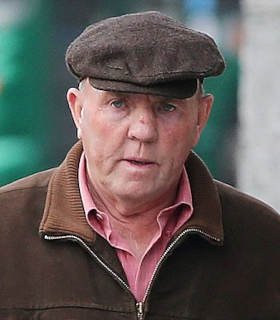


 seamus dubhghaill