seamus dubhghaill

Promoting Irish Culture and History from Little Rock, Arkansas, USA


Leave a comment

Birth of George Noble Plunkett, Scholar & Revolutionary

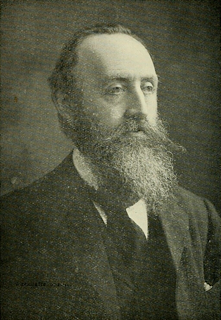
George Noble Plunkett, scholar and revolutionary, is born on December 3, 1851, at 1 Aungier Street, Dublin, the youngest and only survivor from infancy of the three children of Patrick Joseph Plunkett (1817–1918), builder and politician, and his wife, Elizabeth (née Noble). The Plunketts are Catholic, claiming collateral descent from Archbishop of Armagh Oliver Plunkett, and nationalist: the two drummers from the republican army at Vinegar Hill in 1798 visit George’s cradle.

Plunkett is educated expensively: at a primary school in Nice, making him fluent in French and Italian, then at Clongowes Wood College, and, from 1872, at Trinity College Dublin (TCD), where his generous allowance allows him to study renaissance and medieval art. He enrolls at King’s Inns in 1870 and the Middle Temple in 1874, but is not called to the bar until 1886. While there he befriends Oscar Wilde and Jeremiah O’Donovan Rossa. In 1877, he endows a university gold medal for Irish speakers and publishes a book of poems, God’s Chosen Festival, and the following year he issues a pamphlet, The Early Life of Henry Grattan. He also writes articles for magazines, editing a short-lived one, Hibernia, for eighteen months from 1882. In 1883, he donates funds and property to the nursing order of the Little Company of Mary (Blue Sisters), and on April 4, 1884, Pope Leo XIII makes him a count.

On June 26, 1884, Plunkett marries Mary Josephine Cranny (1858–1944). The couple has seven children: Philomena (Mimi) (b. 1886), Joseph (b. 1887), Mary Josephine (Moya) (b. 1889), Geraldine (b. 1891), George Oliver (b. 1894), Fiona (b. 1896), and Eoin (Jack) (b. 1897).

Plunkett surprises many in 1890 by declaring for Charles Stewart Parnell against the Catholic hierarchy. In the 1892 United Kingdom general election in Ireland he is a Parnellite candidate for Mid Tyrone but withdraws from a potential three-cornered fight lest he let in the unionist. He is sole nationalist candidate for Dublin St. Stephen’s Green in the 1895 United Kingdom general election in Ireland, and at an 1898 by-election there he cuts the unionist majority to 138 votes. The reunited Irish Party wins the seat in 1900.

In 1894, Plunkett part-edits Charles O’Kelly‘s memoir The Jacobite War in Ireland. By 1900, when he publishes the standard biography Sandro Botticelli, he is supplementing his income by renewed artistic studies, which until 1923 finances his lease of Kilternan Abbey, County Dublin. His Pinelli (1908) is followed by Architecture of Dublin, and, in 1911, by his revised edition of Margaret McNair Stokes‘s Early Christian Art in Ireland. In 1907, he becomes director of the National Museum of Ireland, where he increases annual visits from 100 to 3,000.

Joseph Plunkett swears his father into the Irish Republican Brotherhood (IRB) in April 1916, sending him secretly to seek German aid and a papal blessing for the projected Easter rising. After its defeat, Plunkett is sacked by the National Museum of Ireland and deported with the countess to Oxford, and the following January he is expelled by the Royal Dublin Society (RDS). This earns him nomination as the surviving rebels’ candidate in the North Roscommon by-election. He returns to Ireland illegally on January 31, 1917, and wins the seat easily three days later. Pledging abstention from attendance at Westminster in accordance with Sinn Féin policy, he initiates a Republican Liberty League, which coalesces with similar groups such as Sinn Féin. In October this front becomes the new Sinn Féin, committed to Plunkett’s republic rather than to the “king, lords and commons“ of Arthur Griffith. Plunkett and Griffith become the new party’s vice-presidents, under Éamon de Valera.

On May 18, 1918, Plunkett is interned again. Released after Sinn Féin’s general election landslide (in which he is returned unopposed), he presides, Sinn Féin’s oldest MP, at the planning meeting for Dáil Éireann on January 17, 1919, and at its opening session on January 21. On the 22nd he is made foreign affairs minister by Cathal Brugha, an appointment reaffirmed by de Valera on April 10. He criticises his president for advocating a continuing Irish external relationship with Britain, and fails to organise an Irish foreign service. In February 1921, de Valera makes Robert Brennan his departmental secretary and a ministry takes shape, while Plunkett publishes a book of poems, Ariel. After uncontested “southern Irish“ elections to the Second Dáil, de Valera moves his implacable foreign minister from the cabinet to a tailor-made portfolio of fine arts. Plunkett’s Dante sexcentenary commemoration is overshadowed by news of the Anglo–Irish Treaty. Opposing this, Plunkett cites his oath to the republic and its martyrs including his son. He leaves his ministry on January 9, 1922.

Plunkett chairs the anti-treaty Cumann na Poblachta, which loses the June general election, though he is returned again unopposed. In the Irish Civil War the treatyites intern him and the republicans appoint him to their council of state. In the August 1923 Irish general election, his first electoral contest since 1917, the interned count tops the poll in County Roscommon. He is released in December.

When de Valera forms Fianna Fáil in 1926, Plunkett stays with Sinn Féin, and loses his deposit in the June 1927 Irish general election. A year later he publishes his last poetry collection, Eros. He runs for a new Cumann Poblachta na hÉireann in a County Galway by-election in 1936, but loses his deposit again. On December 8, 1938, with the other six surviving abstentionist Second Dáil TDs, he transfers republican sovereignty to the IRA Army Council.

Plunkett is a big man with a black beard which whitens steadily after his fiftieth birthday. He is always formally pleasant and courteous. His oratory is described by M. J. MacManus as “level, cultured tones . . . [more] used to addressing the members of a learned society than to the rough and tumble of the hustings” (The Irish Press, March 15, 1948). Theoretically and practically, he is more scholar than politician. His portrait is on display at the Royal Society of Antiquaries of Ireland (RSAI).

Plunkett dies from cancer on March 12, 1948, and is buried in Glasnevin Cemetery, survived by his children Geraldine (wife of Thomas Dillon), Fiona, and Jack. His grandson Joseph (1928–66), son of George Oliver Plunkett, inherits the title.

(From: “Plunkett, Count George Noble” by D. R. O’Connor Lysaght, Dictionary of Irish Biography, http://www.dib.ie, October 2009)

Leave a comment

Death of William Conway, Cardinal of the Roman Catholic Church

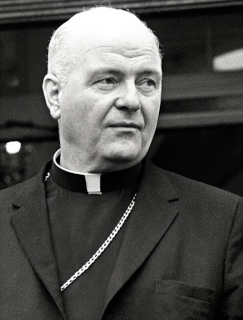
William John Cardinal Conway, Irish cardinal of the Roman Catholic Church who serves as Archbishop of Armagh and Primate of All Ireland from 1963 until his death, dies in Armagh, County Armagh, Northern Ireland, on April 17, 1977, after a short illness.

Conway is born on January 22, 1913, in Belfast, the eldest of four sons and five daughters of Patrick Joseph Conway and Annie Conway (née Donnelly). His father, a self-employed housepainter, also has a paint shop in Kent Street off Royal Avenue. His mother, who survives her son, is born in Carlingford, County Louth. He attends Boundary Street Primary School, St. Mary’s CBS (now St. Mary’s CBGS Belfast). His academic successes are crowned by a scholarship to Queen’s University Belfast. He decides to study for the diocesan priesthood. In 1933 he is conferred with an honours BA in English literature and goes on to read a distinguished course in theology at St. Patrick’s College, Maynooth.

Conway is ordained on June 20, 1937, and awarded a DD (1938). On November 12, 1938, he enters the Pontifical Irish College in Rome, and in 1941 he receives the DCL degree at the Pontifical Gregorian University. When Italy enters World War II in June 1940, he returns to Belfast to take up duty in the Diocese of Down and Connor. He is appointed to teach English and Latin in St. Malachy’s College in Belfast, but after one year he is named professor of moral theology and canon law in Maynooth. He contributes regular ‘Canon law replies’ to the Irish Ecclesiastical Record, which are later collected as Problems in canon law (1950), the only book published by him.

In 1957 Conway becomes vice-president of Maynooth, and in 1958, he is named Ireland’s youngest bishop, Titular Bishop of Neve, and auxiliary bishop to Cardinal John D’Alton, Archbishop of Armagh and Primate of All Ireland. He is consecrated in St. Patrick’s Cathedral, Armagh on July 27, 1958. He serves as administrator of St. Patrick’s Church, Dundalk, for the next five years, gaining valuable pastoral experience, and also uses these years to familiarise himself with his new diocese, especially its geography. On the death of D’Alton, he is chosen to succeed him in September 1963, and is enthroned on September 25 in St. Patrick’s Cathedral, Armagh by the apostolic nuncio, Archbishop Sensi. At the end of 1964, Pope Paul VI chooses him as Ireland’s seventh residential cardinal, and he receives the red hat in the public consistory of February 22, 1965.

The thirteen-odd years of Conway’s ministry as primate are dominated firstly by the Second Vatican Council and secondly by the Troubles in Northern Ireland. His primary concern is the church, to steer it through testing times. He is a very active bishop in a diocese of 160,000 Catholics, with fifty-seven parishes and some 167 priests. He carries the burden alone until 1974 when he is given an auxiliary in the person of his secretary, Fr. Francis Lenny (1928–78). Two new parishes are created, five new churches are built, and many others are renovated to meet the requirements of liturgical reform. Twenty new schools are also provided. He attends all four sessions of the Vatican council (1962–65), as auxiliary bishop and as primate. On October 9, 1963, he addresses the assembly, making a plea that the council might not be so concerned with weightier matters as to neglect to speak about priests. He also makes contributions on the topics of mixed marriages, Catholic schools, and the laity. On the topic of education, he is convinced that integrated schools will not solve Northern Ireland’s problems.

Conway represents the Irish Catholic Bishops’ Conference at each assembly of the Synod of Bishops in Rome, at first with Bishop Michael Browne of the Diocese of Galway and Kilmacduagh, his former professor in Maynooth, and later with the Archbishop of Dublin, Dermot Ryan. With Cardinals Jean-Marie Villot and Pericle Felici, he is chairman of the first synod in 1969, a signal honour conferred on him by Pope Paul VI. He addresses the assembly, opposing the ordination of married men as a move that would release a flood of applications from around the world for dispensations from priestly celibacy. His experience of violence in Northern Ireland is reflected in contributions he makes to later synod assemblies, especially in 1971 and 1974.

Apart from the synod, Conway travels a few times each year to Rome for meetings of the three Roman congregations on which he is called to serve (those of bishops, catholic education, and the evangelisation of peoples) and the commission for the revision of the code of canon law. He also travels further afield in a representative capacity to the International Eucharistic Congress at Bogotá, also attended by Pope Paul VI, and to Madras (1972), where he acts as papal legate for the centenary celebrations in honour of St. Thomas. In 1966 he is invited by the bishops of Poland to join in celebrations for the millennium of Catholicism in that country but is refused an entry visa by the Polish government. In January 1973 he feels obliged to forgo participation in the Melbourne eucharistic congress because of the troubled situation at home. Within Ireland he accepts invitations to become a freeman of Cork and Galway (1965) and of Wexford (1966). In 1976 the National University of Ireland (NUI) confers on him an honorary LL.D.

Conway is acknowledged as an able and diligent chairman of the Irish Catholic Bishops’ Conference. The core problem in the early years is how to lead the Irish church into the difficult new era that follows the council. He shows exceptional leadership qualities in the manner in which he promotes firm but gentle progress, avoiding sudden trauma and divisions. A major event in his term as Archbishop of Armagh, and one that gives him much satisfaction, is the canonization of Oliver Plunkett, his martyred predecessor, in the holy year 1975. He follows with great interest the final stages of the cause from 1968 and is greatly disappointed when grounded by his doctors six weeks before the event. He does however take part, concelebrating with Pope Paul VI at the ceremony on October 12, 1975. He also presides the following evening at the first mass of thanksgiving in the Lateran Basilica, receiving a tumultuous applause from the thousands of Irish present.

More than anything else, the Troubles in Northern Ireland occupy Conway during the second half of his term as archbishop and primate. He is the leading spokesman of the Catholic cause but never fails to condemn atrocities wherever the responsibility lay. He brands as ‘monsters’ the terrorist bombers on both sides. In 1971 he denounces internment without trial, and the following year he is mainly responsible for highlighting the ill-treatment and even torture of prisoners in Northern Ireland. He repudiates the idea that the conflict is religious in nature, emphasising its social and political dimensions, and is openly critical of the British government over conditions in Long Kesh Detention Centre, and of ‘the cloak of almost total silence’ surrounding violence against the Catholic community.

In January 1977 Conway undergoes surgery in a Dublin hospital, and almost immediately comes to know that he is terminally ill. It is the best-kept secret in Ireland until close to the end. On March 29, he writes to his fellow bishops informing them that the prognosis regarding his health is ‘not good, in fact . . . very bad,’ and that he is perfectly reconciled to God’s will. He is still able to work at his desk until Good Friday, April 8, 1977.

Conway dies in Armagh on Low Sunday night, April 17, 1977. Seven countries are represented at his funeral by six cardinals and many bishops. The apostolic nuncio, the bishops of Ireland, the president and Taoiseach, six Irish government ministers, and the Secretary of State for Northern Ireland are also among the mourners. The cardinal is laid to rest in St. Patrick’s Cathedral Cemetery, Armagh. The red hat received from Pope Paul VI is suspended from the ceiling of the Lady chapel, joining those of his four immediate predecessors.

(From: “Conway, John William,” Dictionary of Irish Biography, http://www.dib.ie, contributed by J. J. Hanley)


Leave a comment

Death of Edward John Moreton Drax Plunkett, 18th Baron Dunsany

Edward John Moreton Drax Plunkett, 18th Baron of Dunsany FRSL, Anglo-Irish writer and dramatist, dies in hospital in Dublin on October 25, 1957, following an attack of appendicitis. Over 90 volumes of fiction, essays, poems and plays appear in his lifetime, and a modest amount of material is published posthumously.

Plunkett, known to his family as “Eddie,” is born in London, England, on July 24, 1878, the first son of John William Plunkett, 17th Baron of Dunsany (1853–1899), and his wife, Ernle Elizabeth Louisa Maria Grosvenor Ernle-Erle-Drax, (née Burton) (1855–1916). From a historically wealthy and famous family, he is related to many well-known Irish figures. He is a kinsman of the Catholic Saint Oliver Plunkett, the martyred Archbishop of Armagh. He is also related to the prominent Anglo-Irish unionist and later nationalist Home Rule politician Sir Horace Plunkett and George Noble Plunkett, Papal Count and Republican politician, father of Joseph Plunkett, executed for his part in the 1916 Easter Rising.

Plunkett’s only grown sibling, a younger brother, from whom he is estranged from about 1916, for reasons not fully clear but connected to his mother’s will, is the noted British naval officer Sir Reginald Drax. Another younger brother dies in infancy.

Plunkett grows up at the family properties, notably, Dunstall Priory in Shoreham, Kent, and Dunsany Castle in County Meath, but also in family homes such as in London. His schooling is at Cheam School, Eton College and the Royal Military College, Sandhurst, which he enters in 1896.

The title passes to Plunkett at his father’s death in 1899 at a fairly young age. The young Lord Dunsany returns to Dunsany Castle in 1901 after war duty. In that year he is also confirmed as an elector for the Representative Peers for Ireland in the House of Lords.

In 1903, Plunkett meets Lady Beatrice Child Villiers (1880–1970), youngest daughter of Victor Child Villiers, 7th Earl of Jersey, who is then living at Osterley Park. They marry in 1904. Their one child, Randal, is born in 1906. Lady Beatrice is supportive of her husband’s interests and helps him by typing his manuscripts, selecting work for his collections, including the 1954 retrospective short story collection, and overseeing his literary heritage after his death.

The Plunketts are socially active in Dublin and London and travel between homes in Meath, London and Kent, other than during the First and Second World Wars and the Irish War of Independence. He circulates with many literary figures of the time. To many of these in Ireland he is first introduced by his uncle, the co-operative pioneer Sir Horace Plunkett, who also helps to manage his estate and investments for a time. He is friendly, for example, with George William Russell, Oliver St. John Gogarty, and for a time, W. B. Yeats. He also socialises at times with George Bernard Shaw and H. G. Wells and is a friend of Rudyard Kipling.

In 1910 Plunkett commissions a two-story extension to Dunsany Castle, with a billiard room, bedrooms and other facilities. The billiard room includes the crests of all the Lords Dunsany up to the 18th.

Plunkett serves as a second lieutenant in the Coldstream Guards in the Second Boer War. Volunteering in World War I and appointed Captain in the Royal Inniskilling Fusiliers, he is stationed for a time at Ebrington Barracks in Derry, Northern Ireland. Hearing while on leave of disturbances in Dublin during the Easter Rising of 1916, he drives in to offer help and is wounded by a bullet lodged in his skull. After recovery at Jervis Street Hospital and what is then the King George V Hospital (now St. Bricin’s Military Hospital), he returns to duty. His military belt is lost in the episode and later used at the burial of Michael Collins. Having been refused forward positioning in 1916 and listed as valuable as a trainer, he serves in the later war stages in the trenches and in the final period writing propaganda material for the War Office with MI7b. There is a book at Dunsany Castle with wartime photographs, on which lost members of his command are marked.

During the Irish War of Independence, Plunkett is charged with violating the Restoration of Order in Ireland Act 1920, tried by court-martial on February 4, 1921, convicted, and sentenced to pay a fine of 25 pounds or serve three months in prison without labour. The Crown Forces had searched Dunsany Castle and had found two double-barreled shotguns, two rook rifles, four Very pistols, an automatic pistol and a large quantity of pistol ammunition, along with shotgun and rifle ammunition.

During World War II, Plunkett signs up for the Irish Army Reserve and the British Home Guard, the two countries’ local defence forces, and is especially active in Shoreham, Kent, the English village bombed most during the Battle of Britain.

Plunkett’s fame arises chiefly from his prolific writings. He is involved in the Irish Literary Revival. Supporting the Revival, he is a major donor to the Abbey Theatre, and he moves in Irish literary circles. He is well acquainted with W. B. Yeats, Lady Gregory, Percy French, George “AE” Russell, Oliver St. John Gogarty, Padraic Colum and others. He befriends and supports Francis Ledwidge, to whom he gives the use of his library, and Mary Lavin.

Plunkett makes his first literary tour to the United States in 1919 and further such visits up to the 1950s, in the early years mostly to the eastern seaboard and later, notably, to California. His own work and contribution to the Irish literary heritage are recognised with an honorary degree from Trinity College Dublin.

In 1940, Plunkett is appointed Byron Professor of English in the University of Athens in Greece. Having reached Athens by a circuitous route, he is so successful that he is offered a post as Professor of English in Istanbul. However, he has to be evacuated due to the German invasion of Greece in April 1941, returning home by an even more complex route, his travels forming a basis for a long poem published in book form (A Journey, in 5 cantos: The Battle of Britain, The Battle of Greece, The Battle of the Mediterranean, Battles Long Ago, The Battle of the Atlantic, special edition January 1944). Olivia Manning‘s character Lord Pinkrose in her novel sequence the Fortunes of War is a mocking portrait of Dunsany in that period.

In 1947, Plunkett transfers his Meath estate in trust to his son and heir and settles in Kent at his Shoreham house, Dunstall Priory, not far from the home of Rudyard Kipling. He visits Ireland only occasionally thereafter and engages actively in life in Shoreham and London. He also begins a new series of visits to the United States, notably California, as recounted in Hazel Littlefield-Smith’s biographical Dunsany, King of Dreams.

In 1957, Plunkett becomes ill while dining with the Earl and Countess of Fingall at Dunsany, in what proves to be an attack of appendicitis. He dies in hospital in Dublin, at the age of 79, on October 25, 1957. He is buried in the churchyard of the ancient church of St. Peter and St. Paul, Shoreham, Kent. His funeral is attended by many family members, representatives of his old regiment and various bodies in which he had taken an interest, and figures from Shoreham. A memorial service is held at Kilmessan in County Meath, with a reading of “Crossing the Bar,” which coincides with the passing of a flock of geese.

Beatrice survives Plunkett, living mainly at Shoreham and overseeing his literary legacy until her death in 1970. Their son Randal succeeds to the barony and is in turn succeeded by his grandson, the artist Edward Plunkett. Plunkett’s literary rights pass from Beatrice to Edward.


Leave a comment

Birth of Edward Plunkett, 18th Baron of Dunsany

Edward John Moreton Drax Plunkett, 18th Baron of Dunsany FRSL, Anglo-Irish writer and dramatist, is born in London, England, on July 24, 1878. Over 90 volumes of fiction, essays, poems and plays appear in his lifetime, and a modest amount of material is published posthumously.

Plunkett, known to his family as “Eddie,” is the first son of John William Plunkett, 17th Baron of Dunsany (1853–1899), and his wife, Ernle Elizabeth Louisa Maria Grosvenor Ernle-Erle-Drax (née Burton) (1855–1916). From a historically wealthy and famous family, he is related to many well-known Irish figures. He is a kinsman of the Catholic Saint Oliver Plunkett, the martyred Archbishop of Armagh. He is also related to the prominent Anglo-Irish unionist and later nationalist Home Rule politician Sir Horace Plunkett and George Noble Plunkett, Papal Count and Republican politician, father of Joseph Plunkett, executed for his part in the 1916 Easter Rising.

Plunkett’s only grown sibling, a younger brother, from whom he is estranged from about 1916, for reasons not fully clear but connected to his mother’s will, is the noted British naval officer Sir Reginald Drax. Another younger brother dies in infancy.

Plunkett grows up at the family properties, notably, Dunstall Priory in Shoreham, Kent, and Dunsany Castle in County Meath, but also in family homes such as in London. His schooling is at Cheam School, Eton College and the Royal Military College, Sandhurst, which he enters in 1896.

The title passes to Plunkett at his father’s death in 1899 at a fairly young age. The young Lord Dunsany returns to Dunsany Castle in 1901 after war duty. In that year he is also confirmed as an elector for the Representative Peers for Ireland in the House of Lords.

In 1903, Plunkett meets Lady Beatrice Child Villiers (1880–1970), youngest daughter of Victor Child Villiers, 7th Earl of Jersey, who is then living at Osterley Park. They marry in 1904. Their one child, Randal, is born in 1906. Lady Beatrice is supportive of her husband’s interests and helps him by typing his manuscripts, selecting work for his collections, including the 1954 retrospective short story collection, and overseeing his literary heritage after his death.

The Plunketts are socially active in Dublin and London and travel between homes in Meath, London and Kent, other than during the First and Second World Wars and the Irish War of Independence. He circulates with many literary figures of the time. To many of these in Ireland he is first introduced by his uncle, the co-operative pioneer Sir Horace Plunkett, who also helps to manage his estate and investments for a time. He is friendly, for example, with George William Russell, Oliver St. John Gogarty, and for a time, W. B. Yeats. He also socialises at times with George Bernard Shaw and H. G. Wells and is a friend of Rudyard Kipling.

In 1910 Plunkett commissions a two-story extension to Dunsany Castle, with a billiard room, bedrooms and other facilities. The billiard room includes the crests of all the Lords Dunsany up to the 18th.

Plunkett serves as a second lieutenant in the Coldstream Guards in the Second Boer War. Volunteering in World War I and appointed Captain in the Royal Inniskilling Fusiliers, he is stationed for a time at Ebrington Barracks in Derry, Northern Ireland. Hearing while on leave of disturbances in Dublin during the Easter Rising of 1916, he drives in to offer help and is wounded by a bullet lodged in his skull. After recovery at Jervis Street Hospital and what is then the King George V Hospital (now St. Bricin’s Military Hospital), he returns to duty. His military belt is lost in the episode and later used at the burial of Michael Collins. Having been refused forward positioning in 1916 and listed as valuable as a trainer, he serves in the later war stages in the trenches and in the final period writing propaganda material for the War Office with MI7b. There is a book at Dunsany Castle with wartime photographs, on which lost members of his command are marked.

During the Irish War of Independence, Plunkett is charged with violating the Restoration of Order in Ireland Act 1920, tried by court-martial on February 4, 1921, convicted, and sentenced to pay a fine of 25 pounds or serve three months in prison without labour. The Crown Forces had searched Dunsany Castle and had found two double-barrelled shotguns, two rook rifles, four Very pistols, an automatic pistol and a large quantity of pistol ammunition, along with shotgun and rifle ammunition.

During World War II, Plunkett signs up for the Irish Army Reserve and the British Home Guard, the two countries’ local defence forces, and is especially active in Shoreham, Kent, the English village bombed most during the Battle of Britain.

Plunkett’s fame arises chiefly from his prolific writings. He is involved in the Irish Literary Revival. Supporting the Revival, he is a major donor to the Abbey Theatre, and he moves in Irish literary circles. He is well acquainted with W. B. Yeats, Lady Gregory, Percy French, George “AE” Russell, Oliver St. John Gogarty, Padraic Colum and others. He befriends and supports Francis Ledwidge, to whom he gives the use of his library, and Mary Lavin.

Plunkett makes his first literary tour to the United States in 1919 and further such visits up to the 1950s, in the early years mostly to the eastern seaboard and later, notably, to California. His own work and contribution to the Irish literary heritage are recognised with an honorary degree from Trinity College Dublin.

In 1940, Plunkett is appointed Byron Professor of English in the University of Athens in Greece. Having reached Athens by a circuitous route, he is so successful that he is offered a post as Professor of English in Istanbul. However, he has to be evacuated due to the German invasion of Greece in April 1941, returning home by an even more complex route, his travels forming a basis for a long poem published in book form (A Journey, in 5 cantos: The Battle of Britain, The Battle of Greece, The Battle of the Mediterranean, Battles Long Ago, The Battle of the Atlantic, special edition January 1944). Olivia Manning‘s character Lord Pinkrose in her novel sequence the Fortunes of War is a mocking portrait of Dunsany in that period.

In 1947, Plunkett transfers his Meath estate in trust to his son and heir and settles in Kent at his Shoreham house, Dunstall Priory, not far from the home of Rudyard Kipling. He visits Ireland only occasionally thereafter and engages actively in life in Shoreham and London. He also begins a new series of visits to the United States, notably California, as recounted in Hazel Littlefield-Smith’s biographical Dunsany, King of Dreams.

In 1957, Plunkett becomes ill while dining with the Earl and Countess of Fingall at Dunsany, in what proves to be an attack of appendicitis. He dies in hospital in Dublin, at the age of 79, on October 25, 1957. He is buried in the churchyard of the ancient church of St. Peter and St. Paul, Shoreham, Kent. His funeral is attended by many family members, representatives of his old regiment and various bodies in which he had taken an interest, and figures from Shoreham. A memorial service is held at Kilmessan in County Meath, with a reading of “Crossing the Bar,” which coincides with the passing of a flock of geese.

Beatrice survives Plunkett, living mainly at Shoreham and overseeing his literary legacy until her death in 1970. Their son Randal succeeds to the barony and is in turn succeeded by his grandson, the artist Edward Plunkett. Plunkett’s literary rights pass from Beatrice to Edward.


Leave a comment

Birth of Alice Curtayne, Writer & Lecturer

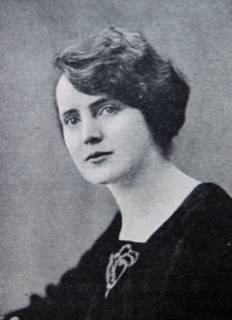
Alice Curtayne, Irish writer and lecturer, is born on November 6, 1898, in Upper Castle Street, Tralee, County Kerry.

Curtayne is the youngest child of John Curtayne, founder and proprietor of the Tralee Carriage Works, and his wife Bridget Curtayne (née O’Dwyer). She receives her initial education at local convents before attending La Sainte Union College in Southampton, England. Having taken a typing course, she is engaged as a secretary in Milan, where she remains for four and a half years. This proves to be a formative period in her life. She comes to regard Italy as a second home and is greatly influenced by the work of the Italian Catholic philosopher, Giovanni Papini.

On leaving Italy Curtayne works for a time in Liverpool. She joins the Liverpool Catholic Evidence Guild, from where she receives her diploma as a diocesan catechist. While in England she also develops an interest in public speaking. Her first book, Catherine of Siena (1929), is followed by numerous publications on religious and historical subjects, including Lough Derg (1933), Patrick Sarsfield (1934), The Trial of Oliver Plunkett (1953), Twenty Tales of Irish Saints for children (1955), and The Irish Story (1962).

Curtayne’s enthusiasm for Italy is reflected in her many publications of Italian interest, including a scholarly work on Dante, and a novel House of Cards (1940), which centres on the experiences of a young Irish woman living in Italy. In 1972 she produces Francis Ledwidge: A Life of the Poet, her well regarded biography of the poet Francis Ledwidge, and in 1974 it is followed by an edition of his complete poems, The Complete Works of Francis Ledwidge. Throughout her journalistic career she is a contributor to various magazines and papers, among them The Irish Times, Irish Independent, The Irish Press, Books on Trial, The Spectator, and The Standard.

During the 1950s and early 1960s Curtayne makes five lecture tours in the United States, speaking on Irish life, history, and literature. In 1959 she receives an honorary doctorate in Humane Letters from Anna Maria College in Paxton, Massachusetts, where she briefly teaches. She is presented with the Key to Worcester City by Mayor James D. O’Brien. She also gives a course of lectures on Dante at Craiglockhart College, Edinburgh, in 1956, and in 1965 she again speaks on Dante in a Radio Éireann Thomas Davis lecture.

In December 1954 The Irish Press sends Curtayne to Rome to write daily reports on the close of the Marian year. She goes to Rome again for the final session of the Second Vatican Council. She is commissioned to send weekly reports to local newspapers, The Nationalist (Carlow) and The Kerryman. She also sends a series of profiles of outstanding personages of this Vatican Council to The Universe and an article for Hibernia journal.

In 1935, Curtayne marries the English-born writer and broadcaster Stephen Rynne, with whom she has two sons and two daughters. They run a farm at Prosperous, County Kildare, and are well known advocates of the values of rural living. One son, Andrew Rynne, becomes a medical practitioner and well known for his liberal views on birth control. Daughter Brigid Rynne later illustrates some of her mother’s books.

Curtayne dies on August 9, 1981, in the Hazel Hall Nursing Home in Clane, County Kildare, and is buried at Killybegs Cemetery.


Leave a comment

Death of Francis Lenny, Roman Catholic Bishop

Francis Lenny, Irish Roman Catholic bishop in the last third of the 20th century, dies in Mullavilly, County Armagh, Northern Ireland, on July 16, 1978.

Lenny is born in Cookstown, County Tyrone, on September 27, 1928. He is educated at St. Patrick’s Grammar School, Armagh, and St. Patrick’s College, Maynooth. He is ordained priest for the Archdiocese of Armagh on June 21, 1953. Pursuing his studies in ancient classes and canon law in Maynooth and the Dunboyne Institute, in July 1955 he is named secretary to Cardinal John D’Alton, Primate of Ireland, and upon his death in 1963, proceeds in the same position with his successor, Cardinal William Conway.

Lenny is appointed parish priest in Mullavilly in 1972. Less than two years later he is named coadjutor bishop of Armagh, receiving his episcopal consecration with the titular see of Rotdon from Cardinal Conway on June 16, 1974. Financial secretary to the Bishops’ Financial and General Purposes Committee, upon Conway’s death, he becomes vicar capitular of the archdiocese until Tomás Ó Fiaich is named his successor.

Lenny is a well-known canonist, and it is he who transfers a major relic of Saint Oliver Plunkett from Downside Abbey to Ireland in 1975, and is presently preserved in Oldcastle, County Meath, Plunkett’s birthplace.

A man of great charity and deep disposition, Lenny experiences great opposition from members of the Protestant community of Mullavilly, refusing to leave the village despite threats he receives. His bungalow is maliciously set on fire, and he dies at the early age of forty-nine on July 16, 1978, the fourth anniversary of his episcopal consecration, from injuries received complicated by a heart attack. Dressed in chasuble and mitre, he is laid to rest in a simple solid oak coffin following the celebration of a Funeral Mass celebrated at St. Patrick’s Cathedral in Armagh, presided by Archbishop Ó Fiaich which sees the participation of thousands.


Leave a comment

Execution of Oliver Plunkett, Catholic Archbishop of Armagh

Oliver Plunkett (Irish: Oilibhéar Pluincéid), Catholic Archbishop of Armagh and Primate of All Ireland who is the last victim of the Popish Plot, is executed in Tyburn, London, England, on July 1, 1681. He is beatified in 1920 and canonised in 1975, thus becoming the first new Irish saint in almost seven hundred years.

Plunkett is born on November 1, 1625 (earlier biographers give his date of birth as November 1, 1629, but 1625 has been the consensus since the 1930s) in Loughcrew, County Meath, to well-to-do parents with Hiberno-Norman ancestors. A grandson of James Plunket, 8th Baron Killeen (c. 1542-1595), he is related by birth to a number of landed families, such as the recently ennobled Earls of Roscommon, as well as the long-established Earls of Fingall, Lords Louth, and Lords Dunsany. Until his sixteenth year, his education is entrusted to his cousin Patrick Plunkett, Abbot of St. Mary’s, Dublin, and brother of Luke Plunket, 1st Earl of Fingall, who later becomes successively Bishop of Ardagh and of Meath.

As an aspirant to the priesthood, Plunkett sets out for Rome in 1647, under the care of Father Pierfrancesco Scarampi of the Roman Oratory. At this time the Irish Confederate Wars are raging in Ireland. These are essentially conflicts between native Irish Catholics, English and Irish Anglicans and Nonconformists. Scarampi is the Papal envoy to the Catholic movement known as the Confederation of Ireland. Many of Plunkett’s relatives are involved in this organisation.

Plunkett is admitted to the Pontifical Irish College in Rome and proves to be an able pupil. He is ordained a priest in 1654 and deputed by the Irish bishops to act as their representative in Rome. Meanwhile, the Cromwellian conquest of Ireland (1649–53) had defeated the Catholic cause in Ireland. In the aftermath the public practice of Catholicism is banned, and Catholic clergy are executed. As a result, it is impossible for Plunkett to return to Ireland for many years. He petitions to remain in Rome and, in 1657, becomes a professor of theology. Throughout the period of the Commonwealth and the first years of Charles II‘s reign, he successfully pleads the cause of the Irish Catholic Church and also serves as theological professor at the College of Propaganda Fide. At the Congregation of Propaganda Fide on July 9, 1669, he is appointed Archbishop of Armagh, the Irish primatial see, and is consecrated on November 30 at Ghent by the Bishop of Ghent, Eugeen-Albert, count d’Allamont. He eventually sets foot on Irish soil again on March 7, 1670, as the Stuart Restoration of 1660 had begun on a basis of toleration. The pallium is granted him in the Consistory of July 28, 1670.

After arriving back in Ireland, Plunkett tackles drunkenness among the clergy, writing, “Let us remove this defect from an Irish priest, and he will be a saint.” The Penal Laws had been relaxed in line with the Declaration of Breda in 1660 and he is able to establish a Jesuit College in Drogheda in 1670. A year later 150 students attend the college, no fewer than 40 of whom are Protestant, making this college the first integrated school in Ireland. His ministry is a successful one and he is said to have confirmed 48,000 Catholics over a four-year period. The government in Dublin, especially under the Lord Lieutenant of Ireland, James Butler, 1st Duke of Ormond (the Protestant son of Catholic parents), extend a generous measure of toleration to the Catholic hierarchy until the mid-1670s.

On the enactment of the Test Act in 1673, to which Plunkett does not agree for doctrinal reasons, the college is closed and demolished. He goes into hiding, travelling only in disguise, and refuses a government edict to register at a seaport to await passage into exile. For the next few years, he is largely left in peace since the Dublin government, except when put under pressure from the English government in London, prefer to leave the Catholic bishops alone.

In 1678 the so-called Popish Plot, concocted in England by clergyman Titus Oates, leads to further anti-Catholic action. Archbishop of Dublin Peter Talbot is arrested, and Plunkett again goes into hiding. Despite being on the run and with a price on his head, he refuses to leave his flock. He is arrested in Dublin on December 6, 1679, and imprisoned in Dublin Castle, where he gives absolution to the dying Talbot. He is tried at Dundalk for conspiring against the state by allegedly plotting to bring 20,000 French soldiers into the country, and for levying a tax on his clergy to support 70,000 men for rebellion. Though this is unproven, some in government circles are worried about the possibility that a repetition of the Irish Rebellion of 1641 is being planned and, in any case, this is a convenient excuse for proceeding against Plunkett.

Plunkett is found guilty of high treason in June 1681 “for promoting the Roman faith,” and is condemned to death. Numerous pleas for mercy are made but Charles II, although himself a reputed crypto-Catholic, thinks it too politically dangerous to spare Plunkett.

Plunkett is hanged, drawn and quartered at Tyburn on July 1, 1681, the last Catholic martyr to die in England. His body is initially buried in two tin boxes, next to five Jesuits who had died previously, in the courtyard of St. Giles in the Fields church. The remains are exhumed in 1683 and moved to the Benedictine monastery at Lamspringe, near Hildesheim in Germany. The head is brought to Rome, and from there to Armagh, and eventually to Drogheda where since June 29, 1921, it has rested in St. Peter’s Roman Catholic Church. Most of the body is brought to Downside Abbey, England, where the major part is located today, with some parts remaining at Lamspringe. On the occasion of his canonization in 1975 his casket is opened, and some parts of his body given to the St. Peter’s Church in Drogheda.


Leave a comment

Birth of William John Conway, Cardinal of the Roman Catholic Church

William John Cardinal Conway, Irish cardinal of the Roman Catholic Church who serves as Archbishop of Armagh and Primate of All Ireland from 1963 until his death, is born on January 22, 1913, in Belfast.

Conway is the eldest of four sons and five daughters of Patrick Joseph Conway and Annie Conway (née Donnelly). His father, a self-employed housepainter, also has a paint shop in Kent Street off Royal Avenue. His mother, who survives her son, is born in Carlingford, County Louth. He attends Boundary Street Primary School, St. Mary’s CBS (now St. Mary’s CBGS Belfast). His academic successes are crowned by a scholarship to Queen’s University Belfast. He decides to study for the diocesan priesthood. In 1933 he is conferred with an honours BA in English literature and goes on to read a distinguished course in theology at St. Patrick’s College, Maynooth.

Conway is ordained on June 20, 1937, and awarded a DD (1938). On November 12, 1938, he enters the Pontifical Irish College in Rome, and in 1941 he receives the DCL degree at the Pontifical Gregorian University. When Italy enters World War II in June 1940, he returns to Belfast to take up duty in the Diocese of Down and Connor. He is appointed to teach English and Latin in St. Malachy’s College in Belfast, but after one year he is named professor of moral theology and canon law in Maynooth. He contributes regular ‘Canon law replies’ to the Irish Ecclesiastical Record, which are later collected as Problems in canon law (1950), the only book published by him.

In 1957 Conway becomes vice-president of Maynooth, and in 1958, he is named Ireland’s youngest bishop, Titular Bishop of Neve, and auxiliary bishop to Cardinal John D’Alton, Archbishop of Armagh and Primate of All Ireland. He is consecrated in St. Patrick’s Cathedral, Armagh on July 27, 1958. He serves as administrator of St. Patrick’s Church, Dundalk, for the next five years, gaining valuable pastoral experience, and also uses these years to familiarise himself with his new diocese, especially its geography. On the death of D’Alton, he is chosen to succeed him in September 1963, and is enthroned on September 25 in St. Patrick’s Cathedral, Armagh by the apostolic nuncio, Archbishop Sensi. At the end of 1964, Pope Paul VI chooses him as Ireland’s seventh residential cardinal, and he receives the red hat in the public consistory of February 22, 1965.

The thirteen-odd years of Conway’s ministry as primate are dominated firstly by the Second Vatican Council and secondly by the Troubles in Northern Ireland. His primary concern is the church, to steer it through testing times. He is a very active bishop in a diocese of 160,000 Catholics, with fifty-seven parishes and some 167 priests. He carries the burden alone until 1974 when he is given an auxiliary in the person of his secretary, Fr. Francis Lenny (1928–78). Two new parishes are created, five new churches are built, and many others are renovated to meet the requirements of liturgical reform. Twenty new schools are also provided. He attends all four sessions of the Vatican council (1962–65), as auxiliary bishop and as primate. On October 9, 1963, he addresses the assembly, making a plea that the council might not be so concerned with weightier matters as to neglect to speak about priests. He also makes contributions on the topics of mixed marriages, Catholic schools, and the laity. On the topic of education, he is convinced that integrated schools will not solve Northern Ireland’s problems.

Conway represents the Irish Catholic Bishops’ Conference at each assembly of the Synod of Bishops in Rome, at first with Bishop Michael Browne of the Diocese of Galway and Kilmacduagh, his former professor in Maynooth, and later with the Archbishop of Dublin, Dermot Ryan. With Cardinals Jean-Marie Villot and Pericle Felici, he is chairman of the first synod in 1969, a signal honour conferred on him by Pope Paul VI. He addresses the assembly, opposing the ordination of married men as a move that would release a flood of applications from around the world for dispensations from priestly celibacy. His experience of violence in Northern Ireland is reflected in contributions he makes to later synod assemblies, especially in 1971 and 1974.

Apart from the synod, Conway travels a few times each year to Rome for meetings of the three Roman congregations on which he is called to serve (those of bishops, catholic education, and the evangelisation of peoples) and the commission for the revision of the code of canon law. He also travels further afield in a representative capacity to the International Eucharistic Congress at Bogotá, also attended by Pope Paul VI, and to Madras (1972), where he acts as papal legate for the centenary celebrations in honour of St. Thomas. In 1966 he is invited by the bishops of Poland to join in celebrations for the millennium of Catholicism in that country but is refused an entry visa by the Polish government. In January 1973 he feels obliged to forgo participation in the Melbourne eucharistic congress because of the troubled situation at home. Within Ireland he accepts invitations to become a freeman of Cork and Galway (1965) and of Wexford (1966). In 1976 the National University of Ireland (NUI) confers on him an honorary LL.D.

Conway is acknowledged as an able and diligent chairman of the Irish Catholic Bishops’ Conference. The core problem in the early years is how to lead the Irish church into the difficult new era that follows the council. He shows exceptional leadership qualities in the manner in which he promotes firm but gentle progress, avoiding sudden trauma and divisions. A major event in his term as Archbishop of Armagh, and one that gives him much satisfaction, is the canonization of Oliver Plunkett, his martyred predecessor, in the holy year 1975. He follows with great interest the final stages of the cause from 1968 and is greatly disappointed when grounded by his doctors six weeks before the event. He does however take part, concelebrating with Pope Paul VI at the ceremony on October 12, 1975. He also presides the following evening at the first mass of thanksgiving in the Lateran Basilica, receiving a tumultuous applause from the thousands of Irish present.

More than anything else, the Troubles in Northern Ireland occupy Conway during the second half of his term as archbishop and primate. He is the leading spokesman of the Catholic cause but never fails to condemn atrocities wherever the responsibility lay. He brands as ‘monsters’ the terrorist bombers on both sides. In 1971 he denounces internment without trial, and the following year he is mainly responsible for highlighting the ill-treatment and even torture of prisoners in Northern Ireland. He repudiates the idea that the conflict is religious in nature, emphasising its social and political dimensions, and is openly critical of the British government over conditions in Long Kesh Detention Centre, and of ‘the cloak of almost total silence’ surrounding violence against the Catholic community.

In January 1977 Conway undergoes surgery in a Dublin hospital, and almost immediately comes to know that he is terminally ill. It is the best-kept secret in Ireland until close to the end. On March 29, he writes to his fellow bishops informing them that the prognosis regarding his health is ‘not good, in fact . . . very bad,’ and that he is perfectly reconciled to God’s will. He is still able to work at his desk until Good Friday, April 8, 1977.

Conway dies in Armagh on Low Sunday night, April 17, 1977. Seven countries are represented at his funeral by six cardinals and many bishops. The apostolic nuncio, the bishops of Ireland, the president and Taoiseach, six Irish government ministers, and the Secretary of State for Northern Ireland are also among the mourners. The cardinal is laid to rest in St. Patrick’s Cathedral Cemetery, Armagh. The red hat received from Pope Paul VI is suspended from the ceiling of the Lady chapel, joining those of his four immediate predecessors.

(From: “Conway, John William,” Dictionary of Irish Biography, http://www.dib.ie, contributed by J. J. Hanley)


Leave a comment

The Arrest of Oliver Plunkett, Archbishop of Armagh

Oliver Plunkett, Catholic Archbishop of Armagh and Primate of All Ireland, is accused of instigating the Popish Plot and arrested on December 6, 1679. He is the last victim of the Popish Plot.

Plunkett is born on November 1, 1625, in Loughcrew, County Meath, to parents of Hiberno-Norman ancestors. Until his sixteenth year, his education is entrusted to his cousin Patrick Plunkett, Abbot of St. Mary’s, Dublin, and brother of Luke Plunkett, 1st Earl of Fingall, who later becomes successively Bishop of Ardagh and of Meath. As an aspirant to the priesthood, he sets out for Rome in 1647.

Plunkett is admitted to the Pontifical Irish College in Rome and proves to be an able pupil. He is ordained a priest in 1654 and deputed by the Irish bishops to act as their representative in Rome. Meanwhile, the Cromwellian conquest of Ireland (1649–1653) has defeated the Roman Catholic cause in Ireland. As a result, it is impossible for Plunkett to return to Ireland for many years, so he petitions to remain in Rome. At the Congregation of Propaganda Fide on July 9, 1669, he is appointed Archbishop of Armagh and is consecrated on November 30 at Ghent. He returns to Ireland on March 7, 1670, as the English Restoration of 1660 has begun on a basis of toleration.

Plunkett sets about reorganising the ravaged Roman Church and builds schools both for the young and for clergy. The Penal Laws have been relaxed in line with the Declaration of Breda in 1660 and he is able to establish a Jesuit College in Drogheda in 1670, which becomes the first Catholic-Protestant integrated school in Ireland.

On the enactment of the Test Act in 1673, to which Plunkett does not agree for doctrinal reasons, the college is closed and demolished. Plunkett goes into hiding, traveling only in disguise, and refuses a government edict to register at a seaport to await passage into exile.

In 1678 the so-called Popish Plot, concocted in England by clergyman Titus Oates, leads to further anti-Roman Catholic action. Archbishop Peter Talbot of Dublin is arrested, and Plunkett again goes into hiding. Despite being on the run and with a price on his head, he refuses to leave his flock.

Plunkett is arrested in Dublin on December 6, 1679, and imprisoned in Dublin Castle. He is tried at Dundalk for conspiring against the state by allegedly plotting to bring 20,000 French soldiers into the country, and for levying a tax on his clergy to support 70,000 men for rebellion. The trial soon collapses as the prosecution witnesses are themselves wanted men and afraid to appear in court. Plunkett is moved to Newgate Prison in London in order to face trial at Westminster Hall. The first grand jury finds no true bill, but he is not released. The second trial is generally regarded as a serious miscarriage of justice as Plunkett is denied defending counsel.

Archbishop Plunkett is found guilty of high treason in June 1681 “for promoting the Roman faith,” and is condemned to death. Plunkett is hanged, drawn, and quartered at Tyburn on July 1, 1681, the last Roman Catholic martyr to die in England. His body is initially buried in two tin boxes in the courtyard of St. Giles in the Fields church. The remains are exhumed in 1683 and moved to the Benedictine monastery at Lamspringe, near Hildesheim in Germany. His head is brought to Rome, and from there to Armagh, and eventually to Drogheda where it has rested in St. Peter’s Church since June 29, 1921. Most of the body is brought to Downside Abbey, England, where the major part is located today, with some parts remaining at Lamspringe.

Sir Oliver Plunkett is canonised in Rome by Pope Paul VI on October 12, 1975, the first new Irish saint in almost seven hundred years, and the first of the Irish martyrs to be beatified. For the canonisation, the customary second miracle is waived.


Leave a comment

Birth of Mairéad Ní Mhaonaigh, Irish Fiddler & Vocalist

Compressed by jpeg-recompress

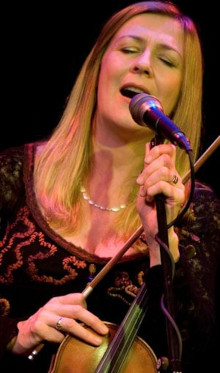
Mairéad Ní Mhaonaigh, Irish fiddler and lead vocalist for the Irish traditional music band Altan, is born on July 26, 1959 in Gweedore, County Donegal, where Gaeilge is her primary language and she learns her songs and tunes from her family and neighbours.

Ní Mhaonaigh’s father, Proinsias Ó Maonaigh, is a noted fiddler, song writer and school teacher and is her first main influence. Her mother, Kitty Rua is also raised in a musical house that holds frequent house dances. It is no surprise that she and her siblings, Gearóid and Anna, all play music together.

In the early 1980s, Ní Mhaonaigh qualifies as a Primary school teacher and teaches in Saint Oliver Plunkett National School in Malahide, County Dublin. She and her husband, Frankie Kennedy, record Ceol Aduaidh (Music from the North) for Irish label Gael Linn in 1983. This timeless recording is the genesis of what later becomes Altan. The recording features her brother Gearóid Ó Maonaigh on guitar, Fintan Mc Manus on bouzouki, Ciaran Curran on bouzouki and Eithne Ní Bhraonáin (now known as Enya) on keyboards. The album quietly gains praise among enthusiasts of traditional Irish music worldwide, which leads the way for a career in music.

Ní Mhaonigh’s teaching career comes to a halt after she and her husband take a career break in 1987 and formed Altan. The band goes on to become one of the most acclaimed Irish traditional bands touring the world. They record for Green Linnet Records in the United States and tour North America extensively.

In 1994, Frankie Kennedy passes away to cancer, which is a tremendous loss to Ní Mhaonigh. She continues with the band at her late husband’s request and signs to multinational record label Virgin Records London in late 1994. This marks the first traditional Irish band to be signed to a major record label and propels Altan and Ní Mhaonigh into a wider audience of followers.

Altan travels all over the world headlining shows from Tokyo, the Sydney Opera House, the Hollywood Bowl to the National Concert Hall, Dublin.

Ní Mhaonaigh, along with fronting Altan, remains close her roots between touring and returns to her native County Donegal to play, sing and teach her music to a new generation. She helps set up Cairdeas na bhFidléirí (The Fellowship / Friendship of Fiddlers) in the early 1980s to promote and preserve the fiddle music of County Donegal.

In 2009, Ní Mhaonaigh releases her first solo album, Imeall (Edge/Theshold), as a limited edition. After many years of playing with the band and numerous requests for a solo recording she finally gets time to record the album after parting with her second husband Dermot Byrne, with whom she has her daughter Nia. She tours the album between Altan commitments with her co-producer and recording engineer Manus Lunny.

The album prompts one reviewer, Paul O’Connor, to remark, “Her identified success as the leader of Altan has dominated our sense of her to the point that we aren’t cognisant of how good she is as an artist, musician, composer in her own right.”

This new focus on Ní Mhaonaigh as an artist in her own right, prompts The Donegal Association in Dublin to grant her “Donegal Person of the Year 2009” at a gala dinner in Dublin’s prestigious Burlington Hotel.

Ní Mhaonaigh is awarded the top recognition in traditional Irish music by her fellow peers in 2018, when she is awarded TG4 Gradam Ceoil’s Traditional Musician of the Year. The following year, she is honoured in her own county at the now world famous “Cup o’Tae Festival” which is held annually in Ardara, County Donegal.

Ní Mhaonaigh is also a member of String Sisters, which is a Grammy listed folk supergroup of six of the world’s leading female fiddlers. Together they have released two albums – the Grammy-longlisted Live and Between Wind and Water. She is a member of T with the Maggies, which is a vocal supergroup of Donegal singers comprised of Maighread and Tríona Ní Dhomhnaill and Moya Brennan of Clannad fame.

Recently Ní Mhaonaigh has recorded with a group of thirteen County Donegal-based female fiddlers which is called ‘SíFiddlers.’

(From: Mairéad Ní Mhaonaigh’s website, http://www.mairead.ie)