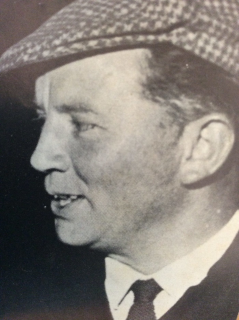
In October 1964, during the general election campaign, a photo of McMillen is placed in the window of the election office in Divis Street flanked on one side by the Starry Plough flag and on the other by the tricolour. His campaign draws national attention after Ian Paisley demands that police remove the tricolour from McMillen’s election offices. The RUC raids the premises and confiscates the flag, sparking several days of rioting during which McMillen leads several thousand protesters in defiantly displaying the tricolour. He recalls the IRA gaining a “couple of dozen recruits” following the election, but he finishes at the bottom of the poll with 3,256 votes (6%). Around this time, he succeeds Billy McKee as the Officer commanding (OC) of the Belfast Brigade.
McMillen is keen to work for the unity of Protestant and Catholic workers. Roy Garland recalls that McMillan’s grandfather was master of an Orange lodge in Edinburgh and McMillan knew of that heritage and the meaning of the colours of the Irish flag. He prominently displays in his election offices a verse of a poem by John Frazier, a Presbyterian from County Offaly: “Till then the Orange lily be your badge my patriot brother. The everlasting green for me and we for one and other.”
In 1967, McMillen is involved in the formation of the Northern Ireland Civil Rights Association (NICRA) and is a member of a three-man committee which draws up the Association’s constitution. The NICRA’s peaceful activities result in violent opposition from many unionists, leading to fears that Catholic areas will come under attack. In May 1969, when asked at an IRA army council meeting by Ruairí Ó Brádaigh how many weapons the Belfast Brigade has for defensive operations, McMillen states they have only one pistol, a machine gun and some ammunition.
By August 14, 1969, serious rioting has broken out in Belfast and Catholic districts come under attack from both civilian unionists and the RUC. McMillen’s IRA command by this point still has only a limited number of weapons because the leadership in Dublin are reluctant to release guns. While he is involved in some armed actions on this day, he is widely blamed by those who established the Provisional IRA for the IRA’s failure to adequately defend Catholic neighbourhoods from Ulster loyalist attack. He is arrested and temporarily detained by the RUC on the morning of August 15 but is released shortly afterward.
McMillen’s role in the 1969 riots is very important within IRA circles, as it is one of the major factors contributing to the split in the movement in late 1969. In a June 1972 lecture organised by Official Sinn Féin in Dublin, he defends his conduct, stating that by 1969 the total membership of the Belfast IRA is approximately 120 men, and their armaments have increased to a grand total of 24 weapons, most of which are short-range pistols.
In September, McMillen calls a meeting of IRA commanders in Belfast. Billy McKee and several other republicans arrive at the meeting armed and demand McMillen’s resignation. He refuses, but many of those unhappy with his leadership break away and refuse to take orders from him or the Dublin IRA leadership. Most of them join the Provisional Irish Republican Army, when this group splits off from the IRA in December 1969. McMillen himself remains loyal to the IRA’s Dublin leadership, which becomes known as the Official IRA. The split rapidly develops into a bitter rivalry between the two groups. In April 1970, he is shot and wounded by Provisional IRA members in the Lower Falls area of Belfast.
In June 1970, McMillen’s Official IRA have their first major confrontation with the British Army, which had been deployed to Belfast in the previous year, in an incident known as the Falls Curfew. The British Army mounts an arms search in the Official IRA stronghold of the Lower Falls, where they are attacked with a grenade by Provisional IRA members. In response, the British flood the area with troops and declare a curfew. This leads to a three-day gun battle between 80 to 90 Official IRA members led by McMillen and up to 3,000 British troops. Five civilians are killed in the fighting and about 60 are wounded. In addition, 35 rifles, 6 machine guns, 14 shotguns, grenades, explosives and 21,000 rounds of ammunition, all belonging to the OIRA, are seized. McMillen blames the Provisionals for instigating the incident and then refusing to help the Officials against the British.
This ill-feeling eventually leads to an all-out feud between the republican factions in Belfast in March 1971. The Provisionals attempt to kill McMillen again, as well as his second-in-command, Jim Sullivan. In retaliation, McMillen has Charlie Hughes, a young PIRA member, killed. Tom Cahill, brother of leading Provisional Joe Cahill, is also shot and wounded. After these deaths, the two IRA factions in Belfast negotiate a ceasefire and direct their attention instead at the British Army.
When the Northern Ireland authorities introduce internment in August 1971, McMillen flees Belfast for Dundalk in the Republic of Ireland, where he remains for several months. During this time, the Official IRA carries out many attacks on the British Army and other targets in Northern Ireland. However, in April 1972, the organisation in Belfast is badly weakened by the death of their commander in the Markets area, Joe McCann. In May of that year, the Dublin leadership of the OIRA calls a ceasefire, a move which McMillen supports. Nevertheless, in the year after the ceasefire, his command kills seven British soldiers in what they term “retaliatory attacks.” McMillen serves on the Ard Chomhairle (leadership council) of Official Sinn Féin.
By 1974, a group of OIRA members around Seamus Costello are unhappy with the ceasefire. In December 1974, they break away from the Official movement, forming the Irish Republican Socialist Party (IRSP) and the Irish National Liberation Army (INLA). Some OIRA members under McMillen’s command, including the entire Divis Flats unit, defect to the new grouping. This provokes another intra-republican feud in Belfast. The feud begins with arms raids on OIRA dumps and beatings of their members by the INLA. McMillen, in response is accused of drawing up a “death list” of IRSP/INLA members and even of handing information on them over to the loyalist Ulster Volunteer Force (UVF).
The first killing comes on February 20, 1975, when the OIRA shoot dead an INLA member named Hugh Ferguson in west Belfast. A spate of shootings follows on both sides.
On April 28, 1975, McMillen is shot dead by INLA member Gerard Steenson, as he is shopping in a hardware shop on Spinner Street with his wife Mary. He is hit in the neck and dies at the scene. His killing is unauthorised and is condemned by INLA/IRSP leader Seamus Costello. Despite this, the OIRA tries to kill Costello on May 9, 1975, and eventually kills him two years later. McMillen’s death is a major blow to the OIRA in Belfast.
Muldoon, the eldest of three children, is born on June 20, 1951, on a farm in County Armagh, Northern Ireland, outside The Moy, near the boundary with County Tyrone. His father works as a farmer (among other jobs) and his mother is a school mistress. In 2001, Muldoon says of the Moy:
“It’s a beautiful part of the world. It’s still the place that’s ‘burned into the retina,’ and although I haven’t been back there since I left for university 30 years ago, it’s the place I consider to be my home. We were a fairly non-political household; my parents were nationalists, of course, but it was not something, as I recall, that was a major area of discussion. But there were patrols; an army presence; movements of troops; and a sectarian divide. And that particular area was a nationalist enclave, while next door was the parish where the Orange Order was founded; we’d hear the drums on summer evenings. But I think my mother, in particular, may have tried to shelter us from it all. Besides, we didn’t really socialise a great deal. We were ‘blow-ins’ – arrivistes – new to the area, and didn’t have a lot of connections.”
Talking of his home life, Muldoon continues, “I’m astonished to think that, apart from some Catholic Truth Society pamphlets, some books on saints, there were, essentially, no books in the house, except one set, the Junior World Encyclopedia, which I certainly read again and again. People would say, I suppose that it might account for my interest in a wide range of arcane bits of information. At some level, I was self-educated.” He is a “Troubles poet” from the beginning.
In 1969, Muldoon reads English at Queen’s University Belfast (QUB), where he meets Seamus Heaney and becomes close to the Belfast Group of poets which include Michael Longley, Ciaran Carson, Medbh McGuckian and Frank Ormsby. He says of the experience, “I think it was fairly significant, certainly to me. It was exciting. But then I was 19, 20 years old, and at university, so everything was exciting, really.” He is not a strong student at QUB. He recalls, “I had stopped. Really, I should have dropped out. I’d basically lost interest halfway through. Not because there weren’t great people teaching me, but I’d stopped going to lectures, and rather than doing the decent thing, I just hung around.” During his time at QUB, his first collection New Weather (1973) is published by Faber & Faber. He meets his first wife, fellow student Anne-Marie Conway, and they are married after their graduation in 1973. The marriage breaks up in 1977.
For thirteen years (1973–86), Muldoon works as an arts producer for the BBC in Belfast. In this time, which sees the most bitter period of the Troubles, he published the collections Why Brownlee Left (1980) and Quoof (1983). After leaving the BBC, he teaches English and Creative Writing at the University of East Anglia and at Gonville and Caius College and Fitzwilliam College, Cambridge, where his students include Lee Hall (Billy Elliot) and Giles Foden (The Last King of Scotland). In 1987, he emigrates to the United States, where he teaches in the creative writing program at Princeton University. He is Professor of Poetry at Oxford University for the five-year term 1999–2004, and is an Honorary Fellow of Hertford College, Oxford.
A series of riots in Dublin on February 25, 2006, is precipitated by a proposed march down O’Connell Street of a unionist demonstration. The disturbances begin when members of the Garda Síochána attempt to disperse a group of counterdemonstrators blocking the route of the proposed march. The situation escalates as local youths join forces with the counterdemonstrators.
The march of this group in Dublin is viewed as provocative by some Irish nationalists and many Irish republicans, particularly in the context of an Orange Order march. The Orange Order is accused of being a sectarian organisation known for its anti-Catholicism. The right to march is supported by the main Irish political parties and the march is authorised by the Garda Síochána. Love Ulster had organised a similar rally in Belfast in October 2005.
At previous FAIR rallies, a picture of an Ulster Volunteer Force (UVF) member who was allegedly involved in the murder of 26 people in Dublin in the 1974 Dublin and Monaghan bombings, and who was himself killed by the Provisional Irish Republican Army in 1976, had been displayed. An organiser of the Love Ulster demonstration tells a republican newspaper that he cannot guarantee that images of the murder suspect will not be displayed during the demonstration.
Sinn Féin, an Irish republican political party, does not organise a protest and says that the march should be allowed to go ahead, calling for republicans to ignore the march. Republican Sinn Féin, a splinter political party no longer affiliated with Sinn Féin, has an organised presence.
Their protest blocks the northeastern junction of O’Connell Street and Parnell Street. The small Republican Sinn Féin group (and some activists from the Irish Republican Socialist Party) are joined by several hundred local youths. Before the violence breaks out, they chant republican chants. Several thousand bystanders are also on the scene but take no part in the subsequent rioting. When the marchers form up at the top of Parnell Square and their bands begin to play in anticipation of the start of the march, gardaí attempt to disperse the protest at around 12:45 p.m. At this point, scuffles break out between protesters and Gardaí.
After the failure of the initial garda effort to disperse the protesters, the violence escalates. The Garda Public Order Unit is deployed, and stones and metal railings are thrown at gardaí by protesters, as are fireworks, bricks, crude petrol bombs, and other missiles. As the rioting continues, the ranks of the rioters are swelled by many local teenagers who had not taken part in the initial protest. Several barricades are constructed from building materials on the street to impede the march and the Gardaí. The march is due to start at 12:30 p.m., but as the violence goes on the gardaí decide against trying to escort the marchers through O’Connell Street. At about 1:30 p.m. the assembled marchers return to the coaches that had brought them to Dublin from Northern Ireland. The three coaches are then driven to Leinster House, where a small parade is carried out, and a letter is handed to Irish Minister for Justice, Michael McDowell. They are then escorted out of the city. One of the coaches is attacked by stone throwers on the way home.
Violence continues sporadically on O’Connell Street for another hour or so. The Gardaí, advancing from the northern end of the street gradually push the rioters back southward. The most sustained violence takes place around the General Post Office building, where the rioters initially sit down in protest and then, after several of them have been batoned, regroup behind burning barricades and throw rocks, paving slabs and one or possibly two petrol bombs at Gardaí. Several Gardaí, protesters and a number of journalists from RTÉ and TV3 are injured.
While the standoff on O’Connell Street is still going on, several hundred rioters follow the Unionist coaches to the Nassau Street area where they set a number of cars on fire and damage several businesses. Further skirmishes break out around the River Liffey at O’Connell Bridge, Aston Quay, Fleet Street and Temple Bar, as the Gardaí retake O’Connell street, before the rioters disperse.
Having dispersed the rioters, the gardaí then closes O’Connell Street to facilitate a cleanup of the scene by building workers. Media reports estimate the cost of the cleanup job at €50,000, and Dublin Chamber of Commerce places loss of earnings for businesses in the city due to the riots at €10,000,000.
Estimates for the number of unionist marchers before the event are predicted to be over 1,000. However, only eight coach loads turn up in Dublin, indicating a far smaller number, possibly 300 to 400. Estimates for the number of counterdemonstrators vary between 300 and 7,000. The number is made much more difficult to determine by the presence of the several thousand bystanders at the scene who do not take part. Most of the rioters appear to be local youths, though some who brandished leaflets and other political literature are clearly political activists.
A total of 14 people, including six gardaí and a small number of journalists and photographers, are hospitalised as a result of the rioting. A further 41 people are arrested, according to RTÉ news. As of February 27, 2006, thirteen have been charged. Twenty-six people are convicted in January 2009 for their part in the disturbances and given sentences of up to five years. Two are described as “alcoholics.” One of them and a teenage boy are “homeless.” Three are not Irish – a Georgian, a Romanian and a Moldovan are convicted of looting shops on O’Connell Street. Two have travelled from County Offaly, one from County Galway and one from County Donegal for the riot. All the rest come from Dublin.
(Pictured: The Public Order Unit on O’Connell Street during the 2006 Dublin Riots)
David Patrick Moran (Irish: Dáithí Pádraig Ó Móráin), better known as simply D. P. Moran, Irish journalist, activist and cultural-political theorist, dies on January 31, 1936. He is known as the principal advocate of a specifically Gaelic CatholicIrish nationalism during the early 20th century. Associated with the wider Celtic Revival, he promotes his ideas primarily through his journal, The Leader, and compilations of his articles such as the book The Philosophy of Irish Ireland.
Moran is born in Manor, a townland in Waterford, the youngest of twenty children born to James Moran, a builder, and Elizabeth Moran (née Casey). One of his brothers goes on to serve on the defense team of Patrick O’Donnell.
Despite the failure of the 1893 Home Rule Bill and the division of the Irish Parliamentary Party (IPP) in 1891, nationalists take heart from Douglas Hyde‘s 1892 speech, entitled “The Necessity for De-anglicising Ireland.” Moran builds upon this thesis and provides a wider ideology for enthusiasts, particularly after the re-unification of most of the nationalist parties from 1900.
In his 1905 text The Philosophy of Irish-Ireland, Moran argues that to be Irish requires:
the use of the Irish language
membership in the Roman Catholic Church
an anti-materialist outlook on life
the playing of only Gaelic games
Though a sponsor of the use of Irish, he never becomes fluent in the language himself. He emphasises the use of English in 1908–09 as “an active, vigilant, and merciless propaganda in the English language.” In the longer term, when Irish becomes again the language of the people, its use enables a de facto censorship of any foreign and unwelcome ideas written in English.
While Moran argues that the idea of “the Gael” is one that can assimilate others, he also feels that it will be hard if not impossible for members of the Church of Ireland who support the British Empire to ever qualify as Irish, being “resident aliens.” This extends to Anglo-Irish literature. He rejects the Abbey Theatre and questions Yeats‘ genius. He once speaks out against the influence Britain has over Irish Universities, stating, “We are all Palemen now.” In the matter of religious differences, Daniel O’Connell had said in 1826 that “the [Roman] Catholics of Ireland are a nation.” Moran moves beyond that, affirming in 1901 that “…the Irish Nation is de facto a Catholic nation.” He is virulent in his opposition to female suffrage.
Moran’s articles frequently contrast “Belfast” with “Ireland,” yet hope that Belfast can eventually change and assimilate. He feels that Ulster unionists should “… be grateful to the Irish nation for being willing to adopt them.” His paper publishes numerous articles by the future TDArthur Clery (writing under the pen name “Chanel”), who advocates partition on the grounds that Ulster unionists are a separate nation, but Moran himself disagrees and refuses to concede the legitimacy of a northern Protestant identity.
When Irish republicans initiate the Irish War of Independence in 1919, widescale anti-Catholic rioting breaks out in Belfast in 1920 and 1922. Moran identifies this as being caused by Orangeism, which he describes as “a sore and a cancer” in Ireland. He also alleges that “bigotry on the part of Catholics in the Six Counties is immediately due to Orange bigotry.”
Moran is initially a supporter of the Irish Parliamentary Party, believing that the separatism advocated by Arthur Griffith‘s Sinn Féin is impracticable; however, he opposes John Redmond‘s support of the British World War I effort.
Moran supports the Anglo-Irish Treaty agreed in 1921–22 and sees the partition of Ireland as beneficial for a truly Irish culture in the Irish Free State. This causes a sea-change in his opinions; from now on Northern Ireland can be safely ignored, along with what he sees as the English evils of “free thought, free trade, and free literature.” He claims Irish life and culture has to be protected from foreign influences, including the twin evils of the music hall and the English press. The new jazz music of the 1920s and other imported cultural elements are deprecated as “imported debasement and rot.”
On January 9, 1901, Moran marries Theresa Catherine, daughter of Thomas Francis O’Toole, a former Parnellite mayor of Waterford. They have four sons and one daughter.
Moran dies suddenly at his home in Skerries, Dublin, on January 31, 1936. His daughter, Nuala, who has written for the paper since the early 1920s, generally on artistic and social matters, takes over the running of the paper on his death, though it is then much diminished in size and influence. Nuala, who never marries, retains control of The Leader until it ceases publication in 1971.
Jameson is born in Portadown to a ProtestantChurch of Ireland family in about 1953, one of five sons. He has a twin brother, Stuart. A former reservist in the Royal Ulster Constabulary (RUC) (1973-81), he works as a manager in the Jameson Group, a building firm which is a family-owned business. The building firm is regularly awarded government contracts to carry out work for the security forces and it is for this reason that his brother David loses a leg in a 1991 Provisional Irish Republican Army bombing attack. He is a member of the Orange Order‘s Drumherriff Star of Erin LOL 8 Portadown district.
It is not known exactly when Jameson becomes a member of the Ulster Volunteer Force (UVF) nor the leader of its Mid-Ulster Brigade. The Portadown unit of the Mid-Ulster Brigade had been officially stood down by the Brigade Staff in Belfast in August 1996 when it carried out an unauthorised sectarian killing while the UVF were on ceasefire. The Mid-Ulster Brigade’s commander at the time, Billy Wright, was expelled from the UVF. Wright brazenly defies a Combined Loyalist Military Command (CLMC) order to leave Northern Ireland or face execution by establishing the breakaway Loyalist Volunteer Force (LVF), taking most of the Portadown Mid-Ulster UVF with him. The units of the Mid-Ulster Brigade that remain loyal to the Brigade Staff continue to operate and Jameson becomes commander. He is said by The Guardian to be a “staunch supporter of the Good Friday Agreement.”
In the weeks prior to his killing, Jameson is in a violent street altercation with LVF member Muriel Gibson, whom he accuses of involvement in drugs and slaps forcefully in the face. This is followed by a fracas at the Portadown F.C. Social Club on December 27, 1999, where LVF members are commemorating the death of their comrade Billy Wright, shot and killed inside the Maze Prison by the Irish National Liberation Army (INLA) exactly two years previously. When he enters the club, several LVF men begin to push and jostle him and challenge him to a fight, telling him to hit them instead of women. Deeply offended, he leaves and soon returns with a UVF gang armed with pickaxe handles and baseball bats. In the violent brawl that ensues, twelve people, including three LVF prisoners out on Christmas parole, receive severe injuries. The LVF leaders subsequently make the decision that Jameson is to pay for the attack with his life.
One of the LVF members, who lives near Dungannon, gets in touch with a family of north Belfast loyalists who had been members of the UVF but who had left after Wright’s expulsion. From these former UVF members the LVF obtains the gun with which to shoot Jameson. On the evening of January 10, 2000, Jameson returns from work and drives his Isuzu Trooper jeep into the driveway outside his home on the Derrylettiff Road near Portadown. Waiting in ambush, a single gunman suddenly approaches from the passenger side of the parked jeep. Before Jameson can emerge from the vehicle and with the engine still running, the gunman opens fire through the window with a 9mm semi-automatic pistol, shooting Jameson five times in the head and chest. His assassin escapes to a nearby getaway car. He is rushed to Craigavon Area Hospital but dies of his wounds minutes after his arrival. The RUC immediately begins a murder inquiry. Within hours of the killing, the UVF Brigade Staff convene an emergency meeting at “the Eagle,” their headquarters on the Shankill Road, where they compile a list of all those they believe to be involved in Jameson’s death and plan their retaliation against the LVF.
Among those who condemn the killing is Northern Ireland’s First MinisterDavid Trimble who releases the following statement: “This is exactly the sort of thing we thought we had finally put behind us. I’m shocked by the news.”
Jameson’s funeral is held on January 13 at the Tartaraghan Parish Church and attended by several thousand mourners including Progressive Unionist Party (PUP) leaders David Ervine and Billy Hutchinson. Drumcree Orangeman Harold Gracey and Gary McMichael, the son of slain Ulster Defence Association (UDA) brigadier John McMichael, also attend as does local politicians representing the Ulster Unionist Party (UUP) and Democratic Unionist Party (DUP). The service is officiated by Reverend David Hilliard who speaks out against vengeance and describes Jameson as a “man admired and loved by many” and who “had been so cruelly murdered.” He is buried in the adjacent churchyard.
Despite Reverend Hilliard’s pleas and LVF leader Mark “Swinger” Fulton‘s claim that his organisation had nothing to do with Jameson’s shooting, the UVF/LVF feud intensifies. In the immediate aftermath members of Jameson’s family are filmed angrily defacing LVF murals in Portadown. A month after his killing, two Protestant teenagers, Andrew Robb (19) and David McIlwaine (18), are savagely beaten and repeatedly stabbed to death in a country lane outside Tandragee, County Armagh by a local UVF gang. The young men, believed to have been LVF members, are targeted by their UVF killers after they leave a nightclub together in search of a party. However, neither teenager is part of any paramilitary organisation and only Robb had tenuous links to the LVF. It is reported in the Belfast Telegraph that according to court hearings Robb had made disparaging remarks about Jameson’s death. Two of the UVF men, Stephen Leslie Brown and Noel Dillon, are infuriated by the comments and afterward Brown drives the victims to Druminure Road where he, Dillon and another man carry out the double killing. One of Jameson’s brothers, Bobby, is among the mourners at David McIlwaine’s funeral. The West Belfast Brigade of the Ulster Defence Association, whose brigadier Johnny Adair is close to the LVF, briefly becomes involved in the feud after Adair attends Andrew Robb’s funeral and joins LVF members at the Drumcree conflict. After the UVF track down Jameson’s killer to the Oldpark area of Belfast and attempt to shoot him, he is taken away under the protection of the West Belfast Brigade. The tit-for-tat killings continue intermittently until 2005 when the UVF makes a final assault against the LVF, leaving four members dead and the LVF leadership with no alternative but to order its military units to permanently disband.
Jameson’s family has persistently denied that he was a UVF member. They maintain that he was a vigilante who was murdered in retaliation for the firm stand he had taken against drug dealing in the Portadown area. The late PUP leader David Ervine expressed the same opinion the day after the killing by stating, “Mr. Jameson had been murdered by drug dealers masquerading as loyalists because he had been a bulwark in his community against dealers.” Ervine also described him as having been a “fine and honourable man, widely respected in the community.” Northern Ireland security sources, however, have repeatedly named Jameson as the Mid-Ulster UVF commander. He is listed as a UVF member in the CAIN: Sutton Index of Deaths, an online University of Ulster-sponsored project which chronicles the Northern Ireland conflict. It also emerges that for several days prior to his killing, he had been working at the BallykinlerBritish Army base. Immediately after his murder by the LVF, his family begins an anti-drug campaign in Portadown by putting up posters and handing out leaflets to passing motorists.
Dickson is born on December 25, 1744, the eldest son of John Dickson, a tenant farmer of Ballycraigy, in the parish of Carnmoney, County Antrim. His mother is Jane Steel and, on the death of his uncle, William Steel, on May 13, 1747, the family adds his mother’s maiden name to their own.
In his boyhood, Dickson is educated by Robert White, a Presbyterian minister from Templepatrick and enters University of Glasgow in November 1761. Following graduation, he is apparently employed for a time in teaching, and in 1771 he is ordained as a Presbyterian minister. Until the outbreak of the American Revolutionary War, he occupies himself mainly with parochial and domestic duties. His political career begins in 1776, when he speaks and preaches against the “unnatural, impolitic and unprincipled” war with the American colonies, denouncing it as a “mad crusade.” On two government fast-days his sermons on “the advantages of national repentance” (December 13, 1776), and on “the ruinous effects of civil war” (February 27, 1778) create considerable excitement when published. Government loyalists denounce Dickson as a traitor.
Political differences are probably at the root of a secession from his congregation in 1777. The seceders form a new congregation at Kircubbin, County Down, in defiance of the authority of the general synod.
In 1771 Dickson marries Isabella Gamble, a woman of some means, who dies on July 15, 1819. They have at least eight children, but he outlives them all. One of his sons is in the Royal Navy and dies in 1798.
Dickson enters with zest into the volunteer movement of 1778, being warmly in favour of the admission of Roman Catholics to the ranks. This is resisted “through the greater part of Ulster, if not the whole.” In a sermon to the Echlinville volunteers on March 28, 1779, he advocates the enrolment of Catholics and though induced to modify his language in printing the discourse, he offends “all the Protestant and Presbyterian bigots in the country.” He is accused of being a papist at heart, “for the very substantial reason, among others, that the maiden name of the parish priest’s mother was Dickson.”
Though the contrary has been stated, Dickson is not a member of the Volunteer conventions at Dungannon in 1782 and 1783. He throws himself heart and soul into the famous election for County Down in August 1783, when the families of Hill and Stewart, compete for the county seat in Parliament. He, with his forty-shilling freeholders, fails to secure the election of Robert Stewart. But in 1790 he successfully campaigns for the election of Stewart’s son, better known as Lord Castlereagh. Castlereagh proves his gratitude by referring at a later date to Dickson’s popularity in 1790, as proof that he was “a very dangerous person to leave at liberty.”
In December 1791, Dickson joins Robert White’s son, John Campbell White, taking the “test” of the first Society of United Irishmen, organised in October in Belfast following a meeting held with Theobald Wolfe Tone, Protestant secretary of the Catholic Committee in Dublin. According to Dickson himself, he attends no further meetings of the Society but devotes himself to spreading its principles among the volunteer associations, in opposition to the “demi-patriotic” views of the Whig Club.
At a great volunteer meeting in Belfast on July 14, 1792, Dickson opposes a resolution for the gradual removal of Catholic disabilities and assists in obtaining a unanimous pledge in favour of total and immediate emancipation. Parish and county meetings are held throughout Ulster, culminating in a provincial convention at Dungannon on February 15, 1793. He is a leading spirit at many of the preliminary meetings, and, as a delegate from the Barony of Ards, he has a chief hand in the preparation of the Dungannon resolutions. Their avowed object is to strengthen the throne and give vitality to the constitution by “a complete and radical reform.” He is nominated on a committee of thirty to summon a national convention. The Irish parliament goes no further in the direction of emancipation than the Roman Catholic Relief Act 1793, which receives the royal assent on April 9, and remains unextended until 1829. While the passing of Lord Clare‘s Convention Act, still in force, makes illegal all future assemblies of delegates “purporting to represent the people, or any description of the people.”
In March and April 1798, Dickson is in Scotland arranging some family affairs. During his absence plans are made for an insurrection in Ulster, and soon after his return he agrees to take the place of Thomas Russell, who had been arrested, as adjutant-general of the United Irish forces for County Down. A few days before the county is to rise, he is himself arrested at Ballynahinch.
Dickson is conveyed to Belfast and lodged in the “black hole” and other prisons until August 12 when he is removed to a prison ship with William Tennant, Robert Hunter, Robert Simms, David Bailie Warden and Thomas Ledlie Birch, and detained there amid considerable discomfort. On March 25, 1799, Dickson, Tennant, Hunter, and Simms join the United Irish “State Prisoners” on a ship bound for Fort George, Highland prison in Scotland. This group, which includes Samuel Neilson, Arthur O’Connor, Thomas Russell, William James MacNeven, and Thomas Addis Emmet, arrives in Scotland on April 9, 1799. He spends two years there.
Unlike the more high-profile prisoners like O’Connor and MacNeven who are not released until June 1802, Tennant, Dickson, and Simms are permitted to return to Belfast in January 1802.
Dickson returns to liberty and misfortune. His wife has long been a helpless invalid, his eldest son is dead, his prospects are ruined. His congregation at Portaferry had been declared vacant on November 28, 1799. William Moreland, who had been ordained as his successor on June 16, 1800, at once offers to resign, but Dickson will not hear of this. He has thoughts of emigration but decides to stand his ground. At length, he is chosen by a seceding minority from the congregation of Keady, County Armagh, and installed minister on March 4, 1803.
Dickson’s political engagement ends with his attendance on September 9, 1811, of a Catholic meeting in Armagh, on returning from which he is cruelly beaten by Orangemen. In 1815 he resigns his charge in broken health and henceforth subsists on charity. Joseph Wright, an Episcopalian lawyer, gives him a cottage rent-free in the suburbs of Belfast, and some of his old friends make him a weekly allowance. His last appearance in the pulpit is early in 1824. He dies on December 27, 1824, having just passed his eightieth year, and is buried “in a pauper’s grave” at Clifton Street Cemetery, Belfast.
Barnhill, a right‐wing member of the Protestant‐based Ulster Unionist Party (UUP), which rules the British province, is the first member of the Parliament of Northern Ireland to die in two years of violence that have resulted in 196 deaths up to this point.
Barnhill’s wife says that the senator had gone to answer the door at their home, close to the border with the Republic of Ireland. She says she heard two shots and found her husband lying near the door with a gunman kneeling at his side. Then, she says, a second man helps drag him into the main room, where the attackers plant a gelignite bomb beside his body.
Barnhill, 63 years old, has been a Senator for ten years. He often is outspoken in public denunciations of the outlawed Irish Republican Army (IRA) for its terrorist campaign to overthrow the provincial government. He is an officer in the Orange Order, the powerful Freemasonry of Northern Ireland Protestants, and a director of a Londonderry seed company.
The police say that Mrs. Barnhill ran for help from the ruins of her home and is admitted to a hospital under treatment for shock.
At least 28 people die in the violence of the previous nine days, fifteen of them in an explosion on December 4 that wrecks a bar in a Roman Catholic area.
The leadership of the Irish Republican Army disclaims responsibility for the bombs and charges that they were set off as acts of provocation by the British Army. The British dismiss the charge as ludicrous.
The IRA, fighting for the separation of predominantly Protestant Northern Ireland from Britain and its merger with the Republic of Ireland to the south, has threatened to destroy Belfast‘s center by Christmas. Mass arrests fail to halt the latest wave of violence.
Preaching in St. Patrick’s Cathedral, Armagh, Ireland’s ecclesiastical capital, the Belfast‐born Cardinal delivers his toughest attack yet on the latest incidents, which include the fatal shooting of a parttime soldier in his home in front of his five children, and the bombing the previous day of a Protestant‐owned Belfast furniture showroom, in which four people are killed and nineteen are injured.
A plaque commemorating Barnhill’s murder is unveiled at Stormont on the 30th anniversary of his death on December 12, 2001.
(From: “Rightist Ulster Senator Slain by Gunmen in Home,” The New York Times, http://www.nytimes.com, December 13, 1971)
During the mid-1970s, the most violent decade of the Troubles in Northern Ireland, the monitoring of the border between south County Armagh and the Republic of Ireland by the British Army is carried out from several static observation posts. The main goal of these observation posts is to prevent attacks launched from beyond the border. These part-time manned positions are highly vulnerable to attack, as proved by a 1974 bomb attack which claims the lives of two Royal Marines at the outpost of Drummuckavall, a townland 3 kilometers southeast of Crossmaglen close to the border.
It is not until 1986, when the first surveillance watchtowers are erected in operations Condor and Magistrate that the British Army tries to regain the initiative in the region from the IRA.
The intelligence and control over the area relies until then, and for a lapse of ten years, mostly on mobile posts comprising small, uncovered infantry sections.
A section of four soldiers from the Royal Regiment of Fusiliers, coming from Crossmaglen, mount an observation post at 2:00 a.m. on November 21, 1975. The observation post is on a slope at Drummuckavall behind bushes overlooking a small stream that runs along the border. Unknown to them, locals had spotted their position and informed the IRA. At 4:20 p.m. the next day, an IRA unit of up to twelve members attacks the observation post. Heavy gunfire kills three of the Fusiliers and disables their communications equipment. A later inquest finds that the IRA unit had fired from two positions inside the Republic. Those killed are James Duncan (19), Peter McDonald (19), and Michael Sampson (20). The only fusilier on guard duty is McDonald, who is manning a light machine gun. The other soldiers are resting or taking a meal. The lance corporal in charge of the party, Paul Johnson, survives the first burst unscathed. He remains flat on the ground but is seriously injured on the wrist, side and back by a second burst of automatic fire after the IRA unit calls on him to surrender. A second call to surrender is made, followed by more gunfire. The IRA unit then withdraws across the border. According to Johnson, they were shouting “Up the ‘RA!” and laughing. Johnson manages to slip away by crawling 25 yards toward a nearby road, where British troops eventually airlift him to safety in a helicopter.
Shortly after the attack, Merlyn Rees, Secretary of State for Northern Ireland, issues a famous statement dubbing South Armagh Bandit Country. The next year, the British Government declares it is deploying the Special Air Service (SAS) in Northern Ireland, although they had already been deployed unofficially for a number of years. The secretive and undercover nature of this elite force means they are considered the best choice to infiltrate the South Armagh area, after the official report on the action exposes several flaws in the layout of the observation post.
As a complement to the SAS operations, the British Army also changes tactics. Major GeneralRichard Trant establishes small teams of troops, called COPs (Close Observation Platoons), to gather information, often in plain clothes or camouflaged in the landscape. They are also able to set up ambushes, like the ill-fated Operation Conservation on May 6, 1990.
(Pictured: The Drummuckavall border crossing as viewed from the Irish Republic side of the border. At the border the unnamed road crosses a culverted stream to join the Dundalk Road. Photo by Eric Jones and licensed for reuse under Creative Commons License)
Spence, the sixth of seven children, is born and raised in the Shankill Road area of West Belfast in Northern Ireland, the son of William Edward Spence, a member of the Ulster Volunteers who fought in World War I, and Isabella “Bella” Hayes. The family home is 66 Joseph Street in an area of the lower Shankill known colloquially as “the Hammer.” He is educated at the Riddel School on Malvern Street and the Hemsworth Square school, finishing his education at the age of fourteen. He is also a member of the Church Lads’ Brigade, a Church of Ireland group, and the Junior Orange Order. His family has a long tradition of Orange Order membership.
Spence takes various manual jobs in the area until joining the British Army in 1957 as a member of the Royal Ulster Rifles. He rises to the rank of Provost Sergeant (battalion police). He is stationed in Cyprus and sees action fighting against the forces of Colonel Georgios Grivas. He serves until 1961 when ill-health forces him to leave. He then finds employment at the Harland & Wolff shipyard in Belfast, where he works as a stager (builder of the scaffolding in which the ships are constructed), a skilled job that commands respect among working class Protestants and ensures for him a higher status within the Shankill.
From an early age Spence is a member of the Prince Albert Temperance Loyal Orange Lodge, where fellow members include John McQuade. He is also a member of the Royal Black Institution and the Apprentice Boys of Derry. Due to his later involvement in a murder, he is expelled from the Orange Order and the Royal Black Institution. The Reverend Martin Smyth is influential in his being thrown out of the Orange Order.
Spence’s older brother Billy is a founding member of Ulster Protestant Action (UPA) in 1956, and he is also a member of the group. He is frequently involved in street fights with republicans and garners a reputation as a “hard man.” He is also associated loosely with prominent loyalists such as Ian Paisley and Desmond Boal and is advised by both men in 1959 when he launches a protest against Gerry Fitt at Belfast City Hall after Fitt had described Spence’s regiment as “murderers” over allegations that they had killed civilians in Cyprus. He, along with other Shankill Road loyalists, break from Paisley in 1965 when they side with James Kilfedder in a row that follows the latter’s campaigns in Belfast West. Paisley intimates that Kilfedder, a rival for the leadership of dissident unionism, is close to Fine Gael after learning that he had attended party meetings while a student at Trinity College Dublin (TCD). The Shankill loyalists support Kilfedder and following his election as MP send a letter to Paisley accusing him of treachery during the entire affair.
Spence claims that he is approached in 1965 by two men, one of whom was an Ulster Unionist Party MP, who tells him that the Ulster Volunteer Force is to be re-established and that he is to have responsibility for the Shankill. He is sworn in soon afterward in a ceremony held in secret near Pomeroy, County Tyrone. Because of his military experience, he is chosen as the military commander and public face of the UVF when the group is established. However, RUC Special Branch believes that his brother Billy, who keeps a much lower public profile, is the real leader of the group. Whatever the truth of this intelligence, Spence’s Shankill UVF team is made up of only around 12 men on its formation. Their base of operations is the Standard Bar, a pub on the Shankill Road frequented by Spence and his allies.
On May 7, 1966, a group of UVF men led by Spence petrol bomb a Catholic-owned pub on the Shankill Road. Fire also engulfs the house next door, killing the elderly Protestant widow, Matilda Gould (77), who lives there. On May 27, he orders four UVF men to kill an Irish Republican Army (IRA) member, Leo Martin, who lives on the Falls Road. Unable to find their target, the men drive around in search of any Catholic instead. They shoot dead John Scullion (28), a Catholic civilian, as he walks home. Spence later writes “at the time, the attitude was that if you couldn’t get an IRA man you should shoot a Taig, he’s your last resort.” On June 26, the same gang shoots dead Catholic civilian Peter Ward (18) and wounds two others as they leave a pub on Malvern Street in the lower Shankill. Two days later, the government of Northern Ireland uses the Special Powers Act to declare the UVF illegal. Shortly after, Spence and three others are arrested.
In October 1966, Spence is sentenced to life imprisonment for the murder of Ward, although he has always claimed his innocence. He is sent to Crumlin Road Prison. During its July 12, 1967, march, the Orange lodge to which he belongs stops outside the prison in tribute to him. This occurs despite him having been officially expelled from the Orange Order following his conviction. His involvement in the killings gives him legendary status among many young loyalists and he is claimed as an inspiration by the likes of Michael Stone. Tim Pat Coogan describes Spence as a “loyalist folk hero.” The murder of Ward is, however, repudiated by Paisley and condemned in his Protestant Telegraph, sealing the split between the two.
Spence appeals against his conviction and is the subject of a release petition organised by the Ulster Constitution Defence Committee, although nothing comes of either initiative. Despite the fact that control of the UVF lay with his closest ally, Samuel “Bo” McClelland, from prison he is often at odds with the group’s leadership, in particular with regards to the 1971 McGurk’s Bar bombing. Spence now argues that UVF members are soldiers and soldiers should not kill civilians, as had been the case at McGurk’s Bar. He respects some Irish republican paramilitaries, who he feels also live as soldiers, and to this end he writes a sympathetic letter to the widow of Official IRA leader Joe McCann after he is killed in 1972.
Spence is granted two days leave in early July 1972 to attend the wedding of his daughter Elizabeth to Winston Churchill “Winkie” Rea. The latter had formally asked Spence for his daughter’s hand in marriage during a prison visit. Met by two members of the Red Hand Commando upon his release, Spence is informed of the need for a restructuring within the UVF and told not to return to prison. He initially refuses and goes on to attend his daughter’s wedding. Afterward a plot is concocted where Jim Curry, a Red Hand Commando member, will drive Spence back to prison but the car is to be stopped and Spence “kidnapped.” As arranged, the car in which he is a passenger is stopped in Springmartin and he is taken away by UVF members. He remains at large for four months and during that time gives an interview to ITV‘s World in Action in which he calls for the UVF to take an increased role in the Northern Ireland conflict against the Provisional IRA. At the same time, he distances himself from any policy of random murders of Catholics. He also takes on responsibility for the restructuring, returning the UVF to the same command structure and organisational base that Edward Carson had utilised for the original UVF, with brigades, battalions, companies, platoons and sections. He also directs a significant restocking of the group’s arsenal, with guns mostly taken from the security forces. He gives his permission for UVF brigadier Billy Hanna to establish the UVF’s Mid-Ulster Brigade in Lurgan. His fugitive status earns him the short-lived nickname the “Orange Pimpernel.” He is arrested along with around thirty other men at a UVF drinking club in Brennan Street, but after giving a false name, he is released.
Spence’s time on the outside comes to an end on November 4 when he is captured by Colonel Derek Wilford of the Parachute Regiment, who identifies him by tattoos on his hands. He is sent directly to Long Kesh Detention Centre soon afterward, where he shares a cell with William “Plum” Smith, one of the Red Hand Commandos whom he had met upon his initial release and who had since been jailed for attempted murder.
Spence soon becomes the UVF commander within the Long Kesh Detention Centre. He runs his part of Long Kesh along military lines, drilling inmates and training them in weapons use while also expecting a maintenance of discipline. As the loyalist Long Kesh commander, he initially also has jurisdiction over the imprisoned members of the Ulster Defence Association (UDA), although this comes to an end in 1973 when, following a deterioration in relations between the two groups outside the prison walls, James Craig becomes the UDA’s Maze commander. By this time Spence polarises opinion within the UVF, with some members fiercely loyal to a man they see as a folk hero and others resenting his draconian leadership and increasing emphasis on politics, with one anonymous member even labelling him “a cunt in a cravat.”
Spence begins to move toward a position of using political means to advance one’s aims, and he persuades the UVF leadership to declare a temporary ceasefire in 1973. Following Merlyn Rees‘ decision to legalise the UVF in 1974, Spence encourages them to enter politics and support the establishment of the Volunteer Political Party (VPP). However, his ideas are abandoned as the UVF ceasefire falls apart that same year following the Ulster Workers’ Council strike and the Dublin and Monaghan bombings. The carnage of the latter shocks and horrifies Spence. Furthermore, the VPP suffers a heavy defeat in West Belfast in the October 1974 United Kingdom general election, when the DUP candidate, John McQuade, captures six times as many votes as the VPP’s Ken Gibson.
Spence is increasingly disillusioned with the UVF, and he imparts these views to fellow inmates at Long Kesh. According to Billy Mitchell, Spence quizzes him and others sent to Long Kesh about why they are there, seeking an ideological answer to his question. When the prisoner is unable to provide one, Spence then seeks to convince them of the wisdom of his more politicised path, something that he accomplishes with Mitchell. David Ervine and Billy Hutchinson are among the other UVF men imprisoned in the mid-1970s to become disciples of Spence. In 1977, he publicly condemns the use of violence for political gain, on the grounds that it is counterproductive. In 1978, he leaves the UVF altogether. His brother Bobby, also a UVF member, dies in October 1980 inside the Maze, a few months after the death of their brother Billy.
Released from prison in 1984, Spence soon becomes a leading member of the UVF-linked Progressive Unionist Party (PUP) and a central figure in the Northern Ireland peace process. He initially works solely for the PUP but eventually also sets up the Shankill Activity Centre, a government-supported scheme to provide training and leisure opportunities for unemployed youths.
Spence is entrusted by the Combined Loyalist Military Command (CLMC) to read out their October 13, 1994, statement that announces the loyalist ceasefire. Flanked by his PUP colleagues Jim McDonald and William Plum Smith, as well as Ulster Democratic Party (UDP) members Gary McMichael, John White and David Adams, he reads the statement from Fernhill, a former Cunningham family home on their former Glencairn estate in Belfast’s Glencairn area. This building had been an important training centre for members of Edward Carson’s original UVF. A few days after the announcement, he makes a trip to the United States along with the PUP’s David Ervine and Billy Hutchinson and the UDP’s McMichael, Adams and Joe English. Among their engagements is one as guests of honour of the National Committee on American Foreign Policy. He goes on to become a leading advocate for the Good Friday Agreement.
In August 2000, Spence is caught up in moves by Johnny Adair‘s “C” Company of the UDA to take control of the Shankill by forcing out the UVF and other opponents. Due to his involvement in the peace process and the eventual Good Friday Agreement, the authorities insist against his wishes to install additional security measures to the doors and windows. As a result, when Adair’s men try to force their way into Spence’s Shankill home, they only manage to push a long stick through a partially open window of the bungalow and dislodge a few of his military frames off the opposite wall. There is no other damage and other than that small disruption no one is able to gain any physical entry into the property. When Spence’s wife dies three years later, he says that C Company is responsible for her death, as the events had taken on her health.
On May 3, 2007, Spence reads out the statement by the UVF announcing that it will keep its weapons but put them beyond the reach of ordinary members. The statement also includes a warning that activities could “provoke another generation of loyalists toward armed resistance.” He does not specify what activities or what is being resisted.
Spence marries Louie Donaldson, a native of the city’s Grosvenor Road, on June 20, 1953, at Wellwood Street Mission, Sandy Row. The couple has three daughters, Elizabeth (born 1954), Sandra (1956) and Catherine (1960). Louie dies in 2003. Spence, a talented footballer in his youth with Old Lodge F.C., is a lifelong supporter of Linfield F.C.
Spence dies in a Belfast hospital at the age of 78 on September 25, 2011. He had been suffering from a long-term illness and was admitted to hospital 12 days prior to his death. He is praised by, among others, PUP leader Brian Ervine, who states that “his contribution to the peace is incalculable.” Sinn Féin‘s Gerry Kelly claims that while Spence had been central to the development of loyalist paramilitarism, “he will also be remembered as a major influence in drawing loyalism away from sectarian strife.”
However, a granddaughter of Matilda Gould, a 74-year-old Protestant widow who had died from burns sustained in the UVF’s attempted bombing of a Catholic bar next door to her home, objects to Spence being called a “peacemaker” and describes him as a “bad evil man.” The unnamed woman states, “When you go out and throw a petrol bomb through a widow’s window, you’re no peacemaker.”
Spence’s funeral service is held in St. Michael’s Church of Ireland on the Shankill Road. Notable mourners include Unionist politicians Dawn Purvis, Mike Nesbitt, Michael McGimpsey, Hugh Smyth and Brian Ervine, UVF chief John “Bunter” Graham and UDA South Belfast brigadier Jackie McDonald. In accordance with his wishes, there are no paramilitary trappings at the funeral or reference to his time in the UVF. Instead, his coffin is adorned with the beret and regimental flag of the Royal Ulster Rifles, his former regiment. He is buried in Bangor, County Down.
Ervine leaves Orangefield High School at age 14 and joins the Orange Order at age 18, however his membership does not last long. The following year he joins the Ulster Volunteer Force (UVF), believing this to be the only way to ensure the defence of the Protestant community after the events of Bloody Friday.
Ervine is arrested in November 1974, while an active member of the UVF. He is driving a stolen car containing five pounds of commercial explosives, a detonator and fuse wire. After seven months on remand in Crumlin Road Gaol he is found guilty of possession of explosives with intent to endanger life. He is sentenced to 11 years and imprisoned at The Maze.
While in prison, Ervine comes under the influence of Gusty Spence who makes him question what his struggle is about and unquestionably changes Ervine’s direction. After much study and self-analysis, he emerges with the view that change through politics is the only option. He also becomes friends with Billy Hutchinson while in prison.
Ervine is released from prison in 1980 and takes up full-time politics several years later. He stands in local council elections as a Progressive Unionist Party (PUP) candidate in 1985 Northern Ireland local elections. In 1996, he is elected to the Northern Ireland Forum from the regional list, having been an unsuccessful candidate in the Belfast East constituency. In 1998, he is elected to the Northern Ireland Assembly to represent Belfast East and is re-elected in 2003. He is also a member of Belfast City Council from 1997.
Ervine plays a pivotal role in bringing about the loyalist ceasefire of October 1994. He is part of a delegation to Downing Street in June 1996 that meets then British Prime MinisterJohn Major to discuss the loyalist ceasefire.