seamus dubhghaill

Promoting Irish Culture and History from Little Rock, Arkansas, USA


Leave a comment

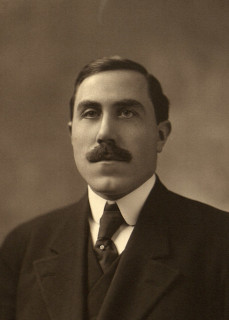
Birth of Joseph McGarrity, Irish American Political Activist

Joseph McGarrity, Irish American political activist best known for his leadership in Clan na Gael in the United States and his support of Irish republicanism back in Ireland, is born on March 28, 1874, in Carrickmore, County Tyrone.

McGarrity’s family grows up in poverty, motivating his need to immigrate later in life. He grows up hearing his father discussing Irish politics, including topics such as the Fenians, the Irish Parliamentary Party (IPP), and Irish Home Rule. By the time he is an adult, he has developed a keen interest in politics himself.

McGarrity immigrates to the United States in 1892 at the age of 18. He is reputed to have walked to Dublin before boarding a cattle boat to Liverpool disguised as a drover, and then sailing to the United States using a ticket belonging to someone else. He settles in Philadelphia, Pennsylvania and becomes successful in the liquor business. His business fails, however, on three occasions, twice due to embezzlement by his business partner.

In 1893 McGarrity joins Clan na Gael, an Irish organisation based in the United States committed to aiding the establishment of an independent Irish state. Clan na Gael had been heavily involved with the Fenian Brotherhood that McGarrity had grown up hearing about, and by the latter half of the 19th century had become a sister organisation of the Irish Republican Brotherhood (IRB). In the decade just before McGarrity joins, Clan na Gael and the Fenian movement had waged the Fenian dynamite campaign, where they attempted to force the British state to make concessions in Ireland by bombing British Infrastructure. However, this had caused a split within Clan na Gael that is not mended until seven years after McGarrity joins when, in 1900, the factions reunite and plead to support “the complete independence of the Irish people, and the establishment of an Irish republic.” In the years that follow the 1880s and 1890s, he is, amongst others, credited with helping to stitch the organisation back together and bring it renewed strength.

McGarrity helps sponsor several Irish Race Conventions and founds and runs a newspaper called The Irish Press from 1918-22 that supports the Irish War of Independence. He is the founder of the Philadelphia chapter of Clan Na Gael.

During World War I, while the United States is still neutral, McGarrity is involved in the Hindu–German Conspiracy. He arranges the Annie Larsen arms purchase and shipment from New York to San Diego for India.

When Éamon de Valera arrives in the United States in 1919 they strike up an immediate rapport and McGarrity manages de Valera’s tour of the country. He persuades de Valera of the benefits of supporting him and the Philadelphia branch against the New York branch of the Friends of Irish Freedom organisation led by John Devoy and Judge Daniel F. Cohalan. He becomes president of the American Association for the Recognition of the Irish Republic. He christens his newborn son Éamon de Valera McGarrity, although their relationship becomes strained upon de Valera’s entry back into Dáil Éireann in the Irish Free State.

McGarrity opposes the Anglo-Irish Treaty and travels to Dublin in 1922 and assists the development of the short-lived Collins/De Valera Pact by bringing de Valera and Michael Collins together before the 1922 Irish general election.

The Irish Civil War sees a split in Clan na Gael just as it had split Sinn Féin back in Ireland. McGarrity and a minority of Clan na Gael members support the anti-treaty side but a majority support the pro-treaty side, including John Devoy and Daniel Cohalan. Furthermore, in October 1920 Harry Boland informs the Clan na Gael leadership that the IRB will be cutting their ties to the Clan unless the IRB is given more influence over their affairs. Devoy and Cohalan resist this, but McGarrity sees the Clan’s connection with the IRB as vital. While McGarrity’s faction is initially labelled “Reorganised Clan na Gael,” they are able to inherit total control of the Clan na Gael name as Devoy is not able to keep effective organisation of the group. In general, however, the in-fighting amongst the Irish on both sides of the Atlantic is quite disheartening for Irish Americans and in the years to come neither pro or anti-treaty sides of Clan na Gael see much in the way of donations.

With the scope of Clan na Gael now narrowed, and Devoy and Cohalan removed from the picture, McGarrity becomes chairman of the organisation. He does not support the founding of Fianna Fáil in 1926 and opposes the party’s entry into the Dáil in 1927. Even after the Irish Civil War, he still supports the idea that a 32-county Irish Republic can be achieved through force. in the spring of 1926, he receives Chief of Staff of the Irish Republican Army Andrew Cooney to the United States. Cooney and Clan na Gael formally agree that each organisation will support the other and that Clan na Gael will raise funds, purchase weapons and build support for the IRA in the United States.

Going into the late 1920s though Clan na Gael, as are most Irish American organisations, is struggling. Having limped past the split caused by the Irish Civil War, the rejection of Fianna Fáil has caused a second split in the membership. Many Irish Americans see the IRA and Fianna Fáil as one and the same at that point and Clan na Gael and McGarrity’s hostility to them causes much friction.

By July 1929, the Clan’s membership in one of its strongholds, New York City, is down to just 620 paid members. Then in October of that same year Wall Street crashes and the Great Depression hits. In 1933 McGarrity is left almost bankrupt after he is found guilty of “false bookkeeping entries.” His livelihood is saved when he becomes one of the main ticket agents in the United States for the Irish Hospitals’ Sweepstake. He is a personal friend of Joseph McGrath, one of the founders of the Sweepstake. The sweepstakes allow him to turn his fortunes around.

Despite the trying times of both Clan na Gael and his personal life, McGarrity holds fast in his belief in physical force Irish Republicanism. In 1939 he supports the demand from Seán Russell for the “S-Plan” bombing campaign in Britain, which proves disastrous. He allegedly meets Hermann Göring in Berlin in 1939 to ask for aid for the IRA, which leads indirectly to “Plan Kathleen.”

McGarrity is a lifelong friend of fellow Carrickmore native and avid Republican, Patrick McCartan. When he dies on September 4, 1940, a mass is held in the St. Mary’s Pro-Cathedral in Dublin. He remains an unrepentant physical force republican all his life. A number of McGarrity’s papers are in the National Library of Ireland. He donates his personal Library to Villanova University.

The IRA signs all its statements ‘J.J. McGarrity’ until 1969 when the organisation splits into the ‘Official‘ and ‘Provisional‘ movements. Thereafter the term continues to be used by the Officials while the Provisionals adopt the moniker ‘P.O’Neill.’

Leave a comment

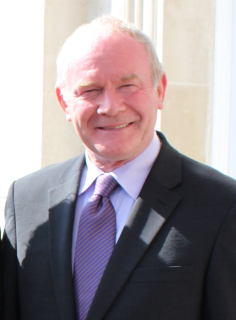
Death of Martin McGuinness, Irish Republican Sinn Féin Politician

Martin McGuinness, former member of the Provisional Irish Republican Army‘s (IRA) Army Council and Sinn Féin‘s chief negotiator in the peace process, dies on the morning of March 21, 2017 at Derry‘s Altnagelvin Area Hospital with his family by his bedside. He had been diagnosed with a rare heart disease in December 2016. In 2011, McGuinness contests the presidential election which is won by Michael D. Higgins.

McGuinness is born James Martin Pacelli McGuinness on May 23, 1950 in Derry. He attends St. Eugene’s Primary School and later the Christian Brothers technical college, leaving school at the age of 15.

McGuinness joins the IRA about 1970, and by 1971 he is one of its leading organizers in Derry. In 1973 a Special Criminal Court in the Republic of Ireland sentences him to six months in prison after he is caught in a car containing large quantities of explosives and ammunition. Although the IRA keeps secret the membership of its seven-person Army Council, few doubt that McGuinness is one of its most important members from the 1970s through the 1990s. Even while reportedly planning attacks on civilians in Northern Ireland and on the British mainland, McGuinness is involved in spasmodic secret talks with British government ministers and officials to end the conflict. In 1972 McGuinness, with fellow IRA leader Gerry Adams, privately negotiates with British Secretary of State for Northern Ireland William Whitelaw, but these and other talks over the next two decades are unsuccessful.

McGuinness contests seats in the British House of Commons on several occasions, losing in 1983, 1987, and 1992. However, in 1997 he is elected to the House of Commons to represent the constituency of Mid Ulster and, in line with party policy, he does not take his seat. He subsequently wins reelection to the seat in 2001, 2005, and 2010.

McGuinness is the IRA’s chief negotiator in the deliberations, also secret at first, that culminate in the Good Friday Agreement in 1998. This pact finally ends the conflict and eventually brings Sinn Féin into a coalition government to rule Northern Ireland. He is elected to the new Northern Ireland Assembly and in 1999 is appointed Minister of Education. In this post he eliminates the controversial eleven-plus examination, which determines which type of secondary school a child should attend. The test had been abolished in most of the rest of the United Kingdom more than 25 years earlier.

Disagreements over such issues as policing and the decommissioning of arms causes Northern Ireland’s Executive and Assembly to be suspended for some years, but a fresh agreement in 2006 paves the way for them to be revived. In elections in March 2007, both Sinn Féin and the antirepublican Democratic Unionist Party (DUP) gain seats, becoming the two largest parties in the Northern Ireland Assembly. McGuinness becomes Deputy First Minister, working with First Minister Ian Paisley, leader of the DUP. The two men, previously bitter enemies, perform so well together that they are dubbed the “Chuckle brothers.”

When Paisley retires in 2008, he is succeeded by the DUP’s Peter Robinson, who is considered to be even more militantly antirepublican. Once again, however, a shared need to rebuild the economy and attract international investment leads to cooperation between former opponents. In 2009 their government is in jeopardy as Sinn Féin and the DUP argue over the devolution of the police and justice system in Northern Ireland. McGuinness and Robinson are involved in the ensuing negotiations, and in February 2010 an agreement is reached for the transfer of powers from Britain to Northern Ireland in April.

In the Assembly elections in May 2011, McGuinness and Robinson are a formidable pair, and voters respond to their call for stability in a time of economic uncertainty. Sinn Féin gains an additional seat and increases its overall share of the vote, and McGuinness is assured an additional term as Deputy First Minister. In the autumn he steps down to run as Sinn Féin’s candidate for the presidency of Ireland. After finishing third in the election held on October 28, he returns to the position of Deputy First Minister a few days later. On June 27, 2012, in an event widely seen as having great symbolic importance for the ongoing reconciliation efforts in Northern Ireland, McGuinness and Elizabeth II shake hands twice, once in private and again in public, during a visit by the British monarch to Belfast.

In January 2017 McGuinness resigns as Deputy First Minister in response to First Minister Arlene Foster’s refusal to temporarily step down from her position during the investigation of a scandal relating to the government’s Renewable Heat Incentive (RHI), a mishandled program under which large amounts of state funds allegedly had been squandered. Foster had served as head of the department that oversaw the RHI before becoming First Minister. Under the power-sharing agreement the posts of First Minister and Deputy First Minister constitute a single joint office so that the resignation of one minister results in termination of the other’s tenure. When Sinn Féin chooses not to nominate a replacement for McGuinness within the required seven-day period, authority reverts to the British government’s Secretary of State for Northern Ireland in advance of a snap election on March 2.

Even before McGuinness’s resignation there had been speculation late in 2016 that he might step down for health reasons, and soon after resigning he confirms that he is suffering from amyloidosis, a rare disease brought about by deposits of abnormal protein in organs and tissue. With McGuinness removing himself from “frontline politics,” Michelle O’Neill leads Sinn Féin into the election. The disease claims McGuinness’s life only months later on March 21, 2017.


2 Comments

Birth of Sir James Comyn, Irish-born English High Court Judge

Sir James Peter Comyn, Irish-born barrister and English High Court judge, is born at Beaufield House, Stillorgan, County Dublin on March 8, 1921. Considered by many to be “the finest all-round advocate at the English bar”, he is appointed to the High Court of Justice in 1978, serving on the bench until his retirement in 1985.

Comyn is the son of Nationalist barrister James Comyn KC and of Mary Comyn. Through his father he is the nephew of the barrister Michael Comyn KC. Both his father and uncle had been political and legal advisers to Éamon de Valera, who at one point uses Beaufield House as a safe house. However, the Comyn brothers have a falling out with de Valera shortly before he comes to power in 1932, and Michael Comyn is passed over as Attorney General of the Irish Free State. As a result, James Comyn, who is then attending Belvedere College in Dublin, is sent by his father to attend The Oratory School in England. He spends six months as a trainee at The Irish Times under the editor R. M. “Bertie” Smyllie, but abandons journalism after a joke he added to an obituary is printed in the paper, leading to his demotion to the racing department.

Comyn then matriculates at New College, Oxford, where he reads law, graduating with Second Class Honours. In 1940, he defeats Roy Jenkins for the presidency of the Oxford Union, winning by four votes. After suffering the first of several breakdowns through his life, he briefly works for the BBC‘s Empire Service during World War II.

Comyn is called to the English bar by the Inner Temple in 1942, the Irish bar in 1947, and the Hong Kong bar in 1969. In 1944, he begins his pupillage with Edward Holroyd Pearce KC, later a law lord, and joins his chambers at Fountain Court. He practises in London and on the Western circuit, supplementing his earnings by teaching banking, a subject of which he knows nothing. On one occasion, he rises in Lambeth County court to cross-examine a female defendant in an eviction case. Just as he begins by saying “Madam,” the defendant opens her bag, takes out a dead cat, and throws it at him. The judge’s reaction is to tell the defendant, “Madam, if you do that again, I’ll commit you.” Comyn wins the case.

Comyn takes silk in 1961, and acquires a large practice as a senior, appearing in many high-profile cases. In 1964, he wins damages for libel for the former safe-breaker Alfred George Hinds against a Scotland Yard inspector by convincing the jury that Hinds is in fact innocent. In 1970, he successfully defends the Labour MP Will Owen, who is accused of providing information to the Czechoslovak intelligence services. In 1975, he defeats the government’s attempt to obtain an injunction against the publication of the diaries of former minister Richard Crossman.

Comyn is Recorder of Andover between 1964 and 1971 (honorary life recorder from 1972), commissioner of assize for the Western Circuit in 1971, and a Recorder of the Crown Court between 1972 and 1977. He is elected a bencher of the Inner Temple in 1968 and serves as chairman of the Bar council from 1973 to 1974.

Having refused a previous invitation by Quintin Hogg, Baron Hailsham of St. Marylebone to join the bench, Comyn is again nominated by Elwyn Jones, Baron Elwyn-Jones, in 1977, and is appointed a High Court judge in 1978, receiving the customary knighthood upon his appointment. Initially assigned to the Family Division, he does not take to the work and is reassigned to the Queen’s Bench Division in 1979. He has a reputation for leniency in sentencing, first acquired as Recorder of Andover. In 1980–81, he presides over an unsuccessful libel action by a member of the Unification Church, colloquially known as the Moonies, against the Daily Mail, the longest libel trial in England up to that time. His Irish background makes him the target of Irish Republican Army (IRA) action, and in 1981 the Provisional IRA burns his house in Tara.

Recurring bouts of depression lead to Comyn’s early retirement, on grounds of ill health, in 1985. In retirement, he divides his time between England and Ireland, whose citizenship he has retained. He writes a number of books, including memoirs, light verse, and books on famous trials. He also breeds Friesian cattle. He dies in Navan, County Meath on January 5, 1997, at age 75.


Leave a comment

Assassination of Norman and James Stronge

Sir Charles Norman Lockhart Stronge and his son James, both former Ulster Unionist Party (UUP) Members of Parliament, are assassinated by the Provisional Irish Republican Army (IRA) at their home, Tynan Abbey, on January 21, 1981. The home is then burned to the ground.

Before his involvement in politics Stronge fights in World War I as a junior officer in the British Army. He fights in the Battle of the Somme in 1916 and is awarded the Military Cross. His positions after the war include Speaker of the House of Commons of Northern Ireland for twenty-three years.

Stronge (86) and his son, James (48), are watching television in the library of Tynan Abbey when members of the Provisional Irish Republican Army, armed with machine guns, use grenades to break down the locked heavy doors to the home.

The Stronge family home is then burned to the ground as a result of two bomb explosions. On seeing the explosions at the house, as well as a flare Stronge lit in an attempt to alert the authorities, the Royal Ulster Constabulary and British Army troops arrive at the scene and establish a roadblock at the gate lodge. They encounter at least eight fleeing gunmen. A twenty-minute gunfight ensues in which at least two hundred shots are fired. There are no casualties among the security forces but the gunmen escape. The bodies of the father and son are later discovered in the library of their burning home, each with gunshot wounds in the head. It is not known who died first, Norman or James. Under the legal fiction known as the doctrine of survival, James is still listed as succeeding to the baronetcy.

The village of Tynan is crowded for the joint funeral of Stronge and his son. Mourners come from throughout the province and from England, including lords, politicians, policemen, judges and church leaders. The coffin is carried by the 5th Battalion the Royal Irish Rangers, the successors to his old regiment. The sword and cap of the Lord Lieutenant of Tyrone, Major John Hamilton-Stubber, are placed on his coffin in lieu of his own, which had been destroyed with his other possessions in the fire. During the service, a telegram sent from Queen Elizabeth II to one of Sir Norman’s daughters, is read. After the service, the chief mourners move out into the churchyard where the “Last Post” is sounded, and a Royal British Legion farewell is given. The two coffins are laid in the family plot, where Lady Stronge, Sir Norman’s wife and mother of James, was buried a year previously.

The Secretary of State for Northern Ireland, Humphrey Atkins, is informed by friends of the Stronge family that he would not be welcome at the funeral because of government policy on Irish border security. Atkins leaves the Northern Ireland Office later that year, to be replaced by Jim Prior. Stronge is commemorated with a tablet in the Northern Ireland Assembly Chamber in Parliament Buildings on the Stormont Estate.

The IRA releases a statement in Belfast, quoted in The Times, claiming that “This deliberate attack on the symbols of hated unionism was a direct reprisal for a whole series of loyalist assassinations and murder attacks on nationalist peoples and nationalist activities.” This follows the loyalist attempted murder of Bernadette McAliskey and her husband Michael McAliskey on January 16, and the loyalist assassinations of four republican activists (Miriam Daly, John Turnley, Noel Lyttle and Ronnie Bunting) which had taken place since May 1980.

The killings are referred to as murder by multiple media sources including The Daily Telegraph, The Scotsman, The New York Times and Time magazine, by the Reverend Ian Paisley in the House of Commons and by Alec Cooke, Baron Cooke of Islandreagh in the House of Lords.

Stronge is described at the time of his death by Social Democratic and Labour Party politician Austin Currie as having been “even at 86 years of age … still incomparably more of a man than the cowardly dregs of humanity who ended his life in this barbaric way.”

The ruins of Tynan Abbey are demolished in 1998, having stood for 249 years.


Leave a comment

The Dunmurry Train Bombing

The Dunmurry train bombing, a premature detonation of a Provisional Irish Republican Army (IRA) incendiary bomb aboard a Ballymena to Belfast passenger train, takes place on January 17, 1980.

The blast engulfs a carriage of the train in flames, killing three and injuring five others. One of the dead and the most seriously injured survivor are volunteers of the IRA. After the blast, the organisation issues a statement acknowledging responsibility, apologising to those who were harmed and state that it was ‘grave and distressing’ but an ‘accident’ caused by the ‘war situation.’

The train is a Northern Ireland Railways afternoon service carrying passengers between Ballymena railway station and Belfast Central railway station. The train is largely empty as it leaves Dunmurry railway station and enters the outskirts of Belfast, crossing under the M1 motorway on its way to Finaghy railway station shortly before 4:55 PM. A large fireball erupts in the rear carriage, bringing the train to a standstill and forcing panicked passengers to evacuate urgently as the smoke and flames spread along the train. The survivors then move down the track in single file to safety while emergency services fight the blaze. After several hours and combined efforts from fire, police and military services the blaze is contained. One fireman is treated for minor injuries. The two damaged carriages are transported to Queen’s Quay in Belfast for forensic examination and are subsequently rebuilt, one remaining in service until 2006 and the other until 2012.

Of the four persons occupying the carriage, three are killed with burns so severe that it is not possible to identify them by conventional means. Rail chief Roy Beattie describes the human remains as “three heaps of ashes.” The fourth, later identified as Patrick Joseph Flynn, is an IRA member and one of the men transporting the bombs. He suffers very serious burns to his face, torso and legs, and is reported to be close to death upon arrival at the hospital. Of the dead, two are eventually named as 17-year-old Protestant student Mark Cochrane from Finaghy and the other a 35-year-old Belfast-based accountant and recent immigrant from Lagos, Nigeria, Max Olorunda, who had been visiting a client in Ballymena. The identity of the third is harder to ascertain, but it is eventually confirmed by the IRA by their statement that he is 26-year-old IRA member Kevin Delaney. In addition to the fireman, four people are injured, including Flynn, two teenagers treated for minor injuries and an older man who suffers much more serious burns.

Further bomb alerts are issued across the region and two similar devices are discovered on trains, at York Road railway station in Belfast and at Greenisland railway station. Both are removed safely, and control detonated. The devices are simple incendiary bombs similar to that which exploded south of Befast, consisting of a 5-lb. block of explosives attached to a petrol can with a simple time device intended to delay the explosion until the train is empty that evening. Later testimony indicates that Delaney armed the first of two bombs and placed it beside him as he picked up the second one. As he arms this device, the first bomb suddenly detonates for reasons that remain unknown. Delaney is killed instantly and his accomplice, Patrick Joseph Flynn, is forced to leap from the train in flames. Flynn is guarded by police in hospital and arrested once his wounds heal sufficiently.

The IRA releases a lengthy statement about the event, terming it a ‘bombing tragedy,’ blaming the Royal Ulster Constabulary for their ‘sickening and hypocritical … collective activity of collaboration with the British forces.’ In Britain, Conservative MP Winston Churchill calls for the death penalty to be reinstated for terrorists as a result of the incident.

Patrick Flynn is tried at Belfast Crown Court for double manslaughter and possession of explosives after he recovers from his injuries. He is severely disfigured and badly scarred from the extensive burns the incendiary device had inflicted upon him. The judge is asked and agrees to take this into account for sentencing after reviewing the evidence and finding Flynn guilty due to his proximity to the explosion, his known IRA affiliation and the discovery of telephone numbers for the Samaritans and Belfast Central railway station in his jacket, to be used to telephone bomb warnings. Justice Kelly sentences Flynn to ten years in prison for each manslaughter as well as seven years for the explosives offences, to be served concurrently.

(Pictured: Dunmurry Railway Station)


Leave a comment

Birth of Danny Morrison, IRA Volunteer, Author & Activist

Daniel Gerard Morrison, former Provisional Irish Republican Army (IRA) volunteer, Irish author and activist, is born in staunchly Irish nationalist Andersonstown, Belfast, on January 9, 1953. He plays a crucial role in public events during the Troubles in Northern Ireland.

Morrison is the son of Daniel and Susan Morrison. His father works as a painter at the Harland & Wolff shipyard in East Belfast. His uncles, including Harry White, had been jailed for their part in the IRA‘s Northern Campaign in the 1940s. He joins Sinn Féin in 1966 and helps to organise 50th anniversary commemorations of the Easter Rising in Belfast. At this time, he later recalls, “as far as we were concerned, there was absolutely no chance of the IRA appearing again. They were something in history books.”

After the 1969 Northern Ireland riots, in which nationalist areas of Belfast are attacked and burned, Morrison joins the newly formed Provisional IRA. After this, he is engaged in clandestine republican activities, but as late as 1971, is still attending Belfast College of Business Studies and editing a student magazine there. He is interned in Long Kesh Detention Centre in 1972.

Morrison’s talents for writing and publicity are quickly recognised within the republican movement and after his release in 1975 he is appointed editor of Republican News. In this journal, he criticises many long-standing policies of the movement. At this time, he becomes associated with a grouping of young, left-wing Belfast based republicans, led by Gerry Adams, who want to change the strategy, tactics and leadership of the IRA and Sinn Féin.

With the rise of Adams’ faction in the republican movement in the late 1970s, Morrison succeeds Seán Ó Brádaigh as Director of Publicity for Sinn Féin. During the 1981 Irish hunger strike, he acts as spokesman for the IRA hunger strikers’ leader Bobby Sands, who is elected to the British Parliament on an Anti H-Block platform.

Morrison is elected as a Sinn Féin Member for Mid Ulster of a short-lived Northern Ireland Assembly from 1982 to 1986. He also stands unsuccessfully for the European Parliament in 1984 and again in 1989. He also stands for the Mid Ulster Westminster seat in 1983 and 1986. Along with Owen Carron, he is arrested on January 21, 1982, while attempting to enter the United States illegally from Canada by car. He is deported and later both men are convicted on a charge of making false statements to US immigration officials.

Morrison is director of publicity for Sinn Féin from 1979 until 1990, when he is charged with false imprisonment and conspiracy to murder a British informer in the IRA, Sandy Lynch. He is sentenced to eight years in prison and is released in 1995.

Since 1989, Morrison has published several novels and plays on themes relating to republicanism and events in the modern history of Belfast. His latest play, The Wrong Man, opens in London in 2005. It is based on his 1997 book of the same name and deals with the career of an IRA man who is suspected by his colleagues of working for the police.

The Bobby Sands Trust (BST) is formed after the 1981 Hunger Strike where ten republican prisoners die due to their hunger strike protest against the UK Government. The legal firm Madden & Finucane continues to act for the Trust whose original members are Gerry Adams, Danny Morrison, Tom Hartley, Tom Cahill, Marie Moore and Danny Devenny. For a time, Bobby’s two sisters, Marcella and Bernadette, are members of the Trust. Current members still include Adams, Morrison and Hartley. The BST claims to hold copyright to all the written works of Bobby Sands. The family of Sands has been critical of the BST, and they have called for it to disband.

Morrison lives in West Belfast with his Canadian-born wife, Leslie. He has two sons from his first marriage.


Leave a comment

The Droppin’ Well Bombing

The Droppin’ Well bombing or Ballykelly bombing occurs on December 6, 1982, when the Irish National Liberation Army (INLA) explodes a time bomb at a disco in Ballykelly, County Londonderry, Northern Ireland. The disco, known as the Droppin’ Well, is targeted because it is frequented by British Army soldiers from nearby Shackleton Barracks. The bomb kills eleven soldiers and six civilians and 30 people are injured, making it the most deadly attack during the INLA’s paramilitary campaign and the most deadly attack during The Troubles carried out in County Londonderry.

The bomb is manufactured by the INLA in nearby Derry. One of those involved later reveals that the INLA unit had carried out reconnaissance missions to the Droppin’ Well to see if there were enough soldiers to justify the likelihood of civilian casualties.

On the evening of December 6, 1982, an INLA member leaves a bomb inside the pub. There are about 150 people inside. The Royal Ulster Constabulary (RUC) believe that the bomb, estimated to be 5 to 10 pounds of commercial (Frangex) explosives, is small enough to fit into a handbag. It has, however, been left beside a support pillar and, when it explodes at about 11:15 PM, the blast brings down the roof. Many of those killed and injured are crushed by fallen masonry.

Following the blast, it takes a few hours to pull survivors from the rubble. The last survivor is freed at 4:00 AM, but it is not until 10:30 AM that the last of the bodies is recovered. Ultimately, 17 people die and 30 are injured, some seriously. Five of the civilians are young women and three (Alan Callaghan, Valerie McIntyre and Angela Maria Hoole) are teenagers. Angela Hoole is celebrating her engagement to one of the soldiers who survives the incident. Of the eleven soldiers who die, eight are from the 1st Battalion Cheshire Regiment, two from the Army Catering Corps and one from The Light Infantry. One of those on the scene is Bob Stewart, then a company commander in the Cheshire Regiment. He loses six soldiers from his company and is deeply affected as he tends to the dead and injured.

Suspicion immediately falls upon the Provisional Irish Republican Army (IRA), who denies involvement. By December 8, the British Army is blaming the INLA on grounds that the IRA, in a mixed village, would have made greater efforts not to risk killing civilians. Shortly afterwards, the INLA issues a statement of responsibility.

The INLA describes the civilians killed as “consorts.” The attack is criticised by many on both sides of the conflict in Northern Ireland due to the high loss of civilian lives. Soon after the INLA had issued its statement, the government of the Republic of Ireland bans the INLA, making membership punishable by seven years imprisonment.

In an interview after the bombing, INLA leader Dominic McGlinchey says that the Droppin’ Well’s owner had been warned six times to stop offering entertainment to British soldiers. He adds that the owner, and those who socialise with the soldiers, “knew full well that the warnings had been given and that the place was going to be bombed at some stage.” It later emerges that the INLA may also have targeted Ballykelly because it believed that the military base was part of NATO‘s radar and communications network.

Six days after the bombing, RUC officers shoot dead INLA members Seamus Grew and Roddie Carroll near a vehicle checkpoint in Armagh. The officers say they believed that the two men were ferrying McGlinchey into Northern Ireland. Neither was armed, nor was McGlinchey in their car.

In June 1986, four INLA members, sisters Anna Moore and Helena Semple, Eamon Moore (no blood relation) and Patrick Shotter, receive life sentences for the attack. Anna Moore later marries loyalist Bobby Corry while both are in prison. Anna’s daughter, Jacqueline Moore, is given ten years for manslaughter as the court believes she had been coerced into involvement. She is pregnant during her arrest and later gives birth in jail. All of those convicted are from Derry.

(Pictured: The Droppin’ Well bar and disco in Ballykelly destroyed by a Irish National Liberation Army bomb in 1982. Credit: PA Wire)


Leave a comment

Jack Lynch Resigns as Taoiseach of Ireland

Jack Lynch, Irish politician and Taoiseach of Ireland from 1966 to 1973 and from 1977 to 1979, resigns as Taoiseach and leader of Fianna Fáil on December 5, 1979.

In 1946, Lynch has his first involvement in politics when he is asked by his local Fianna Fáil cumann to stand for Dáil Éireann in a by-election. Over the next 35 years he serves as Parliamentary Secretary to the Taoiseach (1951-54), Parliamentary Secretary to the Minister for Lands (1951-54), Minister for the Gaeltacht (March 1957-June 1957), Minister for Education (1957-59), Minister for Industry and Commerce (1959-65), Minister for Finance (1965-66), Leader of Fianna Fáil (1966-79), Leader of the Opposition (1973-77), and 5th Taoiseach of Ireland (1977-79).

The year 1979 proves to be the year in which Lynch finally realises that his grip on power has slipped. The first direct elections to the European Parliament take place in June and see the electorate severely punishing the ruling Fianna Fáil party. A five-month postal strike also led to deep anger amongst people all over the country. On 27 August 1979, the Provisional Irish Republican Army assassinates Earl Mountbatten of Burma in County Sligo. On the same day the IRA kills 18 British soldiers at Warrenpoint in County Down.

A radical security review and greater cross-border co-operation are discussed with the new British Prime Minister, Margaret Thatcher. These discussions lead Síle de Valera, a backbench TD, to directly challenge the leadership in a speech at the Liam Lynch commemoration at Fermoy, County Cork, on September 9. Although Lynch quickly tries to impose party discipline, attempting to discipline her for opposing party policy at a parliamentary party meeting held on September 28, de Valera correctly points out that she had not opposed the party policy regarding the North which called for the declaration of the British intent to withdraw from the north. The result is embarrassing for Lynch.

The visit of Pope John Paul II to Ireland in September proves to be a welcome break for Lynch from the day-to-day running of the country. In November, just before he departs on a visit to the United States, he decides that he will resign at the end of the year. This would allow him to complete his term as President of the European Community. The defining event which makes up his mind is the news that Fianna Fáil had lost two by-elections on November 7 in his native Cork (Cork City and Cork North-East).

In addition, during the trip Lynch claims in an interview with The Washington Post that a five-kilometre air corridor between the border had been agreed upon during the meeting with Thatcher to enhance security co-operation. This is something highly unsavory to many in Fianna Fáil. When Lynch returns, he is confronted openly by Síle de Valera, Dr. Bill Loughnane, a noted hardline Republican backbencher, along with Tom McEllistrim, a member of Charles Haughey‘s gang of five, at a parliamentary party meeting. Lynch stated that the British do not have permission to overfly the border. Afterwards Loughnane goes public with the details of the meeting and accuses Lynch of deliberately misleading the party. An attempt to remove the whip from Loughnane fails.

At this stage Lynch’s position has become untenable, with supporters of Haughey caucusing opinion within the party. George Colley, the man whom Lynch sees as his successor, comes to him and encourages him to resign sooner. Colley is convinced that he has enough support to defeat the other likely candidate, Charles Haughey, and that Lynch should resign early to catch his opponents on the hop. Lynch agrees to this and resigns as leader of Fianna Fáil on December 5, 1979, assured that Colley has the votes necessary to win. However, Haughey and his supporters have been preparing for months to take over the leadership and Lynch’s resignation comes as no surprise. He narrowly defeats Colley in the leadership contest and succeeds Lynch as Taoiseach.

Lynch remained on in Dáil Éireann as a TD until his retirement from politics at the 1981 Irish general election.


Leave a comment

Thomas McMahon Sentenced to Life for Mountbatten’s Assassination

Thomas McMahon, former volunteer in the South Armagh Brigade of the Provisional Irish Republican Army (IRA) and one of the IRA’s most experienced bomb-makers, is sentenced to life in prison on November 23, 1979, for the assassination of Louis Mountbatten, 1st Earl Mountbatten of Burma, and three others (two children and an elderly lady) at Mullaghmore, County Sligo.

McMahon plants a bomb in Shadow V, a 27-foot fishing boat belonging to Mountbatten at Mullaghmore, near Donegal Bay. Lord Mountbatten and the others are killed on August 27, 1979, when the bomb detonates. The other victims are Doreen Knatchbull, Baroness Brabourne, Mountbatten’s elder daughter’s mother-in-law, his grandson Nicholas Knatchbull and 15-year-old crewmember Paul Maxwell.

McMahon is arrested by the Garda, the Republic of Ireland‘s police force, two hours before the bomb detonates at a Garda checkpoint between Longford and Granard on suspicion of driving a stolen vehicle.

The IRA claims responsibility for the act in a statement released immediately afterwards. In the statement from the organisation they say, “This operation is one of the discriminate ways we can bring to the attention of the English people the continuing occupation of our country.”

McMahon is tried for the assassinations in the Republic of Ireland and convicted by forensic evidence supplied by Dr. James O’Donovan that shows flecks of paint from the boat and traces of nitroglycerine on his clothes. He is sentenced to life imprisonment for murder on November 23, 1979, but is released in 1998 under the terms of the Good Friday Agreement.

Following his release, Toby Harnden in Bandit Country: The IRA & South Armagh (1999) reports that McMahon is holding a tricolour in the first rank of the IRA colour party at a 1998 IRA meeting in Cullyhanna. However, according to a BBC report, McMahon says that he left the IRA in 1990.

McMahon twice refuses to meet John Maxwell, the father of Paul Maxwell, who seeks him out to explain the reasons for his son’s death. In a May 2011 interview for The Telegraph, Maxwell states that he had “made two approaches to McMahon, the first through a priest, who warned me in advance that he thought there wouldn’t be any positive response. And there wasn’t. I have some reservations about meeting him, obviously – it might work out in such a way that I would regret having made the contact. On the other hand, if we met and I could even begin to understand his motivation. If we could meet on some kind of a human level, a man-to-man level, it could help me come to terms with it. But that might be very optimistic. McMahon knows the door is open at this end.”

McMahon likewise refuses requests from Nicholas Knatchbull’s twin brother, who lost an eye in the same explosion. The latter, however, has forgiven McMahon and other members of the IRA who committed the act.

McMahon’s wife has stated, “Tommy never talks about Mountbatten, only the boys who died. He does have genuine remorse. Oh God yes.”

McMahon lives with his wife Rose in Lisanisk, Carrickmacross, County Monaghan. He has two grown sons. He helps with Martin McGuinness‘s presidential campaign in 2011, erecting posters for McGuinness around Carrickmacross.


Leave a comment

Body of Jack Lynch Moved to Church of St. Paul of the Cross

On October 21, 1999, President Mary McAleese leads mourners at the removal of the body of former Taoiseach and Fianna Fáil leader, Jack Lynch, from Dublin’s Royal Hospital, where he had died the previous day, to the Church of St. Paul of the Cross, Mount Argus.

Jack Lynch, in full John Mary Lynch, is born on August 15, 1917, in Cork, County Cork. He serves as Taoiseach of Ireland from 1966 to 1973 and from 1977 to 1979.

Lynch studies law and enters the civil service with the Department of Justice in 1936. He eventually decides on a legal career, is called to the bar in 1945, resigns from the civil service, and practices on the Cork circuit. He already enjoys a national reputation as a sports hero as he had won five All-Ireland medals as a Cork hurler and another as a footballer.

Lynch joins Fianna Fáil and wins a seat in Dáil Éireann, the lower house of the Oireachtas, in 1948. He works closely with Éamon de Valera in opposition (1948–51), and de Valera appoints him a Parliamentary Secretary in 1951–1954, Minister for the Gaeltacht in 1957, and Minister for Education in 1957–1959. When Seán Lemass succeeds de Valera as Taoiseach in 1959, he makes Lynch Minister for Industry and Commerce and in 1965–1966 Minister for Finance.

Lemass’s retirement in 1966 causes an internal party conflict over the succession that leads to Lynch’s selection as a compromise candidate, a position he reluctantly accepts. In November 1966 he becomes leader of Fianna Fáil and Taoiseach. In June 1969 he becomes the only Fianna Fáil leader other than de Valera to win an overall majority in a general election.

In 1969–1973 Lynch plays an important role when civil unrest leads to the collapse of the government of Northern Ireland and poses a threat to the stability of the Irish state. He fires two cabinet ministers who are suspected of involvement in smuggling arms to the Provisional Irish Republican Army (IRA). He also creates a consensus in Irish party politics on a policy of conciliation and cooperation with the British government in seeking a solution to the Northern Ireland problem based on establishing power-sharing between the unionist majority and the Roman Catholic minority.

In 1972 Lynch wins an 83% majority in a referendum on Ireland’s entry into the European Economic Community and, on January 1, 1973, Ireland becomes a member. Although he is defeated in the 1973 Irish general election, he again demonstrates his remarkable popularity at the polls in 1977 when Fianna Fáil wins their largest and their last overall majority. In December 1979, however, discouraged by challenges to his authority from party colleagues, he resigns his leadership and soon after retires from politics. He serves on a number of corporate boards after his retirement.

Lynch dies in the Royal Hospital, Donnybrook, Dublin on October 20, 1999, at the age of 82. He is honoured with a state funeral which is attended by the President Mary McAleese, Taoiseach Bertie Ahern, former Taoisigh John Bruton, Albert Reynolds and Charles Haughey, and various political persons from all parties. The coffin is then flown from Dublin to Cork where a procession through the streets of the city draws some of the biggest crowds in the city’s history. Following the Requiem Mass celebrated in his home parish of the Cathedral of St. Mary and St. Anne, his friend and political ally, Desmond O’Malley, delivers the graveside oration, paying tribute to Lynch’s sense of decency. He is buried in St. Finbarr’s Cemetery, Cork.