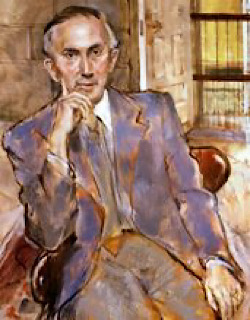
Lyons is a lecturer in history at the University of Hull and then at Trinity College Dublin. He becomes the founding Professor of Modern History at the University of Kent in 1964, serving also as Master of Eliot College from 1969 to 1972.
Lyons principal works include Ireland Since the Famine, the standard university textbook for Irish history from the mid-19th to late-20th century, which The Times calls “the definitive work of modern Irish history” and a biography of Charles Stewart Parnell.
Lyons is critical of Cecil Woodham-Smith‘s much-acclaimed history of the Great Irish Famine and has generally been considered among the “revisionist” historians who reconsiders the role of the British state in events like the Famine.
Lyons marries Jennifer Ann Stuart McAlister in 1954, and has two sons, one of whom, Nicholas, is a former Lord Mayor of London.
On September 15, 1983, Lyons is nominated, unopposed, as chancellor of Queen’s University Belfast (QUB). But less than a week later he is dead, succumbing in Dublin on September 21 to acute pancreatitis, which had struck him in mid-August. He had begun to write the first draft of his W. B. Yeats biography (having accumulated a great archive of material) only a few weeks before. His ashes are buried beside Trinity College chapel.
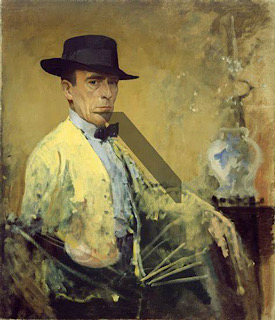
Whelan is awarded many prizes in the Royal Dublin Society (RDS) Taylor art competitions, including one in 1912 for a portrait of his sister Lena, entitled On the Moors, rendered in a strongly academic technique. In 1916, he wins the Taylor scholarship for the Royal Hibernian Academy (RHA) schools for his finest early work, The Doctor’s Visit, an adroitly executed composition of contrasting shadows and light. Typical of many of his genre interiors, the painting depicts a room in the family home, with relatives as models: Whelan’s mother sits by the bed watching over his ill cousin, while his sister, dressed in a Mater hospital nurse’s uniform, is in the background opening the door for the doctor. The subtly evoked atmosphere of restrained emotion foreshadowed a hallmark of his mature style.
Whelan exhibits annually at the RHA for forty-five years (1911–56), averaging six works per year. He is elected an RHA associate in 1920, becoming a full member in 1924. He participates in the Exposition d’art irlandais at the Galerie Barbazanges in Paris in 1922. A visiting teacher at the RHA schools in 1924, he also teaches in the DMSA for a time. He has studios at 64 Dawson Street (1914–27) and 7 Lower Baggot Street (1931–56). Beginning in the 1910s, he receives regular commissions for portraits, constituting his primary source of income. Having become the family’s main breadwinner following his parents’ deaths in the 1920s, he concentrates most of his production on this lucrative activity, portraying numerous leading figures in the spheres of politics, academia, religion, society, medicine, and law.
Situated securely in the academic tradition, in most of his portraits Whelan favours a sombre, restricted palette, with the sitter placed, in grave demeanour, against a monotone background with few accessories. In a 1943 interview he asserts that twentieth-century portraiture suffers from the drabness of modern costume, for which the artist must compensate by careful rendition of the subject’s hands. He tends to depart from his prevailing portrait style when painting women, whom he characteristically depicts in meticulously observed interiors, a notable example being his portrait of Society hostess Gladys Maccabe (c.1946; NGI).
Whelan’s commercial concentration on portraiture notwithstanding, he expresses his true talent in genre compositions, especially kitchen interiors, in which he emulates the technique of the Dutch painter Johannes Vermeer. Two of the most accomplished of these depict his sister Frances in the basement kitchen of the family home: The Kitchen Window (1927; Crawford Art Gallery, Cork) demonstrates a particularly skillful use of light, while Interior of a Kitchen (1935) is notable for the dexterous handling of objects of varied shapes and textures. His genre works include both urban and rural scenes, with a distinctive interest in portraying occupations and other activities. Gypsy (1923), an Orpenesque composition of a shawled woman in a west-of-Ireland landscape with a caravan in the background, receives wide contemporary critical acclaim. Jer (c.1925), depicting a man seated by the fire in a cottage interior, is reproduced in J. Crampton Walker’s Irish Art and Landscape (1927). The Fiddler (c.1932), a naturalistic, sensitively characterised study, is first shown at an Ulster Academy exhibition at Stranmillis, Belfast. A Kerry Cobbler is reproduced in Twelve Irish Artists (1940), introduced by Thomas Bodkin, as among the works denoting the development of a distinctively Irish school of painting.
In 1929, Whelan designs the first Irish Free State commemorative stamp, a portrait of Daniel O’Connell for the centenary of Catholic emancipation. Commissioned by the Thomas Haverty trust to paint an incident from the life of Saint Patrick for the 1932 Eucharistic Congress, he executes The Baptism by St. Patrick of Ethna the Fair and Fedelmia the Ruddy, Daughters of the Ard Rí Laoghaire, a work highly conservative in style. He rapidly completes an oil study of the papal legate, Lorenzo Lauri, also for the Eucharistic Congress. He is represented in the art competitions at the 1932 Summer Olympics in Los Angeles. His depiction of Saint Brigid, shown at the Academy of Christian Art exhibition (1940), becomes a familiar image owing to the wide circulation of reproductions.
Whelan’s political portraits are influential in creating a strong, assured image of the newly formed Irish state, and thus retain an historical significance. His posthumous portrait, The Late General Michael Collins, exhibited at the RHA in 1943 and now held in Leinster House, is an iconic, heroic image of the fallen leader. His portraits of Arthur Griffith and Kevin O’Higgins – commissioned posthumously, as is the Collins, by Fine Gael – also hang in Leinster House, while that of John A. Costello, exhibited at the RHA in 1949, is now held in the King’s Inns, Dublin. He paints two presidents, Douglas Hyde and Seán T. O’Kelly, both works currently in Áras an Uachtaráin. A portrait of Éamon de Valera, painted in 1955 when the sitter is Leader of the Opposition, is in Leinster House. In 1954, he designs a second commemorative stamp, picturing a reproduction of a portrait bust of John Henry Newman, to mark the centenary of the Catholic University of Ireland.
Whelan is elected an honorary academician of both the Ulster Academy of Arts (1931), and the Royal Ulster Academy (1950). He becomes a member of the United Arts Club in 1934. As a representative of the RHA, he sits on the board of governors of the National Gallery of Ireland for many years, and is on the advisory committee of the Municipal Gallery of Modern Art. Unmarried, he resides until his death at the Eccles Street address, with two sisters who continue to manage the family hotel. He dies on November 6, 1956, from leukemia at the Mater private nursing home in Dublin. He is buried in Glasnevin Cemetery.
(From: “Whelan, (Michael) Leo,” by Carmel Doyle, Dictionary of Irish Biography, http://www.dib.ie, October 2009)
Mitchell is the younger son of David William Mitchell, owner of a Dublin ironmongery and furniture business, and Francis Elizabeth Mitchell (née Kirby). His elder brother David becomes president of the Royal College of Physicians of Ireland (RCPI) and his sister Lillias is a noted weaver and teacher. He is educated at The High School, Dublin, and Trinity College Dublin (TCD), where he is a scholar in 1933 and receives a gold medal the following year. In 1934 he is appointed assistant to the professor of geology at TCD, and later is lecturer in geology (1940), reader in Irish archaeology (1959) and professor of Quaternary studies – a personal chair (1965). He is an efficient administrator and serves TCD successively as registrar, senior lecturer, and tutor, and after retirement is briefly a pro-chancellor of the university.
Mitchell’s major research focuses on the evolution of Ireland during the last two million years, particularly during the Quaternary since the retreat of the glacial ice over Ireland, and the effect man has had on this landscape. His interest in Quaternary studies begins in 1934, when he is appointed by the Royal Irish Academy (RIA) as an assistant to the Danish botanist and Quaternary geologistKnud Jessen, who uses the distribution of ancient pollen grains to reconstruct vegetational history. From 1940 he publishes a series of papers on topics such as the distribution of Irish giant deer and reindeer remains in Ireland, lacustrine deposits in County Meath, interglacial deposits in southeast Ireland, the palynology of Irish raised bogs, cave deposits, fossil pingos in County Wexford, bog flows, and the deposits of the older Pleistocene period in Ireland. His major study in this field is the documentation (1965) of the vegetational history of Littleton bog, County Tipperary, which has given its name to the present interglacial – the Littletonian warm stage.
Mitchell does not confine his studies to Ireland but also carries out work in Glasgow, Cornwall, and the Isle of Man. In 1957, he helps organise the British Association for the Advancement of Science meeting in Dublin and is later chairman of the Geological Society of London sub-commission on British and Irish Quaternary stratigraphy, which produces a comprehensive report in 1973. He is a frequent broadcaster on radio and a prolific author of academic papers, and in later life writes several acclaimed books, including The Irish Landscape (1976), which goes through two further editions as Reading the Irish Landscape (1986, 1997), and a volume of semi-autobiography, The Way That I Followed (1990).
In 1940, Mitchell marries Lucy Margaret (‘Pic’) (1911–87), daughter of E. J. Gwynn, provost of TCD. They have two daughters. For many years they live at Townley Hall, near Drogheda, County Louth, which had been TCD’s agricultural facility. A 1985 portrait by David Hone is displayed at Trinity College Dublin.
(From: “Mitchell, George Francis (‘Frank’)” by Patrick N. Wyse Jackson, Dictionary of Irish Biography, http://www.dib.ie, October 2009)
Jellett marries his cousin on his mother’s side, Dorothea Charlotte Morris Morgan, daughter of James Morgan, on July 7, 1855. The marriage produces seven children. His son, William Morgan Jellett, is a member of the Parliament of the United Kingdom and is the father of the celebrated artist Mainie Jellett, and of Dorothea Jellett, director of the orchestra of the Gaiety Theatre, Dublin. Another son Henry Holmes Jellett is a civil engineer in British India. His daughter Harriette Mary Jellett is the wife of the noted Irish physicistGeorge Francis FitzGerald. Another daughter Eva Jellett is the first woman to graduate with a degree in medicine from Trinity and goes on to practice as a doctor in India.
Jellett graduates B.A. in mathematics in 1837, M.A. 1843, B.D. 1866, and D.D. 1881. He is ordained a priest in 1846. In 1848 he is elected to the chair of natural philosophy at TCD, and in 1868 he receives the appointment of commissioner of Irish national education.
In 1851 Jellett is awarded the Cunningham Medal of the Royal Irish Academy for his work on the “Calculus of Variations.” The society later elects him their president, a position he holds from 1869 to 1874.
In 1870, on the death of Dr. Thomas Luby, Jellett is co-opted a Senior Fellow, and thus a member of the Board of TCD. William Ewart Gladstone‘s government in February 1881 appoints him provost of Trinity. In the same year he is awarded a Royal Medal by the Royal Society.
After the disestablishment of the Church of Ireland by the Irish Church Act 1869, Jellett takes an active part in the deliberations of the general synod and in every work calculated to advance its interests. He is an able mathematician and writes A Treatise of the Calculus of Variations (1850), and A Treatise on the Theory of Friction (1872), as well as several papers on pure and applied mathematics, articles in the Transactions of the Royal Irish Academy. He also writes some theological essays, sermons, and religious treatises, of which the principals are An Examination of some of the Moral Difficulties of the Old Testament (1867), and The Efficacy of Prayer (1878).
Jellett dies of blood poisoning at the provost’s house, TCD, on February 19, 1888, and is buried in Mount Jerome Cemetery on February 23. The funeral procession is the largest that ever left Trinity.
(Pictured: “John Hewitt Jellett,” oil on canvas by Sarah Purser)
By 1590 English rule is, with the exception of Ulster, firmly secured throughout Ireland. The CatholicGaels and Old English of Munster, Leinster, and Connacht have been more or less brought to heel, and Presidencies are established over each of them.
English law is dominant, and Protestant English planters are laying claim to the lands seized from the Catholics. The present-day counties are already taking shape, land divisions modeled on the shires of Great Britain. Queen Elizabeth I feels that the time is right to bolster up English civility and in 1592 she grants the city of Dublin a charter to establish a university.
The university is to be named The College of the Holy and Undivided Trinity of Queen Elizabeth, juxta Dublin. It has been commonly called Trinity College Dublin ever since.
The lands and buildings of the college are donated by the city corporation and are originally those of the Augustinian All Hallows Priory which had been suppressed in 1583. This property is situated about half a mile from the city walls.
In Dublin Loftus is appointed the dean of St. Patrick’s Cathedral and in 1567 he is appointed to the See of Dublin. He has opposition from the Lord Deputy of Ireland Sir John Perrot who had sought to have the university put to St. Patrick’s Cathedral. However, at this time Perrot is under suspicion for having verbally abused her majesty’s legitimacy and is to die in the Tower of London in September 1592.
Within two years of its foundation, Trinity College, consisting of a small square, is up and running with some fellows and a handful of students. Its raison d’etre is to provide a Protestant education and to consolidate the Tudor monarchy. Catholics and Dissenting Christians are not permitted entrance unless they convert to the Anglican faith. Those who do attend are the children of the New English and the children of Old English and native Irish who have abandoned their ancestors’ faith, for reasons of dogma or, as is more likely, in order to retain their lands and wealth.
Trinity is, over the next three centuries, to grow into a wealthy establishment. It receives appropriated properties and has annuities paid in from the government. In later years it is to be the the alma mater of many famous men. Sons of the Protestant Ascendency consider it their own during the 17th and 18th centuries but in the 20th century Trinity manages to adapt to the new Irish state with which it is fully involved in all aspects of Irish education and Irish life, and it is much loved by the Irish people.
(From: “The Founding of Trinity College Dublin 1592,” YourIrishCulture, http://www.yourirish.com)
Loftus is born in 1533, the second son of a monastic bailiff, Edward Loftus, in the heart of the English Yorkshire Dales. He embraces the Protestant faith early in his development. He is an undergraduate at Trinity College, Cambridge, where he reportedly attracts the notice of the young Queen Elizabeth, as much by his physique as through the power of his intellect. Although this encounter may never have happened, Loftus certainly meets with the Queen more than once, and she becomes his patron for the rest of her reign. At Cambridge Loftus takes holy orders as a Catholic priest and is appointed rector of Outwell St. Clement in Norfolk. He comes to the attention of the Catholic Queen Mary, who names him vicar of Gedney, Lincolnshire. On Elizabeth’s accession in 1558 he declares himself Anglican.
Loftus makes the acquaintance of the Queen’s favourite Thomas Radclyffe, 3rd Earl of Sussex and serves as his chaplain in Ireland in 1560. In 1561 he becomes chaplain to Alexander Craike, Bishop of Kildare and Dean of St. Patrick’s Cathedral in Dublin. Later that year he is appointed rector of Painstown in Meath and evidently earns a reputation as a learned and discreet advisor to the English authorities in Dublin. In 1563, he is consecrated Archbishop of Armagh at the unprecedented age of 28 by Hugh Curwen, Archbishop of Dublin.
Following a clash with Shane O’Neill, the real power in Ulster during these years, he comes to Dublin in 1564. To supplement the meager income of his troubled archbishopric he is temporarily appointed to the Deanery of St. Patrick’s Cathedral by the queen in the following year. He is also appointed president of the new commission for ecclesiastical causes. This leads to a serious quarrel with the highly respected Bishop of Meath, Hugh Brady.
In 1567 Loftus, having lobbied successfully for the removal of Hugh Curwen, who becomes Bishop of Oxford, and having defeated the rival claims of the Bishop of Meath, is appointed Archbishop of Dublin, where the queen expects him to carry out reforms in the Church. On several occasions he temporarily carries out the functions of Lord Keeper of the Great Seal, and in August 1581 he is appointed Lord Chancellor of Ireland after an involved dispute with Nicholas White, Master of the Rolls in Ireland. He is constantly occupied in attempts to improve his financial position by obtaining additional preferment and is subject to repeated accusations of corruption in public office.
In 1582 Loftus acquires land and builds a castle at Rathfarnham, which he inhabits from 1585. In 1569–1570 the divisions in Irish politics take on a religious tinge with the First Desmond Rebellion in Munster and Pope Pius V‘s 1570 papal bullRegnans in Excelsis. The bull questions Elizabeth’s authority and thereafter Roman Catholics are suspected of disloyalty by the official class unless they are discreet.
Loftus takes a leading part in the execution of Dermot O’Hurley, Archbishop of Cashel. When O’Hurley refuses to give information, Francis Walsingham suggests he should be tortured. Although the Irish judges repeatedly decide that there is no case against O’Hurley, on June 19, 1584, Loftus and Sir Henry Wallop write to Walsingham “We gave warrant to the knight-marshal to do execution upon him, which accordingly was performed, and thereby the realm rid of a most pestilent member.”
Between 1584 and 1591 Loftus has a series of clashes with Sir John Perrot on the location of an Irish University. Perrot wants to use St. Patrick’s Cathedral, Dublin as the site of the new University, which Loftus seeks to preserve as the principal place of Protestant worship in Dublin, as well as a valuable source of income for himself. The archbishop wins the argument with the help of his patron, Queen Elizabeth I, and Trinity College, Dublin is founded at its current location, named after his old college at Cambridge, leaving the Cathedral unaffected. Loftus is named as its first Provost in 1593.
The issue of religious and political rivalry continues during the two Desmond Rebellions (1569–83) and the Nine Years’ War (1594–1603), both of which overlap with the Anglo-Spanish War (1585–1604), during which some rebellious Irish nobles are helped by the Papacy and by Elizabeth’s arch-enemy Philip II of Spain. Due to the unsettled state of the country Protestantism makes little progress, unlike in Celtic Scotland and Wales at that time. It comes to be associated with military conquest and is therefore hated by many. The political-religious overlap is personified by Loftus, who serves as Archbishop and as Lord Chancellor of Ireland. An unlikely alliance forms between Gaelic Irish families and the Norman “Old English“, who had been enemies for centuries but who now mostly remain Roman Catholic.
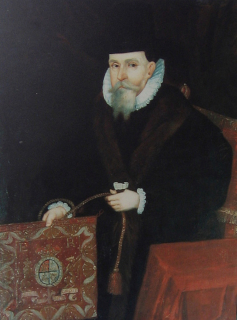
Adam Loftus dies in Dublin on April 5, 1605, and is interred in the building he had helped to preserve for future generations, while many of his portraits hang today within the walls of the University which he helped found. Having buried his wife Jane (Purdon) and two sons (of their 20 children) in the family vault at St. Patrick’s, Loftus dies at his Episcopal Palace in Kevin Street “worn out with age” and joins his family in the same vault. His zeal and efficiency are commended by James I upon the king’s accession.
Hely is born in 1724 at Gortroe, Mallow, son of Francis Hely, a gentleman of County Cork. He is educated at Trinity College Dublin (BA 1744) and is called to the Irish bar in 1748. He takes the additional name of Hutchinson upon his marriage in 1751 to Christiana Nixon, heiress of her uncle, Richard Hutchinson.
Hely-Hutchinson is elected member of the Irish House of Commons for the borough of Lanesborough in 1759, but from 1761 to 1790 he represents Cork City. He at first attaches himself to the patriotic party in opposition to the government, and although he afterwards joins the administration, he never abandons his advocacy of popular measures.
After a session or two in parliament he is made a privy councillor and prime Serjeant-at-law. From this time, he gives a general, though by no means invariable, support to the government. In 1767 the ministry contemplates an increase of the army establishment in Ireland from 12,000 to 15,000 men, but the Augmentation Bill meets with strenuous opposition, not only from Henry Flood, John Ponsonby and the habitual opponents of the government, but from the Undertakers, or proprietors of boroughs, on whom the government has hitherto relied on to secure them a majority in the House of Commons.
It therefore becomes necessary for Lord Townshend to turn to other methods for procuring support. Early in 1768 an English Act is passed for the increase of the army, and a message from King George III setting forth the necessity for the measure is laid before the House of Commons in Dublin. An address favourable to the government policy is, however, rejected as Hely-Hutchinson, together with the speaker and the attorney general, do their utmost both in public and private to obstruct the bill. Parliament is dissolved in May 1768, and the lord lieutenant sets about the task of purchasing or otherwise securing a majority in the new parliament. Peerages, pensions and places are bestowed lavishly on those whose support could be thus secured. Hely-Hutchinson is won over by the concession that the Irish army should be established by the authority of an Irish act of parliament instead of an English one.
The Augmentation Bill is carried in the session of 1769 by a large majority. Hely-Hutchinson’s support had been so valuable that he receives as reward an addition of £1,000 a year to the salary of his sinecure of alnager, a major’s commission in a cavalry regiment, and a promise of the Secretaryship of State. He is at this time one of the most brilliant debaters in the Irish parliament and is enjoying an exceedingly lucrative practice at the bar. This income, however, together with his well-salaried sinecure, and his place as prime serjeant, he surrenders in 1774 to become provost of Trinity College, although the statute requiring the provost to be in holy orders has to be dispensed with in his favour.
For this great academic position Hely-Hutchinson is in no way qualified and his appointment to it for purely political service to the government is justly criticised with much asperity. His conduct in using his position as provost to secure the parliamentary representation of the university for his eldest son brings him into conflict with Patrick Duigenan, while a similar attempt on behalf of his second son in 1790 leads to his being accused before a select committee of the House of Commons of impropriety as returning officer. But although without scholarship Hely-Hutchinson is an efficient provost, during whose rule material benefits are conferred on Trinity College.
Hely-Hutchinson continues to occupy a prominent place in parliament, where he advocates free trade, the relief of the Catholics from penal legislation, and the reform of parliament. He is one of the very earliest politicians to recognise the soundness of Adam Smith‘s views on trade and he quotes from the Wealth of Nations, adopting some of its principles, in his Commercial Restraints of Ireland, published in 1779, which William Edward Hartpole Lecky pronounces one of the best specimens of political literature produced in Ireland in the latter half of the 18th century.
In the same year, the economic condition of Ireland being the cause of great anxiety, the government solicits from several leading politicians their opinion on the state of the country with suggestions for a remedy. Hely-Hutchinson’s response is a remarkably able state paper, which also shows clear traces of the influence of Adam Smith. The Commercial Restraints, condemned by the authorities as seditious, goes far to restore Hely-Hutchinson’s popularity which has been damaged by his greed of office. Not less enlightened are his views on the Catholic question. In a speech in parliament on Catholic education in 1782 the provost declares that Catholic students are in fact to be found at Trinity College, but that he desires their presence there to be legalised on the largest scale.
In 1777 Hely-Hutchinson becomes Secretary of State. When Henry Grattan in 1782 moves an address to the king containing a declaration of Irish legislative independence, he supports the attorney general’s motion postponing the question. On April 16, however, after the Easter recess, he reads a message from the Lord Lieutenant, the William Cavendish-Bentinck, 3rd Duke of Portland, giving the king’s permission for the House to take the matter into consideration, and he expresses his personal sympathy with the popular cause which Grattan on the same day brings to a triumphant issue. Hely-Hutchinson supports the opposition on the regency question in 1788, and one of his last votes in the House is in favour of parliamentary reform. In 1790 he exchanges the constituency of Cork for that of Taghmon in County Wexford, for which borough he remains member until his death at Buxton, Derbyshire on September 4, 1794.
(Pictured: Portrait, oil on canvas, of John Hely-Hutchinson (1724–1794) by Sir Joshua Reynolds (1723–1792))
After acting as chaplain to Seth Ward, Bishop of Exeter and then Bishop of Salisbury, and Lord Chancellor Clarendon, he is elected principal of St. Alban Hall, Oxford, in 1673. In 1679 he is appointed provost of Trinity College, Dublin, where he does much to encourage the study of the Irish language. He helps to found the Dublin Philosophical Society and contributes to it a paper entitled Introductory Essay to the Doctrine of Sounds (printed in Philosophical Transactions, No. 156, Oxford, 1684).
In 1683 Marsh is consecrated Bishop of Ferns and Leighlin, but after the accession of James II he is compelled by the turbulent soldiery to flee to England in 1689, when he becomes Vicar of Gresford, Flintshire, and Canon of St. Asaph. Returning to Ireland in 1691 after the Battle of the Boyne, he is made Archbishop of Cashel, and three years later he becomes Archbishop of Dublin. About this time, he founds Marsh’s Library in Dublin, which is the oldest public library in Ireland. He becomes Archbishop of Armagh in 1703. Between 1699 and 1711 he is six times a Lord Justice of Ireland.
Narcissus Marsh dies on November 2, 1713. His funeral oration is pronounced by his successor at Dublin, Archbishop William King. A more acerbic account is provided by Jonathan Swift.
Many oriental manuscripts belonging to Narcissus Marsh are now in the Bodleian Library in Oxford.





 seamus dubhghaill