seamus dubhghaill

Promoting Irish Culture and History from Little Rock, Arkansas, USA


Leave a comment

Birth of Father Leonard Eugene Boyle

leonard-eugene-boyle

Leonard Eugene Boyle, Irish and Canadian scholar in medieval studies and palaeography, is born in Ballintra, County Donegal on November 13, 1923. He is the first Irish and North American Prefect of the Vatican Library in Rome from 1984 to 1997.

Boyle spends some years in Tralee, County Kerry, following the July 1940 death of his older brother John, who is a member of Garda Síochána and drowns while on holiday in Ballybunion, County Kerry. He is educated in the Irish language and enters the Dominican Order in 1943. He is ordained a priest in 1949 having received his doctorate in Oxford.

Boyle frequently visits Tralee, where a number of his family still reside, and is involved in many projects in the town. His immense knowledge and expertise in historical and archaeological issues is freely given in order to enhance the town. Of particular concern is his hope that the site of the original Dominican Priory at the centre of the town be conserved for future archaeological excavation.

After moving to Toronto, Boyle teaches at the Pontifical Institute of Mediaeval Studies and at the Centre for Medieval Studies at the University of Toronto from 1961 to 1984. He also serves as Professor of Latin Palaeography and History of Medieval Theology at the Pontifical University of St. Thomas Aquinas in Rome from 1956 to 1961.

In 1984 Boyle is appointed Prefect of the Vatican Library by Pope John Paul II. This appointment takes him by surprise but appears to be a recognition of his immense scholarship, expertise in antiquity and renowned interest in learning as a whole. In an effort to modernise the Vatican Library, he sets about the digitisation of the library’s many thousands of manuscripts that date from hundreds of years BC, which leads to their greater availability to scholars around the world. He also extends the opening hours of the library and employs women for the first time as part of the library’s staff. In 1987, he is made an Officer of the Order of Canada. In 1997, he is ousted as Prefect after his dealings with some American fund-raising associates result in lawsuits involving the Vatican.

Known for his wit and independence of mind and spirit, Boyle is once asked of his interest in being a Cardinal given the fact that all of his predecessors have gone on to be Cardinals. His reply is in the negative saying “nothing but the papacy” would do him.

Father Boyle dies on October 25, 1999. He is buried in his beloved Basilica di San Clemente, in 2000, a year after his death, following official desire to give him the honour of interment in the vaults of San Clemente — one of Rome’s holiest and most historical shrines.


Leave a comment

Death of Composer Michael William Balfe

michael-william-balfe

Michael William Balfe, Irish composer best remembered for his opera The Bohemian Girl, dies in Dublin on October 20, 1870.

Balfe is born in Dublin on May 15, 1808, where his musical gifts become apparent at an early age. He receives instruction from his father, a dancing master and violinist, and the composer William Rooke. His family moves to Wexford when he is a child.

In 1817, Balfe appears as a violinist in public, and in this year composes a ballad, first called “Young Fanny” and afterwards, when sung in Paul Pry by Lucia Elizabeth Vestris, “The Lovers’ Mistake”. In 1823, upon the death of his father, he moves to London and is engaged as a violinist in the orchestra of the Theatre Royal, Drury Lane. He eventually becomes the leader of that orchestra. While there, he studies violin with Charles Edward Horn and composition with Charles Frederick Horn.

While still playing the violin, Balfe pursues a career as an opera singer. He debuts unsuccessfully at Norwich in Carl Maria von Weber‘s Der Freischütz. In 1825, Count Mazzara takes him to Rome for vocal and musical studies and introduces him to Luigi Cherubini. In Italy, he also pursues composing, writing his first dramatic work, a ballet, La Perouse. He becomes a protégée of Gioachino Rossini‘s, and at the close of 1827, he appears as Figaro in The Barber of Seville at the Italian opera in Paris.

Balfe soon returns to Italy, where he is based for the next eight years, singing and composing several operas. In 1829 in Bologna, he composes his first cantata for the soprano Giulia Grisi, then 18 years old. He produces his first complete opera, I rivali di se stessi, at Palermo in the carnival season of 1829—1830.

Balfe returned to London in May 1835. His initial success takes place some months later with the premiere of The Siege of Rochelle on October 29, 1835, at Drury Lane. Encouraged by his success, he produces The Maid of Artois in 1836, which is followed by more operas in English. In July 1838, Balfe composes a new opera, Falstaff, for The Italian Opera House, based on The Merry Wives of Windsor, with an Italian libretto by S. Manfredo Maggione.

In 1841, Balfe founds the National Opera at the Lyceum Theatre, but the venture is a failure. The same year, he premieres his opera, Keolanthe. He then moves to Paris, presenting Le Puits d’amour in early 1843, followed by his opera based on Les quatre fils Aymon for the Opéra-Comique and L’étoile de Seville for the Paris Opera. Meanwhile, in 1843, he returns to London where he produces his most successful work, The Bohemian Girl, on November 27, 1843, at the Theatre Royal, Drury Lane. The piece runs for over 100 nights, and productions are soon mounted in New York, Dublin, Philadelphia, Vienna, Sydney, and throughout Europe and elsewhere.

From 1846 to 1852, Balfe is appointed musical director and principal conductor for the Italian Opera at Her Majesty’s Theatre. There he first produces several of Giuseppe Verdi‘s operas for London audiences. He conducts for Jenny Lind at her opera debut and on many occasions thereafter.

In 1851, in anticipation of The Great Exhibition in London, Balfe composes an innovative cantata, Inno Delle Nazioni, sung by nine female singers, each representing a country. He continues to compose new operas in English, including The Armourer of Nantes (1863), and writes hundreds of songs. His last opera, nearly completed when he dies, is The Knight of the Leopard and achieves considerable success in Italian as Il Talismano.

Balfe retires in 1864 to Hertfordshire, where he rents a country estate. He dies at his home in Rowney Abbey, Ware, Hertfordshire, on October 20, 1870, and is buried at Kensal Green Cemetery in London, next to fellow Irish composer William Vincent Wallace. In 1882, a medallion portrait of him is unveiled in Westminster Abbey.

In all, Balfe composes at least 29 operas. He also writes several cantatas and a symphony. His only large-scale piece that is still performed regularly today is The Bohemian Girl.


Leave a comment

Birth of Painter James Barry

james-barry-self-portrait

James Barry, Irish painter best remembered for his six-part series of paintings entitled The Progress of Human Culture in the Great Room of the Royal Society of Arts in London, is born in Water Lane (now Seminary Road) on the northside of Cork, County Cork on October 11, 1741.

Barry first studies painting under local artist John Butts. At the schools in Cork to which he is sent he is regarded as a child prodigy. About the age of seventeen he first attempts oil painting, and between that and the age of twenty-two, when he first goes to Dublin, he produces several large paintings.

The painting that first brings him into public notice, and gains him the acquaintance and patronage of Edmund Burke, is founded on an old tradition of the landing of Saint Patrick on the sea-coast of Cashel, although Cashel is an inland town far from the sea, and of the conversion and Baptism of the King of Cashel. It is exhibited in London in 1762 or 1763 and rediscovered in the 1980s in unexhibitable condition.

In late 1765 Barry goes to Paris, then to Rome, where he remains upwards of three years, from Rome to Florence and Bologna, and thence home through Venice. He paints two pictures while abroad, an Adam and Eve and a Philoctetes.

Soon after his return to England in 1771 Barry produces his painting of Venus, which is compared to the Triumph of Galatea of Raphael, the Venus of Urbino of Titian and the Venus de’ Medici. In 1773 he exhibits his Jupiter and Juno on Mount Ida. His Death of General Wolfe, in which the British and French soldiers are represented in very primitive costumes, is considered as a falling-off from his great style of art.

In 1773 Barry publishes An Inquiry into the real and imaginary Obstructions to the Acquisition of the Arts in England, vindicating the capacity of the English for the fine arts and tracing their slow progress to the Reformation, to political and civil dissensions, and lastly to the general direction of the public mind to mechanics, manufactures and commerce.

In 1774 a proposal is made through Valentine Green to several artists to ornament the Great Room of the Society for the encouragement of Arts, Manufactures and Commerce (now the Royal Society of Arts), in London’s Adelphi Theatre, with historical and allegorical paintings. This proposal is rejected at the time. In 1777 Barry makes an offer, which is accepted, to paint the whole on condition that he is allowed the choice of his subjects, and that he is paid by the society the costs of canvas, paints and models. He finishes the series of paintings after seven years to the satisfaction of the members of the society. He regularly returns to the series for more than a decade, making changes and inserting new features. The series of six paintings, The progress of human knowledge and culture, has been described by critic Andrew Graham-Dixon as “Britain’s late, great answer to the Sistine Chapel.”

Soon after his return from the continent Barry is chosen a member of the Royal Academy of Arts. In 1782 he is appointed professor of painting in the room of Edward Penny with a salary of £30 a year. In 1799 he is expelled from the Academy soon after the appearance of his Letter to the Society of Dilettanti, an eccentric publication, full of enthusiasm for his art and at the same time of contempt for the living professors of it. He remains the only academician ever to be expelled by the Academy until Brendan Neiland in July 2004.

After the loss of his salary, a subscription is set on foot by the Earl of Buchan to relieve Barry from his difficulties, and to settle him in a larger house to finish his painting of Pandora. The subscription amounts to £1000, with which an annuity is bought, but on February 6, 1806 he is seized with illness and dies on February 22. His remains are interred in St. Paul’s Cathedral, London on March 4, 1806.

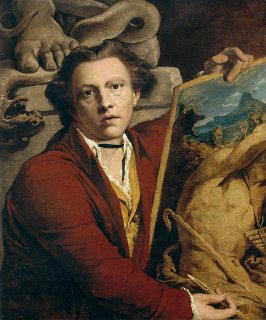
(Pictured: James Barry, Self-portrait, 1803, oil on canvas. National Gallery of Ireland, Dublin.)


Leave a comment

Pope John Paul II Meets Jubilee 2000 Delegation

geldof-bono-pope-john-paul-ii

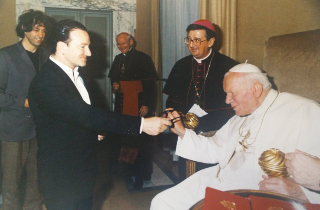
Bob Geldof, Bono, Quincy Jones and other members of an international lobby group meet with Pope John Paul II in Rome on September 23, 1999 to discuss the cancellation of third world debt repayments.

In an extraordinary meeting, marking 100 days to the millennium, Pope John Paul II makes a strong appeal to world to leaders to take urgent and decisive action towards resolving the debt crisis that afflicts the world’s poorest countries.

Speaking during a meeting with an international Jubilee 2000 delegation of economists, artists and campaigners, the Pope questions why progress in resolving the debt problem is so slow, and expresses impatience with the protracted negotiations. He warns that it “is the poor that pay the cost of indecision and delay.”

The Pope says “the Catholic Church looks at the situation with great concern. Not because she has any concrete technical model of development to offer, but because she has a moral vision of what the good of individuals and of the human family demands. She has consistently taught that there is a ‘social mortgage‘ on all private property, a concept which today must also be applied to ‘intellectual property‘ and to ‘knowledge.’ The law of profit alone cannot be applied to that which is essential for the fight against hunger, disease and poverty.”

Addressing the Pope on behalf of the delegation, Ann Pettifor, director and co-founder of Jubilee 2000, appeals to the Vatican to prevail upon the world’s leaders to meet again before the New Year, to cancel debts that result in the deaths of 20,000 children every day. She says, “This is a day that will go down in history. The Pope has given his endorsement and blessing to the passion and commitment of millions of Jubilee 2000 campaigners around the world. It is now up to the world’s leaders to rise to the Pope’s call and moral leadership.”

Following the meeting Bob Geldof says, “Were the spirit of this frail old man mirrored in a practical way by our political leaders, then the final push of political will to eradicate this unnecessary tragedy, would be easily achieved…and I liked his shoes!”

Professor Jeffrey Sachs adds, “With 100 days left to the millennium, we are halfway up the summit. But much more is needed. For hundreds of millions of the world’s poorest people, the Pope’s message today is crucial: the time is urgent for rich and poor to take the full and bold measure of debt cancellation that is so vitally needed.”

Bono summed it up saying, “His everyday courage amazes me. As aged as he is and as infirm as he has been, he will, you know, hang out with a bunch of pop stars…who could turn this man down?”

(Source: “Pope meets Bobo and calls for debt relief,” The Guardian, September 23, 1999)


Leave a comment

Birth of Thomas Burke, Irish Dominican Preacher

thomas-nicholas-burke-statue

Thomas Nicholas Burke, Irish Dominican preacher, is born in Galway, County Galway on September 8, 1830.

Burke’s parents, though in moderate circumstances, gave him a good education. He studies at first under the care of the Patrician Brothers and is afterwards sent to a private school. An attack of typhoid fever when he is fourteen years old, and the famine year of 1847 have a sobering effect. Toward the end of that year, he asks to be received into the Order of Preachers and is sent to Perugia in Italy to make his novitiate. On December 29, he is clothed there in the habit of St. Dominic and receives the name of Thomas.

Shortly afterward Burke is sent to Rome to begin his studies at the College of St. Thomas, the future Pontifical University of Saint Thomas Aquinas, where he is a student of philosophy and theology. He passes thence to the Roman convent of Santa Sabina. His superiors send him, while yet a student, as novice-master to Woodchester, the novitiate of the resuscitated English Province. He is ordained into the priesthood on March 26, 1853. On August 3, 1854, he defends publicly the theses in universâ theologiâ. He is made lector at the College of St. Thomas in 1854.

Early in the following year Burke is recalled to Ireland to found the novitiate of the Irish Province at Tallaght, near Dublin. In 1859 he preaches his first notable sermon on “Church Music.” It immediately lifts him into fame.

Elected Prior of Tallaght in 1863, Burke goes to Rome the following year as Rector of the Dominican Convent of San Clemente and attracts great attention by his preaching. He returns to Ireland in 1867 and delivers his oration on Daniel O’Connell at Glasnevin before fifty thousand people.

Bishop Leahy takes him as his theologian to the First Vatican Council in 1870, and the following year he is sent as Visitor to the Dominican convents in America. He is besieged with invitations to preach and lecture. The seats are filled hours before he appears, and his audiences overflow the churches and halls in which he lectures. In New York City he delivers the discourses in refutation of the English historian James Anthony Froude.

In an eighteen-month period Burke gives four hundred lectures, exclusive of sermons, with the proceeds amounting to nearly $400,000. His mission is a triumph, but the triumph is dearly won. When he arrives in Ireland on March 7, 1873, he is spent and broken.

During the next decade Burke preaches in Ireland, England, and Scotland. He begins the erection of the church in Tallaght in 1883, and the following May preaches a series of sermons in the new Dominican church, London. In June he returns to Tallaght in a dying condition and preaches his last sermon in the Jesuit church, Dublin, in aid of the starving children of Donegal. A few days afterwards, on July 2, 1882, he dies. He is buried in the church of Tallaght, now a memorial to him.

(Pictured: Statue of Thomas Nicholas Burke by John Francis Kavanagh by Nimmo’s Pier in Galway)


Leave a comment

Opening of The Museum of Science and Art, Dublin

national-museum-of-ireland

The Museum of Science and Art, Dublin on Kildare Street opens on August 29, 1890. The museum is founded on August 14, 1877, by act of Parliament. The decision to establish a state-run museum arises from requests by the Royal Dublin Society for continued government funding for its expanding museum activities.

A number of developments lead to the Science and Art Museums Act of 1877, which has the effect of transferring the buildings and collections of the Royal Dublin Society to state ownership. The collections are further enhanced by the transfer of other notable collections from institutions such as the Royal Irish Academy and Trinity College Dublin.

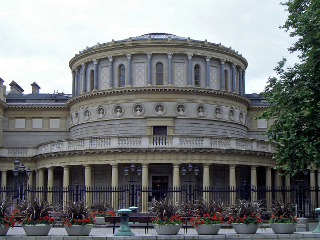
The Museum is the responsibility of the Department of Science and Art, which is also responsible for the South Kensington museums in London. State support for the institution is manifested in the construction of the new building on Kildare Street. It is built in the Victorian Palladian style and has been compared with the Altes Museum in Berlin, designed by Karl Friedrich Schinkel in the 1820s. Neoclassical influences can be seen in the colonnaded entrance and the domed rotunda, which rises to a height of 20 metres, and is modeled on the Pantheon in Rome.

The new museum houses coins, medals and significant Irish antiquities from the Royal Irish Academy including the Tara Brooch and Ardagh Chalice, ethnographical collections with material from Captain James Cooke‘s voyages from Trinity College Dublin, and the collections of the Geological Survey of Ireland.

These are joined by material from the decorative arts and ethnographical collections of the Royal Dublin Society along with their Irish collections of antiquities, minerals and plants. The old Royal Dublin Society museum on the Merrion Street side of Leinster House, erected with government assistance and opened in 1856, is devoted to natural history. It is dominated by zoology throughout much of its subsequent history and has an annex devoted to geology.

The building on Kildare Street is designed by Thomas Newenham Deane and is used to show contemporary Irish, British and Continental craftsmanship in its construction. State involvement in the running of the Museum allows for steady funding and a connection with other state museums in London and Edinburgh which is of considerable benefit. The collections grow with material acquired through purchase, public donation and shares of significant collections acquired by the state and dispersed by the London museums.

Catalogues are prepared by leading experts in various disciplines and printed in the Museum’s own press. In 1900 control passes to the Department of Agriculture and Technical Instruction and in 1908 its name is changed from “The Dublin Museum of Science and Art” to the “National Museum of Science and Art.” The name of the institution is changed again in 1921 to the “National Museum of Ireland.”


Leave a comment

Death of Denis Devlin, Poet & Diplomat

denis-devlin

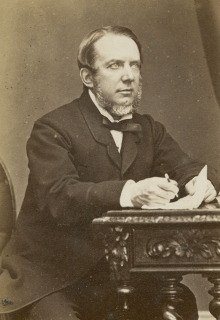
Denis Devlin, one of the major figures and influences of modern and modernist Irish poetry, dies in Dublin on August 21, 1959. Along with Samuel Beckett and Brian Coffey, he is one of the generation of Irish modernist poets to emerge at the end of the 1920s. He is also a career diplomat.

Devlin is born in Greenock, Scotland of Irish parents on April 15, 1908. His family returns to live in Dublin in 1918. He studies at Belvedere College and, from 1926, as a seminarian for the Roman Catholic priesthood at Clonliffe College. As part of his studies, he attends a degree course in modern languages at University College Dublin (UCD), where he meets and befriends Brian Coffey. Together they publish a joint collection, Poems, in 1930.

In 1927, Devlin abandons the priesthood and leaves Clonliffe College. He graduates from UCD with his BA in 1930 and spends that summer on the Blasket Islands to improve his spoken Irish. Between 1930 and 1933, he studies literature at Ludwig Maximilian University of Munich and the University of Paris, meeting, amongst others, Beckett and Thomas MacGreevy. He then returns to UCD to complete his MA thesis on Michael de Montaigne.

Devlin joins the Irish Diplomatic Service in 1935 and spends a number of years in Rome, New York and Washington, D.C. During this time, he meets the French poet Saint-John Perse, and the Americans Allen Tate and Robert Penn Warren. He goes on to publish a translation of Exile and Other Poems by Saint-John Perse, and Tate and Warren edit his posthumous Selected Poems.

Denis Devlin dies suddenly at the age of 51 in Dublin on August 21, 1959. Since his death, there have been two Collected Poems published; the first in 1964 is edited by Coffey and the second in 1989 by J.C.C. Mays.

Devlin’s personal papers are held in University College Dublin Archives.


Leave a comment

Birth of Mary Lavin, Short Story Writer & Novelist

mary-josephine-lavin

Mary Josephine Lavin, noted Irish short story writer and novelist, is born in Walpole, Massachusetts on June 10, 1912. She is regarded as a pioneering female author in the traditionally male-dominated world of Irish letters. Her subject matter often deals explicitly with feminist issues and concerns as well as a deep Catholic faith.

Lavin is the only child born to Tom and Nora Lavin, an immigrant Irish couple. She attends primary school in East Walpole until the age of ten, when her mother decides to go back to Ireland. Initially, Mary and Nora live with Nora’s family in Athenry, County Galway. Afterwards, they purchase a house in Dublin, and Mary’s father comes back from the United States to join them.

Lavin attends Loreto College, a convent school in Dublin, before going on to study English and French at University College Dublin (UCD). She teaches French at Loreto College for a while. As a postgraduate student, she publishes her first short story, “Miss Holland,” which appears in the The Dublin Magazine in 1938. Tom Lavin then approaches Edward Plunkett, 18th Baron of Dunsany, the well-known Irish writer, on behalf of his daughter and asks him to read some of Mary’s unpublished work. Suitably impressed, Lord Dunsany becomes her literary mentor.

In 1943, Lavin publishes her first book, Tales from Bective Bridge, a volume of ten short stories about life in rural Ireland. It is a critical success and goes on to win the James Tait Black Memorial Prize for fiction. That same year, she marries William Walsh, a Dublin lawyer. Over the next decade, the couple has three daughters and moves to “abbey farm” which they purchase in County Meath and includes the land around Bective Abbey. Her literary career flourishes. She publishes several novels and collections of short stories during this period. Her first novel, The House in Clewe Street, is serialised in The Atlantic Monthly before its publication in book form in 1945.

In 1954, William Walsh dies. Lavin, her reputation as a major writer already well-established, is left to confront her responsibilities alone. She raises her three daughters and keeps the family farm going at the same time. She also manages to keep her literary career on track, continuing to publish short stories and winning several awards for her work, including the Katherine Mansfield Prize in 1961, Guggenheim Fellowships in 1959 and 1961, and an honorary doctorate from UCD in 1968. Some of her stories written during this period, dealing with the topic of widowhood, are acknowledged to be among her finest.

Lavin remarries in 1969. Michael Scott is an old friend from her student days in University College. He has been a Jesuit priest in Australia but has obtained release from his vows from Rome and returned to Ireland. The two remain together until Scott’s death in 1991.

In 1992, Lavin, by now retired, is elected Saoi by the members of Aosdána for achieving “singular and sustained distinction” in literature. Aosdána is an affiliation of creative artists in Ireland, and the title of Saoi one of the highest honours in Irish culture.

Mary Lavin dies at the age of 83 on March 25, 1996.


Leave a comment

Official Opening of Ireland West Airport

ireland-west-airport

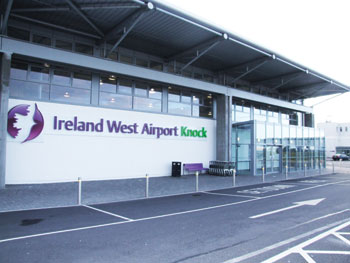
Ireland West Airport, officially known as Ireland West Airport Knock, at Knock, County Mayo, and now named Horan International Airport, is officially opened by Taoiseach Charles Haughey on May 30, 1986. The airport is located 5.6 km (3.5 miles) southwest of Charlestown, County Mayo. The village of Knock is 20 km (12.5 miles) away.

The airport opens on October 25, 1985 with three Aer Lingus charter flights to Rome however the official opening is on May 30, 1986. The site, on a hill in boggy terrain, is thought by many to be unrealistic but the airport is built following a long and controversial campaign by Monsignor James Horan, the story of which has even spawned a musical.

At the time of construction, the primary motivation is for pilgrims to Knock Shrine. Despite criticisms that the site is too boggy and too foggy, Monsignor Horan delivers an airport within five years, primarily financed by a Government grant of £9.8 million. Monsignor Horan dies shortly after the opening of the airport, and his funeral is held at the then named Horan International Airport. In recent times, Monsignor Horan has been celebrated with a bronze statue erected at the airport.

By 1988, over 100,000 passengers have passed through the airport. In 1995 Aer Lingus commences flights to Birmingham Airport. On June 1, 2003, hundreds of people gather to view an Air Atlanta Icelandic Boeing 747 land with 500 returning pilgrims from Lourdes.

In 2016, 735,869 passengers use the airport, making it the fourth busiest in the Republic of Ireland after Dublin Airport, Cork Airport and Shannon Airport. It is announced in November 2017 that €15 million will be invested in improving and upgrading the airport in 2018 and 2019, to coincide with strong passenger growth. These plans include upgrading of car parks, passenger facilities, the terminal and resurfacing of the runway.


Leave a comment

Catherine Nevin Found Guilty of Murder

catherine-nevin

On April 11, 2000, Catherine Nevin (née Scully), in a dramatic end to the two-month trial, is found guilty by a jury at the Central Criminal Court of all four charges against her arising out of the 1996 shooting death of her husband, Tom Nevin, at Jack White’s Inn, a pub owned by the couple in County Wicklow. The jury also finds her guilty on three charges of soliciting others to kill him after five days of deliberation, then the longest period of deliberation in the history of the Republic of Ireland. She is subsequentlty dubbed the “Black Widow” by the press. She is the subject of significant coverage by the tabloid press and Justice Mella Carroll orders a ban on the press commenting on Nevin’s appearance or demeanour during the trial.

Catherine Scully meets Tom Nevin in Dublin in 1970 and they are married in Rome in 1976. Within ten years, they own two houses and manage a pub in Finglas, Dublin. In 1986 they open Jack White’s Inn near Brittas Bay in County Wicklow.

On March 19, 1996, Tom Nevin is killed with a shot from a nine pellet shotgun while counting the day’s takings in Jack White’s Inn. According to Catherine Nevin, she is awakened by someone pressing her face into a pillow. She claims it was a man shouting profanities and holding a knife in his left hand. IR£13,000 is taken from the pub, and the Nevins’ car is stolen. It is later found abandoned in Dublin.

After her conviction, Nevin serves her sentence at the Dóchas Centre, Dublin. She loses an appeal in 2003 and, in 2010, also loses an application to have her conviction declared a miscarriage of justice.

Catherine Nevin is diagnosed with a brain tumor in 2016 and given only months to live by doctors at Dublin’s Mater Private Hospital. She receives compassionate release in late 2017 and dies on February 19, 2018. She denies any involvement in her husband’s murder to the very end.