seamus dubhghaill

Promoting Irish Culture and History from Little Rock, Arkansas, USA


Leave a comment

Death of Leo Whelan, Portrait & Genre Painter

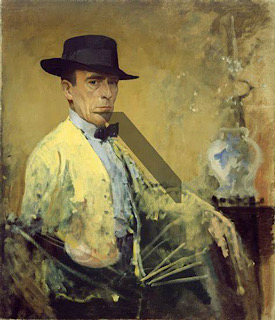
(Michael) Leo Whelan, portrait and genre painter, dies from leukemia on November 6, 1956, at the Mater private nursing home in Dublin.

Whelan is born on January 17, 1892, at 20 St. George’s Villas, Fairview, Dublin, one of two sons and three daughters of Maurice Whelan, a draper, of County Kerry ancestry, and Mary Whelan (née Cruise), from County Roscommon. The family subsequently moves to 65 Eccles Street, where his parents operated a small hotel. Educated at Belvedere College, Dublin, he then attends the Dublin Metropolitan School of Art (DMSA) (1908–14), where he is a student of William Orpen, who has a huge influence on his artistic style. His fellow students at the school include Patrick Tuohy and Séan Keating.

Whelan is awarded many prizes in the Royal Dublin Society (RDS) Taylor art competitions, including one in 1912 for a portrait of his sister Lena, entitled On the Moors, rendered in a strongly academic technique. In 1916, he wins the Taylor scholarship for the Royal Hibernian Academy (RHA) schools for his finest early work, The Doctor’s Visit, an adroitly executed composition of contrasting shadows and light. Typical of many of his genre interiors, the painting depicts a room in the family home, with relatives as models: Whelan’s mother sits by the bed watching over his ill cousin, while his sister, dressed in a Mater hospital nurse’s uniform, is in the background opening the door for the doctor. The subtly evoked atmosphere of restrained emotion foreshadowed a hallmark of his mature style.

Whelan exhibits annually at the RHA for forty-five years (1911–56), averaging six works per year. He is elected an RHA associate in 1920, becoming a full member in 1924. He participates in the Exposition d’art irlandais at the Galerie Barbazanges in Paris in 1922. A visiting teacher at the RHA schools in 1924, he also teaches in the DMSA for a time. He has studios at 64 Dawson Street (1914–27) and 7 Lower Baggot Street (1931–56). Beginning in the 1910s, he receives regular commissions for portraits, constituting his primary source of income. Having become the family’s main breadwinner following his parents’ deaths in the 1920s, he concentrates most of his production on this lucrative activity, portraying numerous leading figures in the spheres of politics, academia, religion, society, medicine, and law.

Coming from a family of militant nationalist sympathies, in 1922 he begins a large group portrait, GHQ Staff of the Pre-Treaty IRA, including Michael CollinsRichard MulcahyRory O’ConnorLiam Mellows and nine others, composed from individual studies of the men rendered during clandestine sittings in his home and studio. The painting, which he leaves unfinished, is in McKee Barracks, Dublin. He receives special praise for his portraits of John Henry Bernard, Provost of Trinity College Dublin (TCD) and of Louis Claude Purser, TCD vice-provost. The latter is awarded a medal at the 1926 Tailteann Games. He exhibits seventeen paintings at the Royal Society of Portrait Painters, London, of which he is a member, and shows two works at the Royal Academy of Arts, London. His 1929 portrait of John McCormack, one of his major patrons, is presented by the tenor’s family some fifty years later to the National Concert Hall, Dublin.

Situated securely in the academic tradition, in most of his portraits Whelan favours a sombre, restricted palette, with the sitter placed, in grave demeanour, against a monotone background with few accessories. In a 1943 interview he asserts that twentieth-century portraiture suffers from the drabness of modern costume, for which the artist must compensate by careful rendition of the subject’s hands. He tends to depart from his prevailing portrait style when painting women, whom he characteristically depicts in meticulously observed interiors, a notable example being his portrait of Society hostess Gladys Maccabe (c.1946; NGI).

Whelan’s commercial concentration on portraiture notwithstanding, he expresses his true talent in genre compositions, especially kitchen interiors, in which he emulates the technique of the Dutch painter Johannes Vermeer. Two of the most accomplished of these depict his sister Frances in the basement kitchen of the family home: The Kitchen Window (1927; Crawford Art Gallery, Cork) demonstrates a particularly skillful use of light, while Interior of a Kitchen (1935) is notable for the dexterous handling of objects of varied shapes and textures. His genre works include both urban and rural scenes, with a distinctive interest in portraying occupations and other activities. Gypsy (1923), an Orpenesque composition of a shawled woman in a west-of-Ireland landscape with a caravan in the background, receives wide contemporary critical acclaim. Jer (c.1925), depicting a man seated by the fire in a cottage interior, is reproduced in J. Crampton Walker’s Irish Art and Landscape (1927). The Fiddler (c.1932), a naturalistic, sensitively characterised study, is first shown at an Ulster Academy exhibition at Stranmillis, Belfast. A Kerry Cobbler is reproduced in Twelve Irish Artists (1940), introduced by Thomas Bodkin, as among the works denoting the development of a distinctively Irish school of painting.

In 1929, Whelan designs the first Irish Free State commemorative stamp, a portrait of Daniel O’Connell for the centenary of Catholic emancipation. Commissioned by the Thomas Haverty trust to paint an incident from the life of Saint Patrick for the 1932 Eucharistic Congress, he executes The Baptism by St. Patrick of Ethna the Fair and Fedelmia the Ruddy, Daughters of the Ard Rí Laoghaire, a work highly conservative in style. He rapidly completes an oil study of the papal legate, Lorenzo Lauri, also for the Eucharistic Congress. He is represented in the art competitions at the 1932 Summer Olympics in Los Angeles. His depiction of Saint Brigid, shown at the Academy of Christian Art exhibition (1940), becomes a familiar image owing to the wide circulation of reproductions.

Whelan’s political portraits are influential in creating a strong, assured image of the newly formed Irish state, and thus retain an historical significance. His posthumous portrait, The Late General Michael Collins, exhibited at the RHA in 1943 and now held in Leinster House, is an iconic, heroic image of the fallen leader. His portraits of Arthur Griffith and Kevin O’Higgins – commissioned posthumously, as is the Collins, by Fine Gael – also hang in Leinster House, while that of John A. Costello, exhibited at the RHA in 1949, is now held in the King’s Inns, Dublin. He paints two presidents, Douglas Hyde and Seán T. O’Kelly, both works currently in Áras an Uachtaráin. A portrait of Éamon de Valera, painted in 1955 when the sitter is Leader of the Opposition, is in Leinster House. In 1954, he designs a second commemorative stamp, picturing a reproduction of a portrait bust of John Henry Newman, to mark the centenary of the Catholic University of Ireland.

Whelan is elected an honorary academician of both the Ulster Academy of Arts (1931), and the Royal Ulster Academy (1950). He becomes a member of the United Arts Club in 1934. As a representative of the RHA, he sits on the board of governors of the National Gallery of Ireland for many years, and is on the advisory committee of the Municipal Gallery of Modern Art. Unmarried, he resides until his death at the Eccles Street address, with two sisters who continue to manage the family hotel. He dies on November 6, 1956, from leukemia at the Mater private nursing home in Dublin. He is buried in Glasnevin Cemetery.

(From: “Whelan, (Michael) Leo,” by Carmel Doyle, Dictionary of Irish Biography, http://www.dib.ie, October 2009)

Leave a comment

Birth of Composer Geoffrey Molyneux Palmer

Geoffrey Molyneux Palmer (Irish: Seathrún de Pámar), Irish composer, is born to Protestant Irish parents in Staines, Middlesex, England, on October 8, 1882. His compositions consist mainly of operas and vocal music, among them the first musical settings of poems by James Joyce.

Palmer grows up in South Woodford, an area of East London, where his father, Abram Smythe Palmer, is vicar at Holy Trinity Church. He studies at the University of Oxford where, in 1901, he is the youngest Bachelor of Music (BMus) in college history. Between 1904 and 1907 he studies composition with Charles Villiers Stanford at the Royal College of Music, London. He moves to Ireland in 1910 where he is initially active as a church organist in Dublin suburbs. From his early twenties he suffers from multiple sclerosis, which makes a professional independence increasingly difficult.

Palmer’s music includes at least three operas, a number of choral pieces and many songs. His strong interest in opera comes during a politically difficult period in Irish history. Ireland is struggling for independence, and cultural politicians often regard opera (and classical music in general) as alien to Irish culture. Initially, however, he is successful, his earliest stage work being Finn Varra Maa (a transliteration from the Gaelic meaning “good Finbar”), subtitled The Irish Santa Claus. It survives as a libretto only, published in a drama series by Talbot Press, Dublin, in 1917. Contrary to what the (sub-)title may suggest, the work is a political satire that is much criticised for its nationalismSruth na Maoile (“The Sea of Moyle”) is first performed in July 1923 and restaged by the O’Mara Opera Company in the cultural by-programme of the Tailteann Games in August 1924. Its story is based on the legend of the Children of Lir, while the music relies on numerous references to Irish traditional music, including the song Silent O Moylefrom Thomas Moore‘s Irish Melodies. A third work, Grania Goes (1924), conceived as a light, comic opera, cannot be performed in the years following Irish independence. The manuscript scores of the Sruth na Maoile and Grania Goes are in the National Library of Ireland.

Between 1925 and 1930, Palmer embarks on a cycle of three full-scale operas on the Cuchullain cycle to words by William Mervyn Crofton. In one of them, Deirdre of the Sorrows (1925), Crofton acknowledges Palmer’s “beautiful music.” Despite this, Palmer’s illness prevents the completion of the score, which is later handed over to the composer Staf Gebruers (1902–70), but they are never performed. The manuscript scores of the operas Cuchullain and Deirdre of the Sorrows composed by Gebruers are held by his son Adrian. Unfortunately, despite extensive searching, the score of The Wooing of Emer has not been located, though it is referenced in Gebruers’ own inventories and mentioned as being of three hours duration. In addition, there is a copy of The King’s Song, also composed by Gebruers with lyrics by Crofton and described as from Act 1 of The Black Hag, but whether or not this has any connection with Palmer is unknown.

Palmer is mainly known as the composer of light songs and ballads, often in a folkloristic style, that find publishers in England and are frequently performed. “They show a skilled hand with a talent for vocal harmony but little originality.” His choral music is mainly on a similar miniature scale, an exception being the early cantata The Abbot of Innisfallen (1909). There are some isolated examples of orchestral music performed by the orchestra of Radio Éireann, but the surviving references may not give a full picture of his output.

In the last decades of his life, Palmer was confined to a wheelchair and depends upon the care of his two sisters, who were running Hillcourt, a private girls’ boarding school in Glenageary, near their home in Sandycove (south Dublin). Palmer dies in Dublin on November 29, 1957.


Leave a comment

Birth of Luke O’Toole, Irish Gaelic Games Administrator

Luke O’Toole, Irish Gaelic games administrator, is born on June 21, 1873, in Ballycumber, Tinahely, County Wicklow.

O’Toole is the second son among five children of John O’Toole and Bridie O’Toole (née Doran). Of farming stock on both sides, he is educated at the local national school at Ballycumber and at a Dublin secondary school. When in the mid-1890s he moves to Dublin, he joins the Benburb Gaelic Football Club at Donnybrook, where his teammates include the future nationalist parliamentarian Thomas M. Kettle, who is killed in 1916 near Ginchy, France, during World War I. The proprietor of two newsagents’ shops near his home in Mount Pleasant Square, he soon becomes his club’s delegate to the Dublin county committee of the Gaelic Athletic Association about 1899. Founded in 1884 by Michael Cusack, the GAA by the late 1890s is insolvent and almost moribund, having been riven by rival nationalist factions. However, a group of younger officials which includes O’Toole is determined not to allow the Association to die, and at its annual congress in Thurles on September 22, 1901, stages what is in effect a palace coup. Alderman James Nowlan of Kilkenny, County Kilkenny, a labour activist and Gaelic League enthusiast, is elected president, and in a contest for the post of secretary, O’Toole defeats Cusack.

O’Toole holds the post of chief officer of the GAA until his death almost thirty years later. During this period, despite major political and military turmoil, including the world war, the Irish War of Independence, and the Irish Civil War, he is instrumental in turning the Association into the biggest Irish sports body, and some leading members, such as Michael Collins and Harry Boland, play major political roles between 1913 and 1923. Essentially a backroom administrator, O’Toole rarely appears in public apart from GAA events, one notable exception being on November 25, 1913, at the foundation meeting of the Irish Volunteers at the Rotunda Rink, Dublin, where he is one of the platform party. After the suppression of the 1916 Easter Rising, he goes into hiding temporarily in his native Wicklow. From then until the cessation of hostilities in mid-1921 he manages to evade the notice of the authorities though he is always a close associate of Sinn Féin leaders. He plays a big part in reviving the fortunes of the GAA after the Irish Civil War and is a principal organiser of the Tailteann Games in 1924 and 1928. His career, however, is cut short at the age of 56 by his sudden death at his desk on July 17, 1929.

For most of his life O’Toole resides in a house provided by the GAA beside Croke Park, the Association’s headquarters and principal stadium. He marries Bridget Doyle, a shopkeeper of Dublin. They have four sons and four daughters.

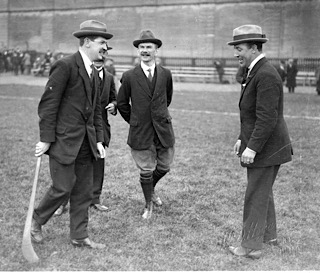
(From: “O’Toole, Luke” by Marcus de Búrca, Dictionary of Irish Biography, http://www.dib.ie, October 2009 | Pictured: Michael Collins, Luke O’Toole and Harry Boland in 1921, Image credit: GAA)


Leave a comment

Death of J. J. Walsh, Politician & Businessman

James Joseph Walsh, generally referred to as J. J. Walsh, Postmaster General (later Minister for Posts and Telegraphs) of the Irish Free State from 1922 to 1927, dies in Dublin on February 3, 1948. He is also a senior Gaelic Athletic Association (GAA) organiser and Cumann na nGaedheal politician. Later, he has heavy connections with fascism, including his association with Ailtirí na hAiséirghe.

Walsh is born in the townland of Rathroon, near Bandon, County Cork, on February 20, 1880. His family comes from a farming background, “working a substantial holding of medium but well-cultivated land.” Until the age of fifteen, he attends a local school in Bandon, but by his own account “as far as learning went, I may as well have been at home.” Together with his school friend P. S. O’Hegarty, he passes the Civil Service exams for the Postal service. He later works locally as a clerk in the Post Office. Like O’Hegarty, he spends three years in London at King’s College, studying for the Secretary’s Office “a syllabus (which) differed little from the Indian Civil Service.” While O’Hegarty succeeds in his studies, Walsh does not, and returns to Cork where a friend, Sir Edward Fitzgerald, arranges work for him on the Entertainments Committee of the Cork International Exhibition.

Walsh is active in the GAA, promoting Gaelic games in many areas, but particularly in Cork city and county. His interest in organised sports has a strong political dimension.

“I happened to be one of those who realised the potentialities of the GAA as a training ground for Physical Force. Contamination with the alien and all his works was taboo. I gathered around me a force of youthful enthusiasts from the University, Civil Service and Business. With this intensely organised instrument, war was declared on foreign games which were made to feel the shock so heavily that one by one, Soccer and Rugby Clubs began to disappear.”

Walsh is also instrumental in establishing the “revived” Tailteann Games. He is Chairman of the Cork County Council GAA and is involved in the founding of the Cork City Irish Volunteers.

Walsh participates in the Easter Rising in 1916 in the General Post Office (GPO). He claims he is responsible for mobilising 20 members of the Hibernian Rifles and takes them to the GPO. However, Rifles commandant John J. Scollan contradicts this account. He is promoted from Rifleman to Vice-Commandant of the Hibernian Rifles in 1915.

Walsh is arrested following the general surrender and sentenced to death after a court-martial at Richmond Barracks. This is almost immediately commuted to life imprisonment, but he is released the following year under a general amnesty.

In later 1917 Walsh is arrested and imprisoned after making a speech declaring “the only way to address John Bull is through the barrel of a rifle.”

In the autumn of 1919 Walsh is involved in a failed assassination attempt on John French, 1st Earl of Ypres.

Walsh is elected as a Sinn Féin Member of Parliament (MP) in the 1918 United Kingdom general election for the Cork City constituency. As a member of the First Dáil he is arrested for partaking in an illegal government. He is released in 1921 and supports the Anglo-Irish Treaty and goes on to become a founding member of the new political party, Cumann na nGaedheal. He serves as Postmaster General from 1922 until 1924 and joins the cabinet of W. T. Cosgrave between 1924 and 1927, after the office is reconstituted as the Department of Posts and Telegraphs. He is elected at every election for the Cork Borough constituency until 1927 when he retires from government.

In August 1922 Walsh is part of a government committee which is intended to consider what the Irish Free State’s policy towards north-east Ulster will be.

During World War II, known at the time in Ireland as “the Emergency,” Walsh’s connections with fascism, including his association with Ailtirí na hAiséirghe, bring him to the attention of the Directorate of Military Intelligence, the Intelligence branch of the Irish Army. Their request to the Minister for Justice, Gerald Boland, to place a tap on Walsh’s phone is, however, refused. He is closely associated with Irish-based pro-Nazi initiatives through his association with Ailtirí na hAiséirghe, frequently expressing his views with anti-semitic rhetoric.

After leaving politics Walsh founds a bus company which operates with great success between the city centre and south Dublin. When private bus services are bought out by the Dublin Tramway Co., he invests his profits in other Irish companies including Clondalkin Paper Mills, Solus Teoranta and Benbulben Barytes. He is also a director of Killeen and Newbrook Paper Mills, timber exporters Dinan Dowds, the Moore Clothing Co., and Fancy Goods. In 1937 he is elected president of the Federation of Irish Manufacturers, having previously held the vice-presidency. His businesses benefit greatly from the protectionist measures introduced by Fianna Fáil after 1932. Nonetheless, he complains that not enough has been done to make capital available to native entrepreneurs, and that “alien” interests are allowed too much scope to penetrate the Irish market.

In 1944 Walsh publishes a short memoir, Recollections of a Rebel. In his later years he suffers from deteriorating health, leading to his resignation from the presidency of the Federation of Irish Manufacturers in 1946. He dies in Dublin on February 3, 1948. He is buried in St. Finbarr’s Cemetery, Cork, County Cork.

On April 24, 2016, a plaque commemorating Walsh is unveiled in Kilbrittain, County Cork.


2 Comments

Death of Patrick O’Callaghan, Olympic Gold Medalist

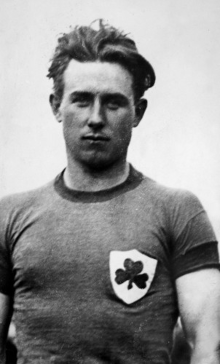
Patrick “Pat” O’Callaghan, Olympic gold medalist and world record holder, dies on December 1, 1991, in Clonmel, County Tipperary.

O’Callaghan is born on September 15, 1905, at Derrygallon, Kanturk, County Cork. He attends the Royal College of Surgeons in Ireland (RCSI) in Dublin and qualifies as a doctor at the age of 20. He joins the Royal Air Force Medical Services in 1926 on a short-service engagement, before moving to Clonmel in 1931 to work as an assistant medical officer in St. Luke’s Hospital, later setting up as a general practitioner in the town. He continues to practise there until the late 1980s.

While in university, O’Callaghan develops an interest in the hammer, having seen the country’s top hammer-throwers practise at the University College Dublin (UCD) grounds, then at Terenure College. At home in Cork for the summer, he does not have access to a hammer, so he collects an old cannon ball from Macroom Castle which he feels might approximate to the required 16 lb. (7.25 kg) weight, has it drilled at a foundry in Mallow and fitted with a handle and wire, and uses it to train at the family farm. In 1926 he wins the Munster title in the 56 lb. (25.4 kg) shot and follows that with an Irish hammer title in 1927. Victory the following year in that same championship qualifies him for the 1928 Summer Olympics in Amsterdam, which he enters as a complete unknown with a previous best of 166 ft. 11 in. (50.87 m), as against three other contenders who have each thrown well over 170 ft. (51.8 m). The hammer event is staged on July 30, 1928, and, lying third after four rounds, he throws 168 ft. 7 in. (51.38 m) with his penultimate attempt, to defeat the Swedish favourite, Ossian Skiöld, by 4 inches (10 cm), with the American contenders Edmund Black and Frank Conner, still further behind. He becomes the first athlete from the Irish Free State to be crowned Olympic champion. Less than a fortnight later, he wins the Tailteann Games with an Irish record throw of 170 ft. 2 in. (51.87 m).

Over the following years O’Callaghan wins events across Ireland and Europe and continues to achieve pioneering feats, not least in 1931, when he wins six Irish titles in one afternoon: hammer, shot put, discus, high jump, 56 lbs. without follow, and 56 lbs. over-the-bar. On August 1, 1932, he defends his Olympic title at the 1932 Summer Olympics in Los Angeles. With just one throw left in the competition, he trails second behind the Finnish champion, Ville Pörhölä. With his last throw, he claims the event with a distance of 176 ft. 11 in. (53.92 m), becoming the only Irish person in history to win two gold medals at the Olympic games. He seems in prime condition to defend his title for a third time at the 1936 Summer Olympics in Berlin, but a dispute in the athletics world brings the suspension of the National Athletic and Cycling Association of Ireland (NACAI) by the International Amateur Athletic Federation (IAAF). The subsequent decision not to send a team to Berlin by the Irish Olympic Council denies him the opportunity to win a hat-trick of gold medals.

O’Callaghan remains a dominant force in athletic circles, however. In 1934 he sets the record for the hammer on European soil with a throw of 186 ft. 10 in. (56.95 m) at Enniscorthy, County Wexford. He later achieves an unofficial world record in the hammer in 1937 in Fermoy, County Cork, with a remarkable throw of 195 ft. 5 in. (59.55 m), breaking the old record by more than 6 ft. (1.83 m). As the IAAF still refuses to sanction the NACAI, the record is not ratified, ensuring that the then twenty-four-year-old record of his compatriot, Patrick Ryan, who competes for the United States, remains in place. In total, as well as his two Olympic gold medals, he also wins six Irish championships in the hammer, four Irish championships in the 56 lb. shot, three Irish championships throwing the 56 lb. weight over-the-bar, and one Irish championship in the discus. He also wins the American hammer championship in 1933 and the British championship in the same event the following year. Despite his size, he jumps 6 ft. 2 in. (1.88 m) in the high jump and is Irish champion on three consecutive occasions (1929–31).

After an accident in which a child is killed by a flying hammer, O’Callaghan emigrates to the United States just before World War II and takes up professional wrestling. Attempts are made to set up a match with world wrestling champion Dan O’Mahoney, but this never occurs. He has a high profile, however. Samuel Goldwyn offers him the film role of Tarzan and he plays handball with Bing Crosby before returning home to Clonmel, where he becomes a prominent member of Clonmel Commercials Gaelic football club and manages that club’s senior team to three county championships (1965–67). He is later chairman and honorary president of the club. In 1984 he is made a Freeman of Clonmel, a town where he is known as “the doc” or “Dr. Pat” and revered as a humble, charming, jovial man, with a reputation for particular kindness to his poorer patients. At 6 ft. 1 in. (1.855 m) and sixteen stone (101.6 kg), he is a larger-than-life figure and the focal point of innumerable stories confirming his status as a living legend. In 1960 he is the first person voted into the newly conceived Texaco Hall of Fame. He lives for many years at Roseville, Western Road, Clonmel, and dies there on December 1, 1991.

O’Callaghan is survived by three sons and one daughter. His younger brother Con represents Ireland in the decathlon at the 1928 Olympic games and wins that event at the third Tailteann games in 1932.

(From: “O’Callaghan, Patrick (‘Pat’)” by Paul Rouse, Dictionary of Irish Biography, http://www.dib.ie)