Mitchel is born in Camnish, near Dungiven, County Derry, on November 3, 1815, the son of a Presbyterian minister. At the age of four, he is sent to a classical school, run by an old minister named Moor, nicknamed “Gospel Moor” by the students. He reads books from a very early age. When a little over five years old, he is introduced to Latin grammar by his teacher and makes quick progress. In 1830, not yet 15 years old, he enters Trinity College, Dublin (TCD) and obtains a law degree in 1834.
In the spring of 1836, Mitchel meets Jane Verner, the only daughter of Captain James Verner. Though both families are opposed to the relationship, they become engaged in the autumn and are married on February 3, 1837, by the Rev. David Babington in Drumcree Church, the parish church of Drumcree.
Mitchel works in a law office in Banbridge, County Down, where he eventually comes into conflict with the local Orange Order. He meets Thomas Davis and Charles Gavan Duffy during visits to Dublin. He joins the Young Ireland movement and begins to write for The Nation. Deeply affected by the misery and death caused by the Great Famine, he becomes convinced that nothing will ever come of the constitutional efforts to gain Irish freedom. He then forms his own paper, United Irishmen, to advocate passive resistance by Ireland’s starving masses.
In May 1848, the British tire of Mitchel’s open defiance. Ever the legal innovators in Ireland, they invent a crime especially for the Young Irelanders – felony-treason. They arrest him for violating this new law and close down his paper. A rigged jury convicts him, and he is deported first to Bermuda and then to Australia. However, in June 1853, he escapes to the United States.
Mitchel works as a journalist in New York City and then moves to the South. When the American Civil War erupts, he is a strong supporter of the Southern cause, seeing parallels with the position of the Irish. His family fully backs his commitment to the Southern cause. He loses two sons in the war, one at the Battle of Gettysburg in 1863 and another at the Battle of Fort Sumter in 1864, and another son loses an arm. His outspoken support of the Confederacy causes him to be jailed for a time at Fort Monroe, where one of his fellow prisoners is Confederate PresidentJefferson Davis.
In 1874, the British allow Mitchel to return to Ireland and in 1875 he is elected in a by-election to be a member of the Parliament of the United Kingdom representing the Tipperary constituency. However, his election is invalidated on the grounds that he is a convicted felon. He contests the seat again in the resulting by-election and is again elected, this time with an increased vote.
Unfortunately, Mitchel, one of the staunchest enemies to English rule of Ireland in history, dies in Newry on March 20, 1875. He is buried in his parents’ grave in the unitarian cemetery, High Street, Newry, where a monument is later erected by his widow. He is also commemorated by a statue in Newry. Thirty-eight years later, his grandson, John Purroy Mitchel, is elected Mayor of New York City.
Mitchel is born in Camnish, near Dungiven, County Derry on November 3, 1815, the son of a Presbyterian minister. At the age of four, he is sent to a classical school, run by an old minister named Moor, nicknamed “Gospel Moor” by the students. He reads books from a very early age. When a little over five years old, he is introduced to Latin grammar by his teacher and makes quick progress. In 1830, not yet 15 years old, he enters Trinity College, Dublin (TCD) and obtains a law degree in 1834.
In the spring of 1836, Mitchel meets Jane Verner, the only daughter of Captain James Verner. Though both families are opposed to the relationship, they become engaged in the autumn and are married on February 3, 1837, by the Rev. David Babington in Drumcree Church, the parish church of Drumcree.
Mitchel works in a law office in Banbridge, County Down, where he eventually comes into conflict with the local Orange Order. He meets Thomas Davis and Charles Gavan Duffy during visits to Dublin. He joins the Young Ireland movement and begins to write for The Nation. Deeply affected by the misery and death caused by the Great Famine, he becomes convinced that nothing will ever come of the constitutional efforts to gain Irish freedom. He then forms his own paper, United Irishman, to advocate passive resistance by Ireland’s starving masses.
In May 1848, the British tire of Mitchel’s open defiance. Ever the legal innovators in Ireland, they invent a crime especially for the Young Irelanders – felony-treason. They arrest him for violating this new law and close down his paper. A rigged jury convicts him, and he is deported first to Bermuda and then to Australia. However, on June 8, 1853, he escapes to the United States.
Mitchel works as a journalist in New York City and then moves to the South. When the American Civil War erupts, he is a strong supporter of the Southern cause, seeing parallels with the position of the Irish. His family fully backs his commitment to the Southern cause. He loses two sons in the war, one at the Battle of Gettysburg in 1863 and another at the Battle of Fort Sumter in 1864, and another son loses an arm. His outspoken support of the Confederacy causes him to be jailed for a time at Fort Monroe, where one of his fellow prisoners is Confederate PresidentJefferson Davis.
In 1874, the British allow Mitchel to return to Ireland and in 1875 he is elected in a by-election to be a member of the Parliament of the United Kingdom representing the Tipperary constituency. However, his election is invalidated on the grounds that he is a convicted felon. He contests the seat again in the resulting by-election and is again elected, this time with an increased vote.
Unfortunately, Mitchel, one of the staunchest enemies to English rule of Ireland in history, dies in Newry on March 20, 1875, and is buried there. Thirty-eight years later, his grandson, John Purroy Mitchel, is elected Mayor of New York City.
Hayes-McCoy is born to Thomas Hayes-McCoy and Mary Kathleen Hayes-McCoy (née Wallace). His grandfather, Thomas Hayes-McCoy, is a Dubliner who as a child came to Galway in 1834 and is later a well-known Parnellite. His maternal grandfather, Thomas Burke, is a Galway artist. He grows up on Eyre Square where his father runs a gentleman’s hairdressing business. His two older siblings are Ignatius and Marguerite. The latter receives a PhD-degree in History at University College Galway (UCG), and later teaches at the Galway Technical School.
Hayes-McCoy receives his early education from the Patrician Brothers, Galway. His earliest notebook of 1927 and a manuscript history of Poland of the same year, now at the National Library of Ireland (NLI), testify to an early interest in history and heritage. From 1928 to 1932 he is a student scholarship holder at University College Galway, graduating in 1932 with a Bachelor of Commerce, and a Bachelor of Arts, with first-class honours in both, and a specialisation in “History, Ethics, Politics” for the latter. Mary Donovan O’Sullivan is one of his professors of history, and Liam Ó Briain, professor of Romance languages, is a stimulating influence. At this time, Hayes-McCoy is a member of the Republican Club, a committee member of the Literary and Debating Society, and in 1931 he is one of the founding members of a new Irish Students’ Association.
Hayes-McCoy pursues his PhD at the University of Edinburgh, and then spends two years at the Institute of Historical Research, London, in the Tudor seminar of J. E. Neale, rewriting his PhD and eventually publishing it as Scots mercenary forces in Ireland, 1565–1603 (Dublin and London, 1937), with a foreword by Eoin MacNeill. This is characterised by meticulous archival research, and it anticipates by sixty years the much-vaunted New British History of the late twentieth century by tracing the interconnections between events in England, Ireland, and Scotland.
In the absence of an academic post, Hayes-McCoy becomes an assistant keeper in the Art and Industrial Division at the National Museum of Ireland (1939–1959), with a responsibility for the Military History, and the Irish War of Independence collections. One of his first tasks is to prepare a standing exhibition on Irish history before 1916. His research, long-standing personal interest in the military, and his curatorial experience, helps form an expert knowledge of historical Irish warfare. This leads to his role in co-founding The Military History Society of Ireland in 1949 whose journal, The Irish Sword, he edits. He describes the vagaries of setting up such a body, its reception, and the historiographical considerations attendant on it, in a paper published posthumously in The Irish Sword.
On August 19, 1941, Hayes-McCoy marries Mary Margaret “May” O’Connor, daughter of C.J. and M.B. O’Connor of New Ross/Enniscorthy. They have three daughters and two sons: Mary, Ann, Ian, Robert, Felicity. The family home is in Dublin.
Earning high reputation by continued research and by publishing leads to Hayes-McCoy’s receipt of the D.Litt. degree from the National University, and to his membership in the Royal Irish Academy in 1950. In his professional career, apart from the broad spectrum of press publications, he publishes prolifically. The works that are judged most influential, are his Scots mercenary forces in Ireland 1565–1603 (1937), the papers “The early history of guns in Ireland” (1938–1939), “Strategy and tactics in Irish warfare, 1593–1601” (1941), “The army of Ulster, 1593–1601” (1951), the controversial “Gaelic society in Ireland in the late sixteenth century” (1963), and the monographs “Irish battles” (London 1969), and “A history of Irish flags from earliest times” (Dublin 1979). A member of the Irish Manuscripts Commission, his most notable contribution is the publication “Ulster and other Irish maps, c.1600” (Dublin 1964).
In 1946, Hayes-McCoy is appointed to a committee of eight historians to advise on setting up the Bureau of Military History, a body established for the creation and compilation of material on the history of the Irish movements for independence, 1913–1921, specifically from witness statements. The committee is also to further offer guidance and oversee progress of the Bureau in coordination with the Ministry of Defence. It subsequently expresses concerns about the state’s role and methods in the collection of statements.
Having begun writing for the press at an early stage, Hayes-McCoy’s public position at the Museum encourages him to go further. He has broad involvement with local history groups to whom he presents papers, and also works for newspapers and for radio and television. To the national and Galway press he usually contributes articles on military aspects of Irish history, as well as book reviews, but he also uses them as a platform to engage with what he sees are flaws in the education of history in Ireland which during his lifetime is constrained by a certain degree of political and cultural state control.
During the 1940s and 1950s, Hayes-McCoy becomes involved in a number of paratheatrical events of national significance one of which – the “Pageant of St.Patrick” for which he writes the script (An Tóstal 1954) – is realised on an immense scale. He scripts these works to begin with and is later principally engaged as historical consultant. In that capacity, he collaborates in 1955 and 1956 with Micheál Mac Liammóir and Denis Johnston on their scripts for pageants on St. Patrick and on the Táin Bó Cuailgne, at times finding it difficult to square the historical liberties taken by these artists with his own role.
On Irish radio and television Hayes-McCoy is most active in the mid-1960s, editing and contributing to Thomas Davis lectures series, writing scripts for a series of thirty children’s programmes on all aspects of Irish history, and preparing/contributing on air to the television series “Irish battles” and “The long winter.” As well as writing for RTÉ, Ireland’s national broadcaster, he contributes scripts to BBC Northern Ireland‘s schools radio programmes.
In 1959, Hayes-McCoy succeeds to the chair of his former history professor at UCG with the full remit of lecturing, administering examinations to undergraduates, and supervising postgraduate theses. Among his students who continue in the field of history are Nicholas Canny, Martin Coen, Patrick Melvin, Peter Toner, Tony Claffey, and Breandán Ó Bric. After his appointment to UCG, the family home remains in Dublin, and he commutes to Galway weekly during term time.
In the early 1960s, Hayes-McCoy becomes a spokesperson for the movement rekindled by the Old Galway Society to preserve the landmark “Lion’s Tower” in the city. The ultimate failure of the campaign informs his regret, expressed a year later, that Ireland is forgetful about its past and that “we don’t bother to find out about it or to maintain our ancient heritage,” and, on a perceived spirit of conformity, “take my own city of Galway, it is now more prosperous than it was, but it is no longer distinctive. I do not believe that it is essential for progress that we should lose our heritage.”
While at one time member and secretary of the London Sinn Féin office and informed by a pride of country and place, Hayes-McCoy’s professional and private outlook are marked by a distrust of nationalism or of any antagonising national agendas compromising genuine scholarship. In a paper drafted on tendencies in modern historical studies, he criticises the two historiographical extremes, each to be avoided, each unfortunately characteristic of the moment – extreme de-bunking and extreme “adding for effect.” “A history is a record of fact; to add pseudo-facts is as grave a sin as to leave out real facts that may change the colour of the whole.”
Hayes-McCoy’s abiding pastime is drawing. Among his papers in the James Hardiman Library, NUI Galway are approximately 40 items with predominantly maritime subjects, and he has a special regard for the history of ships, and a romantic liking of the sea. He also has a lifelong interest in Robert Louis Stevenson, Sir Walter Scott, and their works, and in the Pre-Raphaelite movement.
Hayes-McCoy’s middle age is marked by intermittent ill health. He dies on November 27, 1975, in his room at the Great Southern Hotel, Eyre Square, Galway.
Hayes-McCoy’s papers are held at the James Hardiman Library, National University of Ireland, Galway.
Doheny receives a rudimentary education from an itinerant scholar while labouring on his father’s holding, and in 1826 attends Maher’s classical academy near Emly for nine months. Educating himself in the late 1820s and early 1830s while teaching the children of local farmers, he determines on a career in law to help secure political redress for the disenfranchised poor. He is admitted to Gray’s Inn in November 1834, enters the King’s Inns, Dublin, in 1835 and is called to the Irish bar in 1838. Settling later that year in Cashel, County Tipperary, he first practises in the local courts and then on the southern circuit. Appointed legal assessor to the borough of Cashel under the Municipal Corporations (Ireland) Act 1840, he successfully prosecutes former borough officers for misappropriation of funds and fraudulent transfer of property, winning wider attention. He had supported the campaign for repeal in the early 1830s, and in 1841 joins Daniel O’Connell‘s Repeal Association, becoming active in forming temperance bands and setting up town meetings. By May 1841 he is on the association’s general committee. O’Connell finds him less tractable than most and is ruffled by his queries into the association’s financial management.
During 1842 Doheny begins to associate with the more militant members of the repeal movement such as Thomas Davis. There is a marked gap in age and class between Doheny and most of this group and some look down on his lack of refinement. Others, however, admire his zeal and sincerity, and an anonymous colleague describes him as “rough, generous, bold, a son of the soil, slovenly in dress, red-haired and red-featured, but a true personification of the hopes, passions, and traditions of the people.” Assisting in the launch of The Nation in October 1842, he is chagrined to find most of his articles rejected as unfit for publication, although fifteen are published between January 1843 and September 1844. He also publishes a competent History of the American Revolution (1846) for The Nation‘s “Library of Ireland” series. More impressive as a speaker than a writer, he contributes regularly to repeal meetings at Conciliation Hall, Burgh Quay, Dublin. He enthuses at the apparent martial potential of the immense, ordered crowds attending the “monster” repeal meetings of 1843, and is one of the main organisers of the Cashel meeting of May 31, 1843, at which he is loudly cheered. However, his later claim to have deliberately set up these meetings, with Davis and John Blake Dillon, on quasi-military lines in order to prepare the peasantry for a future war with Britain, is far-fetched. His opposition to O’Connell’s decision to submit to proclamation of the proposed meeting of October 8, 1843, at Clontarf again greatly irritates O’Connell.
An active member of the Repeal Association parliamentary committee from February 1844, in February and March 1845 Doheny chairs a sub-committee of five senior barristers investigating the legality of withdrawal from the House of Commons by the body of repeal MPs, coming “reluctantly” to the verdict that such an action is open to criminal prosecution. O’Connell’s gruff dismissal of his report testifies to their awkward relationship. He further vexes O’Connell by his advocacy of non-denominational university education during debates over the Maynooth College Act 1845. Irrevocable divisions between the Young Irelanders and O’Connell open up between April and July 1846 when Doheny leads calls for endorsement of the conduct of William Smith O’Brien – imprisoned for a month for refusal to serve on a parliamentary committee – and voices Young Ireland’s martial convictions in a speech at Liverpool. After the secession of the Young Irelanders from the Repeal Association in July 1846, he opposes attempts at reconciliation and is one of the founders of the Irish Confederation on January 13, 1847.
During the summer of 1847, Doheny begins setting up “Confederate Clubs” in east Tipperary and aids James Fintan Lalor in organising a failed tenant league meeting at Holycross, County Tipperary, on September 19. He is one of the few Young Irelanders attracted to Lalor’s revolutionary agrarian philosophy, but supports Smith O’Brien against John Mitchel in January 1848, deploring irresponsible demands for insurrection. However, after Mitchel’s conviction for treason felony in May, he supports armed action. Arrested for seditious speechmaking at Cashel on July 12, he is bailed on July 20. During the confused period of “rebellion” in late July, he attempts to organise the peasantry in Tipperary but is frustrated by O’Brien’s vacillation.
After the collapse of the armed adventure at Ballingarry on July 31, Doheny takes refuge near Slievenamon and, with James Stephens, eludes pursuit for nearly two months, until he finally escapes, disguised as a clergyman, on a cattle-ship from Cork to Bristol. Some days later he reaches Paris, where he stays for two months with Stephens and John O’Mahony before leaving for New York City. Practising law in New York, he dedicates himself to the development of an Irish Americanrepublican movement. Tensions between conservative and radical Young Ireland exiles, perhaps aggravated by social snobbery, surface by late 1849, when he is arrested for attempting to push Thomas D’Arcy McGee into an open cellar on a New York street, angered by accusations of boasting, drunkenness, and incompetence. Similar criticisms are made by John Blake Dillon and appear to have some foundation.
Doheny finds time to write The Felon’s Track (1849), a polemical account of the repeal agitation and the 1848 insurrection that is highly critical of O’Connell. Despite a rambling narrative, it becomes a popular work and is reprinted several times. He also gives several lectures on historical and literary subjects to Irish American societies and contributes a memoir on Geoffrey Keating to O’Mahony’s translation (1857) of Foras Feasa ar Éirinn.
Involved with the New York Irish militia from his arrival, he is elected lieutenant colonel of the 69th Infantry Regiment in November 1851, and in September 1852 becomes colonel of a new regiment, the Irish Republican Rifles. These formations are often wracked by dissension over strategy and leadership, and in February 1856 he and O’Mahony found the Emmet Monument Association, planning to mobilise an Irish American force to invade Ireland. Efforts to acquire Russian backing fails on the close of the Crimean War in March 1857.
In autumn 1857, Doheny and O’Mahony make overtures to James Stephens to reorganise the republican movement in Ireland, and in March 1858 they accept Stephens’s demands for undisputed authority there, though by the winter of 1858–59 Doheny shows increasing distrust of Stephens’s ambitions. Adopting the organisational structure set out by Stephens in establishing the IRB in 1858, he and O’Mahony found the American equivalent, the Fenian Brotherhood, in early 1859, although he plays a subordinate part. In July 1859, he founds and edits a short-lived newspaper in New York, The Phoenix, to promote Fenian ideals. Active in opposing the national petition for self-government of 1860–61, he argues that Britain will only yield to force. He assists in making preparations for the funeral of Terence Bellew MacManus in Ireland and acts as one of the pallbearers in New York. Travelling to Ireland in October 1861, he appears to argue for using the excitement engendered by the funeral to spark an insurrection in Dublin but is thwarted by Stephens.
Doheny dies suddenly on April 1, 1862, in New York and is buried in Calvary Cemetery in the city’s borough of Queens.
(From: “Doheny, Michael” by James Quinn and Desmond McCabe, Dictionary of Irish Biography, http://www.dib.ie, October 2009)
Duffy is born on April 12, 1816, in Dublin Street, Monaghan, County Monaghan. Both of his parents die while he is still a child and his uncle, Fr. James Duffy, who is the Catholic parish priest of Castleblayney, becomes his guardian for a number of years. He is educated at St. Malachy’s College in Belfast and is admitted to the Irish Bar in 1845. He becomes a leading figure in Irish literary circles.
In August 1850, Duffy forms the Tenant Right League to bring about reforms in the Irish land system and protect tenants’ rights, and in 1852 is elected to the House of Commons for New Ross. By 1855, the cause of Irish tenants seems more hopeless than ever. Broken in health and spirit, Duffy publishes a farewell address to his constituency, declaring that he has resolved to retire from parliament, as it is no longer possible to accomplish the task for which he has solicited their votes.
In 1871, Duffy leads the opposition to Premier Sir James McCulloch‘s plan to introduce a land tax, on the grounds that it unfairly penalised small farmers. When McCulloch’s government is defeated on this issue, he becomes Premier and Chief Secretary. The majority of the colony is Protestant, and he is accused of favouring Catholics in government appointments. In June 1872, his government is defeated in the Assembly on a confidence motion allegedly motivated by sectarianism.
When Graham Berry becomes Premier in 1877, he makes Duffy Speaker of the Legislative Assembly, a post he holds without much enthusiasm until 1880, when he quits politics and retires to the south of France. Duffy remains interested in both the politics of his adoptive country and of Ireland. He is knighted in 1873 and is made KCMG in 1877.
Duffy spends his last years in Nice and dies at the age of 86 on February 9, 1903, at his home there, 12 Boulevard Victor Hugo. He is buried at Glasnevin Cemetery, Glasnevin, Dublin on March 8. 1903. The length of his career, the breadth of his experience, and his voluminous labours as a chronicler make him an important figure in the history of Ireland and the Irish diaspora in the nineteenth century. He also deserves attention as the most prominent and articulate Ulster catholic nationalist of his time. There are Duffy papers in the Royal Irish Academy and National Library of Ireland.
Duffy is born in 1809 probably in County Cavan, at either Shercock or Kingscourt, and is educated locally at a hedge school. He has at least two brothers and two sisters. He first makes a living as a pedlar in County Cavan and County Meath, dealing with Bryan Geraghty, a bookseller in Anglesea Street, Dublin, with whom he exchanges Irish manuscripts for Catholicprayer books. He also buys up Bibles distributed in Ireland by Protestant missionaries for resale in Great Britain. When aged about thirty he sets up in business in Anglesea Street as a publisher, printer and bookseller, specialising in low-priced Catholic books, such as A pocket missal for the use of the laity (1838) and a new edition of the Catechism (1848) by Andrew Donlevy, made possible by the invention of the stereotype. He moves his business to Wellington Quay in 1846. He also prints and distributes public statements by Catholic prelates, and is able to call himself “bookseller to the cardinal archbishop of Dublin.”
At the request of the editor of The Nation, Charles Gavan Duffy (to whom he is not related), he republishes an anthology of nationalistic ballads, The spirit of the nation (1843; 59th ed., 1934), a successful venture that links him to the Young Ireland movement and expands into the publication of numerous popular historical writings, beginning with Gavan Duffy’s Library of Ireland series. He publishes several periodicals for Catholic readers, which combine pietism and patriotism with hagiography: Duffy’s Irish Catholic Magazine (1847–8), Duffy’s Fireside Magazine (1850–54), and Duffy’s Hibernian Magazine (1860–64).
Judged by the distinction of his authors (who include William Carleton, Thomas Davis, John Mitchel, James Clarence Mangan and Richard Robert Madden, the number and popularity of his productions, and their formative influence on Catholic popular opinion, he can be considered the most important Irish publisher in the middle decades of the nineteenth century. He is particularly significant in providing the Young Ireland movement with a cheap and reliable publisher for the dissemination of their writings. Charles Gavan Duffy describes him as “a man of shrewd sense and sly humour but without cultivation or judgment in literature.” He never takes a holiday and, though a kindly employer, never allows his staff to take holidays. The Irish American newspaper Irish American Weekly credits him with providing employment for 500 people and with having bought enough land to give him an income of £5,000 a year. It also notes that his ruthlessness had made him unpopular within his trade.
In 1840 Duffy marries Frances Lynch in Kingscourt, County Cavan. They have five sons and five daughters. The family susceptibility to pulmonary illnesses takes a dreadful toll: none of the sons live beyond the age of twenty-three, three dying from tuberculosis, while one of his daughters dies of pneumonia at the age of fourteen and another two daughters succumb as relatively young adults to tuberculosis.
Duffy dies at the age of 62 on July 4, 1871, at his home at Clontarf, Dublin. He is buried at Glasnevin Cemetery. His will, which disposes of an estate worth almost £25,000, is contested unsuccessfully in court by the younger of his two surviving sons. His son-in-law, Edmund Burke, becomes managing director of James Duffy and Company Limited, but after his death in 1901 the company passes out of the control of its founder’s family.
(From: “Duffy, James” by C. J. Woods, Dictionary of Irish Biography, http://www.dib.ie, October 2009)
Mangan is born on May 1, 1803, in Dublin. His poetry fits into a variety of literary traditions. Most obviously, and frequently, his work is read alongside such nationalist political authors as John Mitchel, as they appear in The Nation, The Vindicator and the United Irishman newspapers or as a manifestation of the 19th-century Irish Cultural Revival. He is also frequently read as a Romantic poet.
Mangan is the son of James Mangan, a former hedge school teacher and native of Shanagolden, County Limerick, and Catherine Smith from Kiltale, County Meath. Following his marriage to Smith, James Mangan takes over a grocery business in Dublin owned by the Smith family, eventually becoming bankrupt as a result. Mangan describes his father as having “a princely soul but no prudence,” and attributes his family’s bankruptcy to his father’s suspect business speculations and tendency to throw expensive parties. Thanks to poor record keeping, inconsistent biographies, and his own semi-fictional and sensationalized autobiographical accounts, his early years are the subject of much speculation. However, despite the popular image of him as a long-suffering, poor poet, there is reason to believe that his early years are spent in middle class comfort.
Mangan is educated at a Jesuit school where he learns Latin, Spanish, French, and Italian. He attends three schools before the age of fifteen. Obliged to find a job in order to support his family, he then becomes a lawyer’s clerk, and is later an employee of the Ordnance Survey and an assistant in the library of Trinity College, Dublin.
Mangan’s first verses are published in 1818. From 1820 he adopts the middle name Clarence. In 1830 he begins producing translations – generally free interpretations rather than strict transliterations – from German, a language he had taught himself. Of interest are his translations of Johann Wolfgang von Goethe. From 1834 his contributions begin appearing in the Dublin University Magazine. In 1840 he begins producing translations from Turkish, Persian, Arabic and Irish. He is also known for literary hoaxes as some of his “translations” are in fact works of his own, like Twenty Golden Years Ago, attributed to a certain Selber.
Mangan is friends with the patriotic journalists Thomas Davis and John Mitchel, who ultimately writes his biography. His poems are published in their newspaper The Nation.
Although Mangan’s early poetry is often apolitical, after the Great Famine he begins writing patriotic poems, including influential works such as Dark Rosaleen, a translation of “Róisín Dubh,” and A Vision of Connaught in the Thirteenth Century.
Mangan’s best known poems include Dark Rosaleen, Siberia, Nameless One, A Vision of Connaught in the Thirteenth Century, The Funerals, To the Ruins of Donegal Castle, Pleasant Prospects for the Land-eaters and Woman of Three Cows. He writes a brief autobiography, on the advice of his friend Charles Patrick Meehan, which ends mid-sentence. This is apparently written in the last months of his life, since he mentions his narrative poem of the Italian Gasparo Bandollo, which is published in the Dublin University Magazine in May 1849.
Mangan is a lonely and often difficult man who suffers from mood swings, depression and irrational fears, and becomes a heavy drinker and opium user. His appearance grows eccentric, and he is described by the artist WF Wakeman as frequently wearing “a huge pair of green spectacles,” padded shirts to hide his malnourished figure and a hat which “resembled those which broomstick-riding witches are usually represented with.” On June 20, 1849, weakened by poverty, alcoholism and malnutrition, he succumbs to cholera at the age of 46. He is buried in Glasnevin Cemetery in Dublin.
(Pictured: Memorial bust of James Mangan in St. Stephen’s Green, sculpted by Oliver Sheppard)
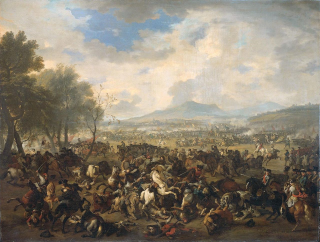
For the Grand Alliance – Austria, England, and the Dutch Republic – the Battle of Ramillies follows an indecisive campaign against the Bourbon armies of King Louis XIV of France in 1705. Although the Allies capture Barcelona that year, they are forced to abandon their campaign on the Moselle, stall in the Spanish Netherlands and suffer defeat in northern Italy. Yet despite his opponents’ setbacks Louis XIV wants peace, but on reasonable terms. Because of this, as well as to maintain their momentum, the French and their allies take the offensive in 1706.
In less than four hours Marlborough’s Dutch, English, and Danish forces overwhelm Villeroi’s and Maximilian II Emanuel‘s Franco-Spanish-Bavarian army. The Duke’s subtle moves and changes in emphasis during the battle, something his opponents fail to realise until it is too late, catches the French in a tactical vice. With their foe broken and routed, the Allies are able to fully exploit their victory. Town after town falls, including Brussels, Bruges and Antwerp. By the end of the campaign Villeroi’s army has been driven from most of the Spanish Netherlands. With Prince Eugene of Savoy‘s subsequent success at the Siege of Turin in northern Italy, the Allies impose the greatest loss of territory and resources that Louis XIV would suffer during the war. Thus, the year 1706 proves, for the Allies, to be an annus mirabilis.
(Pictured: “The Battle of Ramillies between the French and the English, 23 May 1706” by Jan van Huchtenburgh, oil on canvas painted between 1706 and 1710)
Mitchel is born in Camnish, near Dungiven, County Derry on November 3, 1815, the son of a Presbyterian minister. At the age of four, he is sent to a classical school, run by an old minister named Moor, nicknamed “Gospel Moor” by the students. He reads books from a very early age. When a little over five years old, he is introduced to Latin grammar by his teacher and makes quick progress. In 1830, not yet 15 years old, he enters Trinity College, Dublin and obtains a law degree in 1834. In the spring of 1836 he meets Jane Verner, the only daughter of Captain James Verner. Though both families are opposed to the relationship, they become engaged in the autumn and are married on February 3, 1837, by the Rev. David Babington in Drumcree Church, the parish church of Drumcree.
Mitchel works in a law office in Banbridge, County Down, where he eventually comes into conflict with the local Orange Order. He meets Thomas Davis and Charles Gavan Duffy during visits to Dublin. He joins the Young Ireland movement and begins to write for The Nation. Deeply affected by the misery and death caused by the Great Famine, he becomes convinced that nothing will ever come of the constitutional efforts to gain Irish freedom. He then forms his own paper, United Irishmen, to advocate passive resistance by Ireland’s starving masses.
In May 1848, the British tire of Mitchel’s open defiance. Ever the legal innovators in Ireland, they invent a crime especially for the Young Irelanders – felony-treason. They arrest him for violating this new law and close down his paper. A rigged jury convicts him, and he is deported first to Bermuda and then to Australia. However, in June 1853, he escapes to the United States.
Mitchel works as a journalist in New York City and then moves to the South. When the American Civil War erupts, he is a strong supporter of the Southern cause, seeing parallels with the position of the Irish. His family fully backs his commitment to the Southern cause. He loses two sons in the war, one at the Battle of Gettysburg in 1863 and another at the Battle of Fort Sumter in 1864, and another son loses an arm. His outspoken support of the Confederacy causes him to be jailed for a time at Fort Monroe, where one of his fellow prisoners is Confederate PresidentJefferson Davis.
In 1874, the British allow Mitchel to return to Ireland and in 1875 he is elected in a by-election to be a member of the Parliament of the United Kingdom representing the Tipperary constituency. However, his election is invalidated on the grounds that he is a convicted felon. He contests the seat again in the resulting by-election and is again elected, this time with an increased vote.
Unfortunately, Mitchel, one of the staunchest enemies to English rule of Ireland in history, dies eight days later in Newry on March 20, 1875, and is buried there. Thirty-eight years later, his grandson, John Purroy Mitchel, is elected Mayor of New York City.
As a young man O’Neill leaves Ireland, one of the ninety-nine involved in the Flight of the Earls escaping the English conquest of his native Ulster. He grows up in the Spanish Netherlands and spends 40 years serving in the Irish regiment of the Spanish army. He sees most of his combat in the Eighty Years’ War against the Dutch Republic in Flanders, notably at the Siege of Arras, where he commands the Spanish garrison. He also distinguishes himself in the Franco-Spanish War by holding out for 48 days with 2,000 men against a French army of 35,000.
O’Neill is, like many Gaelic Irish officers in the Spanish service, very hostile to the English Protestant presence in Ireland. In 1627, he is involved in petitioning the Spanish monarchy to invade Ireland using the Irish Spanish regiments. He proposes that Ireland be made a republic under Spanish protection to avoid in-fighting between Irish Catholic landed families over which of them would provide a prince or king of Ireland. This plot comes to nothing. However in 1642, He returns to Ireland with 300 veterans to aid the Irish Rebellion of 1641.
The subsequent war, known as the Irish Confederate Wars, is part of the Wars of the Three Kingdoms, civil wars throughout Britain and Ireland. Because of his military experience, O’Neill is recognised on his return to Ireland in July 1642, at Doe Castle in County Donegal, as the leading representative of the O’Neills and head of the Ulster Irish. Sir Phelim O’Neill resigns the northern command of the Irish rebellion in his favour and escorts him from Lough Swilly to Charlemont.
Jealousy between the kinsmen is complicated by differences between O’Neill and the Catholic Confederation which meet at Kilkenny in October 1642. O’Neill professes to be acting in the interest of Charles I, but his real aim is the complete Independence of Ireland as a Roman Catholic country, while the Old English Catholics represented by the council desire to secure religious liberty and an Irish constitution under the crown of England. More concretely, O’Neill wants the Plantation of Ulster overturned and the recovery of the O’Neill clan’s ancestral lands. Moreover, he is unhappy that the majority of Confederate military resources are directed to Thomas Preston‘s Leinster army. Preston is also a Spanish veteran but he and O’Neill have an intense personal dislike of each other.
Although O’Neill is a competent general, he is outnumbered by the Scottish Covenanter army that lands in Ulster in 1642. Following a reverse at Clones, he has to abandon central Ulster and is followed by thousands of refugees, fleeing the retribution of the Scottish soldiers for some atrocities against Protestants in the rebellion of 1641. He does his best to stop the killings of Protestant civilians, for which he receives the gratitude of many Protestant settlers. From 1642–1646 a stalemate exists in Ulster, which he uses to train and discipline his Ulster Army. This poorly supplied force nevertheless gains a very bad reputation for plundering and robbing friendly civilians around its quarters in northern Leinster and southern Ulster.
In 1646 O’Neill, with substantial Gallowglass numbers and additionally furnished with supplies by the Papal Nuncio, Giovanni Battista Rinuccini, attacks the Scottish Covenanter army under Major-General Robert Monro, who had landed in Ireland in April 1642. On June 5, 1646 O’Neill utterly routs Monro at the Battle of Benburb, killing or capturing up to 3,000 Scots. However after being summoned to the south by Rinuccini, he fails to take advantage of the victory, and allows Monro to remain unmolested at Carrickfergus.
In March 1646 a treaty is signed between James Butler, 1st Duke of Ormond and the Catholics, which would have committed the Catholics to sending troops to aid the Royalist cause in the English Civil War. The peace terms however, are rejected by a majority of the Irish Catholic military leaders and the Catholic clergy including the Nuncio, Rinuccini. O’Neill leads his Ulster army, along with Thomas Preston’s Leinster army, in a failed attempt to take Dublin from Ormond. However, the Irish Confederates suffer heavy military defeats the following year at the hands of Parliamentarian forces in Ireland at Dungan’s Hill and Knocknanauss, leading to a moderation of their demands and a new peace deal with the Royalists. This time O’Neill is alone among the Irish generals in rejecting the peace deal and finds himself isolated by the departure of the papal nuncio from Ireland in February 1649.
So alienated is O’Neill by the terms of the peace the Confederates have made with Ormond that he refuses to join the Catholic/Royalist coalition and in 1648 his Ulster army fights with other Irish Catholic armies. He makes overtures for alliance to George Monck, 1st Duke of Albemarle, who is in command of the parliamentarians in the north, to obtain supplies for his forces, and at one stage even tries to make a separate treaty with the English Parliament against the Royalists in Ireland. Failing to obtain any better terms from them, he turns once more to Ormond and the Catholic confederates, with whom he prepares to co-operate more earnestly when Oliver Cromwell‘s arrival in Ireland in August 1649 brings the Catholic party face to face with serious danger.
Before, however, anything is accomplished by this combination, O’Neill dies on November 6, 1649 at the O’Reilly stronghold of Cloughoughter Castle located on an island in Lough Oughter in County Cavan. There is no clear evidence of the cause of death, with one belief being that he was poisoned by a priest, while others think it is more likely that he died from an illness resulting from an old wound. Under cover of night he is reputed to have been brought to the Franciscan abbey in Cavan town for burial. However some local tradition still suggests that it may have been at Trinity abbey located upon an island in Lough Oughter, which may be more likely given the logistics of his removal. His death is a major blow to the Irish of Ulster and is kept secret for some time.
The Catholic nobles and gentry meet in Ulster in March 1650 to appoint a commander to succeed O’Neill, and their choice is Heber MacMahon, Roman Catholic Bishop of Clogher, the chief organiser of the recent Clonmacnoise meeting. O’Neill’s Ulster army is unable to prevent the Cromwellian conquest of Ireland, despite a successful defence of Clonmel by O’Neill’s nephew Hugh Dubh O’Neill and is destroyed at the Battle of Scarrifholis in County Donegal in 1650. Its remnants continue guerrilla warfare until 1653, when they surrender at Cloughoughter Castle in County Cavan. Most of the survivors are transported to serve in the Spanish Army.






 seamus dubhghaill