Bleakley runs for the Westminster seat of Belfast East in 1970 (gaining 41% of the vote), February 1974 and October 1974 for the Northern Ireland Labour Party each time, but never enough to win the Westminister seat from the Ulster Unionist Party (UUP). In 1971, Brian Faulkner appoints him as his Minister for Community Relations at Stormont, but as Bleakley is not an MP, he can only hold the post for six months. He resigns five days before his term expires in order to highlight his disagreement with government policy, specifically the failure to widen the government to include non-Unionist parties, and the decision to introduce internment. He writes a respectful biography of Faulkner and his own memoir of the period.
After the Parliament is abolished, Bleakley stands for, and is elected to, the Northern Ireland Assembly and its successor, the Northern Ireland Constitutional Convention. He stands again for Belfast East in the February and October UK general elections, but wins only 14% of the vote each time.
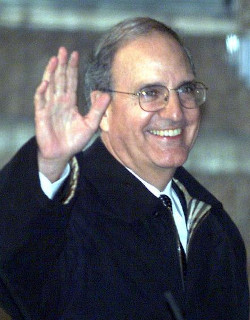
The soft-spoken but firm Mitchell leads a review of the 1998 Good Friday Agreement, which he played a crucial part in brokering. The aim is to halt a renewed drift to violence by pro-British Protestant and pro-Irish Catholicparamilitaries, and to persuade the two communities to begin cooperating in the province’s elected assembly.
“The peace process is mired in mistrust on both sides of the sectarian divide,” says a British government official, who declines to be identified. “It will need somebody of Mr. Mitchell’s political caliber and neutrality to find a way forward.” The future role of the Northern Ireland police force, the Royal Ulster Constabulary (RUC), will be “part of the tangle [Mitchell] has to unravel,” the official adds. The 92% Protestant force, in a society where Catholics make up 42% of the population, is widely seen as requiring urgent attention.
The Protestant political leaders are unwilling to accept the good faith of Sinn Féin, the political ally of the Irish Republican Army (IRA). They are also attacking Northern Ireland Secretary of StateMo Mowlam for having refused to acknowledge that republican paramilitaries have breached the cease-fire despite several violent incidents and the discovery of an alleged plot to send arms to the IRA from the United States.
Mowlam’s decision enraged David Trimble, leader of the Ulster Unionist Party, Northern Ireland’s main Protestant political party and first minister-designate in a devolved Belfast government. Trimble and his senior lieutenants called for her to be fired. Trimble also launches a bitter attack on the Patten Commission after a leaked report indicates it would recommend allowing active IRA members to join the RUC police force.
Mitchell’s main contribution to the peace process has been to insist that the issue of decommissioning terrorist arms must be addressed in parallel with talks on future political structures in Northern Ireland. But he still has to find a formula that will satisfy Unionists for the IRA to begin handing in its weapons and explosives. Trimble and other Protestant leaders insist the IRA must agree to decommission before Sinn Féin is allowed to join a devolved Belfast government. Sinn Féin says that was not part of the 1998 peace accord.
Most worrying for Mitchell is the recent outcry over IRA tactics that makes a solution to the problem of law and order all the more important. The IRA is known to use threats and so called “punishment beatings” to maintain law and order in areas under its control, where RUC forces dare not tread. Six Catholic youths are in hiding in Britain after being threatened with violence, even death, if they remained in Northern Ireland.
According to the RUC, the youths have been targeted because of their refusal to accept the authority of sectarian paramilitaries in the areas where they live. Vincent McKenna, spokesman for the Northern Ireland Human Rights Bureau, says, “The IRA thinks it has the right to police its own areas, and it is determined to punish anyone critical of the political direction of the Sinn Féin leadership.” He adds that since the Belfast agreement was signed 16 months earlier, 757 young people have been “exiled” by the IRA and Protestant paramilitary groups.
Mowlam reportedly says that if the Patten Commission can come up with a blueprint for the police that gives Catholics a larger role in legitimate law enforcement, the scope for policing by paramilitary groups will be reduced.
(From: “Mitchell returns to N. Ireland tinderbox,” The Christian Science Monitor, September 2, 1999)
In April 1943 backbench dissent forces Andrews from office. He is replaced as Prime Minister by Basil Brooke, 1st Viscount Brookeborough. He remains, however, the recognised leader of the UUP for a further three years. Five years later he becomes the Grand Master of the Orange Order. From 1949, he is the last parliamentary survivor of the original 1921 Northern Ireland Parliament, and as such is recognised as the Father of the House. He is the only Prime Minister of Northern Ireland not to have been granted a peerage. His predecessor and successor receive hereditary viscountcies, and later prime ministers are granted life peerages.
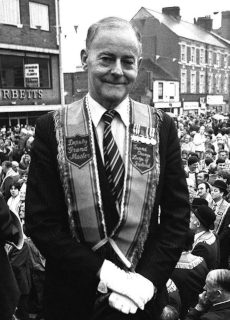
Throughout his life Andrews is deeply involved in the Orange Order. He holds the positions of Grand Master of County Down from 1941 and Grand Master of Ireland (1948–1954). In 1949 he is appointed Imperial Grand Master of the Grand Orange Council of the World.
Andrews is a committed and active member of the Non-subscribing Presbyterian Church of Ireland. He regularly attends Sunday worship, in the church built on land donated by his great-grandfather, James Andrews, in his hometown Comber. He serves on the Comber Congregational Committee from 1896 until his death on August 5, 1956, holding the position of Chairman from 1935 onwards. He is buried in the small graveyard adjoining the church.
From June 7, 1921, until March 30, 1972, the devolved legislature for Northern Ireland is the Parliament of Northern Ireland, which always has an Ulster Unionist Party (UUP) majority and always elects a UUP government. The Parliament is suspended on March 30, 1972.
Shortly after this first parliament is abolished, attempts begin to restore devolution on a new basis that will see power shared between Irish nationalists and unionists. To this end a new parliament, the Northern Ireland Assembly, is established by the Government of the United Kingdom on May 3, 1973.
Following the June 28 elections, the Northern Ireland Constitution Act 1973, which receives the Royal Assent on July 18, 1973, abolishes the suspended Parliament of Northern Ireland and the post of Governor and makes provision for a devolved administration consisting of an Executive chosen by the Assembly.
One hundred eight members are elected by single transferable vote from Northern Ireland’s eighteen Westminster constituencies, with five to eight seats for each depending on its population. The Assembly meets for the first time on July 31, 1973.
After opposition from within the Ulster Unionist Party and the Ulster Workers’ Council strike over the proposal of an all-Ireland council, the Executive and Assembly collapses on May 28, 1974, when Brian Faulkner resigns as Chief Executive. The Northern Ireland Assembly is abolished by the Northern Ireland Act 1974.
In 1982 another Northern Ireland Assembly is established at Stormont, initially as a body to scrutinise the actions of the Secretary of State, the British minister with responsibility for Northern Ireland. It receives little support from Irish nationalists and is officially dissolved in 1986.
The Northern Ireland Act 1998 formally establishes the Assembly in law, in accordance with the Good Friday Agreement. The first election of Members of the Northern Ireland Assembly is on June 25, 1998, and it first meets on July 1, 1998. However, it only exists in “shadow” form until December 2, 1999, when full powers are devolved to the Assembly. Since then, the Assembly has operated intermittently and has been suspended on five occasions.
Pressure is coming from all sides on the Irish Republican Army to give peace a chance in Northern Ireland. Governments in London, Dublin, and Washington, D.C., as well as the vast majority of Northern Ireland’s citizens, are calling on the paramilitary group to call a new ceasefire. Even Gerry Adams, president of Sinn Féin, the IRA’s political wing, appeals to the IRA to reconsider its refusal to renew the ceasefire it broke in February with a bomb blast in London.
An opinion poll in the Dublin-based Sunday Tribune shows 97 percent of people, including 84 percent of Sinn Féin voters, want the IRA to renew its ceasefire.
Earlier in the year Senator Mitchell reported to the British government on the prospects for peace in Northern Ireland and drew up six principles which, if fulfilled by all the parties, would produce a lasting political settlement.
As internal and international pressure on the IRA mounts, politicians from the Ulster Unionist Party (UUP), a moderate party representing the province’s Protestants, shows signs of drifting apart on whether Sinn Féin should be allowed to participate. Even if the IRA announces “a ceasefire of convenience,” Sinn Féin should be barred from attending, says Peter Robinson, deputy leader of the radical Democratic Unionist Party (DUP).
Furthermore, the choice of Mitchell to head the talks makes some Protestants uneasy. Earlier, DUP leader Ian Paisley says Mitchell could not be trusted as chairman. “He is carrying too much American Irish baggage.”
Yet David Trimble, leader of the larger UUP, says a new IRA ceasefire might “get Sinn Féin to the door.” To be fully admitted to the all-party talks, however, its leadership will have to “commit itself to peace and democracy.” Trimble adds that he has doubts about Mitchell’s objectivity and had sought “certain assurances” before finally agreeing to lead a UUP delegation to the opening round. Mitchell, at an impromptu news conference in Belfast, says he plans to show “fairness and impartiality.”
The attitudes of the two unionist parties appear to reflect concern that the IRA would declare a ceasefire before the talks open, or during the early stages, technically clearing the way for Sinn Féin participation. David Wilshire, a senior Conservative member of Britain’s Parliament, who supports the unionist cause, says that a ceasefire by the IRA now would be a “cynical ploy.” He adds that “the government should not fall for it.”
Sinn Féin leaders, meanwhile, meet on Saturday, June 8, and announced that regardless of the IRA’s intentions, Adams and other Sinn Féin leaders will turn up at the opening session and demand to be admitted. They cite the party’s strong showing at special elections in May to the peace forum at which they obtain 15 percent of the vote and win a strong mandate from Catholic voters in West Belfast.
It is “the British government’s responsibility” to urge the IRA to renew its truce, says Martin McGuinness, Adams’s deputy. Yet Adams himself makes a direct approach to the IRA. This is confirmed by Albert Reynolds, the former Irish Taoiseach. He says that Adams has advised him that he is about to make a new ceasefire appeal to the IRA leadership. “I am now satisfied Gerry Adams and Sinn Féin will seek an early reinstatement of the ceasefire which, of course, has not broken down in Northern Ireland. I see a set of similar elements to those in 1994, which brought about the ceasefire, now coming together. Everyone must now compromise,” Reynolds says.
On June 8, the IRA tells the British Broadcasting Corporation that its military council has called a meeting to examine the agenda for the Northern Ireland talks.
(From:”Hopes for N. Ireland Talks Rely on Squeezing the IRA” by Alexander MacLeod, The Christian Science Monitor, June 10, 1996)
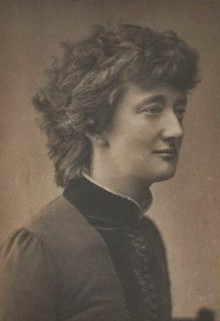
In the 1890s Stopford Green becomes interested in Irish history and the nationalist movement as a result of her friendship with John Francis Taylor. She is vocal in her opposition to English colonial policy in South Africa during the Boer Wars and supports Roger Casement‘s Congo Reform movement. Her 1908 book The Making of Ireland and its Undoing argues for the sophistication and richness of the native Irish civilisation. She is active in efforts to make the prospect of Home Rule more palatable to Ulster Unionists. She is closely involved in the Howth gunrunning.
Stopford Green moves to Dublin in 1918 where her house at 90 St. Stephen’s Green becomes an intellectual centre. She supports the pro-Treaty side in the Irish Civil War and is among the first nominees to the newly formed Seanad Éireann in 1922, where she serves as an independent member until her death in Dublin on May 28, 1929, two days shy of her 82nd birthday. She is one of four women elected or appointed to the first Seanad in 1922.
Trimble has vowed to quit as head of the Stormont Executive, where his party shares power with Sinn Féin, if the Irish Republican Party (IRA) has not started to get rid of its guns by July 1. Paisley, however, has accused Trimble and British Prime MinisterTony Blair of breaking their promises to the people of Northern Ireland by allowing into government a party linked to a terrorist group, without prior arms decommissioning.
While Clinton is no longer the most powerful man in the world, his charisma and his past efforts to keep the peace process moving are still appreciated by many. He receives Northern Ireland political leaders countless times at the White House and gives support and encouragement by phone during difficult periods of the peace talks.
The leader of the Social Democratic and Labour Party (SDLP), John Hume, who welcomes Clinton to Derry, says the former president has done a great deal of good for all the people of Ireland. But the Democratic Unionist Party (DUP) deputy leader, Peter Robinson, claims that Clinton and Blair could have a negative effect on Trimble’s campaign. “As a unionist, I wouldn’t like to be sitting next to either of them just before an election,” he said. “Blair’s name is associated with the now-broken pledges he wrote on a board here just before the [Good Friday agreement] referendum, so for him to come over and moralise now won’t do much good. And Clinton is so disgraced and powerless that, while he might prop up the nationalist SDLP and Sinn Féin vote, he’ll have no impact on unionists voters.”
(Pictured: Bill Clinton and SDLP leader John Hume at public address at Guildhall Square in Derry. Sinn Féin leader Gerry Adams and Chelsea Clinton are in the second row.)
Andrews is born in Comber, County Down, on July 17, 1871, the eldest child in the family of four sons and one daughter of Thomas Andrews, flax spinner, and his wife Eliza Pirrie, a sister of William Pirrie, 1st Viscount Pirrie, chairman of Harland & Wolff. He is named after his maternal great-uncle, John Miller of Comber (1795–1883). As a young man, with his parents and family, he is a committed and active member of the Non-subscribing Presbyterian Church of Ireland. He regularly attends Sunday worship in the church built on land donated by his great-grandfather James Andrews in his home town Comber.
In 1902 Andrews marries Jessie Ormrod, eldest daughter of Bolton stockbroker Joseph Ormrod at Rivington Unitarian Chapel, Rivington, near Chorley, Lancashire, England. They have one son and two daughters. His younger brother, Sir James, marries Jessie’s sister.
In April 1943 backbench dissent forces him from office. He is replaced as Prime Minister by Sir Basil Brooke. Andrews remains, however, the recognised leader of the UUP for three more years. Five years later he becomes the Grand Master of the Orange Order. Throughout his life he is deeply involved in the Orange Order. He holds the positions of Grand Master of County Down from 1941 and Grand Master of Ireland (1948–1954). In 1949 he is appointed Imperial Grand Master of the Grand Orange Council of the World.
From 1949, he is the last parliamentary survivor of the original 1921 Northern Ireland Parliament, and as such is recognised as the Father of the House. He is the only Prime Minister of Northern Ireland not to have been granted a peerage. His predecessor and successor received hereditary viscountcies, and later prime ministers are granted life peerages.
Andrews serves on the Comber Congregational Committee from 1896 until his death, holding the position of Chairman from 1935 onward. He dies in Comber on August 5, 1956 and is buried in the small graveyard adjoining the Non-subscribing Presbyterian Church of Ireland.
Hume, 61, the Catholic head of the Social Democratic and Labor Party, is cited by the Nobel Committee in Oslo for having been the “clearest and most consistent of Northern Ireland’s political leaders in his work for a peaceful solution.”
Trimble, 54, the Protestant leader of the Ulster Unionist Party, is honored for having demonstrated “great political courage when, at a critical stage in the process, he advocated solutions which led to the peace agreement.”
The accord, signed on April 10 and known as the Good Friday Agreement, gives the 1.7 million residents of Northern Ireland a respite from the sectarian violence that has claimed more than 3,200 lives in the previous 30 years. It also opens the possibility of lasting stability for the first time since the establishment of Northern Ireland with partition from Ireland in 1921.
Forging concessions from fiercely antagonistic populations, the accord seeks to balance the Protestant majority’s wish to remain part of Britain with Catholic desires to strengthen ties to the Republic of Ireland to the south. The committee, seeing in Northern Ireland’s two warring groups a dispute with notable similarities to violent tribal confrontations elsewhere, expresses the hope that the accord will serve “to inspire peaceful solutions to other religious, ethnic and national conflicts around the world.”
Adams, in New York on a fund-raising trip for Sinn Féin, welcomes the Oslo announcement and particularly praises Hume, who is widely seen as having helped persuade the IRA to adopt a cease-fire and having eased Sinn Féin’s entry into the talks. “Indeed, there would be no peace process but for his courage and vision,” Adams says, adding, “No one deserves this accolade more.” He also wishes Trimble well and says the prize imposes on everyone the responsibility to “push ahead through the speedy implementation of the agreement.”
In the unforgiving politics of Northern Ireland, the Unionist dissidents and members of other Protestant parties who do not join in the peace talks attack both Trimble and Hume. Ian Paisley Jr., son of the head of the Democratic Unionist Party, calls the Nobel Committee’s decision a “farce” and says of the winners, “These people have not delivered peace, and they are not peacemakers.”
Trimble says he is “slightly uncomfortable” with the award because so many other people have been involved beside him in reaching the settlement and much remains to be done to put it in place. “We know that while we have the makings of peace, it is not wholly secure yet,” he tells the BBC from Denver, where he is on an 11-city North American tour to spur foreign investment in Ulster. “I hope it does not turn out to be premature.”
Hume receives word of the prize at his home in Londonderry and terms it “an expression of the total endorsement of the work of very many people.” He adds, “This isn’t just an award to David Trimble and myself. It is an award to all the people in Northern Ireland.”
In Washington, D.C., President Clinton says “how very pleased” he is, “personally and as President, that the Nobel Prize Committee has rewarded the courage and the people of Northern Ireland by giving the Nobel Peace Prize to John Hume and to David Trimble.” He adds “a special word of thanks” to George Mitchell, who issues a statement praising Hume and Trimble as “fully deserving of this honor.”
The peace talks began in the summer of 1996. They eventually draw the participation of 8 of the 10 Northern Irish parties, with many of the men around the table convicted murderers and bombers who had emerged from prison with a commitment to peaceful resolution to what for nearly a century have been referred to wearily as “the Troubles.” The paramilitary groups had also made the tactical decision that violence would not secure their goals; a shared conviction that gives these talks a chance for success that past fitful attempts at settlement lacked.
The peace talks move in a desultory manner until Blair takes office in May 1997 and highlights the cause of peace in Northern Ireland as an early commitment. At his and Ahern’s urging, the IRA declares a cease-fire in July, and by September Sinn Féin is permitted to join the talks.
Blair also gives Trimble and Adams unprecedented access to 10 Downing Street, and the Ulster Protestants report that they obtained from Clinton the most sympathetic hearing they ever had from an American President, allaying their longtime suspicions of Washington’s bias in favor of the Catholic minority.
(From: “2 Ulster Peacemakers Win the Nobel Prize,” The New York Times, Warren Hoge, October 17, 1998)
Molyneaux is educated at nearby Aldergrove School. Although he is raised an Anglican, as a child he briefly attends a local Catholic primary school. He leaves school at age 15 and works on his father’s poultry farm. When a Catholic church near his home is burned down by Ulster loyalist arsonists in the late 1990s, he helps to raise funds for its rebuilding.
After demobilization Molyneaux establishes a printing business with his uncle, and in 1946 he joins the UUP. He is first elected to local government in 1964 and enters Parliament six years later. He staunchly opposes all power-sharing deals, notably the Anglo-Irish Agreement (1985) between British Prime MinisterMargaret Thatcher and Irish TaoiseachGarret FitzGerald, which gives Dublin an official consultative role in the affairs of Northern Ireland and paves the way for devolution.
Molyneaux lacks the firebrand public image of his longtime rival Ian Paisley, who in 1971 breaks with the UUP to form the Democratic Unionist Party (DUP). He never acquiesces to the Good Friday Agreement, which calls for the devolution of Northern Ireland’s government from London to Belfast, however, unlike Paisley and David Trimble, who in 1997 succeeds Molyneaux as the UUP leader and in April 1998 signs the devolution accord.
On retiring as UUP leader, Molyneaux is knighted as a Knight Commander of the Order of the British Empire (KBE) in 1996. The following year, after standing down as an MP at the 1997 general election, he is created a life peer on June 10, 1997, as Baron Molyneaux of Killead, of Killead in the County of Antrim.


 Former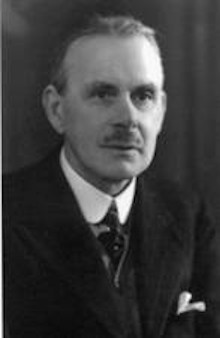


 seamus dubhghaill