In 1849, O’Donoghue, together with William Smith O’Brien, Terence MacManus, Thomas Francis Meagher and many others, are on board the prisoner transport ship The Swift for a six-month, 14,000-mile journey under difficult conditions on which some fellow prisoners do not survive.
On January 26, 1850, “Using materials he had begged and borrowed” as one account gives it, O’Donoghue starts publishing in Hobart a weekly newspaper named The Irish Exile, aimed mainly at fellow Irish prisoners and deportees and considered to be the first Irish Nationalist paper to be published in Australia.
The paper features Irish ballads and poetry, articles about Irish history, and a regular column by John Martin reporting on the situation of the Repeal Movement, a campaign to repeal the Acts of Union 1800 under which the Irish Parliament had been abolished. There is also local news of the Irish deportee community, then numbering in the thousands, and of Hobart daily life in general.
O’Donoghue uses The Irish Exile to publish excerpts of his journal aboard The Swift, which are reprinted in Australian, British and Irish newspapers. Brisbane‘s The Moreton Bay Courier, reprinted from Dublin’s The Nation, finds that the journal “will show how severely the tyrannical government of England visited the offences of the Ballingarry cabbage-tree heroes. The studies of Messrs. O’Brien, Meagher (afterwards O’), and O’Donoghoe, will amuse the reader”. While in Van Diemen’s Land, The Examiner, the daily newspaper of Launceston, Tasmania, reprints London‘s The Examiner‘s view that “a singularly large amount of mercy has been shown to those grown-up children who made the escapade from Dublin to raise the standard of Irish rebellion at Ballingarry. One of the worthies, Mr. Patrick O’Donoghue, has published an account of his deportation; and certainly a more pleasureable [sic] voyage could not have been under taken at the expanse of government. A roomy cabin, a capital library, a fair dinner, with a couple of glasses of wine, and cigars upon deck, from the dietary and the entertainment of the political exiles.”
Publication of the paper is not in itself illegal, but is highly displeasing to the Governor, Sir William Denison, who finds that the paper can be suppressed by arresting O’Donoghue and charging him with having “left his allocated district.” He is sentenced to one year’s work in a chain gang – a time spent at hard labour, living in a convict station and wearing a convict uniform, mainly in the company of non-political prisoners such as “rapists, muggers and thieves.”
In March 1851, O’Donoghue is released and taken back to Hobart. Undeterred, he immediately restarts his paper, prominently featuring an extensive personal account of his year with the chain gang. The governor reacts by sending him again to a chain gang, at a more distant location this time – the Cascades Penal Station. Three months later the governor orders him released from there and sent to Launceston.
On the way there, O’Donoghue succeeds in escaping from his guards with the help of fellow-prisoners, who manage to smuggle him on board the ship Yarra Yara, on its way to Melbourne. There, he successfully hides from the British authorities and, with further help from Irish sympathisers, manages to get to San Francisco, where some of his fellows such as MacManus and Meagher have also ended up.
O’Donoghue dies in New York City on January 22, 1854, shortly before the arrival of his wife on a ship from Ireland. The time spent in the chain gang may have contributed to undermining his health. The other escaped state prisoners do not attend his funeral, although Michael Doheny and Michael Cavanagh, fellow Young Irelanders who are living in New York City at the time, are in attendance.
The local Sinn Féin branch in Carlow is named after O’Donoghue.
In June 1846, Sir Robert Peel‘s Tory Ministry falls, and the Whigs under Lord John Russell comes to power. Daniel O’Connell, founder of the Repeal Association which campaigns for a repeal of the Acts of Union 1800 between Great Britain and Ireland, simultaneously attempts to move the Association into supporting the Russell administration and English Liberalism.
The intention is that Repeal agitation is to be damped down in return for a profuse distribution of patronage through Conciliation Hall, home of the Repeal Association. On June 15, 1846, Thomas Francis Meagher denounces English Liberalism in Ireland saying that there is a suspicion that the national cause of Repeal will be sacrificed to the Whig government and that the people who are striving for freedom will be “purchased back into factious vassalage.” Meagher and the other “Young Irelanders” (an epithet of opprobrium used by O’Connell to describe the young men of The Nation newspaper), as active Repealers, vehemently denounce in Conciliation Hall any movement toward English political parties, be they Whig or Tory, so long as Repeal is denied.
The “Tail” as the “corrupt gang of politicians who fawned on O’Connell” are named, and who hope to gain from the government places decide that the Young Irelanders must be driven from the Repeal Association. The Young Irelanders are to be presented as revolutionaries, factionists, infidels and secret enemies of the Church. For this purpose, resolutions are introduced to the Repeal Association on July 13 which declare that under no circumstances is a nation justified in asserting its liberties by force of arms. The Young Irelanders, as members of the association, have never advocated the use of physical force to advance the cause of repeal and oppose any such policy. Known as the “Peace Resolutions,” they declare that physical force is immoral under any circumstances to obtain national rights. Meagher agrees that only moral and peaceful means should be adopted by the Association, but if it is determined that Repeal cannot be carried by those means, a no less honourable one he would adopt though it be more perilous. The resolutions are again raised on July 28 in the Association and Meagher then delivers his famous “Sword Speech.”
Addressing the Peace Resolutions, Meagher holds that there is no necessity for them. Under the existing circumstances of the country, any provocation to arms will be senseless and wicked. He dissents from the Resolutions because by assenting to them he would pledge himself to the unqualified repudiation of physical force “in all countries, at all times, and in every circumstance.” There are times when arms will suffice, and when political amelioration calls for “a drop of blood, and many thousand drops of blood.” He then “eloquently defended physical force as an agency in securing national freedom.” Having been at first semi-hostile, Meagher carries the audience to his side and the plot against the Young Irelanders is placed in peril of defeat. Observing this he is interrupted by O’Connell’s son, John, who declares that either he or Meagher must leave the hall. William Smith O’Brien then protests against John O’Connell’s attempt to suppress a legitimate expression of opinion, and leaves with other prominent Young Irelanders, and never returns.
After negotiations for a reunion have failed, the seceders decide to establish a new organisation which is to be called the Irish Confederation. Its founders determine to revive the uncompromising demand for a national Parliament with full legislative and executive powers. They are resolute on a complete prohibition of place-hunting or acceptance of office under the existing Government. They wish to return to the honest policy of the earlier years of the Repeal Association, and are supported by the young men, who have shown their repugnance for the corruption and insincerity of Conciliation Hall by their active sympathy with the seceders. There are extensive indications that many of the previously Unionist class, in both the cities and among land owners, are resentful of the neglect of Irish needs by the British Parliament since the famine began. What they demand is vital legislative action to provide both employment and food, and to prevent all further export of the corn, cattle, pigs and butter which are still leaving the country. On this there is a general consensus of Irish opinion according to Dennis Gwynn, “such as had not been known since before the Act of Union.”
The first meeting of the Irish Confederation takes place in the Rotunda, Dublin, on January 13, 1847. The chairperson for the first meeting is John Shine Lawlor, the honorary secretaries being John Blake Dillon and Charles Gavan Duffy. Duffy is later replaced by Meagher. Ten thousand members are enrolled, but of the gentry there are very few, the middle class stand apart and the Catholic clergy are unfriendly. In view of the poverty of the people, subscriptions are purely voluntary, the founders of the new movement bearing the cost themselves if necessary.
Following mass emigration by Irish people to England, the Irish Confederation then organises there also. There are more than a dozen Confederate Clubs in Liverpool and over 700 members of 16 clubs located in Manchester and Salford.
Mitchel is born Jane Verner around 1820 near Newry, County Down. At the time she, her brother and her mother, Mary Ward, are living with Captain James Verner (1777–1847), who is from a prominent Armagh family, and is involved in the Orange Order, going on to become Orange deputy grandmaster of Ireland in 1824. Although James Verner raises Mitchel, she is not believed to be his child. She attends Miss Bryden’s School for Young Ladies in Newry.
Mitchel meets her husband, John Mitchel, when she is fifteen. The couple elopes in November 1836, but do not marry as James Verner pursues them to Chester and brings her home to Ireland. They elope again in 1837, and are married at Drumcree Church, County Armagh, on February 3. At this point, Mitchel is disowned by James Verner, and goes to live with her in-laws at Dromalane, County Down. They then move to Banbridge in 1839 where her husband practises law. The couple goes on to have six children, three daughters and three sons.
The couple moves to Dublin in October 1845 when John Mitchel becomes the assistant editor of The Nation. They live at 8 Ontario Terrace, Rathmines, where they meet Young Irelanders. She is a full supporter of her husband’s nationalism. She aids in his work with The Nation, reading other newspapers, keeping and filing reference clippings, going on to become an editor and anonymous contributor to the United Irishman from February 1848. John Mitchel is convicted of treason for inciting insurrection in May 1848, and is sentenced to fourteen years’ transportation. Mitchel urges his fellow Young Irelanders to fight his removal, and denounces them when they fail to come out in support of him.
Due to her standing in the nationalist community, £1,450 is raised to support her and her family. For three years, Mitchel lives in Newry and Dublin, before she joins her husband in Van Diemen’s Land (Tasmania) in June 1851, where they settle in the village of Bothwell. Their youngest child, Isabel, is born there in 1853.
The Mitchels travel around the island with her husband, visiting fellow Irish exiles, becoming fond of William Smith O’Brien in particular.
When John Mitchel escapes in July 1853, Mitchel travels with her children to join him in Sydney, from where they sail to the United States. They live for a time in Brooklyn, New York, from 1853 to 1855, rekindling friendships with old friends who are fellow Young Ireland exiles.
In May 1855, the family moves to a remote farm at Tucaleechee Cove in Tennessee. She fears that the isolation and life in a primitive log cabin will be detrimental to their children’s education, and at her behest the family moves to Knoxville, Tennessee, in September 1856. From here, John Mitchel runs a pro-slavery newspaper, the Southern Citizen.
The family moves again in December 1858 to Washington, D.C. Mitchel supports her husband in the Southern cause, albeit with some reservation. Nothing, she says, will induce her “to become the mistress of a slave household.” Her objection to slavery is “the injury it does to the white masters.”
Mitchel accompanies her husband to Paris in September 1860, and in opposition to some of the family, she supports her daughter Henrietta’s conversion to Catholicism and entrance into a convent. She remains in Paris and Ireland with her daughters, while her husband and sons assist the Confederacy during the American Civil War. Without letting her husband know, she resolves to return to America when she hears of her youngest son, William’s, death at Gettysburg in July 1863. She sails with her daughters, Mary and Isabel, as Henrietta had died earlier the same year. While their ship runs a blockade by the Union, the ship is shelled, runs aground, and catches fire near the coast of North Carolina. She and her daughters are unhurt, but lose all of their possessions. By December 1863, she has joined her husband in Richmond, Virginia, remaining their for the rest of the Civil War. Their eldest son, John, is killed in action in July 1864.
The family returns to New York after the war, and John Mitchel sets up another paper, The Irish Citizen (1867–72). Due to lack of funding for the Irish American press and her husband’s ill health results in the family falling into poverty. This is alleviated by a testimonial raised by William and John Dillon in 1873. Mitchel is widowed in March 1875, going on to receive $30,000 from nationalist sympathisers. She invests this money in a photolithographic firm she and her son, James, run. She dies at home in Bedford Park, New York, on December 31, 1899. She is buried in Woodlawn Cemetery, Bronx, New York, with her plot marked with a large Celtic cross. She is survived by two of her children, James (1840–1908) and Mary (1846–1910).
Kickham’s father, John Kickham, is the proprietor of the principal drapery in the locality and is held in high esteem for his patriotic spirit. His mother, Anne O’Mahony, is related to the Fenian leader John O’Mahony. He grows up largely deaf and almost blind, the result of an explosion with a powder flask when he is thirteen. He is educated locally, where it is intended that he study for the medical profession. During his boyhood the campaign for a repeal of the Acts of Union 1800 between Great Britain and Ireland is at its height, and he soon becomes versed in its arguments and is inspired by its principles. He often hears the issues discussed in his father’s shop and at home amongst all his friends and acquaintances.
From a young age Kickham is imbued with these patriotic ideals. He becomes acquainted with the teaching of the Young Irelanders through their newspaper The Nation from its foundation in October 1842. His father read the paper aloud every week for the family. Like all the young people of the time, and a great many of the old ones, his sympathies are with the Young Irelanders on their secession from the Repeal Association.
When he is 22 years old, Kickham contributes The Harvest Moon sung to the air of “The Young May Moon,” to The Nation on August 17, 1850. Other verses are to follow, but the finest of his poems according to A. M. O’Sullivan, appear in other journals. Rory of the Hill, The Irish Peasant Girl, and Home Longings, better known as Slievenamon, are published in the Celt. The First Felon appears in the Irishman. Patrick Sheehan, the story of an old soldier, is published in the Kilkenny Journal, and becomes very popular as an anti-recruiting song.
Kickham begins to write for a number of papers, including The Nation, but also the Celt, the Irishman, the Shamrock, and becomes one of the leading writers of The Irish People, the Fenian newspaper, in which many of his poems appear. His writings are signed using his initials, his full name, or the pseudonyms, “Slievenamon” and “Momonia.”
Kickham is the leading member of the Confederation Club in Mullinahone, which he is instrumental in founding. When the revolutionary spirit begins to grip the people in 1848, he turns out with a freshly made pike to join William Smith O’Brien and John Blake Dillon when they arrive in Mullinahone in July 1848. On hearing of the progress of O’Brien through the country, he sets to work manufacturing pikes and is in the forge when news reaches him that the leaders are looking for him. It is here that he meets James Stephens for the first time. At O’Brien’s request, he rings the chapel bell to summon the people and before midnight a Brigade has answered the summons. He later writes a detailed account about this period which brings his connection with the attempted Rising of 1848 to a close.
After the failed 1848 uprising at Ballingarry, Kickham has to hide for some time, as a result of the part he had played in rousing the people of his native village to action. When the excitement has subsided, he returns to his father’s house and resumes his interests in the sports of fishing and fowling and spends much of his time in literary pursuits. Some of the authors in which he is well versed are Alfred Tennyson and Charles Dickens and he greatly admires George Eliot, and after William Shakespeare, is Robert Burns.
In the autumn of 1857, a messenger arrives from New York with a message for James Stephens from members of the Emmet Monument Association, calling on him to get up an organization in Ireland. On December 23, Stephens dispatches Joseph Denieffe to the United States with his reply and outlines his conditions and his requirements from the organisation in America. Denieffe returnd on March 17, 1858, with the acceptance of Stephens’ terms and £80. That evening the Irish Republican Brotherhood commences. Those present in Langan’s, lathe-maker and timber merchant, 16 Lombard Street, for that first meeting are Stephens, Kickham, Thomas Clarke Luby, Peter Langan, Denieffe and Garrett O’Shaughnessy. Later it includes members of the Phoenix National and Literary Society, which is formed in 1856 by Jeremiah O’Donovan Rossa in Skibbereen, County Cork.
In mid-1863, Stephens informs his colleagues that he wishes to start a newspaper, with financial aid from O’Mahony and the Fenian Brotherhood in America. The offices are established at 12 Parliament Street, almost at the gates of Dublin Castle. The first issue of The Irish People appears on November 28, 1863. The staff of the paper along with Kickham are Luby and Denis Dowling Mulcahy as the editorial staff, O’Donovan Rossa and James O’Connor in charge of the business office, with John Haltigan being the printer. John O’Leary is brought from London to take charge in the role of Editor. Shortly after the establishment of the paper, Stephens departs on an America tour, and to attend to organizational matters. Before leaving, he entrusts to Luby a document containing secret resolutions on the Committee of Organization or Executive of the IRB. Though Luby intimates its existence to O’Leary, he does not inform Kickham as there seems no necessity. This document later forms the basis of the prosecution against the staff of The Irish People.
Kickham’s first contribution to The Irish People, entitled Leaves from a Journal, appears in the third issue and is based on a journal he kept on his way to America in 1863. This article leaves no doubt as to his literary capacity according to O’Leary. It falls to Kickham, as a good Catholic, to tackle the priests, though not exclusively with articles such as “Two Sets of Principles,” a rebuff to the doctrines laid down by Lord Carlisle, and “A Retrospect,” dealing with the tenant-right movement chiefly but also the events of the recent past and their bearing on the present. Kickham articulates the attitude held by the IRB in relation to priests, or more particularly in politics.
On July 15, 1865, American-made plans for a rising in Ireland are discovered when the emissary loses them at Kingstown railway station. They find their way to Dublin Castle and to Superintendent Daniel Ryan, head of G Division. Ryan has an informer within the offices of The Irish People named Pierce Nagle. He supplies Ryan with an “action this year” message on its way to the IRB unit in Tipperary. With this information, Ryan raids the offices of The Irish People on September 15, followed by the arrests of O’Leary, Luby, and O’Donovan Rossa. Kickham is caught after a month on the run. Stephens is also caught but with the support of Fenian prison warders John J. Breslin and Daniel Byrne is less than a fortnight in Richmond Bridewell when he vanishes and escapes to France. The last issue of The Irish People is dated September 16, 1865.
On November 11, 1865, Kickham is convicted of treason. Judge William Keogh, with many expressions of sympathy for the prisoner, and many compliments in reference to his intellectual attainments, sentences him to fourteen years’ penal servitude. The prisoners’ refusal to disown their opposition to British rule in any way, even when facing charges of life-imprisonment, earn them the nickname of “the bold Fenian men.” Kickham spends time from 1866 until his release in the Woking Convict Invalid Prison.
Kickham is given a free pardon from Queen Victoria on February 24, 1869, because of ill-health, and upon his release he is made Chairman of the Supreme Council of the IRB and the unchallenged leader of the reorganized movement. He is an effective orator and chairman of meetings despite his physical handicaps. He wears an ear trumpet and can only read when he holds books or papers within a few inches of his eyes. For many years he carries on conversations by means of the deaf and dumb alphabet.
Kickham is the author of three well-known stories, dealing sympathetically with Irish life and manners and the simple faith, the joys and sorrows, the quaint customs and the insuppressible humour of the peasantry. Knocknagow is deemed one of the finest tales of peasant life ever written. Sally Cavanagh is a touching story illustrating the evils of landlordism and emigration. For the Old Land deals with the fortunes of a small farmer’s family.
Kickham dies on August 22, 1882, at the house of James O’Connor, a former member of the IRB and afterward MP for West Wicklow, 2 Montpelier Place, Blackrock, Dublin, where he had been living for many years, and had been cared for by the poet Rose Kavanagh. He is buried in Mullinahone, County Tipperary.
Gwynn is educated at St. Columba’s College, Dublin, and Trinity College Dublin. In 1896 he heads the list of Foundation Scholars in Classics at TCD. In 1898 he graduates Bachelor of Arts, gaining a “first of firsts” with gold medals in Classics and Modern Literature.
In 1900, along with his brother Edward Gwynn and others, Gwynn founds the Social Services (Tenements) Company to provide housing for poor families in Dublin. He subsequently spends many periods working with the poor in Dublin’s slums. He is instrumental in founding the Trinity Mission, which serves slum dwellers in Belfast, and is for many years actively involved in the Dublin University Fukien Mission (later the Dublin University Far Eastern Mission), eventually becoming its chairman and president.
He is ordained deacon in 1906, achieving full priesthood two years later. He is the only one of Rev. John Gwynn’s sons to be ordained, and he never serves in a parish. That same year, he proceeds to MA and is elected a Fellow of Trinity College Dublin.
In 1907 Gwynn is appointed Lecturer in Divinity and Tutor. He remains Lecturer in Divinity until 1919 and continues as Tutor until 1937. He is appointed Chaplain of TCD in 1911, retaining that post until 1919.
In January 1909 he is appointed Acting Warden of his old school, St. Columba’s College, which is facing a major financial crisis. He keeps the institution afloat until a new warden is appointed.
Horrified by the brutality of the Dublin Metropolitan Police (DMP) toward strikers during the lockout in 1913, Gwynn becomes a prominent advocate of the workers’ cause and joins the Industrial Peace Committee. On November 12, 1913, when the committee is barred from holding its meeting at the Mansion House, he invites the members to his college rooms at No. 40, New Square. It is this meeting that leads to the foundation of the Irish Citizen Army (ICA). In their history of Trinity College McDowell and Webb observe, “Gwynn’s support for the ‘army’ concept was based simply on the idea that military-style discipline would keep unemployed men fit and give them self-respect. ‘Sancta simplicitas!'”
In 1914 Gwynn marries Dr. Eileen Gertrude Glenn, a rector’s daughter from Pomeroy, County Tyrone. They have six children.
In 1916 Gwynn is appointed Professor of Biblical Greek, a post he holds for forty years (1916-56). During those four decades, he holds a number of other, often overlapping, academic appointments at the university, including Professor of Hebrew (1920-37), Registrar (1941), Vice-Provost (1941-43), Senior Lecturer (1944-50), and Senior Tutor (1950-56). In 1937 he is co-opted to Senior Fellowship. He is made an honorary fellow in 1958.
When the Dublin University Fabian Society is formed. Gwynn becomes one of its vice-presidents.
Like several of his brothers, Gwynn is a fine cricket player, in his youth captaining both his school XI and the Dublin University XI. A right-handed batsman and right-arm slow bowler, he plays once for the Ireland cricket team in 1901. He also plays four first-class matches for Dublin University in 1895. He retains a lifelong interest in the sport, and John V. Luce portrays him as President of the Dublin University Cricket Club, with his “tall rangy figure … a familiar sight at matches in College Park.”
Gwynn is tall and athletic, but in later life suffers from deafness. To aid his hearing he carries a large ear trumpet with him and this, together with his height and glowing white hair, makes him an impressive and instantly recognizable figure around Trinity College. In character, he is patient, kind and wise, but at the same time resolute and tough. His nephew-in-law, the late Archbishop of Armagh, George Simms, remarks that his “gentle humility inspired trust and drew confidences, his stubborn integrity brought surprises for those who mistook charity for easy-going indifference,” and spoke of his “Athanasian courage.”
Gwynn dies in Dublin at the age of 85 on June 25, 1962. He is buried in Whitechurch churchyard.
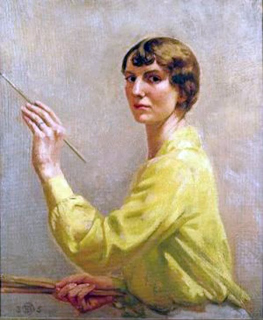
Brigid GanlyHRHA, Irish painter and sculptor, is born Rosaleen Brigid O’Brien on January 29, 1909, in Dublin.
Ganly is one of five children born to Dermod O’Brien and his wife Mabel Smiley. Her father is a painter. His grandfather is the Irish republicanWilliam Smith O’Brien. She grows up in Country Limerick at a farm in Cahirmoyle until the family moves to Fitzwilliam Square in Dublin. She goes on to attend the Metropolitan School of Art where she has the opportunity to study under Patrick Tuohy, Seán Keating and Oliver Sheppard. She is a talented sculptor and wins several awards, including the Taylor scholarship in 1929, for her allegorical male nude, Pity. She spends time in Paris in 1951 where she trains with André Lhote. She travels to Greece where Lhote continues to influence her work.
Ganly also studies painting in the Royal Hibernian Academy School where she has Margaret Clarke and Seán O’Sullivan as teachers. She is made an associate of the Royal Hibernian Academy in 1928 and becomes a member in 1935, though in 1969 she resigns her membership in protest at the lack of young artists being given the opportunity to exhibit. In 1972 she is made an honorary member and returns.
Ganly is a representational artist and while known as a portrait artist, she also paints landscapes, interiors and may be best known for her still lifes. Some of her best works are portraits of her husband, her sister Ethel, her father, and her friend Sheila Pim. She illustrates the book-jackets of Pym’s works. She has many exhibitions, with the RHA and the Water Colour Society of Ireland. There is a retrospective of her life in 1998 in the Hugh Lane Gallery and her works are in the collections there. She is also in the collections of the Waterford Municipal Gallery, Crawford Art Gallery, Cork and in The National Self-Portrait Collection of Ireland. She is part of the 2014 exhibition “Irish Women Artists: 1870-1970.”
Ganly’s sister-in-law is Kitty Wilmer O’Brien with whom she often exhibits. She marries Andrew Ganly, a dental surgeon and writer, in 1936. He dies in 1982. They have two children, Eoghan and Phillida.
Gwynn is born in Ramelton, County Donegal, on May 5, 1873. He is a member of a family well known in Dublin at the time for its academic and sporting achievements. He is the fourth son of the Very Rev. John Gwynn, Regius Professor of Divinity at Trinity College Dublin (TCD), and Lucy Josephine, daughter of the Irish patriot William Smith O’Brien. He and his three immediate younger brothers, Arthur, Robin and Jack, all in turn captain their school and university cricket teams and play the game at first class level. He is also a talented rugby player.
Gwynn’s academic career outshines even his sporting achievements. He enters Trinity College Dublin as a foundation Scholar and achieves a double first in his degree finals. In 1899 he is elected a Fellow of Trinity College and commences what promises to be a distinguished academic career.
At school Gwynn is mainly a bowler, his brother Arthur being the superior bat, though this inequality is ironed out at university. He is captain of the Dublin University Cricket Club XI for two seasons, 1894 and 1895, then plays under Arthur’s captaincy. The three brothers make up a formidable threesome in those years.
Primarily noted for his bowling prowess during early outings with the Dublin University XI, Gwynn takes 44 wickets at an average of 8.14 in Trinity’s annus mirabilis of 1893, a season which witnesses victories over Leicestershire, Oxford University, Warwickshire (dismissed for a paltry total of 15 runs) and a draw against Essex.
Gwynn, a right-handed batsman, who records the highest first-class average (56.87) among those batsmen who complete ten innings or more during the English season of 1895, enjoys another remarkably productive season in 1896, plundering over a thousand runs in Trinity flannels, a superlative effort complemented by a haul of 93 wickets at 9.37. His irrepressible form reputedly earns him an invitation to represent England against Australia in the second Ashes Test at Old Trafford in July 1896. However, concurrent university examinations render him unable to participate. Instead, English cricket is introduced to the wizardry of K. S. Ranjitsinhji, who takes Gwynn’s place.
Gwynn makes his debut for Ireland against I Zingari in July 1892 and goes on to play for Ireland 13 times, his last game coming in May 1902 against Marylebone. Two of his matches for Ireland have first-class status.
Gwynn also plays first-class cricket in two Gentlemen v Players matches, representing the gentlemen, and four matches for Dublin University in 1895, for whom he makes his top score of 153 not out against Leicestershire. In all, he amasses 3,195 runs and 311 wickets for Dublin University, in addition to 499 runs and 14 wickets for Ireland.
Remarkably, Gwynn also represents Ireland seven times at rugby union, debuting against Scotland at Belfast in February 1893. He features in all three legs of Ireland’s 1894 Triple Crown-winning campaign.
In 1901 Gwynn marries Katharine Rawlins of Bristol. He is already suffering from persistent symptoms of debility and fatigue. A few months later a Harley Street physician diagnoses tuberculosis. He is admitted to a sanatorium at Davos Platz in Switzerland, but the illness has progressed too far for any treatment to succeed. He dies on December 23, 1902, at the age of 29. The couple’s only child, a daughter named Rhoda, is born in September 1902, just three months before his death.
Sullivan, the second of six sons of Daniel Sullivan, house painter, and his wife, Catherine (née Baylor), a teacher, is born on May 15, 1829, in Bantry, County Cork. A popular date for Sullivan’s birth appears in many histories as 1830, but his gravestone reads 1829. He is educated in the local national school. One of his brothers is Timothy Daniel Sullivan, the Lord Mayor of Dublin from 1886 to 1888.
During the Great Famine of 1845 to 1847, Sullivan is employed as a clerk in connection with the relief works started by the government. Deeply influenced by the distress he witnesses, he afterward joins the Confederate Club formed in Bantry in support of the revolutionary movement of the Young Irelanders and is the organiser of the enthusiastic reception given by the town to William Smith O’Brien in July 1848 during the insurgent leader’s tour of the southern counties. Early in 1853, he goes to Dublin to seek employment as an artist. An exhibition of the arts and industries of Ireland is held in Dublin that year, and he is engaged to supply pencil sketches to the Dublin Expositor, a journal issued in connection with the exhibition. Subsequently, he obtains a post as a draughtsman in the Irish valuation office, and afterward as a reporter on the Liverpool Daily Post.
In 1855, Sullivan becomes assistant editor of The Nation, and subsequently editor and proprietor. From 1861 to 1884, in conjunction with his elder brother, T. D. Sullivan, he makes The Nation one of the most potent factors in the Irish Nationalist cause and also issues the Weekly News and Zozimus. Called to the Irish bar in 1876, he is a “special call” of the Inner Temple in 1877 and is made QC in 1881. He mainly practices at the English bar, though he acts in some political cases in Ireland.
As a member of the Dublin Corporation, Sullivan secures a magnificent site for the Grattan Monument, toward which he donates £400, the amount of a subscription by his admirers while he is undergoing imprisonment for a political offence in 1868. The monument is formally unveiled in January 1876. Between 1878 and 1882 he is engaged in many notable trials. His last great case is on November 30, 1883, when he is a colleague of Lord Russell in the defence of Patrick O’Donnell for the murder of James Carey, an informer.
Sullivan suffers another heart attack while on holiday in Bantry in September 1884 and spends his last days with William Martin Murphy at Dartry, County Dublin. Murphy regards him as a father figure, attributing his success to Sullivan’s early advice and journalistic training. Sullivan dies on October 17, 1884, at Dartry Lodge, Rathmines, Dublin. He is buried at Glasnevin Cemetery. With his wife, Frances Genevieve Donovan, whom he marries on April 27, 1861, and who outlives him by nearly forty years, he has a family of three sons and five daughters. His second son and namesake, Alexander Martin Sullivan, is the last to hold the rank of Serjeant-at-law (Ireland).
In addition to his labours, Sullivan is a great temperance reformer. He also writes two notable books, The Story of Ireland and New Ireland and contributes many sketches (including some verse) to Irish Penny Readings (1879–85). Some of his correspondence is located in the Isaac Butt papers in the National Library of Ireland.
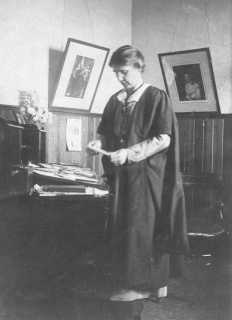
Gwynn is appointed first lady registrar of Trinity College Dublin in February 1905. Women had only been admitted to the university the previous year. Despite coming from a family of academics, she had been unable to get a university education herself. She is 39 years old when appointed to her position in the university.
Students describe Gwynn as a pioneer. Her role as women’s registrar is described by one of her charges as “to control our movements to some extent and to protect the college and the students from criticism.”
In 1907, Gwynn is summoned before the Fry Commission on Dublin University to defend the position of women at Trinity. She is supported by the parents of the students. The result is that the commission endorses the principle of women’s admission to the university.
In 1922, the Dublin University Women Graduates’ Association is founded, under Gwynn’s presidency.
Gwynn never marries. As an eldest daughter she is required to assist in the management of her parents’ household and attend to them in their old age. From her mother’s brother, architect Robert Donough O’Brien, she inherits the house he had designed and built at Parteen-a-Lax in County Clare, close to Limerick. It is there that she retires at the end of her working life. Her hobby is tending its beautiful garden which lay next to the River Shannon.
Gwynn dies in County Clare in 1947.
Founded, by subscription, in 1948 in memory of Lucy Gwynn, the Lucy Gwynn Memorial Prize is awarded annually in the Michaelmas term to a Junior Sophister woman student for distinction in her course. The award is made by two women on the university staff nominated by the Board, and one of the female tutors. The value of the prize is €1,207.
Farrell is born in 1827 in Mecklenburgh Street (later called Railway Street) in Summerhill, Dublin, one of six sons of Terence Farrell, sculptor, and Maria Farrell (née Ruxton). He trains as a sculptor in his father’s workshops. In 1842 he enters the modelling school of the Royal Dublin Society, where he is awarded the prize for “Original design in clay” the following year. He is awarded premiums by the Royal Irish Art Union in 1844 and 1846. As a student he becomes acquainted with the neoclassical sculpture of John Flaxman and John Hogan. His first commission is a monument to ArchbishopDaniel Murray in St. Mary’s Pro-Cathedral in Dublin.
Throughout his career, Farrell remains actively involved in the Royal Hibernian Academy (RHA). He is elected directly as a full member in 1860 rather than undergoing an initial phase of associate membership. He exhibits almost annually with the academy until his death. He holds a number of posts, including professor of sculpture and treasurer, before being elected president in 1893, being the first sculptor to be so honoured. His achievements are recognised with a knighthood in May 1894.
Farrell dies at his residence, Redesdale House, in Stillorgan, County Dublin, on July 2, 1900. He is a shy, retiring man, and his death is not announced to the public for three days, in keeping with his wishes to avoid any sort of elaborate display on his behalf. Intensely private, he never marries and lives a life immersed in his work. Contemporary accounts describe him as constantly dissatisfied with his work despite consistent public approval for it.





 seamus dubhghaill