O’Halloran is the third son of Michael O’Halloran, a prosperous farmer, and his wife Mary McDonnell. He is named after Sylvester Lloyd, the titular Catholic bishop of Killaloe (1728–39). His mother’s cousin, Sean Claragh McDonnell, teaches him much at an early age, including some Greek and Latin. He goes on to a Limerick school run by Robert Cashin, a Protestantclergyman, which is unusual at the time as the O’Hallorans are Roman Catholics during the difficult time of the Penal Laws.
O’Halloran and his brothers engage successfully in areas of life that work around the restrictions of the Penal Laws. Joseph becomes a Jesuit and holds chairs in rhetoric, philosophy and divinity at the Jesuit College at Bordeaux in France. George becomes a jeweler and in time a property-owner. O’Halloran goes to London to learn medicine at the age of 17, particularly studying the methods of Richard Mead, as well as the oculists Taylor and Hillmer. After further study at Leiden, and in Paris under the anatomist and academician Antoine Ferrein, he sets up practice as a surgeon in Limerick in early 1749.
O’Halloran writes several learned treatises on medical matters, and his fame is acknowledged by his membership of the RIA in 1787. He is a founder of the County Limerick Infirmary that starts with four beds in 1761 before moving to larger premises at St. Francis’s Abbey in 1765. The foundation stone of the original infirmary is now preserved in the Sylvester O’Halloran Post Graduate Centre at the Mid-Western Regional Hospital, Limerick.
While in France, O’Halloran is very impressed with the Académie Royale de Chirurgie, which had been founded in Paris in 1731 during the reign of Louis XV. He is subsequently instrumental in founding the Royal College of Surgeons in Ireland (RCSI), by writing its blueprint, Proposals for the Advancement of Surgery in Ireland, in 1765. In 1780, he is made an honorary member of the new Dublin Society of Surgeons and, when the RCSI receives its charter in 1784, is again elected an honorary member, equivalent to a Fellowship today.
As well as his scientific knowledge, O’Halloran’s interest in the arts begins with his collection of Gaelic poetry manuscripts and this leads on to an interest in Irish history. Given his background, he argues to validate the pre-Norman history of Ireland which had often been dismissed as a period of barbarism.
In 1789, Charlotte Brooke publishes the first English-language compendium of Irish poetry, the seminal “Reliques of Irish Poetry”, giving full due to O’Halloran for lending her his manuscript collection and for having written the essential history underlying her anthology.
In 1752, O’Halloran marries Mary Casey of Ballycasey, County Limerick, and they have four sons and a daughter. Their homes are in Change Lane and then on Merchants’ Quay. One of their sons is Major-General Sir Joseph O’Halloran, the father of Thomas Shuldham O’Halloran, after whom the Adelaide, South Australia suburb of O’Halloran Hill is named. Mary dies in 1782.
After a stroke, O’Halloran is infirm and confined to his chair for some time before his death on August 11, 1807, at his home on Limerick’s Merchant Quay. His is buried at St. Munchin’s graveyard at Killeely, which is now a suburb of Limerick.
Though politically restricted in his life by the Penal Laws, O’Halloran helps establish the county Infirmary, is elected President of the city’s Free Debating Society in 1772 and is elected to a committee in 1783 that examines the River Shannon navigation. Appropriately, a Limerick bridge over the River Shannon has been named after him.
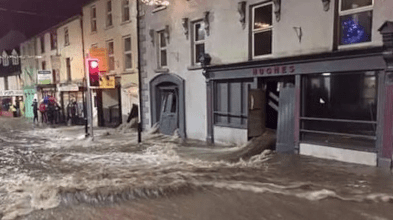
Clean-up operations are underway around Ireland on Wednesday, December 30, 2015, in the wake of Storm Frank, which causes widespread flooding following its landfall in western areas on Tuesday, December 29. Thousands of households and businesses are left without electricity in many areas of the country.
A Met Éireann status orange wind warning is lifted at 2:00 p.m. on Wednesday although the forecasts caution that severe winds of 65-80 km/h and gusts of up 130 km/h are still expected. While the heaviest rainfall from the storm falls overnight, many rivers and lakes have yet to peak meaning further flooding is possible.
According to an ESB Networks spokesman, 7,500 homes are without power in the afternoon, down from the overnight total of 13,000. He says repair crews are working to restore power to those cut off. The biggest single outage overnight is around Bandon and Fermoy in County Cork where 4,000 homes are without power, although it has been restored to almost all homes by the afternoon of December 30.
At 2:00 p.m. on Wednesday, the worst affected areas are County Wicklow with 1,200 houses without power, Macroom in County Cork where 600 are without power and Athlone where 500 homes are cut off. Around 500 homes in Naas, County Kildare, are without power as are 350 houses in Skerries in north County Dublin. It is hoped that power will be restored to all customers by the evening.
County Cork appears to be the worst affected by the storm where 60 mms (almost three inches) of rain falls since the morning of December 29. The threat of further flooding in Cork remains as the ESB increases the flow of water through the Inniscarra Dam to 250 cumecs (cubic metres per second) between 9:00 a.m. and midday which leads to increased flooding downstream. This is higher than the level of flow (180 cumecs) the previous and between December 6 and 12 along the River Lee following Storm Desmond.
Cork County manager Tim Lucey says there has been “extensive flooding” across a range of areas, but that Midleton and Bandon are worst hit with some 90 properties affected in each of the towns. He tells RTÉ Radio that one positive is the fact flood defences in Mallow and Fermoy have done their job. He notes that some five feet of water has built up behind a flood barrier in Mallow and this indicates the damage that could have been done to the town.
South Galway bears the brunt of flooding in the west, with river gauges expected to rise further over the coming days. Overnight rainfall is not as heavy as anticipated in the west, but several properties succumb to the waters. Up to 30 families in the south Galway area are forced to stay with relatives, with several being accommodated in hotels by Galway County Council, as floodwaters cut off access routes to their homes.
In Mayo, the area around the Neale remains underwater and a number of minor roads and thousands of acres of farmland are also affected. With rain continuing to fall across the west, conditions are expected to remain critical over the next few days.
The N11 between Rosslare and Dublin, the N25 from Cork to Waterford, the N71 between Cork and Killarney and the N4 between Dublin and Sligo all have diversions in place. The N25 is closed overnight between Killeagh and Castlemartyr in County Cork due to flooding. The N71 Cork/Bandon Road is also closed overnight at the viaduct due to flooding. There is severe flooding on the N40 South Ring Rd. at J6 Kinsale, particularly on the westbound off-ramp. The N11 Dublin/Wexford Road is impassable through Enniscorthy and also at Kyle’s Cross near Oylegate. The N4 is closed eastbound at Ballynafid in County Westmeath due to flooding. There are also several road closures in Kerry, Waterford and Tipperary.
Midleton is also hit by severe flooding as water levels in the Owenacurra River rise dramatically with up to 30 families having to be evacuated from their homes. Macroom in mid-Cork is also flooded for the first time during the year. Bandon is put on red alert by Cork County Council’s early warning system. Traders and residents are told to take all measures necessary to protect their property and stock. Locals stay up all night preparing the town for the latest round of flooding. Nevertheless, some 20 businesses in Bandon are flooded for the second time in a month after waters start to come up shores and gutters in the town as water levels in the River Bandon rise overnight.
The River Slaney burst its banks in Enniscorthy, County Wexford, causing widespread flooding in the town. Several cars have to be abandoned. High tide in Enniscorthy occurs around 10:30 a.m. on December 30.
The ESB says the flow of water through Parteen Weir, which regulates water flow through Ardnacrusha power plant, will remain at 440 (cubic metres per second) on December 30 and that the situation will be reviewed again the following day. “The levels in Lough Derg may reach 2009 levels in the coming days and, as a result, the flow through Parteen Weir may increase to 2009 levels (up to 500 cumecs) in the coming days,” it says.
Clare County Council says water levels on the lower River Shannon at Springfield, Clonlara, have increased by 5-10cm in the last 24 hours and are some 20cm below a peak level recorded on December 13th. It says the Mulkear River in County Limerick, which enters the River Shannon south of Annacotty, is currently in flood and is contributing to increased water levels at Springfield. Council staff are assisted by the Fire Service and Defence Forces at Springfield in their pumping operations and transporting residents of some 12 homes isolated by floodwaters.
Fianna Fáil urges TaoiseachEnda Kenny to call an emergency Cabinet meeting to address the fallout from the storm. The party’s environment spokesman, Barry Cowen, says many communities felt neglected as further significant damage was inflicted on homes and businesses by the rainfall and winds brought by Storm Frank. “The scenes that we are witnessing in communities impacted by the latest storm are truly heart-breaking,” he says. “People feel neglected by the Government. It’s astonishing that the Taoiseach has decided not to interrupt his Christmas holidays in light of the devastation caused by Storm Frank.”
The Government’s National Coordination Group on Severe Weather meets in Dublin on December 30. Sinn FéinMEPLiadh Ní Riada says the Government has displayed “ineptitude in preparing flood defences” and that “more hollow promises” from the Coalition are no substitute for action. “The risk of flooding is increasing and will continue to increase. People across this island need to know that our political leaders have a plan to prevent this happening in the future,” she says.
(From: “Storm Frank causes floods, closes roads and cuts power to thousands” by Ronan McGreevy, Th Irish Times, http://www.irishtimes.com, December 30, 2015 | Pictured: Water flows through buildings and down the street in Graignamanagh, Co Kilkenny on Tuesday night by Paul B via Twitter)
Initially trained as an organist and composer, he turns to musicology in the early 1950s, first specialising in English and Irish music of the Middle Ages and increasingly turning to ethnomusicological subjects in the course of his career. His Music in Medieval Britain (1958) is still a standard work on the subject, and Time, Place and Music (1973) is a key textbook on ethnomusicology.
Harrison is born in Dublin on September 29, 1905, the second son of Alfred Francis Harrison and Florence May (née Nash). He becomes a chorister at St. Patrick’s Cathedral, Dublin in 1912 and is educated at the cathedral grammar school and Mountjoy School. A competent organist, he is deputy organist at St. Patrick’s from 1925 to 1928. In 1920, he also begins musical studies at the Royal Irish Academy of Music, where he studies with John Francis Larchet (composition), George Hewson (organ) and Michele Esposito (piano). In 1926, he graduates Bachelor of Music at Trinity College Dublin and is awarded a doctorate (MusD) in 1929 for a musical setting of Psalm 19. He then works in Kilkenny for one year, serving as organist at St. Canice’s Cathedral and music teacher at Kilkenny College.
In 1930, Harrison emigrates to Canada to become organist at Westminster Presbyterian Church in New Glasgow, Nova Scotia. In 1933, he studies briefly with Marcel Dupré in France but returns to Canada in 1934 to become organist at Knox Presbyterian Church in Ottawa. In 1935, he takes a position as organist and choirmaster at St. George’s Cathedral in Kingston, Ontario, as well as taking up the newly created post of “resident musician” at Queen’s University at Kingston. His duties include giving lectures, running a choir and an orchestra, and conducting concerts himself. His course in the history and appreciation of music is the first music course to be given for full credit at Queen’s. He resigns from St. George’s in 1941 to become assistant professor of music at Queen’s in 1942. During his years in Canada he still pursues the idea of remaining a performing musician and composer, winning three national composition competitions: for Winter’s Poem (1931), Baroque Suite (1943) and Night Hymns on Lake Nipigon (1945).
In 1951, Harrison takes the degrees of Master of Arts (M.A.) and Doctor of Music (DMus) at Jesus College, Oxford, and becomes lecturer (1952), senior lecturer (1956), and reader in the history of music (1962–1970) there. In 1965, he is elected Fellow the British Academy and Senior Research Fellow at Oxford. From 1970 to 1980, he is Professor of Ethnomusicology at the University of Amsterdam in the Netherlands, retiring to part-time teaching in 1976.
Harrison also holds Visiting Professorships in musicology at Yale University (1958–1959), Princeton University (spring 1961 and 1968–1969), and Dartmouth College (winter 1968 and spring 1972). He also briefly returns to Queen’s University at Kingston as Queen’s Quest Visiting Professor in the fall of 1980 and is Visiting Andrew W. Mellon Professor of Music at the University of Pittsburgh for the calendar year 1981.
Harrison’s honorary titles also include Doctor of Laws at Queen’s University, Kingston (1974), Corresponding Member of the American Musicological Society (1981), and Vice President and Chairman of the Plainsong and Medieval Music Society (1985). At Queen’s also, the new Harrison-LeCaine Hall (1974) is partly named in his honour.
Harrison dies in Canterbury, England on December 29, 1987.
In 1989, Harry White appreciates Harrison as “an Irish musicologist of international standing and of seminal influence, whose scholarly achievement, astonishingly, encompassed virtually the complete scope of the discipline which he espoused.” David F. L. Chadd writes of him “He was above all things an explorer, tirelessly curious and boyishly delighted in the pursuit of knowledge, experience and ideas, and totally heedless of artificially imposed constraints and boundaries.”
Since 2004, the Society for Musicology in Ireland (SMI) awards a bi-annual Irish Research Council Harrison Medal in his honour to distinguished international musicologists.
Cronin is known as an arts activist as well as a writer. He is Cultural Adviser to TaoiseachCharles Haughey and briefly to Garret FitzGerald. He involves himself in initiatives such as Aosdána, the Irish Museum of Modern Art and the Heritage Council. He is a founding member of Aosdána, and is a member of its governing body, the Toscaireacht, for many years. He is elected Saoi, a distinction for exceptional artistic achievement, in 2003. He is also a member of the governing bodies of the Irish Museum of Modern Art and the National Gallery of Ireland, of which he is for a time Acting Chairman.
His first collection of poems, called simply Poems (Cresset Press, London), is published in 1958. Several collections follow and his Collected Poems (New Island Books, Dublin) is published in 2004. The End of the Modern World (New Island Books, 2016), written over several decades, is his final publication.
Cronin’s novel, The Life of Riley, is a satire on Bohemian life in Ireland in the mid-20th century, while his memoir Dead as Doornails addresses the same subject.
Cronin knows Samuel Beckett from when they do some work for the BBC during the 1950s and 1960s. He gives a prefatory talk to Patrick Magee‘s reading of The Unnamable on the BBC Third Programme. Beckett is not impressed, saying, “Cronin delivered his discourse… It was all right, not very exciting.” Cronin later publishes a biography of him, Samuel Beckett: The Last Modernist (1996), followed on from No Laughing Matter: The Life and Times of Flann O’Brien (1989).
In his later years, Cronin suffers from failing health, which prevents him from traveling abroad, thus limiting his dealings to local matters. He dies in Dublin on December 27, 2016, one day short of his 93rd birthday.
Cronin firstly marries Thérèse Campbell, from whom he separates in the mid-1980s. She dies in 1999. They have two daughters, Iseult and Sarah. Iseult is killed in a road accident in Spain. He secondly marries the writer Anne Haverty who, along with daughter Sarah, survives him.
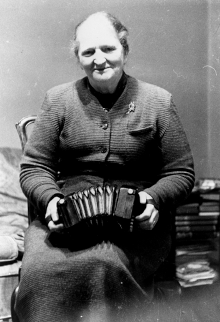
Markham is born on January 8, 1886, at Gower, Cooraclare, County Clare, the youngest in the large family of Michael Markham, farmer, and Margaret Markham (née Keane). She attends national school in Cooraclare from 1893 to 1899. Although she does not speak or understand the Irish language, as do her father and likely her mother, the Rosary is recited in Irish at home. She and a sister are the only siblings not to emigrate. Her mother plays the fiddle, while her older sister Margaret (Maggie) plays the concertina and probably influences her to do likewise. She has no single teacher and acquires tunes and her style of playing from neighbours and family friends. She begins to play a two-row German-type concertina at house dances throughout west Clare and becomes very much in demand.
In 1914, Markham marries Michael (Miko) Crotty from Gowerhass, the townland next to Gower. Miko had been in the United States for a couple of years and uses the money earned there to buy a public house on the Market Square in Kilrush, now known as “Crotty’s Pub.” They live in the Square in Kilrush and Miko bottles his own whiskey. The pub is an important venue for Irish traditional music, especially for those who wish to hear Crotty play. She remains relatively unknown outside of Clare until the early 1950s, and there are a relatively small number of recordings of her playing the concertina. The broadcaster Ciarán Mac Mathúna conducts recording sessions in her house in 1955 and she is to be heard on A Job of Journeywork, his programme on Radio Éireann. She possesses a number of concertinas, but the Lachenal that she purchases in the 1950s is her favourite and the one with which she is most closely identified. In 1954, she is a founder member and the first president of the Clare branch of Comhaltas Ceoltóirí Éireann. During her time as president, the All Ireland Fleadh is held in Ennis in 1956.
Crotty often sings the traditional song “An draighneán donn,” which is one of her favourites. Among tunes she enjoys playing are the “Ewe reel,” the “Dublin reel,” and “The maid of Mount Cisco,” along with “The wind that shakes the barley.” Her straight style of playing for dancing and dancers increases her popularity. Seán Ó Riada regards her as one of the finest concertina players he ever heard. Although she does not read or write staff notation, she creates a written code for herself by giving the concertina keys a number and by using a symbol for the press or draw movement on the concertina keys.
Crotty suffers from severe angina which necessitates visits for medical treatment to Dublin, where she becomes friends with fiddle player Kathleen Harrington (née Gardiner). They attend the Pipers’ Club in Thomas Street, play together on Radio Éireann, and travel together to fleadhanna.
Crotty dies on December 27, 1960, of an anginal attack while at her home. She is buried in (old) Shanakyle cemetery. She loses her first three children, and a son drowns in the River Shannon in 1945. Another son, Thomas, becomes a priest. A festival, ‘Éigse Mrs Crotty’, is held in her memory each summer in Kilrush. Her son Paddy gives three perpetual trophies for presentation at the All-Ireland Fleadh Cheoil.
(From: “Crotty, Elizabeth (‘Lizzie’)” by Ríonach uí Ógáin, Dictionary of Irish Biography, http://www.dib.ie, October 2009)
There are commercially available recordings of over fifty of Wilson’s works on labels including Diatribe Records, Riverrun, RTÉ Lyric fm, Black Box, Timbre, Guild, Meridian and Chandos Records. His music is published by Ricordi (London) and Universal Edition.
Remaining active during the interwar years, Dill serves as chief assistant to the commandant of the Staff College (1919–22) before commanding the Welsh Border Brigade, TA (1922–23), and 2nd Infantry Brigade at Aldershot (1923–26). In late 1926, he is appointed army instructor at the newly established Imperial Defence College. A period in India follows as general staff officer of the Western Command (1929–31), based at Quetta. On return to England, he is promoted to major general and made commandant of the Staff College. Appointments as commander of the British forces in Palestine and Transjordan (1936–37) and the Aldershot Command (1937–39) follow. During this period, he shows a remarkable ability to both train and inspire those under his command. Most of his colleagues expect him to become the new chief of the Imperial General Staff and are surprised when Major General Lord Gort, junior to Dill in both rank and seniority, is appointed to the post.
At the outbreak of World War II Dill commands I CorpsBritish Expeditionary Force (BEF) in France and is made a full general. In April 1940, he is made vice-CIGS and in May takes over as CIGS. His initial period in office is not a happy one, and he has to inform the public of setbacks in both Norway and France. His workload is enormous, and after the evacuation at Dunkirk in late May he devotes himself to preparing the defences of Britain against invasion. He clashes with Winston Churchill throughout 1941, advocating a more cautious and realistic approach to the situations in North Africa, Greece, and Crete.
The workload begins to affect his health adversely, and in November 1941 it is announced that he will resign as CIGS on reaching the age of 60 and serve as governor-designate of Bombay with the rank of field marshal. He seeks to be more actively involved in the war effort, however, and in December 1941 he visits the United States with Churchill, remaining there as head of the British joint staff mission in Washington, D.C. He plays a significant role in promoting Anglo–American military cooperation and attends the Casablanca, Quebec, and Tehran conferences.
Dill first marries (1907) Ada Maud Le Mottée, daughter of Col. William Le Mottée of the 18th Regiment. Their son, Major John de Guerin Dill, serves as an artillery officer throughout World War II. In October 1941, Dill marries Nancy Isabelle Charrington, widow of Brigadier Denis Walter Furlong. Dill’s honours include a GCB (1942), an honorary degree from Princeton University (1944), the Howland Memorial Prize of Yale University (1944), and a posthumous Distinguished Service Medal (DSM) from the United States government. There are portraits of him in Cheltenham College and the Imperial War Museum, and a statue in Washington, D.C.
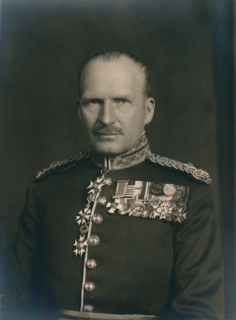
(From: “Dill, Sir John Greer” by David Murphy, Dictionary of Irish Biography, http://www.dib.ie, October 2009 | Pictured: Sir John Greer Dill, bromide print, 1932, by Walter Stoneman, National Portrait Gallery, London)
O’Neill, along with O’Donnell, train an army and before long they find a powerful ally, King Phillip III of Spain. King Phillip is more than keen to help the Irish for two reasons. Firstly, he wants revenge for the famous defeat of his Spanish Armada in 1588 and secondly, he sees Ireland as a terrific foundation from which he can invade England.
King Phillip agrees to the request of O’Neill and O’Donnell to send a large army to help them defeat the English. For several years prior they had held the English at bay from the strongholds in Ulster, beating them at Yellow Ford in 1598 and Moyry Pass in 1600. But if they are to ever drive the English back across the Irish Sea, they have to come out from the hills and passes and meet them in open battle. King Phillip eventually sends his army of 4,800 men to Kinsale in County Cork, thirteen miles south of Cork, arriving on September 21, 1601. They are surrounded by the English army, led by Charles Blount, 8th Baron Mountjoy, and George Carew, 1st Earl of Totnes, the President of Munster.
The landing of the Spanish army is not where O’Neill would have hoped as he and O’Donnell are located in the northern county of Donegal. He had sent a message asking them to land further north, so they might join forces and march against the English, but that message either never arrives or arrives too late. Now O’Neill and O’Donnell face a long march to join with their allies, and the English are much closer to Kinsale than they.
Before the Irish can get there, Mountjoy’s army has laid siege to the Spaniards at Kinsale. To leave their northern strongholds holds many dangers for the Irish chieftains, but leave they do, marching their army 250 miles to Kinsale to put the future of Gaelic Ireland to the test on the battlefield, a march which many say is one of the greatest marches to date in Irish History.
On the morning of December 24, O’Neill moves to attack Mountjoy’s army. There is no coordination between O’Neill’s army and the Spanish in Kinsale, under Don Juan del Águila. The Spaniards make no attempt to attack in force or even create a diversion. O’Neill’s army, especially his cavalry, which perform badly, are not ready to meet the English in this sort of combat. The battle lasts only an hour, with Irish losses of 1,200 soldiers whereas the English lose only twenty. The critical battle of the Nine Years’ War has been lost.
Afterwards, O’Donnell flees to Spain where he lives comfortably until he dies a few months later, said to have been poisoned by a spy of Carew’s named Blake.
Hugh O’ Neill surrenders to the English in 1603 and later returns to Ulster, where Lord Mountjoy treats him respectively well. However, most of his lands and authority are non-existent. In 1607, he goes to Spain with a number of family members and supporters, most of whom are lesser chieftains, and this becomes famously known as the Flight of the Earls. The power of the Gaelic chiefs in Ireland become a thing of the past.
In June 1919, de Valera arrives in the United States for what is to be an 18-month visit. He has recently escaped from Lincoln Gaol in England in sensational fashion, after a duplicate key is smuggled into the jail in a cake and he escapes dressed as a woman. A few months later he is a stowaway aboard the SS Lapland from Liverpool bound for America.
De Valera’s plan is to secure recognition for the emerging Irish nation, tap into the huge Irish American community for funds, and to pressurize the U.S. government to take a stance on Irish independence. Playing on his mind is the upcoming Versailles conference where the nascent League of Nations is preparing to guarantee “existing international borders” – a provision that will imply Ireland remaining within the United Kingdom.
De Valera also has a challenge in winning over PresidentWoodrow Wilson, who is less than sympathetic to Ireland’s cause.
De Valera’s interest in America is of course personal. He is born in New York City on October 14, 1882, and his U.S. citizenship is one of the reasons he is spared execution after the 1916 Easter Rising.
At first de Valera keeps a low profile in America. Though he is greeted by Harry Boland and others when he docks in New York City, he first goes to Philadelphia and stays with Joseph McGarrity, the County Tyrone-born leader of Clan na Gael and a well-known figure in Irish America. He also quietly pays a visit to his mother in Rochester, New York.
De Valera’s first major engagement is on June 23, 1919, when he is unveiled to the American public at a press conference in the Waldorf-Astoria hotel in New York City. Crowds throng the streets around the hotel, and de Valera proclaims, “I am in America as the official head of the Republic established by the will of the Irish people in accordance with the principle of self-determination.”
De Valera then embarks upon a tour across America. Vast crowds turn out to see the self-proclaimed “president of the Irish republic.” In Boston an estimated crowd of 70,000 people hear him talk in Fenway Park. In San Francisco he unveils a statute of Irish revolutionary hero Robert Emmet in Golden Gate Park.
Later in the year, de Valera holds a huge rally in Philadelphia, where he is welcomed by the mayor at Independence Hall. He also visits smaller towns and cities across the United States, and his trip garners huge press coverage – an invaluable boon for his campaign to heighten awareness of the Irish issue in America.
But difficulties soon emerged during de Valera’s visit. He becomes embroiled in a bitter split among Irish Americans. He finds himself at odds with Judge Daniel Cohalan and John Devoy, central figures in the Friends of Irish Freedom (FOIF) association. Part of the dispute centers around money. De Valera had settled on an idea for a bond sale as a way of raising money for the cause – investors would be given bond certificates that would be exchangeable for bonds of the Irish Republic once it gets international recognition. But Cohalan and Devoy, who have already raised thousands through the Friends of Irish Freedom, are opposed, concerned about the scheme’s legality for one.
De Valera’s claim in an interview that Irish-British relations can be analogous to the relationship between Cuba and America also enrages the Cohalan-Devoy camp, who accuse him of surrendering the idea of full Irish sovereignty.
De Valera’s increasingly acrimonious relationship with Cohalan and Devoy spills over into the 1920 Republican and Democratic conventions. Against the advice of Cohalan and Devoy, he advances a resolution about Irish independence which is rejected 12-1 at the Republican convention in June of that year. A rival resolution by Cohalan squeezes through but ultimately is overturned. Similarly, he fails to secure the inclusion of the Irish issue in the Democratic Party’s policy platform during the Democrats’ convention in San Francisco.
De Valera leaves the United States in December 1920 with mixed results. Though he has raised millions of dollars through the bond sale, he has made little progress in co-opting official America to Ireland’s cause. Much as division is to characterise the next chapter of his political career in Ireland, de Valera’s sojourn in America leaves Irish America more divided than it has ever been.
(From: “Éamon de Valera’s US trip that left Irish America divided” by Suzanne Lynch, The Irish Times, http://www.irishtimes.com, June 1, 2019 | Pictured: Éamon de Valera (center) in New York with Friends of Irish Freedom’s Judge Daniel Cohalan and John Devoy in July 1919, Topical Press Agency/Getty)
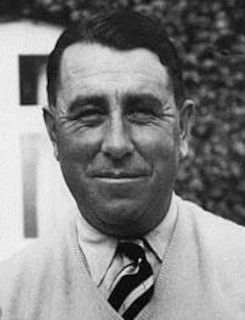
Harry Bradshaw, a leading Irish professional golfer of the 1940s and 1950s, dies on December 22, 1990, in St. Vincent’s hospital, County Dublin.
Bradshaw is born on October 9, 1913, in Killincarrig, County Wicklow, eldest among four sons and two daughters of Edward ‘Ned’ Bradshaw, golf caddie and later golf professional, and Elizabeth Bradshaw (née Walsh) of Killincarrig. He is educated locally. A golf prodigy, he has a hole-in-one at the age of ten on an 80-yard par three at Delgany Golf Club, County Wicklow. He joins Delgany Golf Club, where he progresses from caddie to assisting his father, who is the club’s professional. As a teenager, he tends to hook the ball wildly, before he develops a grip that allows him to hit with great accuracy. Thereafter, he concentrates on honing his peerless approach play from within 100 yards of the hole. Another feature of his game is what is called his “hit and hark” approach to putting: he never lifts his head to follow the ball until he hears it drop.
Bradshaw plays in his first tournament as a professional in 1932, the same year he shoots a course record 68 at Delgany. In 1938, he wins his first professional tournament, the Bromford-Adgey Cup at Skerries Golf Club, County Dublin. In 1941, he is appointed golf professional at Kilcroney, County Wicklow, and in 1950 he begins his long association with Portmarnock Golf Club, County Dublin, when he is appointed golf professional there. By then he has already made his mark on domestic Irish golf, having won the Irish Open in 1947 and 1949. In Ireland he wins the Irish Dunlop Trophy three times, the Willie Nolan Trophy eleven times, the Moran Cup twelve times and the Irish Professional Championship ten times, the last a record later equaled by Christy O’Connor Snr.
Bradshaw is not well known outside of Ireland prior to the famous “bottle” incident at the 1949 Open Championship at Royal St. George’s Golf Club in Sandwich, Kent, England. Having headed the qualifiers and shooting an opening 68, he continues his good form into the second round when his drive at the par four fifth hole just misses the fairway and lands in a beer bottle that is standing upright with the neck and shoulder broken off. The rules are unclear on whether the bottle constitutes a hazard, and he elects to play the ball where it lay, judging (correctly) that he is not entitled to a free drop. Closing his eyes and turning his head away, he swings, shattering the bottle and advancing the ball about twenty-five yards. He is shaken and records a lacklustre round of 77. Back to his best in the next two rounds, he would win the title had his putt on the last not stopped just short. Instead, he ties with the South AfricanBobby Locke who defeats him by twelve strokes in the thirty-six-hole play-off with superlative rounds of 67 and 68. As a result of his experience with the broken bottle, the rules are changed to cater for the possibility of such an incident recurring. It is the closest a golfer from the Republic of Ireland comes to winning the Open Championship until Pádraig Harrington’s victory in 2007.
Bradshaw subsequently revenges himself on Locke by narrowly beating him to the Irish Open title the following month. He is then one of four British and Irish golfers to participate in a sixteen-week tour of South Africa from December 1950 to March 1951 during which he engages in further jousts with Locke, deepening their new-found friendship.
Establishing himself on the international golf circuit, Bradshaw goes on to win the DunlopBritish Masters on two occasions (1953, 1955), and in 1958 he becomes the first Irishman to win the PGA Close Championship. He had also won the Dunbar Open Tournament in Scotland in 1953 and the Gleneagles Hotel Foursomes Tournament pro-am with Joe Carr in 1955. The highlight of his career comes in Mexico City in 1958, when, in partnership with Christy O’Connor Snr, he wins the Canada Cup, later known as the World Cup, for Ireland, also losing a play-off for the individual title. His performance is particularly impressive, given that he is forty-five and carrying weight while competing at altitude in oppressive heat. He and O’Connor are fêted upon their return home, and their victory is considered to play the determining role in popularising golf in Ireland. He caps a memorable year by receiving the Association of Golf Writers’ Trophy for 1958.
Bradshaw appears on three Ryder Cup teams. At the Wentworth Club in 1953, he wins his foursomes match partnering Fred Daly and his singles match against Fred Haas, but in 1955 he loses both his foursomes and singles matches at the Thunderbird Country Club in California. In 1957, he is a member of the side that defeats the American team 7–4 at Lindrick Golf Club in South Yorkshire, only the third victory by the Britain and Ireland side in the twelve matches played up to that time. He holes a five-footer to tie his match with U.S. Open champion Dick Mayer after a classic encounter. In 1963, he takes on Billy Casper, one of America’s top golfers, in a match at Portmarnock televised as part of the prestigious Shell’s Wonderful World of Golf series. Bradshaw’s three-stroke victory earns him $3,000, which is then considered a bonanza in golfing terms.
Bradshaw remains the golf professional at Portmarnock until 1983, latterly spending most of his day in the club shop. Even after his formal retirement, he remains on the payroll at Portmarnock as an informal ambassador for the club. Nicknamed “the Brad,” he is extremely popular with amateur and professional alike, is a great raconteur and tremendous company, and is noted for his lack of rancor towards, or criticism of, other players.
Bradshaw marries Elizabeth Foley from Carlow in 1944 and they have four children. His three brothers, Eddie, Hughie and Jimmy, are all professional golfers.
(From: “Bradshaw, Harry” by Jim Shanahan, Dictionary of Irish Biography, http://www.dib.ie, November 2022)







 seamus dubhghaill