seamus dubhghaill

Promoting Irish Culture and History from Little Rock, Arkansas, USA


Leave a comment

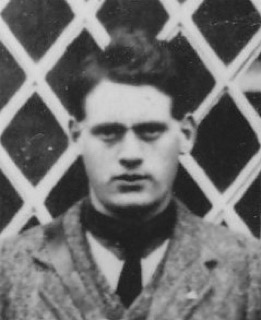
The Body of Harry McEntee of the IRA Dublin Brigade is Found

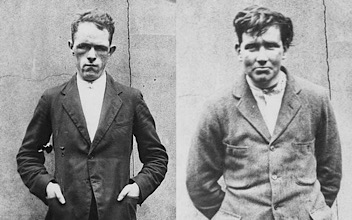
On August 3, 1923, the body of Captain Henry Hugh “Harry” McEntee is found at Dubber Cross near Jamestown Road, Finglas, County Dublin. McEntee, 26, is a carpenter and a member of the Irish Republican Army’s Dublin Brigade, serving on the active service unit (ASU) during the Irish Civil War.

McEntee is abducted by members of the Criminal Investigation Department (CID), based at Oriel House, Westland Row, who are linked to National Army Intelligence and the Protective Corps. He is reportedly threatened by CID officers before his death. The abduction occurs on July 31, 1923, near his home on Gloucester Street (now Seán McDermott Street).

On the morning of August 3, his body is discovered in a field at Maher’s farm, close to Jamestown Road in Finglas. He had been shot dead. The exact details of his capture and killing are later ordered to be destroyed in 1932 by the Pro-Treaty government.

McEntee is buried in the Republican Plot at Glasnevin Cemetery, Dublin. A National Graves Association memorial plaque is placed there around 1932 and is maintained by the Fianna Sluagh in Finglas during the 1950s–60s. In 2023, his family and community commemorate the centenary of his death, remembering him as a skilled carpenter, devoted father, and soldier of the Irish Citizen Army.

In summary, Henry McEntee’s abduction and murder in August 1923 are part of the violent post-war repression of anti-Treaty IRA members, and his case remains a poignant example of the personal toll of Ireland’s Civil War.


Leave a comment

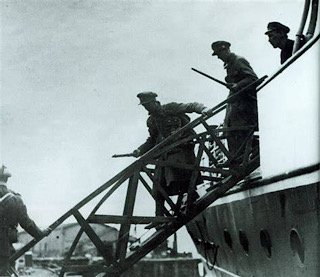
Irish Free State Army’s Seaborne Landing at Fenit, County Kerry

On Wednesday, August 2, 1922, the Irish Free State’s National Army launches a seaborne landing at Fenit pier, County Kerry, marking the first of a series of amphibious assaults in the Cork and Kerry campaign. The operation is conceived by Major General Emmet Dalton as a way to strike at the anti-Treaty Irish Republican Army’s (IRA) “Munster Republic” from the rear, exploiting the element of surprise to shorten the war.

By mid-July 1922, the Free State has re-taken counties Limerick and Waterford, but the IRA still controls counties Cork and Kerry, as well as much of the west under Liam Lynch’s command. A purely land-based advance into these areas risks long, attritional battles. Dalton’s plan is to create a second front by landing troops along the County Kerry and County Cork coasts, isolating republican strongholds like Tralee.

The SS Lady Wicklow carries 450 soldiers of the Dublin Guard brigade under Paddy Daly, along with a field gun and an armoured car nicknamed the Ex-Mutineer. The Dublin Guards are considered the most disciplined and politically reliable unit in the Army, and Daly is one of Michael Collins’ trusted lieutenants. The landing is intended to secure Fenit as a base for an amphibious assault on Tralee, a key republican stronghold.

The surprise attack catches the IRA forces off guard, taking their left flank in the rear. The Free State quickly advances, and by the following days, much of County Kerry is freed from republican control. The operation is part of a broader offensive that culminates in the capture of Tralee on August 2, one of the bloodiest single days of combat for the National Army.

While the initial landings are successful, the IRA mounts counterattacks over August and September, regaining some ground. However, the Free State’s superior resources, better equipment, and lack of popular support for the republicans allows them to consolidate control in County Kerry over time. The Fenit landing is a turning point, shifting the momentum in favour of the Free State and contributing to the eventual republican defeat in the Irish Civil War.

In summary, the August 2, 1922, naval landing at Fenit is a bold, surprise amphibious operation that disrupts republican defenses, opens County Kerry to Free State advance, and alters the course of the Irish Civil War.

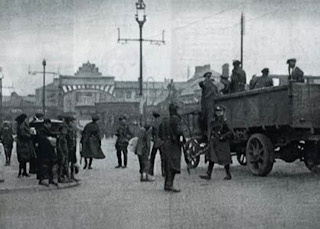
(Pictured: Free State troops landing at Fenit, County Kerry, on August 2, 1922)


Leave a comment

Diarmait Mac Murchada is Defeated in Battle by Ruaidrí Ua Conchobair

On August 1, 1166, Diarmait Mac Murchada (anglicised Dermot MacMurrough), King of Leinster, is defeated in battle by Ruaidrí Ua Conchobair (anglicised Rory O’Conor), who has recently become High King of Ireland. This defeat is a decisive blow to Mac Murchada’s power and marks the end of his reign as an independent ruler.

Mac Murchada has ruled Leinster since 1126 and is a powerful and ambitious king. He is an ally of Muirchertach Mac Lochlainn, High King of Ireland, but their alliance is strained by rivalries and political maneuvering. In 1166, Mac Lochlainn’s own position is weakened after his subjects rebel and kill him, and Mac Murchada is next in Ua Conchobair’s line of succession.

Ua Conchobair, now High King, turns his attention to eliminating rivals. On August 1, 1166, Mac Murchada is defeated in open battle and forced to flee Ireland. His expulsion is a critical turning point as it strips him of his kingdom and leaves him without a base to rule.

In exile, Mac Murchada seeks help from King Henry II of England. He promises to swear fealty to Henry and grant land in Ireland in exchange for military support to reclaim his throne. Henry allows him to enlist the aid of Richard de Clare, 2nd Earl of Pembroke (“Strongbow”), and other Norman lords from South Wales.

Mac Murchada returns to Ireland in 1167 with an advance party of Anglo-Normans. In 1170, Strongbow arrives with a larger force, and together they capture Dublin. Mac Murchada marries his daughter, Aoife (Eva), to Strongbow, and upon his death in 1171, Strongbow succeeds as ruler of Leinster.

Mac Murchada’s defeat and subsequent alliance with the Normans initiates the Anglo-Norman invasion of Ireland, a process that leads to centuries of English political and military involvement in the country. His actions are remembered as a pivotal moment in Irish history, with complex legacies — seen by some as a desperate ruler trying to restore his throne, and by others as a traitor who opens the door to foreign domination.

In summary, August 1, 1166, is the day Diarmait Mac Murchada is overthrown by Ruaidrí Ua Conchobair, leading to his exile and ultimately setting in motion the Norman conquest of Ireland.

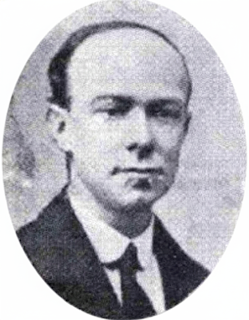
(Pictured: Diarmait Mac Murchada)