seamus dubhghaill

Promoting Irish Culture and History from Little Rock, Arkansas, USA


Leave a comment

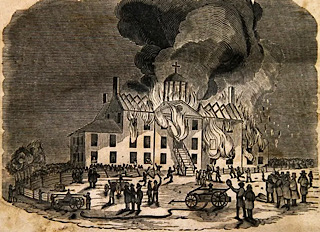
The Ursuline Convent Riots in Massachusetts

Shortly after midnight on August 12, 1834, a Protestant mob attacks and burns the Ursuline Convent School in Charlestown, Massachusetts (now part of Somerville), an act that becomes a flashpoint in the region’s anti-Catholic tensions.

The Ursuline Convent, founded in 1820 by Bishop Jean-Louis Lefebvre de Cheverus, is a Catholic school for girls established to educate the poor. It is built on a 24-acre estate with brick structures, gardens, and a chapel, attracting both Catholic and Protestant students. By the early 1830s, about 50–60 Protestant girls from wealthy families attend, alongside Catholic students.

Rev. Lyman Beecher helps to incite the mob hours earlier, giving three anti-Catholic diatribes at three different churches in Boston. Beecher, whose children include educator Catharine and abolitionist and author of Uncle Tom’s Cabin, Harriet Beecher Stowe, later expresses regret over the arson but, as is often the case, violent speech leads to violent action.

The riots are sparked by rumors and gossip about a nun, Elizabeth Harrison (Sister Mary St. John), who had left the convent for 24 hours on July 28 to visit a student’s family and then returned. Her decision to leave and return is framed by anti-Catholic sympathizers as evidence of instability or even “insanity,” feeding existing prejudices. These rumors are amplified by the “Know Nothingnativist movement, which is gaining traction in Massachusetts.

In the early morning hours of August 12, 1834, a Protestant mob—largely poor Yankee laborers hostile to Irish Catholic immigrants—sack the convent. The nuns and their students flee for their lives, and the convent is set ablaze. The destruction is swift and complete, leaving only the ruins.

The burning reflects deep-seated anti-Catholic sentiment in New England, rooted in colonial-era restrictions on Catholic worship and reinforced by Irish immigration and Protestant revivalism. It foreshadows the more violent nativist uprisings of the 1850s, such as the Know Nothing Party’s later attacks on Catholic institutions.

Those arrested for the outrage are quickly found not guilty and become heroes in Boston. After failed attempts to get the Commonwealth of Massachusetts to pay for the damages, and amid threats of further violence, the nuns eventually move to Canada, driven from the country by bigotry and hate.

The convent is never rebuilt, and the event becomes a symbol of sectarian violence. Survivors and the community face legal and social challenges, and the incident is widely reported in newspapers, fueling further anti-Catholic rhetoric.

In short, the 1834 Charlestown convent burning is both a localized mob attack and a harbinger of the intense anti-Catholic nativism that defines much of antebellum America.


Leave a comment

Liam Lynch & the Anti-Treaty IRA Abandon Fermoy

On August 11, 1922, Liam Lynch, Chief of Staff of the Anti-Treaty Irish Republican Army (IRA), abandons Fermoy — the last major republican-held town in County Cork — as the Free State forces advance. This marks a significant turning point in the Irish Civil War, symbolizing the collapse of the IRA’s last strongholds in County Cork.

By mid-1922, the Anti-Treaty IRA is in retreat after the Anglo-Irish Treaty has split the IRA into pro- and anti-Treaty factions. Lynch, a staunch opponent of the Treaty, had been appointed Chief of Staff in April 1922 to unify the Anti-Treaty leadership. Fermoy, a key County Cork town, has been a republican stronghold since the Irish War of Independence, but by August 1922, it is under increasing pressure from Free State troops.

Fermoy’s surrender is not a single battle but a series of engagements and encirclements. Free State forces have been systematically dismantling republican positions in County Cork, and Fermoy’s defenses are proving unsustainable. Lynch, recognizing the strategic and tactical inevitability of defeat, orders the withdrawal of IRA forces from the town. This move effectively ends the IRA’s presence in Cork city and its surrounding areas.

Fermoy’s fall is a strategic loss as it removes the last major republican-held town in County Cork, cutting off supply lines and communication with other Anti-Treaty strongholds. The abandonment underscores the crumbling of the Anti-Treaty position and the Free State’s consolidation of control over the south. It also results in a leadership shift as Lynch’s decision reflects his pragmatic approach — while ideologically opposed to the Treaty, he seeks to avoid further bloodshed and preserve the IRA’s remaining forces.

Following Fermoy’s fall, Lynch continues to command the Anti-Treaty IRA from the south, but without a major base. His leadership soon faces further challenges, culminating in his death on April 10, 1923, during a pursuit by Free State troops in the Knockmealdown Mountains.

In short, the abandonment of Fermoy on August 11, 1922, is both a military and symbolic end to the Anti-Treaty IRA’s last stronghold in County Cork, accelerating the end of the Irish Civil War.

(Pictured: IRA Chief of Staff Liam Lynch, shortly before the start of the Civil War. Photo © RTE Photographic Archive)


Leave a comment

The Hanging of IRA members Reginald Dunne & Joseph O’Sullivan

Reginald Dunne and Joseph O’Sullivan, members of the London Battalion of the Irish Republican Army (IRA), are hanged at Wandsworth Prison on August 10, 1922, for the assassination of Field Marshal Sir Henry Wilson on June 22, 1922.

Wilson, a senior British Army officer and military advisor to the Belfast Government (Stormont), is shot dead on the steps of his Eaton Square home in London as he returns from an unveiling ceremony at Liverpool Street station. Dunne and O’Sullivan, both former British Army soldiers, have joined the London IRA and are active in the anti-Treaty republican movement. O’Sullivan lost a leg at Ypres, Belgium, in 1917, while Dunne served in the Irish Guards during World War I.

The killing is widely seen as a political act, with Dunne and O’Sullivan claiming to have acted in defence of Irish nationalist principles, blaming Wilson for the “Orange Terror” and the deployment of the Ulster Special Constabulary (USC). Some historians suggest the assassination may have been intended to pressure Michael Collins to attack the Four Courts garrison, though no conclusive evidence of orders was ever established.

After the shooting, Dunne escapes but O’Sullivan is captured by a hostile crowd. Dunne attempts to rescue him but is himself arrested after wounding two police officers and a passerby. Both are tried quickly, found guilty after just three minutes of deliberation, and sentenced to death by Justice Montague Shearman.

Despite petitions from 45,000 people and appeals from figures like George Bernard Shaw, both men are executed on August 10, 1922, and buried within the prison grounds.

The executions are a major political flashpoint. It is only after the abolition of hanging that the law is changed and Joseph’s brother, with the assistance of the Irish National Graves Association, is able to arrange for the bodies of the two men to be repatriated to Ireland.

In 1967, the British government allows the bodies of Dunne and O’Sullivan to be exhumed and returned to Ireland. Former comrades accompany the bodies from England to Dublin Airport, where they place an Irish tricolour flag on Dunne’s coffin. This is the same flag that Dunne had placed on the coffin of Terence MacSwiney at Euston railway station when his body was returned to Cork in 1920.

Graveside orations are held in Dublin, attended by former comrades, Michael Collins’s associates, and representatives of Éamon de Valera, the president of Ireland. The bodies are reinterred in Dean’s Grange Cemetery outside Dublin in 1967.

Dunne’s trial speech, reprinted in the Irish Independent, remains a notable piece of republican political rhetoric, framing the act as a necessary stand for Irish rights.

(Pictured: Joseph O’Sullivan (left) and Reginald Dunne (right))


Leave a comment

The First Vietnamese Boat People Arrive in Ireland

On August 9, 1979, Ireland welcomes its first group of Vietnamese refugees, known as the “boat people,” under a United Nations High Commissioner for Refugees (UNHCR) resettlement initiative. These are Vietnamese who have fled the communist takeover of Vietnam after the fall of Saigon in 1975, enduring perilous journeys across the South China Sea in small boats.

The first arrivals come on a flight from Hong Kong, with 58 Vietnamese refugees disembarking at Dublin Airport. They are met by members of the Irish Red Cross and Minister for Foreign Affairs Michael O’Kennedy, who assures them of Ireland’s willingness to help. The refugees are taken by bus to a Red Cross centre in Blanchardstown for initial accommodation.

Many of the refugees have spent months in refugee camps in Hong Kong and Malaysia, often rescued from overcrowded boats after long, dangerous voyages. Some, like Tri Quoc Nguyen, recall the smell of vomit and sweat from days at sea, and the trauma of internment for family members. Delays in resettlement elsewhere—such as the United States—leads some to choose Ireland for its perceived safety and shorter wait.

The Irish government invites these refugees, and religious and non-governmental organisations play a major role in resettlement. The first group of about 212 Vietnamese is dispersed to various Irish towns, including Tralee, Portlaoise, and Cork. Many later move to Dublin, where they begin building new lives.

Over the decades, the Vietnamese-Irish community has grown into a well-established ethnic minority in Ireland, with contributions in business, education, and culture. Many open Vietnamese restaurants and community businesses, and maintain strong family and cultural ties.

This August 9, 1979 event marks the beginning of a significant chapter in Irish migration history, symbolising Ireland’s role in humanitarian resettlement during the late 20th century.

(Photo credit: RTÉ Stills Library)


Leave a comment

The Free State Seaborne Landings in Cork

On the morning of August 8, 1922, the National Army of the Irish Free State launches a decisive seaborne assault on Cork, County Cork, the Free State’s second largest city, which is held by anti-Treaty Irish Republican Army (IRA) forces. The operation begins at Passage West, a ferry port and fishing village on the estuary of the River Lee, where the steamship Arvonia docks. The anti-Treaty IRA garrison in Cobh across the bay opens fire with three machine guns, but the National Army troops on deck respond with silence, surprising the sentry who had fired a warning shot.

Over 200 pro-Treaty soldiers disembark, quickly securing the town. The Arvonia is unloaded with 450 troops, an 18-pounder field gun, and several armoured cars. Simultaneously, landings are made at Youghal in east County Cork and Union Hall near Skibbereen in west County Cork, disgorging another 350 troops. This is part of Michael Collins’s plan to seize Cork and end the Irish Civil War swiftly.

Cork is a flashpoint of the Treaty split. While the majority of IRA fighters in the county oppose the Anglo-Irish Treaty, the majority of civilians support it. There are also strong neutral tendencies and peace calls within Cork’s civil and military communities. The Free State’s move aims to break the “Munster Republic” stronghold and force a rapid political settlement.

The landing marks the start of the Battle for Cork, which intensifies over the next days. National Army forces advance toward Cork city, encountering fierce resistance from anti-Treaty IRA positions in areas like Rochestown, Oldcourt Wood, and Garryduff. The fighting is brutal, with estimates of up to 20 fatalities and many wounded. The conflict also produces poignant moments, such as the death of Free State soldier Flood, shot by a former Irish War of Independence comrade, Frank O’Donoghue.

The August 8 landings are the decisive military stroke of the Irish Civil War. They re-take Cork for the Irish Free State, dismantle the Munster Republic, and end the conventional phase of the conflict, paving the way for a prolonged guerrilla war until the anti-Treaty side’s defeat. The event remains a key moment in Irish revolutionary history, remembered for its scale, the use of armoured units, and the deep divisions it exposes in Cork.


Leave a comment

Death of IRA Volunteer Joe Hudson

On August 7, 1922, Joe Hudson (also known as “Sonny” Hudson), an anti-Treaty Irish Republican Army (IRA) volunteer from Glasthule, Dún Laoghaire, is shot dead in his garden at 3 Carrolls Cottages by an Irish Free State Army (National Army) officer. He is in command of a small anti‑Treaty IRA group active in the area, operating from Glasthule down to Bray and across to Deansgrange.

Free State Army officers, acting on intelligence that a meeting is in progress at Hudson’s home, leave Portobello Barracks (now Cathal Brugha Barracks) in two cars. As they approach, a Fianna Éireann member on sentry duty blows his whistle, alerting the occupants. The group scatters through the back garden, and Hudson is injured, dropping his weapon. A Free State Army officer approaches him at point‑blank range and shoots him.

At the time of his death, Hudson reportedly has his hands up, and he makes a deathbed declaration to that effect. An automatic pistol is found with him, but it is loaded with the wrong calibre ammunition, suggesting he could not have fired it.

Hudson’s killing occurs during a period of intense guerrilla warfare in south County Dublin. The area had seen earlier clashes between pro‑ and anti‑Treaty forces, and by August 1922, anti‑Treaty IRA columns are active in Dún Laoghaire and surrounding towns. His death is part of a broader campaign by Irish Free State forces to suppress anti‑Treaty resistance in the region.

Hudson’s case is remembered as one of the more controversial incidents of the Irish Civil War, reflecting the brutality and political divisions of the conflict. His father, Joseph Hudson Snr, was also an IRA volunteer.


Leave a comment

Death of Joan Trimble, Composer, Pianist & Newspaper Proprietor

Joan Trimble, Northern Irish composer, pianist, and newspaper proprietor, dies on August 6, 2000, in Enniskillen, County Fermanagh, Northern Ireland

Trimble is born on June 18, 1915, in Enniskillen, the elder daughter of William Egbert Trimble, proprietor of The Impartial Reporter, and Marie Dowse, a violinist from a Dublin family of musicians. She attends Enniskillen Royal School for Girls and is the school’s first Head Girl. She studies at the Royal Irish Academy of Music (RIAM), Trinity College Dublin (TCD), and the Royal College of Music in London, where she studies composition with Herbert Howells and Ralph Vaughan Williams, and piano with Arthur Benjamin. She and her sister Valerie become a celebrated piano duo, performing widely in the UK and Europe, and are known for their signature tune Jamaican Rumba.

Between 1959 and 1977, Trimble is professor of accompaniment and musicianship at the Royal College of Music.

Trimble’s compositional career spans two decades, producing works such as Buttermilk Point (1938), The Heather Glen (1949), Phantasy for Piano Trio (1940), and the suite Ulster Airs (1939–40). In 1957, she makes a notable mark by composing Blind Raftery, the first new opera by a woman to be broadcast on BBC Television.

Later in life, Trimble inherits her father’s newspaper, becoming its proprietor and editor, and takes up composition again in 1990 when commissioned for her 75th birthday. She dies in Enniskillen on August 6, 2000, at the age of 85, two weeks after the death of her husband. She is remembered for her contributions to Irish music, her skill as a pianist, and her role in preserving her family’s legacy in both the arts and journalism.

In 2002, the Joan Trimble Awards Scheme is established by her family in her memory, and administered by the Fermanagh Trust “in recognition of her lifelong commitment to County Fermanagh.” The purpose of the scheme is to encourage and support the involvement of young people in creativity, the performing arts and Irish culture, and to provide bursaries for training and education.

In 2012, Fermanagh County Museum stages an exhibition titled “Buttermilk Point: The Musical Life of Joan Trimble, 1915–2000.”

On June 18, 2015, “Music in Fermanagh” presents A Celebration Concert as part of the Joan Trimble Centenary Celebration at the Ardhowen Theatre in Enniskillen.


Leave a comment

Anti-Treaty IRA Attempts to Isolate Dublin

In the early morning of August 5, 1922, during the Irish Civil War, around 200 anti-Treaty Irish Republican Army (IRA) volunteers are mobilised around Dublin. Their mission is to isolate the city by destroying all bridges and road crossings leading into it, cutting off Free State forces and supplies.

The anti-Treaty IRA, opposed to the Anglo-Irish Treaty and the newly established Irish Free State, aim to dismantle the stone bridges over Dublin’s rivers and canal, lay explosives on road and railway bridges, dig trenches in roads to block movement and scout the surrounding countryside for Free State troops.

They are organised in groups of 5–40, some armed with handguns and grenades, others with explosives and tools like spades and picks. Parties are sighted in the hills south of the city (from Kilakee to Roundwood) and across villages north of Dublin (from Raheny to Blanchardstown).

The Free State’s intelligence service intercepts the plan when Liam Clarke, a captured anti-Treaty officer, reveals the details to Free State Intelligence officers. This intelligence allows the Free State to anticipate and counter the operation.

On August 6, Free State forces move quickly to intercept the IRA. They capture 31 anti-Treaty irregulars at Glencullen Bridge (pictured) and later take 104 fighters in County Dublin, including officer Pat Sweeney. These actions cripple the remnants of the anti-Treaty IRA in Dublin and prevent the city from being isolated.

The “Bridges Job” is a major anti-Treaty attempt to cut off Dublin during the Irish Civil War. Its failure marks a turning point, as Free State forces can now move freely into the city, accelerating the end of the conventional phase of the conflict.


Leave a comment

Birth of Christopher Burke, Prominent Irish Revolutionary

Christopher Patrick Burke, prominent Irish revolutionary, hunger striker, and sportsman, is born on August 4, 1898, in Drogheda, County Louth.

Burke is born into an influential Drogheda family, the Burkes of Duleek Street. His father, also named Christopher Patrick Burke, is a gas works secretary, and his mother is Mary McQuillan. The family lives initially on Coola Street before moving to Duleek Street after his father’s death in 1906.

Raised in a well-off household, Burke’s early years are shaped by the nationalist and cultural revival movements of the time, including the Gaelic League, which fosters physical resilience and republican ideals. His family connections, including to fellow revolutionary Thomas Burke, provide him with early exposure to Sinn Féin and Irish Volunteers activities.

Burke joins the Irish Volunteers in 1917, rising to officership. In 1919, he is appointed officer in command of the Irish Republican Army (IRA) arsenal in Bailieborough, County Cavan, a role recommended by General Seán Mac Eoin. He is the only IRA member skilled in forging cast iron hand grenades that fragment reliably, producing the majority of the IRA’s war munitions during the Irish War of Independence.

Burke operates under the nom de guerre “Seán Jones” (also “Seaghan Mac Seaghan”) and is captured on at least one occasion by British forces, later released in a prisoner exchange.

During the Irish Civil War, Burke undertakes a 23-day hunger strike, reflecting his continued commitment to republican resistance against the Irish Free State.

In 1932, Burke is brought to court by his older brother, Michael, after assaulting him in the family home on Duleek Street, Drogheda. The house had been left to Michael in the will of their aunt Jane McQuillan, who died in 1919, leaving the premises to him, but requiring his mother and two sisters, Mary “Maise” and Christina Mary “Tena”, to be supported there. However, Burke insists on living there, along with his brother Joseph, leading to a family dispute. The Justice rules that the will gives Michael Burke the ownership of the house and the tenants subject to the charges set out in it. He fines Burke five shillings.

After this, Burke goes into the dairy business with his brother Joseph, and builds a house on the family farm in Bryanstown, County Meath. He dies from coronary occlusion at the age of 65 in his home on June 23, 1964. His sister, Christina Mary “Tena” Burke is present at his death. His requiem mass is celebrated at St. Mary’s Church in Drogheda. His republican comrades attend the funeral, and the Mayor of Drogheda and members of the Drogheda Corporation walk in the cortége wearing their robes of office.

Burke’s contributions to the IRA’s armament production and his steadfast republican stance cements his place in Irish revolutionary history. His life bridges the technical skills of a craftsman with the political resolve of a nationalist leader, making him a notable figure in the struggle for Irish independence.


Leave a comment

The Body of Harry McEntee of the IRA Dublin Brigade is Found

On August 3, 1923, the body of Captain Henry Hugh “Harry” McEntee is found at Dubber Cross near Jamestown Road, Finglas, County Dublin. McEntee, 26, is a carpenter and a member of the Irish Republican Army’s Dublin Brigade, serving on the active service unit (ASU) during the Irish Civil War.

McEntee is abducted by members of the Criminal Investigation Department (CID), based at Oriel House, Westland Row, who are linked to National Army Intelligence and the Protective Corps. He is reportedly threatened by CID officers before his death. The abduction occurs on July 31, 1923, near his home on Gloucester Street (now Seán McDermott Street).

On the morning of August 3, his body is discovered in a field at Maher’s farm, close to Jamestown Road in Finglas. He had been shot dead. The exact details of his capture and killing are later ordered to be destroyed in 1932 by the Pro-Treaty government.

McEntee is buried in the Republican Plot at Glasnevin Cemetery, Dublin. A National Graves Association memorial plaque is placed there around 1932 and is maintained by the Fianna Sluagh in Finglas during the 1950s–60s. In 2023, his family and community commemorate the centenary of his death, remembering him as a skilled carpenter, devoted father, and soldier of the Irish Citizen Army.

In summary, Henry McEntee’s abduction and murder in August 1923 are part of the violent post-war repression of anti-Treaty IRA members, and his case remains a poignant example of the personal toll of Ireland’s Civil War.