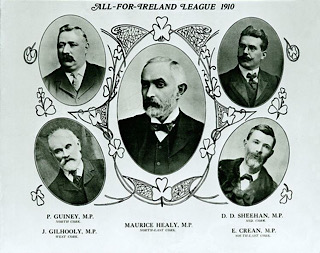
Guiney is the eldest son of Timothy Guiney, a shopkeeper and later clerk of Kanturkpoor law union, and Ellen Carver. He is educated at St. Patrick’s Monastery, Mountrath, County Laois. He serves three terms of imprisonment for activity in the Land War and later Plan of Campaign movement during the 1880s under the Coercion Act. He becomes a farmer and serves as councillor for Newmarket and on the Cork County Council (1908–11) as well as Chair of Newmarket Agricultural Society, Newmarket Gaelic League and Newmarket Old-Age Pensions Committee.
(Pictured: All-for-Ireland League group portrait of five of its Members of Parliament, in the “Cork Free Press”, 30 July 1910. These are: Patrick Guiney (North Cork), James Gilhooly (West Cork), Maurice Healy (North-east Cork), D. D. Sheehan (Mid Cork), and Eugene Crean (South-east Cork))
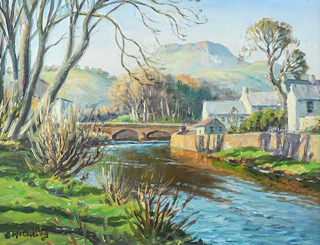
McAuley is the youngest of eight children in a family whose forebears had inhabited the Glens for many generations. He pursues painting from an early age, in a rural area when farming is one of the main sources of life and income. He goes on to become one of Ireland’s most celebrated landscape and figurative painters, his work synonymous with the Glens of Antrim.
A key encounter comes in McAuley’s mid-teens, when the artist James Humbert Craig, who is arts adjudicator at the Feis na nGleann, praises several of his youthful paintings, telling him, “You go ahead with this, and you’ll do well.” His paintings depicted the rivers, mountains, seascapes and rural life that surround him. He briefly studies at both the Belfast School of Art and Glasgow School of Art until he returns to his homeland to which he is utterly devoted. He is a member of the Royal Ulster Academy and the Royal Hibernian Academy.
In 1984. McAuley collaborates with his friend, the poetJohn Hewitt, on The Day of the Corncrake, a publication by the Glens of Antrim Historical Society, in which twenty-five colour reproductions of his paintings are coupled with thirty poems about the Glens by Hewitt. In a foreword, Hewitt writes that his “awareness was not merely graphic but demographic. This has made him for me the authentic regional artist, the painter who belongs to and finds his themes in a known place. Nowadays, with the rapid flow of international styles succeeding each other, this is a distinctive title one can seldom confer.”
In a BBC Television film made in the mid-1980s, McAuley remarks that he might have enjoyed more success if he had made a career in the wider world, but that he certainly would not have been happier. “I’ve spent my boyhood and manhood in the Glens. . .and I have no desire to leave them until I die.”
McAuley dies at the age of 89 on September 30, 1999. He is buried in St. Mary’s Roman Catholic Churchyard in Glenarm, County Antrim, Northern Ireland. On his death, BBC Northern Ireland describes him as “one of Ireland’s greatest colourists, but most significantly, a true and modest gentleman.”
The McAuley’s obituary in The Irish Times notes “Charles McAuley could fairly have claimed to be the artist of “the Glens”; for his native knowledge of the local landscape and people brought to the best of his work a special quality of emotion. Yet it is not a claim he would have made for himself, for self-promotion was a trait absent from his personality.”
Many of McAuley’s works are in private collections internationally. There are several of his paintings in public collections, for example at the Ulster Museum and Queen’s University Belfast.
(Pictured: “Bridge Near Cushendall” by Charles McAuley)
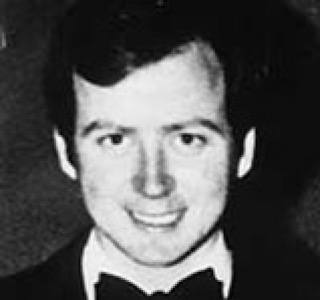
Steenson, a Catholic and the son of Frank Steenson, is born in 1957 and raised in heavily republican West Belfast. He is nicknamed “Doctor Death” by the media and the Royal Ulster Constabulary (RUC) for the multiple assassinations he purportedly accomplishes according to The New York Times. However, Fortnight alleges that he got his nickname after he dressed up in a white coat to attack British soldiers guarding a patient at the Royal Victoria Hospital.
Steenson is widely associated with internecine violence between Irish republican groups. He joins the Official Irish Republican Army‘s Belfast Brigade in 1972 at the age of 14, becoming part of the Brigade’s C Company. Two years later, he leaves to join the Irish National Liberation Army (INLA) upon that paramilitary group’s formation, consequent to their split from the Official IRA. He becomes head of the INLA in Belfast.
Steenson first comes to notoriety as a teenager in 1975 for killing Billy McMillen, the Official IRA’s Belfast leader, during the feud between the INLA and the Official IRA. Jim Cusack, a journalist describes him as the “assassin-in-chief” of Hugh Torney.
During the 1981 Northern Ireland local elections, Steenson and Seán Mackin both lead efforts within the INLA to obstruct Irish Republican Socialist Party (IRSP) candidates which disrupts their votes, viewing the decision to run in the election as wasteful, believing that the allocated resources would be better spent on weapons. Following the election, Steenson later changes his mind with regards to elections, declaring that the party should have run more candidates.
In December 1981, Steenson, fearing that the Dublin INLA leadership will make a move on him following his efforts to set up a parallel organisation, plans an assassination attempt on the Dublin leader, Harry Flynn. Following a meeting of the Ard Comhairle on December 5, Flynn and others go out for drinks in the Flowing Tide pub at the corner of Sackville Place and Marlborough Street in Dublin. Shortly before 11 p.m., Steenson’s gunman enters the pub and fires shots at Flynn before his gun jams and he flees. Though seriously wounded, Flynn survives. After the botched assassination attempt, Steenson then unsuccessfully threatens Seán Flynn for his seat on Belfast City Council. Later, on January 25, 1982, a botched attempt is also made on Seán Flynn and Bernard Dorrian at a bar in the Short Strand area, provoking a feud where a unit from the Derry INLA comes to Belfast searching for Steenson. Failing to secure power, the attacks only demoralise the IRSP and INLA and begin a trend of internal feuds.
In 1985, Steenson is convicted of 67 terrorist offences (including six murders) after his former friend, Harry Kirkpatrick, testifies against him. Kirkpatrick and Steenson are rarely seen apart in public and are given the nicknames “Pinkie and Perky.”
In 1986, Steenson, Jimmy Brown, and Martin “Rook” O’Prey form the Irish People’s Liberation Organisation (IPLO), consisting of disaffected and expelled INLA members, with the express intention of wiping out the INLA and IRSP and replacing them with their own organisation. He argues in letters, written while he is in prison in the early 1980s, that the INLA has become militarily “inefficient” and that the IRSP leadership has become “ineffective” and requires “realignment.”
Steenson is involved in the Rosnaree Hotel shooting on January 20, 1987, where a meeting between the leadership of the INLA and IPLO is to take place to end hostilities. However, IPLO members ambush the four INLA members at the hotel, killing Thomas “Ta” Power and John “Jap” O’Reilly, while Hugh Torney and Peter Stewart manage to escape.
Steenson is viewed highly in the movement with Brown calling him a “committed and highly efficient military activist and a dedicated revolutionary.” However, he is described by Lord Justice Carswell as “a most dangerous and sinister terrorist. A ruthless and highly dedicated, resourceful and indefatigable planner of criminal exploits who did not hesitate to take a leading role in assassinations and other crimes.” Henry McDonald and Jack Holland write, “Both his friends and enemies spoke in a tone of awestruck at his paramilitary abilities.” Ken Wharton refers to him as a “notorious psychopath.” Sean O’Callaghan describes him as someone who “never took to orders.”
Terry George writes of Steenson that he “was extremely clever and even wittier than Billy McMillan. He had an angelic face and women adored him. He was also ruthless, cunning and fearless.”
On March 14, 1987, Steenson and Tony “Boot” McCarthy return to Ballymurphy after a night of drinking which is cut short by anger over the INLA GHQ faction’s show of force in the Divis Flats earlier in the day. After bringing their car to a stop on Springhill Avenue, they are killed in an ambush by an INLA active unit, with a member of the unit closing the security gate at the top of the street to trap the pair. An INLA spokesperson says Steenson was killed for being “actively involved in continuous and concerted efforts to undermine the authority of the … movement.” Jimmy Brown gives the graveside oration.
The IPLO later kills Emmanuel Gargan in the Hatfield Bar on the Lower Ormeau Road and Kevin Barry Duffy in Armagh, County Armagh, in retaliation for the killing of Steenson. The IPLO draws the ire of the Lower Ormeau community through the circumstances surrounding the killing of Gargan, with graffiti appearing in the area labeled “IPLOscum.”
On Halloween 1992, the Provisional Irish Republican Army carries out a large-scale operation (dubbed the “Night of Long Knives”) with the goal of neutralising the IPLO. Following the operation and execution of Jimmy Brown, both the Belfast Brigade and Army Council factions disband.
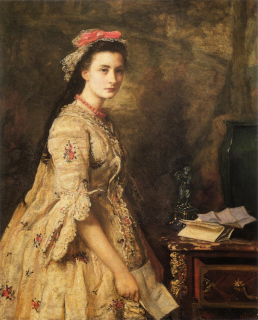
Esther Johnson, an Englishwoman known as “Stella” and known to be a close friend of Jonathan Swift, is born in Richmond, Surrey, England, on March 13, 1681. Whether or not she and Swift are secretly married, and if so, why the marriage is never made public, is a subject of debate.
Johnson spends her early years at Moor Park, Farnham, home of Sir William Temple, 1st Baronet. Here, when she is about eight, she meets Swift, who is Temple’s secretary. He takes a friendly interest in her from the beginning and apparently supervises her education.
Johnson’s parentage has been the subject of much speculation. The weight of evidence is that her mother acts as companion to Temple’s widowed sister, Martha, Lady Giffard, and that Johnson, her mother and her sister Anne are regarded as part of the family. Her father is said to have been a merchant who died young. Gossip that she is Temple’s illegitimate daughter seems to rest on nothing more solid than the friendly interest he shows in her. There are similar rumours about his supposed relationship with Swift.
When Swift sees Johnson again in 1696, he considers that she has grown into the “most beautiful, graceful and agreeable young woman in London.” Temple, at his death in 1699, leaves her some property in Ireland, and it is at Swift’s suggestion that she move to Ireland in 1702 to protect her interests, but her long residence there is probably due to a desire to be close to Swift. She generally lives in Swift’s house, though always with female companions like Rebecca Dingley, a cousin of Temple whom she has known since childhood. She becomes extremely popular in Dublin and an intellectual circle grows up around her, although it was said that she finds the company of other women tedious and only enjoys the conversation of men.
In 1704, their mutual friend, the Reverend William Tisdall, tells Swift that he wishes to marry Johnson, much to Swift’s private disgust, although his letter to Tisdall, which outlines his objections to the marriage, is courteous enough, making the practical point that Tisdall is not in a position to support a wife financially. Little is known about this episode, other than Swift’s letter to Tisdall. It is unclear if Tisdall actually proposes to her. If he does, he seems to have been met with a firm rejection, and he marries Eleanor Morgan two years later. He and Swift, after a long estrangement, become friends once more after Johnson’s death.
Johnson’s friendship with Swift becomes fraught after 1707 when he meets Esther Vanhomrigh, daughter of the Dutch-born Lord Mayor of Dublin, Bartholomew Van Homrigh. Swift becomes deeply attached to her and invents for her the name “Vanessa.” She in turn becomes infatuated with him and after his return to Ireland follows him there. The uneasy relationship between the three of them continues until 1723 when Vanessa, who is by now seriously ill from tuberculosis, apparently asks Swift not to see Johnson again. This leads to a violent quarrel between them, and Vanessa, before her death in June 1723, destroys the will she had made in Swift’s favour, leaving her property to two men, George Berkeley and Robert Marshall, who though eminent in their respective callings are almost strangers to her.
Whether Swift and Johnson are married has always been a subject of intense debate. The marriage ceremony is allegedly performed in 1716 by St. George Ashe, Bishop of Clogher, with no witnesses present, and it is said that the parties agree to keep it secret and live apart. Johnson always describes herself as a “spinster” and Swift always refers to himself as unmarried. Rebecca Dingley, who lives with Johnson throughout her years in Ireland, says that Johnson and Swift were never alone together. Those who know the couple best are divided on whether a marriage ever took place. Some, like Mrs. Dingley and Swift’s housekeeper Mrs. Brent laugh at the idea as “absurd.” On the other hand, Thomas Sheridan, one of Swift’s oldest friends, believes that the story of the marriage is true. He reportedly gives Johnson herself as his source. Historians have been unable to reach a definite conclusion on the truth of the matter. Bishop Ashe dies before the story first becomes public, and there are no other witnesses to the supposed marriage.
A collection of Johnson’s witticisms is published by Swift under the titles of “Bon Mots de Stella” as an appendix to some editions of Gulliver’s Travels. A Journal to Stella, a collection of 65 letters from Swift to Johnson, is published posthumously.
In 1722, Martha, Lady Giffard, dies and leaves money to Johnson and Swift’s sister, Mrs. Fenton, who had been her companion in 1711.
Johnson’s health begins to fail in her mid-forties. In 1726, she is thought to be dying and Swift rushes back from London to be with her but finds her better. The following year it becomes clear that she is gravely ill. After sinking slowly for months, she dies on January 28, 1728, and is buried in St. Patrick’s Cathedral, Dublin. Swift is inconsolable at her death and writes The Death of Mrs. Johnson in tribute to her. When Swift dies in October 1745, he is buried beside her at his own request. A ward in St. Patrick’s University Hospital is named “Stella” in her memory.
In the 1994 film Words Upon the Window Pane, based on the play by William Butler Yeats, Johnson is played by Bríd Brennan. The plot turns on a séance in Dublin in the 1920s, where the ghosts of Swift, Johnson and Vanessa appear to resume their ancient quarrel.
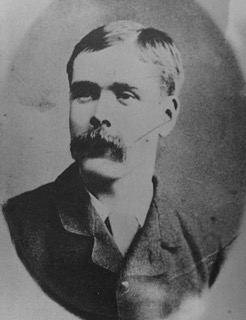
Boycott is the eldest surviving son of William Boycatt (1798–1877), rector of Wheatacrebury, Norfolk, and Elizabeth Georgiana Boycatt (née Beevor). The family name is changed to Boycott by his father in 1862. Educated at a boarding school in Blackheath, London, and the Royal Military Academy, Woolwich, he is commissioned ensign in the 39th (Dorsetshire) Regiment of Foot on February 15, 1850, and serves briefly in Ireland. He sells his commission on December 17, 1852, having attained the rank of captain, marries Annie Dunne of Queen’s County (County Laois) in 1852, and leases a farm in south County Tipperary.
In 1855, Boycott leaves for Achill Island, County Mayo, where he sub-leases 2,000 acres and acts as land agent for a friend, Murray McGregor Blacker, a local magistrate. He settles initially near Keem Strand but after some years builds a fine house near Dooagh overlooking Clew Bay. He clashes with local landowners and agents and is regularly involved in litigation. Twice summonsed unsuccessfully for assault (1856, 1859), he is involved (1859–60) in a bitter dispute with a land agent over salvage rights for shipwrecks, one of the few lucrative activities on the island. Achill’s remoteness and the difficulties of wresting a living from its harsh environment adds a roughness to the island’s social relations and probably aggravates Boycott’s tendency to high-handedness.
In 1873, Boycott inherits money and moves to mainland County Mayo, leasing Lough Mask House near Ballinrobe and its surrounding 300 acres. He also becomes agent for John Crichton, 3rd Earl Erne‘s neighbouring estate of 1,500 acres, home to thirty-eight tenant farmers paying rents of £500 a year, of which he receives 10 per cent as agent. He also serves as a magistrate and is unpopular because of his brusque and authoritarian manner, and for denying locals such traditional indulgences as collecting wood from the Lough Mask estate or taking short cuts across his farm. In April 1879, he purchases the 95-acre Kildarra estate between Claremorris and Ballinlough and an adjoining wood for £1,125, taking out a mortgage of £600 which stretches his finances.
Boycott is no brutal tyrant, but he is aloof, stubborn, and pugnacious, and believes that the Irish peasantry is prone to idleness and require firm handling. Such qualities and beliefs are unremarkable enough, but in the peculiar circumstances of the land war in County Mayo, they are enough to catapult this rather ordinary man to worldwide notoriety.
In autumn 1879, concerted land agitation begins in County Mayo, and on August 1, 1879, Boycott receives a notice threatening his life unless he reduces rents. He ignores it and evicts three tenants, which embitter relations on the estate. Lough Mask House is placed under Royal Irish Constabulary (RIC) surveillance beginning in November 1879. In August 1880, his farm labourers, encouraged by the Irish National Land League, strike successfully for a wage increase from 7s. –11s. to 9s. –15s. Since the harvest is poor, Lord Erne allows a 10 per cent rent abatement. But in September 1880, when Boycott demands the rent, most tenants seek a 25 per cent abatement. Lord Erne refuses, and on September 22, Boycott attempts to serve processes against eleven defaulters. Servers and police are attacked by an angry crowd of local women and forced to take refuge in Boycott’s house. Almost immediately he is subjected to the ostracism against land grabbers advocated by Charles Stewart Parnell in his September 19 speech at Ennis, County Clare. This weapon proves as devastating against an English land agent as an Irish land-grabber. His servants leave him, labourers refuse to work his land, his walls and fences are destroyed, and local traders refuse to do business with him. He is jeered on the roads, is hissed and hustled by hostile crowds in Ballinrobe, and requires police protection.
The campaign against Boycott is largely orchestrated by Fr. John O’Malley, a local parish priest and president of the Neale branch of the Irish National Land League. It is probably O’Malley who coins the term “boycott” as an alternative to the word “ostracise,” which he believes would mean little to the local peasantry. Propagated by O’Malley’s friend, the American journalist, James Redpath, it is adopted by advocates and opponents alike.
On October 22, 1880, before his story breaks on the world, Boycott gives evidence of his treatment to the Bessborough Commission in Galway. He publicises his plight in an October 18, 1880, letter to The Times, and in a long interview with The Daily News on October 24, which is reprinted in Irish unionist newspapers and arouses considerable sympathy for him. Although he rarely uses his former military rank, he becomes universally known as “Captain Boycott,” since it suits both sides to portray him as someone of social standing. Letters of support appear in unionist papers and the Belfast News Letter sets up a “Boycott Relief Fund” and proposes a relief expedition, portraying Boycott as a peaceable English gentleman unjustly subjected to intimidation.
The prospect of hundreds of armed loyalists descending on County Mayo alarms the government, who announce on November 8 that they will provide protection for a small group of labourers to harvest Boycott’s crops. On November 12, fifty-seven loyalists from counties Cavan and Monaghan, “the Boycott Relief Expedition,” arrive at Lough Mask with an escort of almost a thousand troops. After harvesting Boycott’s crops, they leave on November 26. The entire operation costs £10,000 – about thirty times the value of the crops. Although the expedition passes off largely without incident, it focuses international media attention on the affair and establishes the word “boycott” in English and several other languages as a standard term for communal ostracism.
On November 27, Boycott and his wife go to the Hammam Hotel, Dublin, where he receives death threats. On December 1, he travels to London and then to the United States (March–May 1881) to see Murray McGregor Blacker, the friend from his time on Achill Island who has since settled in Virginia. In an interview with the New York Herald, he criticises the liberal government’s weakness toward the Land League and claims that the Irish land question is an intractable problem that can only be solved in the long term by emigration and industrialisation.
Boycott returns to Lough Mask on September 19, 1881, and at an auction in Westport is mobbed and burned in effigy. This, however, is the last outburst of hostility against him, and as the land agitation wanes so does his unpopularity. Although unsuccessful in efforts to win compensation from the government, he receives a public subscription of £2,000. He remains in County Mayo as Lord Erne’s agent until February 1886, when he obtains the post of land agent for Sir Hugh Adair in Flixton, Suffolk, but he keeps the small Kildarra estate, where he continues to holiday. On December 12, 1888, he gives evidence of his treatment to the parliamentary commission on “Parnellism and crime.”
After suffering from ill-health for some years, Boycott dies at Flixton on June 19, 1897, and is buried in the churchyard of Burgh St. Peter. A British-made film, Captain Boycott (1947), stars Cecil Parker in the title role.
Boland is born in Manchester, Lancashire, England, on October 6, 1856. His parents, Patrick Boland and Eliza Boland (née Kelly), are both Great Famine emigrants from Connacht in Ireland. His father is reputed to be a member of the IRB and his mother is a first cousin of ColonelThomas J. Kelly.
Patrick and his brothers may have been involved in the IRB campaign to rescue Kelly and Timothy Deasy from a Manchester police van. Ten-year-old Boland is believed to have been a scout for the party that attacks the van and kills a police officer. As he grows older, he becomes more involved in the movement himself.
Boland moves to Dublin in around 1881 and becomes a foreman with a company paving the streets of Smithfield, Dublin. He is transferred from the Manchester Fenians to the Dublin section. He marries Kate Woods in 1882.
Boland is awarded the Royal Humane Society‘s medal in the same year for “jumping off the Metal Bridge” to save a life.
Boland’s involvement in the Invincibles and the Phoenix Park Murders remains unclear. He works with Joe Brady and is named by informers as a member of the IRB’s Dublin Directory in 1882, while another informer names him as a member of the Invincibles and claims that he gave orders to Brady. He is questioned at Dublin Castle, but when a warrant is issued for his arrest on January 25, 1883, he and Kate had fled to New York.
Boland finds work as an engineer with De Castro & Donner, a sugar-refining company in Brooklyn. He also becomes involved in Clan na Gael and gets to know John Devoy very well. He possibly secretly returns to Ireland in 1883 as he reputedly takes part in IRB meetings that are believed to lead to the formation of the Gaelic Athletic Association (GAA). According to his grandson, Kevin Boland, he is in attendance as a member of the already established General Council at the historic meeting in Hayes’ Hotel in Thurles, County Tipperary.
Boland’s first child, Nellie, is born in the United States, while his second child, Gerald is conceived there, but is born in Manchester in May 1885.
The Boland family returns to Dublin in 1885 where Boland resumes work with the Dublin Corporation, this time directly employed and, by 1891, has been promoted from foreman to overseer. He is a leading figure in the Paviors’ Society. He is also under continuous surveillance by the police as his IRB role continues. He is named number 59 of 63 “dangerous Fenians” in the Dublin Metropolitan Police District in September 1886.
The Bolands’ third child, Harry, is born in 1887. Boland’s involvement in the nationalist movement increases and, after the split over Charles Stewart Parnell‘s leadership of the Irish Parliamentary Party (IPP), he becomes one of the main Parnellite organisers in Dublin. At Parnell’s funeral procession in 1891, he and seven colleagues head a contingent of 2,000, each wielding a camán (hurley) draped in black. He also organises the funeral of his friend Pat Nally, a former member of the IRB’s Supreme Council with whom Boland had originally conspired in Manchester.
In 1892, Boland is brought before the courts charged with keeping drink for the purposes of sale without a license. In court, he is able to show that, in fact, the premises is the new premises of the Nally Branch of the GAA and that the bar is attached to the club. The case is dismissed.
Boland is elected President of the Dublin County Committee of the GAA in 1892 and to the Dublin seat of GAA Central Council for the next two years. The Bolands have two more children, Kathleen in 1889 and Ned in 1893.
In 1894, Boland is elected to the Supreme Council of the IRB.
Boland falls ill in October 1894 with a serious brain disorder. He has received head injuries at two previous incidents. According to accounts, he is hit in the head protecting Parnell from assailants before his last trip to Wicklow and suffers a concussion. The injury also causes an undetected skull fracture. He is also involved in a bombing of the offices of the Parnell’s newspaper United Ireland in 1891 following an attempted takeover by Healyites, during which he is struck in the head.
Boland fails to recover and dies in Dublin on March 11, 1895. Around 1,500 mourners on foot follow his open hearse at his funeral. The group includes three members of parliament, eight city councillors and prominent Nationalists, including Arthur Griffith, James Bermingham and Fred Allan. He is buried at Glasnevin Cemetery, Glasnevin, County Dublin. Following his death, two funds are raised to save his wife and young family from destitution. Enough money is raised to acquire a tobacconists business for Kate Boland.
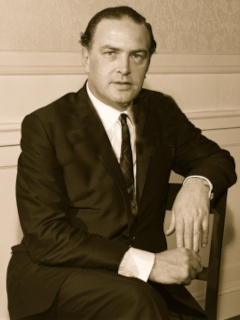
O’Malley is born on January 18, 1921, in Limerick, one of eight surviving children of Joseph O’Malley, civil engineer, and his wife, Mary “Cis” (née Tooher). Born into a wealthy middle-class family, he is educated by the Jesuits at Crescent College and later at Clongowes Wood College, County Kildare. He later studies at University College Galway (UCG), where he is conferred with a degree in civil engineering in 1943. He later returns to Limerick, where he works as an engineer before becoming involved in politics.
O’Malley plays rugby at provincial level for Munster, Leinster and Connacht and at club level for Bohemians and Shannon RFC. His chances at an international career are ruined by the suspension of international fixtures during World War II. It is at a rugby match in Tralee that he first meets Dr. Hilda Moriarty, who he goes on to marry in August 1947.
Although O’Malley runs as a Fianna Fáil candidate, he is born into a politically active family who supports Cumann na nGaedheal until a falling-out with the party in the early 1930s. He first becomes involved in local politics as a member of Limerick Corporation. He becomes Mayor of Limerick in 1961, the third O’Malley brother to hold the office (Desmond from 1941-43 and Michael from 1948-49). He is a strong electoral performer, topping the poll in every general election he runs in.
O’Malley is first elected to Dáil Éireann as a Fianna Fáil TD for Limerick East at the 1954 Irish general election. Fianna Fáil is not returned to government on that occasion. He spends the rest of the decade on the backbenches. However, his party is returned to power in 1957. Two years later, the modernising process begins when Seán Lemass takes over from Éamon de Valera as Taoiseach. Lemass introduces younger cabinet ministers, as the old guard who has served the party since its foundation in 1926 begin to retire.
In 1961, O’Malley joins the government as Parliamentary Secretary to the Minister for Finance. He is part of a new, brasher style of politician that emerges in the 1960s, sometimes nicknamed “the men in the mohair suits.” It is expected that this generation of politician, born after the Irish Civil War, will be a modernising force in post-de Valera Ireland.
Although his sporting background is in rugby and swimming, it is association football which O’Malley gets involved in at a leadership level, becoming President of the Football Association of Ireland despite never having played the sport.
Following Fianna Fáil’s retention of power in the 1965 Irish general election, O’Malley joins the cabinet as Minister for Health. He spends just over a year in this position before he is appointed Minister for Education, a position in which he displays renowned dynamism. Having succeeded Patrick Hillery, another dynamic young minister, he resolves to act swiftly to introduce the recommendations of an official report on education.
As Minister for Education, O’Malley extends the school transport scheme and commissions the building of new non-denominational comprehensive and community schools in areas where they are needed. He introduces Regional Technical Colleges (RTCs), now called Institutes of Technology, in areas where there is no third level college. The best example of this policy is the University of Limerick, originally an Institute of Higher Education, where O’Malley is credited with taking the steps to ensure that it becomes a university. His plan to merge Trinity College Dublin and University College Dublin arouses huge controversy, and is not successful, despite being supported by his cabinet colleague Brian Lenihan. Access to third-level education is also extended, the old scholarship system being replaced by a system of means-tested grants that give easier access to students without well-off parents.
Mid-twentieth century Ireland experiences significant emigration, especially to the neighbouring United Kingdom where, in addition to employment opportunities, there is a better state provision of education and healthcare. Social change in Ireland and policies intending to correct this deficit are often met with strong resistance, such as Noël Browne‘s proposed Mother and Child Scheme. As a former Health Minister, O’Malley has first-hand experience of running the department which had attempted to introduce this scheme and understood the processes that caused it to fail, such as resistance from Department of Finance and John Charles McQuaid. This influences his strategy in presenting the free-education proposal.
Shortly after O’Malley is appointed, he announces that from 1969 all education up to Intermediate Certificate level will be without cost, and free buses will bring students in rural areas to their nearest school, seemingly making this decision without consulting other ministers. However, he does discuss it with Lemass. Jack Lynch, who, as Minister for Finance, has to find the money to pay for the programme, is not consulted and is dismayed at the announcement.
By announcing the decision first to journalists and on a Saturday (during a month when the Dáil is in recess), the positive public reaction tempers resistance to the idea before the next cabinet meeting. O’Malley’s proposals are hugely popular with the public, and it is impossible for the government to go back on his word.
Some Irish commentators consider that O’Malley’s extension of education, changing Ireland from a land where the majority are schooled only to the age of 14 to a country with universal secondary-school education, indirectly leads to the Celtic Tiger boom of the 1990s-2000s when it is followed for some years by an extension of free education to primary degree level in university, a scheme that is launched in 1996 by the Labour Party and axed in 2009 by Fianna Fáil’s Batt O’Keeffe.
In 1967, O’Malley appoints Justice Eileen Kennedy to chair a committee to carry out a survey and report on the reformatory and industrial school systems. The report, which is published in 1970, is considered ground-breaking in many areas and comes to be known as the Kennedy Report. The Report makes recommendations about a number of matters, including the Magdalene laundries, in relation to which they are not acted upon. The report recommends the closure of a number of reformatories, including the latterly infamous reformatory at Daingean, County Offaly.
O’Malley’s reforms make him one of the most popular members of the government. He is affectionately known as “the School Man” for his work in education. His sudden death in Limerick on March 10, 1968, before his vision for the education system is completed, comes as a shock to the public. He is buried with a full Irish state funeral.
Following O’Malley’s death, his widow, Hilda O’Malley, does not run in the subsequent by-election for the seat he has left vacant. It is won narrowly by their nephew Desmond O’Malley. Hilda seeks the Fianna Fáil nomination for the 1969 Irish general election, but Fianna Fáil gives the party nomination to Desmond, as the sitting TD. Hilda runs as an Independent candidate in that election. After what proves a bitter campaign against her nephew, she fails to get the fourth seat in Limerick East by just 200 votes.
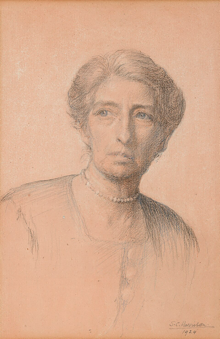
Best is born in Dublin on July 11, 1865, the youngest of fourteen children of Dublin merchant, Eldred Oldham, and Annie (née Alker). Two of her siblings are Alice Oldham, the first of nine women to graduate from university with a degree in either Great Britain or Ireland, and Charles Hubert Oldham, first professor of national economics at University College Dublin (UCD). She attends the Royal Irish Academy of Music (RIAM), studying under Margaret O’Hea and Robert Prescott Stewart. She wins the Lord O’Hagan’s prize in 1883. She is one of the first three candidates to win a scholarship to the Royal College of Music, London, in 1883, becoming an associate of the College by competitive examination in 1887. She is a close friend and confidante of the College’s director, Sir George Grove, to which his 514 letters to her from 1883 to 1899, now housed in the Royal College of Music library, testify.
Best returns to the RIAM as a piano teacher in 1887, remaining in that post until 1932. She is the first female teacher in the RIAM listed as holding a diploma in music. She is also an assistant to Michele Esposito as a local centre examiner. She is a founding member of the Feis Ceoil, undertaking large responsibility for its organisation, and it becomes an annual event under her leadership. In 1898, she describes the foundation of the Feis in a paper to the Incorporated Society of Musicians as being inspired to “ultimately do more for the art of music in Ireland than anything which has yet been attempted.” Along with Joseph Seymour and Edward Fournier she visits the Welsh Eisteddfod to compare it with the Feis, and hopes it will become as influential as the Welsh festival. She works with Eoin MacNeill and the Gaelic League to promote the Feis, and to organise prizes. Under her influence, the festival broadens its scope beyond purely Irish music. She serves as the honorary secretary of the Feis Ceoil Association from 1896 to 1905, and vice-president from 1905 to 1950. In 1897, Esposito dedicates his cantata Deirdre to her. She is a founding member of the Dublin Orchestral Society in 1899, and she succeeds Esposito as the director of music at Alexandra College, Dublin, in 1927. She is made an associate of the Royal Dublin Societyin 1892, and fellow of the RIAM in 1938.
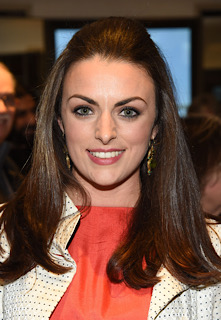
Noone grows up in Upper Newcastle, Galway. She trains for two years at the Performing Arts School in Galway, and is a proficient musician (piano to Grade 7 level) and dancer. Her previous acting roles before starting her acting career, are in school and amateur productions and pantomime.
Noone makes her professional film debut playing Bernadette in the Peter Mullan written and directed film The Magdalene Sisters (2002). The film wins the Best Film prize in the 2002 Venice Film Festival, and is nominated as Best British Picture at the British Academy Film Awards. For her performance as Bernadette, she is nominated for British Newcomer of the Year at the 2004 London Film Critics’ Circle Awards, alongside Mullan, who wins best director and best film of the year.
In 2005, Noone is nominated for Best Supporting Actress in a Feature Film for her role as Holly in The Descent (2005) at the 3rd Irish Film & Television Awards. She is nominated in 2010 for Best Actress in a Supporting Role Film at the 7th Irish Film & Television Awards for her role in the film Savage (2009).
In 2008, Noone co-stars in Doomsday, directed by Neil Marshall, Speed Dating and Ella Enchanted. Other work includes the short films News for the Church written and directed by Andrew McCarthy and The Listener, directed by Michael Chang. She also records Walking at Ringsend for BBC Radio 4. In 2008, she appears in Insatiable.
In 2020, Noone receives a nomination Best Actress in a Leading Role Film at the 17th Irish Film & Television Awards for her performance as Lauren in Wildfire. In 2022, she is involved in the relaunch of The Ipcress File, as Dr. Karen Newton.
In 2023, Noone returns to Ireland as Detective Sergeant Claire Wallace in the RTÉ crime series Hidden Assets.
In 2023, Noone moves back to live in Galway while filming Hidden Assets. She and her husband, fellow actor Chris Marquette, have a daughter in 2020. This is one reason that she decides to return to Ireland.
From the late 1960s until the late 1990s, Northern Ireland undergoes a conflict known as the Troubles, in which more than 3,500 people are killed. More than 700 of those killed are British military personnel, deployed as part of Operation Banner. The vast majority of these British military personnel are killed by the Provisional Irish Republican Army (IRA), which wages an armed campaign to force the British to negotiate a withdrawal from Northern Ireland. In 1997, the IRA calls a final ceasefire and in 1998 the Good Friday Agreement is signed. This is widely seen as marking the end of the conflict.
However, breakaway groups of dissident Irish republicans oppose the ceasefire and continue a low-level armed campaign against the British security forces in Northern Ireland. The main group involved is an IRA splinter group known as the Real IRA. In 2007, the British Army formally ends Operation Banner and greatly reduces its presence in Northern Ireland.
The low-level dissident republican campaign continues. In January 2009, security forces have to defuse a bomb in Castlewellan, County Down, and in 2008 three separate incidents see dissident republicans attempt to kill PSNI officers in Derry, Castlederg and Dungannon. In all three cases, PSNI officers are seriously wounded. Two of the attacks involve firearms while the other involves an under-car booby-trap bomb.
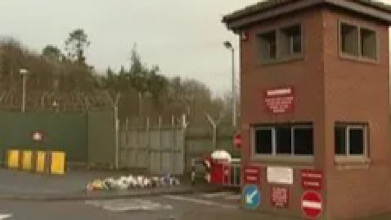
At about 9:40 p.m. on the evening of Saturday, March 7, four off-duty British soldiers of the Royal Engineers walk outside the barracks to receive a pizza delivery from two delivery men. As the exchange is taking place, two masked gunmen in a nearby car open fire with PM md. 63assault rifles. The firing lasts for more than 30 seconds with more than 60 shots being fired. After the initial burst of gunfire, the gunmen walk over to the wounded soldiers lying on the ground and fire again at close range, killing two of them. Those killed are Sappers Mark Quinsey from Birmingham and Patrick Azimkar from London. The other two soldiers and two deliverymen are wounded. The soldiers are wearing desert fatigues and were to be deployed to Afghanistan the following day. A few hours later, the stolen car involved is found abandoned near Randalstown, eight miles (13 km) from the barracks.
A Dublin-based newspaper, the Sunday Tribune, receives a phone call from a caller using a recognised Real IRA codeword. The caller claims responsibility for the attack on behalf of the Real IRA, adding that the civilian pizza deliverymen were legitimate targets as they were “collaborating with the British by servicing them.”
The shootings are the first British military fatalities in Northern Ireland since Lance Bombardier Stephen Restorick was shot dead by the Provisional IRA in February 1997, during the Troubles. The attack comes days after a suggestion by Northern Ireland’s police chief, Sir Hugh Orde, that the likelihood of a “terrorist” attack in Northern Ireland is at its highest level in several years.
Civilian security officers belonging to the Northern Ireland Security Guard Service are criticised for not opening fire during the incident, as a result of which plans are made to retrain and rearm them.
The morning after the attack, worshippers come out of St. Comgall’s Church after mass and keep vigil near the barracks. They are joined by their priest and clerics from the town’s other churches. On March 11, 2009, thousands of people attend silent protests against the killings at several venues in Northern Ireland.
The killings are condemned by all mainstream political parties in Northern Ireland, as well as the Irish government, the United States government and Pope Benedict XVI. Sinn Féin condemns the killings, but is criticised for being less vehement than others in its condemnation.
On March 14, 2009, the PSNI arrests three men in connection with the killings, one of whom is former IRA prisoner Colin Duffy. He had broken away from mainstream republicanism and criticised Sinn Féin’s decision to back the new PSNI. On March 25, 2009, after a judicial review of their detention, all the men are ordered to be released by the Belfast High Court. Duffy is immediately re-arrested on suspicion of murder. On March 26, 2009, Duffy is charged with the murder of the two soldiers and the attempted murder of five other people. The following day he appears in court for indictment and is remanded in custody to await trial after it is alleged that his full DNA profile had been found on a latex glove inside the vehicle used by the gunmen. There is also soil found in the car they drove that matches the soil on the ground in front of the barracks.
Brian Shivers, a cystic fibrosis sufferer, is charged with the soldiers’ murders and the attempted murder of six other people. He is also charged with possession of firearms and ammunition with intent to endanger life. He is arrested in Magherafelt, County Londonderry, in July 2009.
In January 2012, Shivers is convicted of the soldiers’ murders, but Duffy is acquitted. In January 2013, Shivers’s conviction is overturned by Northern Ireland’s highest appeals court. A May 2013 retrial finds Shivers not guilty. He is cleared of all charges and immediately released from jail. The judge questions why the Real IRA would choose Shivers as the gunman, with his cystic fibrosis and his engagement to a Protestant woman.
The barracks are shut down in 2010 as part of the reduction of the British Army presence in Northern Ireland.


 seamus dubhghaill