seamus dubhghaill

Promoting Irish Culture and History from Little Rock, Arkansas, USA


Leave a comment

Formation of the Kildare Place Society

The Kildare Place Society, known officially as the Society for the Promotion of the Education of the Poor of Ireland, is formed on December 2, 1811, to maintain non-denominational schools and to promote the education of the poor. It is the most successful of all the voluntary educational agencies founded in the years prior to the establishment of the National Board of Education in 1831.

Set up in 1811 explicitly to cater to the demand for education among the Catholic poor, the Kildare Place Society aims to provide a Bible-based but non-denominational education that is acceptable to Catholics. In 1816 the society petitions the Parliament of the United Kingdom and is awarded 10,000 pounds, an amount that is greatly increased over the following decade. This money allows the society to spread across the country and to establish the rudiments of a national system of primary education. The society aims to modernize the teaching profession with a training college and an inspectorate, decent schoolhouses, and regular salaries for teachers. It also produces reading material aimed at a popular audience, which competes very favorably with the much-derided chapbooks that are the staple of popular reading material at the time.

Despite the commitment of the founders, many of whom are members of the Society of Friends, to respect denominational differences, and despite the allocation of seats for Catholics on the board of trustees, the society is increasingly drawn into quarrels over the use of the Protestant Bible for educational purposes during the second decade of the 19th century.

Particularly significant is the influence of the evangelical members of the board, especially Chief Justice Thomas Lefroy, who insists on the compulsory use of the Bible “without note or comment” in the Kildare Place schools. This measure is openly and stridently criticized by the Reverend John MacHale in the famous Hierophilus Letters of 1820 and is the immediate cause of the resignations of Daniel O’Connell and Valentine Lawless, 2nd Baron Cloncurry from the society’s board in 1821. This gesture is followed in short order by directives to Catholic parents to withdraw their children from the schools.

The substance of O’Connell’s and MacHale’s attacks on the Kildare Place Society is that its policies are in line with the more overtly proselytizing societies associated with the “Second Reformation” and are therefore unsuitable for Catholic children. The society does not survive the challenge. As a result of the ideological conflict over education, the government inaugurates a series of inquiries to determine what kind of educational system would be acceptable to the different denominations in Ireland, and the outcome is the establishment of the National Board of Education in 1831. Although the Kildare Place Society continues its work into the 1830s, its school system suffers an inevitable decline with the spread of the new national system.

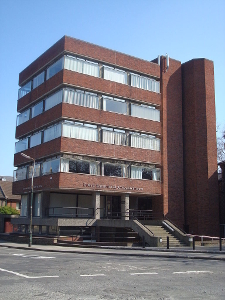
(Pictured: The main offices of the Kildare Place Society in Kildare Place, Dublin)


Leave a comment

Birth of Margaret “Gretta” Cousins, Educationist & Suffragist

Margaret Elizabeth Cousins (née Gillespie), also known as Gretta Cousins, Irish Indian educationist, suffragist and Theosophist, is born into an Irish Protestant family in Boyle, County Roscommon, on October 7, 1878.

Gillespie is educated locally and in Derry. She studies music at the Royal University of Ireland in Dublin, graduating in 1902, and becomes a teacher. As a student she meets the poet and literary critic James Cousins. They are married in 1903. The pair explore socialism, vegetarianism, and parapsychology together. In 1906, after attending a National Conference of Women (NCW) meeting in Manchester, Cousins joins the Irish branch of the NCW. In 1907 she and her husband attend the London convention of the Theosophical Society, and she makes contact with suffragettes, vegetarians, anti-vivisectionists, and occultists in London.

Cousins co-founds the Irish Women’s Franchise League with Hanna Sheehy-Skeffington in 1908, serving as its first treasurer. In 1910 she is one of six Dublin women attending the Parliament of Women, which attempt to march to the House of Commons to hand a resolution to the Prime Minister. After 119 women marching to the House of Commons have been arrested, fifty requiring medical treatment, the women decide to break the windows of the houses of Cabinet Ministers. Cousins is arrested and sentenced to a month in Holloway Prison.

Vacationing with William Butler Yeats in 1912, Cousins and her husband hear Yeats read translations of poems by Rabindranath Tagore. In 1913, breaking the windows of Dublin Castle on the reading of the Second Home Rule Bill, Cousins and other suffragists are arrested and sentenced to one month in Tullamore Jail. The women demand to be treated as political prisoners and go on hunger strike to achieve release.

In 1913, she and her husband move to Liverpool, where James Cousins works in a vegetarian food factory. In 1915 they move to India. James Cousins initially works for New India, the newspaper founded by Annie Besant. After Besant is forced to dismiss him for an article praising the 1916 Easter Rising, she appoints him Vice-Principal of the new Besant Theosophical College, where Margaret teaches English.

In 1916, Cousins becomes the first non-Indian member of the SNDT Women’s University at Poona. In 1917, Cousins co-founds the Women’s Indian Association (WIA) with Annie Besant and Dorothy Jinarajadasa. She edits the WIA’s journal, Stri Dharma. In 1919 Cousins becomes the first Head of the National Girls’ School at Mangalore. She is credited with composing the tune for the Indian national anthem Jana Gana Mana in February 1919, during Rabindranath Tagore’s visit to Besant Theosophical College. In 1922, she becomes the first woman magistrate in India. In 1927, she co-founds the All India Women’s Conference, serving as its President in 1936.

In 1932, she is arrested and jailed for speaking against the Emergency Measures. By the late 1930s she feels conscious of the need to give way to indigenous Indian feminists:

“I longed to be in the struggle, but I had the feeling that direct participation by me was no longer required, or even desired by the leaders of India womanhood who were now coming to the front.”

A stroke leaves Cousins paralysed from 1944 onwards. She receives financial support from the Madras government, and later Jawaharlal Nehru, in recognition of her services to India. She dies on March 11, 1954. Her manuscripts are dispersed in various collections across the world.


Leave a comment

Opening of the Tipperary Rural & Business Development Institute in Thurles

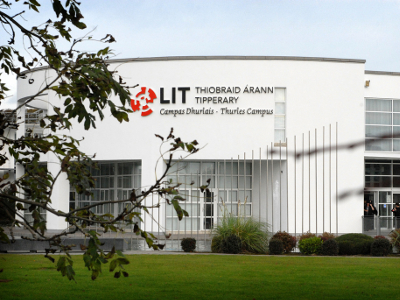
The Tipperary Rural & Business Development Institute (TRBDI), a college of higher education, development agency and research centre founded by the Irish Government in 1998, opens in Thurles, County Tipperary on September 27, 1999. It is one of the five constituent schools of Limerick Institute of Technology (LIT).

Taoiseach Bertie Ahern officially inaugurates the institute on April 7, 2000. The college uses Tipperary Institute as its trading name. In 2010 the Irish government introduces rationalization measures to cut costs of third level bodies, and commences a merger between Tipperary Institute and Limerick Institute of Technology. The formal integration of Tipperary Institute into LIT on September 1, 2011, sees the two campuses become LIT Tipperary.

The college has two academic departments: Business, Education and Social Science and Technology, Media and Science. It is fully accredited by the Higher Education and Training Awards Council (HETAC) and offers National Framework of Qualifications Level 7 and Level 8 full-time degree courses, as well as a number of part-time and evening courses. The college also facilitates the joint-run BSc (Hons) in Strength & Conditioning (level 8) in conjunction with online sports college Setanta College.


Leave a comment

Death of John McElroy, Founder of Boston College

Death of Jesuit John McElroy, the founder of Boston College, at age of 95 in Frederick, Maryland, on September 12, 1877.

McElroy is born on May 14, 1782, in Enniskillen, County Fermanagh, the younger of two sons. In the hopes of providing a better life for John and his brother Anthony, their father, a farmer, finances their travel to the United States. In 1803 the two young men board a ship leaving the port of Londonderry and arrive in Baltimore, Maryland, on August 26. McElroy eventually settles in Georgetown, Washington, D.C., and becomes a merchant.

In 1806, McElroy enters Georgetown College in Washington, D.C., the same year he enters the novitiate of the Society of Jesus as a lay brother. He eventually manages the finances of Georgetown College and in 1808 erects the tower building. He managed the school’s finances so well that through the period of economic hardship following the War of 1812, he is able to send several Jesuits to Rome to study.

McElroy is ordained in May 1817, after less than two years of preparation. As a new priest, he is assigned to Holy Trinity Catholic Church in Georgetown as an assistant pastor. In his short time at Trinity, he contributes to the growth of the congregation and enlarging of the church building. This is achieved by increasing the monthly subscription for congregation members from 12½ cents to $12.50 on July 3, 1819. The following day he travels to most of the congregation members’ homes and collects $2,000 in pledges. He immediately sets to work having the Church modified to include two lateral-wing chapels, which are first used on October 3, 1819.

On January 11, 1819, McElroy is granted United States citizenship. Also in 1819, McElroy starts a Sunday School for black children who are taught prayers and catechism simultaneously with spelling and reading, by volunteer members of the congregation. McElroy spends his remaining years in Georgetown teaching the lower grades.

In 1823, McElroy begins negotiations with the Sisters of Charity in Emmitsburg, Maryland, for the establishment of a school for girls in Frederick. In 1824, the St. John’s Benevolent Female Free School is founded by the Sisters of Charity of Saint Joseph at 200 East Second Street in Frederick. In 1825, McElroy sets to work replacing the pre-American Revolution log cabin that houses the school with a modern building large enough to also house an orphanage.

McElroy’s next task is to found an educational institution for boys. On August 7, 1828, the construction of St. John’s Literary Institute begins. The following year the construction is completed, and the school is opened, a school which is currently operating under the name of Saint John’s Catholic Prep.

In October 1847, McElroy is welcomed in Boston, Massachusetts, by the Bishop of Boston, John Bernard Fitzpatrick, to serve as pastor of St. Mary’s parish in the North End. Bishop Fitzpatrick sets McElroy to work on bringing a college to Boston.

In 1853, McElroy finds a property in the South End where the city jail once stood. After two years of negotiations the project falls through due to zoning issues. A new site is identified, and city officials endorse the sale. In 1858, Bishop Fitzpatrick and Father McElroy break ground for Boston College, and for the Church of the Immaculate Conception. Classes began in the fall of 1864 and continue at this location until 1913 when the college moves to its current location at Chestnut Hill. Initially Boston College offers a 7-year program including both high school and college. This joint program continues until 1927 when the high school is separately incorporated.

In 1868, McElroy retires to the Jesuit novitiate in Frederick, Maryland. He visits Georgetown for the final time in 1872 to celebrate his golden jubilee. His eyesight is failing and while moving through his home he falls, fracturing his femur, which eventually leads to his death. Father John McElroy dies September 12, 1877, at the Jesuit novitiate in Frederick, Maryland. For some years leading up to his death, he is regarded as the oldest priest in the United States and the oldest Jesuit in the world. He is buried in the Novitiate Cemetery. In 1903, the Jesuits withdraw from Frederick and the graves are moved from the Frederick Jesuit Novitiate Cemetery to St. John’s Cemetery.


Leave a comment

Birth of Eugene O’Growney, Priest & Scholar

Eugene O’Growney, Irish priest and scholar, and a key figure in the Gaelic revival of the late 19th century, is born on August 25, 1863 at Ballyfallon, Athboy, County Meath.

The Irish language has largely retreated from Meath when O’Growney is born, and neither of his parents speak it. He becomes interested in the language when he chances upon the Irish lessons in the nationalist newspaper Young Ireland. He has help at first from a few old people who speak the language, and while at St. Patrick’s Pontifical University, Maynooth, where he continues his studies for the priesthood from the year 1882, he spends his holidays in Irish-speaking areas in the north, west and south. He gets to know the Aran Islands and writes about them in the bilingual Gaelic Journal (Irisleabhar na Gaedhilge), which he is later to edit. He is ordained in 1888. His proficiency in the language leads him to be appointed in the re-established Chair of Irish at Maynooth in 1891. He is editor of the Gaelic Journal between 1894 and 1899 and during his tenure ensures that more material is published in Irish.

For O’Growney language, nationality and religion are closely linked. In 1890, writing in the Irish Ecclesiastical Review, he describes literature in Irish as “the most Catholic literature in the world.” He is aware, however, of its other aspects, adding that “even if Irish were to perish as a spoken language, it would remain valuable from the pure literature point of view.”

His Simple Lessons in Irish, first published in the newspaper The Weekly Freeman, proves so popular that they are published in booklet form. There are five books in the series and 320,000 copies have been sold by 1903. In a foreword he states:

“The following course of simple lessons in Irish has been drawn up chiefly for the use of those who wish to learn the old language of Ireland, but who are discouraged by what they have heard of its difficulties… But the difficulties of Irish pronunciation and construction have always been exaggerated. A I myself was obliged to study Irish as a foreign language, and as I have been placed in circumstances which have made me rather familiar with the language as now spoken, I have at least a knowledge of the difficulties of those who, like myself, have no teacher.”

O’Growney is a founding member of the Gaelic League, which is created in Dublin in 1893 “for the purpose of keeping the Irish language spoken in Ireland,” and later becomes its vice-president.

In 1894, failing health causes him to go to Arizona and California, where he dies in Los Angeles on October 18, 1899. Some years later, with the aid of Irish sympathisers in the United States, his body is returned to Ireland. His funeral, held on September 26, 1903 at the St. Mary’s Pro-Cathedral, Dublin, is attended by 6,000 people, including members of the trade guilds, clerics, politicians, members of the nationalist Gaelic Athletic Association and students. He is buried at Maynooth.

(Pictured: Statue of Fr. Eugene O’Growney on the grounds of St. James’ Church in Athboy, courtesy of http://www.athboyparish.ie)


Leave a comment

Patrick Francis Healy Becomes President of Georgetown University

Patrick Francis Healy, Jesuit priest and educator, becomes the 29th President of Georgetown University on July 31, 1874. He is known for expanding the school following the American Civil War. Healy Hall is constructed during his tenure and is named after him. It is designated as a National Historic Landmark in the late 20th century.

Healy is born into slavery in 1834 in Macon, Georgia, the third son of Irish American plantation owner Michael Healy and his African American slave Mary Eliza, who is the multiracial daughter of a black slave and white slaveowner. The law establishes during colonial slavery in the United States that children are to take the legal status of the mother. By the principle of partus sequitur ventrum, Patrick and his siblings are legally considered slaves in Georgia, although their father is free, and they are three-quarters or more European in ancestry.

Discriminatory laws in Georgia prohibit the education of slaves and require legislative approval for each act of manumission, making these essentially impossible to gain. Michael Healy arranges for all his children to leave Georgia and move to the North to obtain their educations and have opportunities in their lives. They are raised as Irish Catholics. Patrick’s brothers and sisters are nearly all educated in Catholic schools and colleges. Many achieve notable firsts for Americans of mixed-race ancestry during the second half of the 19th century, and the Healy family of Georgia is remarkably successful.

Healy sends his older sons first to a Quaker school in Flushing, New York. Despite the Quakers’ emphasis on equality, Patrick encounters some discrimination during his grade school years, chiefly because his father is a slaveholder, which by the late antebellum years the Quakers consider unforgivable. Patrick also meets resistance in the school as an Irish Catholic. When Michael Healy hears of a new Jesuit college, the College of the Holy Cross in Worcester, Massachusetts, he sends his four oldest sons, including Patrick, to study there in 1844. They are joined at Holy Cross by their younger brother Michael in 1849.

Following Patrick’s graduation in 1850, he enters the Jesuit order, the first African American to do so, and continues his studies. The order sends him to Europe to study in 1858. His mixed-race ancestry has become an issue in the United States, where tensions are rising over slavery. He attends the Catholic University of Leuven in Belgium, earning his doctorate, becoming the first American of openly acknowledged part-African descent to do so. During this period, he is also ordained to the priesthood on September 3, 1864.

In 1866 Healy returns to the United States and teaches philosophy at Georgetown University in Washington, D.C. On July 31, 1874, he is selected as the school’s twenty-ninth president. He is the first college president in the United States of African American ancestry. At the time, he identifies as Irish Catholic and is accepted as such.

Patrick Healy’s influence on Georgetown is so far-reaching that he is often referred to as the school’s “second founder,” following Archbishop John Carroll. Healy helps transform the small nineteenth-century college into a major university for the twentieth century, likely influenced by his European education.

He modernizes the curriculum by requiring courses in the sciences, particularly chemistry and physics. He expands and upgrades the schools of law and medicine. The most visible result of Healy’s presidency is the construction of the university’s flagship building designed by Paul J. Pelz, begun in 1877 and first used in 1881. The building is named in his honor as Healy Hall.

Healy leaves the College in 1882 and travels extensively through the United States and Europe, often in the company of his brother James, a bishop in Maine. In 1908 he returns to the campus infirmary, where he dies on January 10, 1910. He is buried on the grounds of the university in the Jesuit cemetery.


Leave a comment

Establishment of the Dublin Institute for Advanced Studies

The Dublin Institute for Advanced Studies (DIAS) is established in Dublin on June 19, 1940, by Taoiseach Éamon de Valera under the Institute for Advanced Studies Act, 1940. The Institute consists of three schools: the School of Theoretical Physics, the School of Cosmic Physics and the School of Celtic studies. The Institute under the act is empowered to “train students in methods of advanced research” but does not itself award degrees. Graduate students working under the supervision of Institute researchers can, with the agreement of the governing board of the appropriate school, be registered for a higher degree in any university worldwide.

Shortly after becoming Taoiseach, Éamon de Valera investigates the possibility of setting up an institute of higher learning. Being of mathematical background, de Valera is aware of the decline of the Dunsink Observatory, where Sir William Rowan Hamilton, regarded as Ireland’s most influential mathematician, has held the position of Royal Astronomer of Ireland. Following meetings with prominent academics in the fields of mathematics and astronomy, he comes to the conclusion that astronomy at Dunsink should be revived and an institute for higher learning should be established.

The Institute is initially located at 64 and 65 Merrion Square and consists of the School of Theoretical Physics and the School of Celtic Studies, to which the School of Cosmic Physics is added in 1947. It is modeled on the Institute for Advanced Study in Princeton, New Jersey, which was founded in 1930. Most importantly, Erwin Schrödinger is interested in coming to Ireland, and this represents an opportunity not to be missed. The School of Celtic Studies owes its founding to the importance de Valera accords to the Irish language. He considers it a vital element in the makeup of the nation, and therefore important that the nation should have a place of higher learning devoted to this subject.

The founding of the Institute is somewhat controversial, since at the time only a minority are successfully completing elementary education, and university education is for the privileged. By this reasoning, the creation of a high-level research institute is a waste of scarce resources. However, Éamon de Valera is aware of the great symbolic importance such a body would have on the international stage for Ireland. This thinking influences much of de Valera’s premiership.

Work by the Geophysics section of the School of Cosmic Physics on the formation of the North Atlantic demonstrates that the Irish continental shelf extends much further than previously thought, thereby more than doubling the area of the seabed over which Ireland can claim economic exploitation rights under the international law of the sea. Fundamental work in statistical mechanics by the School of Theoretical Physics finds application in computer switching technology and leads to the establishment of an Irish campus company to exploit this intellectual property. The Institute has also in recent years been one of the main agents helping to set up a modern e-Infrastructure in support of all Irish research.

In 1968 the Royal Society recognises de Valera’s contribution to science in establishing the Institute by electing him to honorary fellowship.

Currently the Institute has its schools located at three premises on the Southside of Dublin at 10 Burlington Road, 31 Fitzwilliam Place and 5 Merrion Square. It also maintains a presence at Dunsink Observatory in north County Dublin.

(Pictured: Dublin Institute for Advanced Studies School of Theoretical Physics, 10 Burlington Road, Dublin)


2 Comments

Birth of Charles Wood, Composer & Teacher

Charles Wood, composer and teacher, is born in Vicars’ Hill in the Cathedral precincts of Armagh, County Armagh on June 15, 1866. His pupils include Ralph Vaughan Williams at Cambridge and Herbert Howells at the Royal College of Music. For most of his adult life he lives in England, but preserves a lively interest in Ireland.

Wood is the fifth child and third son of Charles Wood, Sr. and Jemima Wood. He is a treble chorister in the choir of the nearby St. Patrick’s Cathedral. His father sings tenor as a stipendiary “Gentleman” or “Lay Vicar Choral” in the Cathedral choir and is also the Diocesan Registrar of the church. He is a cousin of Irish composer Ina Boyle.

Wood receives his early education at the Cathedral Choir School and also studies organ with two Organists and Masters of the Boys of Armagh Cathedral, Robert Turle and his successor Dr. Thomas Marks. In 1883 he becomes one of fifty inaugural class members of the Royal College of Music, studying composition with Charles Villiers Stanford and Charles Hubert Hastings Parry primarily, and horn and piano secondarily. Following four years of training, he continues his studies at Selwyn College, Cambridge through 1889, where he begins teaching harmony and counterpoint.

In 1889 he attains a teaching position at Gonville and Caius College, Cambridge, first as organ scholar and then as fellow in 1894, becoming the first Director of Music and Organist. He is instrumental in the reflowering of music at the college, though more as a teacher and organiser of musical events than as composer. After Stanford dies in 1924, Wood assumes his mentor’s vacant role as Professor of Music in the University of Cambridge.

Like his better-known colleague Stanford, Wood is chiefly remembered for his Anglican church music. As well as his Communion Service in the Phrygian mode, his settings of the Magnificat and Nunc dimittis are still popular with cathedral and parish church choirs, particularly the services in F, D, and G, and the two settings in E flat. During Passiontide his St. Mark Passion is sometimes performed, and demonstrates Wood’s interest in modal composition, in contrast to the late romantic harmonic style he more usually employs.

Wood’s anthems with organ, Expectans expectavi, and O Thou, the Central Orb are both frequently performed and recorded, as are his unaccompanied anthems Tis the day of Resurrection, Glory and Honour and, most popular of all, Hail, gladdening light and its lesser-known equivalent for men’s voices, Great Lord of Lords. All of Wood’s a cappella music demonstrates fastidious craftsmanship and a supreme mastery of the genre, and he is no less resourceful in his accompanied choral works which sometimes include unison sections and have stirring organ accompaniments, conveying a satisfying warmth and richness of emotional expression appropriate to his carefully chosen texts.

Wood collaborates with priest and poet George Ratcliffe Woodward in the revival and popularisation of renaissance tunes to new English religious texts, notably co-editing three books of carols. He also writes eight string quartets, and is co-founder of the Irish Folk Song Society in 1904.

He marries Charlotte Georgina Wills-Sandford, daughter of W. R. Wills-Sandford, of Castlerea, County Roscommon on March 17, 1898. Their son is killed in World War I.

Charles Wood dies on July 12, 1926 and is buried at the Ascension Parish Burial Ground in Cambridge alongside his wife.


Leave a comment

First Priests Ordained at St. Patrick’s College, Maynooth

The ordination of the first priests at St. Patrick’s College, Maynooth takes place on June 6, 1800. The college is the “National Seminary for Ireland” and a Pontifical university located in the village of Maynooth, fifteen miles from Dublin.

The college is established on June 5, 1795, as The Royal College of St. Patrick, by act of the Parliament of Ireland, to provide “for the better education of persons professing the popish or Roman Catholic religion.” The College in Maynooth is originally established to provide a university education for Catholic lay and ecclesiastical students and is based in Riverstown House on the south campus from 1802. With the opening of Clongowes Wood College in 1814, the lay college is closed and the college functions solely as a Catholic seminary for almost 150 years.

The college is particularly intended to provide for the education of Catholic priests in Ireland, who until this Act have to go to the continent for training. The added value in this is the reduction of the number of priests returning from training in revolutionary France, with whom Great Britain is at war, thus hindering potential revolution. The value to the government is proved by the condemnation by the Catholic Church hierarchy of the Irish Rebellion of 1798 and later support for the Act of Union.

In 1800, John Butler, 12th Baron Dunboyne, dies and leaves a substantial fortune to the College. Butler had been a Roman Catholic, and Bishop of Cork, who had embraced Protestantism in order to marry and guarantee the succession to his hereditary title. However, there are no children to his marriage, and it is alleged that he had been reconciled to the Catholic Church at his death. Were this the case, a Penal law demands that the will is invalid, and his wealth will pass to his family. Much litigation follows before a negotiated settlement in 1808 that leads to the establishment of a Dunboyne scholarship fund.

The land is donated by William FitzGerald, 2nd Duke of Leinster, who has argued in favour of Catholic emancipation in the Irish House of Lords. He lives nearby at Carton House and also at Leinster House. The building work is paid for by the British Government and parliament continues to give it an annual grant until the Irish Church Act 1869. When this law is passed the College receives a capital sum of £369,000. The trustees invest 75% of this in mortgages to Irish landowners at a yield of 4.25% or 4.75% per annum. This is considered a secure investment at the time but agitation for land reform and the depression of the 1870s erodes this security. The largest single mortgage is granted to the Earl of Granard. Accumulated losses on these transactions reached £35,000 by 1906.

The first building to go up on the site is designed by, and named after, John Stoyte. Stoyte House, which can still be seen from the entrance to the old campus, is a well-known building to Maynooth students and stands very close to the very historic Maynooth Castle. Over the next 15 years, the site at Maynooth undergoes rapid construction so as to cater to the influx of new students, and the buildings which now border St. Joseph’s Square are completed by 1824.

The Rev. Laurence F. Renehan (1797–1857), a noted antiquarian, church historian, and cleric, serves as president of St. Patrick’s from 1845 until 1857. Under Renehan, many of the college’s most important buildings are constructed by Augustus Pugin.

In 2015–16 there are approximately 80 men studying for the priesthood at Maynooth, 60 resident seminarians and approximately 20 non-residents.


Leave a comment

Founding of the Royal University of Ireland

The Royal University of Ireland is founded by Royal Charter on April 27, 1880, in accordance with the University Education (Ireland) Act 1879 as an examining and degree-awarding university based on the model of the University of London. The first chancellor is the Irish chemist, Robert Kane.

The university becomes the first university in Ireland that can grant degrees to women on a par with those granted to men, granting its first degree to a woman on October 22, 1882. In 1888 Letitia Alice Walkington has the distinction of becoming the first woman in Great Britain or Ireland to receive a degree of Bachelor of Laws. Among the honorary degree recipients of the university is Douglas Hyde, founder of the Gaelic League and later President of Ireland, who is awarded a DLitt in 1906.

The Royal University of Ireland is the successor to the Queen’s University of Ireland, dissolved in 1882, and the graduates, professors, students and colleges of that predecessor are transferred to the new university. In addition to the Queen’s Colleges, Magee CollegeUniversity College Dublin, Cecillia St. Medical School, St. Patrick’s College, Maynooth and Blackrock College present students for examinations as well, and no special status is accorded to the colleges of the former Queen’s University. After the 1880 reforms Catholic Colleges such as St. Patrick’s, Carlow CollegeHoly Cross College and Blackrock College come under the Catholic University, and with a number of other seminaries present students for examination by the RUI.

External students not of approved colleges can sit examinations of the Royal University although they are seen as being at a disadvantage to those of designated colleges whose professors are part of the university. In fact, many schools, including convent schools prepare students for the examinations of the Royal University.

Like the Queen’s University, the Royal University is entitled to grant any degree, similar to that of any other university in the United Kingdom of Great Britain and Ireland, except in theology. The colleges themselves award degrees in theology and divinity.

The professorships and Senate of the Royal University are shared equally between Roman Catholics and Protestants. However, colleges of the university maintain full independence except in the awarding of degrees, and the compilation and enforcement of academic regulations and standards.

The members of the senate of the Royal University included Gerald MolloyWilliam Joseph WalshJohn Healy, the Marquess of Dufferin and AvaGeorge Arthur Hastings Forbes, 7th Earl of GranardDaniel MannixGeorge Johnston Allman.

(Pictured: Coat of Arms of the Royal University of Ireland)