seamus dubhghaill

Promoting Irish Culture and History from Little Rock, Arkansas, USA


Leave a comment

Birth of Albert Rosen, Czech/Irish-Naturalized Conductor

Albert Rosen, Austrian-born and Czech/Irish-naturalised conductor associated with the National Symphony Orchestra of Ireland, the Wexford Festival Opera, the National Theatre in Prague and J. K. Tyl Theatre in Plzeň (Pilsen), is born in Vienna on February 14, 1924. He has a strong affinity with the works of Czech composers such as Bedřich Smetana, Antonín Dvořák, Bohuslav Martinů, and Leoš Janáček.

Rosen’s mother is Czech, while his father’s family is Austrian-Jewish. After Anschluss of Austria in 1938 they move to Bratislava, and after the Slovak version of Nuremberg Laws comes to force in September 1941, he escapes discrimination and genocide via the Danube and the sea to Israel (then Mandatory Palestine). There he works in the Shaʽar_HaGolan kibbutz, manually and as an amateur chorus master, until 1945, when he returns to Bratislava.

In 1946–47 Rosen studies piano, composition and conducting at the Vienna Academy of Music with Joseph Marx and Hans Swarowsky, and continues to study conducting at the Prague Conservatory under Pavel Dědeček and Alois Klíma (1947–48). He starts his career in J. K. Tyl Theatre in Plzeň (Pilsen) as a correpetiteur, assistant conductor and chorus master (1949–52) and conductor (1953–59), participating on the production of 11 operas, 19 ballets and, as the composer of stage music, 17 dramas. In 1960 he is engaged by National Theatre in Prague, to be appointed in 1964 the chief conductor of Smetana Theatre, the National Theatre’s opera stage. He holds this position until 1971, conducting 11 ballets and 9 opera productions.

In 1965 Rosen comes to Ireland for the first time to conduct the National Symphony Orchestra (under its former name, the Radio Telefís Éireann Symphony Orchestra) at the Wexford Festival. This leads to regular appearances at the festival until 1994, conducting 18 Wexford productions, more than anyone else. In 1969 he becomes the orchestra’s chief conductor, until he becomes principal guest conductor in 1981. In 1994 he is honoured with the title Conductor Laureate of the orchestra.

Rosen’s operatic repertoire includes standard works such as Carmen (Bizet), Tosca and Madama Butterfly (Puccini), Il trovatore and Don Carlos (Verdi), Lohengrin (Wagner), Lucrezia Borgia (Donizetti), Otello and L’italiana in Algeri (Rossini), Káťa Kabanová (Janáček), La Wally (Catalani), The Bartered Bride (Smetana), and Salome (Richard Strauss). He also conducted unusual works such as Smetana’s The Two Widows and The Kiss, and Dvořák’s Rusalka, The Devil and Kate and The Jacobin.

In October 1978, in Dublin and Cork, Rosen conducts the National Symphony Orchestra in only the second and third performances of André Tchaikowsky‘s 2nd Piano Concerto, Op. 4, which are the first performances with the composer as soloist. He is to record the work in 1982, again with Tchaikowsky at the piano, but the composer becomes ill, and the recording is cancelled. His other work with the NSO includes standard orchestral repertoire as well as major pieces such as Olivier Messiaen‘s Turangalîla-Symphonie and Gustav Mahler‘s Symphony No. 8 (Symphony of a Thousand). In 1992, the orchestra tours ten cities in Germany, having a major success with Die Fledermaus in Stuttgart.

Rosen makes his American debut at the San Francisco Opera in 1980, in Janáček’s Jenůfa. In Australia, he is chief conductor of the West Australian Symphony Orchestra from 1983 until 1985, and the Adelaide Symphony Orchestra in 1986. He conducts the British premiere of Nikolai Rimsky-Korsakov‘s opera Christmas Eve with English National Opera in 1988. He becomes music director of the Irish National Opera in 1993.

Rosen often conducts the National Youth Orchestra of Ireland during the 1990s, in challenging works such as the tone poems and An Alpine Symphony of Richard Strauss. Other opera orchestras he conducts included those of the Welsh National Opera, Scottish Opera, Vancouver Opera, San Diego Opera, and the Dublin Grand Opera Society.

Rosen becomes an Irish citizen by naturalisation. His own conducting students include John Finucane.

Rosen dies at the age of 73 in Dublin on May 23, 1997, of lung cancer.

(Pictured: Albert Rosen conducts the RTÉ Symphony Orchestra in St. Patrick’s Training College in Drumcondra, Dublin, in 1972)


Leave a comment

Death of John Cowley, Actor & Animal Welfare Activist

John Ultan Cowley, actor and animal welfare activist, dies on February 13, 1998, in Navan, County Meath. He is best known for his role as pater familias, Tom Riordan, in the long-running RTÉ Television drama series, The Riordans.

Cowley is born September 8, 1923, in Ardbraccan, Navan, County Meath, the third child of Patrick Cowley, a small farmer, and his wife Margaret. Educated at the local national school, he leaves at the age of thirteen to work on the family farm. He also works with a horse and cart drawing stones from a local quarry. He is an enthusiastic amateur actor and learns his trade in the fit ups of the forties and fifties. Moving to England, he gets parts in television shows such as Z-Cars and No Hiding Place. During the 1950s and 60s, he is also very active in theatre, and has a long association with the Globe theatre company in Dún Laoghaire, which he joins in 1956. He also plays in the Abbey, Gate and Olympia theatres, travels Europe in 1960–61 with John Millington Synge‘s The Playboy of the Western World, and stars in the early Hugh Leonard play I Loved You Last Summer.

Cowley is best known for his portrayal of the bluff countryman Tom Riordan in RTÉ’s rural drama, The Riordans. First airing on January 4, 1965, it runs until May 28, 1979. One of RTÉ’s most successful programmes, it has a huge audience and a considerable social impact through its treatment of controversial topics such as divorce, contraception, and mixed marriages. When it ends in 1979 Cowley is bitterly disappointed and accuses RTÉ of throwing him on the scrap heap. After this he continues to work in theatre and has occasional appearances on screen, including a part in Jim Sheridan‘s The Field (1991) and the British espionage television series, The Avengers.

Cowley also writes poetry and a play, A Fool and His Money. His other hobbies include a passion for history (particularly the 1798 period), hurling, Gaelic football, boxing, and swimming. A patron and a founder member of the Irish Council Against Blood Sports in 1967, he is a leading opponent of hare coursing, popularising the cause through an appearance on The Late Late Show in 1967.

In 1953 Cowley marries Annie D’Alton, an actor who later appears with him in The Riordans, two years after the death of her first husband, the dramatist Louis D’Alton. They have one son.

Cowley dies in Navan on February 13, 1998. His wife precedes him in death in March 1983.


Leave a comment

Death of Dame Jean Iris Murdoch, Novelist & Philosopher

Dame Jean Iris Murdoch DBE, Irish and British novelist and philosopher, dies in Oxford, England, on February 8, 1999. She is best known for her novels about good and evil, sexual relationships, morality, and the power of the unconscious. In 2008, The Times ranks her twelfth on a list of “The 50 greatest British writers since 1945.”

Murdoch is born on July 15, 1919, in Phibsborough, Dublin, the daughter of Irene Alice (née Richardson) and Wills John Hughes Murdoch. Her father, a civil servant, comes from a mainly Presbyterian sheep farming family from Hillhall, County Down. In 1915, he enlists as a soldier in King Edward’s Horse and serves in France during World War I before being commissioned as a second lieutenant. Her mother trains as a singer before Iris is born and is from a middle-class Church of Ireland family in Dublin. Her parents first meet in Dublin when her father is on leave and are married in 1918. Iris is the couple’s only child. When she is a few weeks old the family moves to London, where her father had joined the Ministry of Health as a second-class clerk.  She is a second cousin of the Irish mathematician Brian Murdoch.

Murdoch is brought up in Chiswick and educated in progressive independent schools, entering the Froebel Demonstration School in 1925 and attending Badminton School in Bristol as a boarder from 1932 to 1938. In 1938 she goes up to Somerville College, Oxford, with the intention of studying English, but switches to “Greats“, a course of study combining classics, ancient history, and philosophy. At Oxford she studies philosophy with Donald M. MacKinnon and attends Eduard Fraenkel‘s seminars on Agamemnon. She is awarded a first-class honours degree in 1942. After leaving Oxford she goes to work in London for HM Treasury. In June 1944 she leaves the Treasury and goes to work for the United Nations Relief and Rehabilitation Administration (UNRRA). At first, she is stationed in London at the agency’s European Regional Office. In 1945 she is transferred first to Brussels, then to Innsbruck, and finally to Graz, Austria, where she works in a refugee camp. She leaves the UNRRA in 1946.

From 1947 to 1948 Murdoch studies philosophy as a postgraduate at Newnham College, Cambridge. She meets Ludwig Wittgenstein at Cambridge but does not hear him lecture, as he had left his Trinity College professorship before she arrives. In 1948 she becomes a fellow of St. Anne’s College, Oxford, where she teaches philosophy until 1963. From 1963 to 1967 she teaches one day a week in the General Studies department at the Royal College of Art.

In 1956 Murdoch marries John Bayley, a literary critic, novelist, and from 1974 to 1992 Warton Professor of English at Oxford University, whom she had met in Oxford in 1954. The unusual romantic partnership lasts more than forty years until Murdoch’s death. Bayley thinks that sex is “inescapably ridiculous.” She in contrast has “multiple affairs with both men and women which, on discomposing occasions, Bayley witnesses for himself.”

Murdoch’s first novel, Under the Net, is published in 1954 and is selected in 1998 as one of Modern Library’s 100 best English-language novels of the 20th century. She had previously published essays on philosophy, and the first monograph about Jean-Paul Sartre published in English. She goes on to produce 25 more novels and additional works of philosophy, as well as poetry and drama.

Murdoch’s 1978 novel The Sea, the Sea wins the Booker Prize. Her other books include The Bell (1958), A Severed Head (1961), The Red and the Green (1965), The Nice and the Good (1968), The Black Prince (1973), Henry and Cato (1976), The Philosopher’s Pupil (1983), The Good Apprentice (1985), The Book and the Brotherhood (1987), The Message to the Planet (1989), and The Green Knight (1993).

In 1976 she is named a Commander of the Order of the British Empire and in 1987 is made a Dame Commander of the Order of the British Empire by Queen Elizabeth II for services to literature. She is awarded honorary degrees by the University of Bath (D.Litt, 1983), University of Cambridge (1993) and Kingston University (1994), among others. She is elected a Foreign Honorary Member of the American Academy of Arts and Sciences in 1982.

Murdoch’s last novel, Jackson’s Dilemma, is published in 1995. She is diagnosed with Alzheimer’s disease in 1997 and dies on February 8, 1999, in Oxford. There is a bench dedicated to her in the grounds of Lady Margaret Hall, Oxford, where she enjoyed walking.


Leave a comment

The Downing Street Mortar Attack

The Downing Street mortar attack was carried out by the Provisional Irish Republican Army (IRA) on February 7, 1991. The IRA launches three homemade mortar shells at 10 Downing Street, London, the headquarters of the British government in an attempt to assassinate prime minister John Major and his war Cabinet, who were meeting to discuss the Gulf War.

During the Troubles, as part of its armed campaign against British rule in Northern Ireland, the Provisional Irish Republican Army repeatedly uses homemade mortars against targets in Northern Ireland. The IRA carries out many attacks in England, but none involve mortars. In December 1988, items used in mortar construction and technical details regarding the weapon’s trajectory are found during a raid in Battersea, South West London, by members of the Metropolitan Police Anti-Terrorist Branch. In the late 1980s, British Prime Minister Margaret Thatcher is top of the IRA’s list for assassination, following the failed attempt on her life in the Brighton hotel bombing.

Security around Downing Street is stepped up following increased IRA activity in England in 1988. Plans to leave a car bomb on a street near Downing Street and detonate it by remote control as Thatcher’s official car is driving by had been ruled out by the IRA Army Council owing to the likelihood of civilian casualties.

The Army Council instead sanctions a mortar attack on Downing Street and, in mid-1990, two IRA members travel to London to plan the attack. One is knowledgeable about the trajectory of mortars and the other, from the IRA’s Belfast Brigade, is familiar with their manufacture. An active service unit (ASU) purchases a Ford Transit van and rents a garage, and an IRA co-ordinator procures the explosives and materials needed to make the mortars. The IRA unit begins making the mortars and cutting a hole in the roof of the van for the mortars to be fired through. Once preparations are complete, the two IRA members return to Ireland, as the IRA leadership considers them valuable personnel and does not wish to risk them being arrested in any follow-up operation by the security services. In November 1990, Thatcher unexpectedly resigns from office, but the Army Council decides the planned attack should still go ahead, targeting her successor, John Major. The IRA plans to attack when Major and his ministers are likely to be meeting at Downing Street and wait until the date of a planned cabinet meeting is publicly known.

On the morning of February 7, 1991, the War Cabinet and senior government and military officials are meeting at Downing Street to discuss the ongoing Gulf War. As well as the Prime Minister, John Major, those present include politicians Douglas Hurd, Tom King, Norman Lamont, Peter Lilley, Patrick Mayhew, David Mellor and John Wakeham, civil servants Robin Butler, Percy Cradock, Gus O’Donnell and Charles Powell, and Chief of the Defence Staff David Craig. As the meeting begins, an IRA member is driving the van to the launch site at the junction of Horse Guards Avenue and Whitehall, about 200 yards from Downing Street.

On arrival, the driver parks the van and leaves the scene on a waiting motorcycle. Several minutes later, at 10:08 AM, as a policeman is walking towards the van to investigate it, three mortar shells are launched from a Mark 10 homemade mortar, followed by the explosion of a pre-set incendiary device. This device is designed to destroy any forensic evidence and set the van on fire. Each shell is four and a half feet long, weighs 140 pounds, and carries a 40-pound payload of the plastic explosive Semtex. Two shells land on Mountbatten Green, a grassed area near the Foreign and Commonwealth Office. One explodes and the other fails to detonate. The third shell explodes in the back garden of 10 Downing Street, 30 yards from the office where the cabinet is meeting. Had the shell struck 10 Downing Street itself, it is likely the entire cabinet would have been killed. On hearing the explosion, the cabinet ducks under the table for cover. Bomb-proof netting on the windows of the cabinet office muffle the force of the explosion, which scorches the back wall of the building, smashes windows and makes a crater several feet deep in the garden.

Once the sound of the explosion and aftershock has died down, the room is evacuated, and the meeting reconvenes less than ten minutes later in the Cabinet Office Briefing Rooms (COBR). No members of the cabinet are hurt, but four people receive minor injuries, including two police officers injured by flying debris. Immediately after the attack, hundreds of police officers seal off the government district, from the Houses of Parliament to Trafalgar Square. Until 6:00 PM, civilians are kept out of the area as forensic experts combed the streets and government employees are locked in behind security gates.

The IRA claims responsibility for the attack with a statement issued in Dublin, saying, “Let the British government understand that, while nationalist people in the six counties [Northern Ireland] are forced to live under British rule, then the British Cabinet will be forced to meet in bunkers.” John Major tells the House of Commons that “Our determination to beat terrorism cannot be beaten by terrorism. The IRA’s record is one of failure in every respect, and that failure was demonstrated yet again today. It’s about time they learned that democracies cannot be intimidated by terrorism, and we treat them with contempt.” Leader of the Opposition Neil Kinnock also condemns the attack, stating, “The attack in Whitehall today was both vicious and futile.” The head of the Metropolitan Police Anti-Terrorist Branch, Commander George Churchill-Coleman, describes the attack as “daring, well planned, but badly executed.”

A further statement from the IRA appears in An Phoblacht, with a spokesperson stating “Like any colonialists, the members of the British establishment do not want the result of their occupation landing at their front or back doorstep … Are the members of the British cabinet prepared to give their lives to hold on to a colony? They should understand the cost will be great while Britain remains in Ireland.” The attack is celebrated in Irish rebel culture when the band The Irish Brigade releases a song titled “Downing Street,” to the tune of “On the Street Where You Live,” which includes the lyrics “while you hold Ireland, it’s not safe down the street where you live.”


Leave a comment

Death of Brinsley MacNamara, Writer & Playwright

John Weldon (alternatively “A. E. Weldon”), Irish writer, playwright, and the registrar of the National Gallery of Ireland, dies in Dublin on February 4, 1963. He adopts the pseudonymBrinsley MacNamara,’ the first name deriving from Richard Brinsley Sheridan, the second from a relative on his mother’s side, and uses it throughout his subsequent career as novelist and playwright.

Weldon is born on September 6, 1890, in Hiskinstown, Delvin, County Westmeath, the eldest son of James Weldon, a schoolteacher, originally of Ballinea, Mullingar, and Fanny Weldon (née Duncan). He attends his father’s school at Delvin until he is eighteen, and the relationship between father and son is to remain rather formal and strict.

Stimulated by the visiting fit-up theatrical companies and of news from Dublin of the Abbey Theatre, in September 1908 he takes the lead in a local staging of a political melodrama, Robert Emmet by Henry C. Mangan. The following summer he leaves for Dublin, ostensibly to become a civil servant but in fact to audition as an actor at the Abbey Theatre. His acting career with the Abbey Theatre begins in September 1910 with a role in R. J. Ryan’s The Casting-out of Martin Whelan.

MacNamara is the author of several novels, the most well-known of which is his first, The Valley of the Squinting Windows (1918), its title a byword for small-town hypocrisy and begrudgery. The work itself is an uneasy fusion of a satiric portrait of gossipy, prying women and dipsomaniacally drinking men with a naturalist tragedy in which the sins of the past repeat themselves in the lives of the younger characters. The novel’s frank treatment of sexual matters is eclipsed as a cause of offence by the unflattering portrayal of almost all the inhabitants of the fictional village called Garradrimna, a place that local people feel would be automatically identified as Delvin. In the ensuing controversy the novelist’s father, James Weldon (widely suspected of being the author), and his school are subject to boycott. His attempts to seek legal redress in 1923 are unsuccessful.

MacNamara continues to write for many years after this controversial first work, and locates most of his later fiction in Garradrimna, in the Irish Midlands. Among his plays are The Glorious Uncertainty (1923) and Look at the Heffernans! (1926). His work is part of the literature event in the art competition at the 1924 Summer Olympics in Paris.

In 1925 McNamara is appointed registrar to the National Gallery of Ireland in Dublin, a position he holds until his retirement in 1960. In 1932 he becomes one of the first members of the Irish Academy of Letters, and in 1935 joins the board of directors of the Abbey Theatre.

MacNamara marries Helena Degidon, a schoolteacher, in 1920. His later years are dogged by increasing ill health and he dies at Sir Patrick Dun’s Hospital, Dublin, on February 4, 1963.


Leave a comment

Birth of Charles McCarthy, Trade Unionist & Academic

Charles McCarthy, trade unionist and academic, is born on January 25, 1924, at 12 Annmount, Friars Walk, Cork, County Cork.

McCarthy is the second child of John George McCarthy of Cork, plumber, and Agnes Abina McCarthy (née O’Donoghue). He is educated at Presentation Brothers College, Cork, University College Dublin (UCD), and King’s Inns, where he enrolls in 1948. He is called to the bar in 1956.

On June 7, 1951, McCarthy marries Muriel, daughter of Liam Breslin. She becomes (1989) keeper of Marsh’s Library, Dublin, receives an honorary LL.D from National University of Ireland (NUI), and is also made an honorary lay canon of St. Patrick’s Cathedral, Armagh. They live at 367 Howth Road, Raheny, Dublin, and have one son and two daughters.

After graduating from UCD McCarthy briefly works as a clerk on a building site and as an insurance agent before becoming an actor with the Radio Éireann Repertory in 1947. During his time with Radio Éireann he also writes four plays, one of which, entitled Jericho’s trumpets, is based on his experiences in the insurance industry. He is later employed as a speech and drama teacher by Cork vocational educational committee. At the same time, he develops an interest in industrial relations as treasurer of the actors’ trade union Equity and then as secretary of the Civil Service Alliance. In 1956 he becomes full-time general secretary of the Vocational Teacher’s Association, which later becomes the Teachers’ Union of Ireland (TUI). Through this post he eventually becomes president (1963–64) of the Irish Congress of Trade Unions (ICTU) and sits on the executive committee for ten years. As secretary to the International Committee of Technical Teachers he organises conferences around the world and develops countless international contacts.

In 1968 McCarthy publishes his first book, The distasteful challenge. A damning indictment of the static nature of Irish society at the time, it stresses the need to face up to change, particularly in the areas of education, the civil service, and local government. This is followed in 1971 by Industrial democracy. The following year he takes a leave of absence from the TUI to become a research fellow at Trinity College Dublin (TCD). In 1973 his dedication to the arts is rewarded with a seat (1973–76) on the RTÉ Authority and in the same year he publishes Decade of upheaval, which documents the experiences of the trade union movement during the turbulent era of the 1960s. In 1977 he becomes a lecturer in industrial relations at TCD and his 670-page magnum opus, Trade unions in Ireland, 1894–1960, is published to critical acclaim. In 1979 he is appointed to the chair in industrial relations at TCD and becomes head of the school of business and administrative studies. He is later appointed dean of the faculty of economic and social studies and made a fellow of TCD.

McCarthy is a firm believer in resolving industrial relations problems through negotiation. Both unions and management alike respect his views and abilities and he is frequently called on by the private and public sectors, as well as governments, to use his expertise to bring an end to protracted disputes. He sits on numerous public bodies including the National Industrial & Economic Council and the Irish National Productivity Committee. In 1985 his ability to bridge the divide between management and unions is recognised with his election to the council of the Irish Management Institute. Despite his career in industrial relations he maintains his interest in drama and is an original shareholder in the new Abbey Theatre. In 1973 he is appointed to the board of the theatre, serving as chairman from 1982–85. He is also a member of the board of governors and guardians of Dr. Steevens’ Hospital, Dublin.

McCarthy dies on September 8, 1986 in Dublin of atherosclerosis of the coronary arteries.

(From: “McCarthy, Charles” contributed by Shaun Boylan, Dictionary of Irish Biography, http://www.dib.ie)


Leave a comment

Death of Bernard Cowen, Fianna Fáil Politician

Bernard Francis Cowen, Irish Fianna Fáil politician who serves as Minister of State for Disadvantaged Areas from March 1982 to December 1982, dies on January 24, 1984, at Donnybrook, Dublin. He serves as a Teachta Dála (TD) for the Laois–Offaly constituency from 1969 to 1973 and 1977 to 1984. He is a Senator for the Agricultural Panel from 1973 to 1977.

Born on January 29, 1932, in Clara, County Offaly, Cowen is the son of Christy Cowen, a cattle dealer and a Fianna Fáil member who served as a member of Offaly County Council from 1932 until his death in 1967. He is educated at Clara National School and subsequently attends Tullamore CBS. After completion of his secondary schooling, he works in the family business which includes a public house and a butcher shop. He later becomes an auctioneer.

Cowen first becomes involved in politics in 1967, when he is co-opted onto Offaly County Council, following the death of his father. Later that year he heads the poll in the Tullamore area and retains his seat until his death.

Cowen is first elected to Dáil Éireann as a Fianna Fáil TD for Laois–Offaly constituency at the 1969 Irish general election. Fianna Fáil returns to government for the fourth successive time following a general election, however, as a new TD, he remains on the backbenches. He loses his seat at the 1973 Irish general election as a Fine GaelLabour coalition government is formed. However, he is subsequently elected to the 13th Seanad for the Agricultural Panel.

Cowen returns to the Dáil following the 1977 Irish general election, when Fianna Fáil returns to power in a landslide. Once again, he remains on the backbenches.

In 1979, Jack Lynch resigns as Taoiseach and Leader of Fianna Fáil. Cowen supports the bid of Charles Haughey for the leadership. Haughey wins the subsequent leadership election. In spite of offering his support, Cowen fails to secure promotion to ministerial office.

A period of political instability follows with three general elections being held throughout 1981 and 1982. Cowen retains his seat in all of these elections. In March 1982, he is finally promoted to junior ministerial level, when he is appointed Minister of State at the Department of Agriculture with special responsibility for disadvantaged areas. He holds that position until December of the same year, when Fianna Fáil loses power.

While attending a meeting of Offaly County Council in January 1984, Cowen is taken ill. He is taken to St. Vincent’s Hospital in Dublin where he dies several days later on January 24, 1984. He is survived by his wife, Mary, and three sons. The consequent by-election for his seat in the 24th Dáil, is won by his second son, Brian, who goes on to serve as Taoiseach from 2008 to 2011. In 2011, Cowen’s youngest son, Barry, is elected to the seat previously held by his father and brother, having previously been an Offaly County Councillor for the Tullamore electoral area.


Leave a comment

Death of Dolours Price, Provisional Irish Republican Army Volunteer

Dolours Price, a Provisional Irish Republican Army (IRA) volunteer, dies in her Malahide, County Dublin home on January 23, 2013.

Price is born in Belfast on December 16, 1950. She and her sister, Marian, also an IRA member, are the daughters of Albert Price, a prominent Irish republican and former IRA member from Belfast. Their aunt, Bridie Dolan, is blinded and loses both hands in an accident handling IRA explosives. 

Price becomes involved in Irish republicanism in the late 1960s and she and Marian participate in the Belfast to Derry civil rights march in January 1969 and are attacked in the Burntollet Bridge incident.

In 1971 Price and her sister join the Provisional Irish Republican Army (IRA). In 1972 she joins an elite group within the IRA called “The Unknowns” commanded by Pat McClure.  The Unknowns are tasked with various secretive activities and transport several accused traitors across the border into the Republic of Ireland where they are “disappeared.” She personally states that she had driven Joe Lynskey across the border to face trial. In addition she states that she, Pat McClure and a third Unknown were tasked with killing Jean McConville, with the third Unknown actually shooting her.

Price leads the car bombing attacks in London on March 8, 1973, which injure over 200 people and is believed to have contributed to the death of one person who suffers a fatal heart attack. The two sisters are arrested, along with Gerry Kelly, Hugh Feeney and six others, on the day of the bombing as they are boarding a flight to Ireland. They are tried and convicted at the Great Hall in Winchester Castle on November 14, 1973. Although originally sentenced to life imprisonment, which is to run concurrently for each criminal charge, their sentence is eventually reduced to 20 years. She serves seven years for her part in the bombing. She immediately goes on a hunger strike demanding to be moved to a prison in Northern Ireland. The hunger strike lasts for 208 days because the hunger strikers are force-fed by prison authorities to keep them alive.

On the back of the hunger-striking campaign, Price’s father contests Belfast West at the February 1974 United Kingdom general election, receiving 5,662 votes (11.9%). The Price sisters, Hugh Feeney, and Gerry Kelly are moved to Northern Ireland prisons in 1975 as a result of an IRA truce. In 1980 she receives the royal prerogative of mercy and is freed on humanitarian grounds in 1981, purportedly suffering from anorexia nervosa due to the invasive trauma of daily force feedings.

After her release in 1980, Price marries Irish actor Stephen Rea, with whom she has two sons, Danny and Oscar. They divorce in 2003.

The Price sisters remain active politically. In the late 1990s, Price and her sister claim that they have been threatened by their former colleagues in the IRA and Sinn Féin for publicly opposing the Good Friday Agreement (i.e. the cessation of the IRA’s military campaign). she is a contributor to The Blanket, an online journal, edited by former Provisional IRA member Anthony McIntyre, until it ceases publication in 2008.

In 2001, Price is arrested in Dublin and charged with possession of stolen prescription pads and forged prescriptions. She pleads guilty and is fined £200 and ordered to attend Alcoholics Anonymous meetings.

In February 2010, it is reported by The Irish News that Price had offered help to the Independent Commission for the Location of Victims’ Remains in locating graves of three men, Joe Lynskey, Seamus Wright, and Kevin McKee. The bodies of Wright and McKee are recovered from a singular grave in County Meath in August 2015. It is unclear if Price played a role in their recovery. The remains of Joe Lynskey have not been recovered as of April 2021.

Price is the subject of the 2018 feature-length documentary I, Dolours in which she gives an extensive filmed interview.

In 2010 Price claims Gerry Adams had been her officer commanding (OC) when she was active in the IRA. Adams, who has always denied being a member of the IRA, denies her allegation. She admits taking part in the murder of Jean McConville, as part of an IRA action in 1972. She claims the murder of McConville, a mother of ten, was ordered by Adams when he was an IRA leader in West Belfast. Adams subsequently publicly further denies Price’s allegations, stating that the reason for them is that she is opposed to the Provisional Irish Republican Army’s abandonment of paramilitary warfare in favour of politics in 1994, in the facilitation of which Adams has been a key figure.

Oral historians at Boston College interview both Price and her fellow IRA paramilitary Brendan Hughes between 2001 and 2006. The two give detailed interviews for the historical record of the activities in the IRA, which are recorded on condition that the content of the interviews is not to be released during their lifetimes. Prior to her death in May 2011, the Police Service of Northern Ireland (PSNI) subpoena the material, possibly as part of an investigation into the disappearance of a number of people in Northern Ireland during the 1970s. In June 2011, the college files a motion to quash the subpoena. A spokesman for the college states that “our position is that the premature release of the tapes could threaten the safety of the participants, the enterprise of oral history, and the ongoing peace and reconciliation process in Northern Ireland.” In June 2011, U.S. federal prosecutors ask a judge to require the college to release the tapes to comply with treaty obligations with the United Kingdom. On July 6, 2012, the United States Court of Appeals for the First Circuit agrees with the government’s position that the subpoena should stand. On October 17, 2012, the Supreme Court of the United States temporarily blocks the college from handing over the interview tapes. In April 2013, after Price’s death, the Supreme Court turns away an appeal that seeks to keep the interviews from being supplied to the PSNI. The order leaves in place a lower court ruling that orders Boston College to give the Justice Department portions of recorded interviews with Price. Federal officials want to forward the recordings to police investigating the murder of Jean McConville.

On January 24, 2013 Price is found dead at her Malahide, County Dublin home, from a toxic effect of mixing prescribed sedative and anti-depressant medication. The inquest returns a verdict of death by misadventure. Her body is buried at Milltown Cemetery in West Belfast.


1 Comment

Birth of Joe Doherty, Former Provisional Irish Republican Army Volunteer

Joe Doherty, former volunteer in the Belfast Brigade of the Provisional Irish Republican Army (IRA), is born on January 20, 1955, in New Lodge, Belfast.

The son of a docker, Doherty is born into an Irish republican family, his grandfather being a member of the Irish Citizen Army which fought against British rule in the 1916 Easter Rising. Doherty leaves school at the age of 14 and begins work on the docks and as an apprentice plumber, before being arrested in 1972 on his seventeenth birthday under the Special Powers Act. He is interned on the prison ship HMS Maidstone and at Long Kesh Detention Centre, and while interned hears of the events of Bloody Sunday in Derry, where 14 civil rights protesters were shot dead by the British Army. This leads to him joining the IRA after he is released in June 1972. In the mid-1970s he is convicted of possession of explosives and sentenced to six years imprisonment in Long Kesh. He is released in December 1979.

After his release, Doherty becomes part of a four-man active service unit nicknamed the “M60 gang” due to their use of an M60 heavy machine gun, along with Angelo Fusco and Paul Magee. On April 9, 1980, the unit lures the Royal Ulster Constabulary (RUC) into an ambush on Stewartstown Road, killing one constable and wounding two others. On May 2 the unit is planning another attack and has taken over a house on Antrim Road, when an eight-man patrol from the Special Air Service (SAS) arrive in plain clothes, after being alerted by the RUC. A car carrying three SAS members goes to the rear of the house, and another car carrying five SAS members arrives at the front of the house. As the SAS members at the front of the house exit the car, the IRA unit opens fire with the M60 machine gun from an upstairs window, hitting Captain Herbert Westmacott in the head and shoulder. Westmacott, who is killed instantly, is the highest-ranking member of the SAS killed in Northern Ireland. The remaining SAS members at the front, armed with Colt Commando automatic rifles, submachine guns and Browning pistols, return fire but are forced to withdraw. Magee is apprehended by the SAS members at the rear of the house while attempting to prepare the IRA unit’s escape in a transit van, while the other three IRA members remain inside the house. More members of the security forces are deployed to the scene and, after a brief siege, the remaining members of the IRA unit surrender.

The trial of Doherty and the other members of the M60 gang begins in early May 1981, on charges including three counts of murder. On June 10, Doherty and seven other prisoners, including Angelo Fusco and the other members of the IRA unit, take a prison officer hostage at gunpoint in Crumlin Road Gaol. After locking the officer in a cell, the eight take other officers and visiting solicitors hostage, also locking them in cells after taking their clothing. Two of the eight wear officers’ uniforms while a third wears clothing taken from a solicitor, and the group moves towards the first of three gates separating them from the outside world. They take the officer on duty at the gate hostage at gunpoint and force him to open the inner gate. An officer at the second gate recognises one of the prisoners and runs into an office and presses an alarm button, and the prisoners run through the second gate towards the outer gate. An officer at the outer gate tries to prevent the escape but is attacked by the prisoners, who escape onto Crumlin Road. As the prisoners are moving towards the car park where two cars are waiting, an unmarked RUC car pulls up across the street outside Crumlin Road Courthouse. The RUC officers open fire, and the prisoners return fire before escaping in the waiting cars. Two days after the escape, Doherty is convicted in absentia and sentenced to life imprisonment with a minimum recommended term of thirty years.

Doherty escapes across the border into the Republic of Ireland, and then travels to the United States on a false passport. He lives with an American girlfriend in Brooklyn and New Jersey, working on construction sites and as a bartender at Clancy’s Bar in Manhattan, where he is arrested by the Federal Bureau of Investigation (FBI) on June 28, 1983. He is imprisoned in the Metropolitan Correctional Center in Manhattan, and a legal battle ensues with the British government seeking to extradite him back to Northern Ireland. Doherty claims he is immune from extradition as the killing of Westmacott was a political act, and in 1985 federal judge John E. Sprizzo rules Doherty cannot be extradited as the killing was a “political offense.” His legal battle continues as the United States Department of Justice then attempts to deport him for entering the country illegally.

Doherty remains in custody at the Metropolitan Correctional Center and attempts to claim political asylum, and June 15, 1988, the United States Attorney General Edwin Meese overturns an earlier ruling by the Federal Board of Immigration Appeals that Doherty can be deported to the Republic of Ireland and orders his deportation to Northern Ireland. In February 1989 new Attorney General Dick Thornburgh chooses not to support the decision made by his predecessor and asks lawyers for Doherty and the Immigration and Naturalization Service to submit arguments for a review of the decision and Doherty’s claim for asylum. By this time Doherty’s case is a cause célèbre with his sympathisers including over 130 Congressmen and a son of then President of the United States George H. W. Bush, and in 1990 a street corner near the Metropolitan Correctional Center is named after him.

In August 1991, Doherty is transferred to a federal prison in Lewisburg, Pennsylvania, and on January 16, 1992, the Supreme Court of the United States overturns a 1990 Federal Appeals Court ruling by a 5-to-3 decision, paving the way for his deportation. On February 19, 1992, he is deported to Northern Ireland, despite pleas to delay the deportation from members of Congress, Mayor of New York City David Dinkins, and the Cardinal Archbishop of New York, John Joseph O’Connor. He is returned to Crumlin Road Gaol before being transferred to HM Prison Maze, and is released from prison on November 6, 1998, under the terms of the Good Friday Agreement. After his release he becomes a community worker specialising in helping disadvantaged young people. In 2006, he appears in the BBC television show Facing the Truth opposite the relatives of a soldier killed in the Warrenpoint ambush.


Leave a comment

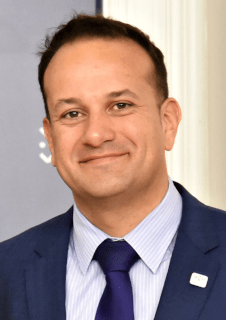
Birth of Leo Varadkar, Fine Gael Politician & Taoiseach

Leo Eric Varadkar, Irish Fine Gael politician who is serving since June 2020 as Tánaiste and Minister for Enterprise, Trade and Employment, is born on January 18, 1979, in the Rotunda Hospital, Dublin.

Varadkar is the third child and only son of Ashok and Miriam (née Howell) Varadkar. His father was born in Bombay (now Mumbai), India, and moved to the United Kingdom in the 1960s to work as a doctor. His mother, born in Dungarvan, County Waterford, meets her future husband while working as a nurse in Slough, Berkshire, England. He is educated at the St. Francis Xavier national school in Blanchardstown, Dublin, and then The King’s Hospital, a Church of Ireland secondary school in Palmerstown. During his secondary schooling, he joins Young Fine Gael. He is admitted to Trinity College Dublin (TCD), where he briefly reads law before switching to its School of Medicine. At TCD, he is active in the university’s Young Fine Gael branch and serves as Vice-President of the Youth of the European People’s Party, the youth wing of the European People’s Party, of which Fine Gael is a member. He is selected for the Washington Ireland Program for Service and Leadership (WIP), a half-year personal and professional development program in Washington, D.C., for students from Ireland.

Varadkar graduates in 2003, after completing his internship at King Edward Memorial Hospital in Mumbai. He then spends several years working as a non-consultant hospital doctor in St. James’s Hospital, Dublin, and Connolly Hospital, Blanchardstown, before specialising as a general practitioner in 2010.

In 2004, Varadkar joins Fine Gael and becomes a member of Fingal County Council and later serves as Deputy Mayor of Fingal. He is elected to Dáil Éireann for the first time in 2007. During the campaign for the 2015 same-sex marriage referendum, he comes out as gay, becoming the first serving Irish minister to do so.

Varadkar is elected a Teachta Dála (TD) for the Dublin West constituency in 2007. He serves under Taoiseach Enda Kenny as Minister for Transport, Tourism and Sport from 2011 to 2014, Minister for Health from 2014 to 2016, and Minister for Social Protection from 2016 to 2017.

In May 2017, Kenny announces that he is planning to resign as Taoiseach and Fine Gael leader. Varadkar stands in the leadership election to replace him. Although more party members vote for his opponent, Simon Coveney, he wins by a significant margin among Fine Gael members of the Oireachtas and is elected leader on June 2. Twelve days later, he is appointed Taoiseach, and at 38 years of age becomes the youngest person to hold the office. He is Ireland’s first, and the world’s fourth, openly gay head of government and the first Taoiseach of Indian heritage.

In 2020, Varadkar calls a general election to be held in February. While polls in 2019 have suggested a favourable result for Fine Gael, they ultimately come in third in terms of seats and votes, behind Fianna Fáil and Sinn Féin, with 35 seats, a loss of 15 seats for the party from the previous general election, when it had finished in first position. He resigns and is succeeded by Micheál Martin as Taoiseach. He is subsequently appointed Tánaiste and Minister for Enterprise, Trade and Employment as part of a three-party coalition composed of Fianna Fáil, Fine Gael and the Green Party.