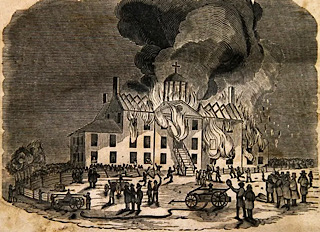
The Ursuline Convent, founded in 1820 by BishopJean-Louis Lefebvre de Cheverus, is a Catholic school for girls established to educate the poor. It is built on a 24-acre estate with brick structures, gardens, and a chapel, attracting both Catholic and Protestant students. By the early 1830s, about 50–60 Protestant girls from wealthy families attend, alongside Catholic students.
The riots are sparked by rumors and gossip about a nun, Elizabeth Harrison (Sister Mary St. John), who had left the convent for 24 hours on July 28 to visit a student’s family and then returned. Her decision to leave and return is framed by anti-Catholic sympathizers as evidence of instability or even “insanity,” feeding existing prejudices. These rumors are amplified by the “Know Nothing” nativist movement, which is gaining traction in Massachusetts.
In the early morning hours of August 12, 1834, a Protestant mob—largely poor Yankee laborers hostile to Irish Catholicimmigrants—sack the convent. The nuns and their students flee for their lives, and the convent is set ablaze. The destruction is swift and complete, leaving only the ruins.
The burning reflects deep-seated anti-Catholic sentiment in New England, rooted in colonial-era restrictions on Catholic worship and reinforced by Irish immigration and Protestant revivalism. It foreshadows the more violent nativist uprisings of the 1850s, such as the Know Nothing Party’s later attacks on Catholic institutions.
Those arrested for the outrage are quickly found not guilty and become heroes in Boston. After failed attempts to get the Commonwealth of Massachusetts to pay for the damages, and amid threats of further violence, the nuns eventually move to Canada, driven from the country by bigotry and hate.
The convent is never rebuilt, and the event becomes a symbol of sectarian violence. Survivors and the community face legal and social challenges, and the incident is widely reported in newspapers, fueling further anti-Catholic rhetoric.
In short, the 1834 Charlestown convent burning is both a localized mob attack and a harbinger of the intense anti-Catholic nativism that defines much of antebellum America.
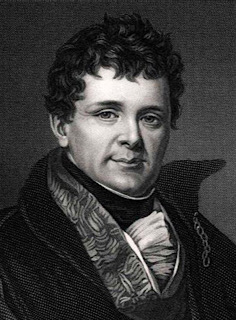
Prime Minister of the United KingdomArthur Wellesley and Home Secretary Sir Robert Peel, who had previously opposed Catholic participation in Parliament, fear that denying O’Connell his seat will provoke outrage and potentially another rebellion in Ireland — a country then about 85% Catholic. This political pressure directly leads to the Roman Catholic Relief Act 1829, which allows Catholics to become MPs, and the Parliamentary Elections (Ireland) Act 1829, which raises the property qualification for voting from £2 to £10.
With the new law in place, O’Connell stands again. The by‑election is unopposed, meaning he is returned without contest. This is significant because the higher property qualification could have disenfranchised many tenant farmers, but in Clare, O’Connell is the only candidate.
In summary, the July 30, 1829, Clare by‑election is a symbolic victory for Catholic emancipation, marking the first time a Catholic MP is elected under the new laws, and cementing O’Connell’s role as “The Liberator” of Irish political rights.
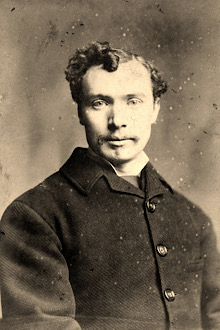
Brennan is the second of two children to Patrick Brennan of the Catholic parish of Beauparc and Catherine Brennan (née Rourke). Little is recorded of his early education, but he develops a reputation as an intelligent and articulate public speaker. At age 18, he begins working as a clerk at Murtagh Bros., a Dublin-based bakery, alongside his uncle James Rourke. Through his connections with Patrick Egan, he and his uncle join the Irish Republican Brotherhood (IRB) and become active in election campaigns and nationalist organizing.
By 1877–1878, Brennan has become the civil secretary of the Leinster IRB and honorary secretary of the Dublin Mechanics Institute. In 1879, he plays an instrumental role in establishing the Land League of Mayo, acting alongside Michael Davitt and Patrick Egan. When the Irish National Land League is formally founded in October 1879, Brennan is appointed assistant secretary, effectively helping manage the League’s operations and campaigns for tenant farmers.
Brennan is known for his eloquence at public rallies, often linking land agitation to Irish nationalist objectives and espousing radical, egalitarian ideas. During the Land League’s activities, he faces trial for encouraging non-payment of rent but is not convicted. He later takes on the duties of national secretary after Davitt’s arrest and authorizes the issuance of the “No Rent Manifesto” from Kilmainham Gaol in 1881, a pivotal document in Ireland’s land struggle.
Following internal shifts in Irish nationalist politics and limitations placed on his influence by Charles Stewart Parnell, Brennan emigrates to the United States. He works for Patrick Ford’s Irish World newspaper in New York City, critiquing aspects of the Irish Parliamentary Party (IPP) and emphasizing non-violent republican principles. By 1883, he settles in Omaha, Nebraska, partnering with Patrick Egan in the Omaha Mortgage Company, specializing in real estate, investment, and insurance. He becomes a respected businessman and seeks to maintain connections with the Irish American nationalist community.
Brennan never marries and eventually dedicates himself to business in Omaha. He passes away on December 19, 1912, in Omaha, Nebraska, having left a lasting impact on Irish land reform efforts and the nationalist movement. He is buried in Holy Sepulchre Cemetery in Omaha.
Brennan is remembered as a founder and key administrator of the Irish National Land League, a signatory of the “No Rent Manifesto,” and a prominent voice in the Irish republican movement. His advocacy helps shape the course of land reform in Ireland and fosters Irish nationalist sentiment both domestically and among the diaspora.
Sources confirm that his activism, speeches, and organizational skill were central to the Land League’s influence, and he remains a notable figure in 19th-century Irish political history.
Mitchel, a writer for The Nation and founder of his own journal, United Irishman, openly preaches rebellion against England. Convicted of treason in 1848, he is sentenced to fourteen years transportation in Van Diemen’s Land (Tasmania). In 1853, he escapes to the United States, where he publishes his Jail Journal. While in the United States, he is editor of the Richmond Examiner and a strong advocate of Confederate rights and champions slavery. He is imprisoned for several months following the end of the American Civil War.
Mitchel’s return visit to Ireland is prompted by political developments in the Irish Parliamentary Party (IPP), which has nominated him for seats in Cork City and Tipperary without informing him. His well-known skepticism toward constitutional “moral force” agitation makes it uncertain whether he will accept the nomination, but the nomination proceeds anyway.
Mitchel’s return is unexpected, yet is met with public acclaim. Upon arriving in Queenstown (now Cobh, County Cork), he is met by a large crowd, and when he reaches Cork, a procession of ten thousand people escorts him to his hotel. This demonstrates the respect and support he still commands among Irish nationalists, despite his exile in the United States since 1853.
Mitchel then goes to Newry, his native town, where he stays for a few months to recuperate his health and await any opportunity to be elected to Parliament. However, no parliamentary vacancy arises during his stay, and he eventually returns to New York City in October 1872.
Mitchel’s return is part of a pattern of political activity in his later years. In 1875, he is again nominated for Tipperary, elected without opposition, and declared an abstentionistMP — but his election is overturned by the British government on the grounds of his previous felony conviction. He dies in March 1875 in Dromolane, County Down, in the same house where he was born.
In summary, July 25, 1872, marks the beginning of a brief but politically charged visit to Ireland for John Mitchel, a figure remembered for his uncompromising republican stance and his role in the Young Ireland movement.
On July 14, 1910, the Irish Socialist Federation (ISF) in New York City hosts a farewell dinner for James Connolly, marking the end of his time as its leader. This event is a significant moment in his career, as he had been instrumental in founding the Federation on March 29, 1907, and has been its driving force in organizing Irish socialist and trade union activity in the United States.
By 1910, Connolly has been active in the socialist movement in the United States for several years. He initially joins the Socialist Labor Party of America but becomes a full-time organizer for the Industrial Workers of the World (IWW) from 1905 to 1910, aligning with its syndicalist approach. His work with the Irish Socialist Federation has been central to building a network of Irish workers in America, linking them to socialist principles and Irish nationalist aspirations.
The July 14, 1910, dinner is a public acknowledgment of Connolly’s contributions and a symbolic send-off as he prepares to return to Ireland. Upon his return, he takes on a major role in the Irish Transport and General Workers Union (ITGWU), first in Belfast and then in Dublin, and later becomes acting General Secretary and Commandant of the Irish Citizen Army (ICA).
The political and labor impact of the event underscores Connolly’s growing influence in both the Irish socialist movement abroad and the domestic labor struggle. It reflects the Federation’s commitment to supporting Irish socialist leaders and their work in the United States and Ireland. It is also remembers as a key moment in Connolly’s transition from U.S. organizer to a central figure in the Irish labor and republican movements.
In short, the July 14, 1910, farewell dinner is both a personal farewell and a political milestone, highlighting Connolly’s role as a bridge between Irish socialism in the United States and the emerging labor and republican movements in Ireland.
The Dublin Harp Society is founded on July 13, 1809, by John Bernard Trotter, a former secretary to Charles James Fox and a passionate supporter of Irish music, to revive and preserve the ancient Irish harp tradition, and it flourishes briefly with contributions from prominent patrons and musicians before closing in 1812 due to financial difficulties.
Inspired by the Belfast Irish Harp Society, Trotter aims to create a society that will extend the revival of the Irish harp to the capital and broaden its audience across Ireland. The society’s purpose is to rescue the old Irish harp from oblivion, teach blind and talented harpers, and promote Irish music through public events, publications, and performances.
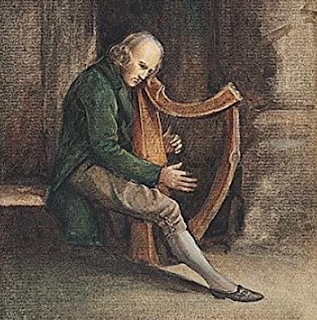
Trotter gathers an influential list of subscribers, including Thomas Moore, the poet and songwriter, and Sir Walter Scott, the Scottish novelist. He brings to Dublin Patrick Quin (pictured), a blind harper from Portadown, County Armagh, as the society’s instructor. Quin is one of the last of the traditional blind harpers and performs extensively at society events, including Turlough O’Carolan commemorations, delighting patrons and audiences. The Bishop of Kildare, Charles Dalrymple Lindsay, also supports the society by providing a house in Glasnevin for the instruction of harpers.
The society engages in multiple avenues to revive Irish harp music. In addition to the previously mentioned Turlough O’Carolan commemorations, circulars and subscription notices are published to drum up public support and secure funding. The Society hosts concerts and gatherings at prominent Dublin locations, offering elaborate performances for subscribers. Tuition and mentorship to young Irish harpers is provided, particularly to blind musicians, as part of a broader cultural and philanthropic effort. Trotter also personally subsidizes the society, contributing £200 annually, which helps maintain performances and attract participants.
Despite early enthusiasm, the society struggles financially due to Trotter’s generous hospitality and personal funding of its activities. By the close of 1812, the Dublin Harp Society becomes defunct when Trotter goes bankrupt. The society attempts to publish rules and regulations in 1810 and conduct active recruitment of subscribers and pupils, but it cannot be sustained beyond three years.
Although short-lived, the Dublin Harp Society contributes significantly to the preservation and promotion of the Irish harp, inspiring subsequent societies and harp revival initiatives in Ireland. It highlights the importance of cultural patrimony, music education, and public patronage, acting as a bridge between the older harp traditions and the modern revival movements seen in later 19th-century Ireland.
In summary, the Dublin Harp Society represents an early 19th-century endeavor to revive Ireland’s venerable harp tradition through education, sponsorship, and celebration of master harpers, leaving a lasting mark on the cultural memory of Irish music.
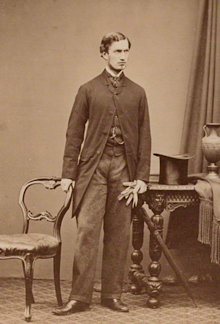
Mathew’s family spends time abroad while his father manages business interests. He comes from a Roman Catholic family. His uncle is Theobald Mathew, the famous temperance campaigner. At the age of fifteen, he enters Trinity College Dublin (TCD), where he excels as a gold medalist and senior moderator, graduating in 1850. He then studies law at Lincoln’s Inn, London, and is called to the English Bar in 1851, building a strong foundation for a legal career despite a slow start at the junior bar.
Initially, Mathew’s legal career progresses slowly, though he is active in debating as a founding member of the Hardwicke Society. He handles numerous jury cases at the Guildhall sittings in London, where he gains experience in commercial law. He becomes treasury counsel during the Tichborne Claimant prosecution in 1873, noted for his composed handling of arguments without quarrel with opposing counsel. Despite opportunities, he refrains from applying for Queen’s Counsel due to a naturally weak voice, though his legal acumen and advocacy are highly respected.
In March 1881, Mathew is appointed to the Queen’s Bench Division of the High Court of Justice and is knighted. He becomes known for his keen judgment, practical approach to legal issues, and eventual standing as one of the best nisi prius judges of his time. In 1895, he persuades fellow judges to establish a Commercial List, the precursor to today’s Commercial Court, and serves as the first judge presiding over it. He advances efficiency in commercial law by minimizing procedural delays, focusing on substantive issues, and producing concise judgments that inspire confidence in the mercantile community.
Mathew also chairs a 1892 royal commission on the evicted tenants in Ireland, despite challenges and disputes with landlords and Edward Carson. His recommendations influence the Wyndham Land Purchase Act (1903). In 1901, he is appointed to the Court of Appeal and continues to emphasize clarity and practicality in legal proceedings until a stroke in 1905 forces his resignation.
Mathew marries Elizabeth Biron in December 1861, with whom he has two sons and three daughters. His family includes notable figures, such as his daughter Elizabeth, who marries Irish MPJohn Dillon, and his grandson, James Matthew Dillon, a later politician. He has a deep cultural appreciation, enjoying music and literature, and maintains friendships across religious and political divides.
Mathew dies on November 9, 1908, at his London home, aged 78. He is buried in St. Joseph’s Cemetery, Cork. His legacy is most strongly associated with founding the Commercial Court, reforming commercial law procedures, and demonstrating a balanced mixture of legal rigor and practical common sense that influenced generations of judges and barristers. His contributions remain a cornerstone in the evolution of modern English and Welsh commercial law.
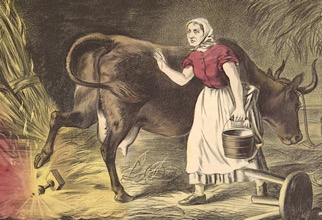
Catherine O’Leary (née Donegan), was an Irish immigrant living in Chicago, Illinois, dies in Chicago on July 3, 1895. She becomes associated with the origin of the Great Chicago Fire in 1871. She is widely accused of starting the fire when a cow in her barn allegedly kicks over a lantern, though the story is later shown to be unfounded.
Donegan is born in Ireland in March 1827, with more specific accounts placing her birth near Cork, in the Munster province, later emigrating to the United States. She marries Patrick O’Leary, and the couple has three children. Their son, James Patrick O’Leary, later operates a saloon and gambling establishment in Chicago.
On the evening of October 8, 1871, a fire begins in the O’Leary family’s barn on DeKoven Street. Fueled by dry conditions and strong winds, the fire spreads rapidly and destroys a large portion of Chicago.
Shortly after the fire, journalist Michael Ahern publishes a story claiming that the fire had started when a cow kicked over a lantern while it was being milked. Although he does not initially name Catherine O’Leary, she soon becomes associated with the incident because the fire began on her property. The story gains widespread attention and is reinforced by illustrations and caricatures.
In 1893, Ahern admits that he had fabricated the story. The official investigation into the fire concludes that its exact cause could not be determined. Anti-Irish sentiment at the time contributes to the O’Leary family being treated as scapegoats, and various unverified claims circulate about the circumstances of the fire.
O’Leary continues to live in Chicago after the fire. She dies of pneumonia on July 3, 1895, and is buried at Mount Olivet Cemetery.
The story of O’Leary’s cow becomes a widely repeated explanation for the Great Chicago Fire, despite its lack of evidence. In 1997, the Chicago City Council formally exonerates O’Leary of any responsibility for the fire, following research by historian Richard Bales.
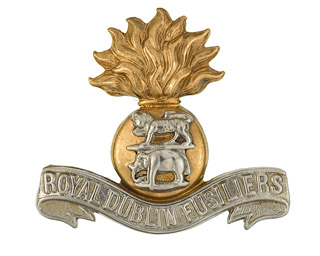
During World War I, the Royal Dublin Fusiliers expand to six additional battalions and see action on the Western Front, the Mediterranean, and the Middle East. The regiment suffers heavy casualties at battles such as LeCateau and the Gallipoli landings at Helles, where only 11 of 1,100 men survive the landing. Members of the regiment are awarded three Victoria Crosses for acts of bravery during the war.
Following the establishment of the Irish Free State in 1922, the Royal Dublin Fusiliers, along with four other southern Irish regiments, is disbanded. The regiment’s history and the service of its soldiers are commemorated by the Royal Dublin Fusiliers Association, which maintains archives, exhibitions, and digitised collections of letters and records from World War I. These archives provide insight into the experiences of Irish soldiers and the conditions they face on the front lines.
The regiment is remembered for its courage and sacrifice, with dedicated websites and museum collections preserving its history, medals, and personal accounts of soldiers. The Royal Dublin Fusiliers remain a significant part of Irish military heritage, reflecting both the contributions of Irish soldiers to the British Army and the complex history of Ireland during the early 20th century.
O’Conor is an active member of parliament, an effective though not an eloquent speaker, and a leading exponent of Catholic opinion. He is deeply involved in the education question, being a critic of the queen’s colleges. In 1867 he introduces a measure to extend the industrial schools act to Ireland, which becomes law the following year. He opposes William Ewart Gladstone‘s university bill of 1873, is appointed to the intermediate education board in 1878, and in May 1879 proposes the transformation of St. Patrick’s College, Maynooth, into a chartered Catholic university. He withdraws this in July, following a government bill creating the Royal University of Ireland. He is on the senate of the university for many years, and is conferred with the honorary degree of LL.D. in 1892. A leading exponent of the Irish language, in 1878 he proposes that it be introduced into secondary schools.
O’Conor is a supporter of Isaac Butt and a keen advocate of land law reform, which leads to his proposing in 1870 the extension of Ulster tenant right to the rest of the country. His brother Denis, MP for County Sligo 1868–83, is a home ruler, but Charles is only ever described as a camp follower. The Nation (October 18, 1873) observes that he “achieved the feat of speaking for two hours at a home rule meeting in Roscommon without telling his audience if he was a home ruler.” He has concrete criticisms such as the hostility of the northern counties, and wants to be allowed to take an independent stance, but Butt strongly deprecates his ambiguity. He does stand on the home rule platform in 1874 and 1880, but his tentative sympathy does nothing to protect him from the drive by Charles Stewart Parnell to establish the Irish Parliamentary Party (IPP). In March 1880, Parnell goes to Roscommon to support his candidate James O’Kelly against O’Conor, who is a popular representative. Parnell calls him a “sample of West Britonism in Ireland . . . if you deprive him of the representation of Roscommon you strike the greatest blow that has been struck against English misgovernment in Ireland since Isaac Butt was elected for the city of Limerick,” which successfully leads to O’Conor’s being ousted. Ironically, he had briefly been Parnell’s landlord when in 1860 he rented a house near Kingstown (now Dún Laoghaire) to the recently widowed Delia Parnell and her family, including the 13-year-old Charles Stewart.
Appointed to the Bessborough commission into the workings of the 1870 land act some months later, O’Conor answers Parnell by going even further than the commission’s proposal to reform land law on the basis of the “three Fs.” He supports outright peasant proprietorship as the only effective and lasting remedy. In 1883, he makes an attempt to return to parliament as a liberal candidate for Wexford Borough, but is defeated by the home ruler Willie Redmond. Always an inveterate committee member, he spends the last twenty-five years of his life on various committees, including the parliamentary committee of 1885 and the royal commission of 1894 on the financial relations between Great Britain and Ireland. He is elected to Roscommon County Council in 1899 and is Lord Lieutenant of Roscommon from 1888 until his death. In 1881 he is sworn to the Privy Council of Ireland.
An ancestor is Charles O’Conor, the noted antiquarian, and O’Conor has his own interest in this area. He is a member of the Royal Irish Academy (RIA) from 1867 and joins the Royal Society of Antiquaries of Ireland (RSAI) in 1869, is a fellow in 1888, and president 1897–9. His antiquarian research is largely confined to his own family. In 1891, he publishes The O’Conors of Connaught, an historical memoir compiled from the manuscripts of John O’Donovan. He first marries Georgina Mary, daughter of Thomas Perry of Warwickshire, England, on April 21, 1868. Secondly he marries Ellen, daughter of John Lewis More O’Ferrall of County Longford, on September 16, 1879. He has four sons by his first marriage.
O’Conor dies at Clonalis, Castlerea, County Roscommon, on June 30, 1906. He is buried in St. Joseph’s Cemetery in Castlerea.
(From: “O’Conor, Charles Owen” by Bridget Hourican, Dictionary of Irish Biography, http://www.dib.ie, October 2009)