Melesina Trench (née Chenevix), Irish writer, poet and diarist, dies in Malvern, Worcestershire, England, on May 27, 1827. During her lifetime she is known more for her beauty than her writing. It is not until her son, Richard Chenevix Trench, publishes her diaries posthumously in 1861 that her work receives notice.
Chenevix is born in Dublin on March 22, 1768, to Philip Chenevix and Mary Elizabeth Gervais. She is orphaned before her fourth birthday and is brought up by her paternal grandfather, Richard Chenevix (1698–1779), the AnglicanBishop of Waterford and Lismore. The family is of Huguenot extraction.
After the death of Richard Chenevix, Chenevix goes to live with her other grandfather, the Archdeacon Gervais. On October 31, 1786, she marries Colonel Richard St. George, who dies only four years later in Portugal, leaving one son, Charles Manners St. George, who becomes a diplomat.
On March 3, 1803, in Paris she marries her second husband, Richard Trench, who is the sixth son of Frederick Trench and brother of Frederick Trench, 1st Baron Ashtown.
After the breakdown of the Peace of Amiens, Richard Trench is detained in France by Napoleon‘s armies, and in August 1805 Melesina takes it upon herself to petition Napoleon in person and pleads for her husband’s release. Her husband is released in 1807, and the couple settles at Elm Lodge in Bursledon, Hampshire, England.
Their son, Francis Chenevix Trench, is born in 1805. In 1807, when they are on holiday in Dublin, their son Richard Chenevix Trench is born. He goes on to be the Archbishop of Dublin, renowned poet and contemporary of Alfred, Lord Tennyson. Her only daughter dies a few years later at the age of four.
Trench corresponds with, amongst others, Mary Leadbeater, with whom she works to improve the lot of the peasantry at her estate at Ballybarney. She dies at the age of 59 in Malvern, Worcestershire on May 27, 1827.
Melesina Trench’s diaries and letters are compiled posthumously by Richard Chenevix Trench as The remains of the late Mrs. Richard Trench in 1861 with an engraving of her taken from a painting by George Romney. Another oil painting, The Evening Star by Sir Thomas Lawrence, has her as a subject, and she is reproduced in portrait miniatures – one in Paris by Jean-Baptiste Isabey and another by Hamilton that is copied by the engraver Francis Engleheart.
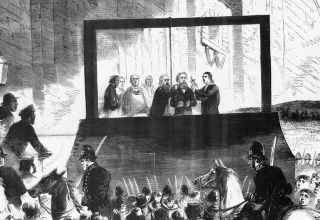
Michael Barrett, Irish activist and a member of the Fenians, is executed on May 26, 1868, for his part in the Clerkenwell Gaol explosion in December 1867. From all the evidence, it is likely he is not guilty. He is the last man to be publicly hanged in England.
Barrett is born in 1841 in Drumnagreshial in the Ederney area of County Fermanagh. As a young man and in search of work, he moves to Glasgow where, at the age of 27, he joins the Irish Republican Brotherhood (IRB), often referred to as Fenians. In the 1860s, the IRB is a political movement that dominates Irish Republican politics and defies the Catholic Church, middle-class nationalists who advocate milder approaches and Irish Unionists. Tens of thousands of Irishmen in both Ireland and Great Britain are recruited into its ranks.
The Clerkenwell bombing is the most infamous action carried out by the Fenians in mainland Britain. It results in a long-lived backlash that foments much hostility against the Irish community in Britain.
The events that lead up to the bombing start with the arrest in November 1867 of Ricard O’Sullivan Burke, a senior Fenian arms agent who planned the “prison-van escape” in Manchester a few months earlier. O’Sullivan-Burke is subsequently imprisoned on remand in the Middlesex House of Detention, Clerkenwell. On December 13, an attempt to rescue him is made by blowing a hole in the prison wall. The explosion is seriously misjudged. It demolishes not only a large section of the wall, but also a number of tenement houses opposite in Corporation Lane (now Corporation Row), killing 12 people and wounding up to 120 more.
The bombing has a traumatic effect on British working-class opinion. The radical, Charles Bradlaugh, condemns the incident in his newspaper, the National Reformer, as an act “calculated to destroy all sympathy, and to evoke the opposition of all classes.”
The day before the explosion, Prime MinisterBenjamin Disraeli bans all political demonstrations in London in an attempt to put a stop to the weekly meetings and marches that are being held in support of the Fenians. He fears that the ban might be challenged, but the explosion has the effect of turning public opinion in his favour.
Months earlier, Barrett had been arrested in Glasgow for illegally discharging a firearm and allegedly false evidence is used to implicate him in the Clerkenwell Prison explosion. In court, he produces witnesses who testify that he had been in Scotland on the date of the incident. The main case against him rests on the evidence of Patrick Mullany, a Dubliner known to have given false testimony before and whose price is a free passage to Australia, who tells the court that Barrett had informed him that he had carried out the explosion with an accomplice by the name of Murphy. After two hours of deliberation the jury pronounces Barrett guilty. On being asked if he has anything to say before sentence is passed, he delivers an emotional speech from the dock.
Barrett is executed outside the walls of Newgate Prison on May 26, 1868, before a crowd of two thousand who boo, jeer and sing “Rule, Britannia!” and “Champagne Charlie” as his body drops. His execution is the last public hanging to take place in England. The hangman is William Calcraft.
Until their transfer to the City of London Cemetery, Barrett’s remains lay for 35 years in a lime grave inside the walls of Newgate Prison. When the prison is demolished in 1903 his remains are taken to their present resting place. Today the grave is a place of Fenian pilgrimage and is marked by a small plaque.
After the explosion, the Prime Minister Disraeli advocates the suspension of the Habeas Corpus Act 1862 in Great Britain, as is already the case in Ireland. Greater security measures are quickly introduced. Thousands of special constables are enrolled to aid the police and at Scotland Yard a special secret service department is established to meet the Fenian threat. Although a number of people are arrested and brought to trial, Barrett is the only one to receive the death sentence.
Within days of the explosion, the Liberal Party leader, William Ewart Gladstone, then in opposition, announces his concern about Irish Nationalist grievances and says that it is the duty of the British people to remove them. Later, he says that it is the Fenian action at Clerkenwell that turned his mind towards Home Rule. When Gladstone discovers at Hawarden later that year that Queen Victoria had invited him to form a government, he famously states, “my mission is to pacify Ireland.”
Richards is born to John William Richards, a lawyer, and Adelaide Roper, suffragist who had chained herself to the railings in St. Stephen’s Green. She goes to school at Alexandra College, Dublin, and after that she attends a finishing school in Paris. Though her family is not in the arts, her godmother is Beatrice Elvery. Shes attends Elvery’s salons with her parents as a child. She meets W. B. Yeats when she is sixteen. Her niece, Geraldine Fitzgerald, daughter of her sister, Edith Catherine Richards, is also one of Ireland’s pre-eminent actresses.
Richards’s acting career starts while attending the Dublin drama league and she is asked at short notice to replace Eileen Crowe in Juno and the Paycock, playing the role of Mary Boyle in the Abbey Theatre production. Richards gets the role of Nora Clithero in the 1926 production of The Plough and the Stars, Seán O’Casey‘s next production. This role means that she ends up with police protection for the duration of the run due to the disturbances the play engenders. Another important role is to take on playing the lead in The Player Queen by Yeats. Maire O’Neill had previously made the role her own and Yeats had let no one perform the part since then so taking on such a challenge is intimidating. Richards continues to take on leading roles with the Abbey Theatre but in 1926 she also begins to direct.
On December 28, 1928, Richards marries playwright Denis Johnston in St. Anne’s Church in Dublin. She tours the United States with the Abbey players in 1932 and with the Irish Players in the mid 1930s. A role in 1938 in Molly Keane‘s Spring Meeting starring Gladys Cooper and A. E. Matthews takes her to Broadway in New York City. War in Europe breaks out while the run is still going on and Richards is advised to stay in the United States. However, by then she has two children, producer Micheal and novelist Jennifer Johnston, so she returns to Dublin. There she runs her own theater company at the Olympia Theatre with Nigel Heseltine. Her marriage to Johnston, broken in 1938, ends with divorce in February 1945.
In 1961 Ireland launches its first television service, Raidió Teilifís Éireann. Richards is one of the first producers, recommended to the station by Hilton Edwards. She is one of the few women in the new station. The first Irish play produced during the opening week is directed by her and she is nominated for a Best Actress award in another production, Inquiry at Lisieux. She works as producer on a wide number of programs for the station including documentaries, soap operas and religious programming. Both Tolka Row and The Riordans are produced by her as well as Denis Johnston’s The Moon on the Yellow River, George Bernard Shaw‘s Arms and the Man and John Millington Synge‘s Riders to the Sea.
Richards retires from her RTÉ career in the early 1970s though she continues to raise funds for the Gate Theatre through the Edwards–MacLiammóir Playhouse Society. In 1983, for her 80th birthday, the Abbey puts on a party for her which includes a special rendition of “Nora” from The Plough and the Stars. Richards is the last living member of the original 1926 cast. The song is repeated at her funeral in 1985. She died in Ballybrack, County Dublin, on January 19, 1985. Her funeral is held in St. Anne’s Church in Dublin and she is cremated in Glasnevin Cemetery.
Johnson works on the docks for an Irish fish merchant, spending much of his time in Dunmore East and Kinsale. It is this way that he picks up ideas about socialism and Irish nationalism, joining a Liverpool branch of the Independent Labour Party in 1893. In 1900 he starts work as a commercial traveller, then moves in 1903 with his family to Belfast where he becomes involved in trade union and labour politics.
In 1907 Johnson helps James Larkin organise a strike in the port, but has to watch in dismay as the strike, which begins with remarkable solidarity between labour, Orange, and nationalist supporters, collapses in sectarian rioting. At various times he is the president, treasurer and secretary of the Irish Trades Union Congress (ITUC) which is, at the time, also the Labour Party in Ireland, until officially founded in 1912 by James Connolly and James Larkin. Johnson becomes Vice-president of the ITUC in 1913, and President in 1915.
Johnson sympathizes with the Irish Volunteers, many of whom are sacked from their jobs, for illegal activities. During the Easter Rising, he notes in his diary that people in Ireland paid little heed to the fate of the defeated revolutionaries. He succeeds as leader of the Labour Party from 1917, when the party does not contest the 1918 Irish general election. When the British government tries to enforce conscription in Ireland in 1918, he leads a successful strike in conjunction with other members of the Irish anti-conscription movement.
Johnson is later elected a TD for Dublin County to the Third Dáil at the 1922 Irish general election and remains leader of the Labour Party until 1927. As such, he is Leader of the Opposition in the Dáil of the Irish Free State, as the anti-treaty faction of Sinn Féin refuses to recognise the Dáil as constituted. He issues a statement of support for the Government of the 4th Dáil when the Irish Army Mutiny threatens civilian control in March 1924.
Johnson is the only Leader of the Labour Party who serves as Leader of the Opposition in the Dáil. He loses his Dáil seat at the September 1927 Irish general election, and the following year he is elected to Seanad Éireann, where he serves until the Seanad’s abolition in 1936.
In 1896 he meets Marie Tregay, then a teacher in St. Multose’s National school, outside Kinsale. A native of Cornwall, she has advanced political views. They marry in 1898 in Liverpool. Their only son, Frederick Johnson, is born in 1899, and becomes a well-known actor. Johnson dies on January 17, 1963, at 49 Mount Prospect Avenue, Clontarf, Dublin.
Each summer, Labour Youth holds the “Tom Johnson Summer School” to host panel discussions, debates and workshops.
Described as having an “ardent and self-confident manner,” Hughes is first heard of in an Irish musical capacity (beyond being honorary organist at St. Peter’s Church on Antrim Road at the age of fourteen) collecting traditional airs and transcribing folksongs in North Donegal in August 1903 with his brother Fred, Francis Joseph Bigger, and John Patrick Campbell. Dedicated to seeking out and recording such ancient melodies as are yet to be found in the more remote glens and valleys of Ulster, he produces Songs of Uladh (1904) with Joseph Campbell, illustrated by his brother John and paid for by Bigger. Throughout his career, he collects and arranges hundreds of traditional melodies and publishes many of them in his own unique arrangements. Three of his best-known works are the celebrated songs, My Lagan Love, She Moved Through the Fair, and Down by the Salley Gardens, which are published as part of his four collections of Irish Country Songs, his key achievement. These are written in collaborations with the poets Joseph Campbell and Padraic Colum, and W. B. Yeats himself. A dispute with Hamilton Harty over copyright on My Lagan Love is pursued on Bigger’s advice, but fails.
Hughes has a unique approach to arranging Irish traditional music. He calls upon the influence of the French impressionistClaude Debussy in his approach to harmony: “Musical art is gradually releasing itself from the tyranny of the tempered scale. […] and if we examine the work of the modern French school, notably that of M. Claude Debussy, it will be seen that the tendency is to break the bonds of this old slave-driver and return to the freedom of primitive scales.” He regards arrangements as an independent art form on an equal level with original composition: “[…] under his [i.e. the arranger’s] hands it is definitively transmuted into an art-song, an art-song of its own generation.” His folksong arrangements have been sung all across the English-speaking world. John McCormack and Kathleen Ferrier are the first to record them on gramophone records.
Hughes also composes a limited amount of original chamber music (a violin sonata is mentioned in a letter to Hughes from Bernard van Dieren dated April 4, 1932), and some scores for the stage (like And So to Bed by James Bernard Fagan) and film. Hughes and John Robert Monsell also create songs for a musical version of Richard Brinsley Sheridan‘s The Rivals called Rivals!, which is staged at the Kingsway Theatre in London in October 1935 by Vladimir Rosing and runs for 86 performances.
Married to Lillian Florence (known as Meena) Meacham and Suzanne McKernan, Hughes has three children: Patrick, known professionally as Spike Hughes, Angela and Helena. He dies in Brighton, England, at the relatively early age of fifty-four on May 1, 1937.
Gleeson is the daughter of Irish-born Edward Moloney Gleeson, a medical doctor, and Harriet (née Simpson), from Bolton, Lancashire. Her father has a practice in Knutsford but on a trip to Ireland he is struck by the poverty and unemployment and, with the advice of his brother-in-law, a textile manufacturer in Lancashire, he founds the Athlone Woollen Mills in 1859, investing all his money in the project. The family moves to Athlone in 1863, but Gleeson is educated in England, where she trains as a teacher. She later studies portraiture in London at the Atelier Ludovici from 1890–92. She goes on to study design with Alexander Millar, a follower of William Morris, who believes she has an exceptional aptitude for colour-blending. Many of her designs are bought by the exclusive Templeton Carpets of Glasgow.
Gleeson takes a keen interest in Irish affairs and, as a member of the Gaelic League and the Irish Literary Society, mixes with the Yeats family and the Irish artistic circle in London and is inspired by the Gaelic revival in art and literature. She is also involved in the suffrage movement and is chairwoman of the Pioneer Club, a women’s club in London. In 1900, an opportunity arises to make a practical contribution to the Irish renaissance and the emancipation of Irish women. She is suffering from ill-health, but her friend Augustine Henry, botanist and linguist, suggests she move away from the London smog to Ireland and open a craft centre with his financial assistance. She seizes the opportunity and discusses her plans with her friends the Yeats sisters, Elizabeth and Lily, who are talented craftswomen and have direct contact with William Morris and his followers. They have no money to contribute to the venture but are enthusiastic and can offer their skills and provide contacts. She seeks advice from W. B. and Jack Yeats, from Henry, who loans her £500, and from her cousin, T. P. Gill, secretary of the Department of Agriculture and Technical Instruction.
During the summer of 1902 Gleeson finds a suitable house in Dundrum, County Dublin, ten minutes from the railway station. The house, originally called Runnymede, is renamed Dun Emer, after the wife of Cú-Chulainn, renowned for her craft skills. The printing press arrives in November 1902, and soon three craft industries are in operation. Lily Yeats runs the embroidery section, since she had trained with Morris’s daughter May. Elizabeth Yeats operates the press, having learned printing at the Women’s Printing Society in London. Gleeson manages the weaving and tapestry and looks after the financial affairs of the industries. W. B. Yeats acts as literary adviser, an arrangement that often causes friction, and Gleeson’s sister, Constance McCormack, is also involved.
Local girls are employed and trained, and the industries seek to use the best of Irish materials to make beautiful, high-quality, lasting products of original design. Church patronage accounts for most of their orders and, in 1902–03, Loughrea cathedral commissions twenty-four embroidered banners portraying Irish saints. They also make vestments, traditional dresses, drapes, cushions and other items, all beautifully crafted and mostly employing Celtic design. The first book published is In the Seven Woods (1903), by W. B. Yeats, cased in full Irish linen.
Gleeson is in demand as an adjudicator in craft competitions around the country and at Feis na nGleann in 1904 she praises the workmanship of the entries but is critical of the lack of teaching in design. She gives lectures and tries to raise the status of craftwork from household occupation to competitive industry. There are tensions with the Yeats sisters, who complain that she is bad-tempered and arrogant. In truth she had taken on too much of a financial burden, even with the support of grants, and she is anxious to repay her debt to Augustine Henry, which he is prepared to forego. The sisters snub her and omit her name in an interview about Dun Emer in the magazine House Beautiful. Millar, her design teacher in London, likens the omission to Hamlet without the prince. In 1904, it is decided to split the industries on a cooperative basis: Dun Emer Guild Ltd. under Gleeson and Dun Emer Industries Ltd. under the Yeats sisters.
Work continues, and the guild and industries exhibit separately at the Royal Dublin Society (RDS) and other craft competitions. In 1907, the National Museum of Ireland commissions a copy of a Flemish tapestry. It takes far longer than anticipated to complete, but the result is beautiful and is exhibited at the Arts and Crafts Society of Ireland in 1910. The guild wins a silver medal at the Milan International exhibition in 1906. The guild and industries both show work at the New York exhibition of 1908. The guild alone shows work in Boston. By now cooperation has turned to rivalry, and there is a final split as the Yeats sisters leave, taking the printing press with them to their house in Churchtown, Dublin. Gleeson writes off a debt of £185 owed to her, on condition that they do not use the name Dun Emer.
The business thrives at Dundrum, with her niece Katherine (Kitty) MacCormack and Augustine Henry’s niece, May Kerley, assisting with design. Later they move the workshops to Hardwicke Street, Dublin. In 1909, Gleeson becomes one of the first members of the Guild of Irish Art Workers and is made master in 1917. The Irish Women Workers’ Union commissions a banner from her about 1919, and, among numerous other notable successes, a Dun Emer carpet is presented to Pope Pius XI in 1932, the year of the Eucharistic Congress of Dublin.
Gleeson dies at the age of 89 at Dun Emer on February 20, 1944, with Kitty carrying on the Guild after her death. The final home of Dun Emer is a shop on Harcourt Street, Dublin, which finally closes in 1964.
(From: “Gleeson, Evelyn” by Ruth Devine, Dictionary of Irish Biography, http://www.dib.ie, October 2009)
O’Brien is the eldest child of a Roman Catholic church musician. In 1885, he first appears in a public piano recital and, later in the year, becomes the organist of Rathmines parish church, a position he holds until 1888. He holds another organist’s position at the Dublin Carmelite church from 1897 to 1899 but is chiefly known as organist and choir director of Dublin’s largest Roman Catholic Church, St. Mary’s Pro-Cathedral, between 1903 and 1946. In 1898, he is the founder and first director of the Palestrina Choir, originally all-male, which is still active, and which is financed for many years by Edward Martyn.
O’Brien studies with Robert Prescott Stewart at the Royal Irish Academy of Music (1888-90), where he is the first winner of the Coulson Scholarship and frequently performs as both tenor singer, piano accompanist, and organist in many public concerts during the 1890s. As a church musician, he becomes particularly involved in the Cecilian Movement, conducting works by Michael Haller and others, and also pursuing their artistic ideals in his own sacred choral compositions.
O’Brien is the founding conductor of the Dublin Oratorio Society (1906), the Brisan Opera Company (1916) and conducts at many ad hoc events. In 1925, he becomes the first music director of Radio Éireann (originally called 2RN), a position he holds until 1941. He singles out his work as music director for the 31st International Eucharistic Congress in Dublin (1932) as his most prized personal achievement. As late as 1945, he founds Our Lady’s Choral Society, a large oratorio choir still in existence, which originally is recruited mainly from the various Roman Catholic church choirs in Dublin.
Among his teaching positions, O’Brien teaches at the diocesan seminary at Holy Cross College, is Professor of Gregorian Chant at the missionary seminary of All Hallows College from 1903, and Professor of Music at the Ladies’ Teacher-Training College at Carysfort Park, Blackrock, County Dublin, from 1908 until his death in Dublin on June 21, 1948. As a much-demanded vocal coach, he teaches at his home, his best-known pupils including John McCormack, Margaret Burke Sheridan and James Joyce. He performs the piano accompaniments for McCormack’s first gramophone recordings and accompanies him during his 1913–14 Australasian tour of 60 performances in three months, during which he also gives organ recitals at the Irish-dominated Catholic cathedrals of Sydney and Melbourne.
Of his two sons, Oliver O’Brien (1922–2001) largely follows in his father’s footsteps, as organist and director of the Palestrina Choir, of Our Lady’s Choral Society, music teacher at Carysfort College and as teacher in various Dublin schools. His other son, Colum O’Brien, is organist in the Pro-Cathedral.
Before his work for the Palestrina Choir, O’Brien’s musical interests are very broad, culminating in 1893 in the composition of the full-scale opera Hester. As a church music composer, he follows Cecilian ideals, with a number of hymns, motets and other choral works. He also composes a number of songs for voice and piano, with The Fairy Tree (1930) being a particular favourite of John McCormack’s.
Máire Nic Shiubhlaigh, Irish actress and republican activist, is born Mary Elizabeth Walker in Charlemont Street, Dublin, on May 8, 1883. She starts acting in her teens and appears in the first Irish language play performed in Ireland. She is a founder-member of the Abbey Theatre and is leading lady on its opening night in 1904, when she plays the title role in W. B. Yeats‘s Cathleen ni Houlihan. She later joins the Theatre of Ireland, which she helps to found.
Nic Shiubhlaigh is born into a nationalist and Irish-speaking family. Her father, Matthew, comes from County Carlow and is a printer and publisher who becomes proprietor of the Gaelic Press. Her mother, Mary, is a dressmaker from Dublin. She grows up in 56 High Street in the Dublin Liberties.
Nic Shiubhlaigh joins the Gaelic League about 1898 and comes into contact with Arthur Griffith and William Rooney. She joins the cultural and revolutionary women’s group Inghinidhe na hÉireann in 1900. With the help of drama enthusiasts William and Frank Fay, she starts acting with the drama group of Inghinidhe na hÉireann. In 1901, the drama group takes part in a feis with two plays, Tobar Draoidheachta by Patrick S. Dinneen and Red Hugh by Alice Milligan. George Russell and W.B. Yeats, who are in attendance at the performance, are moved by the dedication of the amateur players. Russell, who had already offered the Fays his mythic play Deirdre, persuades Yeats to offer them his patriotic play, Cathleen ni Houlihan.
In 1902, Nic Shiubhlaigh joins W. G. Fay’s Irish National Dramatic Company, along with others such as Maire Quinn, Brian Callender, Charles Caulfield, James H. Cousins, P. J. Kelly, Dudley Digges and Frederick Ryan. Their first production of the two one-act plays, Cathleen ni Houlihan, with Maud Gonne in the lead role, and Deirdre, is on April 2, 1902. The company, which has no funds to speak of, acquires a couple of bare rooms at 34 Lower Camden Street, which with the help of friends from Irish-revival societies, they turn into a tiny theatre. They rehearse at the Coffee Palace and also use the Molesworth Hall for productions. In March 1903, with other members of her family, she appears in the first production of Yeats’ morality play, The Hour-Glass, in which she plays the part of the Angel.
In 1903, the playwrights and most of the actors and staff from these productions go on to form the Irish National Theatre Society, which has its registered offices in the Camden Street theatre. Nic Shiubhlaigh is a founder member and on the management committee of the society. Yeats is president, while Russell, Maud Gonne and Douglas Hyde are vice-presidents. William Fay is stage manager. The society founds the Abbey Theatre.
Nic Shiubhlaigh acts in the Abbey Theatre from the time of its founding. On its opening night on December 27, 1904, she plays the name part in Cathleen ni Houlihan. Her portrait is painted by John Butler Yeats for the occasion and hangs in the vestibule. She is the principal actress of the company after Máire Quinn’s departure to the United States, and when she leaves, the burden of the chief women’s rôles falls upon Sara Allgood.
In September 1905, the Abbey administrator and financial backer, an English theatre impresario called Annie Horniman, in hopes of improving the artistic quality of the productions at the Abbey, offers to guarantee salaries (a sum of £500 per year) for the actors and for Willie Fay as producer. To her mind, this will allow the actors and Fay to dispense with their day jobs and concentrate wholly upon their acting. The more nationally-minded members of the staff disagree. Nic Shiubhlaigh writes, “It was pointed out that the old Irish National Theatre Society had been founded in 1902 on the understanding that its independence as a national movement was to be secured only through the efforts of its members. It would be contrary to these ideals to accept a subsidy from an independent source.” For them it would mean a choice between a national theatre and an artistic theatre. At a meeting of the society, supported by Yeats, Gregory and Synge, the motion to accept Miss Horniman’s proposition is passed by a majority of shareholdings rather than a majority of votes. Nic Shiubhlaigh along with others resign, but they agree to remain until the end of the year, as part of an upcoming tour of England.
Nic Shiubhlaigh remains with the Abbey until December 1905, when along with Honor Lavelle (also known as Helen Laird), Emma Vernon, Máire Garvey, Frank Walker, Seumas O’Sullivan, Padraic Colum and George Roberts, she leaves. She joins the Theatre of Ireland, which she helps to found. This is formed in June 1906 with aims similar to the Irish National Theatre Society. She returns to the Abbey in 1910.
At the time of the 1916 Easter Rising, Nic Shiubhlaigh is living in Glasthule, a suburb of Dublin. She cycles into the city and, along with other members of Cumann na mBan, makes her way to Jacob’s Biscuit Factory, whose garrison under the command of Thomas MacDonagh guards the city against the troops of Portobello Barracks, and acts as an information and supplies hub for other garrisons around the city. She commands the women of the garrison. They remain there until the surrender, cooking and rendering first aid to the garrison, and bringing despatches through the city.
Nic Shiubhlaigh had retired from professional acting in 1912, and seldom works in professional theatre again. In 1929, she marries former IRA Director of Organisation, Major General Eamon “Bob” Price, and they move to Laytown, County Meath.
Nic Shiubhlaigh’s last stage appearance, alongside her sister Gypsy, is in a production of Gaol Gate at the Olympia Theatre, Dublin, on November 21, 1948, staged to mark the 150th anniversary of the death of Theobald Wolfe Tone.
Nic Shiubhlaigh dies on September 9, 1958, in the Drogheda cottage hospital.
Her book, The Splendid Years, written with the help of her nephew Edward Kenny, recalls the years of the national revival and the Easter Rising.
Boland is the son of Irish Republican Brotherhood member James Boland and Kate Woods. He was active in GAA circles in early life and referees the 1914 All-Ireland Senior Football Championship Final. He joins the IRB at the same time as his older brother Gerald in 1904, following in the footsteps of his father, uncle and probably grandfather. He is educated at the Synge Street CBS, but hads a personality clash with one of the brothers so he refuses to carry on his attendance at the school. He then goes to De la Salle College, County Laois, as a novice.
Boland later joins the Irish Volunteers along with Gerry and his younger brother Ned. They take an active part in the Easter Rising of 1916.
At the 1918 Irish general election, Boland is elected as an MP for South Roscommon. In line with all the Sinn Féin MPs elected at that election, he does not take his seat in the British House of Commons but withdraws to sit in the declared independent Dáil Éireann (the First Dáil) and is named by Éamon de Valera as special envoy to the United States, a role his uncle Jack had played 25 years earlier. He leaves Ireland for the United States along with de Valera as part of a campaign to raise awareness and support for their cause in America. He negotiates a loan of $20,000 from the Irish Republic to the Russian Soviet Federative Socialist Republic through the head of the Soviet Bureau, Ludwig Martens, using some Russian jewelry as collateral. These jewels are transferred to Ireland when he returns. His sister Kathleen and her mother are entrusted with the safekeeping of jewels.
In the 1922 Irish general election, Boland is re-elected to the Dáil representing Mayo South–Roscommon South. Six weeks later, on July 31, he is shot by soldiers of the National Army when they attempt to arrest him at the Skerries Grand Hotel. Two officers enter his room and, although unarmed, he is shot and mortally wounded during a struggle.
Boland’s death affects Collins and possibly spurs him toward peace negotiations with Éamon de Valera.
Boland’s brother, Gerald Boland, is a prominent member of Fianna Fáil and later serves as Minister for Justice. His nephew, Kevin Boland, serves as a Minister until he resigns in solidarity with the two ministers, Charles Haughey and Neil Blaney, who are sacked from the government in May 1970 during the Arms Crisis. Kevin Boland’s resignation from Fianna Fáil and the subsequent loss of his seat marks the end of an era for the Boland political dynasty.
In the 1991 TV movie The Treaty, Boland is portrayed by Malcolm Douglas. In the 1996 film Michael Collins, he is portrayed by American actor Aidan Quinn. The film is criticised for fictionalising both Boland’s death and Collins’ life.
Cooney is the second of three children of John Cooney and Mary Ann Cooney (née Gleeson), middling farmers. While his grandfather, Patrick Cooney, from nearby Garrykennedy, is reputed to have been a member of the Irish Republican Brotherhood (IRB) and an Irish National Land League activist, his father does not have any inclination towards radical politics. He is educated at Lissenhall national school and St. Joseph’s CBS, Nenagh. In October 1916, he commences studies in medicine at University College Dublin (UCD) just as the Irish War of Independence is getting underway. He plays briefly with the College’s hurling club.
In 1917, Cooney joins the Third Battalion of the Dublin Brigade of the Irish Republican Army (IRA). A year later he is jailed for two months in Mountjoy Prison and Crumlin Road Gaol, Belfast, for illegal drilling. Joining the IRB at the end of 1918, he assists in the December 1918 election by protecting candidates and acts as a guard at sittings of the First Dáil. On June 26, 1920, he plays a major role in the attack on BorrisokaneRoyal Irish Constabulary (RIC) barracks. He takes part in the Bloody Sunday operations of November 21, 1920, at 28 Upper Pembroke Street where a number of British agents are killed and attends Croke Park afterwards. He then goes on the run as a full-time Volunteer and serves with the Dublin Brigade active service unit (ASU).
After the Anglo-Irish truce of July 1921, Cooney is appointed Officer Commanding (O/C) of the 1st Kerry Brigade, IRA, reorganising it and forming a flying column. Opposing the Anglo-Irish Treaty of 1921, he does not immediately break with GHQ, who sends him to organise the 1st Eastern Division. Later in January 1922, the Chief of Staff, Eoin O’Duffy, asks him to become O/C of the 3rd Eastern Division, but later rescinds the appointment. In March 1922 he is appointed O/C of the 1st Eastern Division of the anti-Treaty IRA during the Irish Civil War.
That same year he is captured by Free State forces and interned in Mountjoy Prison, where he becomes O/C of the prisoners in C Wing. He accepts responsibility for an attempted escape bid on October 10, 1922, in which a fellow prisoner, Peadar Breslin, is killed and another man is wounded. After sojourns in Newbridge and Arbour Hill Prison, he is moved with the other leaders to Kilmainham Gaol, where he spends forty-one days on hunger strike. Removed to Harepark Camp, the Curragh, on January 1, 1924, he is among the last to be released on May 29, 1924.
Cooney succeeds Frank Aiken as Chief of Staff of the IRA on November 18, 1925. Central to the reorganisation scheme he puts in place is the need to secure American funds for the IRA and to combat Frank Aiken’s fundraising work in the United States since December 1925 on behalf of the embryo Fianna Fáil organisation. Receiving permission on April 21, 1926, he departs on a fund-raising trip to the United States but returns to Ireland in October. He resigns as chief of staff in favour of Maurice Twomey but retains his position as chairman of the IRA executive until November 21, 1927, when he obtains leave to complete his medical studies.
After internship in the Mater Hospital, Dublin, Cooney finds temporary employment in London, but remains in touch with GHQ. On September 27, 1929, he marries the German-educated Frances (‘Frank’) Brady, daughter of a wealthy Belfast linen family and former Cumann na mBan activist and hunger-striker. The marriage is not a success. Failing to secure employment due to police harassment and the loyalty test then in force, he and his wife are obliged to emigrate to London, where he practises as a GP, still maintaining his IRA links. Their only child, Seán, is born there in 1931. He returns to Ireland in August 1932, after Fianna Fáil’s accession to power.
An intimate friend of Maurice Twomey, who is still Chief of Staff, Cooney remains in the upper echelons of the IRA and attends its conventions. Signifying his standing in republican circles, he is chosen to unveil, inter alia, the Fenian memorial in Glasnevin Cemetery and the Seán Treacy plaque in Talbot Street, Dublin, and is a regular speaker at commemorations. In March 1940, he attempts to intercede with Éamon de Valera on behalf of hunger-striking republicans, and is later arrested, but released.
After the discovery of a German spy ring in the hospitals commission’s subsidiary, the Dublin Hospitals Bureau, Cooney is forced to resign in April 1942 on refusing to take a loyalty pledge to the state. He returns to private practice. He becomes active in the unsuccessful campaign to save Charlie Kerins, Chief of Staff, from being hanged in 1944. In anticipation of emigrating, he finally resigns from the IRA in 1944, though military and police surveillance continue until March 1945.
In August 1945, Cooney joins the United Nations Relief and Rehabilitation Administration, working with displaced persons in the American zone in Germany, and gains rapid promotion. After joining the International Refugee Organisation (UNRRA’s successor) on July 1, 1947, he becomes the chief medical officer of an area including the American sector of Berlin and containing 150,000 displaced persons. He later holds a similar post in Bavaria.
Appointed a part-time member of the hospitals commission by the inter-party government in September 1949 and in severe financial straits, Cooney emigrates alone to the United States on December 2, 1950, and never returns. While employed in a tuberculosissanatorium in New Jersey, he obtains by examination his licence to practise medicine in Maryland on January 14, 1954. Admitted a member of the American College of Chest Physicians, again by examination, on November 23, 1954, he secures, at the age of 57, his first ever permanent post in medicine, in a similar hospital in Pikesville, Maryland. His republican activities continue through Clan na Gael during his U.S. years, and he is a frequent speaker at commemorative events.
(Pictured: Liam Lynch with some of his Divisional Staff and Officers of the Brigades, including the 1st Southern Division, who attend as delegates to the Army Convention at the Mansion House, Dublin, on April 9, 1922. Cooney is first on the right in the 3rd row back.)




 seamus dubhghaill