The DSWA is formally founded at a meeting on January 26, 1876, in the Exhibition Palace, Earlsfort Terrace (now the National Concert Hall). After the Poor Law Guardians (Ireland) (Women) Act 1896 allows women to be elected to the boards of guardians of poor law unions, it renames itself the Dublin Women’s Suffrage and Poor Law Guardians’ Association. After the Local Government (Ireland) Act 1898 allows women to serve on local councils, it becomes the Dublin Women’s Suffrage and Local Government Association. It establishes branches outside Dublin in the 1890s and becomes the IWSLGA in 1901.
In 1919, after the Representation of the People Act 1918 provides full franchise at local elections and partial franchise at parliamentary elections, the IWSLGA merges with the Irish Women’s Association of Citizenship to become the Irish Women Citizens’ and Local Government Association, later renamed the Irish Women’s Citizens Association, which in 1949 merges into the Irish Housewives Association.
The association confines itself to constitutional, nonsectarian and peaceful methods, and attracts support from both unionist and nationalist suffragists. Its tactics include making friends in parliament, hosting meetings with important speakers, and issuing pamphlets and periodicals. Its first secretaries are Anna Haslam and Miss McDowell. Haslam serves as secretary until 1913. In regards to membership, Haslam suggests an annual subscription of one shilling per annum as membership in the association. Other goals include appointing women to positions “such as rate collectors and sanitary inspectors, while always pursuing the association’s main objective of the parliamentary vote.” Prominent members of the association in the 20th century are Lady Margaret Dockrell, Mary Hayden, and Bridget Dudley Edwards (mother of Robert Dudley Edwards). Prominent supporters include Charles Cameron, Sir Andrew Reed, Willie RedmondMP, and William Field MP. Following the Sex Disqualification (Removal) Act 1919, Lady Dockrell is one of the first women appointed Justice of the Peace.
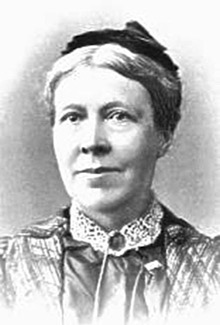
(Pictured: Anna Haslam, co-founder of the DWSA along with her husband, Thomas)
Babington is born on September 1, 1804, to the Rev. Richard Babington and his wife Mary Boyle, both members of the Anglo-Irishlanded gentry. His father, the rector of Lower Comber (Diocese of Derry), leads an extravagant lifestyle and leaves debts of £40,000 on his death in 1831, aged 66, equivalent to some £4.1 million as of 2019. His father’s debt is paid off by his two brothers Richard (1795-1870) and Anthony of Creevagh (1800-1869). Another brother is Major GeneralWilliam Babington. He is educated at Trinity College Dublin (TCD).
Babington begins his career as a curate of Lower Cumber, where his father is rector, in 1827. He becomes rector of Moviddy in 1833, at the age of 29. As rector, he carries out improvements worth the equivalent of £166,766 in 2019. As a clergyman he is part of a wave toward secular education in Ireland in the 1800s. In this capacity he is remembered as a “very forward thinking individual.” He is one of the signatories of a progressive booklet titled Declaration in Favour of United Secular Education in Ireland in 1866. The declaration notes, on behalf of the united Church of England and Ireland, “We entirely admit the justice and policy of the rule which protects scholars from interference with their religious principles and thus enables members of different denominations, to receive together in harmony and peace, the benefits of a good education.”
Babington is also, notably, in 1843, an addressee of the “Crookstown letter,” a famous incident at the time covered by The Cork Examiner and Cork Commercial Courier. He publishes, in the Cork Constitution, the contents of a threatening letter he had received in which it threatens him, among others, with murder if he does not become a repealer of the Acts of Union 1800 and with making a bonfire of hay in his farmyard if he does not show the letter to its other addresses. The letter is allegedly to have been written by a Roman Catholic resident of Crookstown, County Cork. The Roman Catholic parish priest, Fr. Daly, and parishioners refute the allegation that the letter had been authored by a Roman Catholic and claim that, conversely, the letter is an invention of a local Protestant who wrote “repeal or die” on the Crookstown Bridge. A local magistrate, J. B. Warren, to whom the letter has also been addressed, pledges to carry out an investigation but Babington does not hand over the original letter, causing the local Roman Catholic population to regard his publication of the letter in the press as “prejudiced, premature and defamatory of the character of the people whose industry he derives his income.” Babington states that he has always been on friendly terms with the Roman Catholic parish priest and his Roman Catholic parishioners and has no intention of offending them but is in fact pushing to publish it by local magistrates. He continues as rector of Moviddy for another 43 years following this incident.
Babington is also involved with the Society for Promoting the Education of the Poor of Ireland.
In 1836, Babington marries Esther, daughter of Richard Nettles, Esq., JP, of Nettleville, County Cork, with whom he has five sons and eight daughters.
Babington dies at the age of 81 on January 23, 1886, at Moviddy Rectory, County Cork. He is buried with his wife, Esther, who died at the age of 70 on August 29, 1878.
In 1849, O’Donoghue, together with William Smith O’Brien, Terence MacManus, Thomas Francis Meagher and many others, are on board the prisoner transport ship The Swift for a six-month, 14,000-mile journey under difficult conditions on which some fellow prisoners do not survive.
On January 26, 1850, “Using materials he had begged and borrowed” as one account gives it, O’Donoghue starts publishing in Hobart a weekly newspaper named The Irish Exile, aimed mainly at fellow Irish prisoners and deportees and considered to be the first Irish Nationalist paper to be published in Australia.
The paper features Irish ballads and poetry, articles about Irish history, and a regular column by John Martin reporting on the situation of the Repeal Movement, a campaign to repeal the Acts of Union 1800 under which the Irish Parliament had been abolished. There is also local news of the Irish deportee community, then numbering in the thousands, and of Hobart daily life in general.
O’Donoghue uses The Irish Exile to publish excerpts of his journal aboard The Swift, which are reprinted in Australian, British and Irish newspapers. Brisbane‘s The Moreton Bay Courier, reprinted from Dublin’s The Nation, finds that the journal “will show how severely the tyrannical government of England visited the offences of the Ballingarry cabbage-tree heroes. The studies of Messrs. O’Brien, Meagher (afterwards O’), and O’Donoghoe, will amuse the reader”. While in Van Diemen’s Land, The Examiner, the daily newspaper of Launceston, Tasmania, reprints London‘s The Examiner‘s view that “a singularly large amount of mercy has been shown to those grown-up children who made the escapade from Dublin to raise the standard of Irish rebellion at Ballingarry. One of the worthies, Mr. Patrick O’Donoghue, has published an account of his deportation; and certainly a more pleasureable [sic] voyage could not have been under taken at the expanse of government. A roomy cabin, a capital library, a fair dinner, with a couple of glasses of wine, and cigars upon deck, from the dietary and the entertainment of the political exiles.”
Publication of the paper is not in itself illegal, but is highly displeasing to the Governor, Sir William Denison, who finds that the paper can be suppressed by arresting O’Donoghue and charging him with having “left his allocated district.” He is sentenced to one year’s work in a chain gang – a time spent at hard labour, living in a convict station and wearing a convict uniform, mainly in the company of non-political prisoners such as “rapists, muggers and thieves.”
In March 1851, O’Donoghue is released and taken back to Hobart. Undeterred, he immediately restarts his paper, prominently featuring an extensive personal account of his year with the chain gang. The governor reacts by sending him again to a chain gang, at a more distant location this time – the Cascades Penal Station. Three months later the governor orders him released from there and sent to Launceston.
On the way there, O’Donoghue succeeds in escaping from his guards with the help of fellow-prisoners, who manage to smuggle him on board the ship Yarra Yara, on its way to Melbourne. There, he successfully hides from the British authorities and, with further help from Irish sympathisers, manages to get to San Francisco, where some of his fellows such as MacManus and Meagher have also ended up.
O’Donoghue dies in New York City on January 22, 1854, shortly before the arrival of his wife on a ship from Ireland. The time spent in the chain gang may have contributed to undermining his health. The other escaped state prisoners do not attend his funeral, although Michael Doheny and Michael Cavanagh, fellow Young Irelanders who are living in New York City at the time, are in attendance.
The local Sinn Féin branch in Carlow is named after O’Donoghue.
In June 1846, Sir Robert Peel‘s Tory Ministry falls, and the Whigs under Lord John Russell comes to power. Daniel O’Connell, founder of the Repeal Association which campaigns for a repeal of the Acts of Union 1800 between Great Britain and Ireland, simultaneously attempts to move the Association into supporting the Russell administration and English Liberalism.
The intention is that Repeal agitation is to be damped down in return for a profuse distribution of patronage through Conciliation Hall, home of the Repeal Association. On June 15, 1846, Thomas Francis Meagher denounces English Liberalism in Ireland saying that there is a suspicion that the national cause of Repeal will be sacrificed to the Whig government and that the people who are striving for freedom will be “purchased back into factious vassalage.” Meagher and the other “Young Irelanders” (an epithet of opprobrium used by O’Connell to describe the young men of The Nation newspaper), as active Repealers, vehemently denounce in Conciliation Hall any movement toward English political parties, be they Whig or Tory, so long as Repeal is denied.
The “Tail” as the “corrupt gang of politicians who fawned on O’Connell” are named, and who hope to gain from the government places decide that the Young Irelanders must be driven from the Repeal Association. The Young Irelanders are to be presented as revolutionaries, factionists, infidels and secret enemies of the Church. For this purpose, resolutions are introduced to the Repeal Association on July 13 which declare that under no circumstances is a nation justified in asserting its liberties by force of arms. The Young Irelanders, as members of the association, have never advocated the use of physical force to advance the cause of repeal and oppose any such policy. Known as the “Peace Resolutions,” they declare that physical force is immoral under any circumstances to obtain national rights. Meagher agrees that only moral and peaceful means should be adopted by the Association, but if it is determined that Repeal cannot be carried by those means, a no less honourable one he would adopt though it be more perilous. The resolutions are again raised on July 28 in the Association and Meagher then delivers his famous “Sword Speech.”
Addressing the Peace Resolutions, Meagher holds that there is no necessity for them. Under the existing circumstances of the country, any provocation to arms will be senseless and wicked. He dissents from the Resolutions because by assenting to them he would pledge himself to the unqualified repudiation of physical force “in all countries, at all times, and in every circumstance.” There are times when arms will suffice, and when political amelioration calls for “a drop of blood, and many thousand drops of blood.” He then “eloquently defended physical force as an agency in securing national freedom.” Having been at first semi-hostile, Meagher carries the audience to his side and the plot against the Young Irelanders is placed in peril of defeat. Observing this he is interrupted by O’Connell’s son, John, who declares that either he or Meagher must leave the hall. William Smith O’Brien then protests against John O’Connell’s attempt to suppress a legitimate expression of opinion, and leaves with other prominent Young Irelanders, and never returns.
After negotiations for a reunion have failed, the seceders decide to establish a new organisation which is to be called the Irish Confederation. Its founders determine to revive the uncompromising demand for a national Parliament with full legislative and executive powers. They are resolute on a complete prohibition of place-hunting or acceptance of office under the existing Government. They wish to return to the honest policy of the earlier years of the Repeal Association, and are supported by the young men, who have shown their repugnance for the corruption and insincerity of Conciliation Hall by their active sympathy with the seceders. There are extensive indications that many of the previously Unionist class, in both the cities and among land owners, are resentful of the neglect of Irish needs by the British Parliament since the famine began. What they demand is vital legislative action to provide both employment and food, and to prevent all further export of the corn, cattle, pigs and butter which are still leaving the country. On this there is a general consensus of Irish opinion according to Dennis Gwynn, “such as had not been known since before the Act of Union.”
The first meeting of the Irish Confederation takes place in the Rotunda, Dublin, on January 13, 1847. The chairperson for the first meeting is John Shine Lawlor, the honorary secretaries being John Blake Dillon and Charles Gavan Duffy. Duffy is later replaced by Meagher. Ten thousand members are enrolled, but of the gentry there are very few, the middle class stand apart and the Catholic clergy are unfriendly. In view of the poverty of the people, subscriptions are purely voluntary, the founders of the new movement bearing the cost themselves if necessary.
Following mass emigration by Irish people to England, the Irish Confederation then organises there also. There are more than a dozen Confederate Clubs in Liverpool and over 700 members of 16 clubs located in Manchester and Salford.
Callan is born on December 22, 1799, in Darver, County Louth. He attends school at an academy in Dundalk. His local parish priest, Father Andrew Levins, then takes him in hand as an altar boy and Mass server and sees him start the priesthood at Navanseminary. He enters Maynooth College in 1816. In his third year at Maynooth, he studies natural and experimental philosophy under Dr. Cornelius Denvir. He introduces the experimental method into his teaching and has an interest in electricity and magnetism.
Callan is ordained a priest in 1823 and goes to Rome to study at Sapienza University, obtaining a doctorate in divinity in 1826. While in Rome he becomes acquainted with the work of the pioneers in electricity such as Luigi Galvani (1737–98), who is a pioneer in bioelectricity, and Alessandro Volta (1745–1827), who is known especially for the development of the electric battery. In 1826, he returns to Maynooth as the new Professor of Natural Philosophy (now called physics), where he also begins working with electricity in his basement laboratory at the college.
Influenced by William Sturgeon and Michael Faraday, Callan begins work on the idea of the induction coil in 1834. He invents the first induction coil in 1836. An induction coil produces an intermittent high voltagealternating current from a low voltage direct current supply. It has a primary coil consisting of a few turns of thick wire wound around an iron core and subjected to a low voltage (usually from a battery). Wound on top of this is a secondary coil made up of many turns of thin wire. An iron armature and make-and-break mechanism repeatedly interrupts the current to the primary coil, producing a high voltage, rapidly alternating current in the secondary circuit.
Callan invents the induction coil because he needs to generate a higher level of electricity than currently available. He takes a bar of soft iron, about 2 feet long, and wraps it around with two lengths of copper wire, each about 200 feet long. He connects the beginning of the first coil to the beginning of the second. Finally, he connects a battery, much smaller than the enormous contrivance just described, to the beginning and end of winding one. He finds that when the battery contact is broken, a shock can be felt between the first terminal of the first coil and the second terminal of the second coil.
Further experimentation shows how the coil device can bring the shock from a small battery up the strength level of a big battery. So Callan tries making a bigger coil. With a battery of only 14 seven-inch plates, the device produces power enough for an electric shock “so strong that a person who took it felt the effects of it for several days.” He thinks of his creation as a kind of electromagnet, but what he actually makes is a primitive induction transformer.
Callan’s induction coil also uses an interrupter that consists of a rocking wire that repeatedly dips into a small cup of mercury (similar to the interrupters used by Charles Grafton Page). Because of the action of the interrupter, which can make and break the current going into the coil, he calls his device the “repeater.” Actually, this device is the world’s first transformer. He induces a high voltage in the second wire, starting with a low voltage in the adjacent first wire. The faster he interrupts the current, the bigger the spark. In 1837 he produces his giant induction machine using a mechanism from a clock to interrupt the current 20 times a second. It generates 15-inch sparks, an estimated 60,000 volts and the largest artificial bolt of electricity then seen.
Callan experiments with designing batteries after he finds the models available to him at the time to be insufficient for research in electromagnetism. Some previous batteries had used rare metals such as platinum or unresponsive materials like carbon and zinc. He finds that he can use inexpensive cast iron instead of platinum or carbon. For his Maynooth battery he uses iron casting for the outer casing and places a zinc plate in a porous pot (a pot that had an inside and outside chamber for holding two different types of acid) in the centre. Using a single fluid cell, he disposes of the porous pot and two different fluids. He is able to build a battery with just a single solution.
While experimenting with batteries, Callan also builds the world’s largest battery at that time. To construct this battery, he joins together 577 individual batteries (“cells“), which use over 30 gallons of acid. Since instruments for measuring current or voltages have not yet been invented, he measures the strength of a battery by measuring how much weight his electromagnet can lift when powered by the battery. Using his giant battery, his electromagnet lifts 2 tons. The Maynooth battery goes into commercial production in London. He also discovers an early form of galvanisation to protect iron from rusting when he is experimenting on battery design, and he patents the idea.
Callan dies at the age of 64 in Maynooth, County Kildare, on January 10, 1864. He is buried in the cemetery in St. Patrick’s College, Maynooth.
The Callan Building on the north campus of Maynooth University, a university which is part of St. Patrick’s College until 1997, is named in his honour. In addition, Callan Hall in the south campus, is used through the 1990s for first year science lectures including experimental & mathematical physics, chemistry and biology. The Nicholas Callan Memorial Prize is an annual prize awarded to the best final year student in Experimental Physics.
Louisa (Louie) Bennett, suffragette, trade unionist, and peace activist, is born on January 7, 1870, in Garville Avenue, Rathgar, Dublin, the eldest daughter of James Cavendish Bennett, a prosperous auctioneer, and his wife Susan (née Bolger). She is brought up at Temple Hill, Blackrock, and educated at Alexandra College, and at an academy for young ladies in London, where she and her sisters form an Irish League. She goes on to study singing in Bonn, Germany. Already as a teenager she shows an interest in writing, her first literary effort being Memoirs of the Temple Road in the 80s. Afterward she publishes two unsuccessful romantic novels, The Proving of Priscilla (1902) and A Prisoner of His Word (1908), the latter set in County Down in the aftermath of the Irish Rebellion of 1798.
Bennett turns her attention to women’s issues and by 1910 has become involved in the suffrage movement, initially through her reading of the suffrage monthly TheIrish Citizen. In 1911, she co-founds, with her life-long friend and colleague Helen Chenevix, the Irish Women’s Suffrage Federation, an umbrella organisation, which by 1913 has connected fifteen Irish suffrage societies and has established links with Europe and the United States. She and Chenevix are the organisation’s first honorary secretaries. She is also associated with the Irish Women’s Franchise League, for which she runs public speaking classes. However, as the divide between militants and opponents of the use of violence become more pronounced, Bennett, as a confirmed pacifist, who endorses what she calls “constructive, rather than destructive action,” distances herself from the league, and through her involvement in the production of TheIrish Citizen seeks to sideline the militants.
Bennett’s concerns are not limited to the question of women’s franchise. As founder of the Irish Women’s Reform League, she not only addressea the suffrage question, but examines many social issues concerning women. The league focuses on working conditions, monitors court cases involving women, and demands school meals and better education. She is among those who assist in the relief effort at Liberty Hall during the 1913 strike and lockout in Dublin, and she appeals for funds for strikers’ families through TheIrish Citizen. In the period that follows she maintains her links with the labour movement. She often opposes the direct, uncompromising approach of both James Connolly and Helena Molony, and argues that labour and women’s issues can only be hampered by any affiliation with nationalist politics. The aftermath of the Easter Rising, and in particular, the murder of Francis Sheehy-Skeffington, causes her to revise some of her views on nationalism. In late 1916 she accepts an invitation to reorganise the Irish Women Workers’ Union (IWWU), on the understanding that she would have complete independence from Liberty Hall. Assisted by Chenevix and Father John Flanagan, she re-creates the union along professional lines, and by 1918 its membership has risen dramatically from a few hundred to 5,300. She consistently defends its separatist stance, arguing that women’s concerns in a male-dominated union will always be of secondary importance.
Throughout World War I Bennett campaigns for peace, and she is selected as the Irish representative to the Women’s International League for Peace and Freedom. She leads the IWWU in its opposition to the attempted introduction of conscription in 1918, and in 1920 she travels to the United States to highlight Black and Tan atrocities (she later meets David Lloyd George and demands the removal of the Black and Tans from Ireland). As a member of the Women’s Peace Committee, she acts as a mediator during the Irish Civil War.
In 1925, Bennett is appointed to an Irish Trades Union Congress (ITUC) committee to promote a scheme of working class education with the assistance of the labour movement. Her interest in adult education later leads to her involvement with The People’s College. A member of the national executive of the ITUC (1927–32, 1944–50), she becomes the first female president of the congress in 1932. She serves a second presidential term in 1947. Her knowledge of labour issues is officially acknowledged by the Irish government in 1932, when she is sent as a representative to Geneva to put forward the case of Irish women workers. In 1938 she delivers a paper entitled Industrialism in an Agrarian Country to the International Relations Institute in the Netherlands.
Despite the depth of Bennett’s involvement with the union movement, she has ambitions outside trade unionism, and in 1938 she lets her name be put forward by the IWWU as a congress candidate for election to the senate, but this comes to nothing. In that year she is appointed to the government commission on vocational organisation (1938–43). In 1943, she is elected as a Labour Party member of the Dún Laoghaire borough council. As a councillor she consistently lobbies for improved housing and is instrumental in the establishment of Dún Laoghaire’s housing council in 1949. She had refused a labour nomination in the 1918 general election, but she stands for Dublin County Council and Dáil Éireann in 1944, in both cases unsuccessfully. She is the only Labour Party member to criticise the party’s support for the Fianna Fáil minority government of 1932, arguing that it is “never right or wise to co-operate with another party with fundamentally different principles.” As an elected member of the Labour Party executive, she represents Ireland at the International Labour Organization in Europe. She is also a representative at the League of Nations.
Throughout her public career Bennett consistently condemns colonialism, fascism, and armaments expenditure. She is possibly best remembered for her leadership in the laundry workers’ strike of 1945, during which IWWU members successfully fight for a fortnight‘s paid holiday. Her management of the IWWU, which lasts until 1955, is marked by determination and diplomacy, though she often uses threatened resignations as a means of controlling her colleagues. She died, unmarried, on November 25, 1956, in Killiney, County Dublin.
(From: “Bennett, Louisa (‘Louie’)” by Frances Clarke, Dictionary of Irish Biography, October 2009)
Campbell is born on February 1, 1763, in County Down, Ireland (now Northern Ireland), and is raised as an Anglican. He is ordained a minister in the Scottish Seceder Presbyterian Church sometime after graduating from the University of Glasgow in 1786. He leaves Ireland for the United States in April 1807. This move is prompted by the advice of his physician. Once in America, disagreement arises between him and other Presbyterians over certain points related to Calvinist doctrine and the administration of the Eucharist.
When their study of the New Testament leads the reformers to begin to practice baptism by immersion, the nearby Redstone Baptist Association invites Brush Run Church to join with them for the purpose of fellowship. The reformers agree, provided that they will be “allowed to preach and to teach whatever they learned from the Scriptures.”
Thomas and his son, Alexander, work within the Redstone Baptist Association during the period 1815 through 1824. While both the Campbells and the Baptists share practices of baptism by immersion and congregational polity, it is soon clear that the Campbells and their associates are not traditional Baptists. Within the Redstone Baptist Association, some of the Baptist leaders consider the differences intolerable when Alexander Campbell begins publishing a journal, Christian Baptist, which promotes reform. The Campbells anticipated the conflict and move their membership to a congregation of the Mahoning Baptist Association in 1824.
Campbell is a student of the Enlightenment philosopher John Locke. While he does not explicitly use the term “essentials,” in the Declaration and Address, Campbell proposes the same solution to religious division as had been advanced earlier by Herbert and Locke: “[R]educe religion to a set of essentials upon which all reasonable persons might agree.” The essentials he identifies are those practices for which the Bible provides “a ‘Thus saith the Lord,’ either in express terms or by approved precedent.” Unlike Locke, who sees the earlier efforts by Puritans as inherently divisive, he argues for “a complete restoration of apostolic Christianity.” He believes that creeds serve to divide Christians. He also believes that the Bible is clear enough that anyone can understand it and, thus, creeds are unnecessary.
Campbell combines the Enlightenment approach to unity with the Reformed and Puritan traditions of restoration. The Enlightenment affects the Campbell movement in two ways. First, it provides the idea that Christian unity can be achieved by finding a set of essentials that all reasonable people can agree on. The second is the concept of a rational faith that is formulated and defended on the basis of a set of facts derived from the Bible.
Thomas dies on January 4, 1854, in Bethany, West Virginia, and is buried next to his wife in the Campbell family cemetery.
Ó Cuinneagáin Is the third child of Sean Cunningham and his wife Caitlín. He is educated in Belfast, at St. Brigid’s school, Malone Road, and the St. Patrick’s Christian Brothers school on Donegall Street. His political views are permanently influenced by memories of the sectarian violence of 1920–22. In 1927, he enters the Irish civil service as a tax clerk, stationed first at Athlone and then at Castlebar. He is promoted to junior executive officer in the Department of Defence, but resigns in July 1932 after his superiors refuse to allow him six months unpaid leave to study the Irish language in the Donegal Gaeltacht. He turns down a promotion to the Department of Finance, a decision partly motivated by disillusion with Fianna Fáil. He subsequently works as an accountant and lives in the south Dublin suburbs. In 1934, he establishes his own publishing company, Nuachtáin Teoranta, which he boasts is the first company to be registered in the Irish language, and he also contributes to an Irish language socialist paper, An t-Éireannach, under the pen name “Bruinneal gan Smal.”
In 1940–41, Ó Cuinneagáin is active in the Friends of Germany, a pro-Nazi organisation which disintegrates after some of its leading members are interned. On September 26, 1940, he founds Craobh na h-Aiséirighe, a branch of the Gaelic League aimed at attracting dynamic young enthusiasts frustrated by the older activists who dominate established branches. It makes a point of using modern publicity methods to get its message across, a trait which is carried over into Ailtirí na hAiséirghe (Architects of Resurrection), a political movement made up of branch members, which Ó Cuinneagáin founds in 1942. This move leads to the expulsion of Craobh na h-Aiséirighe from the Gaelic League and the establishment of Glún na Buaidhe by branch members who disapprove of his political ambitions and wish to concentrate on the promotion of the Irish language.
Members of Ailtirí wear an informal uniform of a green shirt, tweed suit, and báinín jacket. In private Ó Cuinneagáin reveals that the organisation is modeled on the Hitler Youth. His own title of “ceannaire” (leader) equates with “Führer” and “duce.” Features of the movement copied from Nazism include an emphasis on propaganda based on a few simple concepts and phrases. The claim that party politics allow statesmen to evade individual responsibility, whereas a single leader is necessarily more responsive to public opinion; and the belief that all difficulties can be overcome through willpower.
Ó Cuinneagáin takes to extremes contemporary Catholic advocacy of a corporate state based on vocational principles as the solution to the problems of modernity. While venerating António de Oliveira Salazar‘s Portugal as a role model, he believes that Ireland can surpass it and create a Catholic social model that will redeem the whole world. He takes a quasi-racial view of Irishness and comes close to saying that the only true Irish Catholics are of Gaelic race. When Seán Ó’Faoláin comments acidly in The Bell on the paradox of “Celtophiles” who bear such Celtic names as Blackham and Cunningham, Ó Cuinneagáin protests that he can prove his pure Gaelic descent. The Ailtirí state forces all male citizens to undertake a year’s compulsory military service, which is also used as a means of Gaelicisation, and the resulting citizen army of 250,000 would mount a lightning invasion of Northern Ireland, modeled on the blitzkrieg, with a favourite slogan being “Six Counties, Six Divisions, Sixty Minutes.” In 1943, the Stormont government excludes Ó Cuinneagáin from Northern Ireland.
Ailtirí attracts considerable attention. Its leaders address numerous meetings around the country, attracting large crowds to demonstrations at Dublin and Cork. Ó Cuinneagáin, who is by no means unintelligent, is capable of shrewd observations on the restrictions imposed on most Irish-language bodies by government subsidies, and the impact of the snobbery shown toward the poor by their middle class co-religionists. Several of his lieutenants are academics or engineers. In the 1970s he praises modernist architecture as breaking with the hated Georgian past, and denounces conservationists who oppose plans to build an oil refinery in Dublin Bay. Bilingual pamphlets produced by the group sell thousands of copies. Ó Cuinneagáin is the author of several, including Ireland’s twentieth century destiny (1942), Aiséirí says . . .(1943), Partition: a positive policy (1945), and Aiséirí for the worker (1947). Hus attempts to launch a party paper are stifled until the end of the war. Some of the interest attracted by the group is derived from curiosity or amusement. It also functions to some extent as a front organisation for the banned Irish Republican Army (IRA), with Ó Cuinneagáin declaring that Jews and freemasons should be locked up instead of IRA men. Aiséirí members are involved in the bombing of the Gough memorial in Phoenix Park in July 1957, with the stolen head concealed for a time in the party’s offices.
The party runs four candidates, including Ó Cuinneagáin in Dublin North-West, in the 1943 Irish general election and seven in 1944, but all lose their deposits. Ó Cuinneagáin does not actually vote for himself. Throughout his life he demands Irish language ballot papers. When given English language ones he tears them up, claiming that they disenfranchise him and that this invalidates the election. In 1946, Ailtirí na h-Aiséirí elects eight members to local bodies in counties Louth and Cork. This helps to bring about the decline of the party, as the Cork activists rebell against the rigid Führerprinzip upheld by the electorally unsuccessful ceannaire and his Dublin acolytes. Most of the party’s local support is absorbed by Clann na Poblachta. Ó Cuinneagáin retains a small group of followers centred on his newspaper Aiséirighe.
Ó Cuinneagáin keeps himself in the public gaze by driving around the country in a van painted with slogans, and by regularly appearing in court for refusing to respond to official documents (rates demands, car insurance, court summonses) unless they are supplied in Irish. He enjoys some success in securing the provision of Irish language versions of such documents, and he contrasts the state’s niggardliness on this point with its professed commitment to the revival of Irish. In 1954, he founds an Irish language women’s artistic and social paper, Deirdre, which operates successfully for over a decade without government subsidy.
Ó Cuinneagáin continues to write sympathetically about IRA activities, at one point offering a £1,000 reward for the capture of the Prime Minister of Northern Ireland, Basil Brooke. He maintains surprisingly extensive international neo-fascist contacts. He regularly reprints in Aiséirighe material by the American antisemite and racial segregationistGerald L. K. Smith. He cites praise for Aiséirighe from Der Stahlhelm, a far-right German veterans’ paper, and notes Oswald Mosley‘s support for Irish reunification. He denounces Hugh Trevor-Roper‘s Last days of Hitler as typical British slander of a fallen enemy. He compares the sacrificial ideology of the Hungarian Nazi collaborator Ferenc Szálasi to that of Patrick Pearse. He praises Juan Perón as a model whom Ireland should imitate and he follows the electoral fortunes of Italian neo-fascism with interest. He also maintains contacts with the radical right-wing fringes of Breton, Scottish, and Welsh nationalism. He declares that Ireland’s grievance is against England alone and bemoans the Dublin government’s failure to encourage the break-up of the United Kingdom.
Ó Cuinneagáin denounces the Soviet Union and United States alike as controlled by Zionists and freemasons. He points to illegitimacy and divorce rates in the United States as proof of the folly of those who regard “progressive” American education as superior to the sound Irish teaching methods embodied by the Christian Brothers, and bemoans the increasing flow of “immoral” American comics and paperback books into Ireland. While noting with pride that he has been described as “Ireland’s foremost Jew-baiter,” He claims that his frequent diatribes against Robert Briscoe and the state of Israel are merely anti-Zionist, and that he has nothing against Jews, whom he defines as ultra-Orthodox anti-Zionists. He hopes that a Europe united on national–Christian principles might fend off the influence of the super powers. He echoes Mosleyite calls for European unity and is an early and determined advocate of Irish membership of the European Community. However, he dissents from the Mosleyite view that such a union should be based on African empire. He is generally anti-imperialist, though somewhat more lenient toward Portuguese than British imperialism, and from 1956 the President of Egypt, Gamal Abdel Nasser, becomes one of his heroes. While supporting European unity as a defensive strategy, he also warns that unless Ireland adopts mass conscription the country might be conquered by a regiment of Russian paratroopers landing on Dollymount Strand. Throughout the 1950s and 1960s he regularly calls for the Irish Army to mount a military coup, hinting that it should install him as leader in the same way that the Portuguese army had installed Salazar.
Ó Cuinneagáin gives up contesting elections but regularly cites those who do not vote in elections as indicating the extent of political support for Ailtirí na hAiséirghe. He regularly laments that the safety valve of emigration had taken the steam out of radical politics. In his later years he notes the growth of anti-clericalism and the beginnings of a permissive society in Dublin. He attributes this to the church’s failure to implement its own social teaching and its encouragement of West British snobbery at the expense of the truly Catholic traditions of the Gael.
On April 4, 1945, Ó Cuinneagáin marries Sile Ní Chochláin. They have four sons and two daughters, some of whom become active in left-wing politics. He dies on June 13, 1991. He tends to be remembered as a figure of fun, but this view demands some qualification. He possesses genuine abilities and dedication. His fantasies are an extreme development of the official ideology of the state, and part of his appeal stems from his ability to point out the hypocrisy involved in paying it lip service while failing to push it to its logical conclusion. The blindness and cruelty involved in imposing his world view at a personal level has their counterparts in the institutions of official Ireland. Ailtirí na hAiséirghe may have been a marginal millennial cult, but in Europe during the 1940s such groups were often raised to power by circumstances. Had the World War II taken a different direction after 1940, he might be remembered not as a parody of Pearse but as an Irish Szálasi.
(From: “ÓCuinneagáin, Gearóid Seán Caoimhín” by Patrick Maume, Dictionary of Irish Biography, http://www.dib.e, October 2009)
Doran tours with Benson and other managements, and plays in the West End before setting up his own company in 1920. He leads it for eleven years, before leaving Britain to work in India. On his return he works on stage and makes occasional television appearances.
Doran is the son of Charles Jenkins Doran. He is educated in Cork and privately. In 1899, he makes his stage debut as a member of Frank Benson’s touring company, in Julius Caesar at the Theatre Royal, Belfast. He remains with Benson for two and a half years, during which he makes his London debut, as Captain MacMorris in Henry V at the Lyceum Theatre.
In October 1910, returning to England, Doran plays La Tribe in Count Hannibal at the New Theatre, after which he is Pistol in The Merry Wives of Windsor at the Garrick Theatre to the Falstaff of Asche. For the next ten years he plays in new, ephemeral works, interspersed with classics. Among his roles in the latter are Constantine Levin in Anna Karenina (1913), Douglas in Henry IV, Part 1and the Constable of France in Henry V (1914) in London, and a variety of Shakespeare parts at the Memorial Theatre, Stratford-upon-Avon (1919).
In February 1920, Doran begins touring with his own Shakespearean company, playing Hamlet, Shylock in The Merchant of Venice, Brutus in Julius Caesar, Malvolio in Twelfth Night, Prospero in The Tempest, Petruchio in The Taming of the Shrew, Macbeth, Falstaff, Henry V, and Jaques in As You Like It. He has a keen eye for rising talent, and among his recruits are Noel Streatfeild, Cecil Parker, Ralph Richardson, Edith Sharpe, Norman Shelley, Abraham Sofaer, Francis L. Sullivan and Donald Wolfit.
In 1931, Doran goes to India as director of Shakespeare’s plays at the State Theatre in Jhalawar and then on to Bombay where he performs primarily in Shakespeare on the radio. He returns to England in 1937. His last London appearance is in Song of Norway (1949). His last Shakespearean role in the theatre is Time in The Winter’s Tale (1951). He continues to act on stage in other parts until 1954. He appears on BBC Television as a senator in Othello in 1950 and Adabashev, the tragedian in Curtain Down in 1952.
Doran dies in Folkestone on the south coast of England on April 5, 1964, at the age of 87. An article on him published by Emory University in 2003 sums up his career thus:
On stage in one role or another, Doran’s fifty-seven years in the theatre made him a major force in the profession, particularly in his productions of Shakespeare. Such was his energy and enthusiasm that he kept alive for a few more years the actor-manager system when the major talents, men like Tree, Benson, and Irving, had dissolved their companies. Doran was indeed the last of his theatrical breed.
Mitchel is born Jane Verner around 1820 near Newry, County Down. At the time she, her brother and her mother, Mary Ward, are living with Captain James Verner (1777–1847), who is from a prominent Armagh family, and is involved in the Orange Order, going on to become Orange deputy grandmaster of Ireland in 1824. Although James Verner raises Mitchel, she is not believed to be his child. She attends Miss Bryden’s School for Young Ladies in Newry.
Mitchel meets her husband, John Mitchel, when she is fifteen. The couple elopes in November 1836, but do not marry as James Verner pursues them to Chester and brings her home to Ireland. They elope again in 1837, and are married at Drumcree Church, County Armagh, on February 3. At this point, Mitchel is disowned by James Verner, and goes to live with her in-laws at Dromalane, County Down. They then move to Banbridge in 1839 where her husband practises law. The couple goes on to have six children, three daughters and three sons.
The couple moves to Dublin in October 1845 when John Mitchel becomes the assistant editor of The Nation. They live at 8 Ontario Terrace, Rathmines, where they meet Young Irelanders. She is a full supporter of her husband’s nationalism. She aids in his work with The Nation, reading other newspapers, keeping and filing reference clippings, going on to become an editor and anonymous contributor to the United Irishman from February 1848. John Mitchel is convicted of treason for inciting insurrection in May 1848, and is sentenced to fourteen years’ transportation. Mitchel urges his fellow Young Irelanders to fight his removal, and denounces them when they fail to come out in support of him.
Due to her standing in the nationalist community, £1,450 is raised to support her and her family. For three years, Mitchel lives in Newry and Dublin, before she joins her husband in Van Diemen’s Land (Tasmania) in June 1851, where they settle in the village of Bothwell. Their youngest child, Isabel, is born there in 1853.
The Mitchels travel around the island with her husband, visiting fellow Irish exiles, becoming fond of William Smith O’Brien in particular.
When John Mitchel escapes in July 1853, Mitchel travels with her children to join him in Sydney, from where they sail to the United States. They live for a time in Brooklyn, New York, from 1853 to 1855, rekindling friendships with old friends who are fellow Young Ireland exiles.
In May 1855, the family moves to a remote farm at Tucaleechee Cove in Tennessee. She fears that the isolation and life in a primitive log cabin will be detrimental to their children’s education, and at her behest the family moves to Knoxville, Tennessee, in September 1856. From here, John Mitchel runs a pro-slavery newspaper, the Southern Citizen.
The family moves again in December 1858 to Washington, D.C. Mitchel supports her husband in the Southern cause, albeit with some reservation. Nothing, she says, will induce her “to become the mistress of a slave household.” Her objection to slavery is “the injury it does to the white masters.”
Mitchel accompanies her husband to Paris in September 1860, and in opposition to some of the family, she supports her daughter Henrietta’s conversion to Catholicism and entrance into a convent. She remains in Paris and Ireland with her daughters, while her husband and sons assist the Confederacy during the American Civil War. Without letting her husband know, she resolves to return to America when she hears of her youngest son, William’s, death at Gettysburg in July 1863. She sails with her daughters, Mary and Isabel, as Henrietta had died earlier the same year. While their ship runs a blockade by the Union, the ship is shelled, runs aground, and catches fire near the coast of North Carolina. She and her daughters are unhurt, but lose all of their possessions. By December 1863, she has joined her husband in Richmond, Virginia, remaining their for the rest of the Civil War. Their eldest son, John, is killed in action in July 1864.
The family returns to New York after the war, and John Mitchel sets up another paper, The Irish Citizen (1867–72). Due to lack of funding for the Irish American press and her husband’s ill health results in the family falling into poverty. This is alleviated by a testimonial raised by William and John Dillon in 1873. Mitchel is widowed in March 1875, going on to receive $30,000 from nationalist sympathisers. She invests this money in a photolithographic firm she and her son, James, run. She dies at home in Bedford Park, New York, on December 31, 1899. She is buried in Woodlawn Cemetery, Bronx, New York, with her plot marked with a large Celtic cross. She is survived by two of her children, James (1840–1908) and Mary (1846–1910).

 seamus dubhghaill